×

Gambia🇬🇲 | best landmarksExplore the Best landmarks in The Gambia

Landmarks in Gambia are small, human-scaled and mostly free of crowds. Along the Atlantic coast you get red-brick colonial buildings, and upriver on the Gambia River you get stone circles and fort ruins with only goats and a caretaker for company. Entry costs a few dollars, roads are sandy, and shared taxis and ferries set the pace. Independent travel here rewards patience and a pocketful of small bills.

By Johan Kruseman 🇳🇱 | Updated October 23, 2026
Explore the best national parks in The Gambia

Why go?Key Factors That Shape the Experience

Gambia is a thin ribbon of land hugging one river, so its landmarks follow the water. For centuries the river was the highway for trade, slavery, and colonial ambition, and the remains sit along its banks, from the mouth at the coast to the old inland river ports. Add the Mandinka and Wolof heritage, mosque calls at dawn, and laterite red dust on everything, and the country feels lived-in rather than curated. Know before you go: sites are modest, signage is thin, and interpretation often depends on a local guide rather than a plaque. Distances are short, but heat, ferry queues and rough tracks stretch the day. Anyone expecting polished museums will be disappointed. Anyone happy with crumbling brick, shade trees and a good storyteller will find it deeply rewarding.
Behind the Scenes of Selection
The list of best unique sites in The Gambia is created based on history or culture, wow factor, atmosphere, quirks, and memorability. If you feel a unique site is missing in this list, please let us know.

When to go?Timing Your Visit for the Best Experience

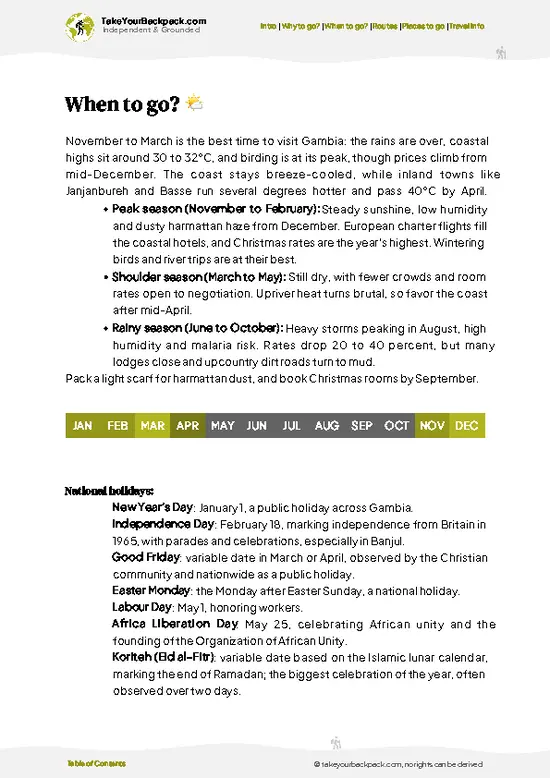
Best months: November to February: The best months are November to February, when days sit around 30 to 34°C, nights drop to about 18 to 22°C, and almost no rain falls, so sandy tracks stay firm and the harmattan haze softens the light. Mornings are cool and dusty, with a pale sun.
Shoulder and wet seasons: March to May turns hot, often 35 to 40°C inland, so visit sites early and rest at midday. The rainy season runs roughly June to October, with the heaviest downpours in August and September (total rainfall around 800 to 1,000 mm). Tracks upriver turn to mud, mosquitoes thicken, and some camps close. In exchange, the land is green and prices drop, often 20 to 40 percent on rooms. December and January are peak, with higher coastal rates and busier flights, so book ahead.

unique site hoppingTips for Visiting Multiple Destinations

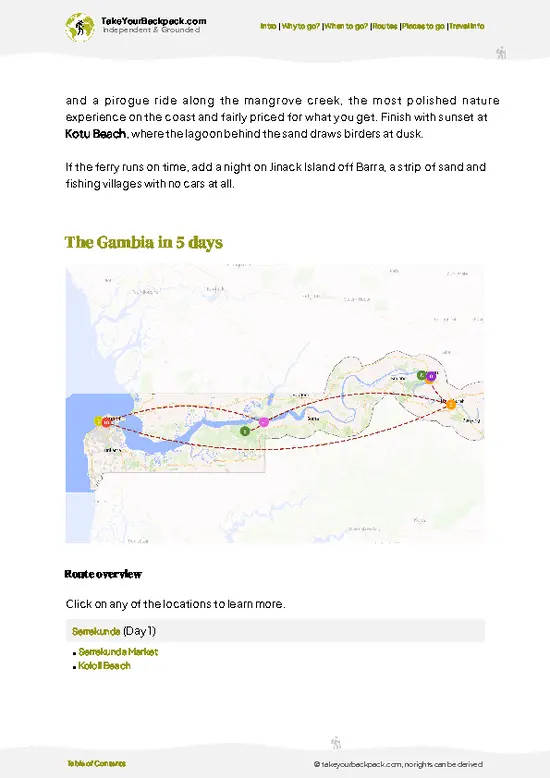
How many days to plan: A trip linking several landmarks in Gambia needs 5 to 8 days. Start on the Atlantic coast around Banjul and Serrekunda, then head east along the river. Coastal stops take 2 to 3 hours each. Upriver sites deserve half a day each, with the long drives eating the rest.
Direction and transport: Moving west to east works best, because you finish deep inland and can return by the same road. Banjul to the Basse area is about 350 km and takes 6 to 8 hours by shared taxi or minibus (gelli-gelli) with a change at Brikama or Soma. The Banjul ferry crossing can take 30 minutes to over 2 hours in queues. The south bank road is the usual way to avoid it.
Planning mistakes: Travelers cram too many stops into one day and arrive at midday, in white heat. Leave the hottest hours for shade … read more 👉
How many days to plan: A trip linking several landmarks in Gambia needs 5 to 8 days. Start on the Atlantic coast around Banjul and Serrekunda, then head east along the river. Coastal stops take 2 to 3 hours each. Upriver sites deserve half a day each, with the long drives eating the rest.
Direction and transport: Moving west to east works best, because you finish deep inland and can return by the same road. Banjul to the Basse area is about 350 km and takes 6 to 8 hours by shared taxi or minibus (gelli-gelli) with a change at Brikama or Soma. The Banjul ferry crossing can take 30 minutes to over 2 hours in queues. The south bank road is the usual way to avoid it.
Planning mistakes: Travelers cram too many stops into one day and arrive at midday, in white heat. Leave the hottest hours for shade and tea, and travel at dawn, since vehicles leave only when full.

The ListMust-Visit landmarks in The Gambia

1 Wassu Stone Circles

Laterite monoliths, funerary circles, touchable stones, Kerr Batch circles

Walk among rust-orange pillars arranged in rings above ancient burials, then follow a local guide to the nearby second group of circles.

gambia-unique-site-wassu-stone-circles
© Google |
Loading the map 🌍

Expert viewTips and Advice from Travelers

How many to visit: I advise three to five landmarks in total. Distances are short on a map but slow on the ground, with sandy tracks, ferry waits and cars that leave only when full. Past five, the red brick and baobab shade start to blur. Fewer stops means time to sit with the caretaker, hear the stories, and drink sweet attaya tea in the shade.
Which kind to prioritize: If your interest is history, put the river-trade and colonial sites first, since a guide turns a few walls into a story. If you care about ancient heritage, the inland stone circles suit you, and they are quiet at dawn. If your time is short or your budget thin, stick to the coast, where taxis are cheap and everything is within reach. Skip anything that needs a private boat unless you split the cost.
What it costs: A realistic … read more 👉
How many to visit: I advise three to five landmarks in total. Distances are short on a map but slow on the ground, with sandy tracks, ferry waits and cars that leave only when full. Past five, the red brick and baobab shade start to blur. Fewer stops means time to sit with the caretaker, hear the stories, and drink sweet attaya tea in the shade.
Which kind to prioritize: If your interest is history, put the river-trade and colonial sites first, since a guide turns a few walls into a story. If you care about ancient heritage, the inland stone circles suit you, and they are quiet at dawn. If your time is short or your budget thin, stick to the coast, where taxis are cheap and everything is within reach. Skip anything that needs a private boat unless you split the cost.
What it costs: A realistic budget is US$25 to 45 a day (about 1,800 to 3,200 Gambian dalasi), including a simple room, local meals and shared transport. Entry fees typically run 100 to 500 dalasi (US$1.50 to 8), and a licensed guide costs roughly 300 to 1,000 dalasi per visit. Taxi hops cost 50 to 300 dalasi, and a private driver for a day runs about US$40 to 70. Carry small notes, since change is rare.
Safety and etiquette: Daytime sites are generally calm, but unofficial guides will approach you. Agree a price before you start and wear the badge of anyone official. Dress modestly, covering shoulders and knees, especially at mosques and village sites. Ask before photographing people, and expect to be asked for a small donation. Carry water, use sunscreen, and avoid walking remote tracks after dark.

✈️ The backpacker research shortcutThe Gambia Travel Guide

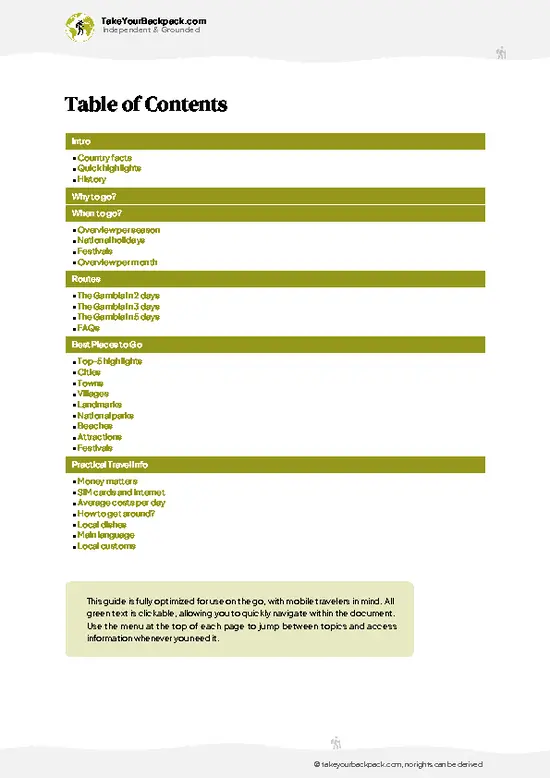
An offline-friendly backpacking guide with optimized travel routes, ranked highlights, transport advice, and the best areas to stay.
example page 0 from our offline Travel Guide for Gambia
example page 1 from our offline Travel Guide for Gambia
example page 2 from our offline Travel Guide for Gambia
example page 3 from our offline Travel Guide for Gambia
example page 4 from our offline Travel Guide for Gambia
example page 5 from our offline Travel Guide for Gambia
example page 6 from our offline Travel Guide for Gambia
example page 7 from our offline Travel Guide for Gambia
The digital guide (213 pages) contains:
✅ 50 highlights, ranked by travel appeal
✅ Optimized 2, 3 & 5-day travel routes
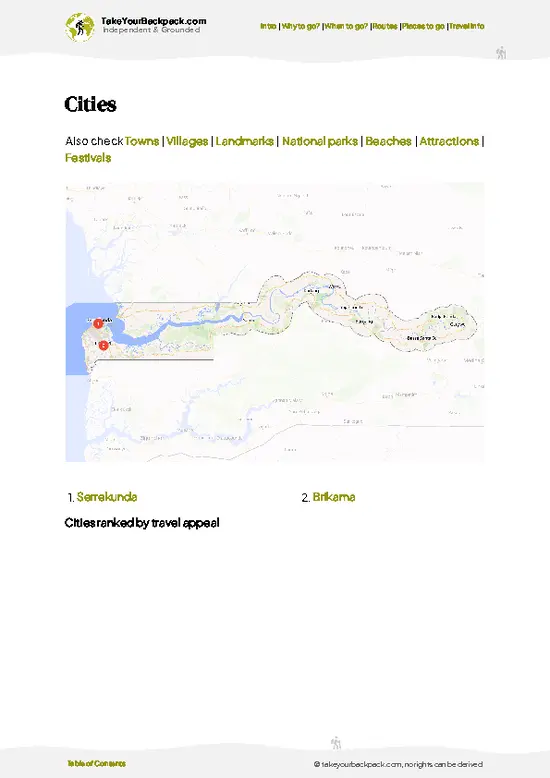
✅ Cities, national parks, landmarks, beaches
✅ How to get around
✅ Offline-friendly for travel without Wi-Fi
👉 Click to see all 30+ guide features

📅 Plan smarter in minutes, not weeks
✅ Month by month travel advice
✅ Festivals & national holidays
✅ Budget expectations

🗺️ Go to the right places, skip the overrated ones
✅ Honest pros & cons of destinations
✅ Top hikes, parks & viewpoints
✅ Lesser-known places most travelers miss
✅ Clear “worth it vs skip it” guidance

🛏️ Travel smoothly without rookie mistakes
✅ Best areas to stay
✅ Transport systems explained simply
✅ Common scams & safety advice
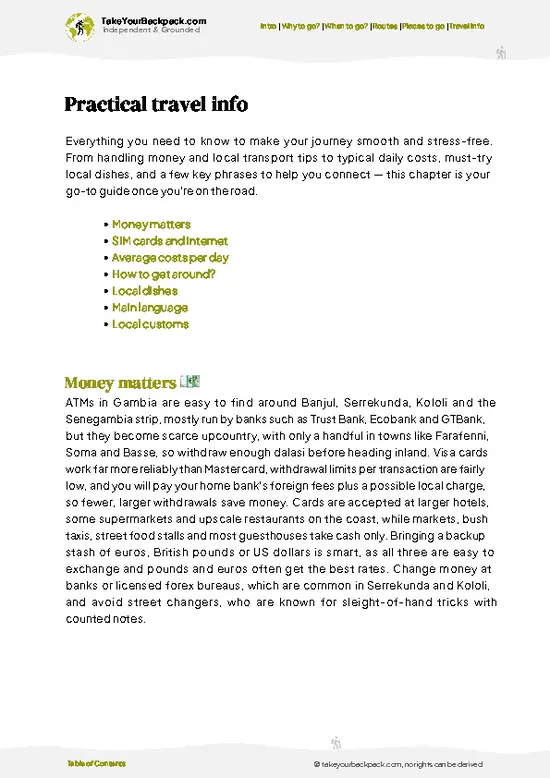
✅ SIM cards, money & practical tips

🌍 Understand the country, not just visit it
✅ Culture & traditions
✅ 52 Essential phrases & customs
✅ Festivals worth planning around
✅ Traveler-friendly historical context
✅ Insights that make places more meaningful

📱 Built for real travel conditions
✅ Fully downloadable PDF
✅ Works completely offline
✅ Optimized for phone use
✅ Useful in remote areas & buses
✅ Everything in one place
Stop searching, start planning
Get instant access to your full guide. 30‑day money-back guarantee.
+ Add another guide for just

By proceeding you agree to our terms.
Sent to your inbox immediately after payment • 100% Secure Checkout
Best Backpacking Travel Advisor 2025 tourism awardBest Backpacking
Travel Advisor
2025
What others say about Take Your Backpack Guides:
⭐⭐⭐⭐⭐
Fantastic, amazing amount of information!
⭐⭐⭐⭐⭐
My goodness this is amazing, it's what I've been looking for hats off too you!
⭐⭐⭐⭐⭐
I think this is absolutely BRILLIANT
⭐⭐⭐⭐
Very complete and informative. It's still missing places, but I gotta to commend you
⭐⭐⭐⭐⭐
This is truly amazing, thank you, can't wait to explore it with my kids!
⭐⭐⭐⭐⭐
Awesome resource, thank you!
⭐⭐⭐⭐⭐
This is amazing! Can't wait to explore the ones I haven't seen
⭐⭐⭐⭐
I love this! Well done, great idea.
⭐⭐⭐⭐⭐
Thanks for taking the time to make this gem!
⭐⭐⭐⭐⭐
This might be the best website I've ever seen.
⭐⭐⭐⭐⭐
Congratulations, and thank you so much for your work; it's incredibly valuable.
⭐⭐⭐⭐
In all seriousness I think you did a great job pointing out the important spots
⭐⭐⭐⭐⭐
10/10 very good
⭐⭐⭐⭐⭐
As someone who's only just starting to visit regularly this is awesome, thank you.
⭐⭐⭐⭐
Thank you very much! I'm going to visit my dad, it's going to be very useful!
⭐⭐⭐⭐⭐
This is really cool! We'll be travelling for the first time and this definitely come in handy.
⭐⭐⭐⭐⭐
You are now our minister of culture, congratulations 👨‍💼
⭐⭐⭐⭐⭐
Just wanted to tell you that this is a pearl! Going to follow your recommendations.
⭐⭐⭐⭐⭐
This is so cool. I'll definitely be using the resource for my travels soon.
⭐⭐⭐⭐⭐
This is very impressive! Good work.
⭐⭐⭐⭐⭐
This is an amazing and informative site. Very well done!

🛏️ Where to stay?Best Stay Options in The Gambia

Budget accommodation in The Gambia means small guesthouses, family-run lodges and simple compounds rather than classic dorm hostels, with private rooms typically running US$15 to 35 a night. Kololi and the Senegambia strip have the most choice plus beach access and the liveliest nightlife, though touts are persistent and prices run higher, while Kotu and Fajara are quieter and calmer and Bakau trades polish for a local fishing-town feel close to Kachikally. Banjul itself has few options and goes quiet after dark, so the south-coast villages of Sanyang and Tanji suit you better if you want eco-lodges and empty beaches, at the cost of being far from transport and nightlife.

If you enjoy meeting … read more 👉
Budget accommodation in The Gambia means small guesthouses, family-run lodges and simple compounds rather than classic dorm hostels, with private rooms typically running US$15 to 35 a night. Kololi and the Senegambia strip have the most choice plus beach access and the liveliest nightlife, though touts are persistent and prices run higher, while Kotu and Fajara are quieter and calmer and Bakau trades polish for a local fishing-town feel close to Kachikally. Banjul itself has few options and goes quiet after dark, so the south-coast villages of Sanyang and Tanji suit you better if you want eco-lodges and empty beaches, at the cost of being far from transport and nightlife.

If you enjoy meeting fellow travelers, consider choosing hostels with high ratings for atmosphere. On the other hand, if you prefer having your own space, a hotel might be a better option.

The GambiaWhere to Go Next

👋 Meet the founderWho’s Behind Take Your Backpack?

Johan, backpacker and founder of TakeYourBackpackHi, I’m Johan (Netherlands 🇳🇱), the creator of TakeYourBackpack. Over the past 3 decades, I’ve backpacked through 90+ countries across six continents, gaining extensive experience with independent travel, long-term trips, and overland routes.

This site is built on a combination of firsthand travel experience and carefully curated insights from other backpackers. Many guides are based on places I’ve personally visited, while others bring together tips, observations, and practical advice shared by trusted travelers I’ve met along the way.

The goal is to provide realistic, experience-driven guidance — not generic itineraries — so you can explore destinations with better context, clearer expectations, and more confidence.