×

Guadeloupe🇬🇵 | best beachesExplore the 10 Best beaches in Guadeloupe

Beaches in Guadeloupe split by island shape. Grande-Terre faces the Atlantic on one side and has calm, reef-protected white sand on the south coast. Basse-Terre has volcanic dark sand, fewer crowds and a wilder feel. The Îles des Saintes and Marie-Galante are quieter still. For backpackers and independent travelers, rental cars and euro prices matter more than the sand color.

By Johan Kruseman 🇳🇱 | Updated October 23, 2026
Explore the best attractions in Guadeloupe

Why go?What Makes Them Special

Guadeloupe is a French overseas department, so the beaches are free and public by law, with no private resort fences along the high-tide line. That is rare in the Caribbean. The butterfly-shaped main island gives two coasts: Grande-Terre's south is sheltered by coral reefs and warm, shallow water, while Basse-Terre's volcanic slopes feed dark sand and some of the best snorkeling in the French Caribbean.

Before choosing it, know that prices run at French eurozone levels, buses are slow and thin outside Pointe-à-Pitre, and a rental car saves most days. Atlantic-facing shores have strong currents, so swim on the calm sides. Sargassum seaweed can pile up on east-facing coasts in some seasons. Shade, showers and snack shacks exist at popular spots, but many quieter stretches have none, so carry water.
Our Approach to Ranking
The list of best beaches in Guadeloupe is created based on beauty, vibe, water quality, activities, and surrounding scenery. If you feel a beach is missing in this list, please let us know.

When to go?Optimal Periods for Travel

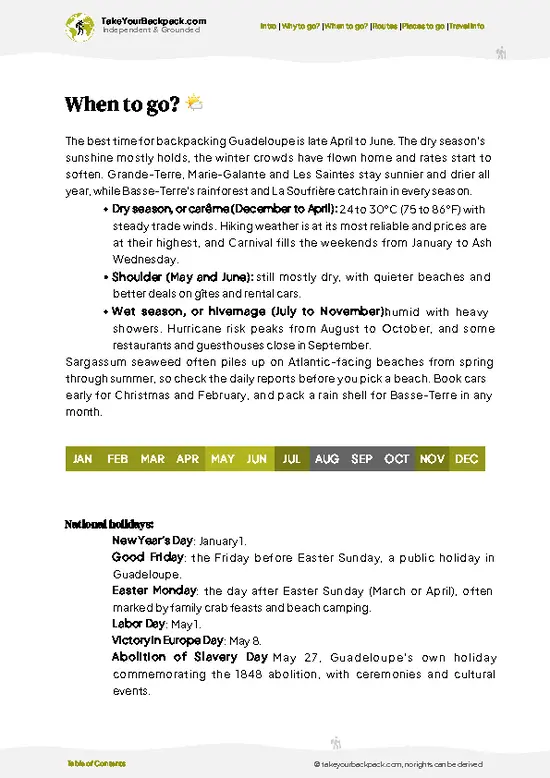
Best months and weather: The best months for beaches in Guadeloupe are December to April, the dry season (carême), when days sit around 28 to 30°C, rain is light and the sea is calm and clear at about 26 to 27°C. February and March are driest, with steady trade winds that keep the heat comfortable.

Shoulder and peak periods: May, June and November are good shoulder months, with quick showers, fewer visitors and flights and rooms often 20 to 40 percent cheaper than at the peak. Christmas to New Year and February school holidays push up prices and fill rentals, so book cars early. July to October is the wet season and the main hurricane window, with peak risk in August and September. Humidity is heavy, and sargassum can hit Atlantic-facing east coasts most in spring and summer. The sheltered … read more 👉
Best months and weather: The best months for beaches in Guadeloupe are December to April, the dry season (carême), when days sit around 28 to 30°C, rain is light and the sea is calm and clear at about 26 to 27°C. February and March are driest, with steady trade winds that keep the heat comfortable.

Shoulder and peak periods: May, June and November are good shoulder months, with quick showers, fewer visitors and flights and rooms often 20 to 40 percent cheaper than at the peak. Christmas to New Year and February school holidays push up prices and fill rentals, so book cars early. July to October is the wet season and the main hurricane window, with peak risk in August and September. Humidity is heavy, and sargassum can hit Atlantic-facing east coasts most in spring and summer. The sheltered Caribbean-side coast of Basse-Terre stays calmer year-round.

beach hoppingTips for Visiting Multiple Destinations

How many days to plan: A trip combining several beaches in Guadeloupe needs 7 to 10 days, with 2 to 3 nights per base rather than one-night hops.

Grouping regions and direction: Arrive at Pointe-à-Pitre airport and start with the Grande-Terre south coast around Gosier and Sainte-Anne, which is easy after a flight. Then drive across to Basse-Terre's west coast, about 1 to 1.5 hours, finishing with a ferry day trip from Trois-Rivières to the Saintes (about 20 to 30 minutes) or from Saint-François to Marie-Galante (about 1 hour).

Pacing and mistakes: Allow a half to full day per stop, longer for snorkeling. Island roads clog near Pointe-à-Pitre at rush hour, so do not schedule transfers between 7 and 9 a.m. or 4 and 6 p.m. Do not cram the Saintes and Marie-Galante together. Last ferries leave … read more 👉
How many days to plan: A trip combining several beaches in Guadeloupe needs 7 to 10 days, with 2 to 3 nights per base rather than one-night hops.

Grouping regions and direction: Arrive at Pointe-à-Pitre airport and start with the Grande-Terre south coast around Gosier and Sainte-Anne, which is easy after a flight. Then drive across to Basse-Terre's west coast, about 1 to 1.5 hours, finishing with a ferry day trip from Trois-Rivières to the Saintes (about 20 to 30 minutes) or from Saint-François to Marie-Galante (about 1 hour).

Pacing and mistakes: Allow a half to full day per stop, longer for snorkeling. Island roads clog near Pointe-à-Pitre at rush hour, so do not schedule transfers between 7 and 9 a.m. or 4 and 6 p.m. Do not cram the Saintes and Marie-Galante together. Last ferries leave in the afternoon, so check times and stay overnight if you want sunset and calm.

The ListHighly Recommended beaches of Guadeloupe

1 Plage de la Caravelle

Reef lagoon, palm and casuarina shade, public access beside Club Med

Float in shallow, reef-protected water and snorkel over small coral heads, ideally early before the shade fills up.

guadeloupe-beach-plage-de-la-caravelle
© Google |

2 Plage de Sainte-Anne

Palm-fringed arc, craft market, Sunday picnics, Creole beach stands

Float in flat reef-calmed water, browse the seafront stalls, and share the sand with local families on loud, social Sundays.

guadeloupe-beach-plage-de-sainte-anne
© Google | Stephanie Spriet

3 Plage de la Perle

Rocky-end snorkeling, sea grape shade, free roadside parking, sunset sand

Snorkel along the rocks at either end, then lie back on gently sloping sand and watch the Caribbean sky turn orange.

guadeloupe-beach-plage-de-la-perle
© Google | Szabados Tamás

4 Grande Anse

Golden crescent, west-facing sunsets, free parking, Deshaies village

Spend a morning on a long golden bay, eat grilled fish near the water, then stay on the sand until the sun drops into the sea.

5 Plage du Souffleur

Waist-deep shallows, casuarina picnic tables, west-facing sunsets, Port-Louis nearby

Walk far out in calm, shallow water, then claim a shaded table under the casuarinas for a long Sunday-style lunch of accras.

guadeloupe-beach-plage-du-souffleur
© Google |

6 Plage de Malendure

Black sand, Pigeon Island reef, glass-bottom boats, dive centers

Use the dark sand as a launch point for Pigeon Island, with snorkeling, boat trips and diving, then finish with grilled fish.

guadeloupe-beach-plage-de-malendure
© Google | Aurelie Gregoire

7 Anse des Châteaux

Cross on the headland, wide white sand, Désirade views, eastern tip

Climb the rocky point to the cross first, then swim in the calmer sections of a wide beach with Désirade on the horizon.

guadeloupe-beach-anse-des-chateaux
© Google | Eric

8 Anse Tarare

Clothing-optional end, sea grape shade, rocky points, no facilities

Settle under sea grape trees on a crescent with a rocky point at each end, and walk the coast toward Pointe des Châteaux.

guadeloupe-beach-anse-tarare
© Google |

9 Anse Castalia

Shallow reef-sheltered cove, weekday quiet, no shade, bring supplies

Wade into a calm, shallow cove on the rough north coast, then pack water and a hat since shade and food are scarce.

10 Trou à Man Louis

Rock-rimmed pool, jagged limestone, Atlantic surf, no sand strip

Scramble over sharp limestone to a calm turquoise pool, swim only when the sea looks tame, then continue to the nearby cliffs.

Loading the map 🌍

Expert viewTips and Advice from Travelers

How many beaches to visit: I would advise four to six beaches on a week-long trip. That gives you one reef-sheltered swimming beach, one dark-sand volcanic beach, one snorkeling stop and one island beach, with slack days in between. Squeezing in more costs hours in traffic and gets you the same sand.

Which kind to prioritize: If you are on a tight budget, favor the free public beaches of Grande-Terre's south coast: shaded, with cheap snack stands and local buses nearby. If snorkeling matters, spend extra time on Basse-Terre's west coast, where a guided or rented-gear session costs about €20 to 50. Island day trips add a ferry of roughly €25 to 45 return, and they are worth it for quieter sand if you can only afford one.

Budget: Expect roughly €60 to 110 a day for a backpacker mixing guesthouses, … read more 👉
How many beaches to visit: I would advise four to six beaches on a week-long trip. That gives you one reef-sheltered swimming beach, one dark-sand volcanic beach, one snorkeling stop and one island beach, with slack days in between. Squeezing in more costs hours in traffic and gets you the same sand.

Which kind to prioritize: If you are on a tight budget, favor the free public beaches of Grande-Terre's south coast: shaded, with cheap snack stands and local buses nearby. If snorkeling matters, spend extra time on Basse-Terre's west coast, where a guided or rented-gear session costs about €20 to 50. Island day trips add a ferry of roughly €25 to 45 return, and they are worth it for quieter sand if you can only afford one.

Budget: Expect roughly €60 to 110 a day for a backpacker mixing guesthouses, supermarket lunches and shared transport, more with a rental car at about €35 to 60 a day. Beach entry is almost always free. Sun loungers and umbrellas, where rented, run €10 to 20, and parking is sometimes a few euros.

Safety and etiquette: Swim only where locals do, since Atlantic-side currents can be strong and few beaches have lifeguards. Do not leave belongings in rental cars at beach parking lots, as break-ins occur. Avoid touching manchineel trees, which grow near some shores and have toxic sap and fruit. Topless sunbathing is accepted at some beaches, but cover up in villages and say bonjour when you arrive anywhere. Sunscreen should be reef-safe in marine protected areas.

✈️ The backpacker research shortcutGuadeloupe Travel Guide

An offline-friendly backpacking guide with optimized travel routes, ranked highlights, transport advice, and the best areas to stay.
example page 0 from our offline Travel Guide for Guadeloupe
example page 1 from our offline Travel Guide for Guadeloupe
example page 2 from our offline Travel Guide for Guadeloupe
example page 3 from our offline Travel Guide for Guadeloupe
example page 4 from our offline Travel Guide for Guadeloupe
example page 5 from our offline Travel Guide for Guadeloupe
example page 6 from our offline Travel Guide for Guadeloupe
example page 7 from our offline Travel Guide for Guadeloupe
The digital guide (206 pages) contains:
✅ 51 highlights, ranked by travel appeal
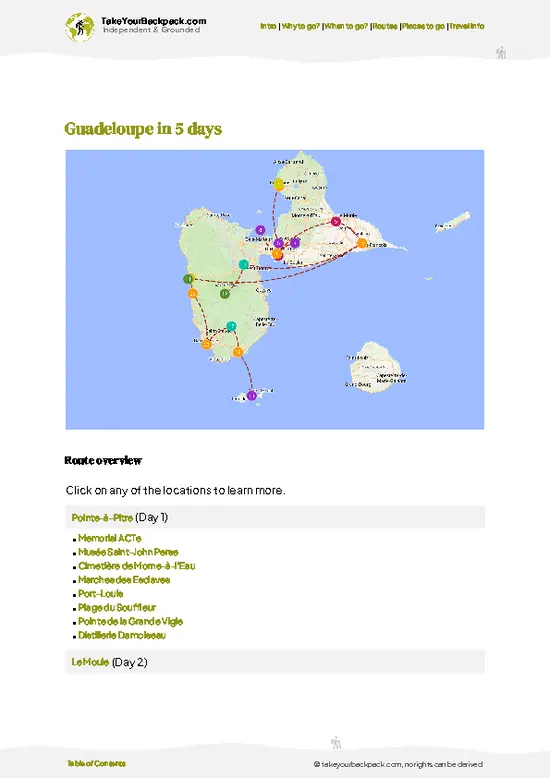
✅ Optimized 2, 3 & 5-day travel routes
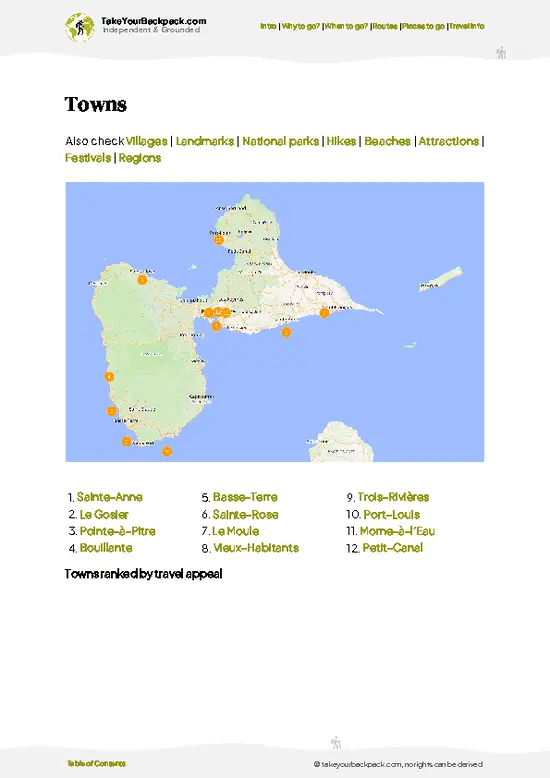
✅ Cities, national parks, landmarks, beaches
✅ How to get around
✅ Offline-friendly for travel without Wi-Fi
👉 Click to see all 30+ guide features

📅 Plan smarter in minutes, not weeks
✅ Month by month travel advice
✅ Festivals & national holidays
✅ Budget expectations

🗺️ Go to the right places, skip the overrated ones
✅ Honest pros & cons of destinations
✅ Top hikes, parks & viewpoints
✅ Lesser-known places most travelers miss
✅ Clear “worth it vs skip it” guidance

🛏️ Travel smoothly without rookie mistakes
✅ Best areas to stay
✅ Transport systems explained simply
✅ Common scams & safety advice
✅ SIM cards, money & practical tips

🌍 Understand the country, not just visit it
✅ Culture & traditions
✅ 52 Essential phrases & customs
✅ Festivals worth planning around
✅ Traveler-friendly historical context
✅ Insights that make places more meaningful

📱 Built for real travel conditions
✅ Fully downloadable PDF
✅ Works completely offline
✅ Optimized for phone use
✅ Useful in remote areas & buses
✅ Everything in one place
Stop searching, start planning
Get instant access to your full guide. 30‑day money-back guarantee.
+ Add another guide for just

By proceeding you agree to our terms.
Sent to your inbox immediately after payment • 100% Secure Checkout
Best Backpacking Travel Advisor 2025 tourism awardBest Backpacking
Travel Advisor
2025
What others say about Take Your Backpack Guides:
⭐⭐⭐⭐⭐
Fantastic, amazing amount of information!
⭐⭐⭐⭐⭐
My goodness this is amazing, it's what I've been looking for hats off too you!
⭐⭐⭐⭐⭐
I think this is absolutely BRILLIANT
⭐⭐⭐⭐
Very complete and informative. It's still missing places, but I gotta to commend you
⭐⭐⭐⭐⭐
This is truly amazing, thank you, can't wait to explore it with my kids!
⭐⭐⭐⭐⭐
Awesome resource, thank you!
⭐⭐⭐⭐⭐
This is amazing! Can't wait to explore the ones I haven't seen
⭐⭐⭐⭐
I love this! Well done, great idea.
⭐⭐⭐⭐⭐
Thanks for taking the time to make this gem!
⭐⭐⭐⭐⭐
This might be the best website I've ever seen.
⭐⭐⭐⭐⭐
Congratulations, and thank you so much for your work; it's incredibly valuable.
⭐⭐⭐⭐
In all seriousness I think you did a great job pointing out the important spots
⭐⭐⭐⭐⭐
10/10 very good
⭐⭐⭐⭐⭐
As someone who's only just starting to visit regularly this is awesome, thank you.
⭐⭐⭐⭐
Thank you very much! I'm going to visit my dad, it's going to be very useful!
⭐⭐⭐⭐⭐
This is really cool! We'll be travelling for the first time and this definitely come in handy.
⭐⭐⭐⭐⭐
You are now our minister of culture, congratulations 👨‍💼
⭐⭐⭐⭐⭐
Just wanted to tell you that this is a pearl! Going to follow your recommendations.
⭐⭐⭐⭐⭐
This is so cool. I'll definitely be using the resource for my travels soon.
⭐⭐⭐⭐⭐
This is very impressive! Good work.
⭐⭐⭐⭐⭐
This is an amazing and informative site. Very well done!

🛏️ Where to stay?Top Places to Consider Staying

Guadeloupe has only a handful of true hostels with dorm beds (roughly €25 to €35 a night), so most budget travelers book gîtes, family-run guesthouses and small rental studios at around €50 to €80 for a double room. Le Gosier has the widest choice and the liveliest bar and club strip on the island. Sainte-Anne and Saint-François on the south coast of Grande-Terre are calmer beach towns with decent bus links, while Deshaies on Basse-Terre is quiet and close to rainforest trails but works best with a rental car. Pointe-à-Pitre is the cheapest base for ferries and buses, though its center empties out after dark and is not a place to wander alone at night.

If you enjoy meeting fellow travelers, consider … read more 👉
Guadeloupe has only a handful of true hostels with dorm beds (roughly €25 to €35 a night), so most budget travelers book gîtes, family-run guesthouses and small rental studios at around €50 to €80 for a double room. Le Gosier has the widest choice and the liveliest bar and club strip on the island. Sainte-Anne and Saint-François on the south coast of Grande-Terre are calmer beach towns with decent bus links, while Deshaies on Basse-Terre is quiet and close to rainforest trails but works best with a rental car. Pointe-à-Pitre is the cheapest base for ferries and buses, though its center empties out after dark and is not a place to wander alone at night.

If you enjoy meeting fellow travelers, consider choosing hostels with high ratings for atmosphere. On the other hand, if you prefer having your own space, a hotel might be a better option.

GuadeloupeMore Places Across Guadeloupe

👋 Meet the founderWho’s Behind Take Your Backpack?

Johan, backpacker and founder of TakeYourBackpackHi, I’m Johan (Netherlands 🇳🇱), the creator of TakeYourBackpack. Over the past 3 decades, I’ve backpacked through 90+ countries across six continents, gaining extensive experience with independent travel, long-term trips, and overland routes.

This site is built on a combination of firsthand travel experience and carefully curated insights from other backpackers. Many guides are based on places I’ve personally visited, while others bring together tips, observations, and practical advice shared by trusted travelers I’ve met along the way.

The goal is to provide realistic, experience-driven guidance — not generic itineraries — so you can explore destinations with better context, clearer expectations, and more confidence.