×

Guadeloupe🇬🇵 | best hikesExplore the 4 Best hikes in Guadeloupe

Hiking in Guadeloupe means two islands in one: the volcanic Basse-Terre with its rainforest trails and the flat, dry Grande-Terre with coastal walks. Trails are mostly free, well marked and used by locals, so crowds stay thin. For independent travelers, a rental car is the trick to reaching trailheads. Start by 7 a.m., because clouds swallow the summits by midmorning.

By Johan Kruseman 🇳🇱 | Updated October 23, 2026
Explore the best beaches in Guadeloupe

Why go?What Makes Them Special

Guadeloupe is a French overseas department, which shows on the trails: the national park maintains marked paths, signposts and car parks, and you won’t pay entry fees on most routes. Basse-Terre’s volcanic spine, topped by an active volcano, catches Atlantic moisture and creates dense rainforest, rivers and waterfalls within a small area. Few Caribbean islands pack that much elevation into so little distance.

Know before you choose it: mud and rain are part of the deal, even in dry months, and summit views are a gamble. The volcano also has sulfur fumes and its alert level is monitored, so access can change. Prices follow France, so food and car rental cost more than on neighboring islands. English is rare outside hotels, so a few French greetings go a long way.
How the List Was Created
The list of best hikes in Guadeloupe is created based on scenery, challenge, trail quality, landmarks, and overall enjoyment. If you feel a hike is missing in this list, please let us know.

When to go?Optimal Periods for Travel

Best months: dry season from February to May: The best months are February to May, when rainfall drops and trails are firmer, with daytime temperatures around 27 to 30°C on the coast. Up high on Basse-Terre it can sit near 15°C at the volcano summit, so bring a light layer.
Shoulder and wet seasons: June to November is the wet season and also hurricane season, with peak risk from August to October. Expect heavy afternoon downpours and swollen river crossings. Mountain slopes get several times the rain of Grande-Terre, which stays drier all year.
Crowds and prices: The busy period runs December to April, when flights and rentals cost the most, sometimes 30 to 50 percent above summer rates. Late April and May give you the best balance of dry trails and softer prices.

hike hoppingTips for Visiting Multiple Destinations

How long you need: 7 to 10 days: A trip linking several hikes needs 7 to 10 days, enough to cover both main islands without rushing. Anchor yourself near Pointe-à-Pitre, where the airport and car rental desks are, then head to Basse-Terre first while the weather is clearest, finishing on Grande-Terre’s drier coast.
Pacing and transfers: Allow 2 to 3 nights per base on Basse-Terre and 2 on Grande-Terre. Drives between the two regions take roughly 45 minutes to 1.5 hours, but mountain roads are slow and winding, so add buffer. Public buses are infrequent and rarely reach trailheads.
Common planning mistakes: Travelers often stack two big hikes in one day and run out of daylight, which falls at around 6 p.m. year-round. Plan one major walk per day, early start, and save afternoons for rest or the … read more 👉
How long you need: 7 to 10 days: A trip linking several hikes needs 7 to 10 days, enough to cover both main islands without rushing. Anchor yourself near Pointe-à-Pitre, where the airport and car rental desks are, then head to Basse-Terre first while the weather is clearest, finishing on Grande-Terre’s drier coast.
Pacing and transfers: Allow 2 to 3 nights per base on Basse-Terre and 2 on Grande-Terre. Drives between the two regions take roughly 45 minutes to 1.5 hours, but mountain roads are slow and winding, so add buffer. Public buses are infrequent and rarely reach trailheads.
Common planning mistakes: Travelers often stack two big hikes in one day and run out of daylight, which falls at around 6 p.m. year-round. Plan one major walk per day, early start, and save afternoons for rest or the beach. Others skip the car; rent one for the whole stay.

The ListHighly Recommended hikes of Guadeloupe

1 La Soufrière

Active crater, sulfur vents, cloud forest, two-coast views

Climb through mossy forest into wind-blasted scrub to reach steaming fumaroles, with views over both the Caribbean and Atlantic coasts on clear days.

guadeloupe-hike-la-soufriere
© Google | Camille Godonaise

2 Les Chutes du Carbet

Three-tier cascade, spray, fern canopy, viewing platforms

Choose between a short stairway to a viewpoint or a longer, muddier trail toward the highest fall, with river crossings and constant roar.

guadeloupe-hike-les-chutes-du-carbet
© Google | Eliott Morisset

3 La Route de la Traversée

Cross-island road, mossy boardwalks, plunge pools, tree frogs

Pick a trail off the road across Basse-Terre and push through mud and damp rainforest to cascades where you can cool off.

4 Grande Anse to Petite Anse

Terre-de-Bas crossing, ferry landing start, dry coastal scrub, church finish

Walk west from the Grande-Anse landing along open sea views and small coves to Petite-Anse, where shops, waterfront lanes and Église Saint-Nicolas wait.

guadeloupe-hike-grande-anse-to-petite-anse
© Google | Alice Matijevic
Loading the map 🌍

Expert viewTips and Advice from Travelers

How many hikes to do: I’d advise four to six hikes over a week. That gives you a mix of summit, forest and coast without wrecking your legs or your schedule, and it leaves slack for the days when cloud or rain shuts down your first choice. More than one big hike a day costs you daylight and comfort for little gain.
Which kind to prioritize: For a tight budget and a love of dramatic scenery, the rainforest and volcano trails on Basse-Terre give the most, since most are free and the views are unlike anything else in the Caribbean. If you want easy days or you’re traveling with less fitness, coastal walks on Grande-Terre cost less effort and stay dry. Waterfall walks suit the middle ground, with short approaches and a swim at the end.
What it costs: Expect US$60 to 110 a day all in. A rental car … read more 👉
How many hikes to do: I’d advise four to six hikes over a week. That gives you a mix of summit, forest and coast without wrecking your legs or your schedule, and it leaves slack for the days when cloud or rain shuts down your first choice. More than one big hike a day costs you daylight and comfort for little gain.
Which kind to prioritize: For a tight budget and a love of dramatic scenery, the rainforest and volcano trails on Basse-Terre give the most, since most are free and the views are unlike anything else in the Caribbean. If you want easy days or you’re traveling with less fitness, coastal walks on Grande-Terre cost less effort and stay dry. Waterfall walks suit the middle ground, with short approaches and a swim at the end.
What it costs: Expect US$60 to 110 a day all in. A rental car runs about €35 to 60 a day and is the biggest line item, while guesthouses and gîtes cost €50 to 90 a night. Fuel adds around €10 to 20 a day. Most trails charge nothing, and a local guide for a volcano or canyoning day costs about €40 to 80. Supermarket picnics at around €8 to 12 save the most money compared with restaurant lunches.
Safety and etiquette: Bring real footwear, a rain jacket and 1.5 to 2 liters of water, since trails turn slick fast. Never cross a swollen river, because flash floods rise within minutes after rain upstream. Near the volcano, respect closures and sulfur fumes, and check the park’s current notices. Leave nothing at car parks, as break-ins happen at trailheads. Greet people with a quick “bonjour” on trails and in villages. It matters here, and it opens conversations.

✈️ The backpacker research shortcutGuadeloupe Travel Guide

An offline-friendly backpacking guide with optimized travel routes, ranked highlights, transport advice, and the best areas to stay.
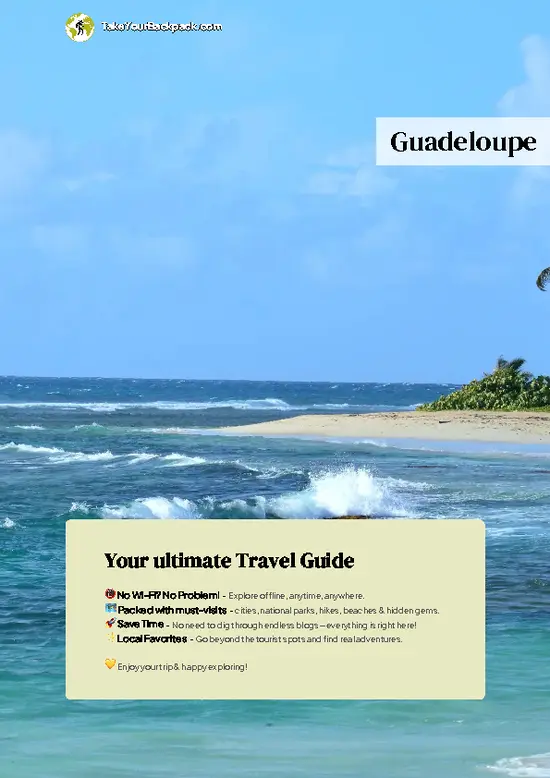
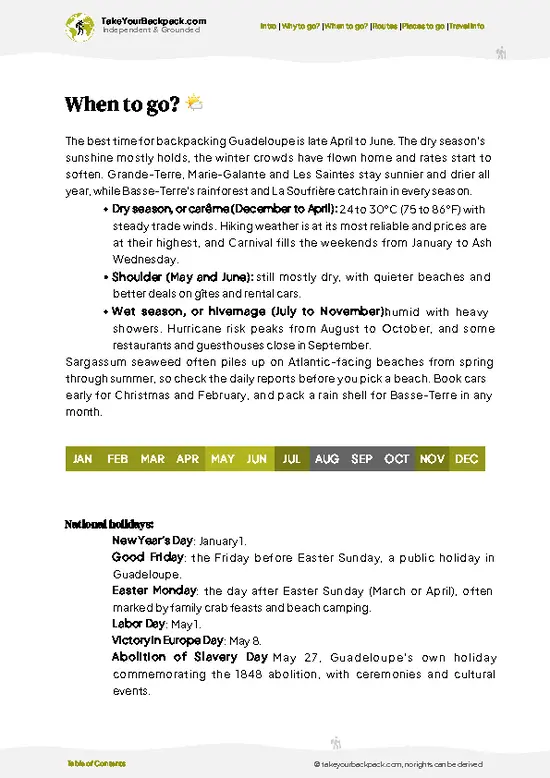
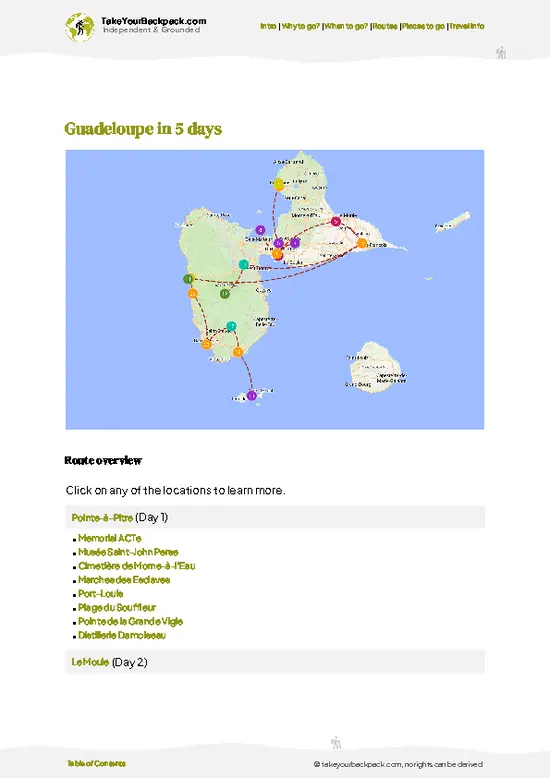
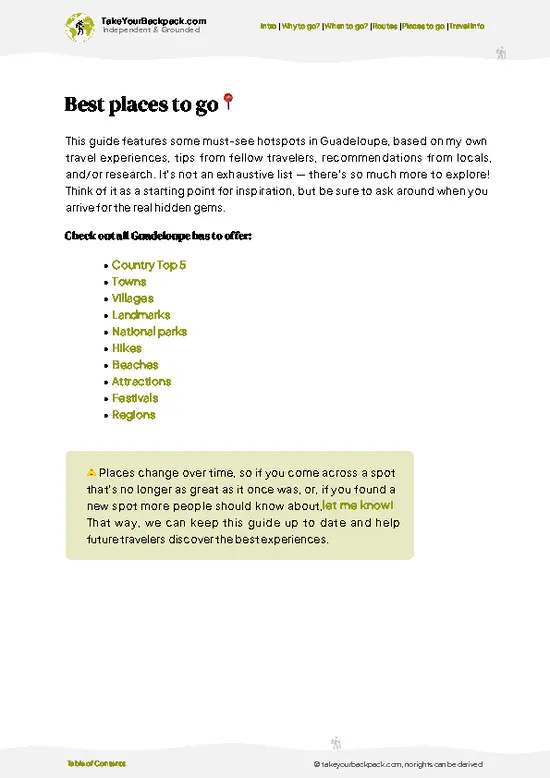
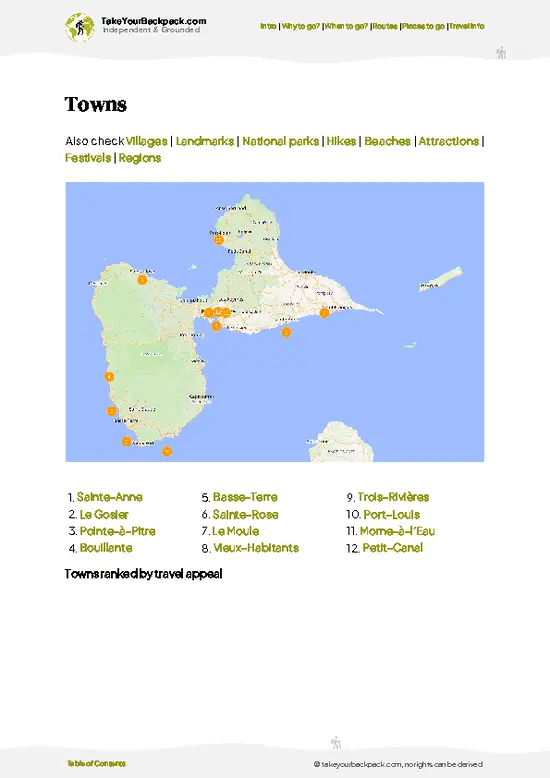
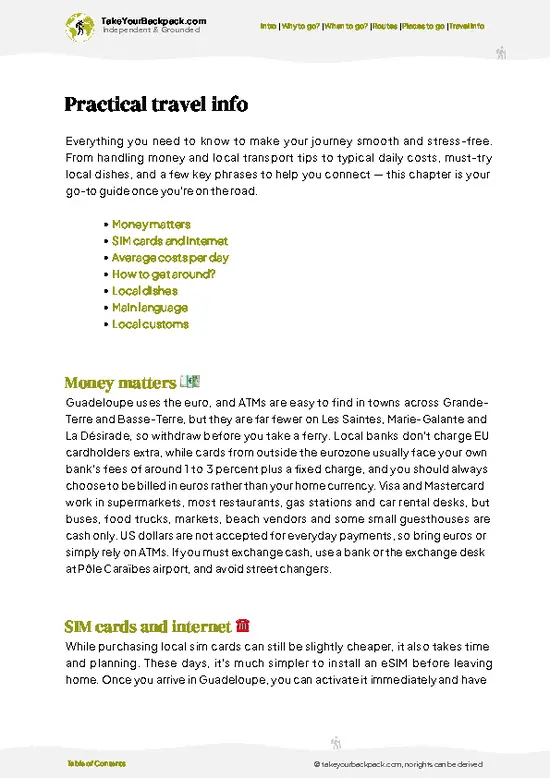
example page 0 from our offline Travel Guide for Guadeloupe
example page 1 from our offline Travel Guide for Guadeloupe
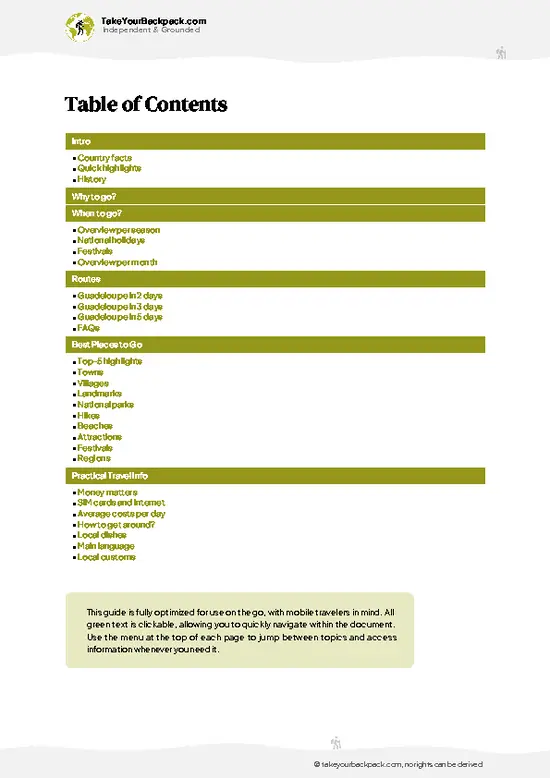
example page 2 from our offline Travel Guide for Guadeloupe
example page 3 from our offline Travel Guide for Guadeloupe
example page 4 from our offline Travel Guide for Guadeloupe
example page 5 from our offline Travel Guide for Guadeloupe
example page 6 from our offline Travel Guide for Guadeloupe
example page 7 from our offline Travel Guide for Guadeloupe
The digital guide (206 pages) contains:
✅ 51 highlights, ranked by travel appeal
✅ Optimized 2, 3 & 5-day travel routes
✅ Cities, national parks, landmarks, beaches
✅ How to get around
✅ Offline-friendly for travel without Wi-Fi
👉 Click to see all 30+ guide features

📅 Plan smarter in minutes, not weeks
✅ Month by month travel advice
✅ Festivals & national holidays
✅ Budget expectations

🗺️ Go to the right places, skip the overrated ones
✅ Honest pros & cons of destinations
✅ Top hikes, parks & viewpoints
✅ Lesser-known places most travelers miss
✅ Clear “worth it vs skip it” guidance

🛏️ Travel smoothly without rookie mistakes
✅ Best areas to stay
✅ Transport systems explained simply
✅ Common scams & safety advice
✅ SIM cards, money & practical tips

🌍 Understand the country, not just visit it
✅ Culture & traditions
✅ 52 Essential phrases & customs
✅ Festivals worth planning around
✅ Traveler-friendly historical context
✅ Insights that make places more meaningful

📱 Built for real travel conditions
✅ Fully downloadable PDF
✅ Works completely offline
✅ Optimized for phone use
✅ Useful in remote areas & buses
✅ Everything in one place
Stop searching, start planning
Get instant access to your full guide. 30‑day money-back guarantee.
+ Add another guide for just

By proceeding you agree to our terms.
Sent to your inbox immediately after payment • 100% Secure Checkout
Best Backpacking Travel Advisor 2025 tourism awardBest Backpacking
Travel Advisor
2025
What others say about Take Your Backpack Guides:
⭐⭐⭐⭐⭐
Fantastic, amazing amount of information!
⭐⭐⭐⭐⭐
My goodness this is amazing, it's what I've been looking for hats off too you!
⭐⭐⭐⭐⭐
I think this is absolutely BRILLIANT
⭐⭐⭐⭐
Very complete and informative. It's still missing places, but I gotta to commend you
⭐⭐⭐⭐⭐
This is truly amazing, thank you, can't wait to explore it with my kids!
⭐⭐⭐⭐⭐
Awesome resource, thank you!
⭐⭐⭐⭐⭐
This is amazing! Can't wait to explore the ones I haven't seen
⭐⭐⭐⭐
I love this! Well done, great idea.
⭐⭐⭐⭐⭐
Thanks for taking the time to make this gem!
⭐⭐⭐⭐⭐
This might be the best website I've ever seen.
⭐⭐⭐⭐⭐
Congratulations, and thank you so much for your work; it's incredibly valuable.
⭐⭐⭐⭐
In all seriousness I think you did a great job pointing out the important spots
⭐⭐⭐⭐⭐
10/10 very good
⭐⭐⭐⭐⭐
As someone who's only just starting to visit regularly this is awesome, thank you.
⭐⭐⭐⭐
Thank you very much! I'm going to visit my dad, it's going to be very useful!
⭐⭐⭐⭐⭐
This is really cool! We'll be travelling for the first time and this definitely come in handy.
⭐⭐⭐⭐⭐
You are now our minister of culture, congratulations 👨‍💼
⭐⭐⭐⭐⭐
Just wanted to tell you that this is a pearl! Going to follow your recommendations.
⭐⭐⭐⭐⭐
This is so cool. I'll definitely be using the resource for my travels soon.
⭐⭐⭐⭐⭐
This is very impressive! Good work.
⭐⭐⭐⭐⭐
This is an amazing and informative site. Very well done!

🛏️ Where to stay?Where to Stay: Guadeloupe Edition

Guadeloupe has only a handful of true hostels with dorm beds (roughly €25 to €35 a night), so most budget travelers book gîtes, family-run guesthouses and small rental studios at around €50 to €80 for a double room. Le Gosier has the widest choice and the liveliest bar and club strip on the island. Sainte-Anne and Saint-François on the south coast of Grande-Terre are calmer beach towns with decent bus links, while Deshaies on Basse-Terre is quiet and close to rainforest trails but works best with a rental car. Pointe-à-Pitre is the cheapest base for ferries and buses, though its center empties out after dark and is not a place to wander alone at night.

If you enjoy meeting fellow travelers, consider … read more 👉
Guadeloupe has only a handful of true hostels with dorm beds (roughly €25 to €35 a night), so most budget travelers book gîtes, family-run guesthouses and small rental studios at around €50 to €80 for a double room. Le Gosier has the widest choice and the liveliest bar and club strip on the island. Sainte-Anne and Saint-François on the south coast of Grande-Terre are calmer beach towns with decent bus links, while Deshaies on Basse-Terre is quiet and close to rainforest trails but works best with a rental car. Pointe-à-Pitre is the cheapest base for ferries and buses, though its center empties out after dark and is not a place to wander alone at night.

If you enjoy meeting fellow travelers, consider choosing hostels with high ratings for atmosphere. On the other hand, if you prefer having your own space, a hotel might be a better option.

GuadeloupeExplore Beyond This Category

👋 Meet the founderWho’s Behind Take Your Backpack?

Johan, backpacker and founder of TakeYourBackpackHi, I’m Johan (Netherlands 🇳🇱), the creator of TakeYourBackpack. Over the past 3 decades, I’ve backpacked through 90+ countries across six continents, gaining extensive experience with independent travel, long-term trips, and overland routes.

This site is built on a combination of firsthand travel experience and carefully curated insights from other backpackers. Many guides are based on places I’ve personally visited, while others bring together tips, observations, and practical advice shared by trusted travelers I’ve met along the way.

The goal is to provide realistic, experience-driven guidance — not generic itineraries — so you can explore destinations with better context, clearer expectations, and more confidence.