×

Guadeloupe🇬🇵 | best landmarksExplore the 4 Best landmarks in Guadeloupe

Landmarks in Guadeloupe are mostly natural and historical, not monumental, and the two islands of the butterfly-shaped Basse-Terre and Grande-Terre feel very different. Basse-Terre has volcanic and rainforest sites, mostly free and quiet before 9 a.m. Grande-Terre offers cliffs, beaches and old sugar heritage, easier by bus. For independent travelers, a rental car unlocks the most, while entry costs stay low.

By Johan Kruseman 🇳🇱 | Updated October 23, 2026
Explore the best national parks in Guadeloupe

Why go?What Makes Them Special

Guadeloupe is a volcanic archipelago under French administration, and that mix shapes everything you will see. Active geology, dense tropical forest and a plantation and slavery history sit side by side, so the best sights tend to be outdoors and tied to the land. Infrastructure is French-standard: good roads, clear signs, euros, and a national park that maintains many trails. That makes independent travel easy, but public transport is thin outside Pointe-à-Pitre, so a car usually matters more than a pass. Prices run higher than in most Caribbean neighbors. Many sites are small and local, with few crowds and little ceremony. Expect French-language signage, lunch closures around midday, and weather that can swallow a summit view in minutes, so go early.
How the List Was Created
The list of best unique sites in Guadeloupe is created based on history or culture, wow factor, atmosphere, quirks, and memorability. If you feel a unique site is missing in this list, please let us know.

When to go?Optimal Periods for Travel

Best months for landmarks: The best months are December to April, the dry season (Carême), when rain is lightest, skies are clearest and trails are firmest. Days sit around 28 to 30°C on the coast, cooler up in the hills. Mountain summits on Basse-Terre stay damp and cloud-prone year-round, so start by 7 or 8 a.m. before cloud builds.Shoulder and wet seasons: May to June and November are good compromises, with fewer visitors and lower prices. July to October is the wet, humid season (Hivernage), with hurricane risk peaking in August and September, and some trails closing after heavy rain. Basse-Terre gets far more rain than Grande-Terre, sometimes several times as much. Christmas to New Year and February school holidays push flights and rooms up noticeably, so book ahead or travel just outside them.

unique site hoppingTips for Visiting Multiple Destinations

How long to allow: Plan 7 to 10 days to combine several landmarks across both islands without rushing. Pointe-à-Pitre airport is the natural hub, with most rental cars collected there. Grande-Terre works best at the start or end, while Basse-Terre deserves a longer, slower block. Allow half a day per stop, or a full day for volcano and forest hikes. Drives between the regions usually take 45 to 90 minutes, but traffic around Pointe-à-Pitre can double that at rush hour.Common planning mistakes: The classic error is packing three sites into one day on Basse-Terre, where winding roads make short distances feel long. Instead, pair one big outdoor stop in the morning with a lighter one after lunch. Another is arriving after noon at mountain sites, when clouds and showers arrive. Skip Sunday and … read more 👉
How long to allow: Plan 7 to 10 days to combine several landmarks across both islands without rushing. Pointe-à-Pitre airport is the natural hub, with most rental cars collected there. Grande-Terre works best at the start or end, while Basse-Terre deserves a longer, slower block. Allow half a day per stop, or a full day for volcano and forest hikes. Drives between the regions usually take 45 to 90 minutes, but traffic around Pointe-à-Pitre can double that at rush hour.Common planning mistakes: The classic error is packing three sites into one day on Basse-Terre, where winding roads make short distances feel long. Instead, pair one big outdoor stop in the morning with a lighter one after lunch. Another is arriving after noon at mountain sites, when clouds and showers arrive. Skip Sunday and holiday plans for small museums, which often close.

The ListHighly Recommended landmarks of Guadeloupe

1 Pointe de la Grande Vigie

80-meter limestone cliffs, Trou à Madame Coco, Antigua horizon, Porte d’Enfer pool

Follow the rough rim path above the Atlantic surf, look north for Antigua, and cool off in the sheltered pool at Porte d’Enfer.

guadeloupe-unique-site-pointe-de-la-grande-vigie
© Google |

2 Cimetière de Morne-à-l’Eau

Black-and-white tiled tombs, central alley, house-shaped graves, All Saints’ Day candles

Walk the central alley between tiled tombs, then climb the side terraces for a view down a hillside patterned like a chessboard.

guadeloupe-unique-site-cimetiere-de-morne-a-leau
© Google |

3 La Grivelière

Bonifieur coffee, drying terraces, old mill, roasting demo

Follow a guided walk through an old estate where coffee was dried, hulled and roasted, and finish with a cup brewed on site.

4 Marches des Esclaves

127 stone steps, Petit-Canal harbor, memorial sculptures

Climb the stone staircase from the harbor to the church square, then read the plaques on the steps and the monuments at their foot.

guadeloupe-unique-site-marches-des-esclaves
© Google |
Loading the map 🌍

Expert viewTips and Advice from Travelers

How many to visit: Aim for six to eight landmarks in a week. That pace leaves room for a rained-out morning, which Guadeloupe will give you, and avoids the fatigue of long, winding drives. More than one major hike a day costs a lot of comfort for little gain.Choosing by travel style: Hikers should lean toward the volcanic and forest sites of Basse-Terre, where the time cost is high but entry is mostly free. Culture seekers get the best value from historical and memorial sites, usually €5 to 15 and often quiet. Beach and coast fans can stick to Grande-Terre, where the cost is almost nothing but transport. A guide for a waterfall or summit hike runs about €30 to 60 and is worth it only in poor visibility or on rougher trails.Budget: Budget about €60 to 110 a day for food, a hostel or basic guesthouse, … read more 👉
How many to visit: Aim for six to eight landmarks in a week. That pace leaves room for a rained-out morning, which Guadeloupe will give you, and avoids the fatigue of long, winding drives. More than one major hike a day costs a lot of comfort for little gain.Choosing by travel style: Hikers should lean toward the volcanic and forest sites of Basse-Terre, where the time cost is high but entry is mostly free. Culture seekers get the best value from historical and memorial sites, usually €5 to 15 and often quiet. Beach and coast fans can stick to Grande-Terre, where the cost is almost nothing but transport. A guide for a waterfall or summit hike runs about €30 to 60 and is worth it only in poor visibility or on rougher trails.Budget: Budget about €60 to 110 a day for food, a hostel or basic guesthouse, and a shared share of a rental car. Entry fees average €0 to 15 per visit, parking can add €2 to 5 at some trailheads, and the cheapest transport option is a shared rental, since buses are infrequent and slow.Safety and respect: Rivers and waterfalls rise quickly after rain, so skip them when the sky darkens upstream. Sulfur fumes near the volcano can irritate the lungs, so stay on marked paths. Leave nothing visible in a parked car, as break-ins happen at popular trailheads. Memorial and historic sites connected to slavery deserve quiet, modest behavior, and a simple “bonjour” when entering a shop or site goes a long way. Bring cash for small sites, since card readers are not universal.

✈️ The backpacker research shortcutGuadeloupe Travel Guide

An offline-friendly backpacking guide with optimized travel routes, ranked highlights, transport advice, and the best areas to stay.
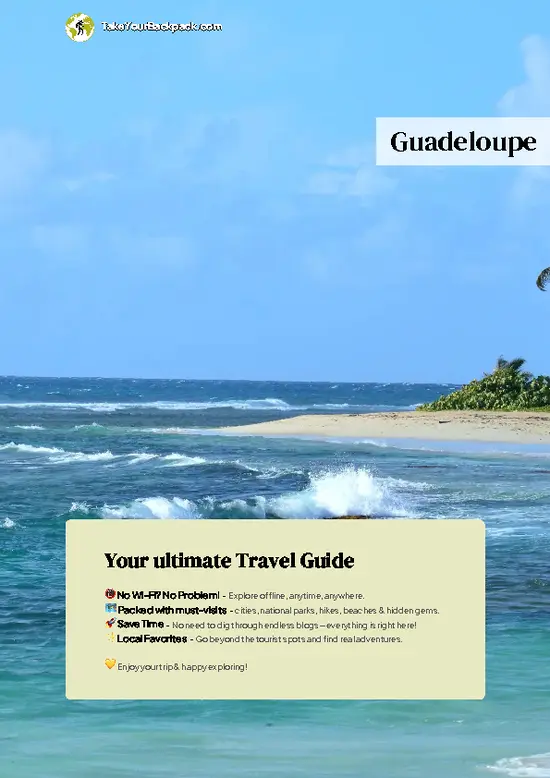
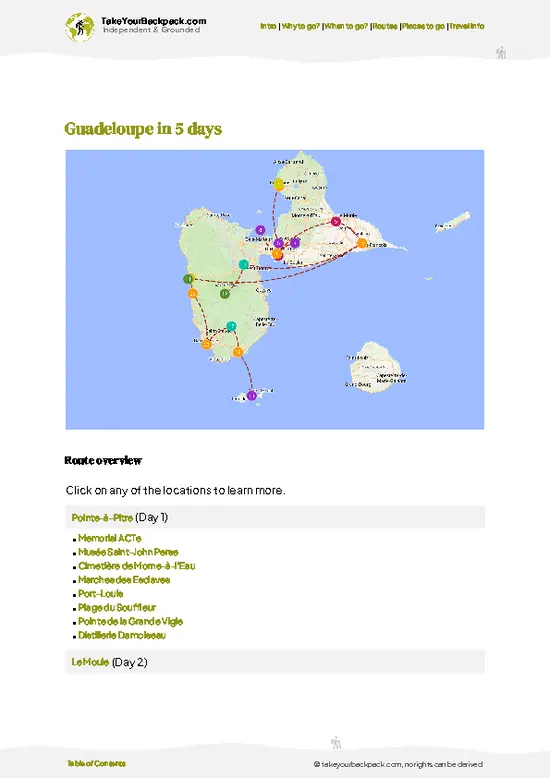
example page 0 from our offline Travel Guide for Guadeloupe
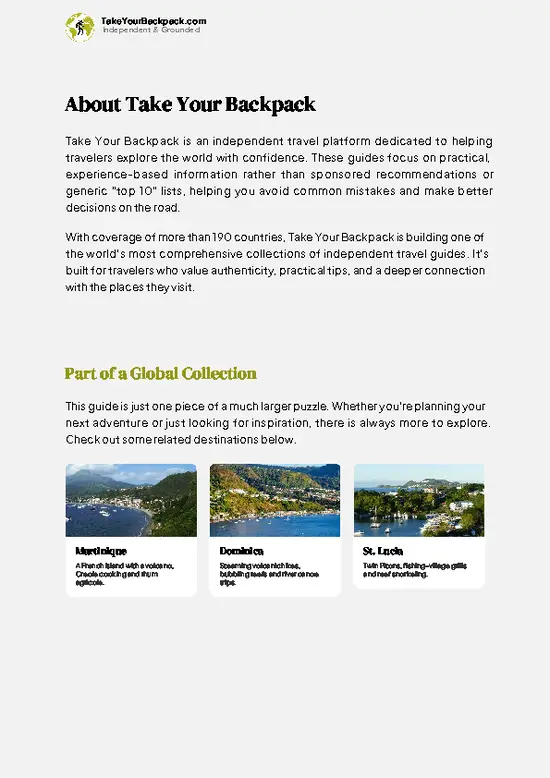
example page 1 from our offline Travel Guide for Guadeloupe
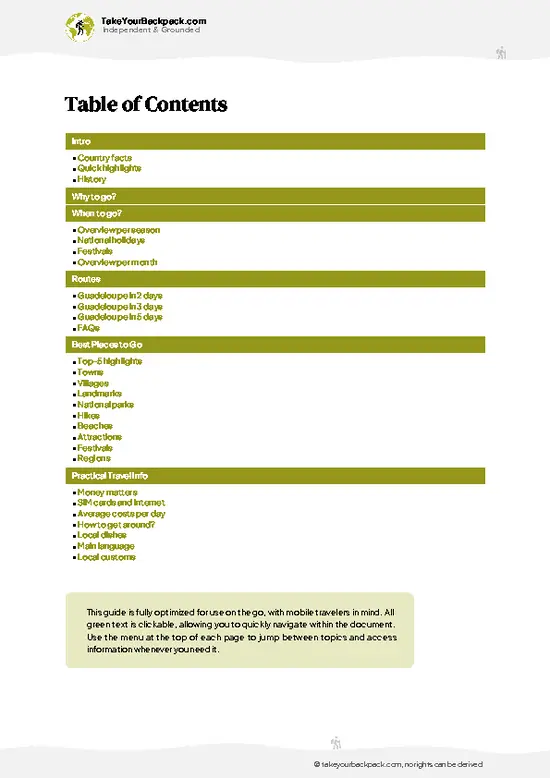
example page 2 from our offline Travel Guide for Guadeloupe
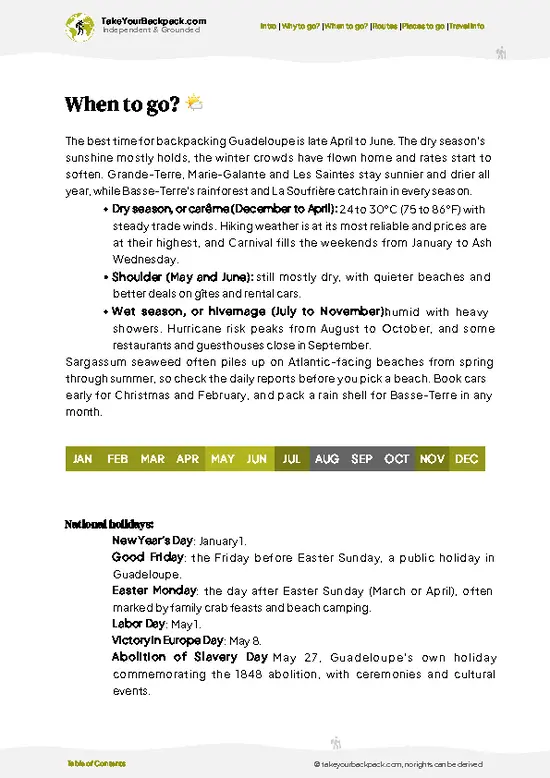
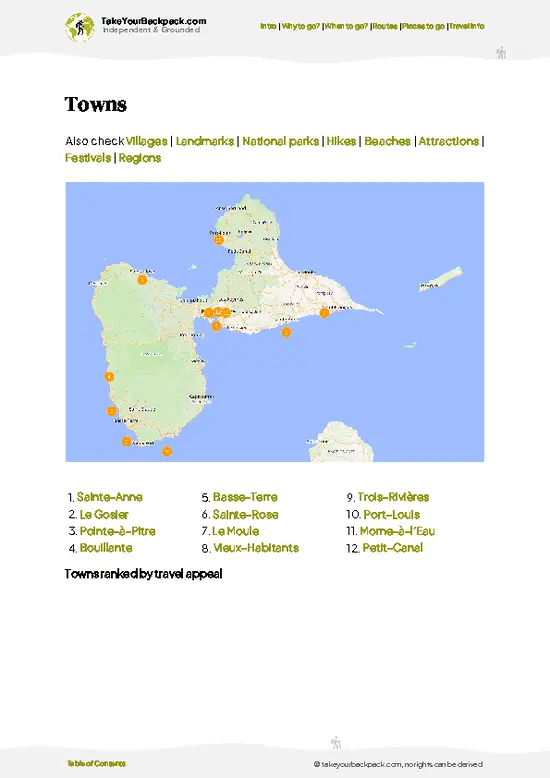
example page 3 from our offline Travel Guide for Guadeloupe
example page 4 from our offline Travel Guide for Guadeloupe
example page 5 from our offline Travel Guide for Guadeloupe
example page 6 from our offline Travel Guide for Guadeloupe
example page 7 from our offline Travel Guide for Guadeloupe
The digital guide (206 pages) contains:
✅ 51 highlights, ranked by travel appeal
✅ Optimized 2, 3 & 5-day travel routes
✅ Cities, national parks, landmarks, beaches
✅ How to get around
✅ Offline-friendly for travel without Wi-Fi
👉 Click to see all 30+ guide features

📅 Plan smarter in minutes, not weeks
✅ Month by month travel advice
✅ Festivals & national holidays
✅ Budget expectations

🗺️ Go to the right places, skip the overrated ones
✅ Honest pros & cons of destinations
✅ Top hikes, parks & viewpoints
✅ Lesser-known places most travelers miss
✅ Clear “worth it vs skip it” guidance

🛏️ Travel smoothly without rookie mistakes
✅ Best areas to stay
✅ Transport systems explained simply
✅ Common scams & safety advice
✅ SIM cards, money & practical tips

🌍 Understand the country, not just visit it
✅ Culture & traditions
✅ 52 Essential phrases & customs
✅ Festivals worth planning around
✅ Traveler-friendly historical context
✅ Insights that make places more meaningful

📱 Built for real travel conditions
✅ Fully downloadable PDF
✅ Works completely offline
✅ Optimized for phone use
✅ Useful in remote areas & buses
✅ Everything in one place
Stop searching, start planning
Get instant access to your full guide. 30‑day money-back guarantee.
+ Add another guide for just

By proceeding you agree to our terms.
Sent to your inbox immediately after payment • 100% Secure Checkout
Best Backpacking Travel Advisor 2025 tourism awardBest Backpacking
Travel Advisor
2025
What others say about Take Your Backpack Guides:
⭐⭐⭐⭐⭐
Fantastic, amazing amount of information!
⭐⭐⭐⭐⭐
My goodness this is amazing, it's what I've been looking for hats off too you!
⭐⭐⭐⭐⭐
I think this is absolutely BRILLIANT
⭐⭐⭐⭐
Very complete and informative. It's still missing places, but I gotta to commend you
⭐⭐⭐⭐⭐
This is truly amazing, thank you, can't wait to explore it with my kids!
⭐⭐⭐⭐⭐
Awesome resource, thank you!
⭐⭐⭐⭐⭐
This is amazing! Can't wait to explore the ones I haven't seen
⭐⭐⭐⭐
I love this! Well done, great idea.
⭐⭐⭐⭐⭐
Thanks for taking the time to make this gem!
⭐⭐⭐⭐⭐
This might be the best website I've ever seen.
⭐⭐⭐⭐⭐
Congratulations, and thank you so much for your work; it's incredibly valuable.
⭐⭐⭐⭐
In all seriousness I think you did a great job pointing out the important spots
⭐⭐⭐⭐⭐
10/10 very good
⭐⭐⭐⭐⭐
As someone who's only just starting to visit regularly this is awesome, thank you.
⭐⭐⭐⭐
Thank you very much! I'm going to visit my dad, it's going to be very useful!
⭐⭐⭐⭐⭐
This is really cool! We'll be travelling for the first time and this definitely come in handy.
⭐⭐⭐⭐⭐
You are now our minister of culture, congratulations 👨‍💼
⭐⭐⭐⭐⭐
Just wanted to tell you that this is a pearl! Going to follow your recommendations.
⭐⭐⭐⭐⭐
This is so cool. I'll definitely be using the resource for my travels soon.
⭐⭐⭐⭐⭐
This is very impressive! Good work.
⭐⭐⭐⭐⭐
This is an amazing and informative site. Very well done!

🛏️ Where to stay?Top Areas to Stay

Guadeloupe has only a handful of true hostels with dorm beds (roughly €25 to €35 a night), so most budget travelers book gîtes, family-run guesthouses and small rental studios at around €50 to €80 for a double room. Le Gosier has the widest choice and the liveliest bar and club strip on the island. Sainte-Anne and Saint-François on the south coast of Grande-Terre are calmer beach towns with decent bus links, while Deshaies on Basse-Terre is quiet and close to rainforest trails but works best with a rental car. Pointe-à-Pitre is the cheapest base for ferries and buses, though its center empties out after dark and is not a place to wander alone at night.

If you enjoy meeting fellow travelers, consider … read more 👉
Guadeloupe has only a handful of true hostels with dorm beds (roughly €25 to €35 a night), so most budget travelers book gîtes, family-run guesthouses and small rental studios at around €50 to €80 for a double room. Le Gosier has the widest choice and the liveliest bar and club strip on the island. Sainte-Anne and Saint-François on the south coast of Grande-Terre are calmer beach towns with decent bus links, while Deshaies on Basse-Terre is quiet and close to rainforest trails but works best with a rental car. Pointe-à-Pitre is the cheapest base for ferries and buses, though its center empties out after dark and is not a place to wander alone at night.

If you enjoy meeting fellow travelers, consider choosing hostels with high ratings for atmosphere. On the other hand, if you prefer having your own space, a hotel might be a better option.

GuadeloupeDiscover the Country

👋 Meet the founderWho’s Behind Take Your Backpack?

Johan, backpacker and founder of TakeYourBackpackHi, I’m Johan (Netherlands 🇳🇱), the creator of TakeYourBackpack. Over the past 3 decades, I’ve backpacked through 90+ countries across six continents, gaining extensive experience with independent travel, long-term trips, and overland routes.

This site is built on a combination of firsthand travel experience and carefully curated insights from other backpackers. Many guides are based on places I’ve personally visited, while others bring together tips, observations, and practical advice shared by trusted travelers I’ve met along the way.

The goal is to provide realistic, experience-driven guidance — not generic itineraries — so you can explore destinations with better context, clearer expectations, and more confidence.