×

Guinea-Bissau🇬🇼 | national parksCantanhez Forests National ParkChimpanzee calls, village homestays, Cacine mangroves, cashew orchards | things to do and best time to go

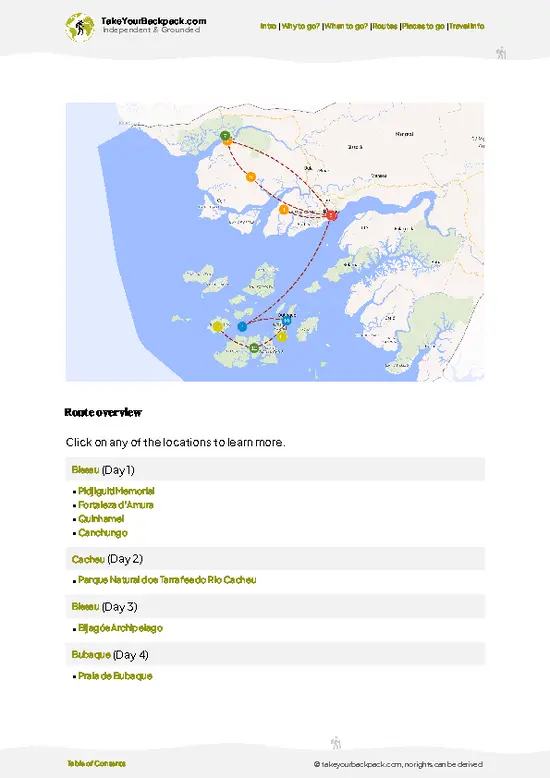
Explore João Vieira and Poilão Marine National ParkExplore Parque Natural dos Tarrafes do Rio Cacheu

Backpacking in Cantanhez Forests
👍 Recommendednational park ranked #3
By Johan Kruseman 🇳🇱 | Updated November 2, 2026

The real decision at Cantanhez is whether to commit to a village homestay or treat the park as a day out from Bissau, and the homestay wins because the forest only gets interesting at dawn and dusk. The park sits in the far southwest of Guinea-Bissau, in the Tombali region near the Guinean border. Roads are rough, so distances feel long, and that is why a night or two on site makes the trip worthwhile. Hiking here means walking forest paths between villages with a local guide, not following signed trails; the guide is there because tracks fork constantly and the people know where chimpanzees feed. Expect humid air, red laterite dust, mangrove mud, and cashew orchards. Crowds are almost nil. Chimpanzees are heard far more often than seen, so go in with that expectation. Evenings end with palm wine, generator hum, and a canopy full of insect noise.

Part of Backpacking in Guinea-Bissau: all 40 places on one map, with routes and the best time to go.
Discover everything you want to know in the 📖 Guinea-Bissau Travel Guide.
Loading the map 🌍
CLICK TO FILTER
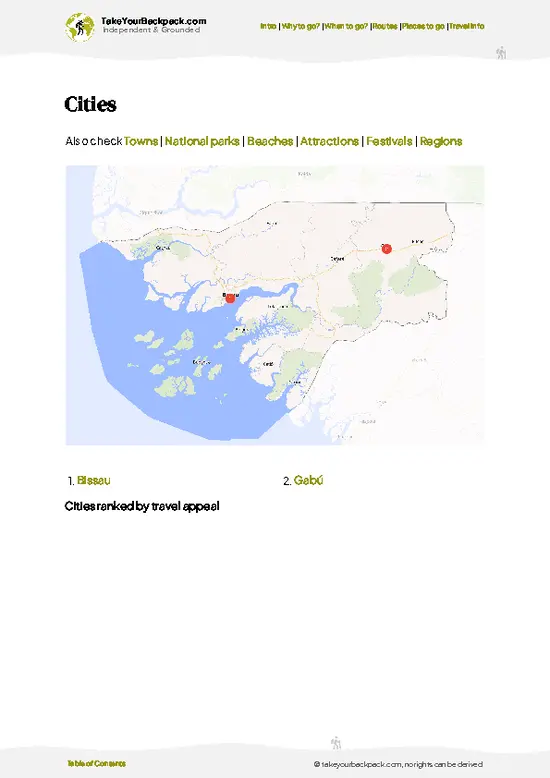
cities
towns
national parks
beaches
attractions
festivals
regions
SHOW COUNTRY’S BESTSHOW ALL

✨ Why go?
Ranked #3 national park in Guinea-Bissau
What sets this place apart

Cantanhez Forests National Park suits backpackers who like finding their own way through places most itineraries ignore. Nothing here is packaged: you arrange a local guide in a village, agree on a walk, and go. That makes it an independent traveler’s park, and tour groups are rare. The big draw is the chance to hear and sometimes see West African chimpanzees in forest that survives alongside farmland, plus red colobus and Campbell’s monkeys, and Cacine River mangroves that you can explore by dugout canoe. Community-run ecotourism is the other reason to come. Villages such as Iemberém run simple guesthouses and campsites, so your money lands with the families who protect the forest. Hammocks, shared meals of rice and fish, and conversation in Kriol or through a guide are the texture of the … read more 👉
Cantanhez Forests National Park suits backpackers who like finding their own way through places most itineraries ignore. Nothing here is packaged: you arrange a local guide in a village, agree on a walk, and go. That makes it an independent traveler’s park, and tour groups are rare. The big draw is the chance to hear and sometimes see West African chimpanzees in forest that survives alongside farmland, plus red colobus and Campbell’s monkeys, and Cacine River mangroves that you can explore by dugout canoe. Community-run ecotourism is the other reason to come. Villages such as Iemberém run simple guesthouses and campsites, so your money lands with the families who protect the forest. Hammocks, shared meals of rice and fish, and conversation in Kriol or through a guide are the texture of the trip. If you want signed trails, visitor centers and fixed schedules, look elsewhere. If you want a forest that still feels lived in and unrehearsed, this is the place.

💡 HighlightsThe experiences that define the visit

  1. Chimpanzee tracking: The park’s signature experience. Guides follow calls and fresh feeding signs through the forest, and sightings are possible but never guaranteed. Even without them, the pant-hoots carry a long way.
  2. Red colobus and Campbell’s monkeys: Easier to spot than chimps, they crash through the canopy in noisy troops, especially near forest edges and fruiting trees.
  3. Cacine River mangroves: Paddling a dugout canoe between tangled roots shows you tidal creeks, kingfishers, and the oyster-gathering that local women do at low tide.
  4. Iemberém village: A community-run base with simple lodging, shared meals, and guides who know the forest paths and the village history.
  5. Sacred forest groves: Patches of old forest protected by local custom. Guides explain which are off limits and which can be
… read more 👉
  1. Chimpanzee tracking: The park’s signature experience. Guides follow calls and fresh feeding signs through the forest, and sightings are possible but never guaranteed. Even without them, the pant-hoots carry a long way.
  2. Red colobus and Campbell’s monkeys: Easier to spot than chimps, they crash through the canopy in noisy troops, especially near forest edges and fruiting trees.
  3. Cacine River mangroves: Paddling a dugout canoe between tangled roots shows you tidal creeks, kingfishers, and the oyster-gathering that local women do at low tide.
  4. Iemberém village: A community-run base with simple lodging, shared meals, and guides who know the forest paths and the village history.
  5. Sacred forest groves: Patches of old forest protected by local custom. Guides explain which are off limits and which can be entered respectfully.
  6. Cashew orchards: Villagers’ main cash crop. In season the air is sweet and fermenting, and you can watch nuts being roasted and fruit pressed into juice and spirits.
  7. Birdwatching along forest edges: Hornbills, turacos, and parrots are common, and early morning is when they are most active and easiest to hear and spot.
  8. Evening in a Tombali village: Palm wine, drumming at times, and unhurried talk under a sky with almost no light pollution.
Allow two full days to cover everything above, or three if you want a second chance at the chimpanzees.
Spotted a mistake or missing something? Contact us.

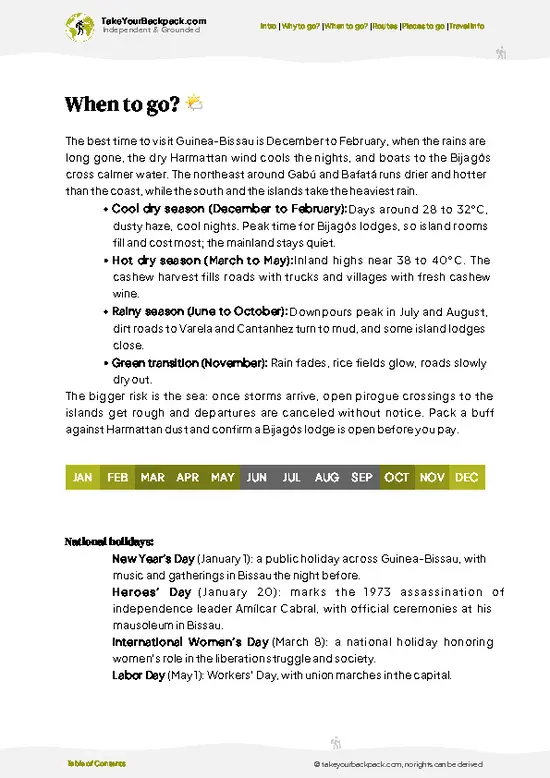
🌤️ When to go?Choosing the right time of year

  • Dry Season (December to April): Trails are firmest and river-crossing boardwalks and mangrove tracks are easiest to walk. Days run 30 to 35°C (86 to 95°F), with cooler nights around 20 to 23°C (68 to 73°F). Daylight lasts roughly 11 to 12 hours, so start walks early. This is the window for chimpanzee tracking, and the few guesthouses fill up around Christmas and Carnival.
  • Early Wet Season (May to June): Heat and humidity climb, 28 to 34°C (82 to 93°F), and the first storms arrive. Cashew harvest and the end of the season for fruit bring village life to the fore. Boat transfers are still reliable.
  • Peak Rains (July to October): Rain falls almost daily, often 25 to 30 mm or more in a single storm. Tracks flood, laterite roads turn slick, and many walks become unreliable. Rates barely drop because
… read more 👉
  • Dry Season (December to April): Trails are firmest and river-crossing boardwalks and mangrove tracks are easiest to walk. Days run 30 to 35°C (86 to 95°F), with cooler nights around 20 to 23°C (68 to 73°F). Daylight lasts roughly 11 to 12 hours, so start walks early. This is the window for chimpanzee tracking, and the few guesthouses fill up around Christmas and Carnival.
  • Early Wet Season (May to June): Heat and humidity climb, 28 to 34°C (82 to 93°F), and the first storms arrive. Cashew harvest and the end of the season for fruit bring village life to the fore. Boat transfers are still reliable.
  • Peak Rains (July to October): Rain falls almost daily, often 25 to 30 mm or more in a single storm. Tracks flood, laterite roads turn slick, and many walks become unreliable. Rates barely drop because options are limited, but some lodges close.
  • November: Rains fade, forest is lush, and crowds are still thin.
Book a guide a few days ahead in the dry season, since community guides are few.


source: climatestotravel.comJANJanuary: excellent for travelingFEBFebruary: excellent for travelingMARMarch: excellent for travelingAPRApril: excellent for travelingMAYMay: highly recommended for travelingJUNJune: fair for travelingJULJuly: fair for travelingAUGAugust: fair for travelingSEPSeptember: fair for travelingOCTOctober: fair for travelingNOVNovember: highly recommended for travelingDECDecember: excellent for traveling
guinea-bissau-national-park-cantanhez-forests-national-park
© Google |

✈️ The backpacker research shortcutGuinea-Bissau Travel Guide

What the free pages can't give you: ready-made routes, every place ranked, and it works offline. All in 1 guide.
example page 0 from our offline Travel Guide for Guinea-Bissau
example page 1 from our offline Travel Guide for Guinea-Bissau
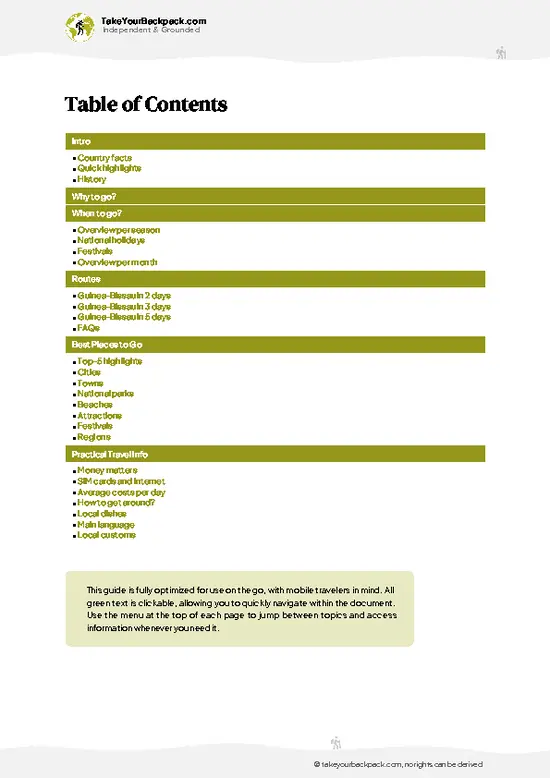
example page 2 from our offline Travel Guide for Guinea-Bissau
example page 3 from our offline Travel Guide for Guinea-Bissau
example page 4 from our offline Travel Guide for Guinea-Bissau
example page 5 from our offline Travel Guide for Guinea-Bissau
example page 6 from our offline Travel Guide for Guinea-Bissau
example page 7 from our offline Travel Guide for Guinea-Bissau
The digital guide (167 pages) contains:-page digital guide:
✅ Ready-made 2, 3 & 5-day routes
✅ All 40 places ranked, so you skip the overrated ones
✅ Works offline, all in 1 guide
✅ Cities, national parks, landmarks, beaches
✅ How to get around
👉 Click to see all 30+ guide features

📅 Plan smarter in minutes, not weeks
✅ Month by month travel advice
✅ Festivals & national holidays
✅ Budget expectations

🗺️ Go to the right places, skip the overrated ones
✅ Honest pros & cons of destinations
✅ Top hikes, parks & viewpoints
✅ Lesser-known places most travelers miss
✅ Clear “worth it vs skip it” guidance

🛏️ Travel smoothly without rookie mistakes
✅ Best areas to stay
✅ Transport systems explained simply
✅ Common scams & safety advice
✅ SIM cards, money & practical tips

🌍 Understand the country, not just visit it
✅ Culture & traditions
✅ 52 Essential phrases & customs
✅ Festivals worth planning around
✅ Traveler-friendly historical context
✅ Insights that make places more meaningful

📱 Built for real travel conditions
✅ Fully downloadable PDF
✅ Works completely offline
✅ Optimized for phone use
✅ Useful in remote areas & buses
✅ All in 1 guide
Stop searching, start planning
Get instant access to your full guide. 30‑day money-back guarantee.


By proceeding you agree to our terms.
Sent to your inbox immediately after payment • 100% Secure Checkout
Best Backpacking Travel Advisor 2025 tourism awardBest Backpacking
Travel Advisor
2025
What others say about Take Your Backpack Guides:
⭐⭐⭐⭐⭐
Fantastic, amazing amount of information!
⭐⭐⭐⭐⭐
My goodness this is amazing, it's what I've been looking for hats off too you!
⭐⭐⭐⭐⭐
I think this is absolutely BRILLIANT
⭐⭐⭐⭐
Very complete and informative. It's still missing places, but I gotta to commend you
⭐⭐⭐⭐⭐
This is truly amazing, thank you, can't wait to explore it with my kids!
⭐⭐⭐⭐⭐
Awesome resource, thank you!
⭐⭐⭐⭐⭐
This is amazing! Can't wait to explore the ones I haven't seen
⭐⭐⭐⭐
I love this! Well done, great idea.
⭐⭐⭐⭐⭐
Thanks for taking the time to make this gem!
⭐⭐⭐⭐⭐
This might be the best website I've ever seen.
⭐⭐⭐⭐⭐
Congratulations, and thank you so much for your work; it's incredibly valuable.
⭐⭐⭐⭐
In all seriousness I think you did a great job pointing out the important spots
⭐⭐⭐⭐⭐
10/10 very good
⭐⭐⭐⭐⭐
As someone who's only just starting to visit regularly this is awesome, thank you.
⭐⭐⭐⭐
Thank you very much! I'm going to visit my dad, it's going to be very useful!
⭐⭐⭐⭐⭐
This is really cool! We'll be travelling for the first time and this definitely come in handy.
⭐⭐⭐⭐⭐
You are now our minister of culture, congratulations 👨‍💼
⭐⭐⭐⭐⭐
Just wanted to tell you that this is a pearl! Going to follow your recommendations.
⭐⭐⭐⭐⭐
This is so cool. I'll definitely be using the resource for my travels soon.
⭐⭐⭐⭐⭐
This is very impressive! Good work.
⭐⭐⭐⭐⭐
This is an amazing and informative site. Very well done!

🛏️ Where to stay?How to pick the right area

The best base is inside the park itself, in the community-run eco-lodges around Iemberém, Cabuxanque and Lautchande, with Iemberém the most practical. The Cantanhez Forests National Park community tourism network runs simple lodges with thatched or mud-brick rooms, mosquito nets, bucket showers and shared meals cooked by villagers. Expect to pay about €10 to 20 per person a night. Electricity is limited, mostly solar, and phone signal is patchy, so bring a power bank. Staying in a village also puts you next to the guides who lead chimpanzee walks, mangrove paddles and visits to sacred forests. … read more 👉
The best base is inside the park itself, in the community-run eco-lodges around Iemberém, Cabuxanque and Lautchande, with Iemberém the most practical. The Cantanhez Forests National Park community tourism network runs simple lodges with thatched or mud-brick rooms, mosquito nets, bucket showers and shared meals cooked by villagers. Expect to pay about €10 to 20 per person a night. Electricity is limited, mostly solar, and phone signal is patchy, so bring a power bank. Staying in a village also puts you next to the guides who lead chimpanzee walks, mangrove paddles and visits to sacred forests.
Outside the park, the towns of Catió and Bedanda serve as gateways. Catió, the regional capital, has a few basic guesthouses at roughly €15 to 30 a room, plus markets and the main shared-taxi (toca-toca) connections. Bedanda sits on the river and has limited lodging, mainly useful for boat links. Most backpackers sleep one night in Bissau first, since the capital has the widest range of hostels and hotels, then continue south. Camping is not a formal option, so arrange a village bed through the community network in advance.

👛 Costs (as of 2 November 2026)How expensive it really is

A realistic budget for Cantanhez Forests National Park is about €35 to 65 per day, with €45 as a comfortable middle for a backpacker using community lodges and local transport. Travelers pay in West African CFA francs, and cash is essential since there are no card machines in the villages.
CategoryBudget RangeLocal Reality
Park entrance and community fee€3 to 8Often paid through the community network or guide; amounts vary by group size.
Accommodation (high season)€10 to 20Village eco-lodge bed with net; Catió guesthouses cost a little more.
Guide (chimpanzee walk or mangrove trip)€8 to 15Shared between group members; local guides are strongly recommended.
Local transport€8 to 12Shared taxi from Bissau to Catió, then a motorbike or pickup to villages.
Food and water€6 to 10Rice with fish or chicken,
… read more 👉
A realistic budget for Cantanhez Forests National Park is about €35 to 65 per day, with €45 as a comfortable middle for a backpacker using community lodges and local transport. Travelers pay in West African CFA francs, and cash is essential since there are no card machines in the villages.
CategoryBudget RangeLocal Reality
Park entrance and community fee€3 to 8Often paid through the community network or guide; amounts vary by group size.
Accommodation (high season)€10 to 20Village eco-lodge bed with net; Catió guesthouses cost a little more.
Guide (chimpanzee walk or mangrove trip)€8 to 15Shared between group members; local guides are strongly recommended.
Local transport€8 to 12Shared taxi from Bissau to Catió, then a motorbike or pickup to villages.
Food and water€6 to 10Rice with fish or chicken, cashew fruit and bottled water; meals at lodges are often prepaid.
Total Daily Budget€35 to 65About €45 on a typical day.
⚠️ Prices can change and everyone travels differently, so take this as a rough guide. Hope it helps you plan your adventure!

🥾 TrailsDiscover Cantanhez Forests's top trails and natural wonders

Cantanhez Forests National Park has no marked, numbered trails. Walks are set by your local guide and by what the animals are doing that day, which is how experienced travelers prefer it: the forest is a patchwork of farmland, palm groves, and dense woodland, so improvised routes work better than fixed ones.
  • Chimpanzee forest walk: Starts from a village such as Iemberém, usually before sunrise. Expect 3 to 5 hours of easy to moderate walking on narrow earth paths, with roots, damp patches, and some low scrambling.
  • Village-to-village walk: Links settlements through cashew orchards, rice fields, and
… read more 👉
Cantanhez Forests National Park has no marked, numbered trails. Walks are set by your local guide and by what the animals are doing that day, which is how experienced travelers prefer it: the forest is a patchwork of farmland, palm groves, and dense woodland, so improvised routes work better than fixed ones.
  • Chimpanzee forest walk: Starts from a village such as Iemberém, usually before sunrise. Expect 3 to 5 hours of easy to moderate walking on narrow earth paths, with roots, damp patches, and some low scrambling.
  • Village-to-village walk: Links settlements through cashew orchards, rice fields, and forest patches. Typically 2 to 4 hours, flat to gently rolling, easy in difficulty and good for seeing daily life.
  • Mangrove canoe trip: A half-day on the Cacine River system in a paddled dugout. Low effort, but timing depends on the tide, so your guide sets the departure.
  • Birding and monkey walk: A slow 2 to 3 hour ramble along forest edges and clearings. Red colobus, Campbell’s monkeys, hornbills, and turacos are the usual targets.
  • Terrain and difficulty: Mostly flat with heat and humidity doing the hard work. Wear closed shoes, long light clothing, and carry plenty of water.
Getting to Cantanhez Forests National Park takes effort. Shared taxis and minibuses run south from Bissau toward Bedanda and Cacine, then local motorbike taxis or pickups reach the villages on unpaved roads that worsen in the wet season. Travelers usually pay a small park or community fee and a guide fee, in local currency, with totals typically around €5 to 15 per day. Crowds are practically absent, and you may be the only visitor in a village. Bring cash, a flashlight, and insect repellent, since there are no ATMs in the park.
⚠️ Hiking info can sometimes be outdated or inaccurate. Before you hit the trail, check the latest conditions with locals. If you do spot anything that's off, I'd love to hear from you, so I can update it for fellow travelers.

🛡️ SafetySafety Tips and Common Scams in Cantanhez Forests

Cantanhez Forests National Park is a quiet, community-run forest where the main hazards are heat, humidity and poor logistics, not crime or dangerous animals. Walk with a local guide, since tracks branch constantly through palm groves, cashew orchards and mangrove edges, and signage is minimal. Start at dawn, carry at least 3 liters of water per person and wear closed shoes, because wet clay is slippery and tidal mud is deep. Malaria is present all year, so take prophylaxis, use repellent and sleep under a net.
Chimpanzees are shy and rarely aggressive. Keep around 10 meters away, stay quiet, never feed them and avoid pointing a phone flash. Crocodiles and snakes are uncommon sightings, but stay on trails. Clinics are basic and the nearest real hospital is in Bissau, so carry a first aid kit … read more 👉
Cantanhez Forests National Park is a quiet, community-run forest where the main hazards are heat, humidity and poor logistics, not crime or dangerous animals. Walk with a local guide, since tracks branch constantly through palm groves, cashew orchards and mangrove edges, and signage is minimal. Start at dawn, carry at least 3 liters of water per person and wear closed shoes, because wet clay is slippery and tidal mud is deep. Malaria is present all year, so take prophylaxis, use repellent and sleep under a net.
Chimpanzees are shy and rarely aggressive. Keep around 10 meters away, stay quiet, never feed them and avoid pointing a phone flash. Crocodiles and snakes are uncommon sightings, but stay on trails. Clinics are basic and the nearest real hospital is in Bissau, so carry a first aid kit and any personal medication. Ask permission before photographing villagers or sacred sites.

FAQCommon questions from travelers

Plan on 2 to 3 days for Cantanhez Forests National Park. That gives you one morning for a chimpanzee walk, one for a mangrove or village visit, and a day lost to the long road south from Bissau, which takes roughly 4 to 6 hours to Catió. Add a fourth day if you want to see sacred forests around Cabuxanque or Lautchande.
Yes, Cantanhez Forests National Park can be reached without a car, but it takes patience. Shared taxis run from Bissau to Catió, and from there motorbike taxis or pickups cover the last stretch to Iemberém and other villages for about €2 to 8. Guides often arrange transfers, and walking between nearby villages is possible in the dry season.
Yes, Cantanhez Forests National Park charges a small fee, usually about €3 to 8, collected through the community tourism network or your guide. No separate permit is needed for walking, but you must arrange a local guide for chimpanzee trails, which costs roughly €8 to 15 per group. Pay in cash and book ahead through a village lodge.
⚠️ Things can change over time, so always validate details locally before you go.

Other Bissau-Guinean national parks near Cantanhez Forests

Explore more nearby:


💡 Not sure where to go next?
Create a personalized itinerary for Guinea-Bissau including Cantanhez Forests and the places that fit your trip.

Generate my itinerary

👉 Discover all national parks

Or checkout all Guinea-Bissau has to offer (think cities, towns, villages, national parks, hikes, beaches, festivals)
Country photo of Guinea-Bissau

We 💚 feedbackIs it worth it?

Cantanhez Forests National Park is at its best in the dry season, and within any day the hour before sunrise is when the forest earns the trip. Chimpanzees call, mist hangs over the orchards, and the heat has not yet arrived. I would sleep in a village rather than rush from Bissau, and bring a headlamp for the pre-dawn walk.

✍️ Help improve this page!
The information on this page is based on in-depth research, insights shared by experienced travelers, and feedback from the local travel community in Guinea-Bissau. While every effort is made to keep the information accurate and current, conditions can change — so if you spot anything incorrect or outdated, please get in touch.


🙋‍♂️ Give feedback

👋 Meet the founderWho’s Behind Take Your Backpack?

Johan, backpacker and founder of TakeYourBackpackHi, I’m Johan (Netherlands 🇳🇱), the creator of TakeYourBackpack. Over the past 30 years, I’ve backpacked through 88 countries across six continents, gaining extensive experience with independent travel, long-term trips, and overland routes.

This site is built on a combination of firsthand travel experience and carefully curated insights from other backpackers. Many guides are based on places I’ve personally visited, while others bring together tips, observations, and practical advice shared by trusted travelers I’ve met along the way.

The goal is to provide realistic, experience-driven guidance — not generic itineraries — so you can explore destinations with better context, clearer expectations, and more confidence.