×

Guinea-Bissau🇬🇼 | attractionsMercado de CaracolProduce lanes, morning bargaining, tailor stalls, Kriol banter | things to do and best time to go

Explore Mercado de BandimExplore Centro Cultural Franco-Bissau-Guineense

Backpacking in Mercado de Caracol
👌 Worth visitingattraction ranked #6
By Johan Kruseman 🇳🇱 | Updated October 22, 2026

Mercado de Caracol is a working neighborhood market in the capital, and it runs on noise: vendors calling prices in Kriol, plastic basins scraped across concrete, motorbike taxis leaning on their horns at the edges. Stalls pile up piles of onions, hot peppers, dried fish and bolts of bright printed cloth under tarps that cast a patchy, orange-tinted shade. It sits in Bissau, the capital of Guinea-Bissau, close to the city center. Crowds thicken in the morning and the lanes are narrow, so expect elbows, mud after rain and a lot of friendly bargaining. Spending is small, and you pay in local cash. This is no polished sight. It is a place to watch daily Bissau life up close. Start in the morning, walk the lanes once without buying, then circle back for fruit and cloth.

Discover everything you want to know in the 📖 Guinea-Bissau Travel Guide.


example page 0 from our offline Travel Guide for Guinea-Bissau
example page 1 from our offline Travel Guide for Guinea-Bissau
example page 2 from our offline Travel Guide for Guinea-Bissau
example page 3 from our offline Travel Guide for Guinea-Bissau
example page 4 from our offline Travel Guide for Guinea-Bissau
example page 5 from our offline Travel Guide for Guinea-Bissau
example page 6 from our offline Travel Guide for Guinea-Bissau
example page 7 from our offline Travel Guide for Guinea-Bissau
Loading the map 🌍
CLICK TO FILTER
cities
towns
national parks
beaches
attractions
festivals
regions
SHOW COUNTRY’S BESTSHOW ALL

✨ Why go?
Ranked #6 attraction in Guinea-Bissau
What sets this place apart

Mercado de Caracol gives you the Bissau that tourists rarely see, the one that shops for dinner. Nobody here is performing for visitors, so you watch real trade: women weighing rice by the tin, fish sellers working through their catch, tailors treadling away beside rolls of fabric. That is the main reason to come.

It also suits a traveler who likes to eat and shop where residents do. Fresh mangoes, cashew fruit in season and peppers cost very little, and conversations start easily when you buy a handful of something. Even a few words of Portuguese or Kriol get warm reactions.

The third reason is context. Bissau is a small, low-key capital, and a market morning explains it better than any monument. Pair that with the nearby waterfront and old town, and you have a full, honest picture of how the country trades, eats and gets by.

💡 HighlightsMust-see experiences and standout moments

  1. Mercado de Caracol produce lanes: the heart of the market, with heaps of onions, peppers, cassava and seasonal fruit laid out on tables and cloths. Go early, when the produce is freshest and the heat is gentler.
  2. Fabric and tailor stalls: bolts of printed West African cloth hang beside tailors at pedal sewing machines. You can watch a shirt or wrap take shape.
  3. Mercado de Bandim: the capital’s largest and most chaotic market, a bigger, louder companion to Caracol. It is worth a comparison walk, with the same food and cloth on a far bigger scale.
  4. Fortaleza de São José da Amura: the old Portuguese fortress by the river, with thick walls, cannons and the mausoleum of independence leader Amílcar Cabral inside the grounds.
  5. Pidjiguti Memorial: a monument at the port to the dockworkers killed in the 1959
… read more 👉
  1. Mercado de Caracol produce lanes: the heart of the market, with heaps of onions, peppers, cassava and seasonal fruit laid out on tables and cloths. Go early, when the produce is freshest and the heat is gentler.
  2. Fabric and tailor stalls: bolts of printed West African cloth hang beside tailors at pedal sewing machines. You can watch a shirt or wrap take shape.
  3. Mercado de Bandim: the capital’s largest and most chaotic market, a bigger, louder companion to Caracol. It is worth a comparison walk, with the same food and cloth on a far bigger scale.
  4. Fortaleza de São José da Amura: the old Portuguese fortress by the river, with thick walls, cannons and the mausoleum of independence leader Amílcar Cabral inside the grounds.
  5. Pidjiguti Memorial: a monument at the port to the dockworkers killed in the 1959 strike, a key moment in the independence story.
  6. Bissau Velho: the old colonial quarter, with faded pastel buildings, quiet streets and cafés where you can rest from the market crowds.
  7. Catedral de Bissau: a whitewashed twin-towered church in the center that is easy to reach on foot and makes a calm stop in the day.
All of it fits into a full day if you spend the morning in the markets and the afternoon around the fortress and old town.
Spotted a mistake or missing something? Contact us.

🌤️ When to go?Choosing the right time of year

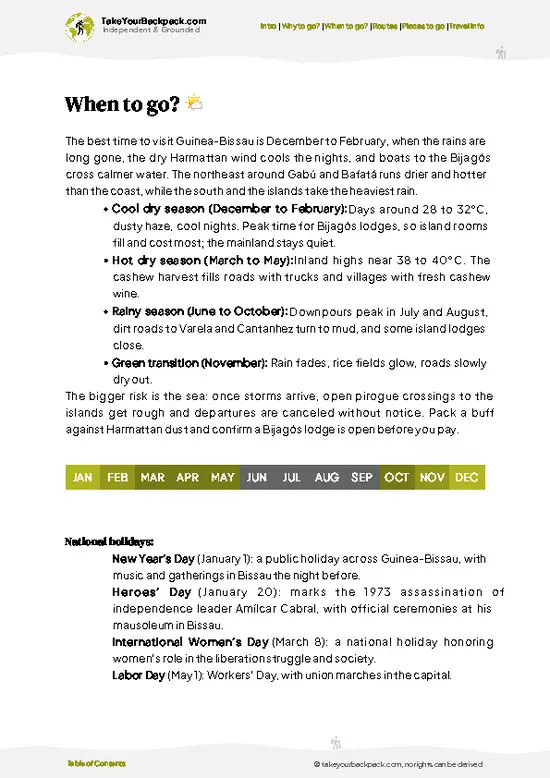
  • Dry Season (November to May): Mercado de Caracol is easiest from December to February, with clear skies, highs of 30 to 35°C (86 to 95°F) and cooler nights near 18 to 22°C (64 to 72°F). Roads are firm and the market is fully stocked.
  • Hot Build-Up (March to May): Afternoons climb to 35 to 38°C (95 to 100°F) and the air gets sticky. Go early, since stalls are busiest before the midday heat.
  • Rainy Season (June to October): Highs sit around 30 to 32°C (86 to 90°F) with heavy downpours, peaking in July and August. Dirt tracks flood, rides slow down and produce choices shift. Prices for transport can creep up when roads are bad.
  • Daylight: Days run roughly 11 to 13 hours all year, so plan to finish your errands by late afternoon.
Arrive in the morning on a dry day, when the stalls are full and the light is kind to photos.

source: climatestotravel.comJANJanuary: excellent for travelingFEBFebruary: excellent for travelingMARMarch: excellent for travelingAPRApril: excellent for travelingMAYMay: highly recommended for travelingJUNJune: fair for travelingJULJuly: fair for travelingAUGAugust: fair for travelingSEPSeptember: fair for travelingOCTOctober: fair for travelingNOVNovember: excellent for travelingDECDecember: excellent for traveling
when-to-go

✈️ The backpacker research shortcutGuinea-Bissau Travel Guide

An offline-friendly backpacking guide with optimized travel routes, ranked highlights, transport advice, and the best areas to stay.
example page 0 from our offline Travel Guide for Guinea-Bissau
example page 1 from our offline Travel Guide for Guinea-Bissau
example page 2 from our offline Travel Guide for Guinea-Bissau
example page 3 from our offline Travel Guide for Guinea-Bissau
example page 4 from our offline Travel Guide for Guinea-Bissau
example page 5 from our offline Travel Guide for Guinea-Bissau
example page 6 from our offline Travel Guide for Guinea-Bissau
example page 7 from our offline Travel Guide for Guinea-Bissau
The digital guide (214 pages) contains:
✅ 48 highlights, ranked by travel appeal
✅ Optimized 2, 3 & 5-day travel routes
✅ Cities, national parks, landmarks, beaches
✅ How to get around
✅ Offline-friendly for travel without Wi-Fi
👉 Click to see all 30+ guide features

📅 Plan smarter in minutes, not weeks
✅ Month by month travel advice
✅ Festivals & national holidays
✅ Budget expectations

🗺️ Go to the right places, skip the overrated ones
✅ Honest pros & cons of destinations
✅ Top hikes, parks & viewpoints
✅ Lesser-known places most travelers miss
✅ Clear “worth it vs skip it” guidance

🛏️ Travel smoothly without rookie mistakes
✅ Best areas to stay
✅ Transport systems explained simply
✅ Common scams & safety advice
✅ SIM cards, money & practical tips

🌍 Understand the country, not just visit it
✅ Culture & traditions
✅ 52 Essential phrases & customs
✅ Festivals worth planning around
✅ Traveler-friendly historical context
✅ Insights that make places more meaningful

📱 Built for real travel conditions
✅ Fully downloadable PDF
✅ Works completely offline
✅ Optimized for phone use
✅ Useful in remote areas & buses
✅ Everything in one place
Stop searching, start planning
Get instant access to your full guide. 30‑day money-back guarantee.
+ Add another guide for just

By proceeding you agree to our terms.
Sent to your inbox immediately after payment • 100% Secure Checkout
Best Backpacking Travel Advisor 2025 tourism awardBest Backpacking
Travel Advisor
2025
What others say about Take Your Backpack Guides:
⭐⭐⭐⭐⭐
Fantastic, amazing amount of information!
⭐⭐⭐⭐⭐
My goodness this is amazing, it's what I've been looking for hats off too you!
⭐⭐⭐⭐⭐
I think this is absolutely BRILLIANT
⭐⭐⭐⭐
Very complete and informative. It's still missing places, but I gotta to commend you
⭐⭐⭐⭐⭐
This is truly amazing, thank you, can't wait to explore it with my kids!
⭐⭐⭐⭐⭐
Awesome resource, thank you!
⭐⭐⭐⭐⭐
This is amazing! Can't wait to explore the ones I haven't seen
⭐⭐⭐⭐
I love this! Well done, great idea.
⭐⭐⭐⭐⭐
Thanks for taking the time to make this gem!
⭐⭐⭐⭐⭐
This might be the best website I've ever seen.
⭐⭐⭐⭐⭐
Congratulations, and thank you so much for your work; it's incredibly valuable.
⭐⭐⭐⭐
In all seriousness I think you did a great job pointing out the important spots
⭐⭐⭐⭐⭐
10/10 very good
⭐⭐⭐⭐⭐
As someone who's only just starting to visit regularly this is awesome, thank you.
⭐⭐⭐⭐
Thank you very much! I'm going to visit my dad, it's going to be very useful!
⭐⭐⭐⭐⭐
This is really cool! We'll be travelling for the first time and this definitely come in handy.
⭐⭐⭐⭐⭐
You are now our minister of culture, congratulations 👨‍💼
⭐⭐⭐⭐⭐
Just wanted to tell you that this is a pearl! Going to follow your recommendations.
⭐⭐⭐⭐⭐
This is so cool. I'll definitely be using the resource for my travels soon.
⭐⭐⭐⭐⭐
This is very impressive! Good work.
⭐⭐⭐⭐⭐
This is an amazing and informative site. Very well done!

🛏️ Where to stay?How to pick the right area

Stay in Bissau's Bairro d'Ajuda or the streets around Avenida Amílcar Cabral, and reach Mercado de Caracol from there by shared taxi in roughly 30 to 60 minutes depending on traffic and road conditions. This is where the budget guesthouses, small hostel-style places and the few traveler-friendly cafés cluster, so you will meet other backpackers over a beer or a plate of grilled fish rather than eat alone.

The center around the old port and Praça dos Heróis Nacionais is walkable, with banks, ATMs, shops and taxis within a few minutes, which matters in a country where cash is king and cards rarely … read more 👉
Stay in Bissau's Bairro d'Ajuda or the streets around Avenida Amílcar Cabral, and reach Mercado de Caracol from there by shared taxi in roughly 30 to 60 minutes depending on traffic and road conditions. This is where the budget guesthouses, small hostel-style places and the few traveler-friendly cafés cluster, so you will meet other backpackers over a beer or a plate of grilled fish rather than eat alone.

The center around the old port and Praça dos Heróis Nacionais is walkable, with banks, ATMs, shops and taxis within a few minutes, which matters in a country where cash is king and cards rarely work. After dark, take a taxi even for short hops. Streets are poorly lit and power cuts are common.

Solo travelers do best choosing a place with a shared courtyard or terrace and a host who can arrange drivers and explain local prices. Nothing comparable exists right at the market, so a Bissau base is the practical, social choice. Book ahead around Carnival in February, when central beds fill up.

👛 Costs (as of 22 October 2026)Typical daily expenses

Mercado de Caracol costs roughly €19 to 37 a day for a backpacker, with no entry fee.
CategoryBudget RangeLocal Reality
EntryFreeOpen market, nobody charges at the gate.
Accommodation (high season)€12 to 20Basic guesthouse room with fan in Bissau; cheaper in low season at around €9 to 15.
Transport€2 to 4Shared taxis and minibuses (toca-toca) run in West African CFA francs, which you pay in cash. Negotiate any private taxi first.
Food€3 to 6Rice with fish or chicken at local eateries; fruit and snacks from stalls cost under €1.
Market purchases€1 to 5Spices, cashews, cloth and produce. Bargaining is expected and polite.
Water and extras€1 to 2Bottled water and small tips for helpers.
Total Daily Budget€19 to 37Cash only, so carry small notes.
⚠️ Prices can change and everyone travels differently, so take this as a rough guide. Hope it helps you plan your adventure!

FAQCommon questions from travelers

Plan on one to two hours at Mercado de Caracol, which is enough to walk the stalls, haggle and snack. Go before 10 am when produce is fresh and the heat is gentler. Add a half day if you travel from Bissau, since road conditions can stretch the trip.
Yes, because Mercado de Caracol has no entry fee, so your only costs are transport and whatever you buy. Expect to spend about €1 to 5 on spices, cashews or cloth, plus a few euros on street food. It is a low-cost way to see everyday trade in action.
Most travelers start in Bissau and take a shared taxi or minibus toward Mercado de Caracol, usually 30 to 60 minutes depending on traffic and road state. Fares are typically €2 to 4, paid in cash in local currency. A private taxi costs more but is easier for a return trip, especially in the rainy season from June to October.
⚠️ Things can change over time, so always validate details locally before you go.

Other Bissau-Guinean attractions near Mercado de Caracol

Explore more nearby:


💡 Not sure where to go next?
Create a personalized itinerary for Guinea-Bissau including Mercado de Caracol and the places that fit your trip.

Generate my itinerary

👉 Discover all attractions

Or checkout all Guinea-Bissau has to offer (think cities, towns, villages, national parks, hikes, beaches, festivals)
Country photo of Guinea-Bissau

We 💚 feedbackKey takeaways before you go

Mercado de Caracol pairs well with a morning at Mercado de Bandim, then an afternoon along the river at the fortress and the old town. I would go early, carry small bills and leave valuables at your guesthouse. Eat fruit from the stalls, then finish with a cold drink in Bissau Velho.

✍️ Help improve this page!
The information on this page is based on in-depth research, insights shared by experienced travelers, and feedback from the local travel community in Guinea-Bissau. While every effort is made to keep the information accurate and current, conditions can change — so if you spot anything incorrect or outdated, please get in touch.


🙋‍♂️ Give feedback

👋 Meet the founderWho’s Behind Take Your Backpack?

Johan, backpacker and founder of TakeYourBackpackHi, I’m Johan (Netherlands 🇳🇱), the creator of TakeYourBackpack. Over the past 3 decades, I’ve backpacked through 90+ countries across six continents, gaining extensive experience with independent travel, long-term trips, and overland routes.

This site is built on a combination of firsthand travel experience and carefully curated insights from other backpackers. Many guides are based on places I’ve personally visited, while others bring together tips, observations, and practical advice shared by trusted travelers I’ve met along the way.

The goal is to provide realistic, experience-driven guidance — not generic itineraries — so you can explore destinations with better context, clearer expectations, and more confidence.