×

Guinea🇬🇳 | attractionsGrand Mosque of Conakryminaret towers, prayer hall, city skyline | things to do and best time to go

Explore Soumba Waterfall Recreation AreaExplore Cathédrale Sainte-Marie de Conakry

Backpacking in Grand Mosque of Conakry
🌟 Highlightattraction ranked #5
By Johan Kruseman 🇳🇱 | Updated May 21, 2026

Your bare feet hit the cool marble, and the air shifts—suddenly heavy with incense and the low, rolling echo of prayer. Sunlight slices through geometric windows, painting the floor in fractured gold. This is the Grand Mosque of Conakry, planted right in the heart of Guinea’s chaotic capital, a stone’s throw from the battered taxis and relentless street vendors of downtown. Here’s the truth: you won’t find the polished serenity of Istanbul or the postcard-perfect crowds of Casablanca. The mosque is massive, yes—one of West Africa’s largest—but it’s also raw, lived-in, and unapologetically local. Backpackers get a front-row seat to Guinea’s spiritual pulse, but don’t expect tourist gloss or easy access; non-Muslims can’t always enter, and the rules shift with the mood of the day. It’s not cheap by local standards, and the city’s grit is inescapable. But if you want a jolt of real West African faith—unfiltered, thunderous, and alive—this is it.

Discover everything you want to know in the 📖 Guinea Travel Guide.


Get your Guinea guide
67 ranked highlights, routes & tips, works offline (282 pages)
Loading the map 🌍
CLICK TO FILTER
cities
towns
landmarks
national parks
hikes
beaches
attractions
festivals
regions
SHOW COUNTRY’S BESTSHOW ALL

✨ Why go?
Ranked #5 attraction in Guinea
Why Grand Mosque of Conakry should be on your travel list

The Grand Mosque of Conakry isn’t just another shiny landmark to tick off your list—it’s a raw, living symbol of Guinea’s complex identity. Sure, it’s massive and visually striking, but don’t expect a quiet, contemplative visit. The place pulses with energy, from the calls to prayer echoing across the city to the sea of worshippers that flood its courtyards. It’s a cultural powerhouse, representing Guinea’s deep Islamic roots and its post-colonial assertion of identity. Backpackers who make the trek here aren’t just chasing a photo op—they’re stepping into a space where history, faith, and daily life collide in real time.

Yes, it can get crowded, and navigating the mosque’s strict dress codes and etiquette might feel like a hassle. But that effort pays off. The mosque stands as a major milestone … read more 👉
The Grand Mosque of Conakry isn’t just another shiny landmark to tick off your list—it’s a raw, living symbol of Guinea’s complex identity. Sure, it’s massive and visually striking, but don’t expect a quiet, contemplative visit. The place pulses with energy, from the calls to prayer echoing across the city to the sea of worshippers that flood its courtyards. It’s a cultural powerhouse, representing Guinea’s deep Islamic roots and its post-colonial assertion of identity. Backpackers who make the trek here aren’t just chasing a photo op—they’re stepping into a space where history, faith, and daily life collide in real time.

Yes, it can get crowded, and navigating the mosque’s strict dress codes and etiquette might feel like a hassle. But that effort pays off. The mosque stands as a major milestone on any Guinea route, a place where you can witness the country’s soul laid bare. It’s not about polished tourist gloss; it’s about raw authenticity. If you want to understand Guinea beyond the surface, the Grand Mosque is a non-negotiable stop. It’s the kind of place that challenges your perspective and rewards you with a deeper connection to the people and their story.
Want to include Grand Mosque of Conakry in your Guinea route?
Create a personalized Guinea itinerary that includes Grand Mosque of Conakry and the places that fit your trip — based on your travel style, budget, and available time. Get your route in seconds.

Generate my trip

💡 HighlightsKey sights and experiences for travelers

The Sheer Scale of the Prayer Hall
Forget the Instagram angles—standing inside the main prayer hall is a gut-check on how small you really are. This is the largest mosque in Sub-Saharan Africa, and it feels like it. The space swallows sound, and the columns seem to march off into infinity. You don’t need to be religious to feel the gravity of a place built to hold 12,500 people at once. It’s not ornate in the way of Istanbul or Casablanca, but the size alone is a spectacle. If you want to understand the ambition of post-independence Guinea, this is the architectural mic drop.


The Rooftop View Over Conakry
Here’s the part the travel brochures skip: the best view isn’t from a minaret, but from the upper terraces. The city sprawls out in a tangle of concrete, palms, and Atlantic haze. You see … read more 👉
The Sheer Scale of the Prayer Hall
Forget the Instagram angles—standing inside the main prayer hall is a gut-check on how small you really are. This is the largest mosque in Sub-Saharan Africa, and it feels like it. The space swallows sound, and the columns seem to march off into infinity. You don’t need to be religious to feel the gravity of a place built to hold 12,500 people at once. It’s not ornate in the way of Istanbul or Casablanca, but the size alone is a spectacle. If you want to understand the ambition of post-independence Guinea, this is the architectural mic drop.


The Rooftop View Over Conakry
Here’s the part the travel brochures skip: the best view isn’t from a minaret, but from the upper terraces. The city sprawls out in a tangle of concrete, palms, and Atlantic haze. You see the real Conakry—chaotic, alive, and not remotely sanitized for tourists. It’s a rare moment of stillness above the city’s relentless traffic. The contrast between the mosque’s calm and the city’s pulse is the real show.


The Friday Surge
If you want to see the mosque at full throttle, show up on a Friday. The crowd is a living river—thousands of worshippers, families, and street vendors converging in a ritual that’s part devotion, part social engine. It’s not a quiet, meditative experience. It’s a spectacle of humanity, with all the noise, color, and unpredictability that comes with it. You’ll never look at a ‘quiet’ mosque photo the same way again.


The Mausoleum of Sékou Touré
Most visitors miss this: Guinea’s first president, Sékou Touré, is buried in a mausoleum on the mosque grounds. Whether you see him as a hero or a strongman, his presence looms large in Guinea’s story. The mausoleum is stark, almost severe, but it’s a direct line to the country’s post-colonial identity. This isn’t just a religious site—it’s a political landmark, and you can feel the weight of history pressing in.


The Courtyard at Sunset
Here’s the magic hour: as the sun drops, the courtyard glows gold, and the city’s noise softens. Locals gather, kids play, and the mosque’s white façade catches the last light. It’s not staged for tourists—this is daily life, unfiltered. If you want a moment that feels earned, not engineered, this is it. No filter needed, and none would do it justice.


The Unvarnished Edges
Let’s be honest: the Grand Mosque isn’t polished. You’ll see peeling paint, cracked tiles, and the occasional power cut. But that’s the point. This is a living, breathing place, not a museum. The imperfections are part of the story—proof that faith and community matter more than flawless marble. If you’re looking for a sanitized postcard, look elsewhere. If you want the real pulse of Conakry, this is where you’ll find it.
Spotted a mistake or missing something? Contact us.

🌤️ When to go?When to go for the best experience


  • Topic: Weather and Temperature – The best time to visit the Grand Mosque of Conakry is during the dry season from November to April. Temperatures hover between 24°C and 30°C (75°F to 86°F), making it bearable for walking around. The rainy season, May to October, brings heavy downpours and humidity that can turn your plans into a soggy mess.

  • Topic: Daylight Hours – Daylight is fairly consistent year-round, with roughly 11 to 12 hours of light daily. This means you won’t have to rush your visits, but starting early is smart to avoid the midday heat and crowds.

  • Topic: Crowds – The mosque draws more visitors during religious holidays and Fridays, especially in the dry season. If you want a quieter experience, aim for weekdays outside major Islamic celebrations.

  • Topic: Seasonal Activities
read more 👉

  • Topic: Weather and Temperature – The best time to visit the Grand Mosque of Conakry is during the dry season from November to April. Temperatures hover between 24°C and 30°C (75°F to 86°F), making it bearable for walking around. The rainy season, May to October, brings heavy downpours and humidity that can turn your plans into a soggy mess.

  • Topic: Daylight Hours – Daylight is fairly consistent year-round, with roughly 11 to 12 hours of light daily. This means you won’t have to rush your visits, but starting early is smart to avoid the midday heat and crowds.

  • Topic: Crowds – The mosque draws more visitors during religious holidays and Fridays, especially in the dry season. If you want a quieter experience, aim for weekdays outside major Islamic celebrations.

  • Topic: Seasonal Activities – The dry season aligns with local festivals and markets, adding cultural layers to your visit. The rainy season limits outdoor activities and can close some local stalls.

  • Topic: Price Fluctuations – Accommodation and transport costs spike slightly during the dry season and holidays. The rainy season offers cheaper rates but comes with the risk of disrupted plans.


Pro-tip: Visit between November and February for the best balance of weather, cultural buzz, and manageable crowds—just avoid Fridays if you want space to soak in the mosque’s atmosphere without the crush.


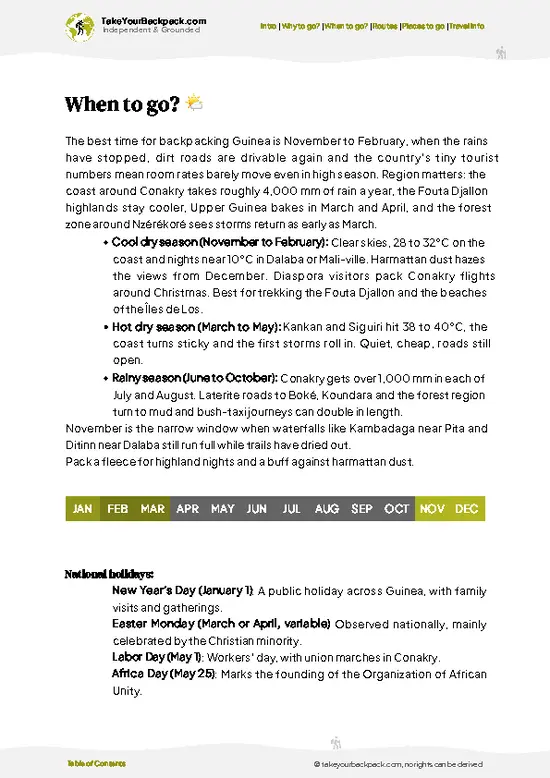
source: climatestotravel.comJANJanuary: excellent for travelingFEBFebruary: excellent for travelingMARMarch: highly recommended for travelingAPRApril: highly recommended for travelingMAYMay: fair for travelingJUNJune: fair for travelingJULJuly: below average for travelingAUGAugust: below average for travelingSEPSeptember: fair for travelingOCTOctober: fair for travelingNOVNovember: excellent for travelingDECDecember: excellent for traveling
when-to-go

✈️ The backpacker research shortcutGuinea Travel Guide

An offline-friendly backpacking guide with optimized travel routes, ranked highlights, transport advice, and the best areas to stay.
example page 0 from our offline Travel Guide for Guineaexample page 1 from our offline Travel Guide for Guineaexample page 2 from our offline Travel Guide for Guineaexample page 3 from our offline Travel Guide for Guineaexample page 4 from our offline Travel Guide for Guineaexample page 5 from our offline Travel Guide for Guineaexample page 6 from our offline Travel Guide for Guineaexample page 7 from our offline Travel Guide for Guinea
The digital guide (282 pages) contains:
67 highlights, ranked by travel appeal
Optimized 5, 10 & 15-day travel routes
Cities, national parks, landmarks, beaches
How to get around
Offline-friendly for travel without Wi-Fi
👉 Click to see all 30+ guide features

📅 Plan smarter in minutes, not weeks
Month by month travel advice
Festivals & national holidays
Budget expectations

🗺️ Go to the right places, skip the overrated ones
Honest pros & cons of destinations
Top hikes, parks & viewpoints
Lesser-known places most travelers miss
Clear “worth it vs skip it” guidance

🛏️ Travel smoothly without rookie mistakes
Best areas to stay
Transport systems explained simply
Common scams & safety advice
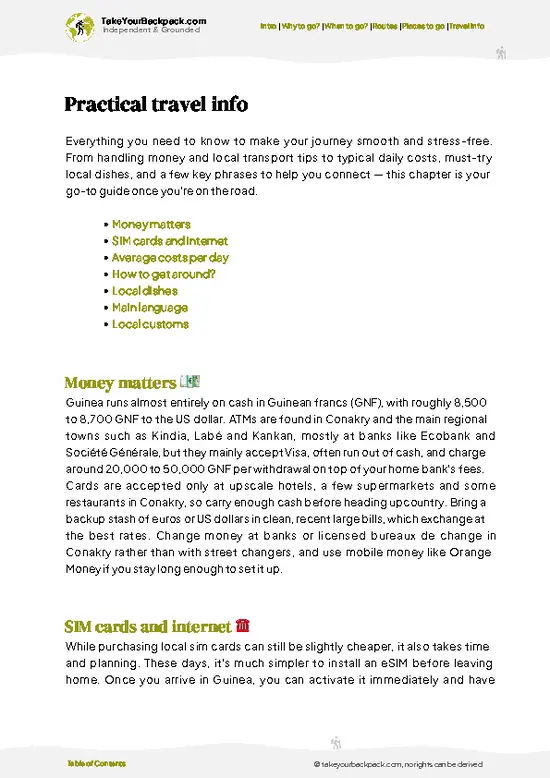
SIM cards, money & practical tips

🌍 Understand the country, not just visit it
Culture & traditions
52 Essential phrases & customs
Festivals worth planning around
Traveler-friendly historical context
Insights that make places more meaningful

📱 Built for real travel conditions
Fully downloadable PDF
Works completely offline
Optimized for phone use
Useful in remote areas & buses
Everything in one place
Save weeks of stressful planning
Get instant access to your full guide. 30‑day money-back guarantee.


By proceeding you agree to our terms.
Sent to your inbox immediately after payment • 100% Secure Checkout
Best Backpacking Travel Advisor 2025 tourism awardBest Backpacking
Travel Advisor
2025
What others say about Take Your Backpack Guides:
⭐⭐⭐⭐⭐
Fantastic, amazing amount of information!
⭐⭐⭐⭐⭐
My goodness this is amazing, it's what I've been looking for hats off too you!
⭐⭐⭐⭐⭐
I think this is absolutely BRILLIANT
⭐⭐⭐⭐
Very complete and informative. It's still missing places, but I gotta to commend you
⭐⭐⭐⭐⭐
This is truly amazing, thank you, can't wait to explore it with my kids!
⭐⭐⭐⭐⭐
Awesome resource, thank you!
⭐⭐⭐⭐⭐
This is amazing! Can't wait to explore the ones I haven't seen
⭐⭐⭐⭐
I love this! Well done, great idea.
⭐⭐⭐⭐⭐
Thanks for taking the time to make this gem!
⭐⭐⭐⭐⭐
This might be the best website I've ever seen.
⭐⭐⭐⭐⭐
Congratulations, and thank you so much for your work; it's incredibly valuable.
⭐⭐⭐⭐
In all seriousness I think you did a great job pointing out the important spots
⭐⭐⭐⭐⭐
10/10 very good
⭐⭐⭐⭐⭐
As someone who's only just starting to visit regularly this is awesome, thank you.
⭐⭐⭐⭐
Thank you very much! I'm going to visit my dad, it's going to be very useful!
⭐⭐⭐⭐⭐
This is really cool! We'll be travelling for the first time and this definitely come in handy.
⭐⭐⭐⭐⭐
You are now our minister of culture, congratulations 👨‍💼
⭐⭐⭐⭐⭐
Just wanted to tell you that this is a pearl! Going to follow your recommendations.
⭐⭐⭐⭐⭐
This is so cool. I'll definitely be using the resource for my travels soon.
⭐⭐⭐⭐⭐
This is very impressive! Good work.
⭐⭐⭐⭐⭐
This is an amazing and informative site. Very well done!

🛏️ Where to stay?How to pick the right area

The Grand Mosque of Conakry is undeniably the city’s crown jewel, but let’s cut through the Instagram gloss: it’s not a polished tourist magnet with endless amenities or a backpacker’s paradise on its own. The mosque’s immediate surroundings are functional, busy, and very much part of a working city, not a curated travel bubble. That means if you want to stay close, you’re signing up for a raw, urban experience—think bustling streets, local markets, and the real pulse of Conakry life, not quiet, polished sidewalks.

For backpackers, the best bet is to settle in neighborhoods just a short walk … read more 👉
The Grand Mosque of Conakry is undeniably the city’s crown jewel, but let’s cut through the Instagram gloss: it’s not a polished tourist magnet with endless amenities or a backpacker’s paradise on its own. The mosque’s immediate surroundings are functional, busy, and very much part of a working city, not a curated travel bubble. That means if you want to stay close, you’re signing up for a raw, urban experience—think bustling streets, local markets, and the real pulse of Conakry life, not quiet, polished sidewalks.

For backpackers, the best bet is to settle in neighborhoods just a short walk or a quick moto ride away. The Kaloum district, for instance, is the city’s administrative and commercial heart. It’s where you’ll find a mix of guesthouses and budget lodgings that cater to travelers who want safety without sacrificing social vibes. Kaloum’s streets are alive with street food vendors, local bars, and a chance to meet other solo travelers or locals who aren’t just passing through.

Another solid option is the Quartier Almamya area. It’s a bit more residential but still close enough to the mosque and city center. This neighborhood offers a quieter, safer feel after dark, which is a big deal in Conakry. It’s where you can find affordable stays that encourage mingling with locals rather than just other tourists.

Bottom line: staying near the Grand Mosque means embracing the city’s gritty charm and unpredictability. It’s not about luxury or polished backpacker hubs but about diving into the authentic urban fabric of Conakry. If you’re ready for that, Kaloum and Almamya are your launchpads.

👛 Costs (as of 9 April 2026)How expensive it really is

As of the most recent estimates, visiting the Grand Mosque of Conakry is free of charge, with donations ranging from €0 to €5 appreciated to support maintenance and local guides.

source: evendo.com
⚠️ Prices can change and everyone travels differently, so take this as a rough guide. Hope it helps you plan your adventure!

Other Guinean attractions near Grand Mosque of Conakry

Explore more nearby:


💡 Not sure where to go next?
Create a personalized itinerary for Guinea including Grand Mosque of Conakry and the places that fit your trip.

Generate my itinerary

👉 Discover all attractions

Or checkout all Guinea has to offer (think cities, towns, villages, national parks, hikes, beaches, festivals)
Country photo of Guinea

We 💚 feedbackParting advice and final tips

The Grand Mosque of Conakry isn’t some quiet sanctuary where you’ll find peace and solitude—expect crowds, especially on Fridays and religious holidays. But here’s the kicker: the real magic isn’t just the architecture or the scale; it’s the pulse of daily life around it. Watching locals gather, kids darting through the plaza, the call to prayer echoing off the concrete—it’s raw, unfiltered Guinea. If you’re ready to soak in something genuine, not just a postcard, this place delivers in spades. Just don’t come expecting a polished tourist trap.

✍️ Help improve this page!
The information on this page is based on in-depth research, insights shared by experienced travelers, and feedback from the local travel community in Guinea. While every effort is made to keep the information accurate and current, conditions can change — so if you spot anything incorrect or outdated, please get in touch.


🙋‍♂️ Give feedback

👋 Meet the founderWho’s Behind Take Your Backpack?

Johan, backpacker and founder of TakeYourBackpackHi, I’m Johan (Netherlands 🇳🇱), the creator of TakeYourBackpack. Over the past decade, I’ve backpacked through 80+ countries across six continents, gaining extensive experience with independent travel, long-term trips, and overland routes.

This site is built on a combination of firsthand travel experience and carefully curated insights from other backpackers. Many guides are based on places I’ve personally visited, while others bring together tips, observations, and practical advice shared by trusted travelers I’ve met along the way.

The goal is to provide realistic, experience-driven guidance — not generic itineraries — so you can explore destinations with better context, clearer expectations, and more confidence.

Get full Guinea guide •
Instant download • 67 highlights • Full Offline guide