×

Haiti🇭🇹 | attractionsFort JacquesMountain fortress, Kenscoff, cannons, uphill walk | things to do and best time to go

Explore Musée Ogier-FombrunExplore Cathedral of Cap-Haïtien

Backpacking in Fort Jacques
🌟 Highlightattraction ranked #5
By Johan Kruseman 🇳🇱 | Updated October 20, 2026

Fort Jacques is not the same fort as its neighbor Fort Alexandre, and travelers regularly lump the two together as one stop, though each has its own approach and its own view. Fort Jacques sits on a ridge above Pétion-Ville, in the hills south of Port-au-Prince in Haiti, built to guard the capital from inland attack. Skip any plan to treat it as a half-day museum visit: there is almost no signage, no polished displays, and little to read. What is worth your time is the thick stone walls, the cannons still pointing over the valley, and the wide view of the city and bay on a clear morning. Crowds are close to nonexistent, which is why the place feels private. Go with a local driver or guide who knows the ridge road, since the route is steep, rough, and easy to get wrong alone.

Discover everything you want to know in the 📖 Haiti Travel Guide.
Safety warning

The current risk level for Haiti is high. Check the advice before going.


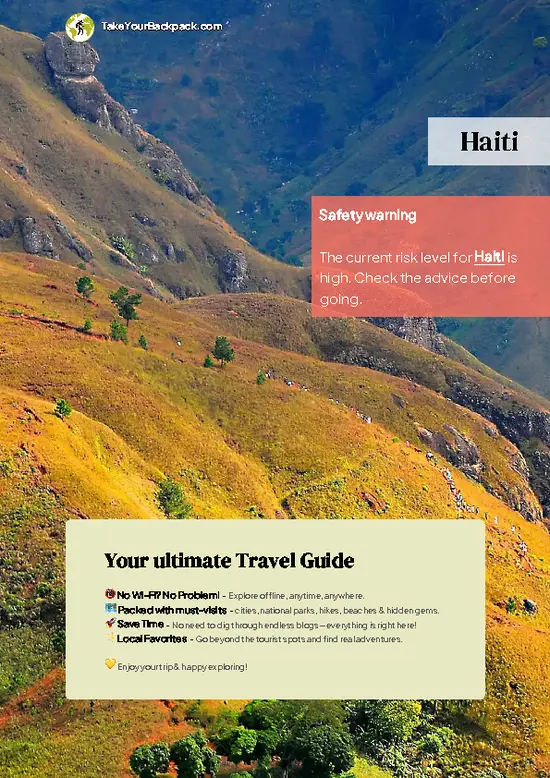
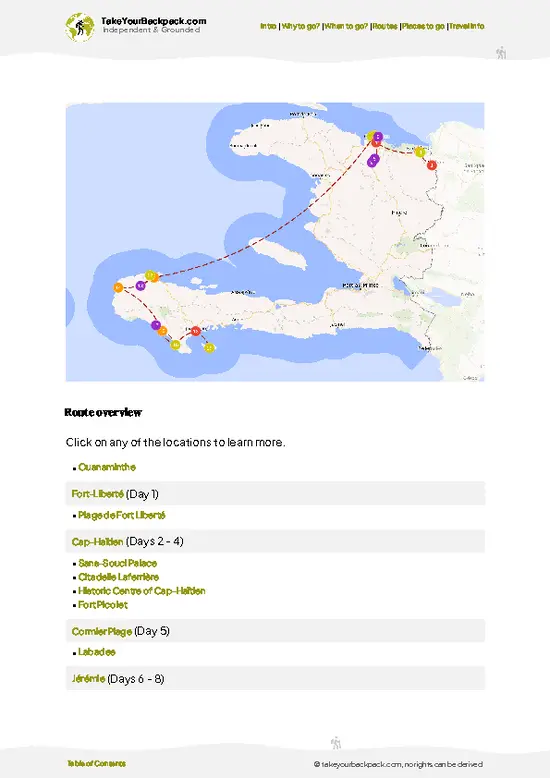
example page 0 from our offline Travel Guide for Haiti
example page 1 from our offline Travel Guide for Haiti
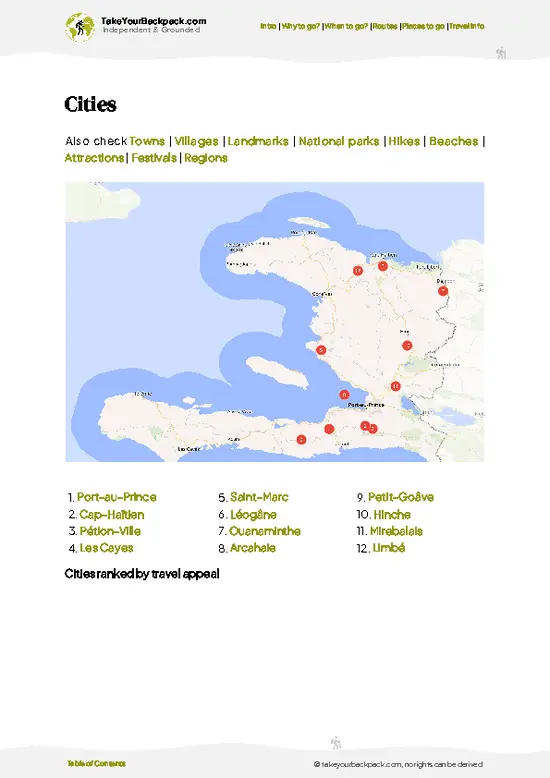
example page 2 from our offline Travel Guide for Haiti
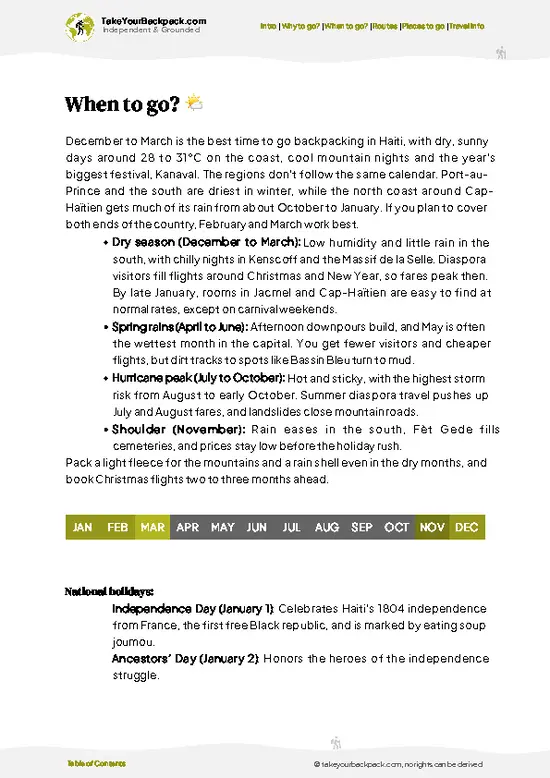
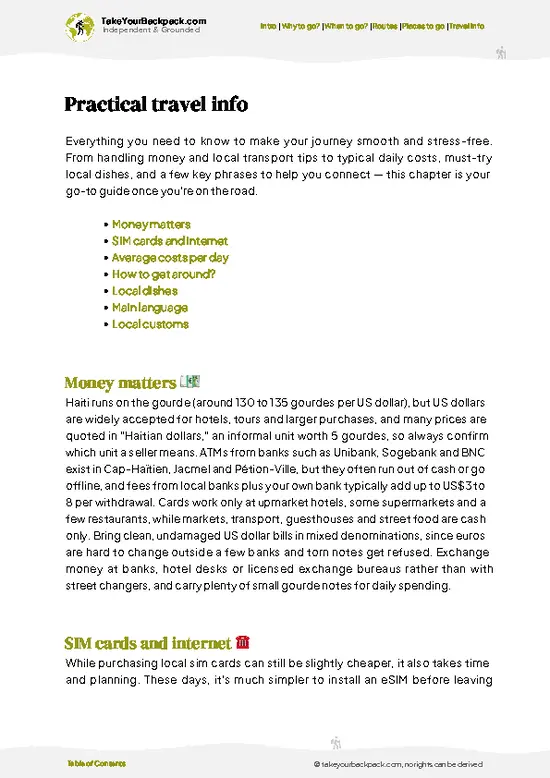
example page 3 from our offline Travel Guide for Haiti
example page 4 from our offline Travel Guide for Haiti
example page 5 from our offline Travel Guide for Haiti
example page 6 from our offline Travel Guide for Haiti
example page 7 from our offline Travel Guide for Haiti
Loading the map 🌍
CLICK TO FILTER
cities
towns
villages
landmarks
national parks
hikes
beaches
attractions
festivals
regions
SHOW COUNTRY’S BESTSHOW ALL

✨ Why go?
Ranked #5 attraction in Haiti
Why visitors keep coming back

Fort Jacques gives you Haiti’s revolutionary story in stone, without a ticket queue between you and it. It was built right after independence, and standing on its ramparts you see exactly why: the ridge above Pétion-Ville commands the approaches to Port-au-Prince from the south and the hills. The walls are massive, the gun platforms are intact enough to read, and the layout makes military logic obvious in a way a plaque never could.

The second reason is the view. From the parapets the whole capital and the Bay of Port-au-Prince spread out below you, which gives a clear sense of the city’s geography that street level never does. It also pairs naturally with its sister fortress on the next hill, so one morning gets you two sites.

The third is simple: few foreigners come, so you share it with … read more 👉
Fort Jacques gives you Haiti’s revolutionary story in stone, without a ticket queue between you and it. It was built right after independence, and standing on its ramparts you see exactly why: the ridge above Pétion-Ville commands the approaches to Port-au-Prince from the south and the hills. The walls are massive, the gun platforms are intact enough to read, and the layout makes military logic obvious in a way a plaque never could.

The second reason is the view. From the parapets the whole capital and the Bay of Port-au-Prince spread out below you, which gives a clear sense of the city’s geography that street level never does. It also pairs naturally with its sister fortress on the next hill, so one morning gets you two sites.

The third is simple: few foreigners come, so you share it with local families and the occasional guide. That makes it a calm, memorable change from the capital’s noise.

💡 HighlightsWhat this place is best known for

  1. The main ramparts and gun platforms: thick masonry walls with cannon still sitting in their embrasures, aimed down the valley toward the capital. This is what people come for, and walking the full circuit takes less than an hour.
  2. The view over Port-au-Prince and the bay: from the upper terrace you can trace the city grid, the harbor, and on clear mornings the line of the Gonâve coast. Early light is clearest before haze builds.
  3. The entrance gate and approach road: the climb up the ridge shows why attackers would have struggled here. Steep switchbacks and open slopes leave no cover.
  4. The powder magazines and interior chambers: low vaulted rooms where ammunition and supplies were kept. They are cool and dark, and show how much the garrison depended on stored stock.
  5. Cannons on the outer bastions:
… read more 👉
  1. The main ramparts and gun platforms: thick masonry walls with cannon still sitting in their embrasures, aimed down the valley toward the capital. This is what people come for, and walking the full circuit takes less than an hour.
  2. The view over Port-au-Prince and the bay: from the upper terrace you can trace the city grid, the harbor, and on clear mornings the line of the Gonâve coast. Early light is clearest before haze builds.
  3. The entrance gate and approach road: the climb up the ridge shows why attackers would have struggled here. Steep switchbacks and open slopes leave no cover.
  4. The powder magazines and interior chambers: low vaulted rooms where ammunition and supplies were kept. They are cool and dark, and show how much the garrison depended on stored stock.
  5. Cannons on the outer bastions: several pieces remain in position, some bearing old markings. Look at how the angles overlap for crossfire.
  6. The neighboring Fort Alexandre ridge: visible from the walls, and the natural companion visit. Seeing both explains how the two forts covered each other.
  7. The cooler hilltop air and ridge walks: the elevation above Pétion-Ville brings a breeze that makes the open walls pleasant even in the middle of the day.
Do the ramparts first, while the light is soft and the view is clearest, then wander the interior chambers once the sun climbs.
Spotted a mistake or missing something? Contact us.

🌤️ When to go?Choosing the right time of year

  • December to March: Dry, bright weather makes the steep climb to the ridge manageable. Expect 28 to 32°C (82 to 90°F) in the valley and a few degrees cooler at the fort. Mornings are clearest for views toward Marigot and the Caribbean.
  • April to June: Afternoon downpours begin, and the track gets slick and muddy. Temperatures reach 30 to 34°C (86 to 93°F). Start early and be down by midday.
  • July to August: Hot and dry spells return, with highs up to 35°C (95°F). Haitian diaspora visitors arrive, so transport and rooms in Jacmel can cost more.
  • September to November: Peak hurricane season and the wettest months. Rivers rise, roads wash out, and the climb is risky.
  • Daylight: Roughly 11 to 13 hours across the year, so plan around the early start.
Aim for a weekday morning in January or February, when … read more 👉
  • December to March: Dry, bright weather makes the steep climb to the ridge manageable. Expect 28 to 32°C (82 to 90°F) in the valley and a few degrees cooler at the fort. Mornings are clearest for views toward Marigot and the Caribbean.
  • April to June: Afternoon downpours begin, and the track gets slick and muddy. Temperatures reach 30 to 34°C (86 to 93°F). Start early and be down by midday.
  • July to August: Hot and dry spells return, with highs up to 35°C (95°F). Haitian diaspora visitors arrive, so transport and rooms in Jacmel can cost more.
  • September to November: Peak hurricane season and the wettest months. Rivers rise, roads wash out, and the climb is risky.
  • Daylight: Roughly 11 to 13 hours across the year, so plan around the early start.
Aim for a weekday morning in January or February, when the trail is firm and you will likely have the ruins to yourself.


source: climatestotravel.comJANJanuary: highly recommended for travelingFEBFebruary: highly recommended for travelingMARMarch: highly recommended for travelingAPRApril: good for travelingMAYMay: below average for travelingJUNJune: below average for travelingJULJuly: below average for travelingAUGAugust: below average for travelingSEPSeptember: below average for travelingOCTOctober: fair for travelingNOVNovember: excellent for travelingDECDecember: highly recommended for traveling
haiti-attraction-fort-jacques
© Google |

✈️ The backpacker research shortcutHaiti Travel Guide

An offline-friendly backpacking guide with optimized travel routes, ranked highlights, transport advice, and the best areas to stay.
example page 0 from our offline Travel Guide for Haiti
example page 1 from our offline Travel Guide for Haiti
example page 2 from our offline Travel Guide for Haiti
example page 3 from our offline Travel Guide for Haiti
example page 4 from our offline Travel Guide for Haiti
example page 5 from our offline Travel Guide for Haiti
example page 6 from our offline Travel Guide for Haiti
example page 7 from our offline Travel Guide for Haiti
The digital guide (332 pages) contains:
✅ 89 highlights, ranked by travel appeal
✅ Optimized 5, 10 & 15-day travel routes
✅ Cities, national parks, landmarks, beaches
✅ How to get around
✅ Offline-friendly for travel without Wi-Fi
👉 Click to see all 30+ guide features

📅 Plan smarter in minutes, not weeks
✅ Month by month travel advice
✅ Festivals & national holidays
✅ Budget expectations

🗺️ Go to the right places, skip the overrated ones
✅ Honest pros & cons of destinations
✅ Top hikes, parks & viewpoints
✅ Lesser-known places most travelers miss
✅ Clear “worth it vs skip it” guidance

🛏️ Travel smoothly without rookie mistakes
✅ Best areas to stay
✅ Transport systems explained simply
✅ Common scams & safety advice
✅ SIM cards, money & practical tips

🌍 Understand the country, not just visit it
✅ Culture & traditions
✅ 52 Essential phrases & customs
✅ Festivals worth planning around
✅ Traveler-friendly historical context
✅ Insights that make places more meaningful

📱 Built for real travel conditions
✅ Fully downloadable PDF
✅ Works completely offline
✅ Optimized for phone use
✅ Useful in remote areas & buses
✅ Everything in one place
Stop searching, start planning
Get instant access to your full guide. 30‑day money-back guarantee.
+ Add another guide for just

By proceeding you agree to our terms.
Sent to your inbox immediately after payment • 100% Secure Checkout
Best Backpacking Travel Advisor 2025 tourism awardBest Backpacking
Travel Advisor
2025
What others say about Take Your Backpack Guides:
⭐⭐⭐⭐⭐
Fantastic, amazing amount of information!
⭐⭐⭐⭐⭐
My goodness this is amazing, it's what I've been looking for hats off too you!
⭐⭐⭐⭐⭐
I think this is absolutely BRILLIANT
⭐⭐⭐⭐
Very complete and informative. It's still missing places, but I gotta to commend you
⭐⭐⭐⭐⭐
This is truly amazing, thank you, can't wait to explore it with my kids!
⭐⭐⭐⭐⭐
Awesome resource, thank you!
⭐⭐⭐⭐⭐
This is amazing! Can't wait to explore the ones I haven't seen
⭐⭐⭐⭐
I love this! Well done, great idea.
⭐⭐⭐⭐⭐
Thanks for taking the time to make this gem!
⭐⭐⭐⭐⭐
This might be the best website I've ever seen.
⭐⭐⭐⭐⭐
Congratulations, and thank you so much for your work; it's incredibly valuable.
⭐⭐⭐⭐
In all seriousness I think you did a great job pointing out the important spots
⭐⭐⭐⭐⭐
10/10 very good
⭐⭐⭐⭐⭐
As someone who's only just starting to visit regularly this is awesome, thank you.
⭐⭐⭐⭐
Thank you very much! I'm going to visit my dad, it's going to be very useful!
⭐⭐⭐⭐⭐
This is really cool! We'll be travelling for the first time and this definitely come in handy.
⭐⭐⭐⭐⭐
You are now our minister of culture, congratulations 👨‍💼
⭐⭐⭐⭐⭐
Just wanted to tell you that this is a pearl! Going to follow your recommendations.
⭐⭐⭐⭐⭐
This is so cool. I'll definitely be using the resource for my travels soon.
⭐⭐⭐⭐⭐
This is very impressive! Good work.
⭐⭐⭐⭐⭐
This is an amazing and informative site. Very well done!

🛏️ Where to stay?Where staying makes the most sense

Jacmel is the base to choose, roughly 15 to 20 km southwest by road, and it has the only real concentration of traveler-friendly lodging in the area. Its colonial center, around Rue du Commerce and the Place d’Armes, is walkable, with cast-iron arcades, art studios, and small restaurants that stay lively into the evening. Guesthouses here are mostly small, family-run places, and the social side comes from shared terraces and the handful of cafés where artists and volunteers gather. Expect dorm-style or basic private rooms at about US$15 to 40 a night.

The seafront near Jacmel Bay is a calmer … read more 👉
Jacmel is the base to choose, roughly 15 to 20 km southwest by road, and it has the only real concentration of traveler-friendly lodging in the area. Its colonial center, around Rue du Commerce and the Place d’Armes, is walkable, with cast-iron arcades, art studios, and small restaurants that stay lively into the evening. Guesthouses here are mostly small, family-run places, and the social side comes from shared terraces and the handful of cafés where artists and volunteers gather. Expect dorm-style or basic private rooms at about US$15 to 40 a night.

The seafront near Jacmel Bay is a calmer alternative, with quieter streets and beach access, though fewer places to eat after dark. Stick to central streets at night and use a moto-taxi or arranged driver rather than walking unlit stretches. Staying in the hills near Marigot gives you a head start on the fort, but lodging there is very limited and you will want to arrange it ahead. For most backpackers, Jacmel offers better safety, easier meals, and simple access to a guide for the climb.

👛 Costs (as of 20 October 2026)Travel costs and budget guide for Fort Jacques

Fort Jacques costs a backpacker around US$41 to 100 a day when based in Jacmel, including a guide and transport. Prices are paid in Haitian gourdes, but US dollars are widely quoted.
CategoryBudget RangeLocal Reality
EntranceUS$0 to 5No formal ticket office. Caretakers or locals may ask for a small contribution.
Local guideUS$10 to 20Useful for the trail and local history. Agree the price before you set off.
TransportUS$8 to 20Moto-taxi or shared ride from Jacmel toward the trailhead. A private driver costs more.
Accommodation (high season)US$15 to 40Basic guesthouse or dorm bed in Jacmel.
Food and waterUS$8 to 15Street plates and small restaurants. Carry at least 2 liters of water for the climb.
Total Daily BudgetUS$41 to 100Around US$55 is realistic for most budget travelers.


source: lonelyplanet.com
⚠️ Prices can change and everyone travels differently, so take this as a rough guide. Hope it helps you plan your adventure!

FAQFrequently asked questions about Fort Jacques

Half a day is enough for Fort Jacques, allowing 2 to 3 hours for the uphill walk and about an hour at the ruins. Starting from Jacmel at 7 or 8 a.m. gets you back by early afternoon. The steep ridge trail is slow in wet conditions, so add extra time after rain.
Fort Jacques is worth the effort because there is little or no entrance fee, usually only a small tip of US$0 to 5 for a caretaker or guide. You get well-preserved stone ramparts, cannon positions from the early 1800s, and wide views of the southern hills and the coast. A guide at US$10 to 20 makes the history clearer.
Reaching Fort Jacques means going first to Jacmel, about 3 to 4 hours by road from Port-au-Prince, with shared minibuses costing roughly US$6 to 12. From Jacmel, hire a moto-taxi or a driver for the 20 to 40 minute ride to the trailhead, around US$8 to 20, then climb on foot. Road conditions shift with rain, so confirm access locally.
⚠️ Things can change over time, so always validate details locally before you go.

Other Haitian attractions near Fort Jacques

Explore more nearby:


💡 Not sure where to go next?
Create a personalized itinerary for Haiti including Fort Jacques and the places that fit your trip.

Generate my itinerary

👉 Discover all attractions

Or checkout all Haiti has to offer (think cities, towns, villages, national parks, hikes, beaches, festivals)
Country photo of Haiti

We 💚 feedbackWhat to keep in mind

Fort Jacques is often treated as a quick photo stop, and that is the mistake. Give it a full morning, arrive early for the clearest view, and walk the whole circuit rather than just the gate. Hire a local guide who knows the ridge road, because without one you will miss most of what the walls explain.

✍️ Help improve this page!
The information on this page is based on in-depth research, insights shared by experienced travelers, and feedback from the local travel community in Haiti. While every effort is made to keep the information accurate and current, conditions can change — so if you spot anything incorrect or outdated, please get in touch.


🙋‍♂️ Give feedback

👋 Meet the founderWho’s Behind Take Your Backpack?

Johan, backpacker and founder of TakeYourBackpackHi, I’m Johan (Netherlands 🇳🇱), the creator of TakeYourBackpack. Over the past 3 decades, I’ve backpacked through 90+ countries across six continents, gaining extensive experience with independent travel, long-term trips, and overland routes.

This site is built on a combination of firsthand travel experience and carefully curated insights from other backpackers. Many guides are based on places I’ve personally visited, while others bring together tips, observations, and practical advice shared by trusted travelers I’ve met along the way.

The goal is to provide realistic, experience-driven guidance — not generic itineraries — so you can explore destinations with better context, clearer expectations, and more confidence.