

×

Haiti🇭🇹 | townsSaut-d’EauSacred falls, pilgrim pools, Ville-Bonheur, July crowds | things to do and best time to go

Explore KenscoffExplore Jérémie

Backpacking in Saut-d’Eau
🏆 Top picktown ranked #5
By Johan Kruseman 🇳🇱 | Updated October 20, 2026

Saut-d’Eau suits pilgrims, culture-minded travelers and waterfall walkers who like their destinations raw and unpolished. If you want beaches, nightlife or a long list of sights, skip it. The village sits in Haiti’s Centre department, in the hills northeast of Port-au-Prince, close to Mirebalais. The road in is rough in places, bumpy and dusty, but it ends at a river valley where the falls drop through green forest and the cool spray is a welcome change after the ride. Streets are small and lively around the market stalls, with simple food and plenty of chatter. Guesthouses are few and basic, so evenings are quiet, and meeting other backpackers is unlikely outside the July pilgrimage. Come for the falls and the living spiritual tradition. Hire a local guide at the entrance, since the paths can be slippery and confusing.

Discover everything you want to know in the 📖 Haiti Travel Guide.
Safety warning

The current risk level for Haiti is high. Check the advice before going.


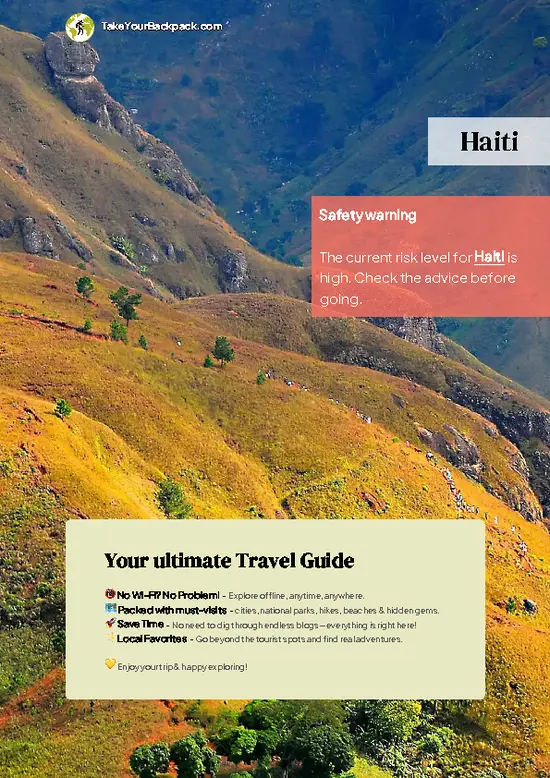
example page 0 from our offline Travel Guide for Haiti
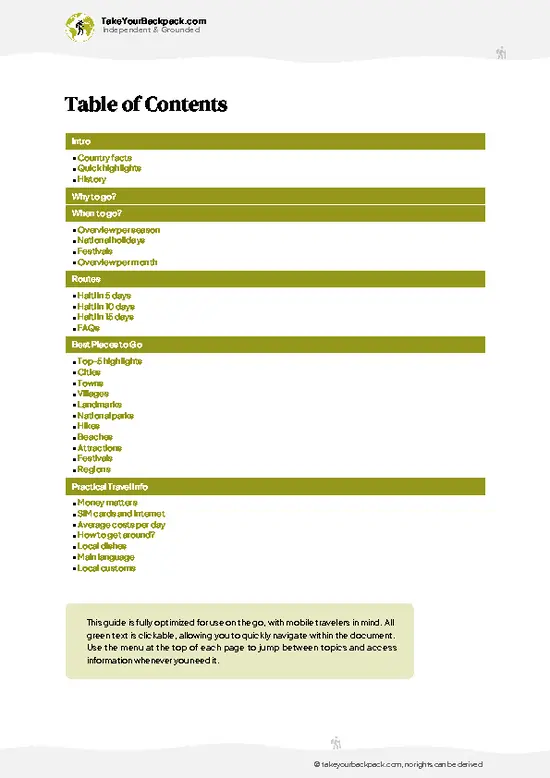
example page 1 from our offline Travel Guide for Haiti
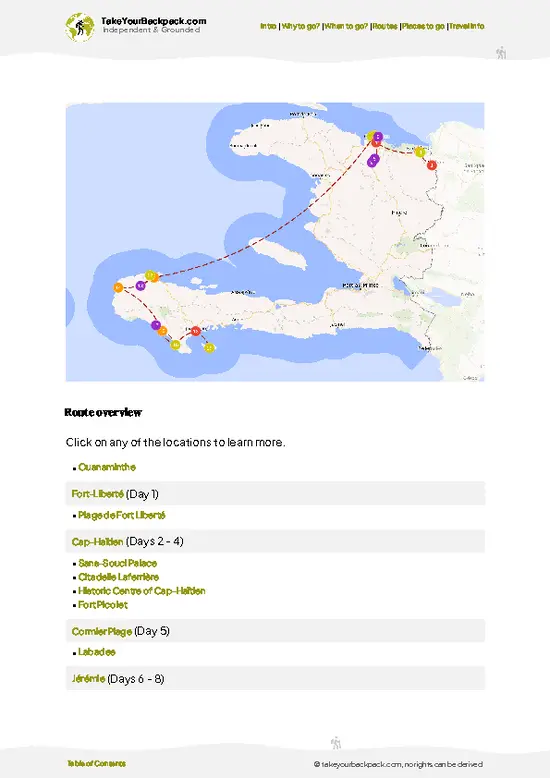
example page 2 from our offline Travel Guide for Haiti
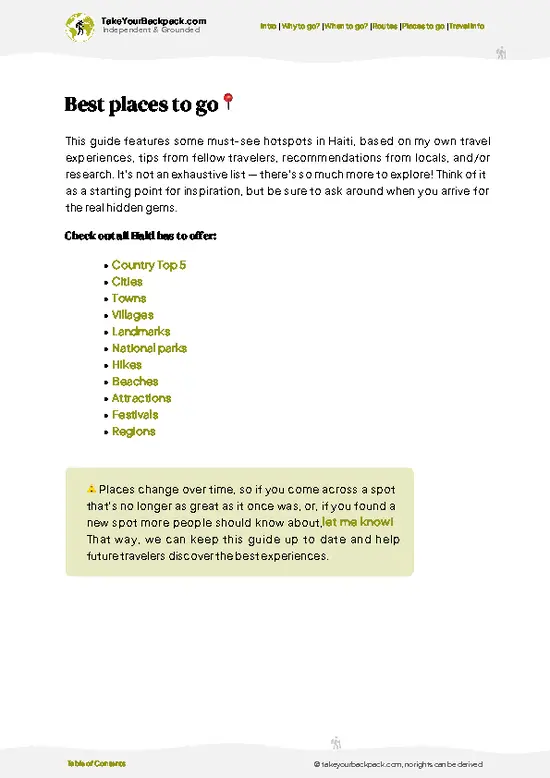
example page 3 from our offline Travel Guide for Haiti
example page 4 from our offline Travel Guide for Haiti
example page 5 from our offline Travel Guide for Haiti
example page 6 from our offline Travel Guide for Haiti
example page 7 from our offline Travel Guide for Haiti
Loading the map 🌍
CLICK TO FILTER
cities
towns
villages
landmarks
national parks
hikes
beaches
attractions
festivals
regions
SHOW COUNTRY’S BESTSHOW ALL

✨ Why go?
Ranked #5 town in Haiti
The unique appeal for travelers

Saut-d’Eau is worth the trouble because it gives you one of the few places in Haiti where nature and living belief share the same riverbank. Pilgrims have long come to bathe beneath the waterfalls, and the ritual atmosphere is part of the visit, with candles, songs and offerings along the stones. The biggest crowds arrive around the July pilgrimage, when the village fills with Catholics and Vodou practitioners honoring Our Lady of Mount Carmel and the spirit Erzulie Dantor. Outside that week, the place is calm, and you can have the pools nearly to yourself. Most backpackers stay one night at most, and many pair it with the nearby town of Ville-Bonheur and its shrine church. That makes it a good match for slow travelers, solo travelers who value local contact, and anyone curious about Haitian … read more 👉
Saut-d’Eau is worth the trouble because it gives you one of the few places in Haiti where nature and living belief share the same riverbank. Pilgrims have long come to bathe beneath the waterfalls, and the ritual atmosphere is part of the visit, with candles, songs and offerings along the stones. The biggest crowds arrive around the July pilgrimage, when the village fills with Catholics and Vodou practitioners honoring Our Lady of Mount Carmel and the spirit Erzulie Dantor. Outside that week, the place is calm, and you can have the pools nearly to yourself. Most backpackers stay one night at most, and many pair it with the nearby town of Ville-Bonheur and its shrine church. That makes it a good match for slow travelers, solo travelers who value local contact, and anyone curious about Haitian spiritual life. If you need hostels, bars or a social scene, you will find it too quiet. Treat it as a focused short stop.

💡 HighlightsPlaces and moments you shouldn't skip

  1. Saut-d’Eau Waterfalls: The main reason to come. Water spills over limestone ledges into pools, and pilgrims bathe, pray and leave offerings on the rocks. Go early on a weekday for quiet. Expect a small entry or guide fee of about US$3 to 8, and allow 2 to 3 hours.
  2. The Sacred Pools and Riverbank Shrines: Below the main drop, trees are tied with cloth and candles burn on the stones. It is worth watching respectfully before you take a swim. Free to wander, and an hour is plenty. Morning light is best.
  3. Ville-Bonheur Shrine Church: Just up the road, this church is the Catholic center of the pilgrimage. The apparition of the Virgin Mary is said to have taken place here in the 1840s. Visit in the morning, free entry, around 30 to 45 minutes.
  4. The Village Market: Stalls sell fruit, candles, charcoal,
… read more 👉
  1. Saut-d’Eau Waterfalls: The main reason to come. Water spills over limestone ledges into pools, and pilgrims bathe, pray and leave offerings on the rocks. Go early on a weekday for quiet. Expect a small entry or guide fee of about US$3 to 8, and allow 2 to 3 hours.
  2. The Sacred Pools and Riverbank Shrines: Below the main drop, trees are tied with cloth and candles burn on the stones. It is worth watching respectfully before you take a swim. Free to wander, and an hour is plenty. Morning light is best.
  3. Ville-Bonheur Shrine Church: Just up the road, this church is the Catholic center of the pilgrimage. The apparition of the Virgin Mary is said to have taken place here in the 1840s. Visit in the morning, free entry, around 30 to 45 minutes.
  4. The Village Market: Stalls sell fruit, candles, charcoal, sweets and ritual items. It is the best place to eat simple local food and talk with vendors. Mornings are busiest. Budget US$2 to 5 for a snack and spend an hour.
  5. The July Pilgrimage: Mid-July brings thousands of visitors, drumming, prayer and bathing in the falls. It is crowded and intense, so go with a guide and a flexible schedule. Costs are mostly the guide, about US$10 to 20, and plan on a full day.
Saut-d’Eau is close to several places worth a day, including the Mirebalais market, Lake Péligre to the north and the hills around Hinche. The village market and the riverbank shrines cost nothing, which makes them the cheapest items on the list.
Spotted a mistake or missing something? Contact us.

🏘️ NeighborhoodsWhere things are and how it's laid out

Saut-d’Eau is a small place, so you cover its areas on foot or by moto-taxi, and only two of them deserve your time.
  • The village center: A cluster of dusty streets with a market, small shops and a few food stalls selling fried plantain, griot and rice and beans. Ten minutes of strolling covers it. Skip lingering here beyond a meal and a cold drink, since nothing else is on show.
  • The waterfall path: The reason to come. A rough road and then a footpath lead uphill through farmland and trees to the falls, where the water drops over rock into a cool pool. Allow 20 to 40 minutes from the road's end, and expect mud after rain. You get the spray on your face and a shady place to sit.
  • The pilgrim zone near the falls: Around July 16, thousands gather to bathe, pray and leave offerings tied to Catholic
… read more 👉
Saut-d’Eau is a small place, so you cover its areas on foot or by moto-taxi, and only two of them deserve your time.
  • The village center: A cluster of dusty streets with a market, small shops and a few food stalls selling fried plantain, griot and rice and beans. Ten minutes of strolling covers it. Skip lingering here beyond a meal and a cold drink, since nothing else is on show.
  • The waterfall path: The reason to come. A rough road and then a footpath lead uphill through farmland and trees to the falls, where the water drops over rock into a cool pool. Allow 20 to 40 minutes from the road's end, and expect mud after rain. You get the spray on your face and a shady place to sit.
  • The pilgrim zone near the falls: Around July 16, thousands gather to bathe, pray and leave offerings tied to Catholic and Vodou traditions. Vendors, drummers and candles fill the paths. On ordinary days it is quiet and mostly empty, which suits photography and conversation with local guides.
  • Ville Bonheur surroundings: The neighboring settlement has the church tied to the Virgin Mary apparition story. It is worth a short look, and the quiet makes it a peaceful stop before heading back.

⌛️ 1 daySeeing the highlights in 24 hours

7:30 AM: Village Market
Start with coffee and a simple breakfast among the stalls. Watch the morning trade and ask about a guide for the falls. It is a gentle way to arrive and meet the people who will help you later.
9:00 AM: Ville-Bonheur Shrine Church
Walk or take a short moto ride up to the church. Step inside quietly, look at the devotional offerings and watch early pilgrims. Take your time and keep photos discreet.
10:30 AM: Saut-d’Eau Waterfalls
Head down the path to the main falls with your guide. The stone is slick, so wear sturdy sandals. Swim if the water is calm and watch the bathing rituals from a respectful distance. Stay until the sun gets high.
1:00 PM: Riverbank Shrines
Follow the stream downstream to the quieter pools where cloth-tied trees and candle stubs mark private offerings. … read more 👉
7:30 AM: Village Market
Start with coffee and a simple breakfast among the stalls. Watch the morning trade and ask about a guide for the falls. It is a gentle way to arrive and meet the people who will help you later.
9:00 AM: Ville-Bonheur Shrine Church
Walk or take a short moto ride up to the church. Step inside quietly, look at the devotional offerings and watch early pilgrims. Take your time and keep photos discreet.
10:30 AM: Saut-d’Eau Waterfalls
Head down the path to the main falls with your guide. The stone is slick, so wear sturdy sandals. Swim if the water is calm and watch the bathing rituals from a respectful distance. Stay until the sun gets high.
1:00 PM: Riverbank Shrines
Follow the stream downstream to the quieter pools where cloth-tied trees and candle stubs mark private offerings. This is the least visited part and the most atmospheric. Keep your voice low and ask before taking photographs.
2:30 PM: Lunch in the Village
Eat rice, beans and fried plantain at a small family kitchen near the road. Rest in the shade and let your guide tell you the stories behind the shrines.
4:00 PM: Hillside Walk
Walk the farm tracks above the village for views over the valley. Follow the light and return before dark.

🌤️ When to go?When to go for the best experience

  • Pilgrimage week (mid-July): Crowds peak around July 16 for the annual pilgrimage. Expect packed paths, drumming, ritual bathing and higher moto and room prices. Come for the spectacle, not for solitude.
  • Dry months (December to March): Days run roughly 27 to 31°C (81 to 88°F), nights cooler near 18 to 21°C (64 to 70°F). Trails stay firm and the falls are clear, though flow is lighter.
  • Spring rains (April to June): Showers arrive in the afternoons, the path turns slick, and the falls run stronger. Mornings are usually fine.
  • Late summer and fall (August to November): Hot, humid, and the wettest stretch, with hurricane season risks and washed-out roads. Prices stay low and visitors are few.
Go early in the day, since afternoon rain is common and the walk is easier before the heat.

source: climatestotravel.comJANJanuary: excellent for travelingFEBFebruary: excellent for travelingMARMarch: highly recommended for travelingAPRApril: good for travelingMAYMay: fair for travelingJUNJune: fair for travelingJULJuly: fair for travelingAUGAugust: fair for travelingSEPSeptember: fair for travelingOCTOctober: fair for travelingNOVNovember: highly recommended for travelingDECDecember: good for traveling
when-to-go

✈️ The backpacker research shortcutHaiti Travel Guide

An offline-friendly backpacking guide with optimized travel routes, ranked highlights, transport advice, and the best areas to stay.
example page 0 from our offline Travel Guide for Haiti
example page 1 from our offline Travel Guide for Haiti
example page 2 from our offline Travel Guide for Haiti
example page 3 from our offline Travel Guide for Haiti
example page 4 from our offline Travel Guide for Haiti
example page 5 from our offline Travel Guide for Haiti
example page 6 from our offline Travel Guide for Haiti
example page 7 from our offline Travel Guide for Haiti
The digital guide (332 pages) contains:
✅ 89 highlights, ranked by travel appeal
✅ Optimized 5, 10 & 15-day travel routes
✅ Cities, national parks, landmarks, beaches
✅ How to get around
✅ Offline-friendly for travel without Wi-Fi
👉 Click to see all 30+ guide features

📅 Plan smarter in minutes, not weeks
✅ Month by month travel advice
✅ Festivals & national holidays
✅ Budget expectations

🗺️ Go to the right places, skip the overrated ones
✅ Honest pros & cons of destinations
✅ Top hikes, parks & viewpoints
✅ Lesser-known places most travelers miss
✅ Clear “worth it vs skip it” guidance

🛏️ Travel smoothly without rookie mistakes
✅ Best areas to stay
✅ Transport systems explained simply
✅ Common scams & safety advice
✅ SIM cards, money & practical tips

🌍 Understand the country, not just visit it
✅ Culture & traditions
✅ 52 Essential phrases & customs
✅ Festivals worth planning around
✅ Traveler-friendly historical context
✅ Insights that make places more meaningful

📱 Built for real travel conditions
✅ Fully downloadable PDF
✅ Works completely offline
✅ Optimized for phone use
✅ Useful in remote areas & buses
✅ Everything in one place
Stop searching, start planning
Get instant access to your full guide. 30‑day money-back guarantee.
+ Add another guide for just

By proceeding you agree to our terms.
Sent to your inbox immediately after payment • 100% Secure Checkout
Best Backpacking Travel Advisor 2025 tourism awardBest Backpacking
Travel Advisor
2025
What others say about Take Your Backpack Guides:
⭐⭐⭐⭐⭐
Fantastic, amazing amount of information!
⭐⭐⭐⭐⭐
My goodness this is amazing, it's what I've been looking for hats off too you!
⭐⭐⭐⭐⭐
I think this is absolutely BRILLIANT
⭐⭐⭐⭐
Very complete and informative. It's still missing places, but I gotta to commend you
⭐⭐⭐⭐⭐
This is truly amazing, thank you, can't wait to explore it with my kids!
⭐⭐⭐⭐⭐
Awesome resource, thank you!
⭐⭐⭐⭐⭐
This is amazing! Can't wait to explore the ones I haven't seen
⭐⭐⭐⭐
I love this! Well done, great idea.
⭐⭐⭐⭐⭐
Thanks for taking the time to make this gem!
⭐⭐⭐⭐⭐
This might be the best website I've ever seen.
⭐⭐⭐⭐⭐
Congratulations, and thank you so much for your work; it's incredibly valuable.
⭐⭐⭐⭐
In all seriousness I think you did a great job pointing out the important spots
⭐⭐⭐⭐⭐
10/10 very good
⭐⭐⭐⭐⭐
As someone who's only just starting to visit regularly this is awesome, thank you.
⭐⭐⭐⭐
Thank you very much! I'm going to visit my dad, it's going to be very useful!
⭐⭐⭐⭐⭐
This is really cool! We'll be travelling for the first time and this definitely come in handy.
⭐⭐⭐⭐⭐
You are now our minister of culture, congratulations 👨‍💼
⭐⭐⭐⭐⭐
Just wanted to tell you that this is a pearl! Going to follow your recommendations.
⭐⭐⭐⭐⭐
This is so cool. I'll definitely be using the resource for my travels soon.
⭐⭐⭐⭐⭐
This is very impressive! Good work.
⭐⭐⭐⭐⭐
This is an amazing and informative site. Very well done!

🛏️ Where to stay?Best areas and accommodation options

Saut-d’Eau has very little formal lodging, so most backpackers sleep in Mirebalais, a larger town roughly 30 to 45 minutes away by road, with a handful of simple guesthouses at about US$20 to 50 a night. Dorm hostels do not exist here, so expect private rooms with a fan and a bucket or shower. Mirebalais has markets, restaurants and regular shared vehicles, which makes onward moves and food easier. Streets are quiet at night, but arrive before dark and get a ride directly to your door instead of wandering.
The second option is a basic room or home stay near Ville Bonheur, close to the falls. It … read more 👉
Saut-d’Eau has very little formal lodging, so most backpackers sleep in Mirebalais, a larger town roughly 30 to 45 minutes away by road, with a handful of simple guesthouses at about US$20 to 50 a night. Dorm hostels do not exist here, so expect private rooms with a fan and a bucket or shower. Mirebalais has markets, restaurants and regular shared vehicles, which makes onward moves and food easier. Streets are quiet at night, but arrive before dark and get a ride directly to your door instead of wandering.
The second option is a basic room or home stay near Ville Bonheur, close to the falls. It is cheaper and puts you at the trailhead early, which helps for dawn starts. Facilities are minimal, electricity can cut out, and food is limited, so bring water, snacks and a flashlight. During the July pilgrimage, beds near the falls fill and prices climb, so reserve through local contacts well ahead.

🚌 Getting aroundHow to get around Saut-d’Eau

Saut-d’Eau village is small enough to walk in ten minutes, but the waterfall sits several kilometers out, and from there walking stops making sense unless you enjoy long uphill hauls on rough road. Most backpackers arrive from Mirebalais or Port-au-Prince and then hop on a motorcycle. Public transport is informal, so plan for flexible timing and cash.
  • Walking: Use it in the village and for the final trail to the falls, roughly 20 to 40 minutes on uneven, muddy ground. You get farm views, birdsong and the first sound of falling water.
  • Moto-taxi: The practical way to reach the trailhead, usually US$2 to 6 depending on distance and bargaining. It is fast, bumpy and dusty. Agree the price and the return pickup before leaving. Skip it after dark.
  • Tap-tap or shared pickup: Brightly painted vehicles
… read more 👉
Saut-d’Eau village is small enough to walk in ten minutes, but the waterfall sits several kilometers out, and from there walking stops making sense unless you enjoy long uphill hauls on rough road. Most backpackers arrive from Mirebalais or Port-au-Prince and then hop on a motorcycle. Public transport is informal, so plan for flexible timing and cash.
  • Walking: Use it in the village and for the final trail to the falls, roughly 20 to 40 minutes on uneven, muddy ground. You get farm views, birdsong and the first sound of falling water.
  • Moto-taxi: The practical way to reach the trailhead, usually US$2 to 6 depending on distance and bargaining. It is fast, bumpy and dusty. Agree the price and the return pickup before leaving. Skip it after dark.
  • Tap-tap or shared pickup: Brightly painted vehicles run from Mirebalais toward Ville Bonheur and Saut-d’Eau, around US$1 to 3, leaving when full. They run mainly during daylight, with the last ones leaving by mid-afternoon. Expect cramped seats and plenty of chatter.
  • Private car with driver: From Port-au-Prince, roughly US$80 to 150 per day, and the best option for a group wanting a comfortable same-day return. You skip the transfers and gain flexibility, but lose the local color.

👛 Costs (as of 20 October 2026)Money, prices, and spending tips

Saut-d’Eau costs most backpackers about US$41 to 78 a day, assuming simple lodging nearby and moto rides to the falls. Prices are paid in cash, and rooms may be in Mirebalais.
CategoryBudget RangeLocal Reality
Dorm accommodationUS$20 to 35No dorms exist. A basic private room with a fan is the norm, pricier in July.
MealsUS$8 to 15Rice and beans, griot, fried plantain and fresh juice at market stalls and small restaurants.
Local transportUS$6 to 12Moto-taxis to the trailhead and shared vehicles to Mirebalais.
Basic activities/entry feesUS$3 to 8Informal guide fee and small donations at the falls and church.
Miscellaneous expensesUS$4 to 8Water, snacks, phone credit and small tips.
Total Daily BudgetUS$41 to 78Around US$60 on a typical day in high season.
Carry small bills and bargain for moto rides … read more 👉
Saut-d’Eau costs most backpackers about US$41 to 78 a day, assuming simple lodging nearby and moto rides to the falls. Prices are paid in cash, and rooms may be in Mirebalais.
CategoryBudget RangeLocal Reality
Dorm accommodationUS$20 to 35No dorms exist. A basic private room with a fan is the norm, pricier in July.
MealsUS$8 to 15Rice and beans, griot, fried plantain and fresh juice at market stalls and small restaurants.
Local transportUS$6 to 12Moto-taxis to the trailhead and shared vehicles to Mirebalais.
Basic activities/entry feesUS$3 to 8Informal guide fee and small donations at the falls and church.
Miscellaneous expensesUS$4 to 8Water, snacks, phone credit and small tips.
Total Daily BudgetUS$41 to 78Around US$60 on a typical day in high season.
Carry small bills and bargain for moto rides before you climb on, which often saves a couple of dollars each way.
⚠️ Prices can change and everyone travels differently, so take this as a rough guide. Hope it helps you plan your adventure!

🚌 Day tripsExploring the surroundings

Saut-d’Eau works well as a base for short outings in the Central Plateau if you have a moto driver or hired car.
Ville Bonheur Church and Pilgrimage Site:
A short ride from the waterfall, this is the center of the Marian apparition story that draws the July crowds. Allow one to two hours and US$2 to 5 for moto fare. Visit in the morning, when it is calmer. First-timers often arrive in mid-afternoon, when the heat is highest and the light flat.

Mirebalais:
The nearest real town, about 30 to 45 minutes away, with a lively market, cheap food and the banks of the Artibonite area. Budget US$5 to 12 including transport and lunch. Market days are busiest and best for people-watching. The common mistake is arriving late and missing the last shared vehicle back.
👉 Explore Mirebalais
Lac de Péligre:
A … read more 👉
Saut-d’Eau works well as a base for short outings in the Central Plateau if you have a moto driver or hired car.
Ville Bonheur Church and Pilgrimage Site:
A short ride from the waterfall, this is the center of the Marian apparition story that draws the July crowds. Allow one to two hours and US$2 to 5 for moto fare. Visit in the morning, when it is calmer. First-timers often arrive in mid-afternoon, when the heat is highest and the light flat.

Mirebalais:
The nearest real town, about 30 to 45 minutes away, with a lively market, cheap food and the banks of the Artibonite area. Budget US$5 to 12 including transport and lunch. Market days are busiest and best for people-watching. The common mistake is arriving late and missing the last shared vehicle back.
👉 Explore Mirebalais
Lac de Péligre:
A large reservoir southeast of Mirebalais with hill views and fishing boats. Getting there takes about 1.5 to 2 hours each way by road, and the cost runs US$15 to 30 with a hired moto or car. Go in the dry months, when the tracks are passable and the sky clear.

🛡️ SafetyTraveler Safety Guide

Saut-d’Eau is generally calm for visitors, and the main problems are rough roads and weather rather than crime. Hire moto drivers through your lodging or a trusted local, agree prices first, and avoid riding after dark, when unlit potholes cause more trouble than people do. Paths to the falls get slippery, so wear shoes with grip. During the July pilgrimage, crowds are dense, so keep phones and cash in a front pocket and expect pushy vendors and unofficial guides asking for payment. A small tip and a firm no are usually enough. Travel on the main roads toward the Central Plateau should be done in daylight, and check the current security situation along the route from Port-au-Prince before leaving, since conditions there change. Solo travelers do fine with a local guide.

FAQFrequently asked questions about Saut-d’Eau

Saut-d’Eau is worth a visit if you want a waterfall with real spiritual significance rather than a quick stopover. The falls sit at the end of a 20 to 40 minute walk, and the nearby Ville Bonheur church adds a second stop. Around July 16 the pilgrimage turns it into one of the most intense gatherings in Haiti.
Saut-d’Eau needs one full day for the falls, the village and the nearby church, with a second day if you want to add Mirebalais or Lac de Péligre. Pilgrimage week deserves an extra day for the crowds and ceremonies. Budget about US$50 to 75 per day.
Saut-d’Eau can be done as a long day trip from Port-au-Prince, roughly two to three hours each way depending on road and traffic, with a hired car costing about US$80 to 150. Staying in Mirebalais shortens the trip to 30 to 45 minutes and gives you an early start at the falls. Check current road conditions before you go.
⚠️ Things can change over time, so always validate details locally before you go.

Other Haitian towns near Saut-d’Eau

Explore more nearby:

  • Thomazeau—Cul-de-Sac plain, brackish lake, cane fields, goat market| 21 km away
  • Cabaret—Duvalierville grid, highway stalls, national road, bay shore| 24 km away
  • Lascahobas—Plateau crossroads, Saturday market, river paths, green valleys| 28 km away

💡 Not sure where to go next?
Create a personalized itinerary for Haiti including Saut-d’Eau and the places that fit your trip.

Generate my itinerary

👉 Discover all towns

Or checkout all Haiti has to offer (think cities, towns, villages, national parks, hikes, beaches, festivals)
Country photo of Haiti

We 💚 feedbackParting advice and final tips

Saut-d’Eau deserves one night, not more. Arrive early, see the falls and shrines, sleep nearby and leave after a slow morning. A second day only makes sense for the July pilgrimage. Bring small bills, sturdy sandals and a towel, and hire a guide you trust before you go to the water.

✍️ Help improve this page!
The information on this page is based on in-depth research, insights shared by experienced travelers, and feedback from the local travel community in Haiti. While every effort is made to keep the information accurate and current, conditions can change — so if you spot anything incorrect or outdated, please get in touch.


🙋‍♂️ Give feedback

👋 Meet the founderWho’s Behind Take Your Backpack?

Johan, backpacker and founder of TakeYourBackpackHi, I’m Johan (Netherlands 🇳🇱), the creator of TakeYourBackpack. Over the past 3 decades, I’ve backpacked through 90+ countries across six continents, gaining extensive experience with independent travel, long-term trips, and overland routes.

This site is built on a combination of firsthand travel experience and carefully curated insights from other backpackers. Many guides are based on places I’ve personally visited, while others bring together tips, observations, and practical advice shared by trusted travelers I’ve met along the way.

The goal is to provide realistic, experience-driven guidance — not generic itineraries — so you can explore destinations with better context, clearer expectations, and more confidence.