×

Indonesia🇮🇩 | citiesMakassarseafood markets, fort ruins, waterfront promenade | things to do and best time to go

Explore SemarangExplore Manado

Backpacking in Makassar
🏆 Top pickcity ranked #6
By Johan Kruseman 🇳🇱 | Updated October 15, 2026

The smell hits you first: clove, salt, and diesel fuel mixing over the Makassar Strait as fishing boats cut through the morning haze. You're standing on the waterfront promenade, watching vendors arrange pyramids of fresh mangosteen and dragon fruit, and it strikes you that this is Indonesia's gateway to the east, a sprawling port city on the southern tip of Sulawesi that most backpackers skip entirely. Makassar rewards the curious. It's grittier than Bali, less polished than Yogyakarta, and far less crowded, which means you move through markets and neighborhoods as a genuine visitor rather than a tourist in a queue. The city suits travelers seeking authentic urban Indonesia, local food scenes, and a genuine sense of discovery. It doesn't suit those wanting beach resort comfort or Instagram-ready temples. Compared to other Sulawesi cities, Makassar is the largest and most connected, making it an ideal base for exploring eastward.

Discover everything you want to know in the 📖 Indonesia Travel Guide.


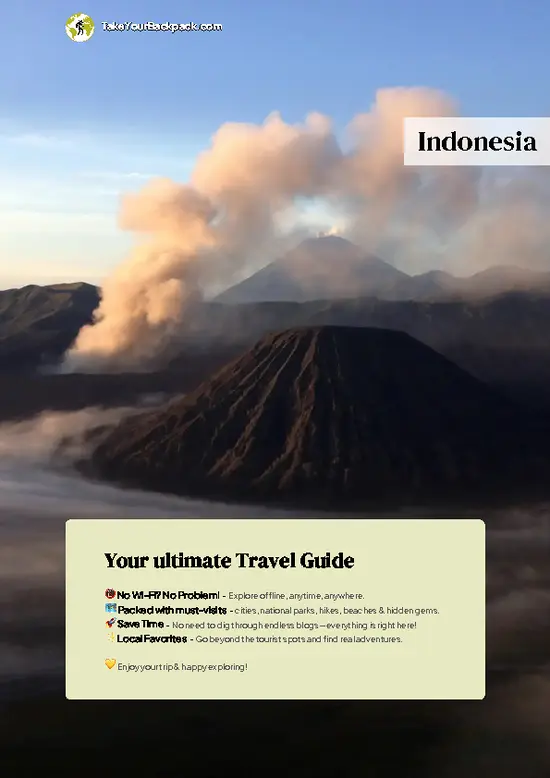
example page 0 from our offline Travel Guide for Indonesia
example page 1 from our offline Travel Guide for Indonesia
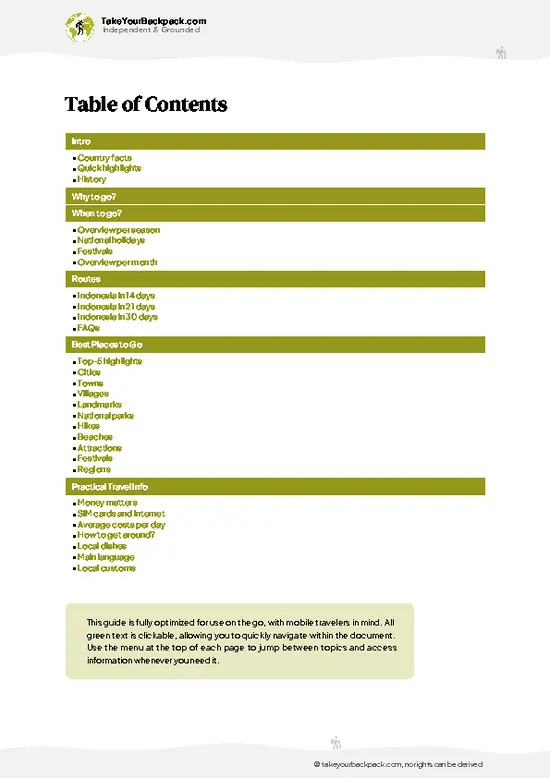
example page 2 from our offline Travel Guide for Indonesia
example page 3 from our offline Travel Guide for Indonesia
example page 4 from our offline Travel Guide for Indonesia
example page 5 from our offline Travel Guide for Indonesia
example page 6 from our offline Travel Guide for Indonesia
example page 7 from our offline Travel Guide for Indonesia
Loading the map 🌍
CLICK TO FILTER
cities
towns
villages
landmarks
national parks
hikes
beaches
attractions
festivals
regions
SHOW COUNTRY’S BESTSHOW ALL

✨ Why go?
Ranked #6 city in Indonesia
Why visitors keep coming back

Makassar functions as a working port city and a genuine backpacking hub, not a tourist destination pretending to be one. The waterfront draws you in, but the real payoff lies in the food markets, where you'll eat better seafood for less money than anywhere else in Indonesia, and the local neighborhoods where you'll find yourself the only foreigner in a warung. The city is walkable in sections, particularly around the harbor and the old Dutch quarter, though distances are large enough that you'll use cheap local transport. Hostels cluster near the waterfront and offer solid social scenes without the party-hard vibe of Bali. Makassar serves as a basecamp for day trips to nearby islands and diving spots, and it's the natural jumping-off point for traveling east to Flores, Komodo, or the Maluku … read more 👉
Makassar functions as a working port city and a genuine backpacking hub, not a tourist destination pretending to be one. The waterfront draws you in, but the real payoff lies in the food markets, where you'll eat better seafood for less money than anywhere else in Indonesia, and the local neighborhoods where you'll find yourself the only foreigner in a warung. The city is walkable in sections, particularly around the harbor and the old Dutch quarter, though distances are large enough that you'll use cheap local transport. Hostels cluster near the waterfront and offer solid social scenes without the party-hard vibe of Bali. Makassar serves as a basecamp for day trips to nearby islands and diving spots, and it's the natural jumping-off point for traveling east to Flores, Komodo, or the Maluku Islands. The onward connections are straightforward, making it easy to slot into a longer eastern Indonesia route.

💡 HighlightsTop highlights of Makassar

  1. Fort Rotterdam: A 17th-century Dutch fortress with thick stone walls, cannons, and a museum inside covering Makassar's colonial past and the Bugis seafaring tradition. The views from the ramparts overlook the harbor. Best visited early morning to avoid heat. 2 to 3 hours. US$3 to 5 entry.
  2. Losari Beach: A long waterfront promenade where locals walk at sunset, street vendors sell grilled fish and coconut drinks, and the sky turns orange over the Makassar Strait. The beach itself is narrow and not for swimming, but the energy here is authentic. Sunset hours are best. Free. 1 to 2 hours.
  3. Paotere Harbor: A working fishing port where traditional wooden boats called pinisi still dock, their hulls painted bright colors. You can walk among the boats, watch fishermen mend nets, and buy fresh catch. Early
… read more 👉
  1. Fort Rotterdam: A 17th-century Dutch fortress with thick stone walls, cannons, and a museum inside covering Makassar's colonial past and the Bugis seafaring tradition. The views from the ramparts overlook the harbor. Best visited early morning to avoid heat. 2 to 3 hours. US$3 to 5 entry.
  2. Losari Beach: A long waterfront promenade where locals walk at sunset, street vendors sell grilled fish and coconut drinks, and the sky turns orange over the Makassar Strait. The beach itself is narrow and not for swimming, but the energy here is authentic. Sunset hours are best. Free. 1 to 2 hours.
  3. Paotere Harbor: A working fishing port where traditional wooden boats called pinisi still dock, their hulls painted bright colors. You can walk among the boats, watch fishermen mend nets, and buy fresh catch. Early morning (5 to 7 AM) is most active. Free. 1 to 2 hours.
  4. Somba Opu Fort Ruins: Remnants of a 16th-century Makassar kingdom fortress, now a modest archaeological site with stone foundations and a small museum. Less crowded than Fort Rotterdam and offers quieter insight into pre-colonial Makassar. Morning or late afternoon. US$2 to 3 entry. 1 to 2 hours.
  5. Karebosi Grand Mall Food Court: Not a tourist attraction, but the basement food court serves authentic Makassar dishes like coto Makassar (spiced beef soup) and tinutuan (rice porridge) at local prices. Lunch hours (11 AM to 1 PM) are busiest. US$2 to 4 per meal. 1 hour.
  6. Taman Makasar: A public park with walking paths, a small lake, and local families relaxing on weekends. It's where you see everyday Makassar life away from tourist zones. Mornings and late afternoons. Free. 1 to 2 hours.
  7. Pulau Samalona: A small island 20 minutes by boat from Losari Beach with coral reefs, clear water for snorkeling, and a few basic beach shacks. Day trips depart 8 to 9 AM. US$8 to 12 per person for boat and snorkeling. 4 to 5 hours total.
Close by, Bantimurung Waterfall (about 40 kilometers northeast) offers a dramatic cascade and freshwater pools, while Tana Toraja's highlands (a 12-hour drive inland) showcase traditional architecture and burial ceremonies. I'd pick Bantimurung first because it's a half-day trip that doesn't require an overnight, and the waterfall itself is worth the drive.
Spotted a mistake or missing something? Contact us.

Things to do in Makassar

Ratings based on Tripadvisor reviews. When you book through this link, you support our work at no extra cost to you.

🏘️ NeighborhoodsUnderstanding the local layout

  • Losari Beach stretches along the waterfront and pulses with energy at sunset. Walk the promenade, grab street food from vendors, and soak in the sea breeze. The area fills with locals and travelers alike, especially evenings. Walkability is excellent, and it costs nothing to explore; eating here runs US$2 to 4 per meal. Best reward for time and money.
  • Makassar Fort (Benteng Rotterdam) anchors the old colonial quarter with narrow lanes, antique shops, and cafés tucked into heritage buildings. Wandering here feels like stepping through layers of history. The fort itself charges a small entry fee (US$2 to 3), and the surrounding streets are highly walkable. Quieter than Losari, with fewer crowds and lower food costs (US$1.50 to 3 per meal).
  • Karebosi Square sits at the city center, ringed by shops,
… read more 👉
  • Losari Beach stretches along the waterfront and pulses with energy at sunset. Walk the promenade, grab street food from vendors, and soak in the sea breeze. The area fills with locals and travelers alike, especially evenings. Walkability is excellent, and it costs nothing to explore; eating here runs US$2 to 4 per meal. Best reward for time and money.
  • Makassar Fort (Benteng Rotterdam) anchors the old colonial quarter with narrow lanes, antique shops, and cafés tucked into heritage buildings. Wandering here feels like stepping through layers of history. The fort itself charges a small entry fee (US$2 to 3), and the surrounding streets are highly walkable. Quieter than Losari, with fewer crowds and lower food costs (US$1.50 to 3 per meal).
  • Karebosi Square sits at the city center, ringed by shops, restaurants, and street vendors. It's the pulse of modern Makassar, busy and loud, perfect for people-watching and grabbing lunch. Walkable and free to explore; meals cost US$2 to 5. Good for energy and variety.
  • Somba Opu offers a more residential feel with local warungs, small markets, and genuine neighborhood life. Less touristy, cheaper (US$1 to 2 per meal), and a solid base for understanding how locals live. Walkable but requires more effort to navigate.

⌛️ 1 dayA smart one-day plan

Makassar rewards early starts and waterfront wandering, mixing colonial history with the working harbor that still defines the city. Begin at the water's edge and move inland through neighborhoods where daily life unfolds.

6:30 AM: Paotere Harbor. Arrive before the heat peaks. Watch fishermen prepare boats, nets spread across the dock, and the first catch being unloaded. The light is soft, the activity genuine. Walk among the pinisi boats and talk to anyone mending nets. Leave by 8 AM.

8:30 AM: Fort Rotterdam. Walk or take a becak (three-wheeled taxi) from the harbor, about 15 minutes. Climb the ramparts, explore the museum inside, and read the plaques about Dutch occupation and Bugis resistance. The stone walls are cool inside. Spend 2 hours here.

10:45 AM: Somba Opu Fort Ruins. A short … read more 👉
Makassar rewards early starts and waterfront wandering, mixing colonial history with the working harbor that still defines the city. Begin at the water's edge and move inland through neighborhoods where daily life unfolds.

6:30 AM: Paotere Harbor. Arrive before the heat peaks. Watch fishermen prepare boats, nets spread across the dock, and the first catch being unloaded. The light is soft, the activity genuine. Walk among the pinisi boats and talk to anyone mending nets. Leave by 8 AM.

8:30 AM: Fort Rotterdam. Walk or take a becak (three-wheeled taxi) from the harbor, about 15 minutes. Climb the ramparts, explore the museum inside, and read the plaques about Dutch occupation and Bugis resistance. The stone walls are cool inside. Spend 2 hours here.

10:45 AM: Somba Opu Fort Ruins. A short becak ride south. This site is quieter than Fort Rotterdam and older, with foundations from the 1500s. The museum is small but focused. 1 to 1.5 hours.

12:30 PM: Karebosi Grand Mall Food Court. Head to the basement for coto Makassar, a rich beef soup with turmeric and spices. Eat where locals eat. 45 minutes.

2:00 PM: Taman Makasar. Walk or becak to this park. Rest in the shade, watch families, sit by the lake. No agenda. 1 hour.

3:15 PM: Losari Beach. Walk the promenade, buy a coconut drink from a vendor, watch the water. Stay until sunset. 2 to 3 hours.

🌤️ When to go?When to go for the best experience

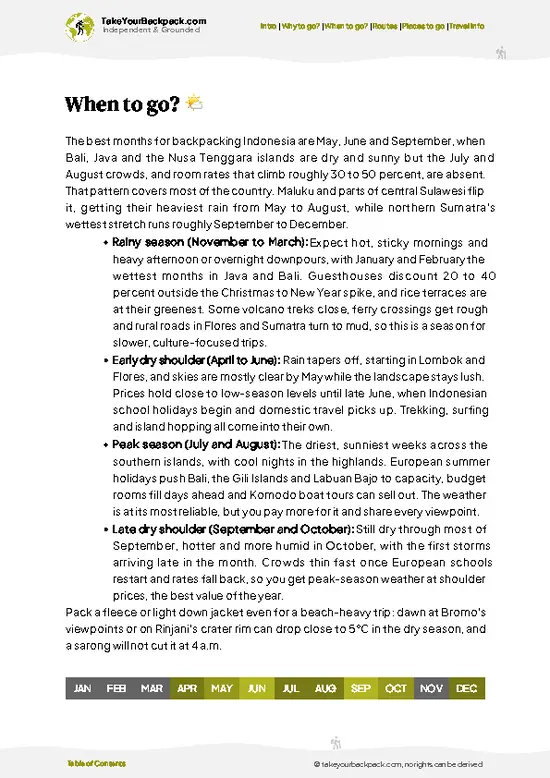
  • Dry Season (May to September): The best window for visiting. Expect temperatures around 28 to 32°C (82 to 90°F), low rainfall, and clear skies. Daylight runs roughly 12 hours year-round. Crowds peak in July and August, pushing accommodation prices up 15 to 25 percent. Prices drop slightly in May, June, and September.
  • Wet Season (November to March): Heavy rain arrives, temperatures stay 26 to 31°C (79 to 88°F), and humidity climbs. Fewer tourists mean lower prices and easier accommodation bookings. Travel between islands becomes less reliable due to rough seas.
  • Shoulder Months (April, October): Unpredictable weather but fewer crowds and moderate prices. April leans wetter; October drier.
Visit May through September for the most reliable weather and easiest island hopping.

source: climatestotravel.comJANJanuary: fair for travelingFEBFebruary: fair for travelingMARMarch: fair for travelingAPRApril: highly recommended for travelingMAYMay: excellent for travelingJUNJune: excellent for travelingJULJuly: highly recommended for travelingAUGAugust: highly recommended for travelingSEPSeptember: excellent for travelingOCTOctober: highly recommended for travelingNOVNovember: fair for travelingDECDecember: fair for traveling
when-to-go

✈️ The backpacker research shortcutIndonesia Travel Guide

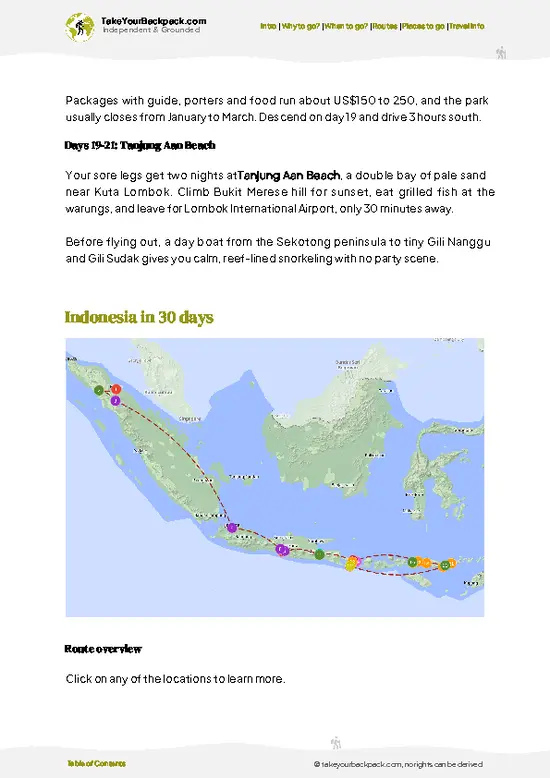
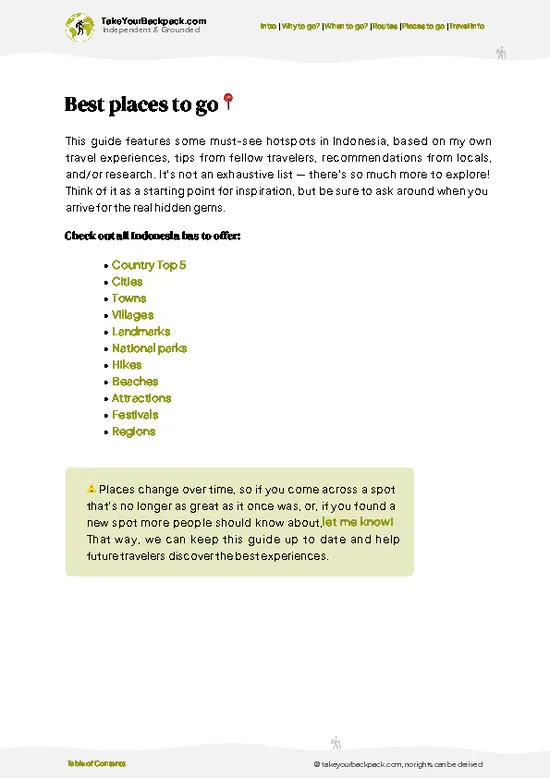
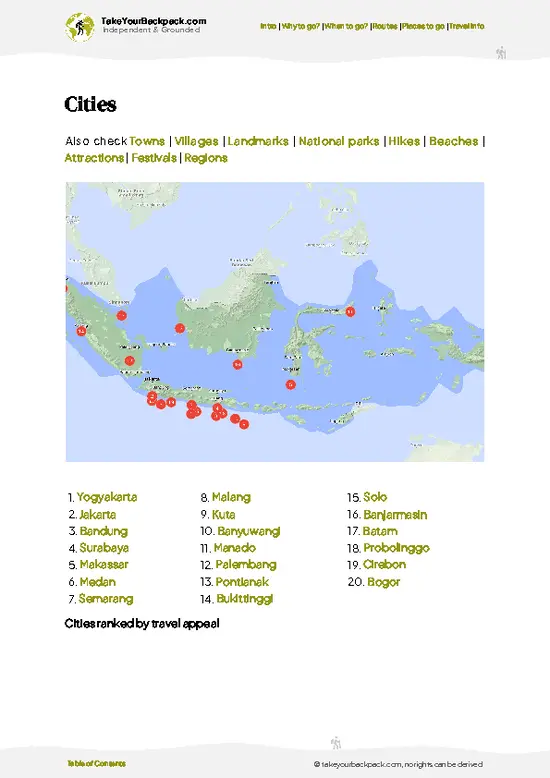
An offline-friendly backpacking guide with optimized travel routes, ranked highlights, transport advice, and the best areas to stay.
example page 0 from our offline Travel Guide for Indonesia
example page 1 from our offline Travel Guide for Indonesia
example page 2 from our offline Travel Guide for Indonesia
example page 3 from our offline Travel Guide for Indonesia
example page 4 from our offline Travel Guide for Indonesia
example page 5 from our offline Travel Guide for Indonesia
example page 6 from our offline Travel Guide for Indonesia
example page 7 from our offline Travel Guide for Indonesia
The digital guide (460 pages) contains:
✅ 153 highlights, ranked by travel appeal
✅ Optimized 14, 21 & 30-day travel routes
✅ Cities, national parks, landmarks, beaches
✅ How to get around
✅ Offline-friendly for travel without Wi-Fi
👉 Click to see all 30+ guide features

📅 Plan smarter in minutes, not weeks
✅ Month by month travel advice
✅ Festivals & national holidays
✅ Budget expectations

🗺️ Go to the right places, skip the overrated ones
✅ Honest pros & cons of destinations
✅ Top hikes, parks & viewpoints
✅ Lesser-known places most travelers miss
✅ Clear “worth it vs skip it” guidance

🛏️ Travel smoothly without rookie mistakes
✅ Best areas to stay
✅ Transport systems explained simply
✅ Common scams & safety advice
✅ SIM cards, money & practical tips

🌍 Understand the country, not just visit it
✅ Culture & traditions
✅ 52 Essential phrases & customs
✅ Festivals worth planning around
✅ Traveler-friendly historical context
✅ Insights that make places more meaningful

📱 Built for real travel conditions
✅ Fully downloadable PDF
✅ Works completely offline
✅ Optimized for phone use
✅ Useful in remote areas & buses
✅ Everything in one place
Stop searching, start planning
Get instant access to your full guide. 30‑day money-back guarantee.
+ Add another guide for just

By proceeding you agree to our terms.
Sent to your inbox immediately after payment • 100% Secure Checkout
Best Backpacking Travel Advisor 2025 tourism awardBest Backpacking
Travel Advisor
2025
What others say about Take Your Backpack Guides:
⭐⭐⭐⭐⭐
Fantastic, amazing amount of information!
⭐⭐⭐⭐⭐
My goodness this is amazing, it's what I've been looking for hats off too you!
⭐⭐⭐⭐⭐
I think this is absolutely BRILLIANT
⭐⭐⭐⭐
Very complete and informative. It's still missing places, but I gotta to commend you
⭐⭐⭐⭐⭐
This is truly amazing, thank you, can't wait to explore it with my kids!
⭐⭐⭐⭐⭐
Awesome resource, thank you!
⭐⭐⭐⭐⭐
This is amazing! Can't wait to explore the ones I haven't seen
⭐⭐⭐⭐
I love this! Well done, great idea.
⭐⭐⭐⭐⭐
Thanks for taking the time to make this gem!
⭐⭐⭐⭐⭐
This might be the best website I've ever seen.
⭐⭐⭐⭐⭐
Congratulations, and thank you so much for your work; it's incredibly valuable.
⭐⭐⭐⭐
In all seriousness I think you did a great job pointing out the important spots
⭐⭐⭐⭐⭐
10/10 very good
⭐⭐⭐⭐⭐
As someone who's only just starting to visit regularly this is awesome, thank you.
⭐⭐⭐⭐
Thank you very much! I'm going to visit my dad, it's going to be very useful!
⭐⭐⭐⭐⭐
This is really cool! We'll be travelling for the first time and this definitely come in handy.
⭐⭐⭐⭐⭐
You are now our minister of culture, congratulations 👨‍💼
⭐⭐⭐⭐⭐
Just wanted to tell you that this is a pearl! Going to follow your recommendations.
⭐⭐⭐⭐⭐
This is so cool. I'll definitely be using the resource for my travels soon.
⭐⭐⭐⭐⭐
This is very impressive! Good work.
⭐⭐⭐⭐⭐
This is an amazing and informative site. Very well done!

🛏️ Where to stay?Choosing the right base

Sleep in Somba Opu or around Jalan Penghibur for the best mix of budget hostels, guesthouses, and transport links. Somba Opu sits near the waterfront and Fort Rotterdam, putting you within walking distance of the city's main draw; it's safe, relatively quiet at night, and angkot routes pass through regularly. Jalan Penghibur runs through the commercial heart and offers more nightlife and street food, with slightly cheaper beds but more noise. Both areas have solid hostel density, reliable internet, and easy access to minibuses heading to day-trip destinations. Avoid the sprawling residential zones … read more 👉
Sleep in Somba Opu or around Jalan Penghibur for the best mix of budget hostels, guesthouses, and transport links. Somba Opu sits near the waterfront and Fort Rotterdam, putting you within walking distance of the city's main draw; it's safe, relatively quiet at night, and angkot routes pass through regularly. Jalan Penghibur runs through the commercial heart and offers more nightlife and street food, with slightly cheaper beds but more noise. Both areas have solid hostel density, reliable internet, and easy access to minibuses heading to day-trip destinations. Avoid the sprawling residential zones further out unless you want isolation; the payoff in lower rent doesn't match the time lost commuting back to the action.

🚌 Getting aroundHow to get around Makassar

A ride on Makassar's minibuses (angkot) costs around US$0.30 to 0.50 and you pay the driver when you exit. The city sprawls across flat terrain, making it walkable in patches but exhausting to cross end-to-end on foot. Traffic moves thick during rush hours, and public transport is reliable enough for daily movement but runs on loose schedules. Grab (ride-hailing app) works here and offers a faster, predictable alternative when you need it.
  • Angkot (minibuses): The backbone of local transport, US$0.30 to 0.50 per ride, no fixed schedule but frequent on main routes. Cheap and social but crowded during peak hours. Best for short hops and getting a feel for how locals move around the city.
  • Grab: Motorcycle taxis and cars available via app, US$1 to 3 for most city trips, faster and more comfortable
… read more 👉
A ride on Makassar's minibuses (angkot) costs around US$0.30 to 0.50 and you pay the driver when you exit. The city sprawls across flat terrain, making it walkable in patches but exhausting to cross end-to-end on foot. Traffic moves thick during rush hours, and public transport is reliable enough for daily movement but runs on loose schedules. Grab (ride-hailing app) works here and offers a faster, predictable alternative when you need it.
  • Angkot (minibuses): The backbone of local transport, US$0.30 to 0.50 per ride, no fixed schedule but frequent on main routes. Cheap and social but crowded during peak hours. Best for short hops and getting a feel for how locals move around the city.
  • Grab: Motorcycle taxis and cars available via app, US$1 to 3 for most city trips, faster and more comfortable than angkot. Useful when carrying luggage or traveling after dark, though slightly pricier.
  • Walking: Practical in compact neighborhoods like Somba Opu and around the waterfront, but distances between districts are long. Flat terrain helps, but heat and humidity make it tiring in midday. Best for exploring one area deeply rather than covering ground.
  • Ojek (motorcycle taxi): Hailed on the street or via app, US$0.50 to 2 depending on distance. Quick through traffic and intimate way to see the city, though requires comfort on a bike and no helmet guarantee.
  • Rental motorbike: US$4 to 8 per day from shops in tourist areas. Gives you freedom to explore outlying spots and nearby towns, but traffic can be chaotic and roads outside the center are rough.

👛 Costs (as of 15 October 2026)Travel costs and budget guide for Makassar

Budget backpackers spend US$25 to 40 per day in Makassar, covering accommodation, food, transport, and activities. The city is cheaper than Bali or Jakarta, with lower accommodation and food costs offsetting slightly higher activity prices for island trips.
CategoryBudget RangeLocal Reality
Dorm accommodation (high season)US$10 to 15Clean, fan-cooled rooms in Losari and Fort District; air-conditioned dorms cost US$15 to 20
Dorm accommodation (off-season)US$8 to 12Same quality, 20 to 30 percent cheaper May through September shoulder months
MealsUS$2 to 5Street food and warungs cost US$1 to 2; sit-down restaurants US$4 to 8
Local transportUS$0.30 to 3Bemo US$0.30 to 0.50; ojek US$1 to 3; Grab US$2 to 5 depending on distance
City transport passN/ANo pass system; pay per ride
Basic activities/entry feesUS$2
… read more 👉
Budget backpackers spend US$25 to 40 per day in Makassar, covering accommodation, food, transport, and activities. The city is cheaper than Bali or Jakarta, with lower accommodation and food costs offsetting slightly higher activity prices for island trips.
CategoryBudget RangeLocal Reality
Dorm accommodation (high season)US$10 to 15Clean, fan-cooled rooms in Losari and Fort District; air-conditioned dorms cost US$15 to 20
Dorm accommodation (off-season)US$8 to 12Same quality, 20 to 30 percent cheaper May through September shoulder months
MealsUS$2 to 5Street food and warungs cost US$1 to 2; sit-down restaurants US$4 to 8
Local transportUS$0.30 to 3Bemo US$0.30 to 0.50; ojek US$1 to 3; Grab US$2 to 5 depending on distance
City transport passN/ANo pass system; pay per ride
Basic activities/entry feesUS$2 to 25Fort entry US$2 to 3; island snorkeling trips US$15 to 35; waterfall entry US$3 to 5
Miscellaneous expensesUS$3 to 8Drinks, snacks, laundry, SIM card top-ups
Total Daily BudgetUS$25 to 40Comfortable mid-range backpacking with occasional paid activities and meals out
Eat at warungs instead of tourist restaurants to cut food costs by half and eat better food.
⚠️ Prices can change and everyone travels differently, so take this as a rough guide. Hope it helps you plan your adventure!

🚌 Day tripsExploring the surroundings

Makassar sits on Sulawesi's coast with several worthwhile escapes within a few hours. Most trips run best in the dry season (May to September) when seas are calmer and roads less treacherous.

Pulau Samalona
A coral island 15 kilometers offshore, reachable by speedboat in 30 to 45 minutes from the harbor (US$8 to 15 return). The reef is patchy but swimmable, and the island has basic warungs and a few homestays if you want to linger. Go early to beat crowds and heat; snorkeling gear rental runs US$3 to 5. First-timers often underestimate the sun reflection off water and arrive sunburned.

Tanjung Bunga Beach
A working fishing village 20 kilometers north, reachable by angkot or Grab in 45 minutes to an hour (US$1 to 3). The beach itself is narrow and busy with boats, but the seafood warungs are … read more 👉
Makassar sits on Sulawesi's coast with several worthwhile escapes within a few hours. Most trips run best in the dry season (May to September) when seas are calmer and roads less treacherous.

Pulau Samalona
A coral island 15 kilometers offshore, reachable by speedboat in 30 to 45 minutes from the harbor (US$8 to 15 return). The reef is patchy but swimmable, and the island has basic warungs and a few homestays if you want to linger. Go early to beat crowds and heat; snorkeling gear rental runs US$3 to 5. First-timers often underestimate the sun reflection off water and arrive sunburned.

Tanjung Bunga Beach
A working fishing village 20 kilometers north, reachable by angkot or Grab in 45 minutes to an hour (US$1 to 3). The beach itself is narrow and busy with boats, but the seafood warungs are excellent and cheap (US$2 to 4 per meal). Go for lunch rather than swimming; the real payoff is eating grilled fish while watching the harbor rhythm.

Bantimurung Waterfall
A two-hour drive inland through limestone hills, best reached by renting a motorbike (US$4 to 8) or hiring a driver for the day (US$25 to 40 split with others). The waterfall is modest but the surrounding karst landscape is dramatic. Entry is US$2 to 3. The road is rough; go in dry season and start early to avoid afternoon heat.

Gowa Fort
A 17th-century fort 30 kilometers south, accessible by angkot or Grab in 45 minutes (US$2 to 5). The ruins sit on a hilltop with views over rice paddies and the coast. Entry is US$2 to 3. Combine it with a stop at nearby Sungguminasa village for local snacks and a quieter pace than the city offers.

🍲 FoodEating & Drinking in Makassar

Makassar's food scene centers on seafood and rice, reflecting its coastal identity. Coto Makassar, a rich beef soup with turmeric and spices, is the signature dish and costs US$2 to 3 at any warung. Grilled fish (ikan bakar) and squid (cumi-cumi) appear everywhere, fresh and cheap (US$3 to 5 per plate). Street food dominates the eating culture. Losari Beach fills with vendors selling grilled corn, satay skewers, and fresh fruit smoothies in the late afternoon. Markets like Paotere offer raw seafood, tropical fruit, and local snacks for pennies. Breakfast means bubur ayam (chicken rice porridge) or fried rice from corner stalls (US$1 to 1.50). Coffee culture is strong; local kopi (black coffee) and sweet condensed-milk coffee cost US$0.50 to 1. Eating is social and informal. Locals eat standing … read more 👉
Makassar's food scene centers on seafood and rice, reflecting its coastal identity. Coto Makassar, a rich beef soup with turmeric and spices, is the signature dish and costs US$2 to 3 at any warung. Grilled fish (ikan bakar) and squid (cumi-cumi) appear everywhere, fresh and cheap (US$3 to 5 per plate). Street food dominates the eating culture. Losari Beach fills with vendors selling grilled corn, satay skewers, and fresh fruit smoothies in the late afternoon. Markets like Paotere offer raw seafood, tropical fruit, and local snacks for pennies. Breakfast means bubur ayam (chicken rice porridge) or fried rice from corner stalls (US$1 to 1.50). Coffee culture is strong; local kopi (black coffee) and sweet condensed-milk coffee cost US$0.50 to 1. Eating is social and informal. Locals eat standing at stalls or sitting on plastic stools, and joining them is expected. Alcohol is available but less central to the culture than in other Indonesian cities; beer costs US$2 to 4 at bars, and local palm wine (tuak) appears in certain warungs.

🛡️ SafetyStaying Safe: What Travelers Should Know

Makassar is broadly safe for backpackers who use standard city sense. Petty theft happens in crowded markets and on bemos, so keep bags zipped and valuables close. Avoid flashing expensive cameras or jewelry. The Losari waterfront and Fort District are well-traveled and secure; stick to main streets after dark. Solo travel is fine, and many backpackers move around comfortably at night, though using Grab instead of flagging down ojeks after 10 p.m. removes unnecessary friction. Scams are rare compared to other Indonesian cities. Occasional overcharging happens at tourist-facing warungs, but asking locals for meal prices beforehand prevents surprises. Petty hassle from touts is minimal. The main annoyance is heat and humidity rather than safety concerns. Keep copies of your passport separate … read more 👉
Makassar is broadly safe for backpackers who use standard city sense. Petty theft happens in crowded markets and on bemos, so keep bags zipped and valuables close. Avoid flashing expensive cameras or jewelry. The Losari waterfront and Fort District are well-traveled and secure; stick to main streets after dark. Solo travel is fine, and many backpackers move around comfortably at night, though using Grab instead of flagging down ojeks after 10 p.m. removes unnecessary friction. Scams are rare compared to other Indonesian cities. Occasional overcharging happens at tourist-facing warungs, but asking locals for meal prices beforehand prevents surprises. Petty hassle from touts is minimal. The main annoyance is heat and humidity rather than safety concerns. Keep copies of your passport separate from the original, and register with your embassy if staying longer than a month.

FAQTraveler FAQ

Two to three days is ideal. One day covers the main sights (Fort Rotterdam, Paotere Harbor, Losari Beach), but two days lets you explore neighborhoods, eat properly, and take a day trip to the Spermonde Islands or nearby waterfalls. Three days is enough to feel settled and venture further afield.
Yes, Makassar is safe for solo backpackers. Petty theft exists in crowded markets and on public transport, so watch your bag and avoid displaying expensive gear. The city is used to foreign travelers, and locals are generally helpful. Use registered taxis or ride-sharing apps at night rather than hailing cabs on the street.
Makassar is known as Indonesia's gateway to the east and a major working port city. It's famous for its seafood markets, the historic Fort Rotterdam, traditional pinisi wooden boats, and its role as a basecamp for diving and island trips in the Spermonde Archipelago. The city is also significant in Indonesian history as a center of resistance during the independence struggle.
⚠️ Things can change over time, so always validate details locally before you go.

Other Indonesian cities near Makassar

Explore more nearby:

  • Baubau—Buton Sultanate, Wakatobi access, Kraton Buton, cassava dishes| 355 km away
  • Kendari—Southeast Sulawesi hub, Kendari Bay, Wakatobi flights, sinonggi| 366 km away
  • Sumbawa Besar—sultan’s palace, buffalo markets, rural gateway| 434 km away

💡 Not sure where to go next?
Create a personalized itinerary for Indonesia including Makassar and the places that fit your trip.

Generate my itinerary

👉 Discover all cities

Or checkout all Indonesia has to offer (think cities, towns, villages, national parks, hikes, beaches, festivals)
Country photo of Indonesia

We 💚 feedbackKey takeaways before you go

Makassar's real draw is its working harbor and the Bugis maritime culture that still pulses through the city, not polished landmarks. The catch is that the city feels rough around the edges, with limited English and infrastructure gaps that require patience. If you're comfortable with that trade-off, it's worth the visit.

✈️ When did I visit Indonesia?
As part of my 1.5 year travel around the world trip, I visited Indonesia twice (and it was worth it): first in September 2015 and a bit later again in January and February 2016.

✍️ Help improve this page!
The information on this page is based on my own backpacking experience in Indonesia, supplemented with up-to-date research and feedback from other travelers. Travel details can change, so if you notice anything outdated or incomplete, feel free to let me know.


🙋‍♂️ Give feedback

👋 Meet the founderWho’s Behind Take Your Backpack?

Johan, backpacker and founder of TakeYourBackpackHi, I’m Johan (Netherlands 🇳🇱), the creator of TakeYourBackpack. Over the past 3 decades, I’ve backpacked through 90+ countries across six continents, gaining extensive experience with independent travel, long-term trips, and overland routes.

This site is built on a combination of firsthand travel experience and carefully curated insights from other backpackers. Many guides are based on places I’ve personally visited, while others bring together tips, observations, and practical advice shared by trusted travelers I’ve met along the way.

The goal is to provide realistic, experience-driven guidance — not generic itineraries — so you can explore destinations with better context, clearer expectations, and more confidence.