×

Indonesia🇮🇩 | national parksWakatobi National Parkbarrier reefs, dive sites, remote islands | things to do and best time to go

Explore Sebangau National ParkExplore Teluk Cenderawasih National Park

Backpacking in Wakatobi
🌟 Highlightnational park ranked #5
By Johan Kruseman 🇳🇱 | Updated October 15, 2026

Book your Wakatobi flights before anything else, because the Wings Air and Express Air seats from Makassar to Wangi-Wangi and Kaledupa are few, and a missed connection can burn a day and a night in Makassar. The park sits in Southeast Sulawesi, in a four-island chain (Wangi-Wangi, Kaledupa, Tomia, Binongko) in the Banda Sea. Forget summit trails. Here you walk sand-lane villages, kayak mangroves and snorkel straight off the beach into some of the most diverse reef in the Coral Triangle. The cons: almost no public transport beyond ferries and ojek, patchy ATMs, and prices that jump at the dive resorts. I once ate grilled fish and sambal on a Kaledupa jetty while parrotfish crunched coral beneath my feet. Compared with Komodo or Bunaken, you get far fewer crowds, though also fewer services.

Discover everything you want to know in the 📖 Indonesia Travel Guide.


example page 0 from our offline Travel Guide for Indonesia
example page 1 from our offline Travel Guide for Indonesia
example page 2 from our offline Travel Guide for Indonesia
example page 3 from our offline Travel Guide for Indonesia
example page 4 from our offline Travel Guide for Indonesia
example page 5 from our offline Travel Guide for Indonesia
example page 6 from our offline Travel Guide for Indonesia
example page 7 from our offline Travel Guide for Indonesia
Loading the map 🌍
CLICK TO FILTER
cities
towns
villages
landmarks
national parks
hikes
beaches
attractions
festivals
regions
SHOW COUNTRY’S BESTSHOW ALL

✨ Why go?
Ranked #5 national park in Indonesia
The unique appeal for travelers

Backpackers pick Wakatobi for independent exploration that the big-name resorts rarely advertise. Local homestays on Wangi-Wangi, Kaledupa and Tomia cost far less than the private dive island, and you can rent a motorbike to circle an island in a few hours. The house reefs are close enough to snorkel from the shore, so you do not need a boat tour every day. The Bajau stilt village of Sampela on Kaledupa adds a cultural layer, and you can paddle out with a local guide rather than a package group. Trail variety is modest: coastal walks, a few hill viewpoints, mangrove boardwalks and village lanes. That suits self-guided travelers who want slow days, cheap fried fish and nobody rushing them. Tours make sense only for remote reefs and boat dives, where a hired local boat with a driver saves hours of haggling and fuel guesswork.

💡 HighlightsMust-see experiences and standout moments

  1. Hoga Island Reef: A small island off Kaledupa with a long research history and dense house-reef coral. Snorkelers float over hard coral gardens within a few meters of the beach.
  2. Sampela Bajau Village: A settlement of houses on stilts over the shallows off Kaledupa. Visit with a local paddler and ask before photographing anyone.
  3. Wangi-Wangi Beaches: Pantai Waha and Cemara have pale sand and shallow turquoise water, handy for an easy first snorkel after arriving.
  4. Tomia Island Reefs: Known for steep walls and clear water, with several well-known dive sites. Tomia also has a quieter backpacker feel than Wangi-Wangi.
  5. Kapota and Mari Mabuk Reefs: Reef and mangrove edges reachable from Wangi-Wangi by hired boat. Good for rays, reef fish and sea turtles.
  6. Patuno Beach and Kaledupa Coast: Long quiet shorelines
… read more 👉
  1. Hoga Island Reef: A small island off Kaledupa with a long research history and dense house-reef coral. Snorkelers float over hard coral gardens within a few meters of the beach.
  2. Sampela Bajau Village: A settlement of houses on stilts over the shallows off Kaledupa. Visit with a local paddler and ask before photographing anyone.
  3. Wangi-Wangi Beaches: Pantai Waha and Cemara have pale sand and shallow turquoise water, handy for an easy first snorkel after arriving.
  4. Tomia Island Reefs: Known for steep walls and clear water, with several well-known dive sites. Tomia also has a quieter backpacker feel than Wangi-Wangi.
  5. Kapota and Mari Mabuk Reefs: Reef and mangrove edges reachable from Wangi-Wangi by hired boat. Good for rays, reef fish and sea turtles.
  6. Patuno Beach and Kaledupa Coast: Long quiet shorelines where the fishing boats come in at dusk. Good for walking and sunset.
  7. Kaledupa Mangrove Paddles: Calm-water kayaking through channels on the island edge. You see wading birds, crabs and small fish nurseries.
I would pick Hoga Island first. It puts world-class reef within a few kicks of the sand, requires no long boat transfer and costs little by Wakatobi standards.
Spotted a mistake or missing something? Contact us.

🌤️ When to go?When to go for the best experience

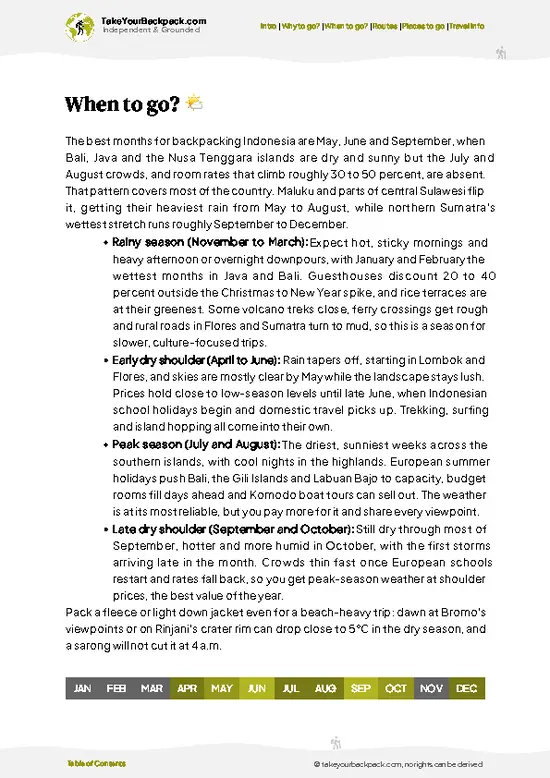
  • Dry Season (April to November): Calmest seas, best visibility (often 20 to 30 m), and daytime highs around 29 to 32°C (84 to 90°F). Sunrise is near 6:00 and sunset near 18:00 year-round.
  • Peak Season (July to September): Most dive visitors and the highest homestay and boat prices. Southeast winds can make crossings choppy, so book flights early.
  • Shoulder Months (April to June, October to November): Clear water, thinner crowds and easier bookings. Expect lows near 24°C (75°F) at night.
  • Wet Season (December to March): Heavy showers, rougher seas, cancelled ferries and flights, and some homestays closing. Temperatures stay 27 to 31°C (81 to 88°F), with humid air.
Aim for late April to June or October for good visibility and softer prices.

source: climatestotravel.comJANJanuary: fair for travelingFEBFebruary: fair for travelingMARMarch: fair for travelingAPRApril: highly recommended for travelingMAYMay: excellent for travelingJUNJune: excellent for travelingJULJuly: highly recommended for travelingAUGAugust: highly recommended for travelingSEPSeptember: excellent for travelingOCTOctober: excellent for travelingNOVNovember: highly recommended for travelingDECDecember: fair for traveling
when-to-go

✈️ The backpacker research shortcutIndonesia Travel Guide

An offline-friendly backpacking guide with optimized travel routes, ranked highlights, transport advice, and the best areas to stay.
example page 0 from our offline Travel Guide for Indonesia
example page 1 from our offline Travel Guide for Indonesia
example page 2 from our offline Travel Guide for Indonesia
example page 3 from our offline Travel Guide for Indonesia
example page 4 from our offline Travel Guide for Indonesia
example page 5 from our offline Travel Guide for Indonesia
example page 6 from our offline Travel Guide for Indonesia
example page 7 from our offline Travel Guide for Indonesia
The digital guide (460 pages) contains:
✅ 153 highlights, ranked by travel appeal
✅ Optimized 14, 21 & 30-day travel routes
✅ Cities, national parks, landmarks, beaches
✅ How to get around
✅ Offline-friendly for travel without Wi-Fi
👉 Click to see all 30+ guide features

📅 Plan smarter in minutes, not weeks
✅ Month by month travel advice
✅ Festivals & national holidays
✅ Budget expectations

🗺️ Go to the right places, skip the overrated ones
✅ Honest pros & cons of destinations
✅ Top hikes, parks & viewpoints
✅ Lesser-known places most travelers miss
✅ Clear “worth it vs skip it” guidance

🛏️ Travel smoothly without rookie mistakes
✅ Best areas to stay
✅ Transport systems explained simply
✅ Common scams & safety advice
✅ SIM cards, money & practical tips

🌍 Understand the country, not just visit it
✅ Culture & traditions
✅ 52 Essential phrases & customs
✅ Festivals worth planning around
✅ Traveler-friendly historical context
✅ Insights that make places more meaningful

📱 Built for real travel conditions
✅ Fully downloadable PDF
✅ Works completely offline
✅ Optimized for phone use
✅ Useful in remote areas & buses
✅ Everything in one place
Stop searching, start planning
Get instant access to your full guide. 30‑day money-back guarantee.
+ Add another guide for just

By proceeding you agree to our terms.
Sent to your inbox immediately after payment • 100% Secure Checkout
Best Backpacking Travel Advisor 2025 tourism awardBest Backpacking
Travel Advisor
2025
What others say about Take Your Backpack Guides:
⭐⭐⭐⭐⭐
Fantastic, amazing amount of information!
⭐⭐⭐⭐⭐
My goodness this is amazing, it's what I've been looking for hats off too you!
⭐⭐⭐⭐⭐
I think this is absolutely BRILLIANT
⭐⭐⭐⭐
Very complete and informative. It's still missing places, but I gotta to commend you
⭐⭐⭐⭐⭐
This is truly amazing, thank you, can't wait to explore it with my kids!
⭐⭐⭐⭐⭐
Awesome resource, thank you!
⭐⭐⭐⭐⭐
This is amazing! Can't wait to explore the ones I haven't seen
⭐⭐⭐⭐
I love this! Well done, great idea.
⭐⭐⭐⭐⭐
Thanks for taking the time to make this gem!
⭐⭐⭐⭐⭐
This might be the best website I've ever seen.
⭐⭐⭐⭐⭐
Congratulations, and thank you so much for your work; it's incredibly valuable.
⭐⭐⭐⭐
In all seriousness I think you did a great job pointing out the important spots
⭐⭐⭐⭐⭐
10/10 very good
⭐⭐⭐⭐⭐
As someone who's only just starting to visit regularly this is awesome, thank you.
⭐⭐⭐⭐
Thank you very much! I'm going to visit my dad, it's going to be very useful!
⭐⭐⭐⭐⭐
This is really cool! We'll be travelling for the first time and this definitely come in handy.
⭐⭐⭐⭐⭐
You are now our minister of culture, congratulations 👨‍💼
⭐⭐⭐⭐⭐
Just wanted to tell you that this is a pearl! Going to follow your recommendations.
⭐⭐⭐⭐⭐
This is so cool. I'll definitely be using the resource for my travels soon.
⭐⭐⭐⭐⭐
This is very impressive! Good work.
⭐⭐⭐⭐⭐
This is an amazing and informative site. Very well done!

🛏️ Where to stay?How to pick the right area

Wangi-Wangi town is the easiest base for backpackers, with simple guesthouses and homestays near the airport and ferry pier for roughly IDR 150,000 to 350,000 a night. Inside the park, there are no official campgrounds, but homestays on Kaledupa, Tomia and Hoga are effectively your in-park options. Kaledupa suits travelers who want villages, snorkeling from shore and a calm pace. Tomia is a quieter pick with a small dive scene. Hoga Island has basic bungalows and a research-station feel, with limited power and food booked ahead. The private resort on Onemobaa Island is luxury and far beyond a … read more 👉
Wangi-Wangi town is the easiest base for backpackers, with simple guesthouses and homestays near the airport and ferry pier for roughly IDR 150,000 to 350,000 a night. Inside the park, there are no official campgrounds, but homestays on Kaledupa, Tomia and Hoga are effectively your in-park options. Kaledupa suits travelers who want villages, snorkeling from shore and a calm pace. Tomia is a quieter pick with a small dive scene. Hoga Island has basic bungalows and a research-station feel, with limited power and food booked ahead. The private resort on Onemobaa Island is luxury and far beyond a typical backpacker budget. Outside the park, Bau-Bau on Buton offers more hotels and a larger market, useful as a transit stop before the ferry. Ask homestays to include meals, since restaurants are few. Book at least a week ahead in July to September, and confirm boat pickup when you arrange your stay.

👛 Costs (as of 15 October 2026)How expensive it really is

A backpacker can expect to spend about USD 30 to 60 a day in Wakatobi National Park when staying in homestays and eating locally. Costs rise sharply with boat hire and diving.
CategoryBudget RangeLocal Reality
Entrance and marine feesUSD 1 to 10Small site or marine fees are usually collected through homestays or dive operators. Ask what is included.
AccommodationUSD 10 to 25Homestays and basic guesthouses are common. Hoga bungalows and some Kaledupa rooms may include meals.
Local transportUSD 5 to 15Motorbike rental runs about USD 5 to 8 a day. Ferries between islands cost a few dollars, and chartered boats cost much more.
Food and suppliesUSD 6 to 12Grilled fish, rice and vegetables at local warung cost USD 2 to 4 a meal. Water and snacks are priced higher on remote islands.
Snorkel and boat tripsUSD
… read more 👉
A backpacker can expect to spend about USD 30 to 60 a day in Wakatobi National Park when staying in homestays and eating locally. Costs rise sharply with boat hire and diving.
CategoryBudget RangeLocal Reality
Entrance and marine feesUSD 1 to 10Small site or marine fees are usually collected through homestays or dive operators. Ask what is included.
AccommodationUSD 10 to 25Homestays and basic guesthouses are common. Hoga bungalows and some Kaledupa rooms may include meals.
Local transportUSD 5 to 15Motorbike rental runs about USD 5 to 8 a day. Ferries between islands cost a few dollars, and chartered boats cost much more.
Food and suppliesUSD 6 to 12Grilled fish, rice and vegetables at local warung cost USD 2 to 4 a meal. Water and snacks are priced higher on remote islands.
Snorkel and boat tripsUSD 15 to 50Gear rental is cheap, but a boat for a day of reef hopping can cost USD 40 to 80 split among travelers.
DivingUSD 40 to 80 per diveOptional, and priced well above other budget items.
⚠️ Prices can change and everyone travels differently, so take this as a rough guide. Hope it helps you plan your adventure!

🥾 TrailsDiscover Wakatobi's top trails and natural wonders

Wakatobi is a marine park, so hiking means coastal and village walking rather than long mountain trails. There are no formally named or signed trails to list. Terrain is flat to gently rolling coral limestone, with sandy lanes, mangrove edges and a few low hill viewpoints on Wangi-Wangi and Tomia. Difficulty is easy, with heat and sun as the main challenge. Wildlife is mostly underwater: reef fish, turtles, rays, and occasional dolphins from boats. On land expect geckos, hornbill-like calls in wooded patches, and monitor lizards in rare sightings. Good outings include a morning walk along Wangi-Wangi’s … read more 👉
Wakatobi is a marine park, so hiking means coastal and village walking rather than long mountain trails. There are no formally named or signed trails to list. Terrain is flat to gently rolling coral limestone, with sandy lanes, mangrove edges and a few low hill viewpoints on Wangi-Wangi and Tomia. Difficulty is easy, with heat and sun as the main challenge. Wildlife is mostly underwater: reef fish, turtles, rays, and occasional dolphins from boats. On land expect geckos, hornbill-like calls in wooded patches, and monitor lizards in rare sightings. Good outings include a morning walk along Wangi-Wangi’s coast road to a beach, a half-day loop through Kaledupa villages, and a mangrove paddle with a local guide. Start before 9:00, carry 2 liters of water and wear reef-safe sun protection.

Getting there takes planning. Wings Air and Express Air fly Makassar to Matahora airport on Wangi-Wangi, and Kaledupa is reached by scheduled ferry or hired boat from Wangi-Wangi. Ferries also run from Bau-Bau on Buton, and speedboats cost more. Once on the islands, ojek and rented motorbikes (around IDR 80,000 to 120,000 a day) are the usual transport. Crowds are light, even in July and August, and busier only around the private dive resort and certain dive sites. Park fees are modest and often collected for visiting marine sites through local operators, so ask your homestay to arrange this. ATMs are scarce away from Wangi-Wangi’s town, so carry extra cash.
⚠️ Hiking info can sometimes be outdated or inaccurate. Before you hit the trail, check the latest conditions with locals. If you do spot anything that's off, I'd love to hear from you, so I can update it for fellow travelers.

🛡️ SafetyStaying Safe: What Travelers Should Know

Wakatobi is generally low-risk, and most problems come from heat, sun and sea conditions. Strong currents can appear near walls and channels, so snorkel with a buoy or a guide, and do not swim alone in windy weather. Wear a rash guard, reef-safe sunscreen and water shoes, since sea urchins and sharp coral are common in shallows. Do not touch or stand on coral, and keep distance from turtles and rays. Boats can be basic, so ask for life jackets and check weather before long crossings. Medical care is limited, with small clinics in Wangi-Wangi and no major hospital on the islands, so bring a basic kit and travel insurance covering evacuation. Carry cash, a power bank and a water bottle, because services drop away quickly outside town.

FAQFrequently asked questions about Wakatobi

Plan 4 to 7 days to see Wakatobi without rushing. Allow 1 to 2 days for travel via Makassar to Wangi-Wangi, then 2 to 3 days for Kaledupa and Hoga reefs. Add 1 to 2 extra days if you want to reach Tomia, since ferry connections run less often.
A car is not needed, and most backpackers do not use one. Rent a motorbike for about IDR 80,000 to 120,000 a day on Wangi-Wangi or Kaledupa, or hire an ojek for short rides. Boats link the islands, with scheduled ferries cheaper than chartered speedboats.
Yes, small marine park and site fees apply, usually a few dollars (about USD 1 to 10 depending on activity). They are normally collected through homestays, guides or dive operators rather than at a single gate. Ask your host to confirm what is included before you pay for a boat trip.
⚠️ Things can change over time, so always validate details locally before you go.

Other Indonesian national parks near Wakatobi

Explore more nearby:

  • Kelimutu National Park—Tri-colored crater lakes, Moni village, pre-dawn climb, Flores highlands| 425 km away
  • Komodo National Park—Komodo dragons, Padar viewpoint, Pink Beach, strong currents| 591 km away
  • Bunaken National Park—Vertical coral walls, Manado Tua volcano, muck-free reefs, shore-entry diving| 804 km away

💡 Not sure where to go next?
Create a personalized itinerary for Indonesia including Wakatobi and the places that fit your trip.

Generate my itinerary

👉 Discover all national parks

Or checkout all Indonesia has to offer (think cities, towns, villages, national parks, hikes, beaches, festivals)
Country photo of Indonesia

We 💚 feedbackSumming up the experience

Wakatobi rewards travelers who like slow days: snorkeling right off the beach, eating grilled fish with a family, and watching boats slide out at dawn. The reef feels alive in a way crowded parks rarely match. The drawback is logistics. Flights are limited, weather can cancel crossings, and cash runs out fast, so build in spare days and carry more rupiah than you expect.

✈️ When did I visit Indonesia?
As part of my 1.5 year travel around the world trip, I visited Indonesia twice (and it was worth it): first in September 2015 and a bit later again in January and February 2016.

✍️ Help improve this page!
The information on this page is based on my own backpacking experience in Indonesia, supplemented with up-to-date research and feedback from other travelers. Travel details can change, so if you notice anything outdated or incomplete, feel free to let me know.


🙋‍♂️ Give feedback

👋 Meet the founderWho’s Behind Take Your Backpack?

Johan, backpacker and founder of TakeYourBackpackHi, I’m Johan (Netherlands 🇳🇱), the creator of TakeYourBackpack. Over the past 3 decades, I’ve backpacked through 90+ countries across six continents, gaining extensive experience with independent travel, long-term trips, and overland routes.

This site is built on a combination of firsthand travel experience and carefully curated insights from other backpackers. Many guides are based on places I’ve personally visited, while others bring together tips, observations, and practical advice shared by trusted travelers I’ve met along the way.

The goal is to provide realistic, experience-driven guidance — not generic itineraries — so you can explore destinations with better context, clearer expectations, and more confidence.