

×

Iran🇮🇷 | citiesShushtarWatermills, canals, ancient engineering | things to do and best time to go

Explore DezfulExplore Fajr International Film Festival

Backpacking in Shushtar
👍 Recommendedcity ranked #21
By Johan Kruseman 🇳🇱 | Updated June 8, 2026

Ten years ago Shushtar felt like a time warp: almost no tourists, kids staring at your backpack, guesthouses improvised out of family homes. Today it’s still quiet, but the UNESCO-listed hydraulic system has put it on the map, so you’ll see domestic tour groups and the odd foreigner. In southwest Iran, near Ahvaz and Dezful, it’s cheaper and calmer than both, with less pollution and more history per block. For backpackers, Shushtar is compact, walkable, and very low-stress. The old bridges, watermills, and alleys around the Karun offshoots are the main draw; nightlife is basically tea, riverfront strolls, and families out late. You won’t find a hostel scene or easy traveler meetups, but you will find curious locals, safe streets, and a slow, slightly provincial rhythm that makes two days feel like a full reset.

Discover everything you want to know in the 📖 Iran Travel Guide.
Safety warning

The current risk level for Iran is high. Check the advice before going.


Get your Iran guide
121 ranked highlights, routes & tips, works offline (419 pages)
Loading the map 🌍
CLICK TO FILTER
cities
towns
villages
landmarks
national parks
hikes
beaches
attractions
festivals
regions
SHOW COUNTRY’S BESTSHOW ALL

✨ Why go?
Ranked #21 city in Iran
Why visitors keep coming back

Shushtar is a strategic stop for backpackers weaving through Iran. It offers a unique blend of highlights and activities that make it worth your time. The basecamp value here is solid; you can easily launch day trips to explore nearby wonders. Affordable hostels provide a cozy atmosphere, while the local food scene serves up delicious, budget-friendly meals. The city is walkable, allowing you to soak in the sights without the hassle of transport. When night falls, the nightlife is low-key but charming, perfect for unwinding after a day of exploration. Plus, onward travel is a breeze, making Shushtar a clever choice for your route.
Want to include Shushtar in your Iran route?
Create a personalized Iran itinerary that includes Shushtar and the places that fit your trip — based on your travel style, budget, and available time. Get your route in seconds.

Generate my trip

💡 HighlightsMust-see experiences and standout moments

  • Shushtar Historical Hydraulic System (UNESCO complex) — The whole reason most people come: a unique, ancient irrigation network of dams, canals, sluices and mills that still shapes the city. Seeing it in person gives real context you can’t get from photos.
  • Band-e Kaisar (Kaisar Dam/Bridge) — The iconic stone bridge-dam that diverts the Gargar River; striking to walk across and a great starting point to appreciate the engineering behind the hydraulic system.
  • The Old Watermills of Shushtar — A cluster of watermills and channels where you can watch (and photograph) traditional water-powered mechanisms and dramatic cascades — one of the most atmospheric parts of the hydraulic complex.
  • Salsal / Salasel Fortress area — A ruined fortification that sits among the hydraulic works; it offers good
read more 👉
  • Shushtar Historical Hydraulic System (UNESCO complex) — The whole reason most people come: a unique, ancient irrigation network of dams, canals, sluices and mills that still shapes the city. Seeing it in person gives real context you can’t get from photos.
  • Band-e Kaisar (Kaisar Dam/Bridge) — The iconic stone bridge-dam that diverts the Gargar River; striking to walk across and a great starting point to appreciate the engineering behind the hydraulic system.
  • The Old Watermills of Shushtar — A cluster of watermills and channels where you can watch (and photograph) traditional water-powered mechanisms and dramatic cascades — one of the most atmospheric parts of the hydraulic complex.
  • Salsal / Salasel Fortress area — A ruined fortification that sits among the hydraulic works; it offers good views of the canals and helps you picture the military and administrative side of historic Shushtar.
  • Gargar Canal walks and waterfalls — Simple but unforgettable: stroll along the stepped falls and narrow canals, listen to rushing water, and see how water was routed through the town. Great for slow afternoons and local photography.
  • Jameh Mosque of Shushtar (Grand Mosque) — The central congregational mosque with traditional Persian-Islamic architecture and courtyard life; worth a look for history, tilework, and the daily rhythm of the city.
  • Old Bazaar (Bazaar-e Shushtar) — The compact historic market where you’ll find spices, local sweets, textiles and a real slice of everyday life. Good place to try local treats and watch commerce still happen the old way.
  • Historic residential quarter and traditional houses — Wander the narrow lanes to see mud-brick houses, inner courtyards and cooling wind-catches; the scale and texture of the old neighborhoods tell more about local life than any museum placard.
  • Canal-side teahouses and riverside cafes — Low-key but essential: sit by the water, sip tea, and watch fishermen or families. It’s the best way to absorb the atmosphere after walking the hydraulic sites.
  • Local handicraft stalls and small workshops — Small-scale weaving, metalwork or woodworking stalls around the bazaar and riverfront where you can see artisans at work and pick up honest, locally made souvenirs.
You can also do easy day trips from Shushtar to nearby highlights like the ancient ruins at Susa (Shush) and the Chogha Zanbil ziggurat, or the old bridge and bazaar in Dezful.
Spotted a mistake or missing something? Contact us.

🏘️ NeighborhoodsHow different areas shape the experience

Shushtar offers a unique blend of history and culture, perfect for backpackers seeking an authentic experience.

Old Shushtar: This area is a labyrinth of ancient architecture and canals. The vibe is laid-back, ideal for wandering. Costs are low, with budget-friendly guesthouses. Walkability is excellent; everything is close. Nightlife is minimal, but the quiet streets are perfect for reflection. Great for short stays.

Shahrak-e Keshavarz: A more modern neighborhood with a youthful energy. Cafés and shops line the streets, making it lively. Prices are slightly higher, but still reasonable. It’s walkable, and public transport is accessible. A good mix of nightlife and quiet spots, suitable for longer stays.

Zarand: This residential area offers a glimpse into local life. It’s less touristy, … read more 👉
Shushtar offers a unique blend of history and culture, perfect for backpackers seeking an authentic experience.

Old Shushtar: This area is a labyrinth of ancient architecture and canals. The vibe is laid-back, ideal for wandering. Costs are low, with budget-friendly guesthouses. Walkability is excellent; everything is close. Nightlife is minimal, but the quiet streets are perfect for reflection. Great for short stays.

Shahrak-e Keshavarz: A more modern neighborhood with a youthful energy. Cafés and shops line the streets, making it lively. Prices are slightly higher, but still reasonable. It’s walkable, and public transport is accessible. A good mix of nightlife and quiet spots, suitable for longer stays.

Zarand: This residential area offers a glimpse into local life. It’s less touristy, so costs are very low. Walkability is decent, but you might need to rely on taxis. It’s quiet, making it perfect for those wanting to escape the hustle. Best for longer stays to soak in the culture.

⌛️ 1 dayA smart one-day plan

Shushtar, Iran, is a captivating blend of ancient engineering and vibrant local life, famous for its intricate water systems and historical sites. Start your day in the old town, where the sound of flowing water accompanies your stroll through narrow alleys. Visit the UNESCO-listed Shushtar Historical Hydraulic System, an engineering marvel that dates back to the Sassanian era.

In the afternoon, head to the bustling bazaar. Here, you can sip on fragrant tea while chatting with friendly locals. Don’t miss the chance to explore the nearby Khoramabad Bridge, a lesser-known spot that offers stunning views and a glimpse into daily life away from the tourist crowds.

As evening approaches, unwind at the scenic banks of the Karun River. Grab a bite at a local eatery, savoring traditional dishes … read more 👉
Shushtar, Iran, is a captivating blend of ancient engineering and vibrant local life, famous for its intricate water systems and historical sites. Start your day in the old town, where the sound of flowing water accompanies your stroll through narrow alleys. Visit the UNESCO-listed Shushtar Historical Hydraulic System, an engineering marvel that dates back to the Sassanian era.

In the afternoon, head to the bustling bazaar. Here, you can sip on fragrant tea while chatting with friendly locals. Don’t miss the chance to explore the nearby Khoramabad Bridge, a lesser-known spot that offers stunning views and a glimpse into daily life away from the tourist crowds.

As evening approaches, unwind at the scenic banks of the Karun River. Grab a bite at a local eatery, savoring traditional dishes like kebabs or fresh bread. This day in Shushtar isn’t just about sights; it’s about immersing yourself in the rhythm of a city that thrives on its rich history and warm hospitality.
Turn your Shushtar visit into an Iran adventure
Build a complete Iran route with Shushtar, hidden gems, must-see destinations, and realistic travel times included.

Generate my trip

🌤️ When to go?Seasonal considerations and timing


  • Topic: Weather and Temperature – Spring (March to May) and autumn (September to November) offer the best balance. Expect highs around 22-28°C (72-82°F) and lows near 10-15°C (50-59°F). Summers scorch with temps soaring above 40°C (104°F), making daytime trekking brutal.

  • Topic: Daylight Hours – Longer days in spring and autumn provide 11-13 hours of light, perfect for maximizing exploration without rushing or overheating.

  • Topic: Crowds – Shushtar isn’t a tourist hotspot, but local holidays in spring can bring modest crowds. Autumn sees fewer visitors, offering a quieter, more immersive experience.

  • Topic: Seasonal Activities – Spring blooms and agricultural festivals add cultural flavor, while autumn’s harvest season showcases local food traditions and markets.

  • Topic: Price Fluctuations
read more 👉

  • Topic: Weather and Temperature – Spring (March to May) and autumn (September to November) offer the best balance. Expect highs around 22-28°C (72-82°F) and lows near 10-15°C (50-59°F). Summers scorch with temps soaring above 40°C (104°F), making daytime trekking brutal.

  • Topic: Daylight Hours – Longer days in spring and autumn provide 11-13 hours of light, perfect for maximizing exploration without rushing or overheating.

  • Topic: Crowds – Shushtar isn’t a tourist hotspot, but local holidays in spring can bring modest crowds. Autumn sees fewer visitors, offering a quieter, more immersive experience.

  • Topic: Seasonal Activities – Spring blooms and agricultural festivals add cultural flavor, while autumn’s harvest season showcases local food traditions and markets.

  • Topic: Price Fluctuations – Accommodation and transport costs peak slightly during spring festivals but drop in autumn, making fall the wallet-friendly sweet spot.


Pro-tip: Aim for late autumn to dodge heat, crowds, and price hikes—your comfort and budget will thank you.


source: climatestotravel.comJANJanuary: fair for travelingFEBFebruary: fair for travelingMARMarch: highly recommended for travelingAPRApril: highly recommended for travelingMAYMay: good for travelingJUNJune: below average for travelingJULJuly: below average for travelingAUGAugust: below average for travelingSEPSeptember: excellent for travelingOCTOctober: excellent for travelingNOVNovember: highly recommended for travelingDECDecember: fair for traveling
when-to-go

✈️ The backpacker research shortcutIran Travel Guide

An offline-friendly backpacking guide with optimized travel routes, ranked highlights, transport advice, and the best areas to stay.
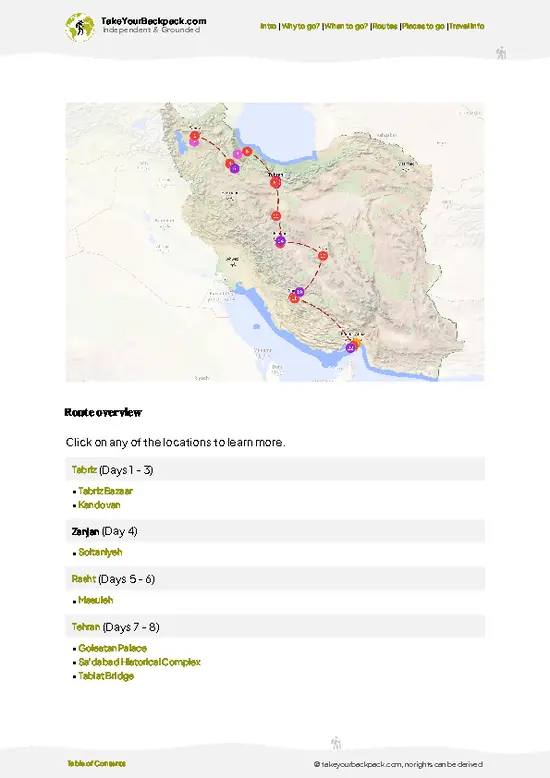
example page 0 from our offline Travel Guide for Iran
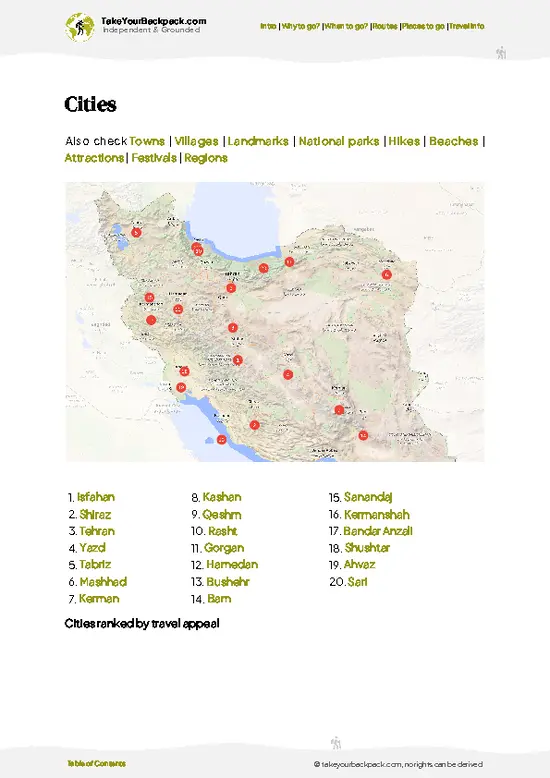
example page 1 from our offline Travel Guide for Iran
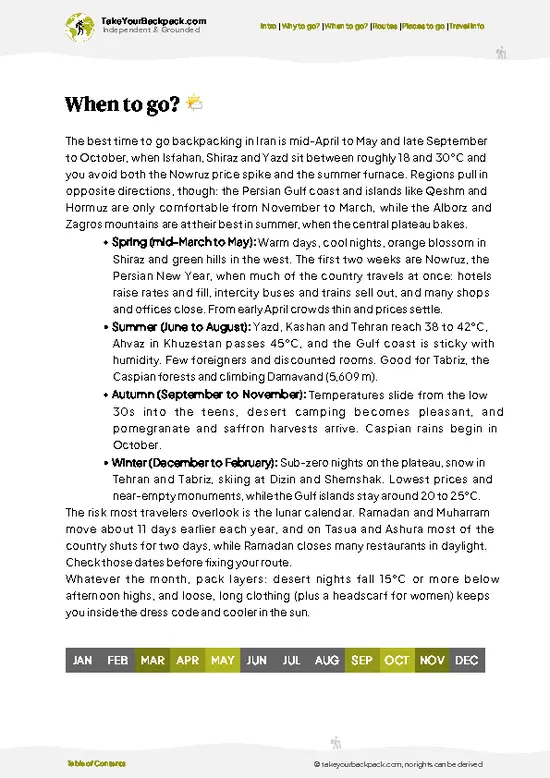
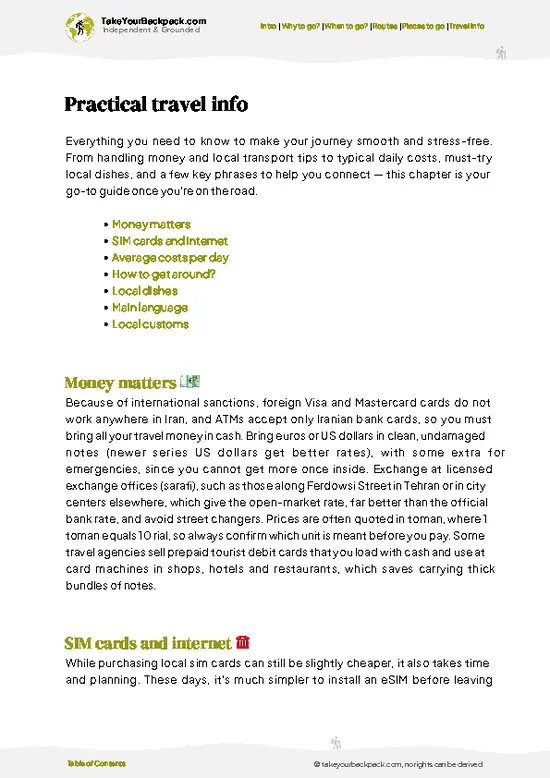
example page 2 from our offline Travel Guide for Iran
example page 3 from our offline Travel Guide for Iran
example page 4 from our offline Travel Guide for Iran
example page 5 from our offline Travel Guide for Iran
example page 6 from our offline Travel Guide for Iran
example page 7 from our offline Travel Guide for Iran
The digital guide (419 pages) contains:
121 highlights, ranked by travel appeal
Optimized 7, 14 & 21-day travel routes
Cities, national parks, landmarks, beaches
How to get around
Offline-friendly for travel without Wi-Fi
👉 Click to see all 30+ guide features

📅 Plan smarter in minutes, not weeks
Month by month travel advice
Festivals & national holidays
Budget expectations

🗺️ Go to the right places, skip the overrated ones
Honest pros & cons of destinations
Top hikes, parks & viewpoints
Lesser-known places most travelers miss
Clear “worth it vs skip it” guidance

🛏️ Travel smoothly without rookie mistakes
Best areas to stay
Transport systems explained simply
Common scams & safety advice
SIM cards, money & practical tips

🌍 Understand the country, not just visit it
Culture & traditions
52 Essential phrases & customs
Festivals worth planning around
Traveler-friendly historical context
Insights that make places more meaningful

📱 Built for real travel conditions
Fully downloadable PDF
Works completely offline
Optimized for phone use
Useful in remote areas & buses
Everything in one place
Save weeks of stressful planning
Get instant access to your full guide. 30‑day money-back guarantee.


By proceeding you agree to our terms.
Sent to your inbox immediately after payment • 100% Secure Checkout
Best Backpacking Travel Advisor 2025 tourism awardBest Backpacking
Travel Advisor
2025
What others say about Take Your Backpack Guides:
⭐⭐⭐⭐⭐
Fantastic, amazing amount of information!
⭐⭐⭐⭐⭐
My goodness this is amazing, it's what I've been looking for hats off too you!
⭐⭐⭐⭐⭐
I think this is absolutely BRILLIANT
⭐⭐⭐⭐
Very complete and informative. It's still missing places, but I gotta to commend you
⭐⭐⭐⭐⭐
This is truly amazing, thank you, can't wait to explore it with my kids!
⭐⭐⭐⭐⭐
Awesome resource, thank you!
⭐⭐⭐⭐⭐
This is amazing! Can't wait to explore the ones I haven't seen
⭐⭐⭐⭐
I love this! Well done, great idea.
⭐⭐⭐⭐⭐
Thanks for taking the time to make this gem!
⭐⭐⭐⭐⭐
This might be the best website I've ever seen.
⭐⭐⭐⭐⭐
Congratulations, and thank you so much for your work; it's incredibly valuable.
⭐⭐⭐⭐
In all seriousness I think you did a great job pointing out the important spots
⭐⭐⭐⭐⭐
10/10 very good
⭐⭐⭐⭐⭐
As someone who's only just starting to visit regularly this is awesome, thank you.
⭐⭐⭐⭐
Thank you very much! I'm going to visit my dad, it's going to be very useful!
⭐⭐⭐⭐⭐
This is really cool! We'll be travelling for the first time and this definitely come in handy.
⭐⭐⭐⭐⭐
You are now our minister of culture, congratulations 👨‍💼
⭐⭐⭐⭐⭐
Just wanted to tell you that this is a pearl! Going to follow your recommendations.
⭐⭐⭐⭐⭐
This is so cool. I'll definitely be using the resource for my travels soon.
⭐⭐⭐⭐⭐
This is very impressive! Good work.
⭐⭐⭐⭐⭐
This is an amazing and informative site. Very well done!

🛏️ Where to stay?Best areas to stay in Iran

In Shushtar, the best spot for backpackers is the area around the historic hydraulic system, especially near the old town’s core. This neighborhood balances safety with a lively, authentic vibe where locals and travelers mingle easily. It’s compact, so you can walk to key sites without hassle, saving time and money on transport. Hostels here are limited but cozy, often run by locals who double as informal guides, adding social value beyond just a bed. Compared to newer districts, this area feels more genuine and less isolated, making it ideal for solo travelers craving connection without sacrificing comfort or budget.

🚌 Getting aroundGetting around like a local

Shushtar moves at its own rhythm—less about strict timetables and more about a flow that blends tradition with necessity. It’s a city where the clock is a guideline, not a dictator. You’ll find that timing here is flexible, shaped by the sun’s arc and the hum of daily life rather than rigid schedules. This means your travel choices are less about catching a precise departure and more about reading the pulse of the city, balancing patience with practicality.


  • Walking: The most reliable and free way to navigate Shushtar’s compact center. Streets are pedestrian-friendly, and walking lets you absorb the city’s layers at your own pace—no schedule, just your own rhythm.

  • Shared Taxis: These operate on a semi-flexible schedule, usually starting around 7 AM and tapering off by 9 PM. They’re cheap,
read more 👉
Shushtar moves at its own rhythm—less about strict timetables and more about a flow that blends tradition with necessity. It’s a city where the clock is a guideline, not a dictator. You’ll find that timing here is flexible, shaped by the sun’s arc and the hum of daily life rather than rigid schedules. This means your travel choices are less about catching a precise departure and more about reading the pulse of the city, balancing patience with practicality.


  • Walking: The most reliable and free way to navigate Shushtar’s compact center. Streets are pedestrian-friendly, and walking lets you absorb the city’s layers at your own pace—no schedule, just your own rhythm.

  • Shared Taxis: These operate on a semi-flexible schedule, usually starting around 7 AM and tapering off by 9 PM. They’re cheap, around 10,000 IRR per ride, and faster than buses but less predictable in departure times.

  • Local Buses: Running roughly from 6 AM to 8 PM, buses are the cheapest option (a few thousand IRR) but slower and less comfortable. Expect stops every few blocks and a crowd that reflects the city’s daily grind.

  • Motorbike Taxis: For when time is tight and money is moderate, these zippy rides cost about double a shared taxi but slice through traffic with ease. Available throughout the day, they offer speed at the expense of comfort and safety.

👛 Costs (as of 18 February 2026)Travel costs and budget guide for Shushtar

Backpacking in Shushtar, Iran, offers a fascinating blend of affordability and cultural richness, but understanding the cost dynamics is key to making smart choices. Here’s the breakdown of what you’re likely to spend daily as an independent traveler:
  • Dorm Accommodation (High Season): Expect to pay around $8 to $12 per night in basic dorms. High season can push prices slightly up due to demand, but Shushtar remains budget-friendly compared to major Iranian cities.
  • Dorm Accommodation (Off-Season): Prices drop to about $5 to $8 per night. Off-season travelers can take advantage of quieter hostels and better deals without sacrificing safety or cleanliness.
  • Meals: Street food and local eateries dominate here, with meals typically costing between $2 and $5. Traditional Iranian dishes like kebabs
read more 👉
Backpacking in Shushtar, Iran, offers a fascinating blend of affordability and cultural richness, but understanding the cost dynamics is key to making smart choices. Here’s the breakdown of what you’re likely to spend daily as an independent traveler:
  • Dorm Accommodation (High Season): Expect to pay around $8 to $12 per night in basic dorms. High season can push prices slightly up due to demand, but Shushtar remains budget-friendly compared to major Iranian cities.
  • Dorm Accommodation (Off-Season): Prices drop to about $5 to $8 per night. Off-season travelers can take advantage of quieter hostels and better deals without sacrificing safety or cleanliness.
  • Meals: Street food and local eateries dominate here, with meals typically costing between $2 and $5. Traditional Iranian dishes like kebabs or stews are filling and affordable, making it easy to eat well on a shoestring.
  • Local Transport: Shushtar’s compact size means short taxi rides or minibuses cost roughly $0.20 to $0.50 per trip. Walking is often the best option, but when you need a lift, local transport won’t break the bank.
  • City Transport Pass: If you plan to use public transport extensively, a monthly pass is rare here, but daily transport costs remain low enough that passes aren’t necessary for short stays.
  • Basic Activities/Entry Fees: Visiting historical sites like the Shushtar Historical Hydraulic System usually costs around $1 to $3. These fees are modest, allowing you to explore without worrying about steep entrance costs.
  • Miscellaneous Expenses: Budget $1 to $3 for essentials like bottled water, snacks, or small souvenirs. Internet cafes and SIM cards are inexpensive, but factor in occasional extras for comfort or convenience.

In total, you’re looking at a daily budget between $12 and $25, depending on your accommodation choice and how much you move around. This range gives you the freedom to balance comfort and thrift while diving deep into Shushtar’s unique heritage.


source: irantravelingcenter.com
⚠️ Prices can change and everyone travels differently, so take this as a rough guide. Hope it helps you plan your adventure!

🚌 Day tripsEasy escapes and nearby places

Shushtar is a fantastic base for day trips, offering a blend of history, culture, and stunning landscapes. Here are some worthwhile excursions to consider.

Chogha Zanbil
This ancient ziggurat is a UNESCO World Heritage site that transports you back to the Elamite civilization. It’s about a 1.5-hour drive from Shushtar. The entrance fee is minimal, making it a budget-friendly excursion. Aim for early morning visits to avoid the heat and crowds. Many first-timers underestimate the time needed to explore the site fully, so plan for at least three hours.


Susa (Shush)
Just under two hours away, Susa is rich in archaeological treasures. The Achaemenid ruins and the Tomb of Daniel are must-sees. Expect to spend around $5 for transportation and entry fees. Spring and autumn are ideal for … read more 👉
Shushtar is a fantastic base for day trips, offering a blend of history, culture, and stunning landscapes. Here are some worthwhile excursions to consider.

Chogha Zanbil
This ancient ziggurat is a UNESCO World Heritage site that transports you back to the Elamite civilization. It’s about a 1.5-hour drive from Shushtar. The entrance fee is minimal, making it a budget-friendly excursion. Aim for early morning visits to avoid the heat and crowds. Many first-timers underestimate the time needed to explore the site fully, so plan for at least three hours.


Susa (Shush)
Just under two hours away, Susa is rich in archaeological treasures. The Achaemenid ruins and the Tomb of Daniel are must-sees. Expect to spend around $5 for transportation and entry fees. Spring and autumn are ideal for pleasant weather. A common mistake is rushing through the site; take your time to absorb the history.
👉 Explore Susa

Khoramabad
About a two-hour drive, this city is known for its stunning natural beauty and the Lorestan Museum. The museum showcases artifacts from the region, and the surrounding mountains offer great hiking. Budget around $10 for transport and entry. Visit in spring for the best views. Many backpackers overlook the museum, but it’s a treasure trove of local history.


Dezful
Just an hour away, Dezful is famous for its ancient bridge and vibrant bazaar. The bridge is a perfect spot for photos, and the bazaar is a great place to sample local snacks. Expect to spend around $5 for transport and snacks. Fall is the best time to visit. First-timers often miss the bazaar, so don’t skip it!
👉 Explore Dezful
Want to know what more Iran offers?
The Iran Travel Guide describes 121 highlights, from cities to national parks, from beaches to hikes

Get the Travel Guide -

🍲 FoodLocal Flavors for Backpackers

In Shushtar, the food scene is a vibrant tapestry of flavors. Dive into Khoresht-e Gheymé, a rich stew of tender meat and split peas, served with fluffy rice. Street vendors offer Samosas, crispy pastries stuffed with spiced potatoes, perfect for a quick bite.

Don’t miss the local tea culture; sipping sweet, fragrant tea is a ritual here. Cafés buzz with chatter, where locals gather to unwind.

When dining, expect to share dishes; it’s a sign of hospitality. Remember, eating with your right hand is customary, adding a personal touch to the experience. Embrace the lively atmosphere, and let the flavors of Shushtar linger on your palate.

🛡️ SafetyTraveler Safety Guide

Shushtar is generally safe, but a few areas require extra awareness, especially near busy markets. If you’re solo, keep your wits about you after dark; stick to well-lit streets and avoid wandering into quieter alleys.

Common scams are rare, but be cautious of overly friendly locals who may try to guide you for a fee. Everyday annoyances include aggressive street vendors; a polite but firm “no, thank you” usually does the trick. Carry yourself confidently, and you’ll navigate the city with ease.

Other Iranian cities near Shushtar

Explore more nearby:

  • Dezful—Ancient bridge, riverbank parks, citrus gardens| 57 km away
  • Ahvaz—Karun River, palm groves, ethnic diversity| 83 km away
  • Khorramabad—Hilltop castle, waterfalls, Lurish culture| 165 km away

💡 Not sure where to go next?
Create a personalized itinerary for Iran including Shushtar and the places that fit your trip.

Generate my itinerary

👉 Discover all cities

Or checkout all Iran has to offer (think cities, towns, villages, national parks, hikes, beaches, festivals)
Country photo of Iran

We 💚 feedbackIs it worth it?

Shushtar’s charm lies in its ancient water systems and laid-back vibe. Don’t miss the stunning waterfalls; they’re a delightful surprise. Just be ready for the heat—stay hydrated and take it slow. This place rewards those who wander thoughtfully.

✍️ Help improve this page!
The information on this page is based on in-depth research, insights shared by experienced travelers, and feedback from the local travel community in Iran. While every effort is made to keep the information accurate and current, conditions can change — so if you spot anything incorrect or outdated, please get in touch.


🙋‍♂️ Give feedback

👋 Meet the founderWho’s Behind Take Your Backpack?

Johan, backpacker and founder of TakeYourBackpackHi, I’m Johan (Netherlands 🇳🇱), the creator of TakeYourBackpack. Over the past decade, I’ve backpacked through 80+ countries across six continents, gaining extensive experience with independent travel, long-term trips, and overland routes.

This site is built on a combination of firsthand travel experience and carefully curated insights from other backpackers. Many guides are based on places I’ve personally visited, while others bring together tips, observations, and practical advice shared by trusted travelers I’ve met along the way.

The goal is to provide realistic, experience-driven guidance — not generic itineraries — so you can explore destinations with better context, clearer expectations, and more confidence.

Get full Iran guide •
Instant download • 121 highlights • Full Offline guide