×

Iran🇮🇷 | national parksSiahkalCaspian rainforests, mossy ravines, ferns | things to do and best time to go

Explore Lut DesertExplore Tandooreh

Backpacking in Siahkal
👀 For curious travelersnational park ranked #20
By Johan Kruseman 🇳🇱 | Updated September 4, 2026

Many travelers assume Siahkal is just another roadside forest on the way to Rasht; it’s actually a sizable, humid Caspian-slope park in Gilan Province, northern Iran. Trails are informal but rewarding, with steep, muddy hikes through dense broadleaf forest, misty valleys, and decent birdlife, yet little big-game viewing. Access by shared taxi is straightforward, fees are low, and camping is common but basic, with some cheap guesthouses nearby. Expect local weekend crowds, far fewer foreign hikers, and a quieter, less polished experience than better-known parks like Alamut or Golestan.

Discover everything you want to know in the 📖 Iran Travel Guide.
Safety warning

The current risk level for Iran is high. Check the advice before going.


Get your Iran guide
118 ranked highlights, routes & tips, works offline (412 pages)
Loading the map 🌍
CLICK TO FILTER
cities
towns
villages
landmarks
national parks
hikes
beaches
attractions
festivals
regions
SHOW COUNTRY’S BESTSHOW ALL

✨ Why go?
Ranked #20 national park in Iran
What makes this national park worth exploring

Backpackers flock to Siahkal for its blend of independent exploration and budget-friendly options. The park offers a range of camping spots and nearby hostels, making it easy to stretch your budget. With trail variety, from gentle walks to challenging hikes, there’s something for everyone. This park is particularly suited for self-guided travelers; the well-marked paths allow you to navigate without a tour. Embrace the freedom to set your own pace and soak in the stunning landscapes without the constraints of a group. Just be prepared for changing weather—it’s part of the adventure.
Want to include Siahkal in your Iran route?
Create a personalized Iran itinerary that includes Siahkal and the places that fit your trip — based on your travel style, budget, and available time. Get your route in seconds.

Generate my trip

💡 HighlightsMust-see experiences and standout moments

  • Hyrcanian old-growth forest — ancient beech, hornbeam and chestnut stands with mossy trunks and a closed canopy; this is the same temperate forest belt that’s UNESCO-recognized, so expect dense, green, primeval-feeling woods unlike the dry interior of Iran.
  • Rudkhan Castle trail and fortress — a steep, stone-step hike through the forest that finishes at a brick medieval fortress on a ridge; great mix of exercise, history and sweeping views over the treetops.
  • Deylaman plateau and mountain meadows — high meadows that bloom with wildflowers in summer, dotted with grazing flocks and simple shepherd huts; excellent for gentle day hikes, camping and wide, open panoramas.
  • Waterfalls and mountain springs — numerous small cascades and crystal springs tucked into gullies and along trails; perfect
read more 👉
  • Hyrcanian old-growth forest — ancient beech, hornbeam and chestnut stands with mossy trunks and a closed canopy; this is the same temperate forest belt that’s UNESCO-recognized, so expect dense, green, primeval-feeling woods unlike the dry interior of Iran.
  • Rudkhan Castle trail and fortress — a steep, stone-step hike through the forest that finishes at a brick medieval fortress on a ridge; great mix of exercise, history and sweeping views over the treetops.
  • Deylaman plateau and mountain meadows — high meadows that bloom with wildflowers in summer, dotted with grazing flocks and simple shepherd huts; excellent for gentle day hikes, camping and wide, open panoramas.
  • Waterfalls and mountain springs — numerous small cascades and crystal springs tucked into gullies and along trails; perfect for cooling off, taking photos, or a picnic by clear, cold water.
  • River gorges and trout streams — narrow, rocky valleys carved by fast rivers with glassy pools and native trout; good spots for quiet breaks and landscape photography.
  • Birdwatching and wildlife — a rich bird list (woodpeckers, tits, raptors, kingfishers) and mammals like wild boar, roe deer and jackal; larger predators such as the Persian leopard are only rarely seen, but the area is important habitat.
  • Traditional mountain villages — small local villages with timber-and-stone houses, home-cooked Gilan cuisine and friendly hospitality; great for a cultural detour, buying local cheese or watching village life slow down at dusk.
Spotted a mistake or missing something? Contact us.

🌤️ When to go?Weather, crowds, and seasonal trade-offs


  • Weather: Spring (April to June) offers mild, pleasant conditions with temperatures ranging from 15°C to 25°C (59°F to 77°F), ideal for hiking without the oppressive heat or heavy rain of other seasons.

  • Temperature: Summer can spike above 30°C (86°F), making strenuous backpacking uncomfortable, while winter drops below freezing, often bringing snow that complicates trails.

  • Daylight Hours: Late spring and early summer provide long daylight—up to 14 hours—maximizing your trekking time without rushing.

  • Crowds: Peak tourist season is late spring; expect more visitors, which can affect campsite availability and local prices.

  • Seasonal Activities: Spring and early summer are best for wildflower blooms and birdwatching; autumn offers colorful foliage but shorter days.

  • Price Fluctuations: Accommodation
read more 👉

  • Weather: Spring (April to June) offers mild, pleasant conditions with temperatures ranging from 15°C to 25°C (59°F to 77°F), ideal for hiking without the oppressive heat or heavy rain of other seasons.

  • Temperature: Summer can spike above 30°C (86°F), making strenuous backpacking uncomfortable, while winter drops below freezing, often bringing snow that complicates trails.

  • Daylight Hours: Late spring and early summer provide long daylight—up to 14 hours—maximizing your trekking time without rushing.

  • Crowds: Peak tourist season is late spring; expect more visitors, which can affect campsite availability and local prices.

  • Seasonal Activities: Spring and early summer are best for wildflower blooms and birdwatching; autumn offers colorful foliage but shorter days.

  • Price Fluctuations: Accommodation and local services tend to be pricier during spring’s peak; off-season visits can save money but at the cost of harsher weather.


Pro-tip: Aim for late April to early June to balance weather, daylight, and crowd levels—saving your energy and budget for the trails, not the hassles.


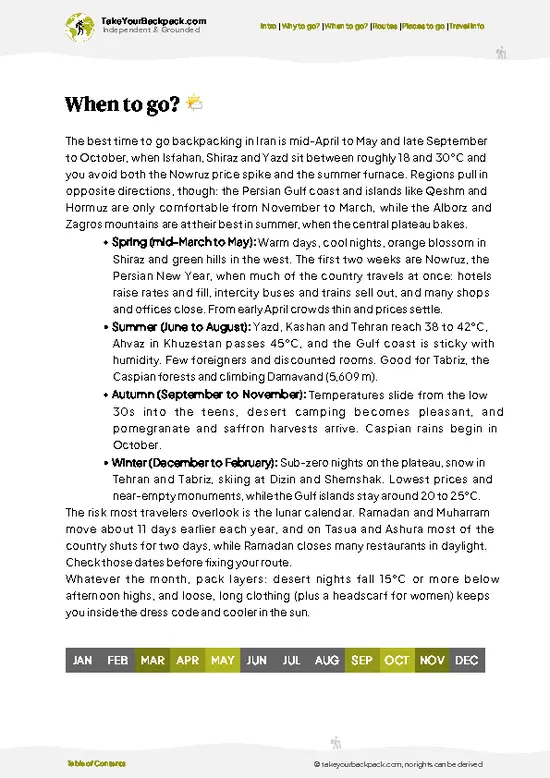
source: climatestotravel.comJANJanuary: below average for travelingFEBFebruary: below average for travelingMARMarch: fair for travelingAPRApril: excellent for travelingMAYMay: excellent for travelingJUNJune: highly recommended for travelingJULJuly: fair for travelingAUGAugust: fair for travelingSEPSeptember: good for travelingOCTOctober: good for travelingNOVNovember: fair for travelingDECDecember: below average for traveling
when-to-go

✈️ The backpacker research shortcutIran Travel Guide

An offline-friendly backpacking guide with optimized travel routes, ranked highlights, transport advice, and the best areas to stay.
example page 0 from our offline Travel Guide for Iran
example page 1 from our offline Travel Guide for Iran
example page 2 from our offline Travel Guide for Iran
example page 3 from our offline Travel Guide for Iran
example page 4 from our offline Travel Guide for Iran
example page 5 from our offline Travel Guide for Iran
example page 6 from our offline Travel Guide for Iran
example page 7 from our offline Travel Guide for Iran
The digital guide (412 pages) contains:
118 highlights, ranked by travel appeal
Optimized 7, 14 & 21-day travel routes
Cities, national parks, landmarks, beaches
How to get around
Offline-friendly for travel without Wi-Fi
👉 Click to see all 30+ guide features

📅 Plan smarter in minutes, not weeks
Month by month travel advice
Festivals & national holidays
Budget expectations

🗺️ Go to the right places, skip the overrated ones
Honest pros & cons of destinations
Top hikes, parks & viewpoints
Lesser-known places most travelers miss
Clear “worth it vs skip it” guidance

🛏️ Travel smoothly without rookie mistakes
Best areas to stay
Transport systems explained simply
Common scams & safety advice
SIM cards, money & practical tips

🌍 Understand the country, not just visit it
Culture & traditions
52 Essential phrases & customs
Festivals worth planning around
Traveler-friendly historical context
Insights that make places more meaningful

📱 Built for real travel conditions
Fully downloadable PDF
Works completely offline
Optimized for phone use
Useful in remote areas & buses
Everything in one place
Save weeks of stressful planning
Get instant access to your full guide. 30‑day money-back guarantee.
+ Add another guide for just US$7.80

By proceeding you agree to our terms.
Sent to your inbox immediately after payment • 100% Secure Checkout
Best Backpacking Travel Advisor 2025 tourism awardBest Backpacking
Travel Advisor
2025
What others say about Take Your Backpack Guides:
⭐⭐⭐⭐⭐
Fantastic, amazing amount of information!
⭐⭐⭐⭐⭐
My goodness this is amazing, it's what I've been looking for hats off too you!
⭐⭐⭐⭐⭐
I think this is absolutely BRILLIANT
⭐⭐⭐⭐
Very complete and informative. It's still missing places, but I gotta to commend you
⭐⭐⭐⭐⭐
This is truly amazing, thank you, can't wait to explore it with my kids!
⭐⭐⭐⭐⭐
Awesome resource, thank you!
⭐⭐⭐⭐⭐
This is amazing! Can't wait to explore the ones I haven't seen
⭐⭐⭐⭐
I love this! Well done, great idea.
⭐⭐⭐⭐⭐
Thanks for taking the time to make this gem!
⭐⭐⭐⭐⭐
This might be the best website I've ever seen.
⭐⭐⭐⭐⭐
Congratulations, and thank you so much for your work; it's incredibly valuable.
⭐⭐⭐⭐
In all seriousness I think you did a great job pointing out the important spots
⭐⭐⭐⭐⭐
10/10 very good
⭐⭐⭐⭐⭐
As someone who's only just starting to visit regularly this is awesome, thank you.
⭐⭐⭐⭐
Thank you very much! I'm going to visit my dad, it's going to be very useful!
⭐⭐⭐⭐⭐
This is really cool! We'll be travelling for the first time and this definitely come in handy.
⭐⭐⭐⭐⭐
You are now our minister of culture, congratulations 👨‍💼
⭐⭐⭐⭐⭐
Just wanted to tell you that this is a pearl! Going to follow your recommendations.
⭐⭐⭐⭐⭐
This is so cool. I'll definitely be using the resource for my travels soon.
⭐⭐⭐⭐⭐
This is very impressive! Good work.
⭐⭐⭐⭐⭐
This is an amazing and informative site. Very well done!

🛏️ Where to stay?How to pick the right area

For backpackers heading to Siahkal National Park, your best bet is to stay in the nearby town of Siahkal itself. It offers budget-friendly guesthouses and local inns that provide a cozy atmosphere without breaking the bank.

Inside the park, accommodation options are limited. You might find a few basic lodges, but they can fill up quickly, especially in peak season.

Consider staying in Rasht, about 30 kilometers away, for more choices. It’s a larger city with a variety of hostels and hotels. Just be mindful of transportation times to the park; plan your trips accordingly to maximize your adventure.

👛 Costs (as of 4 September 2026)Money, prices, and spending tips

Visiting Siahkal National Park in Iran can be a rewarding experience, but it’s essential to be aware of the costs involved to avoid any surprises.

Entrance fees typically range from €2 to €5 (or $2 to $6). This is a small price to pay for access to the park’s stunning landscapes and diverse wildlife.

Accommodation options vary widely. Budget travelers can find basic guesthouses or campsites for around €10 to €20 ($11 to $22) per night. If you’re looking for something more comfortable, mid-range hotels might cost between €30 and €60 ($33 to $66) per night.

Food is generally affordable. Street food or local eateries can cost as little as €3 to €7 ($3 to $8) per meal. If you opt for a sit-down restaurant, expect to pay around €10 to €15 ($11 to $17) for a decent meal.

Transportation can … read more 👉
Visiting Siahkal National Park in Iran can be a rewarding experience, but it’s essential to be aware of the costs involved to avoid any surprises.

Entrance fees typically range from €2 to €5 (or $2 to $6). This is a small price to pay for access to the park’s stunning landscapes and diverse wildlife.

Accommodation options vary widely. Budget travelers can find basic guesthouses or campsites for around €10 to €20 ($11 to $22) per night. If you’re looking for something more comfortable, mid-range hotels might cost between €30 and €60 ($33 to $66) per night.

Food is generally affordable. Street food or local eateries can cost as little as €3 to €7 ($3 to $8) per meal. If you opt for a sit-down restaurant, expect to pay around €10 to €15 ($11 to $17) for a decent meal.

Transportation can add up. Local taxis or rideshare services might charge between €5 to €15 ($6 to $17) for short trips within the area. If you’re planning to rent a car, prices can start at around €30 ($33) per day, plus fuel.

Keep in mind that guided tours can enhance your experience, but they come with a price. Expect to pay anywhere from €50 to €100 ($55 to $110) for a full-day tour, depending on the inclusions.

Plan your budget wisely. Knowing these costs upfront will help you focus on enjoying the park rather than worrying about your wallet.


source: irantravelingcenter.com
⚠️ Prices can change and everyone travels differently, so take this as a rough guide. Hope it helps you plan your adventure!

🥾 TrailsExploring Siahkal: trails, terrain, and views

Siahkal National Park is a hidden gem in Iran, with a mix of rugged mountains, lush valleys, and stunning vistas that make it a hiker’s delight. The terrain varies from rocky paths to soft, grassy meadows, offering something for everyone. Wildlife is abundant here; keep an eye out for native species like wild goats and various bird species that call this place home. The hiking challenges can range from easy strolls to more strenuous climbs, depending on your route.

One popular route is the Siahkal Loop. Here are the details:
  • Length: 10 km
  • Estimated Duration: 4-5 hours
  • Difficulty Level: Moderate
  • Key
read more 👉
Siahkal National Park is a hidden gem in Iran, with a mix of rugged mountains, lush valleys, and stunning vistas that make it a hiker’s delight. The terrain varies from rocky paths to soft, grassy meadows, offering something for everyone. Wildlife is abundant here; keep an eye out for native species like wild goats and various bird species that call this place home. The hiking challenges can range from easy strolls to more strenuous climbs, depending on your route.

One popular route is the Siahkal Loop. Here are the details:
  • Length: 10 km
  • Estimated Duration: 4-5 hours
  • Difficulty Level: Moderate
  • Key Features: Scenic views of the surrounding mountains and valleys, opportunities for wildlife spotting
  • Terrain: Mixed, with some rocky sections and gentle inclines

Getting to Siahkal National Park is pretty straightforward. You can catch a bus from nearby cities like Rasht or Tehran, which usually takes a few hours. Just be prepared for some adventure, as public transport can be a bit of a wild card in terms of schedules. As for crowds, it can get busy during weekends, especially in peak season, but you’ll still find plenty of quiet spots if you venture a bit off the main trails. Entrance fees are generally low, making this a wallet-friendly option for nature lovers. Just check locally for the latest info, as it can change.
⚠️ Hiking info can sometimes be outdated or inaccurate. Before you hit the trail, check the latest conditions with locals. If you do spot anything that's off, I'd love to hear from you, so I can update it for fellow travelers.

🛡️ SafetyStaying Safe: What Travelers Should Know

Siahkal National Park offers a rewarding experience, but it’s wise to stay grounded. Weather can shift quickly, so pack layers and be prepared for sudden changes. The terrain varies; some trails are steep and rocky, requiring careful footing. Navigation can be tricky, so a reliable map or GPS is essential. Wildlife is present, but encounters are rare; keep a respectful distance and don’t feed animals. First-timers often underestimate the altitude; acclimatize gradually to avoid fatigue. Stay aware, pace yourself, and enjoy the journey.

FAQCommon questions from travelers

2 to 3 days are sufficient to explore the main trails and natural features of Siahkal National Park. This allows time for hiking, wildlife observation, and enjoying the forest scenery. Longer stays are possible if you want to explore more remote areas or camp overnight.
Yes, you can visit Siahkal without a car by using local buses or taxis from nearby towns like Rasht. However, public transport options may be limited and less frequent, so plan accordingly. Hiring a local guide or arranging transport in advance is recommended for easier access.
Yes, an entrance fee or permit is required to enter Siahkal National Park. The fee is typically around 20,000 to 50,000 Iranian Rials per person, but it can vary. Permits are usually obtained at the park entrance or local ranger stations.
⚠️ Things can change over time, so always validate details locally before you go.

Other Iranian national parks near Siahkal

Explore more nearby:

  • Alamut Valley—castle ruins, limestone cliffs, remote villages| 88 km away
  • Tangeh Vashi—narrow gorge, river crossing, ancient reliefs| 226 km away
  • Lar National Park—Damavand views, alpine lakes, summer pastures| 231 km away

💡 Not sure where to go next?
Create a personalized itinerary for Iran including Siahkal and the places that fit your trip.

Generate my itinerary

👉 Discover all national parks

Or checkout all Iran has to offer (think cities, towns, villages, national parks, hikes, beaches, festivals)
Country photo of Iran

We 💚 feedbackIs it worth it?

Siahkal has a laid-back charm that sneaks up on you. The best surprise? The local food—don’t skip the fresh fish from the Caspian Sea. Just a heads-up: public transport can be tricky, so plan your rides ahead to keep your energy for exploration.

✍️ Help improve this page!
The information on this page is based on in-depth research, insights shared by experienced travelers, and feedback from the local travel community in Iran. While every effort is made to keep the information accurate and current, conditions can change — so if you spot anything incorrect or outdated, please get in touch.


🙋‍♂️ Give feedback

👋 Meet the founderWho’s Behind Take Your Backpack?

Johan, backpacker and founder of TakeYourBackpackHi, I’m Johan (Netherlands 🇳🇱), the creator of TakeYourBackpack. Over the past decade, I’ve backpacked through 80+ countries across six continents, gaining extensive experience with independent travel, long-term trips, and overland routes.

This site is built on a combination of firsthand travel experience and carefully curated insights from other backpackers. Many guides are based on places I’ve personally visited, while others bring together tips, observations, and practical advice shared by trusted travelers I’ve met along the way.

The goal is to provide realistic, experience-driven guidance — not generic itineraries — so you can explore destinations with better context, clearer expectations, and more confidence.

Get full Iran guide •
Instant download • 118 highlights • Full Offline guide