×

Iran🇮🇷 | landmarksTrans-Iranian Railwaymountain tunnels, viaducts, engineering landmarks | things to do and best time to go

Explore Tchogha ZanbilExplore Qeshm Island Geopark

Backpacking in Trans-Iranian Railway
UNESCO World Heritage site
👀 For curious travelersunique site ranked #12
By Johan Kruseman 🇳🇱 | Updated May 27, 2026

Most people think the Trans-Iranian Railway is just “a long train ride through the desert” you do for the Instagram window shot. Wrong. It’s a brutal, brilliant piece of engineering that cuts from the Caspian coast in the north, over the Alborz and Zagros ranges, down to the Persian Gulf in the south, stitching together half of Iran. For backpackers, it’s cheap by global standards, slow by design, and absolutely not glamorous: hard seats, delays, and locals hauling real-life cargo, not curated aesthetics. But the payoff is huge—tunnels, bridges, wild geology, Soviet-feeling stations, constant tea, and a front-row seat to how Iran actually moves, works, and talks.

Discover everything you want to know in the 📖 Iran Travel Guide.
Safety warning

The current risk level for Iran is high. Check the advice before going.


Get your Iran guide
121 ranked highlights, routes & tips, works offline (419 pages)
Loading the map 🌍
CLICK TO FILTER
cities
towns
villages
landmarks
national parks
hikes
beaches
attractions
festivals
regions
SHOW COUNTRY’S BESTSHOW ALL

✨ Why go?
Ranked #12 unique site in Iran
What makes this unique site worth visiting

The Trans-Iranian Railway isn’t just a train ride; it’s a journey through time and terrain. Sure, you’ll share the car with a few tourists, but the real magic lies in the stunning landscapes—from the Alborz Mountains to the vast deserts. This isn’t a quick Instagram snap; it’s a slow burn of experiences that unfold over hours.

Costs are low, especially when you consider the value of what you’re seeing. It’s a budget-friendly way to connect Iran’s diverse regions, making it a natural fit in any broader route. Plus, you’ll meet locals who are often eager to share stories, adding layers to your adventure. The Trans-Iranian Railway is a must for those who crave authenticity over the polished tourist experience.
Want to include Trans-Iranian Railway in your Iran route?
Create a personalized Iran itinerary that includes Trans-Iranian Railway and the places that fit your trip — based on your travel style, budget, and available time. Get your route in seconds.

Generate my trip

💡 HighlightsPlaces and moments you shouldn't skip

  • Veresk Bridge — A jaw-dropping 1930s arch bridge tucked into the Alborz Mountains; engineering and location combine so dramatically it became legendary during WWII as a critical supply route and a local symbol of grit.
  • Alborz mountain tunnels and viaducts — Long carved tunnels, steep grades and cantilevered viaducts make the northern stretches feel like a civil-engineering safari; the way the track snakes through cliffs is unlike most rail trips anywhere.
  • Tehran Railway Station & Railway Museum — The grand old station and its small museum let you touch the material history: vintage locomotives, period signage and the atmosphere of Iran’s early rail era all in one place.
  • Caspian and Persian Gulf contrasts — Riding parts of the line you’ll go from humid, green Caspian lowlands to arid southern
read more 👉
  • Veresk Bridge — A jaw-dropping 1930s arch bridge tucked into the Alborz Mountains; engineering and location combine so dramatically it became legendary during WWII as a critical supply route and a local symbol of grit.
  • Alborz mountain tunnels and viaducts — Long carved tunnels, steep grades and cantilevered viaducts make the northern stretches feel like a civil-engineering safari; the way the track snakes through cliffs is unlike most rail trips anywhere.
  • Tehran Railway Station & Railway Museum — The grand old station and its small museum let you touch the material history: vintage locomotives, period signage and the atmosphere of Iran’s early rail era all in one place.
  • Caspian and Persian Gulf contrasts — Riding parts of the line you’ll go from humid, green Caspian lowlands to arid southern plains and coastal panoramas — a neat way to see Iran’s ecological variety without changing transport modes.
  • Historic stations and market towns — Small stations along the route often double as local hubs: grab tea, watch goods being loaded, and walk a few minutes to bazaars where everyday provincial life feels authentic and unfussed.
  • Classic bridges and masonry structures — Beyond Veresk there are a bunch of handsome stone and steel bridges and culverts from the original construction — practical engineering that also reads as quietly handsome architecture.
  • Living heritage and national story — The railway isn’t just old infrastructure; it helped unify north and south, jump-started modern industry, and still functions today — so you get history that’s active, noisy and useful rather than museum-quiet.
Spotted a mistake or missing something? Contact us.

🌤️ When to go?Seasonal considerations and timing


  • Weather: The Trans-Iranian Railway cuts through varied landscapes, so expect extremes. Spring (April-May) and autumn (September-October) offer mild, comfortable temperatures—perfect for long days on the rails without sweating buckets or freezing your fingers off.

  • Temperature: Summer can scorch with highs hitting 35-40°C (95-104°F), especially in desert stretches. Winters plunge below freezing in mountainous zones, sometimes down to -10°C (14°F), making travel tougher and less scenic.

  • Daylight Hours: Longer daylight in spring and autumn means more time to soak in views. Winter days are short and gray, while summer days stretch long but bring heat that can sap your energy.

  • Crowds: Peak tourist season aligns with spring and autumn. Expect more travelers, but nothing like the crush at major global
read more 👉

  • Weather: The Trans-Iranian Railway cuts through varied landscapes, so expect extremes. Spring (April-May) and autumn (September-October) offer mild, comfortable temperatures—perfect for long days on the rails without sweating buckets or freezing your fingers off.

  • Temperature: Summer can scorch with highs hitting 35-40°C (95-104°F), especially in desert stretches. Winters plunge below freezing in mountainous zones, sometimes down to -10°C (14°F), making travel tougher and less scenic.

  • Daylight Hours: Longer daylight in spring and autumn means more time to soak in views. Winter days are short and gray, while summer days stretch long but bring heat that can sap your energy.

  • Crowds: Peak tourist season aligns with spring and autumn. Expect more travelers, but nothing like the crush at major global sites. Winter sees fewer visitors, offering solitude but harsher conditions.

  • Seasonal Activities: Spring blooms and autumn foliage add color to the journey. Winter snows transform mountain passes into stark, dramatic scenes, but limit outdoor stops. Summer’s heat discourages lengthy breaks outside the train.

  • Price Fluctuations: Ticket prices and accommodation along the route rise modestly in peak seasons. Winter offers cheaper fares but fewer services, so weigh cost savings against comfort.


Pro-tip: Aim for late April or early October—sweet spots where weather, daylight, and crowd levels align to let the railway’s raw, rugged charm shine without the hassle.


source: climatestotravel.comJANJanuary: fair for travelingFEBFebruary: fair for travelingMARMarch: good for travelingAPRApril: excellent for travelingMAYMay: excellent for travelingJUNJune: good for travelingJULJuly: fair for travelingAUGAugust: fair for travelingSEPSeptember: excellent for travelingOCTOctober: excellent for travelingNOVNovember: good for travelingDECDecember: fair for traveling
iran-unique-site-trans-iranian-railway
© Google |

✈️ The backpacker research shortcutIran Travel Guide

An offline-friendly backpacking guide with optimized travel routes, ranked highlights, transport advice, and the best areas to stay.
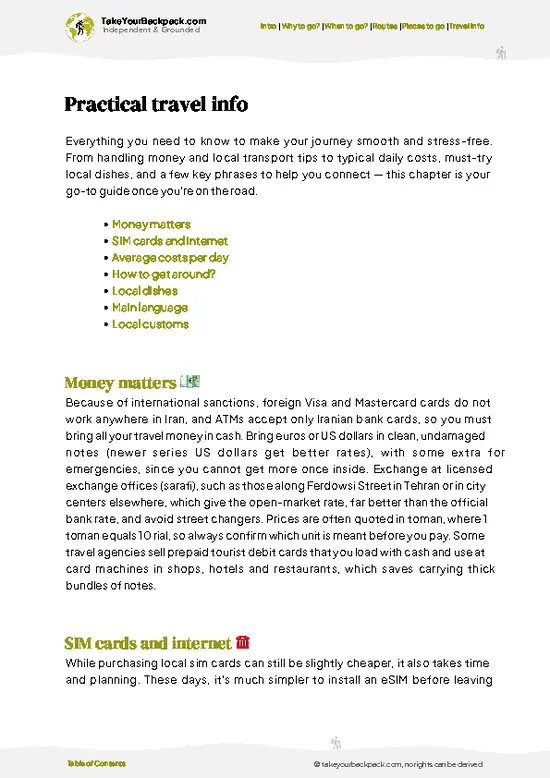
example page 0 from our offline Travel Guide for Iran
example page 1 from our offline Travel Guide for Iran
example page 2 from our offline Travel Guide for Iran
example page 3 from our offline Travel Guide for Iran
example page 4 from our offline Travel Guide for Iran
example page 5 from our offline Travel Guide for Iran
example page 6 from our offline Travel Guide for Iran
example page 7 from our offline Travel Guide for Iran
The digital guide (419 pages) contains:
121 highlights, ranked by travel appeal
Optimized 7, 14 & 21-day travel routes
Cities, national parks, landmarks, beaches
How to get around
Offline-friendly for travel without Wi-Fi
👉 Click to see all 30+ guide features

📅 Plan smarter in minutes, not weeks
Month by month travel advice
Festivals & national holidays
Budget expectations

🗺️ Go to the right places, skip the overrated ones
Honest pros & cons of destinations
Top hikes, parks & viewpoints
Lesser-known places most travelers miss
Clear “worth it vs skip it” guidance

🛏️ Travel smoothly without rookie mistakes
Best areas to stay
Transport systems explained simply
Common scams & safety advice
SIM cards, money & practical tips

🌍 Understand the country, not just visit it
Culture & traditions
52 Essential phrases & customs
Festivals worth planning around
Traveler-friendly historical context
Insights that make places more meaningful

📱 Built for real travel conditions
Fully downloadable PDF
Works completely offline
Optimized for phone use
Useful in remote areas & buses
Everything in one place
Save weeks of stressful planning
Get instant access to your full guide. 30‑day money-back guarantee.


By proceeding you agree to our terms.
Sent to your inbox immediately after payment • 100% Secure Checkout
Best Backpacking Travel Advisor 2025 tourism awardBest Backpacking
Travel Advisor
2025
What others say about Take Your Backpack Guides:
⭐⭐⭐⭐⭐
Fantastic, amazing amount of information!
⭐⭐⭐⭐⭐
My goodness this is amazing, it's what I've been looking for hats off too you!
⭐⭐⭐⭐⭐
I think this is absolutely BRILLIANT
⭐⭐⭐⭐
Very complete and informative. It's still missing places, but I gotta to commend you
⭐⭐⭐⭐⭐
This is truly amazing, thank you, can't wait to explore it with my kids!
⭐⭐⭐⭐⭐
Awesome resource, thank you!
⭐⭐⭐⭐⭐
This is amazing! Can't wait to explore the ones I haven't seen
⭐⭐⭐⭐
I love this! Well done, great idea.
⭐⭐⭐⭐⭐
Thanks for taking the time to make this gem!
⭐⭐⭐⭐⭐
This might be the best website I've ever seen.
⭐⭐⭐⭐⭐
Congratulations, and thank you so much for your work; it's incredibly valuable.
⭐⭐⭐⭐
In all seriousness I think you did a great job pointing out the important spots
⭐⭐⭐⭐⭐
10/10 very good
⭐⭐⭐⭐⭐
As someone who's only just starting to visit regularly this is awesome, thank you.
⭐⭐⭐⭐
Thank you very much! I'm going to visit my dad, it's going to be very useful!
⭐⭐⭐⭐⭐
This is really cool! We'll be travelling for the first time and this definitely come in handy.
⭐⭐⭐⭐⭐
You are now our minister of culture, congratulations 👨‍💼
⭐⭐⭐⭐⭐
Just wanted to tell you that this is a pearl! Going to follow your recommendations.
⭐⭐⭐⭐⭐
This is so cool. I'll definitely be using the resource for my travels soon.
⭐⭐⭐⭐⭐
This is very impressive! Good work.
⭐⭐⭐⭐⭐
This is an amazing and informative site. Very well done!

🛏️ Where to stay?Best areas and accommodation options

Staying near the Trans-Iranian Railway is about more than just a bed; it’s about immersing yourself in the heart of Iran’s landscape and culture.

Look for accommodations in Tehran, where the railway begins. It’s bustling, with a mix of locals and travelers. You’ll find plenty of budget-friendly hostels that foster a social vibe, perfect for meeting fellow adventurers.

Isfahan is another hotspot. Known for its stunning architecture, it’s a great base for exploring the railway’s scenic routes. The hostels here often organize group outings, making it easy to connect with others while soaking … read more 👉
Staying near the Trans-Iranian Railway is about more than just a bed; it’s about immersing yourself in the heart of Iran’s landscape and culture.

Look for accommodations in Tehran, where the railway begins. It’s bustling, with a mix of locals and travelers. You’ll find plenty of budget-friendly hostels that foster a social vibe, perfect for meeting fellow adventurers.

Isfahan is another hotspot. Known for its stunning architecture, it’s a great base for exploring the railway’s scenic routes. The hostels here often organize group outings, making it easy to connect with others while soaking in the city’s rich history.

Yazd, with its unique desert charm, offers a more laid-back atmosphere. The guesthouses are often family-run, providing a warm welcome and a chance to experience authentic Persian hospitality.

These areas are safe, vibrant, and filled with opportunities to dive deep into the local culture while you explore the railway’s breathtaking journey.

👛 Costs (as of 5 February 2026)Travel costs and budget guide for Trans-Iranian Railway

Visiting the Trans-Iranian Railway is a journey that blends breathtaking landscapes with a rich tapestry of culture. But let’s get real about the costs involved.
  • Train Tickets: Expect to pay between €10 to €50 ($11 to $55) depending on the class and distance. First-class tickets offer more comfort but can be a splurge. The scenic views are worth every cent, especially on longer routes.
  • Accommodation: Budget options start around €10 to €20 ($11 to $22) per night in hostels or guesthouses. Mid-range hotels can range from €30 to €70 ($33 to $77). Prices vary significantly based on location and amenities, so do your homework.
  • Food: Street food is your best friend here. You can eat well for about €3 to €7 ($3.30 to $7.70) per meal. If you opt for sit-down restaurants, expect to spend €10 to €20 ($11
read more 👉
Visiting the Trans-Iranian Railway is a journey that blends breathtaking landscapes with a rich tapestry of culture. But let’s get real about the costs involved.
  • Train Tickets: Expect to pay between €10 to €50 ($11 to $55) depending on the class and distance. First-class tickets offer more comfort but can be a splurge. The scenic views are worth every cent, especially on longer routes.
  • Accommodation: Budget options start around €10 to €20 ($11 to $22) per night in hostels or guesthouses. Mid-range hotels can range from €30 to €70 ($33 to $77). Prices vary significantly based on location and amenities, so do your homework.
  • Food: Street food is your best friend here. You can eat well for about €3 to €7 ($3.30 to $7.70) per meal. If you opt for sit-down restaurants, expect to spend €10 to €20 ($11 to $22) for a decent meal. Local cuisine is a highlight, so don’t skip it.
  • Transportation: Local transport is affordable. Buses and taxis can cost around €1 to €5 ($1.10 to $5.50) for short distances. If you’re traveling between cities, budget for €5 to €15 ($5.50 to $16.50) for bus fares.
  • Activities: Entrance fees to attractions along the railway can range from €1 to €10 ($1.10 to $11). Some natural sites are free, but guided tours might add to your costs. Always check what’s included.

The Trans-Iranian Railway isn’t just about the ticket price; it’s about the experience. Prepare for crowds in peak seasons, but the journey through Iran’s diverse landscapes is a reward that transcends the costs.


source: irantravelingcenter.com
⚠️ Prices can change and everyone travels differently, so take this as a rough guide. Hope it helps you plan your adventure!

Other Iranian landmarks near Trans-Iranian Railway

Explore more nearby:


💡 Not sure where to go next?
Create a personalized itinerary for Iran including Trans-Iranian Railway and the places that fit your trip.

Generate my itinerary

👉 Discover all landmarks

Or checkout all Iran has to offer (think cities, towns, villages, national parks, hikes, beaches, festivals)
Country photo of Iran

We 💚 feedbackWhat to keep in mind

The Trans-Iranian Railway isn’t just a ride; it’s a journey through the heart of Iran. Expect crowds and a few delays, but the real magic lies in the conversations with locals. The best surprise? Stumbling upon a tiny village market where the spices hit you like a warm hug. Just be ready for the occasional language barrier—it adds character.

✍️ Help improve this page!
The information on this page is based on in-depth research, insights shared by experienced travelers, and feedback from the local travel community in Iran. While every effort is made to keep the information accurate and current, conditions can change — so if you spot anything incorrect or outdated, please get in touch.


🙋‍♂️ Give feedback

👋 Meet the founderWho’s Behind Take Your Backpack?

Johan, backpacker and founder of TakeYourBackpackHi, I’m Johan (Netherlands 🇳🇱), the creator of TakeYourBackpack. Over the past decade, I’ve backpacked through 80+ countries across six continents, gaining extensive experience with independent travel, long-term trips, and overland routes.

This site is built on a combination of firsthand travel experience and carefully curated insights from other backpackers. Many guides are based on places I’ve personally visited, while others bring together tips, observations, and practical advice shared by trusted travelers I’ve met along the way.

The goal is to provide realistic, experience-driven guidance — not generic itineraries — so you can explore destinations with better context, clearer expectations, and more confidence.

Get full Iran guide •
Instant download • 121 highlights • Full Offline guide