×

Iran🇮🇷 | best landmarksExplore the 12 Best landmarks in Iran

Landmarks in Iran are layered: Achaemenid stone, Safavid tilework and Qajar mansions often sit within a few hours of each other. The experience changes sharply by region. The central plateau (Isfahan, Yazd, Shiraz) holds the densest, best-maintained sites, with the heaviest foreign and domestic crowds and the highest entry fees. The south offers ancient ruins with wide open space and few visitors. The northwest and west bring rural churches, caves and hill fortresses that take real effort to reach and cost little. Entry tickets for foreigners run roughly 10 to 20 times what Iranians pay, so budget for that. For independent travel and backpacking, the plateau cities are easy: cheap buses, shared taxis and hostels. Skip anything in the far southeast unless you have extra days and a driver. Choose the plateau for density and ease, and the south or west for solitude.

By Johan Kruseman 🇳🇱 | Updated October 18, 2026
Explore the best national parks in Iran

Why go?Why These unique site Stand Out

Iran suits landmarks because it was the center of several empires in succession: Achaemenid, Parthian, Sasanian, then Islamic dynasties that rebuilt the same cities rather than abandoning them. The result is a country where one itinerary covers over two millennia of architecture without crossing a border. Geography helped preservation. The dry plateau climate keeps mud-brick, wood and painted plaster intact far longer than damp regions would, and the desert cities were designed around wind towers, underground water channels and thick walls that survive as working structures.

A few things shape the experience. Foreigner ticket prices are set far above local rates and are paid in rials, with prices quoted to tourists often in the equivalent of US$5 to 10 for a major site. International bank … read more 👉
Iran suits landmarks because it was the center of several empires in succession: Achaemenid, Parthian, Sasanian, then Islamic dynasties that rebuilt the same cities rather than abandoning them. The result is a country where one itinerary covers over two millennia of architecture without crossing a border. Geography helped preservation. The dry plateau climate keeps mud-brick, wood and painted plaster intact far longer than damp regions would, and the desert cities were designed around wind towers, underground water channels and thick walls that survive as working structures.

A few things shape the experience. Foreigner ticket prices are set far above local rates and are paid in rials, with prices quoted to tourists often in the equivalent of US$5 to 10 for a major site. International bank cards do not work, so you carry cash in dollars or euros and change it locally. Many sites are open daily but close for midday prayers or a long afternoon break, and some museums shut on Mondays or national holidays.

Signs are often in Persian only at lesser sites, and English labeling is thin outside the big five. Hire a guide only for ruins where context matters; at working mosques and palaces, wandering is fine. Expect dress rules at every religious site: women need a headscarf and loose clothing, and some shrines provide a chador. Not worth the time: the many small provincial museums with mostly unlabeled pottery. Worth every rial: sites where the architecture is the experience, such as large mosque complexes and ancient terraces, where you want hours, not minutes.
Why These Made the Cut
The list of best unique sites in Iran is created based on history or culture, wow factor, atmosphere, quirks, and memorability. If you feel a unique site is missing in this list, please let us know.

When to go?When to Plan Your Trip

Best months: The best months for landmarks in Iran are April to May and late September to October, when the central plateau sits at roughly 18 to 28°C by day and the light suits both open ruins and tiled interiors. Rain is rare in these windows, and cities like Isfahan, Yazd and Shiraz are comfortable to walk from morning to evening.
Shoulder and low seasons: March is cooler, with daytime highs near 12 to 18°C and cold nights, and it brings the Nowruz period (around March 20 to early April). That is the one peak that changes decisions: Iranians travel en masse, hotels fill, prices rise by 30 to 100 percent in popular cities, and buses and trains sell out days ahead. Avoid it unless you book transport and beds early. November is fine on the plateau but the days shorten and temperatures drop … read more 👉
Best months: The best months for landmarks in Iran are April to May and late September to October, when the central plateau sits at roughly 18 to 28°C by day and the light suits both open ruins and tiled interiors. Rain is rare in these windows, and cities like Isfahan, Yazd and Shiraz are comfortable to walk from morning to evening.
Shoulder and low seasons: March is cooler, with daytime highs near 12 to 18°C and cold nights, and it brings the Nowruz period (around March 20 to early April). That is the one peak that changes decisions: Iranians travel en masse, hotels fill, prices rise by 30 to 100 percent in popular cities, and buses and trains sell out days ahead. Avoid it unless you book transport and beds early. November is fine on the plateau but the days shorten and temperatures drop to around 10 to 18°C.
Summer: June to August is not worth it on the plateau and in the south. Yazd and Kashan regularly pass 40°C, Shiraz is only slightly gentler, and open-air ruins in the southwest (Khuzestan) can exceed 45°C. Sites there are practically empty for good reason. If you must go in summer, favor the northwest and Caspian-facing mountains, where highs stay around 25 to 32°C.
Winter: December to February is cold in the north and northwest, with snow closing mountain roads in Kurdistan, Azerbaijan and parts of the Zagros. The south (Persian Gulf coast, Shiraz region) is mild, around 15 to 22°C, which makes it the winter choice. Prices and crowds are lowest, but daylight is short, with sunset near 5:30 pm, so plan sightseeing early.

unique site hoppingHow to Combine landmarks Into One Trip

How many days a multi-landmark trip needs: A trip linking Iran’s main landmarks needs 12 to 18 days. Under 10 days, you spend more time on buses and in airports than at the sites. Past 21 days, the added stops start repeating each other: another mosque courtyard, another garden, another bazaar.
Regions that cluster and the direction to travel: Three clusters work well. The central desert belt (Kashan, Yazd, Isfahan) sits along one corridor, and each city is 2 to 4 hours from the next by road. The south (Shiraz and the Persepolis area) hangs off Isfahan by a 5 to 6 hour drive or a short flight. The northwest (Tabriz, Kandovan, Zanjan) is a separate trip, 10 to 14 hours by road from Isfahan, so skip it unless you have extra days or are willing to fly.
The sensible direction is Tehran, then Kashan, … read more 👉
How many days a multi-landmark trip needs: A trip linking Iran’s main landmarks needs 12 to 18 days. Under 10 days, you spend more time on buses and in airports than at the sites. Past 21 days, the added stops start repeating each other: another mosque courtyard, another garden, another bazaar.
Regions that cluster and the direction to travel: Three clusters work well. The central desert belt (Kashan, Yazd, Isfahan) sits along one corridor, and each city is 2 to 4 hours from the next by road. The south (Shiraz and the Persepolis area) hangs off Isfahan by a 5 to 6 hour drive or a short flight. The northwest (Tabriz, Kandovan, Zanjan) is a separate trip, 10 to 14 hours by road from Isfahan, so skip it unless you have extra days or are willing to fly.
The sensible direction is Tehran, then Kashan, Isfahan, Yazd, Shiraz, and a flight or overnight bus back to Tehran (about 1 hour by air, 12 to 14 hours by bus). Running south to north also works, and it often means cheaper late-season flights. Reversing mid-trip does not.
Time per stop and between regions: Isfahan needs 2 to 3 full days, Shiraz with Persepolis 2 to 3, Yazd 2, Kashan 1 to 2 and Tehran 1 to 2. Overnight VIP buses between hubs cost roughly US$8 to 20 and save a hotel night, but you arrive at 5 a.m. with nowhere to go. Domestic flights run US$25 to 60 and pay off on the long hops only. Trains are comfortable on Tehran to Yazd and Tehran to Isfahan, and they sell out around Nowruz.
Planning mistakes and fixes: The first mistake is cramming Tehran, Isfahan, Yazd and Shiraz into one week. Cut Yazd or Shiraz instead. The second is booking bus legs back to back without a rest day, which wrecks your attention by day six. Add one slow day in the middle. The third is ignoring closing days. Many museums close on Mondays and mosques shut for midday prayer, so check hours and plan interiors for the morning. The fourth is allowing no buffer for a delayed flight or a booked-out train. Buy tickets for the long legs two to three days ahead, and leave one spare day before an international departure.
Mark the Nowruz and Muharram dates, when transport fills and sites change their hours.

The ListMust-Visit landmarks in Iran

1 Persepolis

Achaemenid terraces, stone reliefs, ceremonial stairways

Survey the remains of an imperial capital where carved processions and ruined columns evoke the scale of ancient Persian rule.

iran-unique-site-persepolis
© Google |

2 Naqsh-e Jahan Square

grand square, Safavid palaces, bazaar arcades

Stand at the heart of a planned urban space, surrounded by monumental buildings and the daily rhythms of commerce and gathering.

3 Bam Citadel

adobe fortress, desert ramparts, ancient watchtowers

Walk through the layered corridors and sunbaked towers of a mud-brick stronghold that once guarded Silk Road traders and desert dwellers.

4 Jameh Mosque of Isfahan

layered prayer halls, brick domes, calligraphic tilework

Absorb centuries of architectural evolution in a mosque where shifting styles and dynastic influences are visible in every arch and inscription.

5 Shushtar Historical Hydraulic System

stone bridges, water mills, canal networks

Observe a complex system that harnessed river power for urban life, blending engineering with the landscape’s natural contours.

6 Chogha Zanbil

ziggurat tiers, Elamite sanctuary, mudbrick platforms

Climb the stepped remains of a sacred complex built for ancient rituals, set apart in the arid plains of Khuzestan.

7 Chahkooh Canyon

wind-carved ravine, striated rock walls, narrow passageways

Descend into a sculpted labyrinth where shifting light reveals intricate stone textures and silence amplifies every footstep.

iran-unique-site-chahkooh-canyon
© Google |

8 Chalus Road

mountain passes, river valleys, roadside bazaars

Walk alongside a famed mountain highway, crossing bridges and stopping at small markets, with frequent views of forested slopes and rivers.

9 Qeshm Island Geopark

salt caves, tidal valleys, fossil beds

Explore a protected area where geological formations, rare ecosystems, and traditional villages coexist along the Persian Gulf coast.

iran-unique-site-qeshm-island-geopark
© Google |

10 Sheikh Safi al-Din Shrine

Sufi mausoleum, mosaic corridors, domed sanctuaries

Follow a sequence of chambers and courtyards that reflect spiritual lineage and the artistry of centuries-old religious devotion.

iran-unique-site-sheikh-safi-al-din-shrine
© Google |

11 Soltaniyeh

turquoise dome, Ilkhanid mausoleum, brickwork patterns

Marvel at a monumental tomb whose vast dome and intricate details reveal the ambitions of Mongol-era rulers.

12 Trans-Iranian Railway

mountain tunnels, viaducts, engineering landmarks

Travel a route that links the Caspian to the Persian Gulf, crossing diverse landscapes and showcasing early twentieth-century ambition.

iran-unique-site-trans-iranian-railway
© Google |
Loading the map 🌍

Expert viewExpert Commentary on landmarks

How many landmarks to aim for: For a typical backpacker, 8 to 12 landmarks across a 10 to 14 day trip is the right number. Beyond that, ticket fatigue sets in: mosques, palaces and gardens start blurring, and the afternoon closures make rushing pointless. Plan one major site in the morning, one smaller in the late afternoon, and leave room for a bazaar or a teahouse. Fewer, longer visits beat a checklist.
Which kinds to prioritize: If you are drawn to architecture and color, spend your time on the big mosque and palace complexes of the plateau cities. If you care about history and scale, put ancient ruins first and pay for a guide there, because the stones without context are just stones. If you are on a tight budget or traveling slowly, favor living sites: bazaars, old neighborhoods, teahouses … read more 👉
How many landmarks to aim for: For a typical backpacker, 8 to 12 landmarks across a 10 to 14 day trip is the right number. Beyond that, ticket fatigue sets in: mosques, palaces and gardens start blurring, and the afternoon closures make rushing pointless. Plan one major site in the morning, one smaller in the late afternoon, and leave room for a bazaar or a teahouse. Fewer, longer visits beat a checklist.
Which kinds to prioritize: If you are drawn to architecture and color, spend your time on the big mosque and palace complexes of the plateau cities. If you care about history and scale, put ancient ruins first and pay for a guide there, because the stones without context are just stones. If you are on a tight budget or traveling slowly, favor living sites: bazaars, old neighborhoods, teahouses and caravanserais, which are free or very cheap and show the country in use. Skip small regional museums unless a topic interests you. They rarely justify the ticket.
What it costs: Plan US$25 to 45 a day for a mid-range backpacker: hostel or simple guesthouse US$10 to 25, meals US$5 to 10, buses and shared taxis US$3 to 12 per leg. Entry tickets for foreigners usually run US$4 to 15, and the biggest complexes can cost more. A multi-site day in Isfahan or Shiraz can easily add US$20 to 30 in tickets alone. A local guide at major ruins costs roughly US$20 to 50 for a half day, split between travelers if possible. Taxis between sites should be negotiated or booked through an app, and a ride within a city typically costs US$1 to 4.
Costs and delays that catch people out: International cards do not work in Iran, so bring enough cash in US dollars or euros for the whole trip, in clean, undamaged notes. Exchange rates differ sharply between the official rate and the open market, and accepting a bad rate at a hotel or airport can cost you 20 percent or more. Dollar prices on tickets are often set to the market rate, so confirm the rial amount before paying. Many sites close around midday or on a weekly day, and arriving at 1 pm to a locked door wastes a taxi fare and half a day. Check hours the evening before and go early. Never pay a guide in advance, and settle the price and duration before starting.
Safety and cultural considerations: Iran is generally safe for travelers on the main circuit, and petty theft is low. Rules, however, are strict. Women must cover their hair and wear loose clothing that covers arms and legs at all times in public. Men should avoid shorts. Religious sites require modest dress, and some bar non-Muslims from the inner shrine. Photography is banned at military, government and some infrastructure sites, and drones are a bad idea anywhere. Politics and photographs of police are best left alone. Check your government’s travel advice before you go and carry travel insurance that explicitly covers Iran, since many standard policies exclude it. Avoid the border regions with Afghanistan and Pakistan unless you have solid local advice.

✈️ The backpacker research shortcutIran Travel Guide

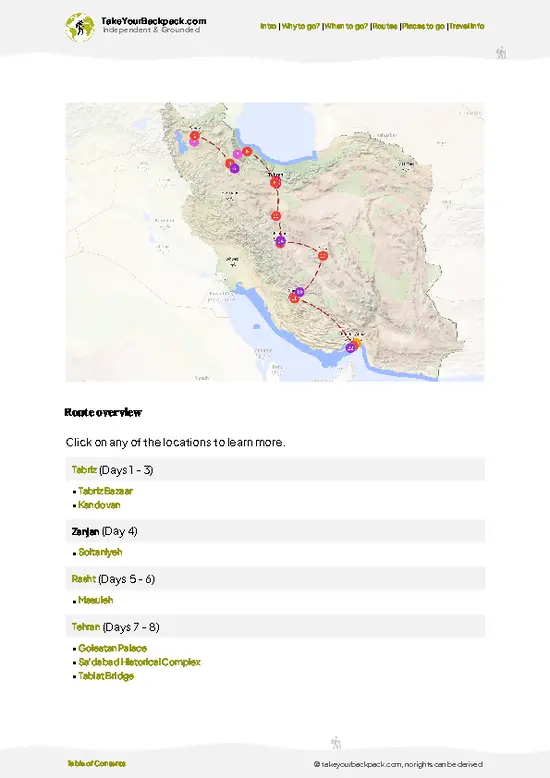
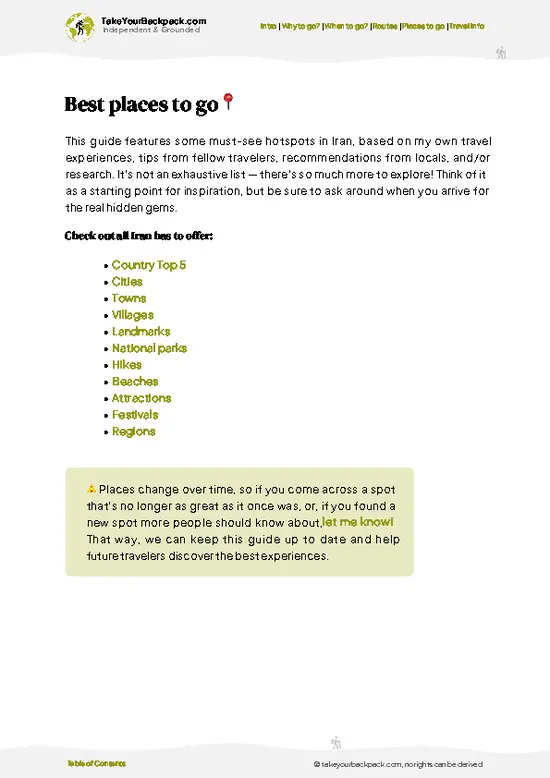
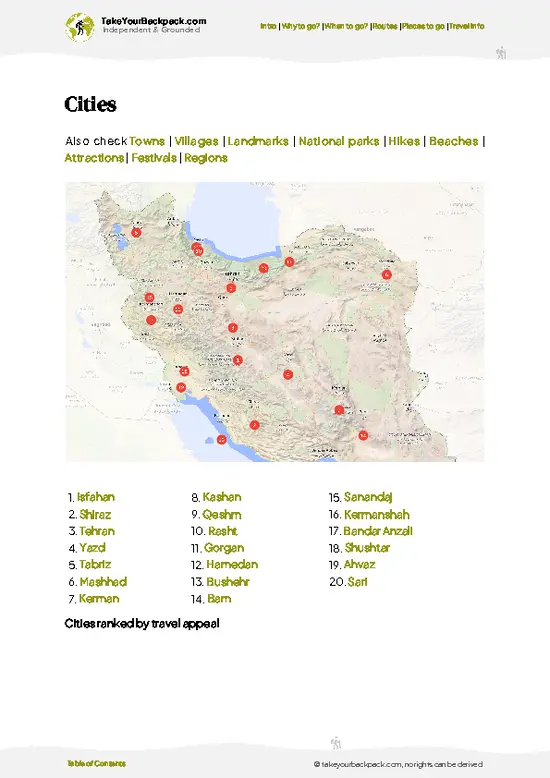
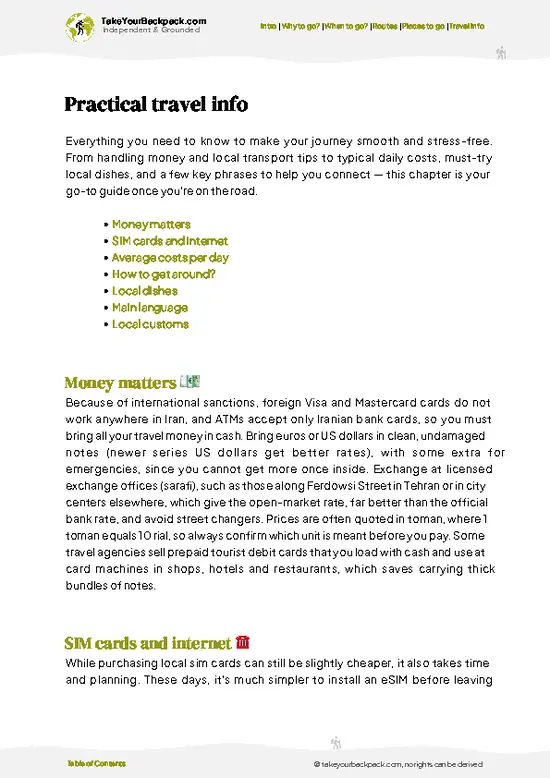
An offline-friendly backpacking guide with optimized travel routes, ranked highlights, transport advice, and the best areas to stay.
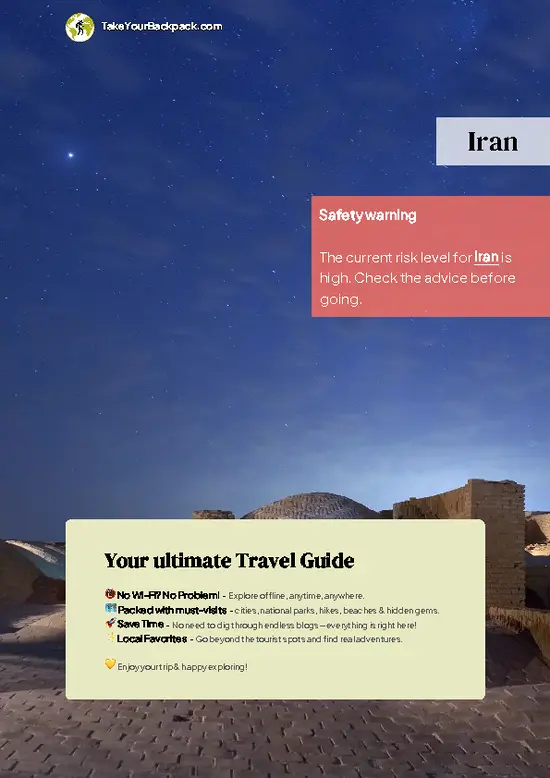
example page 0 from our offline Travel Guide for Iran
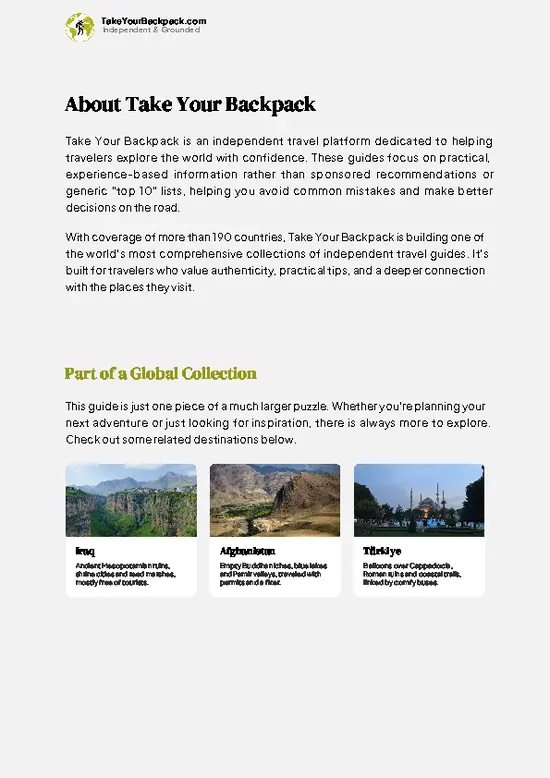
example page 1 from our offline Travel Guide for Iran
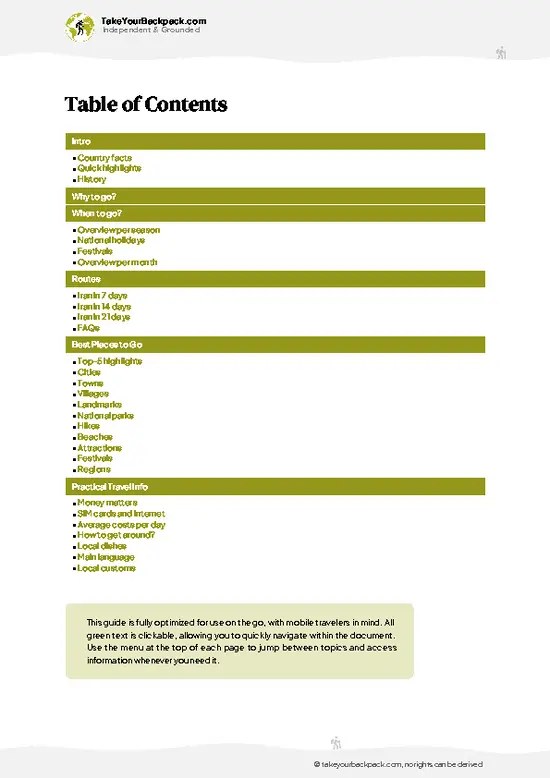
example page 2 from our offline Travel Guide for Iran
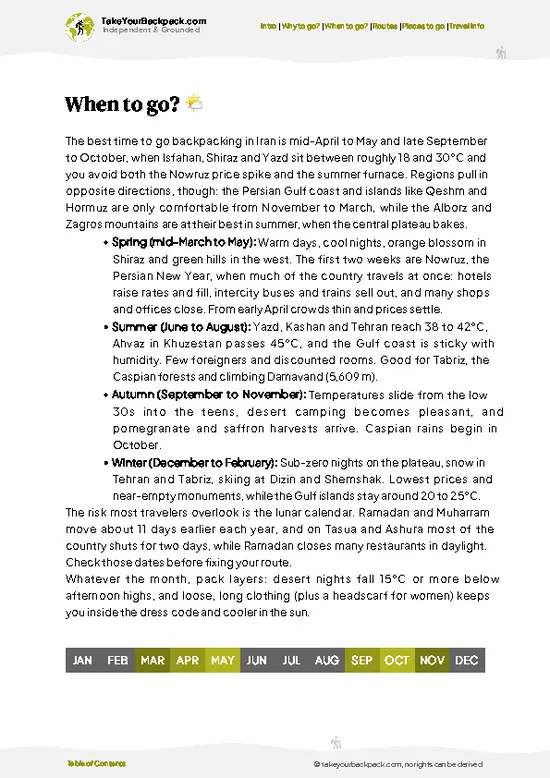
example page 3 from our offline Travel Guide for Iran
example page 4 from our offline Travel Guide for Iran
example page 5 from our offline Travel Guide for Iran
example page 6 from our offline Travel Guide for Iran
example page 7 from our offline Travel Guide for Iran
The digital guide (407 pages) contains:
✅ 115 highlights, ranked by travel appeal
✅ Optimized 7, 14 & 21-day travel routes
✅ Cities, national parks, landmarks, beaches
✅ How to get around
✅ Offline-friendly for travel without Wi-Fi
👉 Click to see all 30+ guide features

📅 Plan smarter in minutes, not weeks
✅ Month by month travel advice
✅ Festivals & national holidays
✅ Budget expectations

🗺️ Go to the right places, skip the overrated ones
✅ Honest pros & cons of destinations
✅ Top hikes, parks & viewpoints
✅ Lesser-known places most travelers miss
✅ Clear “worth it vs skip it” guidance

🛏️ Travel smoothly without rookie mistakes
✅ Best areas to stay
✅ Transport systems explained simply
✅ Common scams & safety advice
✅ SIM cards, money & practical tips

🌍 Understand the country, not just visit it
✅ Culture & traditions
✅ 52 Essential phrases & customs
✅ Festivals worth planning around
✅ Traveler-friendly historical context
✅ Insights that make places more meaningful

📱 Built for real travel conditions
✅ Fully downloadable PDF
✅ Works completely offline
✅ Optimized for phone use
✅ Useful in remote areas & buses
✅ Everything in one place
Stop searching, start planning
Get instant access to your full guide. 30‑day money-back guarantee.
+ Add another guide for just

By proceeding you agree to our terms.
Sent to your inbox immediately after payment • 100% Secure Checkout
Best Backpacking Travel Advisor 2025 tourism awardBest Backpacking
Travel Advisor
2025
What others say about Take Your Backpack Guides:
⭐⭐⭐⭐⭐
Fantastic, amazing amount of information!
⭐⭐⭐⭐⭐
My goodness this is amazing, it's what I've been looking for hats off too you!
⭐⭐⭐⭐⭐
I think this is absolutely BRILLIANT
⭐⭐⭐⭐
Very complete and informative. It's still missing places, but I gotta to commend you
⭐⭐⭐⭐⭐
This is truly amazing, thank you, can't wait to explore it with my kids!
⭐⭐⭐⭐⭐
Awesome resource, thank you!
⭐⭐⭐⭐⭐
This is amazing! Can't wait to explore the ones I haven't seen
⭐⭐⭐⭐
I love this! Well done, great idea.
⭐⭐⭐⭐⭐
Thanks for taking the time to make this gem!
⭐⭐⭐⭐⭐
This might be the best website I've ever seen.
⭐⭐⭐⭐⭐
Congratulations, and thank you so much for your work; it's incredibly valuable.
⭐⭐⭐⭐
In all seriousness I think you did a great job pointing out the important spots
⭐⭐⭐⭐⭐
10/10 very good
⭐⭐⭐⭐⭐
As someone who's only just starting to visit regularly this is awesome, thank you.
⭐⭐⭐⭐
Thank you very much! I'm going to visit my dad, it's going to be very useful!
⭐⭐⭐⭐⭐
This is really cool! We'll be travelling for the first time and this definitely come in handy.
⭐⭐⭐⭐⭐
You are now our minister of culture, congratulations 👨‍💼
⭐⭐⭐⭐⭐
Just wanted to tell you that this is a pearl! Going to follow your recommendations.
⭐⭐⭐⭐⭐
This is so cool. I'll definitely be using the resource for my travels soon.
⭐⭐⭐⭐⭐
This is very impressive! Good work.
⭐⭐⭐⭐⭐
This is an amazing and informative site. Very well done!

🛏️ Where to stay?Top Areas to Stay

Iran has a small but well-run hostel scene, plus traditional courtyard guesthouses where a dorm bed usually costs US$6 to 12, although Western governments now advise against all travel, so routine backpacking is effectively on hold. In Tehran, downtown around Ferdowsi and Imam Khomeini Square puts you within walking distance of the bazaar and Golestan Palace and on the metro, but it’s loud and empty after dark, while leafier north Tehran is quieter and full of cafés (the closest thing to nightlife here) but far from the old sights. In Isfahan, beds near Naqsh-e Jahan Square keep everything walkable; in Yazd, the mud-brick old town (Fahadan) offers the most atmospheric courtyard stays, and Shiraz … read more 👉
Iran has a small but well-run hostel scene, plus traditional courtyard guesthouses where a dorm bed usually costs US$6 to 12, although Western governments now advise against all travel, so routine backpacking is effectively on hold. In Tehran, downtown around Ferdowsi and Imam Khomeini Square puts you within walking distance of the bazaar and Golestan Palace and on the metro, but it’s loud and empty after dark, while leafier north Tehran is quieter and full of cafés (the closest thing to nightlife here) but far from the old sights. In Isfahan, beds near Naqsh-e Jahan Square keep everything walkable; in Yazd, the mud-brick old town (Fahadan) offers the most atmospheric courtyard stays, and Shiraz clusters its budget options near Zand Boulevard, all of them very safe, with evenings that wind down early.

If you enjoy meeting fellow travelers, consider choosing hostels with high ratings for atmosphere. On the other hand, if you prefer having your own space, a hotel might be a better option.

IranDiscover the Country

👋 Meet the founderWho’s Behind Take Your Backpack?

Johan, backpacker and founder of TakeYourBackpackHi, I’m Johan (Netherlands 🇳🇱), the creator of TakeYourBackpack. Over the past 3 decades, I’ve backpacked through 90+ countries across six continents, gaining extensive experience with independent travel, long-term trips, and overland routes.

This site is built on a combination of firsthand travel experience and carefully curated insights from other backpackers. Many guides are based on places I’ve personally visited, while others bring together tips, observations, and practical advice shared by trusted travelers I’ve met along the way.

The goal is to provide realistic, experience-driven guidance — not generic itineraries — so you can explore destinations with better context, clearer expectations, and more confidence.