×

Jamaica🇯🇲 | best attractionsWhere to Find the 10 Best attractions in Jamaica

Attractions in Jamaica mostly mean water, music and food, not museums, and the experience changes sharply by coast. The north coast (Ocho Rios, Montego Bay) is the most developed: easy to reach, priced in US dollars, and crowded when cruise ships dock. Negril is the easiest base for independent travelers on a budget. The south coast and the Blue Mountains are slower, cheaper and rougher on the roads, but far less staged. Skip anything sold as a resort-run “authentic” tour. For backpacking, pick two regions, use shared taxis and local guides, and spend your money on places where the locals actually go.

By Johan Kruseman 🇳🇱 | Updated October 23, 2026
Explore the best festivals in Jamaica

Why go?Why Travelers Love These Spots

Jamaica packs an unusual amount into a small island: roughly 235 kilometers long and 82 kilometers wide, with a mountain spine rising to 2,256 meters at Blue Mountain Peak. That compression means rainforest, limestone caves, waterfalls and reef coast sit within a few hours of each other. Warm Caribbean water and a tropical climate keep the outdoors open nearly all year.

Culture is the other draw. Reggae, Rastafari, Maroon heritage and a sugar-and-slavery history are lived traditions here, not museum themes, and they shape food, music and how people talk to you. The island is far more about outdoor and cultural experiences than monuments or grand architecture, so expect little in the way of ruins or old cities.

Know the downsides before you commit. Public transport is cheap but slow and has … read more 👉
Jamaica packs an unusual amount into a small island: roughly 235 kilometers long and 82 kilometers wide, with a mountain spine rising to 2,256 meters at Blue Mountain Peak. That compression means rainforest, limestone caves, waterfalls and reef coast sit within a few hours of each other. Warm Caribbean water and a tropical climate keep the outdoors open nearly all year.

Culture is the other draw. Reggae, Rastafari, Maroon heritage and a sugar-and-slavery history are lived traditions here, not museum themes, and they shape food, music and how people talk to you. The island is far more about outdoor and cultural experiences than monuments or grand architecture, so expect little in the way of ruins or old cities.

Know the downsides before you commit. Public transport is cheap but slow and has no tourist timetable, and the best-known sites are priced for cruise passengers, often in US dollars, so costs run well above Central America or Southeast Asia. Hustling at popular sites is persistent, and some areas of Kingston and Montego Bay are unsafe at night. Jamaica rewards travelers who book through local guides, travel with flexibility and accept that polish varies. If you want tidy, signposted sightseeing, choose somewhere else.
Evaluating the Top Choices
The list of best attractions in Jamaica is created based on cultural significance or entertainment value. If you feel a attraction is missing in this list, please let us know.

When to go?Optimal Periods for Travel

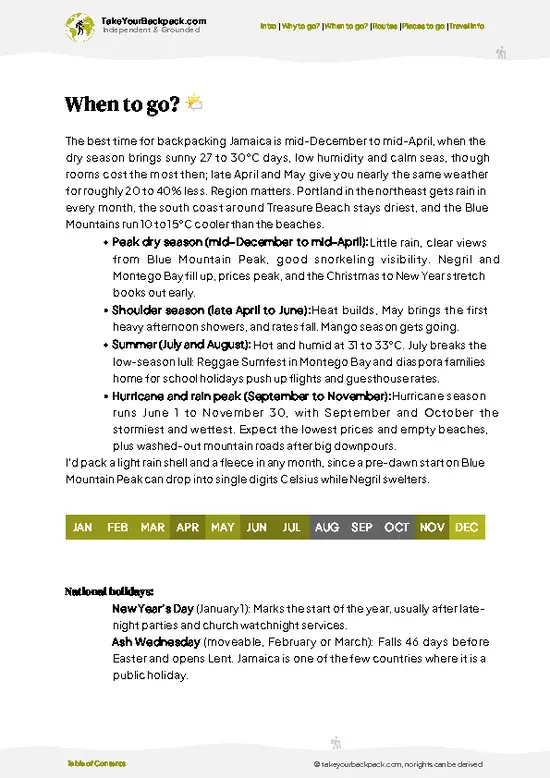
Best months and weather: The best months for attractions in Jamaica are December to April, when it is dry, sunny and not too humid, with daytime highs around 28 to 31°C on the coast and rainfall at its lowest. Sea conditions are calm, rivers and waterfalls are manageable, and mountain roads stay passable.

Peak and shoulder seasons: Mid-December to mid-April is peak season. Expect accommodation to cost 30 to 60 percent more than in the low months, and the north coast (Ocho Rios, Montego Bay) to be packed when cruise ships arrive. Christmas and New Year week are the worst for prices. May to June and November are the better shoulder choices: fewer people, lower rates, and hot but workable weather.

Months to avoid: The wettest periods are May to June and September to November, with October usually … read more 👉
Best months and weather: The best months for attractions in Jamaica are December to April, when it is dry, sunny and not too humid, with daytime highs around 28 to 31°C on the coast and rainfall at its lowest. Sea conditions are calm, rivers and waterfalls are manageable, and mountain roads stay passable.

Peak and shoulder seasons: Mid-December to mid-April is peak season. Expect accommodation to cost 30 to 60 percent more than in the low months, and the north coast (Ocho Rios, Montego Bay) to be packed when cruise ships arrive. Christmas and New Year week are the worst for prices. May to June and November are the better shoulder choices: fewer people, lower rates, and hot but workable weather.

Months to avoid: The wettest periods are May to June and September to November, with October usually the rainiest, often 200 mm or more in the wetter parishes. Hurricane season runs June to November, with the highest risk from August to October. Heavy rain can close river-based attractions and wash out roads in the Blue Mountains and the rural interior. The northeast (Portland) is wet nearly all year, while the south coast around Treasure Beach is noticeably drier. July and August are hot, 31 to 34°C, and cheaper, but the heat makes midday hiking miserable.

attraction hoppingPlanning Your Route Efficiently

How many days a multi-region Jamaica trip needs: A trip that links several of Jamaica’s main attraction areas needs 9 to 14 days, and anything under 7 should stick to one coast. Distances look small on the map (the island is about 235 km long), but roads are narrow, winding and shared with trucks, so 100 km can take 2.5 to 3 hours.
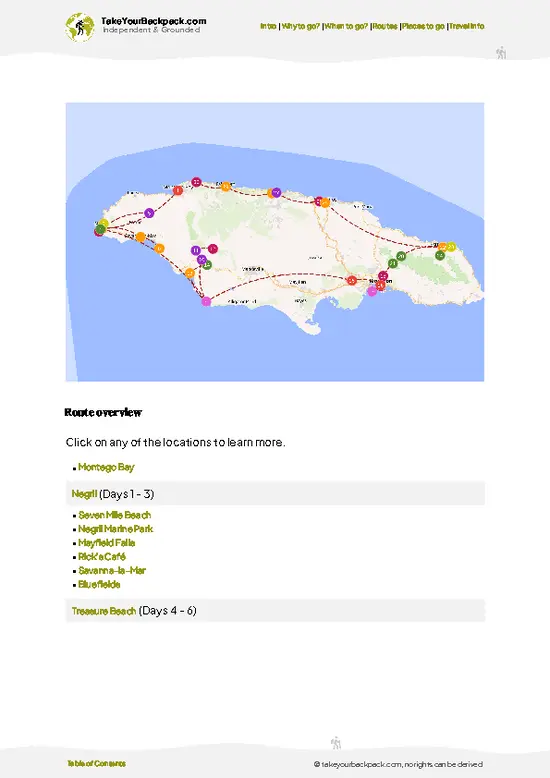
Which regions group well together: Three clusters work. The north coast (Negril, Montego Bay, Ocho Rios, Port Antonio) links by a coastal highway and by route taxis and shared minibuses. The southwest (Treasure Beach, Black River, Mandeville) is quiet and slower to reach. Kingston and the Blue Mountains form the third, with the east coast around Port Antonio close behind. Start in Montego Bay, because Sangster airport has the best flight connections and the cheapest … read more 👉
How many days a multi-region Jamaica trip needs: A trip that links several of Jamaica’s main attraction areas needs 9 to 14 days, and anything under 7 should stick to one coast. Distances look small on the map (the island is about 235 km long), but roads are narrow, winding and shared with trucks, so 100 km can take 2.5 to 3 hours.
Which regions group well together: Three clusters work. The north coast (Negril, Montego Bay, Ocho Rios, Port Antonio) links by a coastal highway and by route taxis and shared minibuses. The southwest (Treasure Beach, Black River, Mandeville) is quiet and slower to reach. Kingston and the Blue Mountains form the third, with the east coast around Port Antonio close behind. Start in Montego Bay, because Sangster airport has the best flight connections and the cheapest car and bus links. Then travel east along the north coast and finish in Kingston, which has the other international airport (Norman Manley). Running the loop in that direction keeps the longest, steepest drive for the middle of the trip, when you are rested.
Time per stop and transfers: Give each coastal base 2 to 3 nights and the mountains 2. Key transfers run roughly 1.5 to 2 hours from Montego Bay to Negril or Ocho Rios, 2 to 2.5 hours from Ocho Rios to Kingston across the Dunn’s River side of the hills, and 2.5 to 3 hours from Kingston to Port Antonio. Knutsford Express coaches connect the major towns on fixed schedules and cost far less than a private driver.
Planning mistakes to avoid: Trying to see three coasts in a week wastes days in transit, so cut a region instead. Booking tours from a resort on the wrong side of the island adds hours and fees, so base yourself near what you want. Arriving at a major site on a cruise-ship day means queues, so check port calendars and go early. Leaving Kingston transfers for late afternoon is a poor idea, as traffic on the approach roads is slow after 4 pm.

The ListThe Best attractions of Jamaica

1 Dunn’s River Falls

Climbable cascades, 180-meter staircase, lockers, guided ascent

Climb a 180-meter staircase of cold, fast water with a guide, then stash your gear in the on-site lockers and changing rooms.

jamaica-attraction-dunns-river-falls
© Google |

2 Bob Marley Museum

56 Hope Road, reggae legacy, guided group tour, Marley’s old home

Walk through the Kingston house where Marley lived, passing his guitar and the bullet-marked walls on a guided tour with limited time to linger.

jamaica-attraction-bob-marley-museum
© Google |

3 Rick’s Café

West End cliffs, 35-foot ledge, sunset crowds, live reggae

Claim a spot on the Negril cliffs for sunset, live reggae and the cheers whenever someone leaps from the 35-foot ledge.

jamaica-attraction-ricks-cafe
© Google |

4 Rose Hall Great House

White Witch legend, hilltop mansion, night tours, Montego Bay views

Tour a hilltop plantation house while guides recount the story of Annie Palmer, with after-dark visits for a spookier version.

jamaica-attraction-rose-hall-great-house
© Google |

5 Appleton Estate Rum Experience

Nassau Valley, rum distillery tour, sugarcane country, guided tasting

Tour a working rum estate deep in the Nassau Valley, with guides who walk you through the making of Jamaican rum before a tasting.

jamaica-attraction-appleton-estate-rum-experience
© Google |

6 Devon House

Kingston lawns, free grounds, mansion tours, ice cream stop

Settle on the lawns of this Kingston mansion for a free picnic, then decide whether the house tour and food court fit your budget.

7 Mystic Mountain Adventure Park

Rainforest canopy, zip lines, bobsled run, chairlift

Ride a chairlift above the treetops, then choose between zip lines and a bobsled track winding through shaded green forest above Ocho Rios.

jamaica-attraction-mystic-mountain-adventure-park
© Google |

8 Cranbrook Flower Forest

Orchid conservatory, hummingbird garden, streamside trail, hilltop lookout

Spend a half day on short garden trails, watching hummingbirds, cooling off by a small cascade and climbing to a lookout over the countryside.

jamaica-attraction-cranbrook-flower-forest
© Google |

9 Dolphin Cove

Dolphin encounters, Ocho Rios coast, early slots, pricey add-ons

Book the first slot of the day to swim alongside dolphins on the north coast, with fewer cruise crowds sharing the water.

Loading the map 🌍

Expert viewPro Tips for Exploring the Best

How many attractions to visit: Plan on one main attraction per day, with 8 to 10 in total across a typical two-week trip. Roads are slow, heat peaks by midday, and most outings (a river, a mountain walk, a cave, a boat trip) take half a day once travel is counted. Two a day leaves you tired, rushed and paying for experiences you barely absorb.

Prioritizing by travel style: Budget travelers should lean on free beaches, public viewpoints, street food and local music nights, and pay for only two or three paid sites. Nature-focused travelers get the best value from guided hikes in the Blue Mountains and waterfall or river outings. Culture seekers should put music, food and heritage visits ahead of the big-name tourist sites, which cost more and give less. Skip anything whose main pitch is a photo … read more 👉
How many attractions to visit: Plan on one main attraction per day, with 8 to 10 in total across a typical two-week trip. Roads are slow, heat peaks by midday, and most outings (a river, a mountain walk, a cave, a boat trip) take half a day once travel is counted. Two a day leaves you tired, rushed and paying for experiences you barely absorb.

Prioritizing by travel style: Budget travelers should lean on free beaches, public viewpoints, street food and local music nights, and pay for only two or three paid sites. Nature-focused travelers get the best value from guided hikes in the Blue Mountains and waterfall or river outings. Culture seekers should put music, food and heritage visits ahead of the big-name tourist sites, which cost more and give less. Skip anything whose main pitch is a photo with a staged performer or a boat trip that includes mandatory shopping stops.

What it costs: Budget about US$40 to 70 a day for a backpacker with a hostel or guesthouse bed (US$20 to 40), local food and route taxis. Add US$10 to 30 a day for attractions. Entry fees at popular sites commonly run US$10 to 30 for foreigners, locals pay far less, and guides for hikes or caves typically cost US$30 to 80 a group. Shared route taxis cost roughly US$1 to 4 per short hop, while a private taxi for a day trip is US$60 to 120. Carry Jamaican dollars for small purchases; many sites quote in US dollars, and the exchange rate offered can be poor.

Costs and delays that catch travelers out: Cruise ship days inflate prices and queues at north coast sites, so check the port schedule and arrive early or go on a day with no ships. Agree the full price before you start with any guide, driver or boat operator, including tips, drinks and photos. Unofficial “guides” at site entrances may follow you and demand payment afterward, so decline politely and firmly. Shuttle rides and packaged tours from resorts often cost two to three times the independent price for the same outing.

Safety and cultural points: Stay out of unlit areas of Kingston and Montego Bay at night and use a licensed taxi (look for red JUTA or red PPV plates). Avoid walking beaches alone after dark. Do not swim at rivers or sea coves after heavy rain because currents rise quickly, and use reef-safe sun protection. Marijuana is decriminalized in small amounts but not legal to use publicly or at most attractions, and sellers can be insistent. Ask before photographing people, especially in rural communities and at Rastafari sites. A friendly greeting, such as “Wah gwaan,” goes a long way, and a calm “no, thank you” ends most hustles.

✈️ The backpacker research shortcutJamaica Travel Guide

An offline-friendly backpacking guide with optimized travel routes, ranked highlights, transport advice, and the best areas to stay.
example page 0 from our offline Travel Guide for Jamaica
example page 1 from our offline Travel Guide for Jamaica
example page 2 from our offline Travel Guide for Jamaica
example page 3 from our offline Travel Guide for Jamaica
example page 4 from our offline Travel Guide for Jamaica
example page 5 from our offline Travel Guide for Jamaica
example page 6 from our offline Travel Guide for Jamaica
example page 7 from our offline Travel Guide for Jamaica
The digital guide (238 pages) contains:
✅ 71 highlights, ranked by travel appeal
✅ Optimized 5, 10 & 15-day travel routes
✅ Cities, national parks, landmarks, beaches
✅ How to get around
✅ Offline-friendly for travel without Wi-Fi
👉 Click to see all 30+ guide features

📅 Plan smarter in minutes, not weeks
✅ Month by month travel advice
✅ Festivals & national holidays
✅ Budget expectations

🗺️ Go to the right places, skip the overrated ones
✅ Honest pros & cons of destinations
✅ Top hikes, parks & viewpoints
✅ Lesser-known places most travelers miss
✅ Clear “worth it vs skip it” guidance

🛏️ Travel smoothly without rookie mistakes
✅ Best areas to stay
✅ Transport systems explained simply
✅ Common scams & safety advice
✅ SIM cards, money & practical tips

🌍 Understand the country, not just visit it
✅ Culture & traditions
✅ 52 Essential phrases & customs
✅ Festivals worth planning around
✅ Traveler-friendly historical context
✅ Insights that make places more meaningful

📱 Built for real travel conditions
✅ Fully downloadable PDF
✅ Works completely offline
✅ Optimized for phone use
✅ Useful in remote areas & buses
✅ Everything in one place
Stop searching, start planning
Get instant access to your full guide. 30‑day money-back guarantee.
+ Add another guide for just

By proceeding you agree to our terms.
Sent to your inbox immediately after payment • 100% Secure Checkout
Best Backpacking Travel Advisor 2025 tourism awardBest Backpacking
Travel Advisor
2025
What others say about Take Your Backpack Guides:
⭐⭐⭐⭐⭐
Fantastic, amazing amount of information!
⭐⭐⭐⭐⭐
My goodness this is amazing, it's what I've been looking for hats off too you!
⭐⭐⭐⭐⭐
I think this is absolutely BRILLIANT
⭐⭐⭐⭐
Very complete and informative. It's still missing places, but I gotta to commend you
⭐⭐⭐⭐⭐
This is truly amazing, thank you, can't wait to explore it with my kids!
⭐⭐⭐⭐⭐
Awesome resource, thank you!
⭐⭐⭐⭐⭐
This is amazing! Can't wait to explore the ones I haven't seen
⭐⭐⭐⭐
I love this! Well done, great idea.
⭐⭐⭐⭐⭐
Thanks for taking the time to make this gem!
⭐⭐⭐⭐⭐
This might be the best website I've ever seen.
⭐⭐⭐⭐⭐
Congratulations, and thank you so much for your work; it's incredibly valuable.
⭐⭐⭐⭐
In all seriousness I think you did a great job pointing out the important spots
⭐⭐⭐⭐⭐
10/10 very good
⭐⭐⭐⭐⭐
As someone who's only just starting to visit regularly this is awesome, thank you.
⭐⭐⭐⭐
Thank you very much! I'm going to visit my dad, it's going to be very useful!
⭐⭐⭐⭐⭐
This is really cool! We'll be travelling for the first time and this definitely come in handy.
⭐⭐⭐⭐⭐
You are now our minister of culture, congratulations 👨‍💼
⭐⭐⭐⭐⭐
Just wanted to tell you that this is a pearl! Going to follow your recommendations.
⭐⭐⭐⭐⭐
This is so cool. I'll definitely be using the resource for my travels soon.
⭐⭐⭐⭐⭐
This is very impressive! Good work.
⭐⭐⭐⭐⭐
This is an amazing and informative site. Very well done!

🛏️ Where to stay?Top Places to Consider Staying

Jamaica has a small but solid spread of hostels, guesthouses and cheap cottages, with dorm beds typically around US$20 to 35 a night and simple private rooms from roughly US$40 to 70. Negril has the widest choice: the West End cliffs are quieter, cheaper and better for swimming off rocks, while Seven Mile Beach puts you near the sand and beach bars but costs more and brings constant hustlers. In Kingston, New Kingston keeps you close to restaurants, nightlife and transport and feels safer than downtown after dark, whereas laid-back Treasure Beach and Port Antonio trade nightlife for calm, friendly guesthouse stays near the coast and the rivers.

If you enjoy meeting fellow travelers, consider … read more 👉
Jamaica has a small but solid spread of hostels, guesthouses and cheap cottages, with dorm beds typically around US$20 to 35 a night and simple private rooms from roughly US$40 to 70. Negril has the widest choice: the West End cliffs are quieter, cheaper and better for swimming off rocks, while Seven Mile Beach puts you near the sand and beach bars but costs more and brings constant hustlers. In Kingston, New Kingston keeps you close to restaurants, nightlife and transport and feels safer than downtown after dark, whereas laid-back Treasure Beach and Port Antonio trade nightlife for calm, friendly guesthouse stays near the coast and the rivers.

If you enjoy meeting fellow travelers, consider choosing hostels with high ratings for atmosphere. On the other hand, if you prefer having your own space, a hotel might be a better option.

JamaicaMore Places Across Jamaica

👋 Meet the founderWho’s Behind Take Your Backpack?

Johan, backpacker and founder of TakeYourBackpackHi, I’m Johan (Netherlands 🇳🇱), the creator of TakeYourBackpack. Over the past 3 decades, I’ve backpacked through 90+ countries across six continents, gaining extensive experience with independent travel, long-term trips, and overland routes.

This site is built on a combination of firsthand travel experience and carefully curated insights from other backpackers. Many guides are based on places I’ve personally visited, while others bring together tips, observations, and practical advice shared by trusted travelers I’ve met along the way.

The goal is to provide realistic, experience-driven guidance — not generic itineraries — so you can explore destinations with better context, clearer expectations, and more confidence.