×

Jamaica🇯🇲 | best landmarksWhere to Find the 8 Best landmarks in Jamaica

Landmarks in Jamaica are mostly natural and historical rather than monumental: waterfalls, caves, mountain peaks, Maroon heritage sites, plantation houses and Port Royal’s drowned-pirate past. The north coast around Ocho Rios and Montego Bay has the busiest, most polished sites, with fixed entry fees (often US$15 to 30) and cruise-ship crowds. The Blue Mountains and the south coast are rougher, cheaper and quieter, but public transport thins out fast. Kingston holds the best history and music sites. Independent travelers should skip the packaged tour-bus stops unless time is short, because shared taxis and a good local guide cover more ground for less money.

By Johan Kruseman 🇳🇱 | Updated October 23, 2026
Explore the best national parks in Jamaica

Why go?Why Travelers Love These Spots

Jamaica’s landmarks matter because the island’s history is compressed into a small, mountainous space. Taíno settlement, Spanish and British colonial rule, sugar plantations, slavery, Maroon resistance and the reggae era all left physical marks within a few hours’ drive of each other. The limestone interior explains the caves, sinkholes and cascading rivers, while the Blue Mountains rise above 2,200 meters and produce a climate and landscape unlike anywhere else in the Caribbean.

Before choosing Jamaica for landmarks, know that infrastructure is uneven. Roads are narrow and winding, so 100 kilometers can take three hours or more. Many heritage sites are modest, with few signs and thin interpretation, so a local guide adds more than any placard. Natural sites can be closed or dangerous after … read more 👉
Jamaica’s landmarks matter because the island’s history is compressed into a small, mountainous space. Taíno settlement, Spanish and British colonial rule, sugar plantations, slavery, Maroon resistance and the reggae era all left physical marks within a few hours’ drive of each other. The limestone interior explains the caves, sinkholes and cascading rivers, while the Blue Mountains rise above 2,200 meters and produce a climate and landscape unlike anywhere else in the Caribbean.

Before choosing Jamaica for landmarks, know that infrastructure is uneven. Roads are narrow and winding, so 100 kilometers can take three hours or more. Many heritage sites are modest, with few signs and thin interpretation, so a local guide adds more than any placard. Natural sites can be closed or dangerous after heavy rain because rivers rise quickly and trails turn to mud. Do not expect large museums or grand monuments on the European model; the value here is in stories, landscape and living culture. The most famous stops are also the most commercialized, with hawkers, mandatory guides and timed entry. Quieter sites cost less and feel more real, but need planning and flexible transport.
How the List Was Created
The list of best unique sites in Jamaica is created based on history or culture, wow factor, atmosphere, quirks, and memorability. If you feel a unique site is missing in this list, please let us know.

When to go?Optimal Periods for Travel

Best months: The best months for Jamaica’s landmarks are December to April, when the dry season brings lower humidity, daytime highs of 28 to 30°C and the most reliable access to rivers, trails and caves. Rain is lowest from February to March, which makes waterfalls safer to climb and mountain views clearer.
Shoulder seasons: May to June and October to November are wetter, with two rainy peaks in the interior. October is usually the wettest month, and some river and cave sites close after downpours. Prices drop by roughly 20 to 40 percent on lodging, and sites are emptier, but plan around afternoon storms and slick trails.
Peak periods and hurricanes: Mid-December to mid-April is peak season, and the north coast, especially Ocho Rios and Montego Bay, is most crowded on cruise-ship days. Book … read more 👉
Best months: The best months for Jamaica’s landmarks are December to April, when the dry season brings lower humidity, daytime highs of 28 to 30°C and the most reliable access to rivers, trails and caves. Rain is lowest from February to March, which makes waterfalls safer to climb and mountain views clearer.
Shoulder seasons: May to June and October to November are wetter, with two rainy peaks in the interior. October is usually the wettest month, and some river and cave sites close after downpours. Prices drop by roughly 20 to 40 percent on lodging, and sites are emptier, but plan around afternoon storms and slick trails.
Peak periods and hurricanes: Mid-December to mid-April is peak season, and the north coast, especially Ocho Rios and Montego Bay, is most crowded on cruise-ship days. Book guesthouses early for Christmas and New Year. Hurricane season runs June to November, with the highest risk from August to October. Skip that window if you want fixed plans, since storms close roads and attractions for days.
Regional differences: The Blue Mountains are 8 to 10°C cooler than the coast. Pack layers and aim for the dry months, with clearest skies at dawn. The south coast around Treasure Beach is drier and sunnier than the north. Kingston is hot year-round, often above 30°C, so visit sites in the morning.

unique site hoppingPlanning Your Route Efficiently

Trip length: A trip combining several landmarks in Jamaica needs 7 to 10 days, and 12 to 14 if you want the Blue Mountains and the south coast as well. Anything shorter turns into a car-window tour.
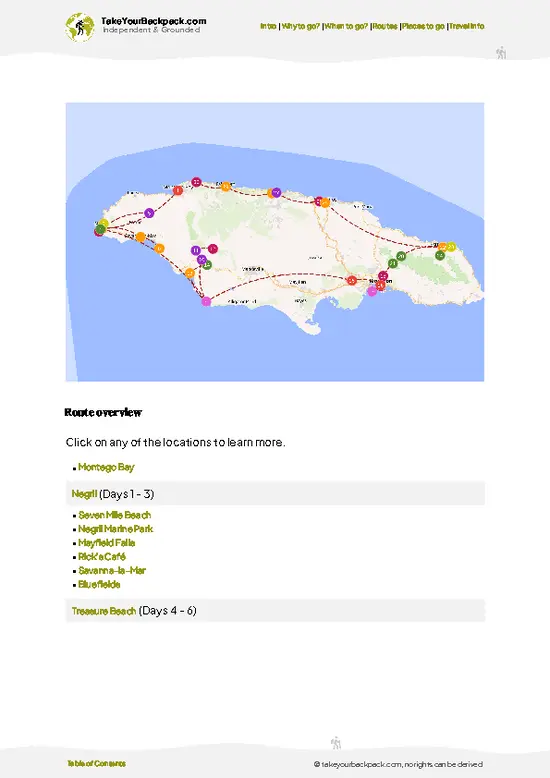
Regional clusters and direction: Three clusters work. Kingston and the Blue Mountains sit together, the north coast from Montego Bay to Ocho Rios forms a second, and the south coast and interior around Treasure Beach and Mandeville is the third. Start in Kingston, since the Norman Manley airport and the capital’s history suit a first stop. Then cross the island north through the interior and finish in Montego Bay, where flights home are frequent. Going the opposite way works too, but avoid backtracking.
Time per stop and transfers: Allow half a day for most sites and a full day for hiking or cave … read more 👉
Trip length: A trip combining several landmarks in Jamaica needs 7 to 10 days, and 12 to 14 if you want the Blue Mountains and the south coast as well. Anything shorter turns into a car-window tour.
Regional clusters and direction: Three clusters work. Kingston and the Blue Mountains sit together, the north coast from Montego Bay to Ocho Rios forms a second, and the south coast and interior around Treasure Beach and Mandeville is the third. Start in Kingston, since the Norman Manley airport and the capital’s history suit a first stop. Then cross the island north through the interior and finish in Montego Bay, where flights home are frequent. Going the opposite way works too, but avoid backtracking.
Time per stop and transfers: Allow half a day for most sites and a full day for hiking or cave visits. Kingston to Ocho Rios is about 2 to 2.5 hours by road. Ocho Rios to Montego Bay takes about 2 to 3 hours, and Montego Bay to Treasure Beach 2.5 to 3.5 hours. Knutsford Express coaches link the main hubs for US$10 to 25. Shared route taxis reach smaller places but run slowly.
Planning mistakes: The most common error is stacking three or four stops in one day. Jamaican roads rarely allow it. Allow 50 percent more drive time than a map suggests. Another is relying on one city as a base for everything; move bases every two to three nights instead. Do not schedule outdoor sites in the afternoon rain window, and leave a spare day for weather.

The ListThe Best landmarks of Jamaica

1 Blue Hole

Turquoise limestone pool, rope swing, upstream cascades, rock chutes

Swing from a rope into deep spring water, then climb upstream past quieter pools and small falls where the crowd thins out.

2 YS Falls

Seven travertine tiers, rope swing, tractor ride, river tubing

Ride a tractor through the estate to terraced pools, then jump from ledges, float on tubes or ride the zipline over the valley.

jamaica-unique-site-ys-falls
© Google |

3 Mayfield Falls

21 river pools, natural jacuzzis, guided wade, bamboo-shaded bank

Wade and swim upstream through stacked cool pools with a local guide, resting in bubbling basins and sliding under small cascades.

4 Fern Gully

Tree ferns, A3 green tunnel, wood carvers, pullout birdsong

Drive slowly beneath tree ferns and meeting branches, stopping at a safe pullout to photograph the canopy and hear forest birds.

5 Green Grotto Caves

Lantern-lit tour, underground lake, bat chambers, limestone formations

Follow a guide with a lantern through narrow passages to a green-tinted lake, roosting bats and cave stories of smugglers and runaways.

6 Bamboo Avenue

Bamboo canopy, A2 roadside, coconut stands, Middle Quarters

Pull over on the narrow A2 and stroll the shaded verge beneath creaking bamboo arches, then buy a machete-opened coconut from a roadside vendor.

7 Lover’s Leap

Sheer sea cliff, white lighthouse, star-crossed legend, Cutlass Bay

Stand at the railing above a limestone drop of roughly 520 meters and listen to the legend of the two lovers told on site.

jamaica-unique-site-lovers-leap
© Google |

8 Nanny of the Maroons Monument

Queen Nanny statue, Bump Grave, Moore Town, abeng horn

Walk through a Maroon village with a local guide to learn how Nanny led resistance from these forested Rio Grande hills.

Loading the map 🌍

Expert viewPro Tips for Exploring the Best

How many landmarks to visit: Visit 6 to 8 landmarks in a 7 to 10 day trip, and no more than one or two in any single day. Jamaica’s winding roads, heat and the time spent bargaining over guides make more than that exhausting, and the later stops get rushed. Fewer, longer visits give you time to talk with locals, who are often the real interpretation of a site.
Which kinds to prioritize: Choose by travel style. If you want history, put weight on Kingston, Port Royal and Maroon heritage sites, where the stories are the main draw. If you like the outdoors, favor waterfalls, caves and the Blue Mountains, and book at least one of those for dry-season mornings. If your budget is tight, skip the most commercial north-coast attractions. They charge the most and deliver the least that you cannot get … read more 👉
How many landmarks to visit: Visit 6 to 8 landmarks in a 7 to 10 day trip, and no more than one or two in any single day. Jamaica’s winding roads, heat and the time spent bargaining over guides make more than that exhausting, and the later stops get rushed. Fewer, longer visits give you time to talk with locals, who are often the real interpretation of a site.
Which kinds to prioritize: Choose by travel style. If you want history, put weight on Kingston, Port Royal and Maroon heritage sites, where the stories are the main draw. If you like the outdoors, favor waterfalls, caves and the Blue Mountains, and book at least one of those for dry-season mornings. If your budget is tight, skip the most commercial north-coast attractions. They charge the most and deliver the least that you cannot get elsewhere more cheaply. Mix one polished site with several quieter ones rather than visiting only famous names.
What it costs: Plan on US$45 to 80 a day for a mid-range independent trip, covering guesthouse, local food, transport and entry, and US$30 to 45 if you stay in hostels and eat at cookshops. Entry fees run about US$5 to 30 per site, with the big tourist-oriented sites at the top of that range. Local guides usually cost US$10 to 40 per visit, depending on the site and whether it is a hike. Shared taxis cost US$1 to 5 per hop, while private taxis for a day run US$80 to 150. Agree the price before you start, and ask whether it is per person or per group. Cash in Jamaican dollars is useful, because small sites rarely take cards.
Costs and mistakes that catch travelers out: Unofficial guides at gates may quote inflated prices or add extras like photos and refreshments. Decline politely, ask for the official rate, and use guides registered at the site. Tours sold at your hotel can cost two to three times the independent price for the same stop. Arriving late is another trap: many sites close around 4 or 5 pm, and rivers become unsafe after rain. Book sunrise or morning slots, and check conditions locally before setting out.
Safety and cultural considerations: Keep valuables out of sight in Kingston and avoid walking at night, especially away from main streets. Use licensed taxis, marked with red plates for public passenger vehicles. Wear sturdy shoes at waterfalls and caves, since slippery rock causes most injuries. Ask before photographing people, and treat Maroon and Rastafari communities with respect: dress modestly and follow local guidance. Greet people before asking for anything. A friendly “good morning” changes the tone of the entire interaction.

✈️ The backpacker research shortcutJamaica Travel Guide

An offline-friendly backpacking guide with optimized travel routes, ranked highlights, transport advice, and the best areas to stay.
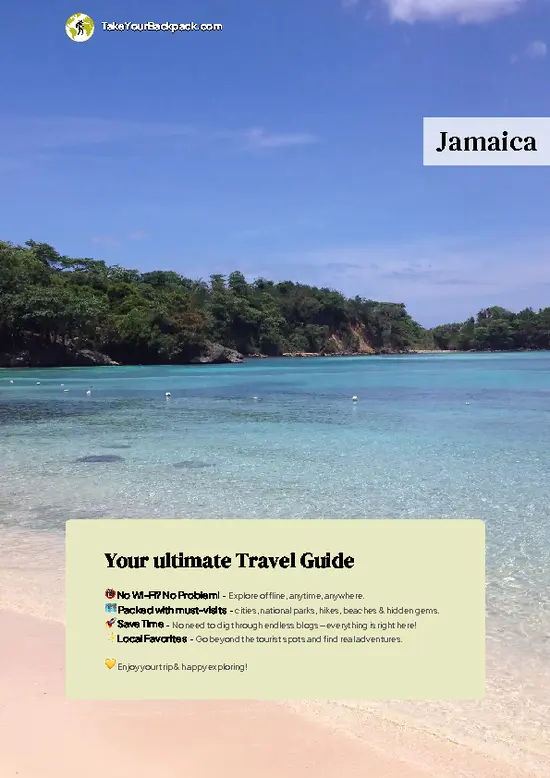
example page 0 from our offline Travel Guide for Jamaica
example page 1 from our offline Travel Guide for Jamaica
example page 2 from our offline Travel Guide for Jamaica
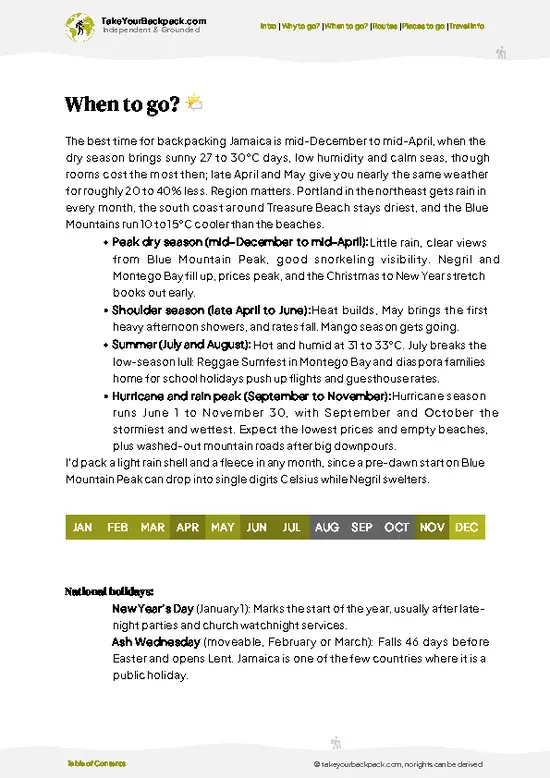
example page 3 from our offline Travel Guide for Jamaica
example page 4 from our offline Travel Guide for Jamaica
example page 5 from our offline Travel Guide for Jamaica
example page 6 from our offline Travel Guide for Jamaica
example page 7 from our offline Travel Guide for Jamaica
The digital guide (238 pages) contains:
✅ 71 highlights, ranked by travel appeal
✅ Optimized 5, 10 & 15-day travel routes
✅ Cities, national parks, landmarks, beaches
✅ How to get around
✅ Offline-friendly for travel without Wi-Fi
👉 Click to see all 30+ guide features

📅 Plan smarter in minutes, not weeks
✅ Month by month travel advice
✅ Festivals & national holidays
✅ Budget expectations

🗺️ Go to the right places, skip the overrated ones
✅ Honest pros & cons of destinations
✅ Top hikes, parks & viewpoints
✅ Lesser-known places most travelers miss
✅ Clear “worth it vs skip it” guidance

🛏️ Travel smoothly without rookie mistakes
✅ Best areas to stay
✅ Transport systems explained simply
✅ Common scams & safety advice
✅ SIM cards, money & practical tips

🌍 Understand the country, not just visit it
✅ Culture & traditions
✅ 52 Essential phrases & customs
✅ Festivals worth planning around
✅ Traveler-friendly historical context
✅ Insights that make places more meaningful

📱 Built for real travel conditions
✅ Fully downloadable PDF
✅ Works completely offline
✅ Optimized for phone use
✅ Useful in remote areas & buses
✅ Everything in one place
Stop searching, start planning
Get instant access to your full guide. 30‑day money-back guarantee.
+ Add another guide for just

By proceeding you agree to our terms.
Sent to your inbox immediately after payment • 100% Secure Checkout
Best Backpacking Travel Advisor 2025 tourism awardBest Backpacking
Travel Advisor
2025
What others say about Take Your Backpack Guides:
⭐⭐⭐⭐⭐
Fantastic, amazing amount of information!
⭐⭐⭐⭐⭐
My goodness this is amazing, it's what I've been looking for hats off too you!
⭐⭐⭐⭐⭐
I think this is absolutely BRILLIANT
⭐⭐⭐⭐
Very complete and informative. It's still missing places, but I gotta to commend you
⭐⭐⭐⭐⭐
This is truly amazing, thank you, can't wait to explore it with my kids!
⭐⭐⭐⭐⭐
Awesome resource, thank you!
⭐⭐⭐⭐⭐
This is amazing! Can't wait to explore the ones I haven't seen
⭐⭐⭐⭐
I love this! Well done, great idea.
⭐⭐⭐⭐⭐
Thanks for taking the time to make this gem!
⭐⭐⭐⭐⭐
This might be the best website I've ever seen.
⭐⭐⭐⭐⭐
Congratulations, and thank you so much for your work; it's incredibly valuable.
⭐⭐⭐⭐
In all seriousness I think you did a great job pointing out the important spots
⭐⭐⭐⭐⭐
10/10 very good
⭐⭐⭐⭐⭐
As someone who's only just starting to visit regularly this is awesome, thank you.
⭐⭐⭐⭐
Thank you very much! I'm going to visit my dad, it's going to be very useful!
⭐⭐⭐⭐⭐
This is really cool! We'll be travelling for the first time and this definitely come in handy.
⭐⭐⭐⭐⭐
You are now our minister of culture, congratulations 👨‍💼
⭐⭐⭐⭐⭐
Just wanted to tell you that this is a pearl! Going to follow your recommendations.
⭐⭐⭐⭐⭐
This is so cool. I'll definitely be using the resource for my travels soon.
⭐⭐⭐⭐⭐
This is very impressive! Good work.
⭐⭐⭐⭐⭐
This is an amazing and informative site. Very well done!

🛏️ Where to stay?Top Places to Consider Staying

Jamaica has a small but solid spread of hostels, guesthouses and cheap cottages, with dorm beds typically around US$20 to 35 a night and simple private rooms from roughly US$40 to 70. Negril has the widest choice: the West End cliffs are quieter, cheaper and better for swimming off rocks, while Seven Mile Beach puts you near the sand and beach bars but costs more and brings constant hustlers. In Kingston, New Kingston keeps you close to restaurants, nightlife and transport and feels safer than downtown after dark, whereas laid-back Treasure Beach and Port Antonio trade nightlife for calm, friendly guesthouse stays near the coast and the rivers.

If you enjoy meeting fellow travelers, consider … read more 👉
Jamaica has a small but solid spread of hostels, guesthouses and cheap cottages, with dorm beds typically around US$20 to 35 a night and simple private rooms from roughly US$40 to 70. Negril has the widest choice: the West End cliffs are quieter, cheaper and better for swimming off rocks, while Seven Mile Beach puts you near the sand and beach bars but costs more and brings constant hustlers. In Kingston, New Kingston keeps you close to restaurants, nightlife and transport and feels safer than downtown after dark, whereas laid-back Treasure Beach and Port Antonio trade nightlife for calm, friendly guesthouse stays near the coast and the rivers.

If you enjoy meeting fellow travelers, consider choosing hostels with high ratings for atmosphere. On the other hand, if you prefer having your own space, a hotel might be a better option.

JamaicaMore Places Across Jamaica

👋 Meet the founderWho’s Behind Take Your Backpack?

Johan, backpacker and founder of TakeYourBackpackHi, I’m Johan (Netherlands 🇳🇱), the creator of TakeYourBackpack. Over the past 3 decades, I’ve backpacked through 90+ countries across six continents, gaining extensive experience with independent travel, long-term trips, and overland routes.

This site is built on a combination of firsthand travel experience and carefully curated insights from other backpackers. Many guides are based on places I’ve personally visited, while others bring together tips, observations, and practical advice shared by trusted travelers I’ve met along the way.

The goal is to provide realistic, experience-driven guidance — not generic itineraries — so you can explore destinations with better context, clearer expectations, and more confidence.