×

Jordan🇯🇴 | best villagesEssential villages to Explore in Jordan

Villages in Jordan are mostly stone-and-concrete settlements strung along ridgelines, wadis and the edge of the desert, where the call to prayer carries over terraced olive groves and goat bells clank at dusk. The north is green, hilly and farmed, with pine smoke in winter and fig trees in summer. The south turns to orange sandstone, Bedouin tents and sweet tea brewed over thorn-bush fires. Independent travelers will find the north easier by minibus and cheaper, while the south has more guesthouses but fewer buses and more sun. Crowds thin out fast once you leave the Petra and Wadi Rum corridor, and prices follow.

By Johan Kruseman 🇳🇱 | Updated October 19, 2026
Explore the best landmarks in Jordan

Why go?What Makes Them Special

Jordan suits village travel because geography sorts the country into sharply different bands within a few hours' drive. A rift valley drops below sea level in the west, mountains rise past 1,000 meters along the King's Highway, and the eastern plateau fades into basalt and sand. Each band has produced its own way of living: farming communities on rainy western slopes, Bedouin settlements around desert wells and grazing grounds, and old Ottoman-era stone villages beside ancient trade routes. Hospitality is a real social rule here, so an invitation for coffee, poured from a brass pot into small cups without handles, is routine rather than staged.

Before choosing Jordan for villages, know that public transport is thin. Minibuses leave when full, mostly in the morning, and many places have no … read more 👉
Jordan suits village travel because geography sorts the country into sharply different bands within a few hours' drive. A rift valley drops below sea level in the west, mountains rise past 1,000 meters along the King's Highway, and the eastern plateau fades into basalt and sand. Each band has produced its own way of living: farming communities on rainy western slopes, Bedouin settlements around desert wells and grazing grounds, and old Ottoman-era stone villages beside ancient trade routes. Hospitality is a real social rule here, so an invitation for coffee, poured from a brass pot into small cups without handles, is routine rather than staged.

Before choosing Jordan for villages, know that public transport is thin. Minibuses leave when full, mostly in the morning, and many places have no scheduled service at all, so taxis, hitchhiking or a rental car fill the gaps. Summer heat in the south and the Jordan Valley is dry and hard, with midday glare off pale rock. Villages are conservative, so modest clothing matters. English is common wherever tourism has touched, less so in farming communities. Expect simple food and lodging: hummus, flatbread, olive oil, and mattresses on floors.
Why These Made the Cut
The list of best villages in Jordan is created based on authenticity, scenic beauty, community spirit, traditions, and overall character. If you feel a village is missing in this list, please let us know.

When to go?Timing Your Visit for the Best Experience

Best Months: The best months for villages in Jordan are March to May and October to early November, when daytime temperatures sit around 18 to 28°C and walking between fields, wadis and ridges is comfortable. In spring the northern hills turn green and wildflowers appear, with black iris blooming around March and April. Autumn brings clear light, olive harvest activity and dust-free air.
Summer: June to August is hot and dry, with highs of 32 to 40°C in the south and over 40°C in the Jordan Valley and desert areas. Higher northern villages stay a few degrees cooler and often catch an evening breeze, but midday is still sun-baked. Rain is almost absent, so dust and glare are the issues. Start walks at dawn.
Winter: December to February is cold at altitude, with lows near 0 to 5°C in the highlands … read more 👉
Best Months: The best months for villages in Jordan are March to May and October to early November, when daytime temperatures sit around 18 to 28°C and walking between fields, wadis and ridges is comfortable. In spring the northern hills turn green and wildflowers appear, with black iris blooming around March and April. Autumn brings clear light, olive harvest activity and dust-free air.
Summer: June to August is hot and dry, with highs of 32 to 40°C in the south and over 40°C in the Jordan Valley and desert areas. Higher northern villages stay a few degrees cooler and often catch an evening breeze, but midday is still sun-baked. Rain is almost absent, so dust and glare are the issues. Start walks at dawn.
Winter: December to February is cold at altitude, with lows near 0 to 5°C in the highlands and occasional snow. Most rain falls from November to March, roughly 300 to 600 mm in the northern highlands and under 100 mm in the south. Wadis can flash flood, and unpaved tracks turn to slick mud. Guesthouse heating can be basic, so bring layers.
Prices and Holidays: Accommodation costs are fairly steady, though spring brings more tour groups to the southern corridor. During Ramadan, daytime eating spots in villages may be closed and pace slows, though evening iftar meals are a highlight.

village hoppingPlanning Your Route Efficiently

How Many Days: A trip combining several villages in Jordan needs 7 to 10 days, enough for two or three regions without spending every day on the road. Most travelers arrive in Amman, which is the main transport hub, so cluster stops by region rather than hopping across the map.
Grouping and Direction: The north (Ajloun, Jerash and Irbid areas) pairs well and is reachable from Amman in 1 to 2 hours by minibus. The central King's Highway (Madaba, Karak and Dana areas) takes 1 to 3 hours between stops. The far south (Wadi Musa, Rum) is 3 to 4 hours from Amman by the Desert Highway or about 5 hours via the slower King's Highway. Traveling north to south works well, ending in the desert where you can recover with a slow evening. Use Aqaba as an exit point with its own airport.
Time per Stop: Allow … read more 👉
How Many Days: A trip combining several villages in Jordan needs 7 to 10 days, enough for two or three regions without spending every day on the road. Most travelers arrive in Amman, which is the main transport hub, so cluster stops by region rather than hopping across the map.
Grouping and Direction: The north (Ajloun, Jerash and Irbid areas) pairs well and is reachable from Amman in 1 to 2 hours by minibus. The central King's Highway (Madaba, Karak and Dana areas) takes 1 to 3 hours between stops. The far south (Wadi Musa, Rum) is 3 to 4 hours from Amman by the Desert Highway or about 5 hours via the slower King's Highway. Traveling north to south works well, ending in the desert where you can recover with a slow evening. Use Aqaba as an exit point with its own airport.
Time per Stop: Allow one to two nights per village. Less than that leaves you with a dusty photo and a headache from road noise, while a hike or farm meal needs a full afternoon.
Common Mistakes: Travelers often pack too many stops into one day because distances look short on a map. Winding mountain roads and infrequent minibuses can double expected times. Instead, schedule one transfer per day, leave mornings for travel when vehicles are most frequent, and book a taxi or driver in advance for remote legs, typically JD 30 to 60 (US$42 to 85) depending on distance.

The ListMust-Visit villages in Jordan

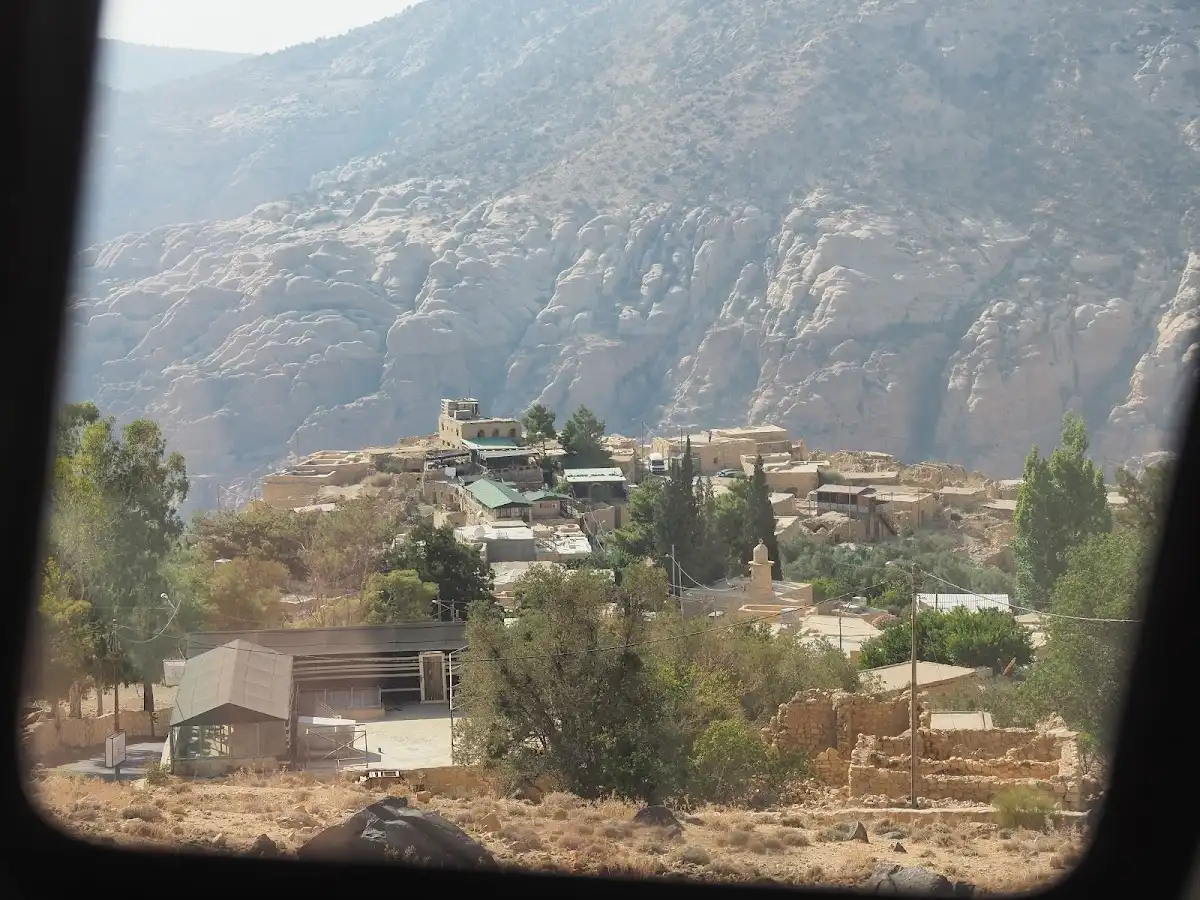
1 Dana

Stone village, nature reserve, terraced slopes

Hike through steep canyons and sleep in simple lodges, with panoramic views and rare wildlife just beyond the village edge.

jordan-city-dana
© Google |
Loading the map 🌍

Expert viewWhat You Should Know

How Many Villages: I advise three to five villages on a trip of a week or more. Fewer means you only meet one landscape. More means you spend your days waiting for minibuses on hot roadsides. Jordan's distances are short, but the winding roads and infrequent service turn every transfer into half a day. Three to five gives you time to sit through tea, walk the surrounding terrain and still sleep properly.
Choosing a Kind: The main choice is between northern farming villages, central highland settlements and southern desert communities. Backpackers on a tight budget get the most from the north: buses are cheap, rooms are inexpensive, and you are often the only foreigner at the falafel counter. Hikers should favor the central highlands, where trails cost little but guides may be needed, and food … read more 👉
How Many Villages: I advise three to five villages on a trip of a week or more. Fewer means you only meet one landscape. More means you spend your days waiting for minibuses on hot roadsides. Jordan's distances are short, but the winding roads and infrequent service turn every transfer into half a day. Three to five gives you time to sit through tea, walk the surrounding terrain and still sleep properly.
Choosing a Kind: The main choice is between northern farming villages, central highland settlements and southern desert communities. Backpackers on a tight budget get the most from the north: buses are cheap, rooms are inexpensive, and you are often the only foreigner at the falafel counter. Hikers should favor the central highlands, where trails cost little but guides may be needed, and food is hearty. Travelers wanting night skies and silence should spend one or two nights in the south, which costs more because everything is driven in, and transport is the hardest part. Mixing one of each gives the best return.
Budget: A frugal traveler can manage US$35 to 55 a day using shared dorms or simple guesthouses (JD 10 to 25, or US$14 to 35), local meals at JD 2 to 5 (US$3 to 7) and minibuses at JD 1 to 6 (US$1.40 to 8.50). Mid-range comfort runs US$60 to 100. Per visit, expect guides at JD 20 to 50 (US$28 to 70) for a half-day hike, a Bedouin camp stay with dinner around JD 25 to 50 (US$35 to 70), and a taxi between villages at JD 15 to 50 (US$21 to 70). The Jordan Pass covers visa fees and many major site entries, though small villages are usually free to enter.
Safety and Culture: Jordan is among the safer countries in the region, and village hosts tend to look after guests carefully. Dress modestly: shoulders and knees covered, for women a light scarf in the pocket. Ask before photographing people, particularly women. Accept the first cup of coffee, and shake the cup lightly to signal you have had enough. Alcohol is hard to find outside larger towns and drinking in public is poor form. Avoid flash flood wadis after rain, carry 3 liters of water in warm months, and keep cash in dinars since card machines are rare. Stay away from the border areas near Syria unless local advice says otherwise.

✈️ The backpacker research shortcutJordan Travel Guide

An offline-friendly backpacking guide with optimized travel routes, ranked highlights, transport advice, and the best areas to stay.
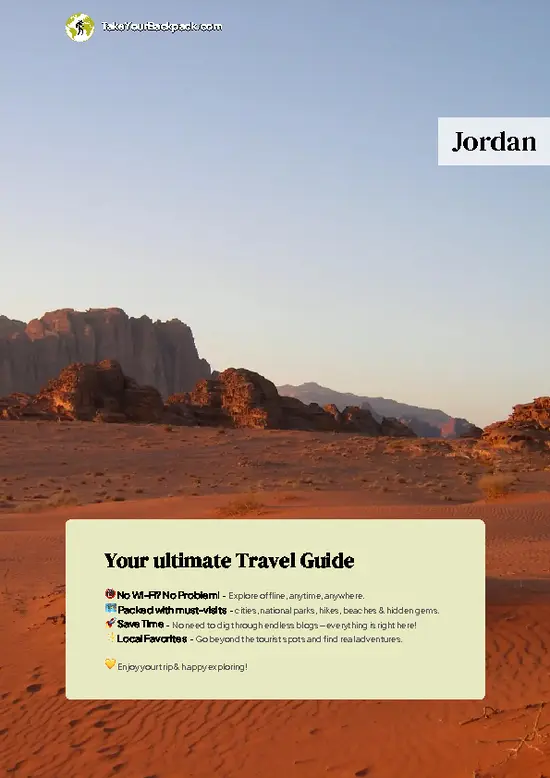
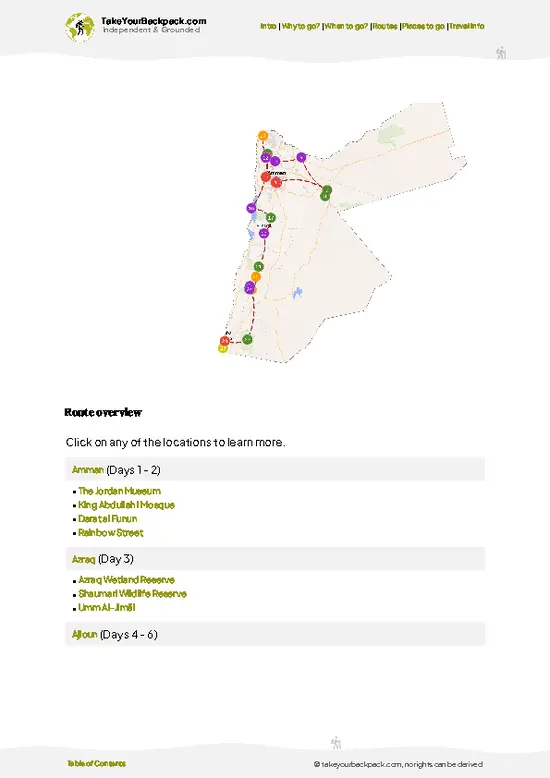
example page 0 from our offline Travel Guide for Jordan
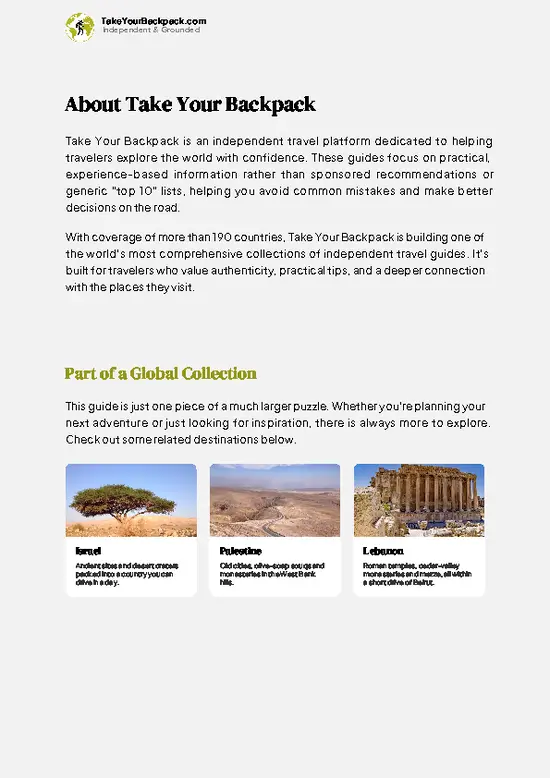
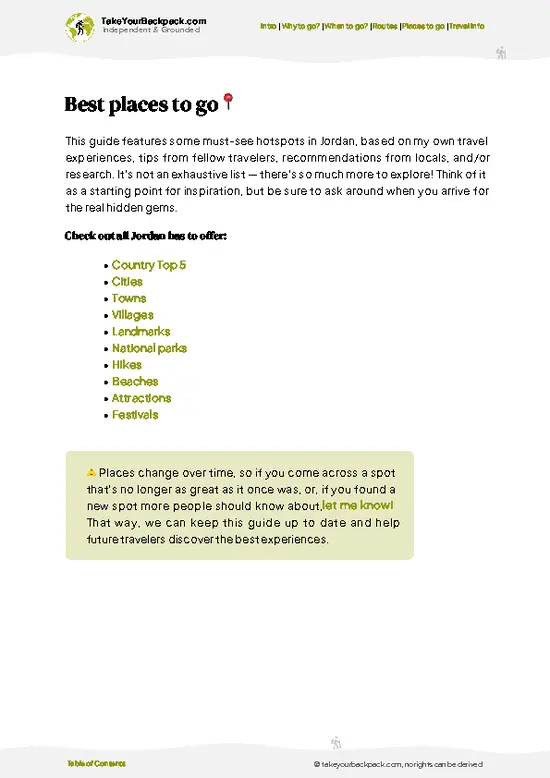
example page 1 from our offline Travel Guide for Jordan
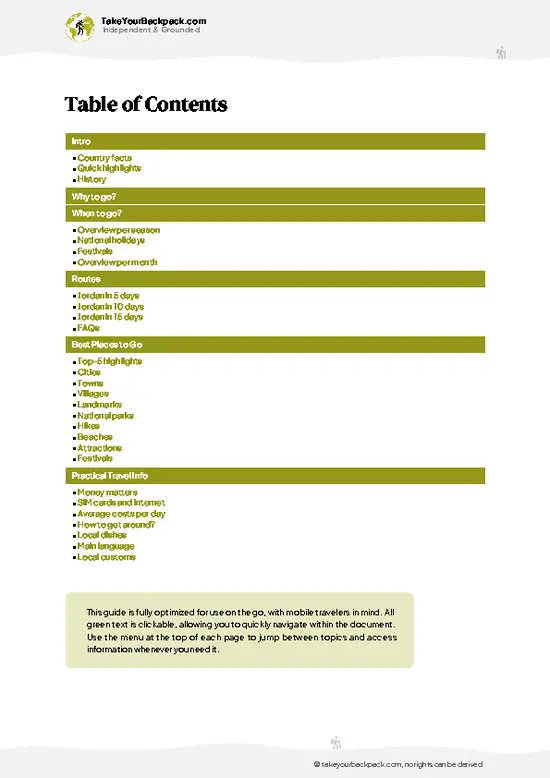
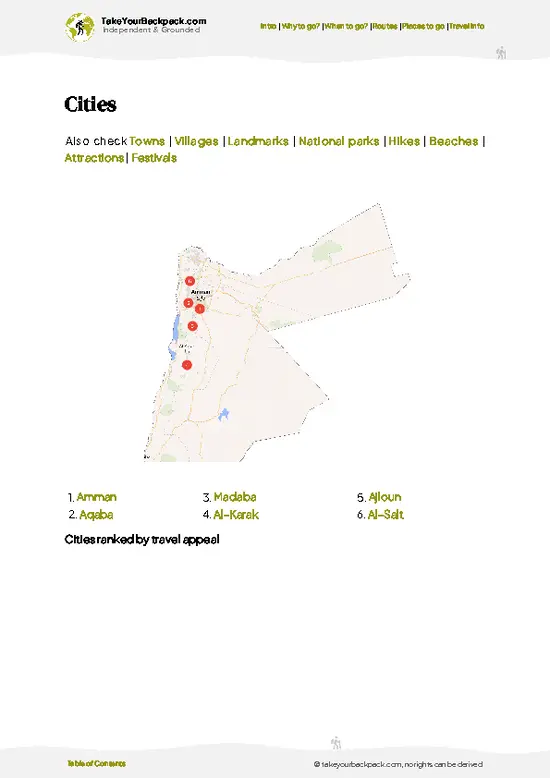
example page 2 from our offline Travel Guide for Jordan
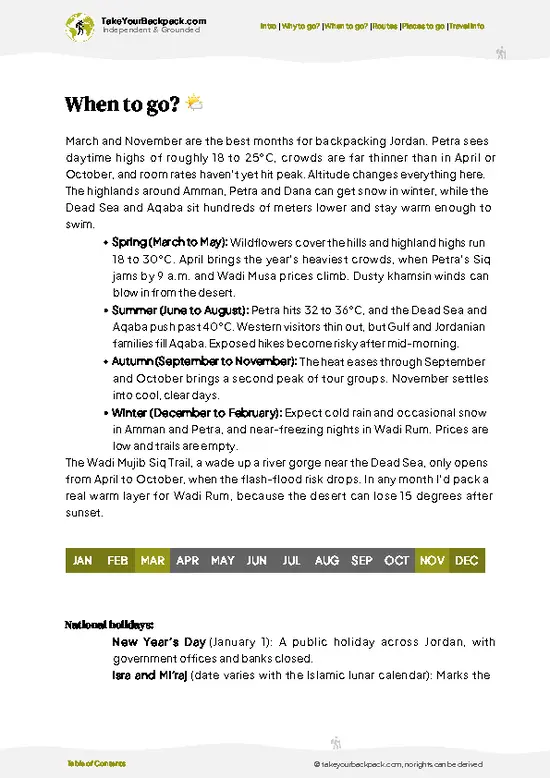
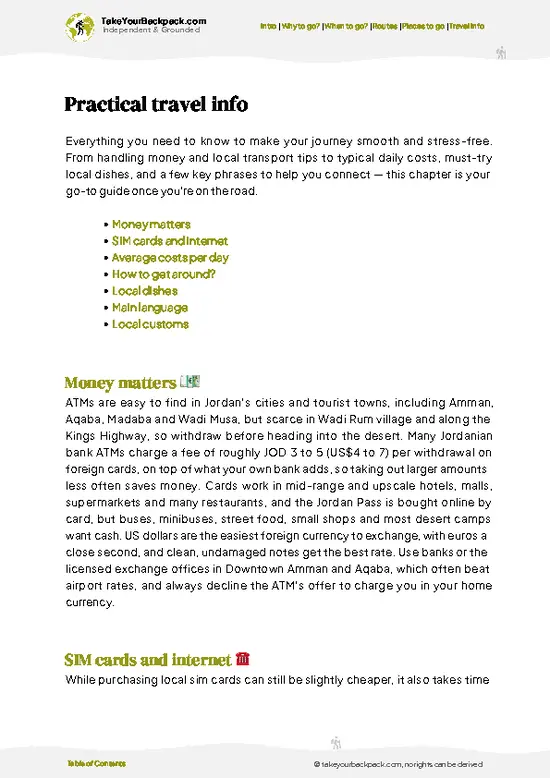
example page 3 from our offline Travel Guide for Jordan
example page 4 from our offline Travel Guide for Jordan
example page 5 from our offline Travel Guide for Jordan
example page 6 from our offline Travel Guide for Jordan
example page 7 from our offline Travel Guide for Jordan
The digital guide (230 pages) contains:
✅ 57 highlights, ranked by travel appeal
✅ Optimized 5, 10 & 15-day travel routes
✅ Cities, national parks, landmarks, beaches
✅ How to get around
✅ Offline-friendly for travel without Wi-Fi
👉 Click to see all 30+ guide features

📅 Plan smarter in minutes, not weeks
✅ Month by month travel advice
✅ Festivals & national holidays
✅ Budget expectations

🗺️ Go to the right places, skip the overrated ones
✅ Honest pros & cons of destinations
✅ Top hikes, parks & viewpoints
✅ Lesser-known places most travelers miss
✅ Clear “worth it vs skip it” guidance

🛏️ Travel smoothly without rookie mistakes
✅ Best areas to stay
✅ Transport systems explained simply
✅ Common scams & safety advice
✅ SIM cards, money & practical tips

🌍 Understand the country, not just visit it
✅ Culture & traditions
✅ 52 Essential phrases & customs
✅ Festivals worth planning around
✅ Traveler-friendly historical context
✅ Insights that make places more meaningful

📱 Built for real travel conditions
✅ Fully downloadable PDF
✅ Works completely offline
✅ Optimized for phone use
✅ Useful in remote areas & buses
✅ Everything in one place
Stop searching, start planning
Get instant access to your full guide. 30‑day money-back guarantee.
+ Add another guide for just

By proceeding you agree to our terms.
Sent to your inbox immediately after payment • 100% Secure Checkout
Best Backpacking Travel Advisor 2025 tourism awardBest Backpacking
Travel Advisor
2025
What others say about Take Your Backpack Guides:
⭐⭐⭐⭐⭐
Fantastic, amazing amount of information!
⭐⭐⭐⭐⭐
My goodness this is amazing, it's what I've been looking for hats off too you!
⭐⭐⭐⭐⭐
I think this is absolutely BRILLIANT
⭐⭐⭐⭐
Very complete and informative. It's still missing places, but I gotta to commend you
⭐⭐⭐⭐⭐
This is truly amazing, thank you, can't wait to explore it with my kids!
⭐⭐⭐⭐⭐
Awesome resource, thank you!
⭐⭐⭐⭐⭐
This is amazing! Can't wait to explore the ones I haven't seen
⭐⭐⭐⭐
I love this! Well done, great idea.
⭐⭐⭐⭐⭐
Thanks for taking the time to make this gem!
⭐⭐⭐⭐⭐
This might be the best website I've ever seen.
⭐⭐⭐⭐⭐
Congratulations, and thank you so much for your work; it's incredibly valuable.
⭐⭐⭐⭐
In all seriousness I think you did a great job pointing out the important spots
⭐⭐⭐⭐⭐
10/10 very good
⭐⭐⭐⭐⭐
As someone who's only just starting to visit regularly this is awesome, thank you.
⭐⭐⭐⭐
Thank you very much! I'm going to visit my dad, it's going to be very useful!
⭐⭐⭐⭐⭐
This is really cool! We'll be travelling for the first time and this definitely come in handy.
⭐⭐⭐⭐⭐
You are now our minister of culture, congratulations 👨‍💼
⭐⭐⭐⭐⭐
Just wanted to tell you that this is a pearl! Going to follow your recommendations.
⭐⭐⭐⭐⭐
This is so cool. I'll definitely be using the resource for my travels soon.
⭐⭐⭐⭐⭐
This is very impressive! Good work.
⭐⭐⭐⭐⭐
This is an amazing and informative site. Very well done!

🛏️ Where to stay?Best Stay Options in Jordan

Jordan has plenty of hostels and budget guesthouses, with dorm beds typically running JD 8 to 15 (US$11 to 21) and simple private rooms from about JD 20 to 35 (US$28 to 50). In Amman, Downtown (Al-Balad) packs in the most cheap options within walking distance of the Citadel and Roman Theater, though it’s noisy with traffic and the call to prayer, while neighboring Jabal Amman around Rainbow Street costs a bit more but gives you leafy, safe streets plus the city’s best cafés and bars. Beyond the capital, Wadi Musa has the budget beds closest to Petra’s gate (quiet after dark), Wadi Rum swaps hostels for Bedouin desert camps, and Aqaba suits divers but has thinner, pricier budget choices.

If you … read more 👉
Jordan has plenty of hostels and budget guesthouses, with dorm beds typically running JD 8 to 15 (US$11 to 21) and simple private rooms from about JD 20 to 35 (US$28 to 50). In Amman, Downtown (Al-Balad) packs in the most cheap options within walking distance of the Citadel and Roman Theater, though it’s noisy with traffic and the call to prayer, while neighboring Jabal Amman around Rainbow Street costs a bit more but gives you leafy, safe streets plus the city’s best cafés and bars. Beyond the capital, Wadi Musa has the budget beds closest to Petra’s gate (quiet after dark), Wadi Rum swaps hostels for Bedouin desert camps, and Aqaba suits divers but has thinner, pricier budget choices.

If you enjoy meeting fellow travelers, consider choosing hostels with high ratings for atmosphere. On the other hand, if you prefer having your own space, a hotel might be a better option.

JordanWhere to Go Next

👋 Meet the founderWho’s Behind Take Your Backpack?

Johan, backpacker and founder of TakeYourBackpackHi, I’m Johan (Netherlands 🇳🇱), the creator of TakeYourBackpack. Over the past 3 decades, I’ve backpacked through 90+ countries across six continents, gaining extensive experience with independent travel, long-term trips, and overland routes.

This site is built on a combination of firsthand travel experience and carefully curated insights from other backpackers. Many guides are based on places I’ve personally visited, while others bring together tips, observations, and practical advice shared by trusted travelers I’ve met along the way.

The goal is to provide realistic, experience-driven guidance — not generic itineraries — so you can explore destinations with better context, clearer expectations, and more confidence.