×

Jordan🇯🇴 | best national parksEssential 10 national parks to Explore in Jordan

National parks in Jordan are mostly protected reserves run by a royal conservation society, plus two famous desert and archaeological areas, so the experience swings with geography. The northern highlands smell of pine resin and wet limestone, and cost little. The Dead Sea rift is hot, loud with running water in its canyons, and often needs advance booking. The south is red sandstone and silence, with the highest fees and the thickest crowds near the headline sites. Independent travelers can reach most by bus and taxi, though remote reserves call for a pre-arranged ride or local guide.

By Johan Kruseman 🇳🇱 | Updated October 19, 2026
Explore the best hikes in Jordan

Why go?What Makes Them Special

Jordan packs an improbable range of terrain into a country you can cross in a day. The land drops to roughly 430 meters below sea level at the Dead Sea, then climbs to highlands above 1,500 meters within an hour or two of driving. That gap gives you cold pine forest, sun-baked canyon and open sand desert in one small area, with air that changes from damp and resinous to dry and mineral as you move.

The park system works differently from the wilderness model of North America or Africa. Most reserves were set up from the 1960s by the Royal Society for the Conservation of Nature, and they run on community employment. Local villagers and Bedouin families staff the gates, guide the trails and cook in the camps, so a lot of your money lands in the right pockets. The flip side is control. Many trails … read more 👉
Jordan packs an improbable range of terrain into a country you can cross in a day. The land drops to roughly 430 meters below sea level at the Dead Sea, then climbs to highlands above 1,500 meters within an hour or two of driving. That gap gives you cold pine forest, sun-baked canyon and open sand desert in one small area, with air that changes from damp and resinous to dry and mineral as you move.

The park system works differently from the wilderness model of North America or Africa. Most reserves were set up from the 1960s by the Royal Society for the Conservation of Nature, and they run on community employment. Local villagers and Bedouin families staff the gates, guide the trails and cook in the camps, so a lot of your money lands in the right pockets. The flip side is control. Many trails need a registered guide, daily visitor numbers are capped, and free-roaming backcountry trekking is limited.

Know before you choose Jordan that water is scarce, summer heat is severe, and winter flash floods close canyons without much notice. Roads are good and English is widely spoken, but public transport to the reserves is thin. The Jordan Pass bundles the visa fee with entry to the biggest sites, which changes the math if you stay at least three nights.
Behind the Scenes of Selection
The list of best national parks in Jordan is created based on landscapes, wildlife, adventure opportunities, facilities, and overall experience. If you feel a national park is missing in this list, please let us know.

When to go?Timing Your Visit for the Best Experience

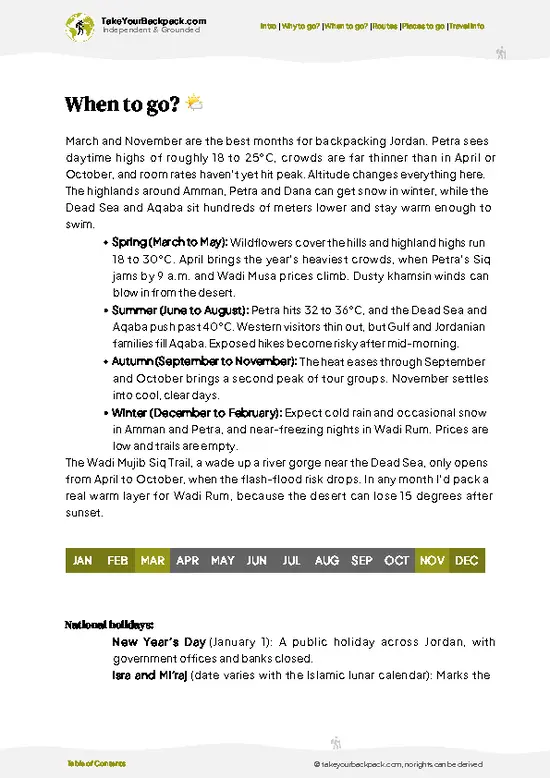
Best months: March to May and October to November: These months bring daytime highs of roughly 20 to 30°C across most of the country, clear light, and trails you can walk without cooking by noon. Spring adds green slopes and wildflowers in the northern and central highlands, with a faint smell of wild thyme after rain.Summer heat and winter floods: From June to August, the southern desert and Aqaba regularly reach 38 to 42°C, and the Dead Sea rift can feel like an oven door opening. Do your walking at dawn, because by 10 a.m. rock surfaces burn your hands. The northern highlands stay a few degrees cooler, around 28 to 33°C, which makes them the better summer choice.

Rain falls mostly between December and February. Amman averages around 270 mm a year, while Aqaba gets under 50 mm. The highlands … read more 👉
Best months: March to May and October to November: These months bring daytime highs of roughly 20 to 30°C across most of the country, clear light, and trails you can walk without cooking by noon. Spring adds green slopes and wildflowers in the northern and central highlands, with a faint smell of wild thyme after rain.Summer heat and winter floods: From June to August, the southern desert and Aqaba regularly reach 38 to 42°C, and the Dead Sea rift can feel like an oven door opening. Do your walking at dawn, because by 10 a.m. rock surfaces burn your hands. The northern highlands stay a few degrees cooler, around 28 to 33°C, which makes them the better summer choice.

Rain falls mostly between December and February. Amman averages around 270 mm a year, while Aqaba gets under 50 mm. The highlands can drop to near freezing at night, and snow occasionally closes roads around the central plateau. The danger is in the wadis, where a storm miles upstream sends brown water down a dry canyon within minutes. Water-trail reserves in the rift commonly close from around November to March.Crowds and prices: Spring and autumn are peak season, and hotels, camps and guide fees run 20 to 40 percent above winter levels. Mid-December to February is cheapest, with the south sunny and mild at about 12 to 18°C by day, though nights in the desert fall near 0 to 5°C. Ramadan shifts opening hours and quiets restaurants during the day.

national park hoppingPlanning Your Route Efficiently

How many days to combine several parks: A trip linking several national parks in Jordan needs 7 to 10 days, because distances are modest but the roads wind and the hiking days are long.Direction and clusters: Three clusters work well. The north (Ajloun and the pine hills) sits 1 to 1.5 hours from Amman. The Dead Sea rift and southern highlands lie along the King’s Highway, a switchback road that takes 3.5 to 4 hours from Amman to Wadi Musa, against about 3 hours on the faster Desert Highway. The far south, around Wadi Rum and Aqaba, is 1 to 1.5 hours beyond Wadi Musa.

Travel north to south, starting in Amman and ending in Aqaba, where you can fly out or cross to Egypt by ferry. The sequence also lets your legs adjust, with easy forest walks first and desert days last.Time per stop: Allow half … read more 👉
How many days to combine several parks: A trip linking several national parks in Jordan needs 7 to 10 days, because distances are modest but the roads wind and the hiking days are long.Direction and clusters: Three clusters work well. The north (Ajloun and the pine hills) sits 1 to 1.5 hours from Amman. The Dead Sea rift and southern highlands lie along the King’s Highway, a switchback road that takes 3.5 to 4 hours from Amman to Wadi Musa, against about 3 hours on the faster Desert Highway. The far south, around Wadi Rum and Aqaba, is 1 to 1.5 hours beyond Wadi Musa.

Travel north to south, starting in Amman and ending in Aqaba, where you can fly out or cross to Egypt by ferry. The sequence also lets your legs adjust, with easy forest walks first and desert days last.Time per stop: Allow half a day for a small forest reserve, one full day for a canyon or water trail, and two days for the large southern sites, since the main archaeological area alone takes 8 to 10 hours on foot.Planning mistakes: The common error is squeezing three parks into two days on the King’s Highway, where 150 kilometers can take over three hours. Plan one major stop per day. Another is arriving by afternoon bus, since many services run only in the morning, so book a taxi or driver ahead for reserves off the main road. Finally, the Dead Sea’s sticky heat saps energy, so avoid pairing it with a long hike the same day.

The ListMust-Visit national parks in Jordan

1 Wadi Rum

Red sand dunes, granite mountains, Bedouin camps

Cross vast desert expanses on foot or by jeep, camping under stars among sculpted rocks and learning from local Bedouin guides.

Jordan - Wadi Rum

2 Dana Biosphere Reserve

Sandstone cliffs, terraced villages, diverse habitats

Descend from mountain plateaus to arid valleys, passing through villages and ecosystems that change dramatically with elevation.

3 Ajloun Forest Reserve

Evergreen oak, hilltop views, ancient ruins

Climb wooded hills dotted with archaeological sites, where panoramic lookouts reveal the patchwork of forest and farmland below.

4 Dibeen Forest Reserve

Pine-oak woodland, rolling hills, wildflowers

Wander through cool, shaded forests where spring brings carpets of blooms and trails wind between ancient trees and gentle slopes.

5 Azraq Wetland Reserve

Oasis pools, reed beds, water buffalo

Spot migratory birds and native wildlife in restored wetlands, where boardwalks cross shallow pools and reeds sway in the breeze.

6 Shaumari Wildlife Reserve

Arabian oryx, desert grassland, wildlife enclosures

Observe rare desert animals in a protected setting where conservation efforts support the survival of native species and open landscapes.

7 Yarmouk Forest Reserve

Black iris, river valley, oak forest

Hike through lush northern woodlands where wildflowers bloom in spring and trails overlook the Yarmouk River’s green corridor.

8 Fifa Nature Reserve

Salt flats, mudflats, Dead Sea basin

Walk across mineral-rich plains below sea level, where unique plant life and saline soils create a landscape shaped by extremes.

9 Wadi Mujib

Deep canyon, river hike, vertical walls

Navigate water-filled gorges with towering rock faces, where adventure trails require swimming, scrambling, and a sense of exploration.

jordan-national-park-wadi-mujib
© Google |

10 Burqu Nature Reserve

Basalt desert, seasonal lake, migratory birds

Experience stark volcanic terrain and shifting water levels that attract flocks of birds and reveal the desert’s changing moods.

Loading the map 🌍

Expert viewWhat You Should Know

How many parks to visit: I advise three to four parks over a week or more. Fewer leaves you with one landscape type, and more turns the trip into a drive between gates, with 90 minutes in each. Four gives you one forest, one canyon or water trail, and the two big southern sites, which are different enough to feel like separate countries.Which kind to prioritize: If your budget is thin, the northern forest reserves give the most for the least: low entry fees and cool air, though less drama. The water canyons cost more in time and money, since they are booked in advance, closed in winter and priced at roughly 20 to 25 JOD (US$28 to 35), but they are the most physical, wet and memorable day you will have. The southern desert and ancient city reward you most visually, but they are crowded and … read more 👉
How many parks to visit: I advise three to four parks over a week or more. Fewer leaves you with one landscape type, and more turns the trip into a drive between gates, with 90 minutes in each. Four gives you one forest, one canyon or water trail, and the two big southern sites, which are different enough to feel like separate countries.Which kind to prioritize: If your budget is thin, the northern forest reserves give the most for the least: low entry fees and cool air, though less drama. The water canyons cost more in time and money, since they are booked in advance, closed in winter and priced at roughly 20 to 25 JOD (US$28 to 35), but they are the most physical, wet and memorable day you will have. The southern desert and ancient city reward you most visually, but they are crowded and expensive. Pay for the Jordan Pass if you stay three nights or more, at 70 to 80 JOD (US$100 to 113), since it folds in the visa fee and the main southern entry.What it costs: A backpacker spends about 45 to 70 JOD (US$63 to 99) a day all in, using dorms or basic rooms at 10 to 20 JOD (US$14 to 28), falafel and hummus meals at 2 to 5 JOD (US$3 to 7), and shared taxis or buses. Smaller reserve entries run 5 to 10 JOD (US$7 to 14). A required guide costs about 15 to 40 JOD (US$21 to 56) per group for a half day. A jeep tour in the desert costs roughly 50 to 100 JOD (US$70 to 141) per vehicle, which drops sharply when split among four. An overnight camp with dinner and breakfast runs 25 to 45 JOD (US$35 to 63). Private drivers to remote reserves cost 30 to 60 JOD (US$42 to 85) round trip, and are worth it where there is no bus.Safety and culture: The main hazard is water, both too little and too much. Carry at least 3 liters per person on desert and summer days, and never enter a narrow wadi if clouds are building anywhere in the watershed. Wear sturdy shoes, because wet limestone and loose sandstone are slick. Dress modestly in villages around the parks, with covered shoulders and knees, particularly for women. Accept the offered tea in a Bedouin tent, ask before photographing people, and leave drones at home, since they are restricted. Use only official guides with a reserve-issued badge, and skip animal rides if the animal looks thin or sore.

✈️ The backpacker research shortcutJordan Travel Guide

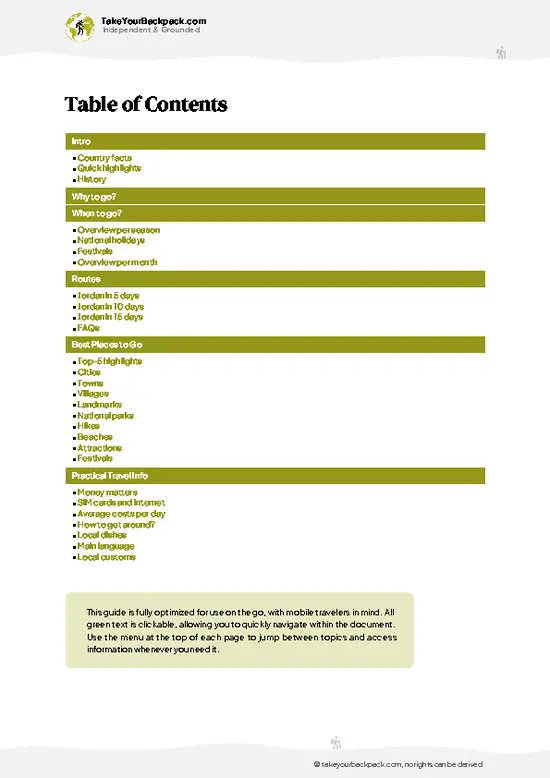
An offline-friendly backpacking guide with optimized travel routes, ranked highlights, transport advice, and the best areas to stay.
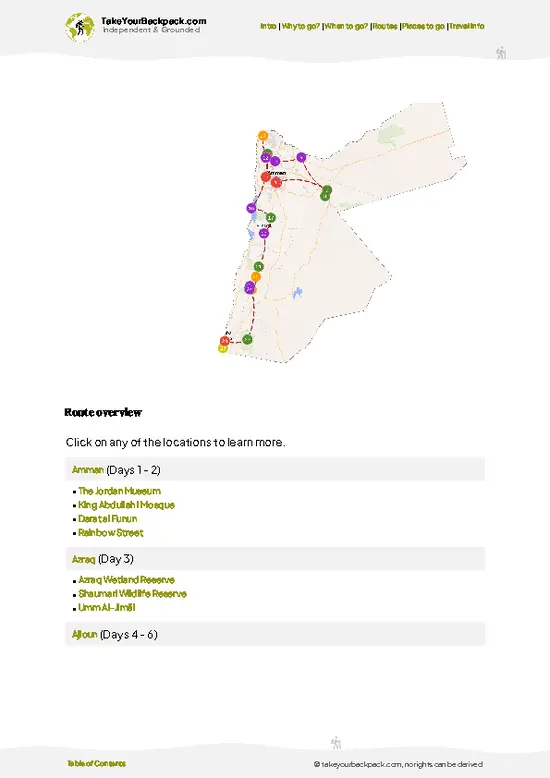
example page 0 from our offline Travel Guide for Jordan
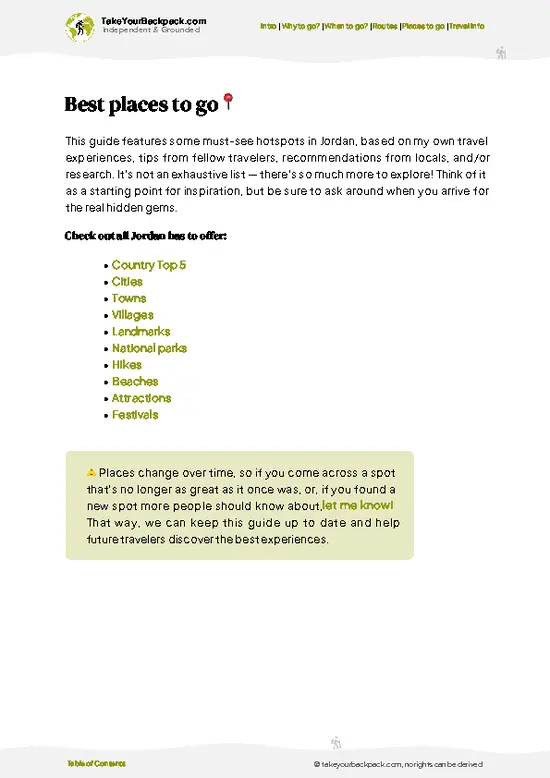
example page 1 from our offline Travel Guide for Jordan
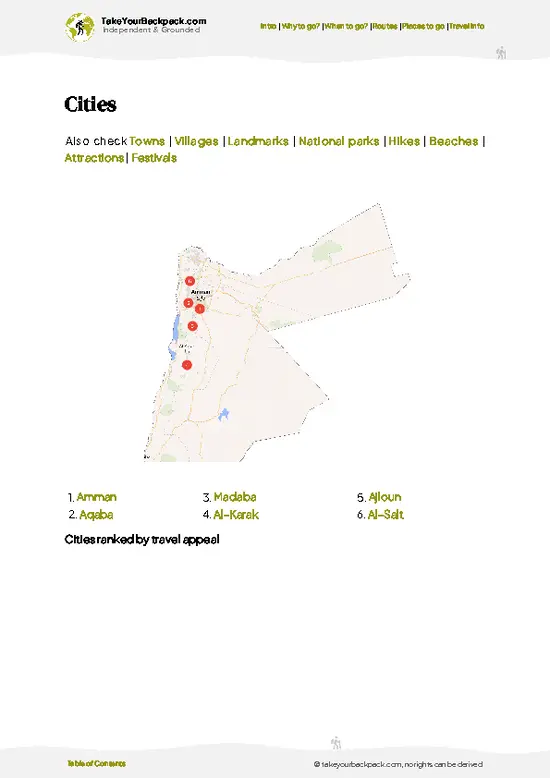
example page 2 from our offline Travel Guide for Jordan
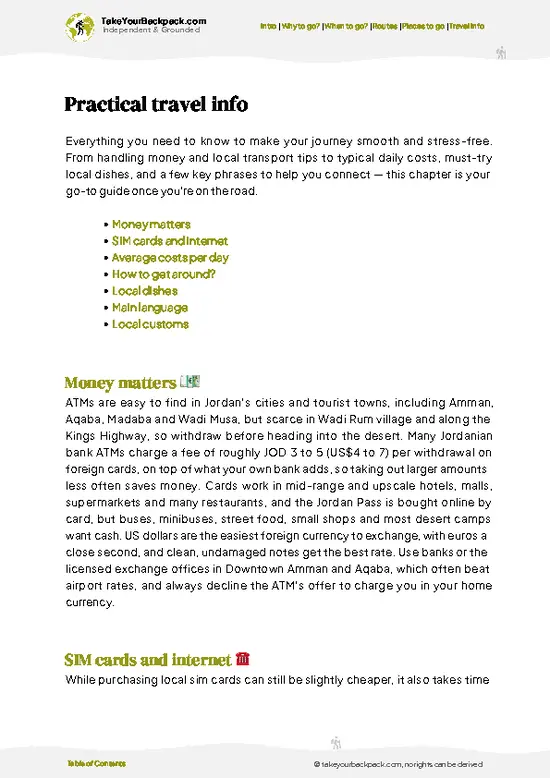
example page 3 from our offline Travel Guide for Jordan
example page 4 from our offline Travel Guide for Jordan
example page 5 from our offline Travel Guide for Jordan
example page 6 from our offline Travel Guide for Jordan
example page 7 from our offline Travel Guide for Jordan
The digital guide (230 pages) contains:
✅ 57 highlights, ranked by travel appeal
✅ Optimized 5, 10 & 15-day travel routes
✅ Cities, national parks, landmarks, beaches
✅ How to get around
✅ Offline-friendly for travel without Wi-Fi
👉 Click to see all 30+ guide features

📅 Plan smarter in minutes, not weeks
✅ Month by month travel advice
✅ Festivals & national holidays
✅ Budget expectations

🗺️ Go to the right places, skip the overrated ones
✅ Honest pros & cons of destinations
✅ Top hikes, parks & viewpoints
✅ Lesser-known places most travelers miss
✅ Clear “worth it vs skip it” guidance

🛏️ Travel smoothly without rookie mistakes
✅ Best areas to stay
✅ Transport systems explained simply
✅ Common scams & safety advice
✅ SIM cards, money & practical tips

🌍 Understand the country, not just visit it
✅ Culture & traditions
✅ 52 Essential phrases & customs
✅ Festivals worth planning around
✅ Traveler-friendly historical context
✅ Insights that make places more meaningful

📱 Built for real travel conditions
✅ Fully downloadable PDF
✅ Works completely offline
✅ Optimized for phone use
✅ Useful in remote areas & buses
✅ Everything in one place
Stop searching, start planning
Get instant access to your full guide. 30‑day money-back guarantee.
+ Add another guide for just

By proceeding you agree to our terms.
Sent to your inbox immediately after payment • 100% Secure Checkout
Best Backpacking Travel Advisor 2025 tourism awardBest Backpacking
Travel Advisor
2025
What others say about Take Your Backpack Guides:
⭐⭐⭐⭐⭐
Fantastic, amazing amount of information!
⭐⭐⭐⭐⭐
My goodness this is amazing, it's what I've been looking for hats off too you!
⭐⭐⭐⭐⭐
I think this is absolutely BRILLIANT
⭐⭐⭐⭐
Very complete and informative. It's still missing places, but I gotta to commend you
⭐⭐⭐⭐⭐
This is truly amazing, thank you, can't wait to explore it with my kids!
⭐⭐⭐⭐⭐
Awesome resource, thank you!
⭐⭐⭐⭐⭐
This is amazing! Can't wait to explore the ones I haven't seen
⭐⭐⭐⭐
I love this! Well done, great idea.
⭐⭐⭐⭐⭐
Thanks for taking the time to make this gem!
⭐⭐⭐⭐⭐
This might be the best website I've ever seen.
⭐⭐⭐⭐⭐
Congratulations, and thank you so much for your work; it's incredibly valuable.
⭐⭐⭐⭐
In all seriousness I think you did a great job pointing out the important spots
⭐⭐⭐⭐⭐
10/10 very good
⭐⭐⭐⭐⭐
As someone who's only just starting to visit regularly this is awesome, thank you.
⭐⭐⭐⭐
Thank you very much! I'm going to visit my dad, it's going to be very useful!
⭐⭐⭐⭐⭐
This is really cool! We'll be travelling for the first time and this definitely come in handy.
⭐⭐⭐⭐⭐
You are now our minister of culture, congratulations 👨‍💼
⭐⭐⭐⭐⭐
Just wanted to tell you that this is a pearl! Going to follow your recommendations.
⭐⭐⭐⭐⭐
This is so cool. I'll definitely be using the resource for my travels soon.
⭐⭐⭐⭐⭐
This is very impressive! Good work.
⭐⭐⭐⭐⭐
This is an amazing and informative site. Very well done!

🛏️ Where to stay?Best Places to Stay in Jordan

Jordan has plenty of hostels and budget guesthouses, with dorm beds typically running JD 8 to 15 (US$11 to 21) and simple private rooms from about JD 20 to 35 (US$28 to 50). In Amman, Downtown (Al-Balad) packs in the most cheap options within walking distance of the Citadel and Roman Theater, though it’s noisy with traffic and the call to prayer, while neighboring Jabal Amman around Rainbow Street costs a bit more but gives you leafy, safe streets plus the city’s best cafés and bars. Beyond the capital, Wadi Musa has the budget beds closest to Petra’s gate (quiet after dark), Wadi Rum swaps hostels for Bedouin desert camps, and Aqaba suits divers but has thinner, pricier budget choices.

If you … read more 👉
Jordan has plenty of hostels and budget guesthouses, with dorm beds typically running JD 8 to 15 (US$11 to 21) and simple private rooms from about JD 20 to 35 (US$28 to 50). In Amman, Downtown (Al-Balad) packs in the most cheap options within walking distance of the Citadel and Roman Theater, though it’s noisy with traffic and the call to prayer, while neighboring Jabal Amman around Rainbow Street costs a bit more but gives you leafy, safe streets plus the city’s best cafés and bars. Beyond the capital, Wadi Musa has the budget beds closest to Petra’s gate (quiet after dark), Wadi Rum swaps hostels for Bedouin desert camps, and Aqaba suits divers but has thinner, pricier budget choices.

If you enjoy meeting fellow travelers, consider choosing hostels with high ratings for atmosphere. On the other hand, if you prefer having your own space, a hotel might be a better option.

JordanExplore Jordan

👋 Meet the founderWho’s Behind Take Your Backpack?

Johan, backpacker and founder of TakeYourBackpackHi, I’m Johan (Netherlands 🇳🇱), the creator of TakeYourBackpack. Over the past 3 decades, I’ve backpacked through 90+ countries across six continents, gaining extensive experience with independent travel, long-term trips, and overland routes.

This site is built on a combination of firsthand travel experience and carefully curated insights from other backpackers. Many guides are based on places I’ve personally visited, while others bring together tips, observations, and practical advice shared by trusted travelers I’ve met along the way.

The goal is to provide realistic, experience-driven guidance — not generic itineraries — so you can explore destinations with better context, clearer expectations, and more confidence.