×

Jordan🇯🇴 | best attractionsEssential 10 attractions to Explore in Jordan

Jordan packs its attractions into a narrow country where the landscape changes every couple of hours by road. In the south, rose-red sandstone canyons and the Wadi Rum desert mean dry heat, the smell of cardamom coffee and sand in your boots, with entry fees that sting. The north and the capital offer Roman stone and hilltop ruins that are cheaper, quieter and easy to reach by minibus. Along the Dead Sea, salt stings every scratch. For backpacking or independent travel, the south is the busiest and priciest, while the north rewards you with space and low cost.

By Johan Kruseman 🇳🇱 | Updated October 19, 2026
Explore the best festivals in Jordan

Why go?What Makes Them Special

Jordan sits where desert, rift valley and Mediterranean hills meet, and that geology explains almost everything you will visit. Soft sandstone, limestone and basalt have been carved by wind and flash floods, then built on by Nabataeans, Romans, Byzantines, Crusaders and Ottomans. The result is a small country with an unusually dense layer of history, often standing in open air with few fences and little glass. Early light turns stone amber and pink, midday glare flattens it, and silence outside the sites can be total.

Before choosing Jordan, know that distances are short but sites are physical. Expect a lot of walking on uneven stone steps, little shade and strong sun. Public transport is thin and unscheduled, so many travelers rely on shared taxis, private drivers or a car. Entry costs are … read more 👉
Jordan sits where desert, rift valley and Mediterranean hills meet, and that geology explains almost everything you will visit. Soft sandstone, limestone and basalt have been carved by wind and flash floods, then built on by Nabataeans, Romans, Byzantines, Crusaders and Ottomans. The result is a small country with an unusually dense layer of history, often standing in open air with few fences and little glass. Early light turns stone amber and pink, midday glare flattens it, and silence outside the sites can be total.

Before choosing Jordan, know that distances are short but sites are physical. Expect a lot of walking on uneven stone steps, little shade and strong sun. Public transport is thin and unscheduled, so many travelers rely on shared taxis, private drivers or a car. Entry costs are high by regional standards, and the Jordan Pass bundles the visa fee waiver with most major site tickets if you stay at least three nights. Water is scarce, so carry plenty. Modest dress is expected in towns, and the desert nights drop sharply in temperature.
Why These Made the Cut
The list of best attractions in Jordan is created based on cultural significance or entertainment value. If you feel a attraction is missing in this list, please let us know.

When to go?Timing Your Visit for the Best Experience

Best months: March to May and September to November are the best months, with daytime highs of roughly 20 to 30°C and clear, dry air that makes long walks on stone comfortable. Spring brings wildflowers in the northern hills and brief rain, while autumn feels warm and steady.
Shoulder and peak seasons: Prices and crowds peak in spring and October, when camps and hotels in the south fill, so book ahead and expect rates to rise 20 to 40 percent. Late February and early November are a little quieter. Summer, from June to August, can reach 35 to 40°C in Petra and Wadi Rum, and over 40°C by the Dead Sea and Aqaba, so start before 7 a.m. and rest through the afternoon. Aqaba is hot but swimmable year-round.
Winter: December to February runs 5 to 15°C in Amman and the highlands, with rain that can … read more 👉
Best months: March to May and September to November are the best months, with daytime highs of roughly 20 to 30°C and clear, dry air that makes long walks on stone comfortable. Spring brings wildflowers in the northern hills and brief rain, while autumn feels warm and steady.
Shoulder and peak seasons: Prices and crowds peak in spring and October, when camps and hotels in the south fill, so book ahead and expect rates to rise 20 to 40 percent. Late February and early November are a little quieter. Summer, from June to August, can reach 35 to 40°C in Petra and Wadi Rum, and over 40°C by the Dead Sea and Aqaba, so start before 7 a.m. and rest through the afternoon. Aqaba is hot but swimmable year-round.
Winter: December to February runs 5 to 15°C in Amman and the highlands, with rain that can flood canyons and occasional snow. Desert nights fall near freezing, so a proper sleeping layer matters. Winter has the thinnest crowds and the lowest prices, but short days limit your time at sites. Ramadan shifts opening habits and food availability in towns, though major sites stay open.

attraction hoppingPlanning Your Route Efficiently

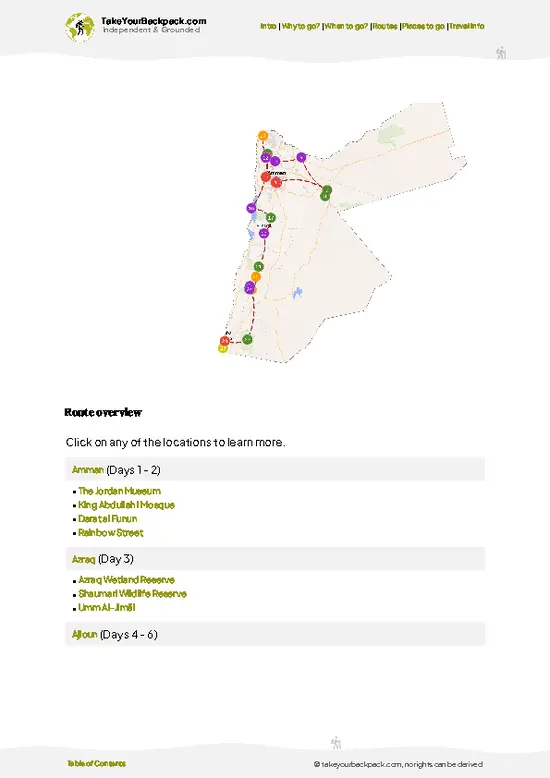
How long to allow: A trip linking several attractions in Jordan needs 7 to 10 days, and 5 days is the practical minimum if you want to avoid constant driving. Most travelers run north to south, flying into Amman, then working through the northern hills, the Dead Sea area and the King's Highway before finishing at Wadi Rum and Aqaba. Aqaba also has a flight and bus connection back to Amman.
Time per stop and between regions: Allow half a day to a full day for northern ruins, one day for the Dead Sea, and one to two full days for the big rock-cut site. Wadi Rum needs one night to feel the silence and the cold clear dark. Amman to Petra takes 3 to 3.5 hours by road, Petra to Wadi Rum around 1.5 hours, Wadi Rum to Aqaba 1 hour, and Aqaba to Amman 4 to 4.5 hours.
Common planning mistakes: Travelers … read more 👉
How long to allow: A trip linking several attractions in Jordan needs 7 to 10 days, and 5 days is the practical minimum if you want to avoid constant driving. Most travelers run north to south, flying into Amman, then working through the northern hills, the Dead Sea area and the King's Highway before finishing at Wadi Rum and Aqaba. Aqaba also has a flight and bus connection back to Amman.
Time per stop and between regions: Allow half a day to a full day for northern ruins, one day for the Dead Sea, and one to two full days for the big rock-cut site. Wadi Rum needs one night to feel the silence and the cold clear dark. Amman to Petra takes 3 to 3.5 hours by road, Petra to Wadi Rum around 1.5 hours, Wadi Rum to Aqaba 1 hour, and Aqaba to Amman 4 to 4.5 hours.
Common planning mistakes: Travelers often cram Petra into half a day in midday heat, so plan an early start and a second visit at dusk or morning. Others rely on buses that run once daily, often in the morning, so check times the day before. Packing three sites into one day on winding mountain roads leaves everyone tired. Build in one slow day after each hard walk.

The ListMust-Visit attractions in Jordan

1 Petra Museum

Nabataean artifacts, carved sandstone, trade route relics

Trace Petra’s evolution through displays of pottery, jewelry, and tools that highlight the city’s role in ancient commerce.

2 The Jordan Museum

Dead Sea Scrolls, prehistoric tools, interactive galleries

Follow Jordan’s story from early human settlements to the present through artifacts, multimedia, and hands-on displays.

3 Jerash Archaeological Museum

Roman statuary, mosaic fragments, ancient coins

View artifacts excavated from Jerash’s ruins, including daily life objects and decorative pieces that illustrate the city’s classical heritage.

4 Royal Automobile Museum

classic cars, royal vehicles, motorbike displays

View a curated collection of vehicles owned by Jordan’s royal family, reflecting decades of automotive history and design.

5 Roman Theatre

amphitheater seating, folk costumes, traditional crafts

Sit among ancient stone tiers and explore exhibits on rural life, music, and dress from across Jordan’s regions.

6 King Abdullah I Mosque

blue mosaic dome, prayer hall, Islamic architecture

Admire geometric tilework and spacious interiors in Amman’s prominent mosque, open to non-Muslim visitors outside prayer times.

7 Rainbow Street

shisha cafés, rooftop bars, street art, local boutiques

Sample Amman’s evening scene with casual eateries, independent shops, and panoramic terraces popular with locals and travelers.

8 Abdali Boulevard

open-air mall, rooftop lounges, designer shops, city views

Stroll a modern urban promenade lined with upscale boutiques, lively cafés, and rooftop venues overlooking Amman’s skyline.

9 Darat al Funun

contemporary galleries, sculpture gardens, restored villas

Experience regional art exhibitions, installations, and creative workshops set within historic buildings and terraced gardens overlooking downtown Amman.

11 Royal Tank Museum

armored vehicles, military history, interactive exhibits

Examine tanks and armored cars from different eras, with displays that detail Jordan’s military technology and regional conflicts.

12 Madaba Archaeological Park & Museum

Byzantine mosaics, ancient churches, Roman street remains

Walk among preserved floor mosaics and ruins that reveal Madaba’s role as a crossroads of early Christian and Roman cultures.

13 Aqaba Archaeological Museum

Red Sea artifacts, Bronze Age finds, ancient inscriptions

Discover relics from Aqaba’s layered past, including early Islamic ceramics and maritime objects unearthed near the city’s old port.

Think you know Jordan?

Prove you’re a true local — uncover 3 lesser-known attractions in Jordan that locals tend to keep to themselves.
Loading the map 🌍

Expert viewWhat You Should Know

How many attractions to visit: Aim for five to seven major sites across a week or more, and fill the gaps with free-to-wander places. Past that number, the stone starts to blur, the sun wears you down and the entry fees add up. One big day on foot costs more in energy than its ticket costs in money, so pair each with a recovery day. A slower pace is both cheaper and kinder to your knees.
Which kind to prioritize: If you love history, put your money into the ancient city sites and one or two northern Roman ruins, which are lower in cost and in crowds. If you want landscape, the desert gives the most for the least walking, since a jeep tour or a night in a camp costs more than a day pass but delivers silence, star-filled sky and tea over a fire. Travelers who want comfort should spend on the … read more 👉
How many attractions to visit: Aim for five to seven major sites across a week or more, and fill the gaps with free-to-wander places. Past that number, the stone starts to blur, the sun wears you down and the entry fees add up. One big day on foot costs more in energy than its ticket costs in money, so pair each with a recovery day. A slower pace is both cheaper and kinder to your knees.
Which kind to prioritize: If you love history, put your money into the ancient city sites and one or two northern Roman ruins, which are lower in cost and in crowds. If you want landscape, the desert gives the most for the least walking, since a jeep tour or a night in a camp costs more than a day pass but delivers silence, star-filled sky and tea over a fire. Travelers who want comfort should spend on the Dead Sea, where a public beach day costs a fraction of resort rates and gives the same salt-thick float. Hikers should favor canyon routes and mountain trails, which usually need a guide and add cost.
What it costs: A frugal backpacker can manage US$40 to 70 a day including a dorm or budget room, falafel and hummus meals and shared transport. Add the big sites and the total rises. The Jordan Pass runs roughly JOD 70 to 80 (about US$100 to 113) and covers dozens of sites and the visa fee. Without it, the main ancient city alone costs about JOD 50 (about US$70) for a one-day ticket. Local guides run JOD 50 to 70 (US$70 to 100) for a half day, while a desert jeep tour is JOD 60 to 100 (US$85 to 140) per vehicle, so share. Taxis between towns often cost JOD 5 to 15 (US$7 to 21) per person when shared.
Safety and cultural points: Jordan is generally calm and welcoming, but follow current government travel advice for border areas. Keep your Jordan Pass and passport handy, since checkpoints are routine on highways. Sun and dehydration are the real hazards, so carry 2 to 3 liters of water, a hat and sturdy shoes. Flash floods in canyons are serious during rain, so skip narrow gorges when storms are forecast. In towns, dress modestly with covered shoulders and knees, and ask before photographing people. Bargain firmly but politely with camel and horse handlers, and agree prices before you start. Accept tea when it is offered, since refusing can feel abrupt, and expect a polite sales pitch to follow.

✈️ The backpacker research shortcutJordan Travel Guide

An offline-friendly backpacking guide with optimized travel routes, ranked highlights, transport advice, and the best areas to stay.
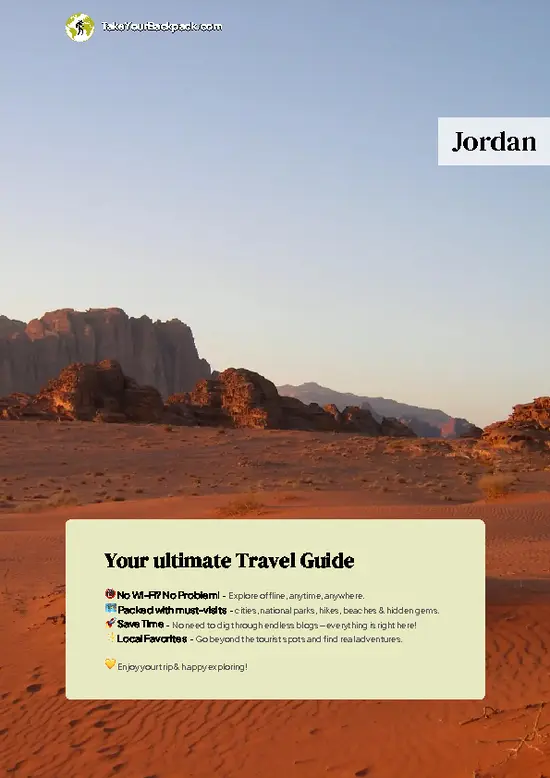
example page 0 from our offline Travel Guide for Jordan
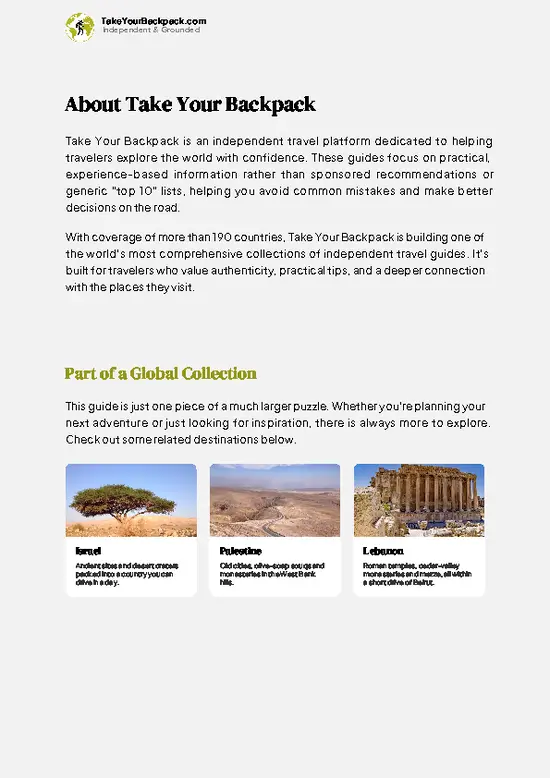
example page 1 from our offline Travel Guide for Jordan
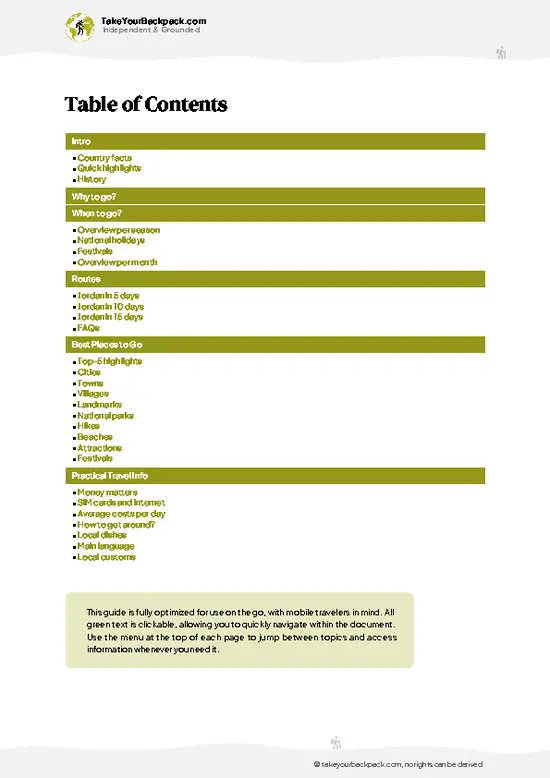
example page 2 from our offline Travel Guide for Jordan
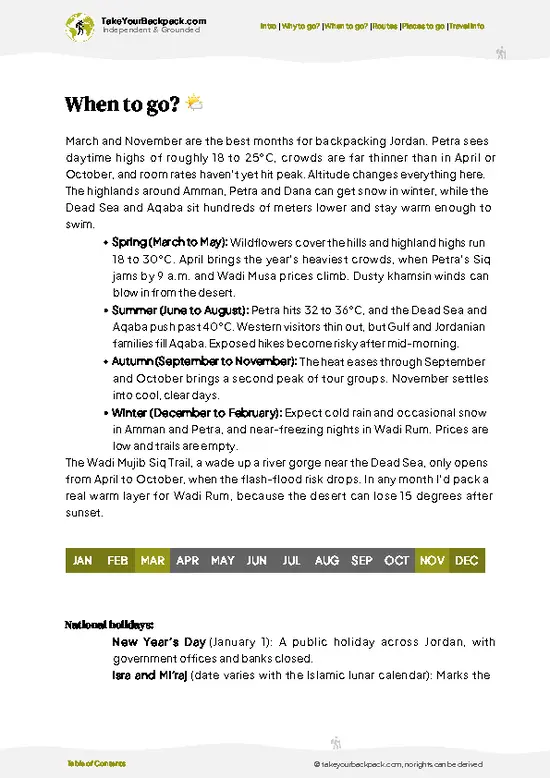
example page 3 from our offline Travel Guide for Jordan
example page 4 from our offline Travel Guide for Jordan
example page 5 from our offline Travel Guide for Jordan
example page 6 from our offline Travel Guide for Jordan
example page 7 from our offline Travel Guide for Jordan
The digital guide (230 pages) contains:
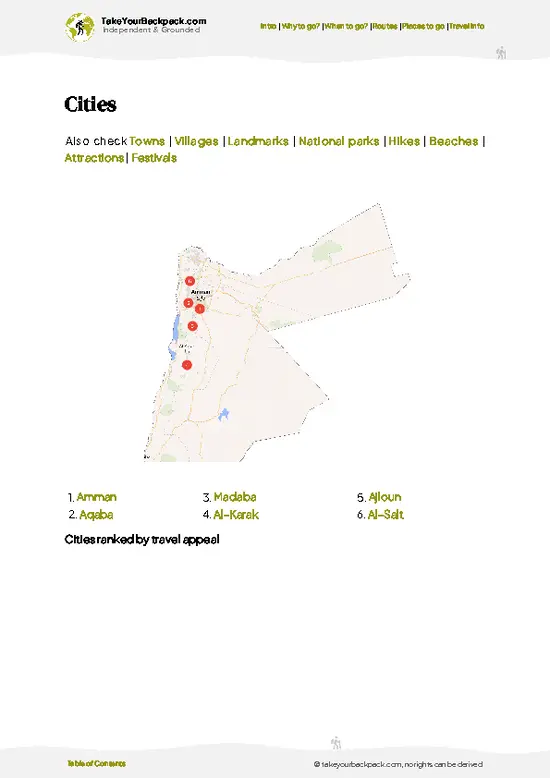
✅ 57 highlights, ranked by travel appeal
✅ Optimized 5, 10 & 15-day travel routes
✅ Cities, national parks, landmarks, beaches
✅ How to get around
✅ Offline-friendly for travel without Wi-Fi
👉 Click to see all 30+ guide features

📅 Plan smarter in minutes, not weeks
✅ Month by month travel advice
✅ Festivals & national holidays
✅ Budget expectations

🗺️ Go to the right places, skip the overrated ones
✅ Honest pros & cons of destinations
✅ Top hikes, parks & viewpoints
✅ Lesser-known places most travelers miss
✅ Clear “worth it vs skip it” guidance

🛏️ Travel smoothly without rookie mistakes
✅ Best areas to stay
✅ Transport systems explained simply
✅ Common scams & safety advice
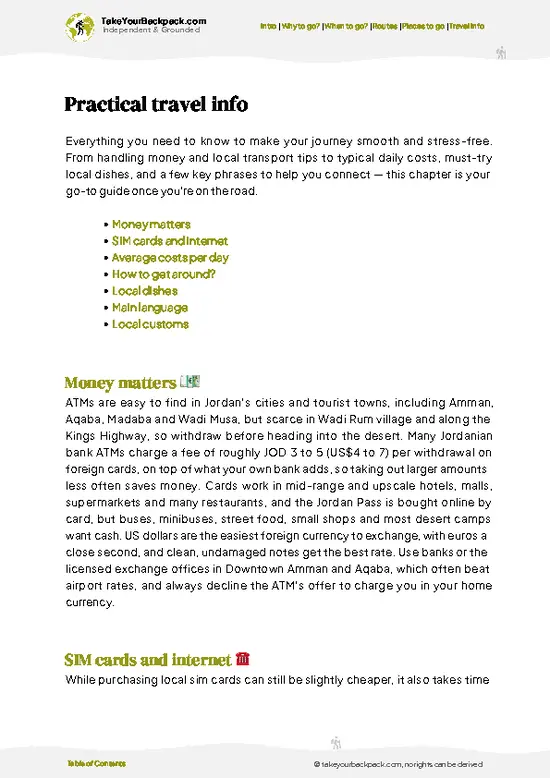
✅ SIM cards, money & practical tips

🌍 Understand the country, not just visit it
✅ Culture & traditions
✅ 52 Essential phrases & customs
✅ Festivals worth planning around
✅ Traveler-friendly historical context
✅ Insights that make places more meaningful

📱 Built for real travel conditions
✅ Fully downloadable PDF
✅ Works completely offline
✅ Optimized for phone use
✅ Useful in remote areas & buses
✅ Everything in one place
Stop searching, start planning
Get instant access to your full guide. 30‑day money-back guarantee.
+ Add another guide for just

By proceeding you agree to our terms.
Sent to your inbox immediately after payment • 100% Secure Checkout
Best Backpacking Travel Advisor 2025 tourism awardBest Backpacking
Travel Advisor
2025
What others say about Take Your Backpack Guides:
⭐⭐⭐⭐⭐
Fantastic, amazing amount of information!
⭐⭐⭐⭐⭐
My goodness this is amazing, it's what I've been looking for hats off too you!
⭐⭐⭐⭐⭐
I think this is absolutely BRILLIANT
⭐⭐⭐⭐
Very complete and informative. It's still missing places, but I gotta to commend you
⭐⭐⭐⭐⭐
This is truly amazing, thank you, can't wait to explore it with my kids!
⭐⭐⭐⭐⭐
Awesome resource, thank you!
⭐⭐⭐⭐⭐
This is amazing! Can't wait to explore the ones I haven't seen
⭐⭐⭐⭐
I love this! Well done, great idea.
⭐⭐⭐⭐⭐
Thanks for taking the time to make this gem!
⭐⭐⭐⭐⭐
This might be the best website I've ever seen.
⭐⭐⭐⭐⭐
Congratulations, and thank you so much for your work; it's incredibly valuable.
⭐⭐⭐⭐
In all seriousness I think you did a great job pointing out the important spots
⭐⭐⭐⭐⭐
10/10 very good
⭐⭐⭐⭐⭐
As someone who's only just starting to visit regularly this is awesome, thank you.
⭐⭐⭐⭐
Thank you very much! I'm going to visit my dad, it's going to be very useful!
⭐⭐⭐⭐⭐
This is really cool! We'll be travelling for the first time and this definitely come in handy.
⭐⭐⭐⭐⭐
You are now our minister of culture, congratulations 👨‍💼
⭐⭐⭐⭐⭐
Just wanted to tell you that this is a pearl! Going to follow your recommendations.
⭐⭐⭐⭐⭐
This is so cool. I'll definitely be using the resource for my travels soon.
⭐⭐⭐⭐⭐
This is very impressive! Good work.
⭐⭐⭐⭐⭐
This is an amazing and informative site. Very well done!

🛏️ Where to stay?Top Areas to Stay

Jordan has plenty of hostels and budget guesthouses, with dorm beds typically running JD 8 to 15 (US$11 to 21) and simple private rooms from about JD 20 to 35 (US$28 to 50). In Amman, Downtown (Al-Balad) packs in the most cheap options within walking distance of the Citadel and Roman Theater, though it’s noisy with traffic and the call to prayer, while neighboring Jabal Amman around Rainbow Street costs a bit more but gives you leafy, safe streets plus the city’s best cafés and bars. Beyond the capital, Wadi Musa has the budget beds closest to Petra’s gate (quiet after dark), Wadi Rum swaps hostels for Bedouin desert camps, and Aqaba suits divers but has thinner, pricier budget choices.

If you … read more 👉
Jordan has plenty of hostels and budget guesthouses, with dorm beds typically running JD 8 to 15 (US$11 to 21) and simple private rooms from about JD 20 to 35 (US$28 to 50). In Amman, Downtown (Al-Balad) packs in the most cheap options within walking distance of the Citadel and Roman Theater, though it’s noisy with traffic and the call to prayer, while neighboring Jabal Amman around Rainbow Street costs a bit more but gives you leafy, safe streets plus the city’s best cafés and bars. Beyond the capital, Wadi Musa has the budget beds closest to Petra’s gate (quiet after dark), Wadi Rum swaps hostels for Bedouin desert camps, and Aqaba suits divers but has thinner, pricier budget choices.

If you enjoy meeting fellow travelers, consider choosing hostels with high ratings for atmosphere. On the other hand, if you prefer having your own space, a hotel might be a better option.

JordanDiscover the Country

👋 Meet the founderWho’s Behind Take Your Backpack?

Johan, backpacker and founder of TakeYourBackpackHi, I’m Johan (Netherlands 🇳🇱), the creator of TakeYourBackpack. Over the past 3 decades, I’ve backpacked through 90+ countries across six continents, gaining extensive experience with independent travel, long-term trips, and overland routes.

This site is built on a combination of firsthand travel experience and carefully curated insights from other backpackers. Many guides are based on places I’ve personally visited, while others bring together tips, observations, and practical advice shared by trusted travelers I’ve met along the way.

The goal is to provide realistic, experience-driven guidance — not generic itineraries — so you can explore destinations with better context, clearer expectations, and more confidence.