
×

Kiribati🇰🇮 | national parksKiritimati National ParkFrigatebird colonies, bonefish flats, reed warbler, salt flats | things to do and best time to go

Explore Abaiang Atoll National ParkExplore Phoenix Islands Protected Area

Backpacking in Kiritimati
By Johan Kruseman 🇳🇱 | Updated October 13, 2026

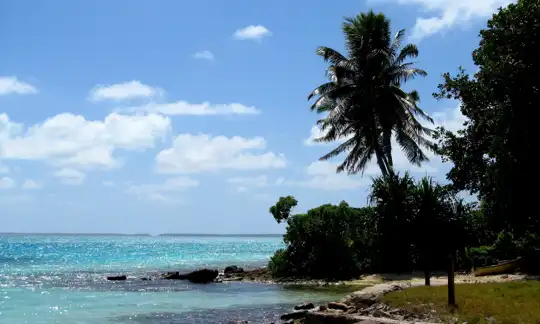
Kiritimati sits at UTC+14, so it is among the first places on Earth to start each new day, and the park’s birds are up well before you are. The protected land lies on the Line Islands atoll of eastern Kiribati, on what is the largest coral atoll on the planet by land area. Walking here means sun-bleached coral tracks, crunching salt flats, the ammonia tang of seabird colonies and a wind that never quite drops. Frigatebirds hang overhead, and the lagoon flats flash silver with bonefish. The hard parts are real: shade is scarce, mosquitoes find you at dusk, the heat flattens afternoons, and there are no marked loops or ranger huts to lean on. Flights are few, crowds are close to zero, and the vibe is quiet and local. A good first day starts at dawn with a slow walk along a village road to the shore, then a rest in the shade through the midday glare, then a boat or guided trip toward the bird islands.

Discover everything you want to know in the 📖 Kiribati Travel Guide.


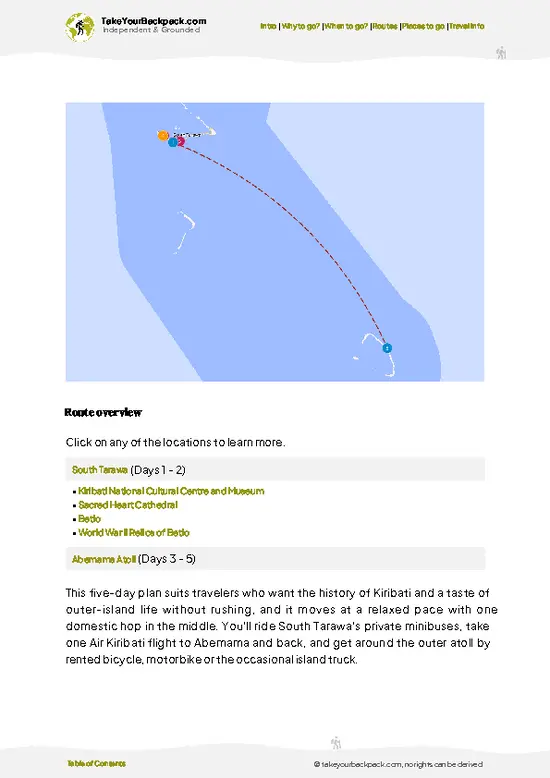
example page 0 from our offline Travel Guide for Kiribati
example page 1 from our offline Travel Guide for Kiribati
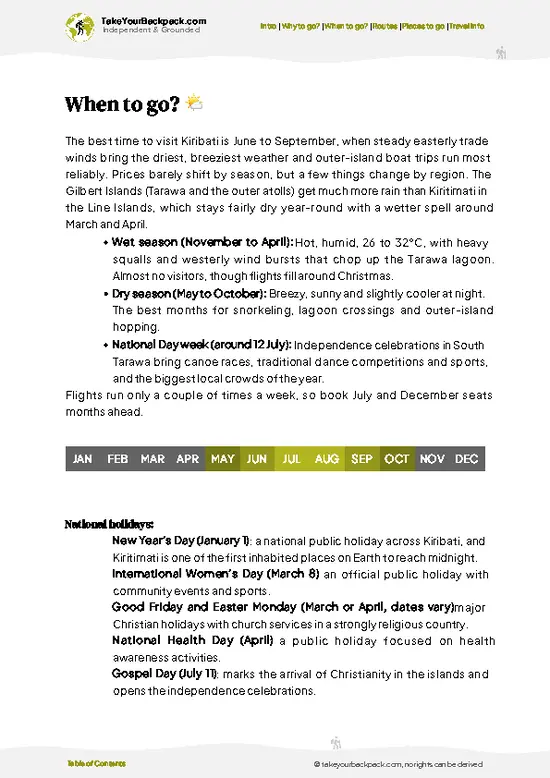
example page 2 from our offline Travel Guide for Kiribati
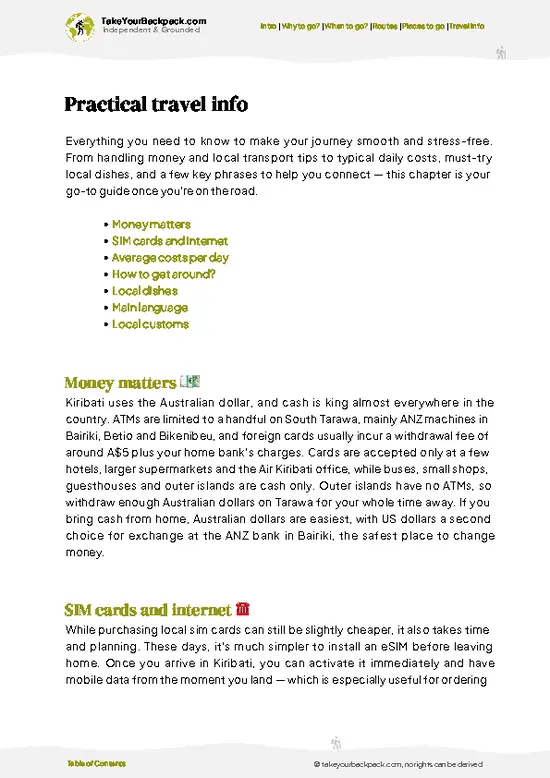
example page 3 from our offline Travel Guide for Kiribati
example page 4 from our offline Travel Guide for Kiribati
example page 5 from our offline Travel Guide for Kiribati
example page 6 from our offline Travel Guide for Kiribati
example page 7 from our offline Travel Guide for Kiribati
Loading the map 🌍
CLICK TO FILTER
towns
villages
landmarks
national parks
beaches
attractions
festivals
regions
SHOW COUNTRY’S BESTSHOW ALL

✨ Why go?
Ranked #99 national park in Kiribati
The unique appeal for travelers

Backpackers come to Kiritimati because nothing else in the Pacific comes close for solitude. The island has the Kiritimati reed warbler, found nowhere else, plus huge seabird colonies of sooty terns, frigatebirds and boobies that nest on the protected islets. You can see more birds in a morning than on a week of mainland trails, and you will often be the only visitor in sight.

It also suits independent travelers who like to build their own days. There are no entry queues, no tour buses and no set itinerary, so you decide whether to chase birds at first light, wade the bonefish flats of the lagoon or simply walk village to village and talk with locals. A homestay or guesthouse base, plus a guide for the sanctuary islands, gives you most of what the place offers without paying for a package. … read more 👉
Backpackers come to Kiritimati because nothing else in the Pacific comes close for solitude. The island has the Kiritimati reed warbler, found nowhere else, plus huge seabird colonies of sooty terns, frigatebirds and boobies that nest on the protected islets. You can see more birds in a morning than on a week of mainland trails, and you will often be the only visitor in sight.

It also suits independent travelers who like to build their own days. There are no entry queues, no tour buses and no set itinerary, so you decide whether to chase birds at first light, wade the bonefish flats of the lagoon or simply walk village to village and talk with locals. A homestay or guesthouse base, plus a guide for the sanctuary islands, gives you most of what the place offers without paying for a package.

The history adds weight. Captain Cook anchored here on Christmas Eve in 1777, which gave the atoll its English name, and the 1950s and 1960s nuclear tests left their own traces. Come prepared to carry water, sunscreen and patience.

💡 HighlightsPlaces and moments you shouldn't skip

  1. Cook Island Bird Sanctuary: A small islet in the lagoon packed with nesting frigatebirds, red-footed boobies and other seabirds. Visits are usually done with a local guide and boat, and the noise and smell up close are intense.
  2. Motu Tabu: A protected sacred islet where seabirds nest in large numbers. You watch from a respectful distance, and the sheer number of birds in the air is what you remember.
  3. Kiritimati reed warbler habitat: The endemic reed warbler lives in scrubby vegetation near the lagoon and village edges. It is a small, shy brown bird, so go early and listen first.
  4. Lagoon bonefish flats: Shallow white sand flats where bonefish cruise in knee-deep water. Even if you never cast a line, wading here at low tide with fish moving around your ankles is memorable.
  5. Salt flats and coastal tracks:
… read more 👉
  1. Cook Island Bird Sanctuary: A small islet in the lagoon packed with nesting frigatebirds, red-footed boobies and other seabirds. Visits are usually done with a local guide and boat, and the noise and smell up close are intense.
  2. Motu Tabu: A protected sacred islet where seabirds nest in large numbers. You watch from a respectful distance, and the sheer number of birds in the air is what you remember.
  3. Kiritimati reed warbler habitat: The endemic reed warbler lives in scrubby vegetation near the lagoon and village edges. It is a small, shy brown bird, so go early and listen first.
  4. Lagoon bonefish flats: Shallow white sand flats where bonefish cruise in knee-deep water. Even if you never cast a line, wading here at low tide with fish moving around your ankles is memorable.
  5. Salt flats and coastal tracks: Wide, glaring flats and coral roads where shorebirds forage, including migrant bristle-thighed curlews in the right season. Shade is rare, so start early.
  6. Village of London: The main settlement, with simple shops, church services and everyday island life. Walking through at a slow pace and greeting people is the best way to meet locals who can arrange boats and guides.
  7. Cook’s landing coast: The shoreline associated with Captain Cook’s Christmas Eve arrival in 1777. There is little to see beyond the surf, the reef and the long horizon, but the story gives the walk meaning.
Cook Island and the bonefish flats combine well in one day, with the birds at dawn and the wading in the calmer light of late morning.
Spotted a mistake or missing something? Contact us.

🌤️ When to go?Choosing the right time of year

The best months for Kiritimati are May to October, when rain is lightest and trade winds keep the air bearable.
  • Drier months (May to October): Highs reach 29 to 31°C (84 to 88°F), nights stay near 25°C (77°F), and showers are short. Daylight is steady at about 12 hours, with sunrise near 6 am. Seabird colonies are active and bonefish flats fish well.
  • Wetter months (November to April): Rain comes in heavy bursts, humidity climbs, and the lagoon tracks turn to mud and standing water. Temperatures run 27 to 31°C (81 to 88°F). Rainfall swings widely between years, and El Niño years can bring serious downpours.
  • Crowds and prices: Visitors are mostly anglers and a few birders, so the island is quiet all year. Flights and beds cost the same in any month, and the only real squeeze is the limited number
… read more 👉
The best months for Kiritimati are May to October, when rain is lightest and trade winds keep the air bearable.
  • Drier months (May to October): Highs reach 29 to 31°C (84 to 88°F), nights stay near 25°C (77°F), and showers are short. Daylight is steady at about 12 hours, with sunrise near 6 am. Seabird colonies are active and bonefish flats fish well.
  • Wetter months (November to April): Rain comes in heavy bursts, humidity climbs, and the lagoon tracks turn to mud and standing water. Temperatures run 27 to 31°C (81 to 88°F). Rainfall swings widely between years, and El Niño years can bring serious downpours.
  • Crowds and prices: Visitors are mostly anglers and a few birders, so the island is quiet all year. Flights and beds cost the same in any month, and the only real squeeze is the limited number of weekly seats, which sell out around fishing season.
Book the flight first, then fit your dates around it, because seats are scarcer than rooms.


source: climatestotravel.comJANJanuary: fair for travelingFEBFebruary: fair for travelingMARMarch: fair for travelingAPRApril: good for travelingMAYMay: excellent for travelingJUNJune: excellent for travelingJULJuly: highly recommended for travelingAUGAugust: highly recommended for travelingSEPSeptember: highly recommended for travelingOCTOctober: highly recommended for travelingNOVNovember: good for travelingDECDecember: fair for traveling
when-to-go

✈️ The backpacker research shortcutKiribati Travel Guide

An offline-friendly backpacking guide with optimized travel routes, ranked highlights, transport advice, and the best areas to stay.
example page 0 from our offline Travel Guide for Kiribati
example page 1 from our offline Travel Guide for Kiribati
example page 2 from our offline Travel Guide for Kiribati
example page 3 from our offline Travel Guide for Kiribati
example page 4 from our offline Travel Guide for Kiribati
example page 5 from our offline Travel Guide for Kiribati
example page 6 from our offline Travel Guide for Kiribati
example page 7 from our offline Travel Guide for Kiribati
The digital guide (120 pages) contains:
✅ 25 highlights, ranked by travel appeal
✅ Optimized 2, 3 & 5-day travel routes
✅ Cities, national parks, landmarks, beaches
✅ How to get around
✅ Offline-friendly for travel without Wi-Fi
👉 Click to see all 30+ guide features

📅 Plan smarter in minutes, not weeks
✅ Month by month travel advice
✅ Festivals & national holidays
✅ Budget expectations

🗺️ Go to the right places, skip the overrated ones
✅ Honest pros & cons of destinations
✅ Top hikes, parks & viewpoints
✅ Lesser-known places most travelers miss
✅ Clear “worth it vs skip it” guidance

🛏️ Travel smoothly without rookie mistakes
✅ Best areas to stay
✅ Transport systems explained simply
✅ Common scams & safety advice
✅ SIM cards, money & practical tips

🌍 Understand the country, not just visit it
✅ Culture & traditions
✅ 52 Essential phrases & customs
✅ Festivals worth planning around
✅ Traveler-friendly historical context
✅ Insights that make places more meaningful

📱 Built for real travel conditions
✅ Fully downloadable PDF
✅ Works completely offline
✅ Optimized for phone use
✅ Useful in remote areas & buses
✅ Everything in one place
Stop searching, start planning
Get instant access to your full guide. 30‑day money-back guarantee.
+ Add another guide for just

By proceeding you agree to our terms.
Sent to your inbox immediately after payment • 100% Secure Checkout
Best Backpacking Travel Advisor 2025 tourism awardBest Backpacking
Travel Advisor
2025
What others say about Take Your Backpack Guides:
⭐⭐⭐⭐⭐
Fantastic, amazing amount of information!
⭐⭐⭐⭐⭐
My goodness this is amazing, it's what I've been looking for hats off too you!
⭐⭐⭐⭐⭐
I think this is absolutely BRILLIANT
⭐⭐⭐⭐
Very complete and informative. It's still missing places, but I gotta to commend you
⭐⭐⭐⭐⭐
This is truly amazing, thank you, can't wait to explore it with my kids!
⭐⭐⭐⭐⭐
Awesome resource, thank you!
⭐⭐⭐⭐⭐
This is amazing! Can't wait to explore the ones I haven't seen
⭐⭐⭐⭐
I love this! Well done, great idea.
⭐⭐⭐⭐⭐
Thanks for taking the time to make this gem!
⭐⭐⭐⭐⭐
This might be the best website I've ever seen.
⭐⭐⭐⭐⭐
Congratulations, and thank you so much for your work; it's incredibly valuable.
⭐⭐⭐⭐
In all seriousness I think you did a great job pointing out the important spots
⭐⭐⭐⭐⭐
10/10 very good
⭐⭐⭐⭐⭐
As someone who's only just starting to visit regularly this is awesome, thank you.
⭐⭐⭐⭐
Thank you very much! I'm going to visit my dad, it's going to be very useful!
⭐⭐⭐⭐⭐
This is really cool! We'll be travelling for the first time and this definitely come in handy.
⭐⭐⭐⭐⭐
You are now our minister of culture, congratulations 👨‍💼
⭐⭐⭐⭐⭐
Just wanted to tell you that this is a pearl! Going to follow your recommendations.
⭐⭐⭐⭐⭐
This is so cool. I'll definitely be using the resource for my travels soon.
⭐⭐⭐⭐⭐
This is very impressive! Good work.
⭐⭐⭐⭐⭐
This is an amazing and informative site. Very well done!

🛏️ Where to stay?Best areas to stay in Kiribati

Most backpackers sleep in or near London, the main village on the northwest tip, because the airport, shops and the island’s few guesthouses sit within a short ride of each other. There are no places to stay inside the wildlife sanctuaries themselves, and camping on the protected islets is not allowed.
The Captain Cook Hotel in London is the established base, with simple air-conditioned rooms, a restaurant and a bar. Expect basic comfort, generator or grid blips and island-pace service. Ikari House and several small family-run guesthouses and fishing lodges around the villages of London, Tennessee, … read more 👉
Most backpackers sleep in or near London, the main village on the northwest tip, because the airport, shops and the island’s few guesthouses sit within a short ride of each other. There are no places to stay inside the wildlife sanctuaries themselves, and camping on the protected islets is not allowed.
The Captain Cook Hotel in London is the established base, with simple air-conditioned rooms, a restaurant and a bar. Expect basic comfort, generator or grid blips and island-pace service. Ikari House and several small family-run guesthouses and fishing lodges around the villages of London, Tennessee, Banana and Poland give you cheaper, more local options, often with meals included and fishing gear for hire. Rooms at these places are plain, with fans or limited air-conditioning and shared bathrooms in the cheapest ones.
Staying in Banana or Tennessee puts you nearer the lagoon and the roads toward the bird sites, but you will rely on a rented bike, a pickup or your host for transport. Book ahead by email or phone, since there are few rooms on the island. Ask your host to arrange sanctuary permits and a guide for the bird islets, and confirm the airport pickup when you book.

👛 Costs (as of 13 October 2026)What things cost and how to budget

A realistic budget for Kiritimati is A$130 to 255 (about US$85 to 170) per person per day, mostly driven by the cost of a room. The island uses the Australian dollar, and almost everything is imported, so prices run higher than the mainland.
CategoryBudget RangeLocal Reality
Accommodation (high season)A$75 to 135 (US$50 to 90)Guesthouse or basic hotel room, often with a fan or small air-conditioner; there are no dorms.
Food and suppliesA$25 to 45 (US$15 to 30)Fish, rice and noodles at guesthouses and small cafés; shop stock varies, so bring snacks and favorite supplies.
Local transportA$15 to 40 (US$10 to 25)Rented bicycles, shared pickups or a driver; no public bus network covers the island.
Sanctuary permits and guidesA$15 to 35 (US$10 to 25)Visits to bird islets need a permit and a guide, and
… read more 👉
A realistic budget for Kiritimati is A$130 to 255 (about US$85 to 170) per person per day, mostly driven by the cost of a room. The island uses the Australian dollar, and almost everything is imported, so prices run higher than the mainland.
CategoryBudget RangeLocal Reality
Accommodation (high season)A$75 to 135 (US$50 to 90)Guesthouse or basic hotel room, often with a fan or small air-conditioner; there are no dorms.
Food and suppliesA$25 to 45 (US$15 to 30)Fish, rice and noodles at guesthouses and small cafés; shop stock varies, so bring snacks and favorite supplies.
Local transportA$15 to 40 (US$10 to 25)Rented bicycles, shared pickups or a driver; no public bus network covers the island.
Sanctuary permits and guidesA$15 to 35 (US$10 to 25)Visits to bird islets need a permit and a guide, and boat transfers cost extra.
Total Daily BudgetA$130 to 255 (US$85 to 170)Flights to the island are the largest single expense and are not included here.


source: kiribatitourism.gov.ki
⚠️ Prices can change and everyone travels differently, so take this as a rough guide. Hope it helps you plan your adventure!

🥾 TrailsHiking Kiritimati national park: highlights and difficulty

Kiritimati has no formal network of named, signposted trails, so hiking here means following coral roads, beach edges and lagoon flats that locals and guides use every day. Terrain is flat, but the glare, the heat and the soft sand make easy distances feel longer than they look.
  • Village road walks: Sandy and coral tracks link the settlements around the main village. Plan a few hours on foot, easy in difficulty, passing coconut groves, small churches and houses with gardens. You get everyday island life up close and the chance to ask about guides and boats.
  • Lagoon shoreline and flats: Walk the sandy
… read more 👉
Kiritimati has no formal network of named, signposted trails, so hiking here means following coral roads, beach edges and lagoon flats that locals and guides use every day. Terrain is flat, but the glare, the heat and the soft sand make easy distances feel longer than they look.
  • Village road walks: Sandy and coral tracks link the settlements around the main village. Plan a few hours on foot, easy in difficulty, passing coconut groves, small churches and houses with gardens. You get everyday island life up close and the chance to ask about guides and boats.
  • Lagoon shoreline and flats: Walk the sandy edge of the lagoon at low tide, easy to moderate depending on the sand and the heat. Expect bonefish, reef herons and shorebirds on the shallow flats. Wear reef shoes, since coral cuts are slow to heal.
  • Salt flat and scrub loops: Open, shadeless ground where terns and shorebirds feed. Allow a half-day, moderate because of the sun and wind. The reed warbler lives in nearby scrub, so listen as you pass.
  • Bird islet visits: Cook Island and Motu Tabu are reached by boat with a local guide rather than on foot. Once ashore, walks are short and quiet, and you should stay on any paths you are shown to avoid disturbing nests.
  • Coastal tracks: Rougher paths along the ocean side where waves hit coral rock. Good for sunrise, with frigatebirds and boobies working the wind, but surf and currents make swimming unsafe.
Getting to the island is the main hurdle, since it depends on a small number of international flights and is a long way from the rest of Kiribati. Once there, public transport is limited, so walking, bicycles and arranged rides do most of the work. Crowds are almost never a problem, but that means you must organize guides and boat access through your host or village contacts, and the sanctuary islands may need permission, so ask before you go. Bring more water than you think you need, a wide hat, long sleeves, strong repellent and sturdy shoes.
⚠️ Hiking info can sometimes be outdated or inaccurate. Before you hit the trail, check the latest conditions with locals. If you do spot anything that's off, I'd love to hear from you, so I can update it for fellow travelers.

🛡️ SafetyTraveler Safety Guide

Kiritimati is straightforward for sensible travelers, and the main risks are sun, heat and getting stranded far from help. There is almost no shade on the flat coral roads and lagoon flats, so carry at least 3 liters of water per person, wear a hat and long light sleeves, and use reef-safe sunscreen. Roads are sandy and rough, and distances between villages are long enough that a flat tire or a breakdown on a rental bike becomes a slog.
On the water, currents run hard through the channels and lagoon mouths, and the reef edge is sharp, so wear closed shoes when wading and never swim alone. Sharks are common on the flats and reefs but rarely trouble people who stay out of fishing and cleaning areas.
In the bird colonies, stay on marked paths and keep your distance from nests, since adults flush … read more 👉
Kiritimati is straightforward for sensible travelers, and the main risks are sun, heat and getting stranded far from help. There is almost no shade on the flat coral roads and lagoon flats, so carry at least 3 liters of water per person, wear a hat and long light sleeves, and use reef-safe sunscreen. Roads are sandy and rough, and distances between villages are long enough that a flat tire or a breakdown on a rental bike becomes a slog.
On the water, currents run hard through the channels and lagoon mouths, and the reef edge is sharp, so wear closed shoes when wading and never swim alone. Sharks are common on the flats and reefs but rarely trouble people who stay out of fishing and cleaning areas.
In the bird colonies, stay on marked paths and keep your distance from nests, since adults flush and chicks are exposed to the sun. Guides are required for sanctuary visits. Bring insect repellent, and carry a phone with local contacts, since coverage can be patchy.

FAQTraveler FAQ

Plan on 4 to 6 days. That gives you a day or two for the bird colonies on Cook Island and the nearby islets, a day on the lagoon flats and a day for villages like London and Banana. Flights arrive only a few times a month, so most visitors stay about a week.
Yes, but expect to hire local transport. There are no buses on the island, so most visitors rent a bicycle (rough in the heat), arrange a shared pickup or pay a driver for the roughly 30 to 60 km of sandy road between villages. Guesthouse hosts in London and Banana can book rides, and boat transfers to the bird islets are arranged with your guide.
Yes, bird sanctuary visits need a permit from the island’s wildlife conservation office, and you must go with a guide. Expect to pay roughly A$15 to 35 (US$10 to 25) for the permit and guide, plus extra for the boat. Your guesthouse can usually organize it in a day or two, so arrange it as soon as you land.
⚠️ Things can change over time, so always validate details locally before you go.

Other I-Kiribati national parks near Kiritimati

Explore more nearby:


💡 Not sure where to go next?
Create a personalized itinerary for Kiribati including Kiritimati and the places that fit your trip.

Generate my itinerary

👉 Discover all national parks

Or checkout all Kiribati has to offer (think cities, towns, villages, national parks, hikes, beaches, festivals)
Country photo of Kiribati

We 💚 feedbackFinal thoughts on exploring Kiritimati

Go in the first two hours after sunrise. The air is still cool, the seabirds are loudest, and the flats hold their best light before the glare turns brutal. I would spend the middle of the day resting in shade and come back out again an hour before dusk, with repellent already on.

✍️ Help improve this page!
The information on this page is based on in-depth research, insights shared by experienced travelers, and feedback from the local travel community in Kiribati. While every effort is made to keep the information accurate and current, conditions can change — so if you spot anything incorrect or outdated, please get in touch.


🙋‍♂️ Give feedback

👋 Meet the founderWho’s Behind Take Your Backpack?

Johan, backpacker and founder of TakeYourBackpackHi, I’m Johan (Netherlands 🇳🇱), the creator of TakeYourBackpack. Over the past 3 decades, I’ve backpacked through 90+ countries across six continents, gaining extensive experience with independent travel, long-term trips, and overland routes.

This site is built on a combination of firsthand travel experience and carefully curated insights from other backpackers. Many guides are based on places I’ve personally visited, while others bring together tips, observations, and practical advice shared by trusted travelers I’ve met along the way.

The goal is to provide realistic, experience-driven guidance — not generic itineraries — so you can explore destinations with better context, clearer expectations, and more confidence.