×

Laos🇱🇦 | attractionsWat Sisaketthousand Buddha images, cloistered courtyard, mural paintings | things to do and best time to go

Explore Wat Xieng ThongExplore Pha That Luang Stupa

Backpacking in Wat Sisaket
🌟 Highlightattraction ranked #5
By Johan Kruseman 🇳🇱 | Updated June 7, 2026

A monk’s saffron robe brushes your arm as you duck beneath a row of chipped Buddha statues, the air thick with incense and the low, constant hum of prayers. Wat Sisaket sits right in the heart of Vientiane, Laos—easy to find, impossible to forget, but not for the reasons Instagram would have you believe. Forget the empty-temple fantasy: you’ll share the space with locals, schoolkids, and a steady trickle of camera-toting tourists. The real magic isn’t in the photos, but in the patina of centuries—crumbling murals, thousands of tiny Buddhas tucked into every alcove, and the sense that this place has survived more than its fair share of history. It’s cheap to enter, central, and refreshingly unpolished compared to the gold-plated showpieces elsewhere in Laos. If you want a temple that feels alive, not staged, this is where you’ll find it.

Discover everything you want to know in the 📖 Laos Travel Guide.


Get your Laos guide
80 ranked highlights, routes & tips, works offline (313 pages)
Loading the map 🌍
CLICK TO FILTER
cities
towns
villages
landmarks
national parks
hikes
beaches
attractions
festivals
regions
SHOW COUNTRY’S BESTSHOW ALL

✨ Why go?
Ranked #5 attraction in Laos
What makes it a must-see attraction

Wat Sisaket in Laos isn’t just another temple slapped on the tourist trail. Yes, it’s crowded—expect groups snapping selfies and tour buses rolling in. But here’s the kicker: this place is a rare survivor. Unlike many temples in Vientiane, Wat Sisaket escaped destruction during the Siamese invasion in 1827. That alone makes it a living, breathing piece of history. Step inside, and you’re surrounded by thousands of tiny Buddha statues, each one telling a story of devotion and craftsmanship that’s been preserved for nearly two centuries. It’s not flashy or overhyped, but it’s a genuine cultural anchor that connects you to Laos’ turbulent past and resilient spirit. For backpackers trekking through Laos, Wat Sisaket is a milestone—proof that you’re peeling back layers beyond the usual tourist … read more 👉
Wat Sisaket in Laos isn’t just another temple slapped on the tourist trail. Yes, it’s crowded—expect groups snapping selfies and tour buses rolling in. But here’s the kicker: this place is a rare survivor. Unlike many temples in Vientiane, Wat Sisaket escaped destruction during the Siamese invasion in 1827. That alone makes it a living, breathing piece of history. Step inside, and you’re surrounded by thousands of tiny Buddha statues, each one telling a story of devotion and craftsmanship that’s been preserved for nearly two centuries. It’s not flashy or overhyped, but it’s a genuine cultural anchor that connects you to Laos’ turbulent past and resilient spirit. For backpackers trekking through Laos, Wat Sisaket is a milestone—proof that you’re peeling back layers beyond the usual tourist gloss. The effort to navigate its quiet courtyards and intricate cloisters pays off with a deep, almost meditative insight into Lao heritage. It’s a stop that rewards patience and curiosity far beyond the Instagram highlight reel.
Want to include Wat Sisaket in your Laos route?
Create a personalized Laos itinerary that includes Wat Sisaket and the places that fit your trip — based on your travel style, budget, and available time. Get your route in seconds.

Generate my trip

💡 HighlightsTop highlights of Wat Sisaket

The Buddha Wall: 6,800 Faces Staring Back
Forget the Instagram angle—no filter can capture the shock of stepping into the cloister and seeing thousands of tiny Buddhas, each one tucked into its own alcove. Some are gold, some are chipped, some look like they’ve been watching you for centuries. This isn’t a museum display; it’s a living archive of faith, with every statue donated by a local. The sheer density is overwhelming. It’s not about the perfect photo—it’s about feeling dwarfed by devotion.


The Sim (Ordination Hall): Oldest Standing in Vientiane
Most temples in Laos have been rebuilt, repainted, or reimagined. Not this one. Wat Sisaket’s main hall survived the Siamese invasion of 1828, making it the oldest original temple in the city. The faded murals and battered pillars are the real … read more 👉
The Buddha Wall: 6,800 Faces Staring Back
Forget the Instagram angle—no filter can capture the shock of stepping into the cloister and seeing thousands of tiny Buddhas, each one tucked into its own alcove. Some are gold, some are chipped, some look like they’ve been watching you for centuries. This isn’t a museum display; it’s a living archive of faith, with every statue donated by a local. The sheer density is overwhelming. It’s not about the perfect photo—it’s about feeling dwarfed by devotion.


The Sim (Ordination Hall): Oldest Standing in Vientiane
Most temples in Laos have been rebuilt, repainted, or reimagined. Not this one. Wat Sisaket’s main hall survived the Siamese invasion of 1828, making it the oldest original temple in the city. The faded murals and battered pillars are the real deal—no glossy restoration here. You’re walking into a time capsule that’s stubbornly refused to become a theme park.


The Murals: Faded but Fierce
You’ll need to squint, but look up and you’ll spot fragments of 19th-century murals wrapping the inner walls. They’re not just decoration—they’re storytelling, packed with scenes from the Jataka tales (the Buddha’s past lives). The colors have bled and the plaster is peeling, but that’s the point: these murals survived war, humidity, and neglect. They’re battle-scarred, and that makes them honest.


The Cloister Walk: Silence in the City
Vientiane is not a city that does quiet well. But step into the cloister and you’ll find a hush that feels almost accidental. The thick walls block out the motorbikes, and the only sound is your own footsteps echoing off the tiles. It’s a rare pocket of calm in a capital that’s always on the move. If you want to feel the weight of history without a crowd breathing down your neck, this is your spot.


The Morning Alms: Real Ritual, Not a Show
If you’re up at dawn, you might catch monks collecting alms from locals. This isn’t a tourist performance—there are no staged photo ops, no guides herding you into place. It’s just daily life, quietly unfolding. Watch from a respectful distance and you’ll see the real heartbeat of the temple, not the version polished for visitors.


The Library: Locked Doors, Open Secrets
You probably won’t get inside—the library is usually closed to the public. But even from the outside, it’s worth a look. The tiny building, with its steep roof and faded paint, holds palm-leaf manuscripts that outdate most of the city. It’s a reminder that Wat Sisaket isn’t just a place of worship; it’s a stubborn archive of Lao culture, still holding secrets behind locked doors.
Spotted a mistake or missing something? Contact us.

Things to do around Wat Sisaket

Ratings based on Tripadvisor reviews. When you book through this link, you support our work at no extra cost to you.

🌤️ When to go?Weather, crowds, and seasonal trade-offs


  • Weather: The best time to visit Wat Sisaket is during the dry season from November to February. Expect clear skies and minimal rain, which means no soggy shoes or ruined photos. Avoid the monsoon months of May to October when heavy rains can flood the temple grounds and make exploring miserable.

  • Temperature: November to February offers the most comfortable temperatures, ranging from 20°C to 25°C (68°F to 77°F). The rest of the year, especially March to May, can hit a brutal 35°C to 40°C (95°F to 104°F), turning your visit into a sweaty slog.

  • Daylight Hours: Daylight is fairly consistent year-round, roughly 11 to 12 hours, but visiting in the dry season means clearer skies and better light for photography and wandering without rushing.

  • Crowds: Peak tourist season aligns with the dry
read more 👉

  • Weather: The best time to visit Wat Sisaket is during the dry season from November to February. Expect clear skies and minimal rain, which means no soggy shoes or ruined photos. Avoid the monsoon months of May to October when heavy rains can flood the temple grounds and make exploring miserable.

  • Temperature: November to February offers the most comfortable temperatures, ranging from 20°C to 25°C (68°F to 77°F). The rest of the year, especially March to May, can hit a brutal 35°C to 40°C (95°F to 104°F), turning your visit into a sweaty slog.

  • Daylight Hours: Daylight is fairly consistent year-round, roughly 11 to 12 hours, but visiting in the dry season means clearer skies and better light for photography and wandering without rushing.

  • Crowds: Peak tourist season aligns with the dry months, so expect more visitors from November to February. If you want fewer people, aim for the shoulder months of March or October, but be ready for hotter weather or some rain.

  • Seasonal Activities: The Lao New Year in April brings vibrant local celebrations but also intense heat and crowds. If you want cultural immersion without the crush, skip April and enjoy quieter months.

  • Price Fluctuations: Accommodation and tours spike in the dry season due to demand. Booking ahead is smart. Off-season offers better deals but comes with the risk of rain and heat.


Pro-tip: Visit early morning during the dry season to dodge crowds and catch the temple bathed in soft, golden light—pure magic without the Instagram filter.


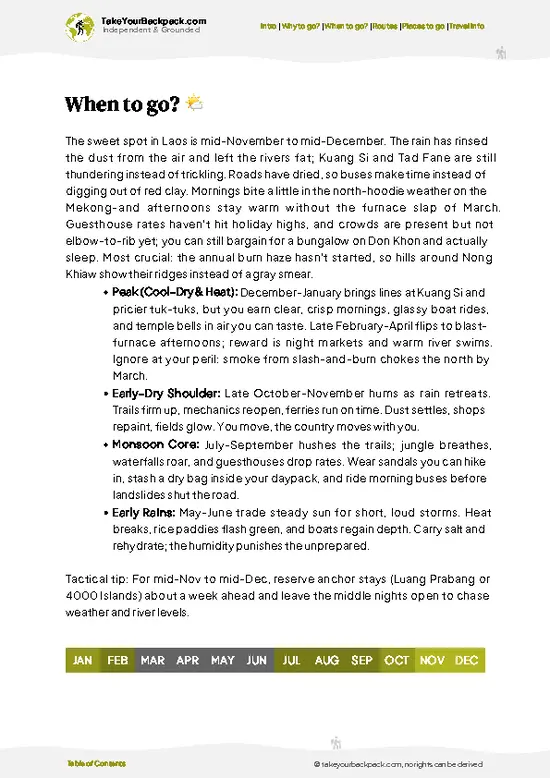
source: climatestotravel.comJANJanuary: excellent for travelingFEBFebruary: excellent for travelingMARMarch: good for travelingAPRApril: fair for travelingMAYMay: below average for travelingJUNJune: below average for travelingJULJuly: below average for travelingAUGAugust: below average for travelingSEPSeptember: below average for travelingOCTOctober: good for travelingNOVNovember: excellent for travelingDECDecember: excellent for traveling
when-to-go

✈️ The backpacker research shortcutLaos Travel Guide

An offline-friendly backpacking guide with optimized travel routes, ranked highlights, transport advice, and the best areas to stay.
example page 0 from our offline Travel Guide for Laos
example page 1 from our offline Travel Guide for Laos
example page 2 from our offline Travel Guide for Laos
example page 3 from our offline Travel Guide for Laos
example page 4 from our offline Travel Guide for Laos
example page 5 from our offline Travel Guide for Laos
example page 6 from our offline Travel Guide for Laos
example page 7 from our offline Travel Guide for Laos
The digital guide (313 pages) contains:
80 highlights, ranked by travel appeal
Optimized 5, 10 & 15-day travel routes
Cities, national parks, landmarks, beaches
How to get around
Offline-friendly for travel without Wi-Fi
👉 Click to see all 30+ guide features

📅 Plan smarter in minutes, not weeks
Month by month travel advice
Festivals & national holidays
Budget expectations

🗺️ Go to the right places, skip the overrated ones
Honest pros & cons of destinations
Top hikes, parks & viewpoints
Lesser-known places most travelers miss
Clear “worth it vs skip it” guidance

🛏️ Travel smoothly without rookie mistakes
Best areas to stay
Transport systems explained simply
Common scams & safety advice
SIM cards, money & practical tips

🌍 Understand the country, not just visit it
Culture & traditions
52 Essential phrases & customs
Festivals worth planning around
Traveler-friendly historical context
Insights that make places more meaningful

📱 Built for real travel conditions
Fully downloadable PDF
Works completely offline
Optimized for phone use
Useful in remote areas & buses
Everything in one place
Save weeks of stressful planning
Get instant access to your full guide. 30‑day money-back guarantee.


By proceeding you agree to our terms.
Sent to your inbox immediately after payment • 100% Secure Checkout
Best Backpacking Travel Advisor 2025 tourism awardBest Backpacking
Travel Advisor
2025
What others say about Take Your Backpack Guides:
⭐⭐⭐⭐⭐
Fantastic, amazing amount of information!
⭐⭐⭐⭐⭐
My goodness this is amazing, it's what I've been looking for hats off too you!
⭐⭐⭐⭐⭐
I think this is absolutely BRILLIANT
⭐⭐⭐⭐
Very complete and informative. It's still missing places, but I gotta to commend you
⭐⭐⭐⭐⭐
This is truly amazing, thank you, can't wait to explore it with my kids!
⭐⭐⭐⭐⭐
Awesome resource, thank you!
⭐⭐⭐⭐⭐
This is amazing! Can't wait to explore the ones I haven't seen
⭐⭐⭐⭐
I love this! Well done, great idea.
⭐⭐⭐⭐⭐
Thanks for taking the time to make this gem!
⭐⭐⭐⭐⭐
This might be the best website I've ever seen.
⭐⭐⭐⭐⭐
Congratulations, and thank you so much for your work; it's incredibly valuable.
⭐⭐⭐⭐
In all seriousness I think you did a great job pointing out the important spots
⭐⭐⭐⭐⭐
10/10 very good
⭐⭐⭐⭐⭐
As someone who's only just starting to visit regularly this is awesome, thank you.
⭐⭐⭐⭐
Thank you very much! I'm going to visit my dad, it's going to be very useful!
⭐⭐⭐⭐⭐
This is really cool! We'll be travelling for the first time and this definitely come in handy.
⭐⭐⭐⭐⭐
You are now our minister of culture, congratulations 👨‍💼
⭐⭐⭐⭐⭐
Just wanted to tell you that this is a pearl! Going to follow your recommendations.
⭐⭐⭐⭐⭐
This is so cool. I'll definitely be using the resource for my travels soon.
⭐⭐⭐⭐⭐
This is very impressive! Good work.
⭐⭐⭐⭐⭐
This is an amazing and informative site. Very well done!

🛏️ Where to stay?How to pick the right area

Wat Sisaket sits in the heart of Vientiane, and the truth is, the area around it isn’t some untouched sanctuary. It’s a busy, lived-in part of town where locals go about their day and tourists mix in, but don’t expect a quiet retreat. The streets nearby hum with motorbikes, street vendors, and the occasional temple bell. Crowds aren’t overwhelming, but you’ll definitely share the space with other travelers, especially during peak hours.

For backpackers, the best spots to stay are within walking distance of the temple, where you get the perfect blend of safety and social buzz. This area is popular … read more 👉
Wat Sisaket sits in the heart of Vientiane, and the truth is, the area around it isn’t some untouched sanctuary. It’s a busy, lived-in part of town where locals go about their day and tourists mix in, but don’t expect a quiet retreat. The streets nearby hum with motorbikes, street vendors, and the occasional temple bell. Crowds aren’t overwhelming, but you’ll definitely share the space with other travelers, especially during peak hours.

For backpackers, the best spots to stay are within walking distance of the temple, where you get the perfect blend of safety and social buzz. This area is popular with budget travelers because it’s close to markets, cheap eats, and casual bars where you can meet other solo adventurers without the forced hostel vibe. It’s not about flashy amenities but about authentic street life and easy access to the city’s pulse. You’ll find yourself stepping out your door into a neighborhood that feels lived-in and real, not sanitized for tourists. That’s the real magic—being part of the daily rhythm while having one of Laos’s most historic temples just minutes away.

👛 Costs (as of 18 April 2026)What things cost and how to budget

The entrance fee for Wat Sisaket is approximately €3 to €5 per person. Additional costs may include donations or purchases of souvenirs, but no mandatory extra fees are typically required.

source: visit-laos.com
⚠️ Prices can change and everyone travels differently, so take this as a rough guide. Hope it helps you plan your adventure!

Other Laotian attractions near Wat Sisaket

Explore more nearby:


💡 Not sure where to go next?
Create a personalized itinerary for Laos including Wat Sisaket and the places that fit your trip.

Generate my itinerary

👉 Discover all attractions

Or checkout all Laos has to offer (think cities, towns, villages, national parks, hikes, beaches, festivals)
Country photo of Laos

We 💚 feedbackIs it worth it?

Wat Sisaket isn’t going to wow you with crowds or flashy temples—expect a steady trickle of visitors, not a crush. But that’s exactly why it’s worth your time. The real magic is in the quiet corners where hundreds of tiny Buddha statues sit like patient witnesses to centuries of history. It’s humble, unpretentious, and refreshingly free of tourist noise. If you want a genuine slice of Vientiane’s soul without the hype, this is it.

✍️ Help improve this page!
The information on this page is based on in-depth research, insights shared by experienced travelers, and feedback from the local travel community in Laos. While every effort is made to keep the information accurate and current, conditions can change — so if you spot anything incorrect or outdated, please get in touch.


🙋‍♂️ Give feedback

👋 Meet the founderWho’s Behind Take Your Backpack?

Johan, backpacker and founder of TakeYourBackpackHi, I’m Johan (Netherlands 🇳🇱), the creator of TakeYourBackpack. Over the past decade, I’ve backpacked through 80+ countries across six continents, gaining extensive experience with independent travel, long-term trips, and overland routes.

This site is built on a combination of firsthand travel experience and carefully curated insights from other backpackers. Many guides are based on places I’ve personally visited, while others bring together tips, observations, and practical advice shared by trusted travelers I’ve met along the way.

The goal is to provide realistic, experience-driven guidance — not generic itineraries — so you can explore destinations with better context, clearer expectations, and more confidence.

Get full Laos guide •
Instant download • 80 highlights • Full Offline guide