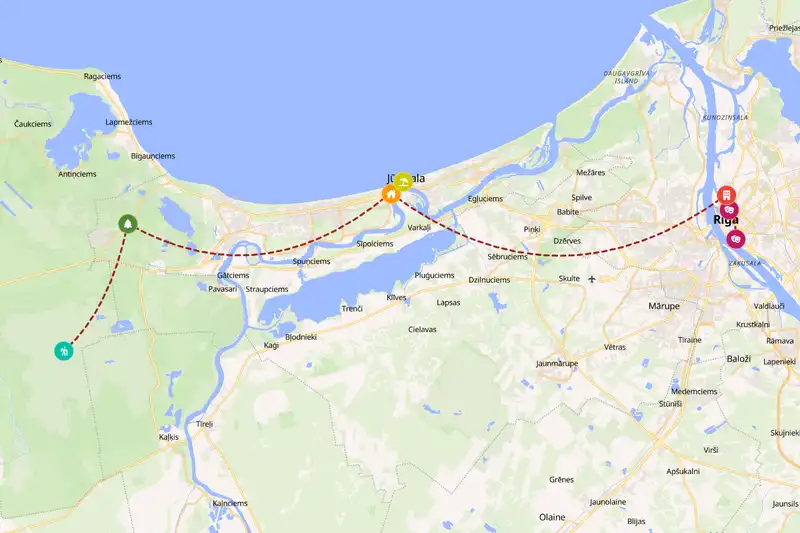
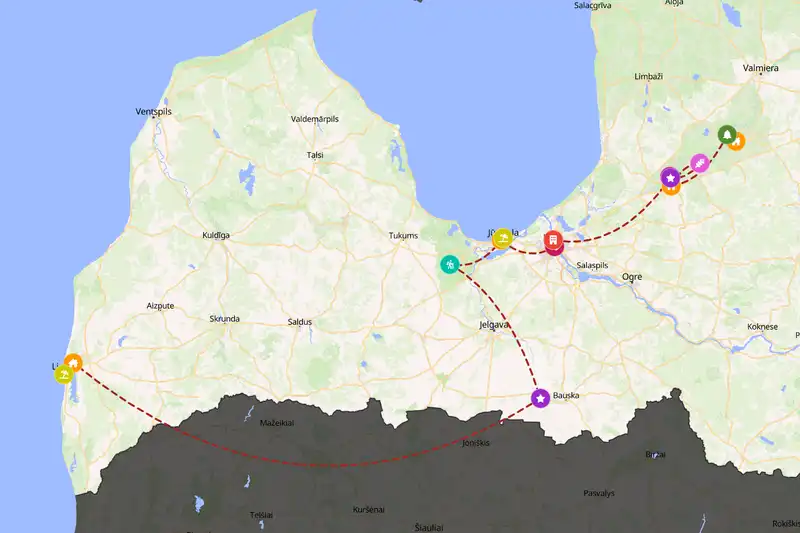
Yes, Latvia is one of the easiest countries in Northern Europe to backpack on your own: it is compact, safe, card payments work almost everywhere, and most people under 40 speak good English.
Dorm beds in
Riga run about €15 to 25 a night, and trains and buses can be booked online or bought at the station. Short hops are cheap: Riga to
Sigulda takes about an hour for €2 to 3, and Riga to
Jūrmala takes 30 to 35 minutes for under €2. Outside the capital, guesthouses replace hostels, usually €35 to 60 for a double, and rural bus timetables thin out on weekends.
Five to seven days covers the main sights of Latvia at a comfortable pace, while two or three days is enough for Riga plus one day trip.
With 2 days, stay in
Riga and add
Jūrmala and the Ķemeri bog by train. With 3 days, head into the
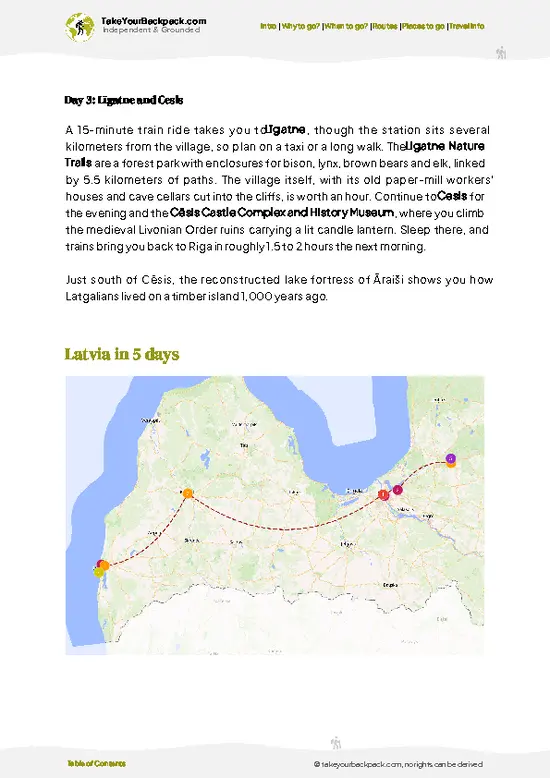
Gauja National Park around Sigulda and Cēsis, each 1 to 2 hours from the capital. Five days lets you add the west:
Kuldīga is 2.5 to 3 hours by bus from Riga, and
Liepāja another 1.5 to 2 hours beyond. A full week or more is needed for remote corners such as Slītere and Kolka or the Latgale lakes around Rāzna.
Yes, you can see most of Latvia without a car, because trains and intercity buses link Riga with every major town and highlight.
Trains reach
Jūrmala and Ķemeri in under an hour,
Sigulda in about an hour and
Cēsis in 1.5 to 2 hours, with fares mostly €2 to 6.
Liepāja is 3 to 3.5 hours by train, and
Kuldīga 2.5 to 3 hours by bus for roughly €8 to 10.
Rundāle Palace works by bus via Bauska. A car or tour makes sense only for remote spots like Kolka, Slītere National Park and the Rāzna lakes, where buses may run once or twice a day.
The places in Latvia you should not miss are Riga, the Gauja valley around Sigulda and Cēsis, Kuldīga, and the coast at Jūrmala and Liepāja.
Give
Riga at least a full day for the Central Market, Old Town and Art Nouveau streets.
Turaida Castle near Sigulda and
Cēsis Castle each fill half a day, an hour or two by train from the capital.
Kuldīga, 2.5 to 3 hours west, has the Venta Rapid, the widest waterfall in Europe. The
Great Kemeri Bog Boardwalk is an easy 3.4-kilometer loop near Jūrmala, and
Rundāle Palace, about 1.5 hours south, is the country’s grandest baroque interior.
If time is short in Latvia, skip the far east and the smaller western ports and concentrate on Riga, the Gauja valley and Kuldīga.
Daugavpils and the Latgale towns of
Rēzekne,
Ludza and
Preiļi sit 3 to 4 hours from Riga and need two days to justify the trip.
Ventspils overlaps with Liepāja, so choose one beach city. The
Riga Motor Museum is for car fans only, and the
Narrow Gauge Train Gulbene - Alūksne runs on limited days and takes a full day for a slow 33-kilometer ride. Slītere and Kolka are wonderful but awkward without a car.
Yes, our itinerary-planner does exactly that. Set your trip length in days, give your interests and travel style, optionally give start- and end location and/or some mandatory stops you would like to include and the itinerary planner creates your personalized routes for Latvia in seconds. Try it out!
Try the itinerary plannerv2.webp)
 Best Backpacking