v2.webp)
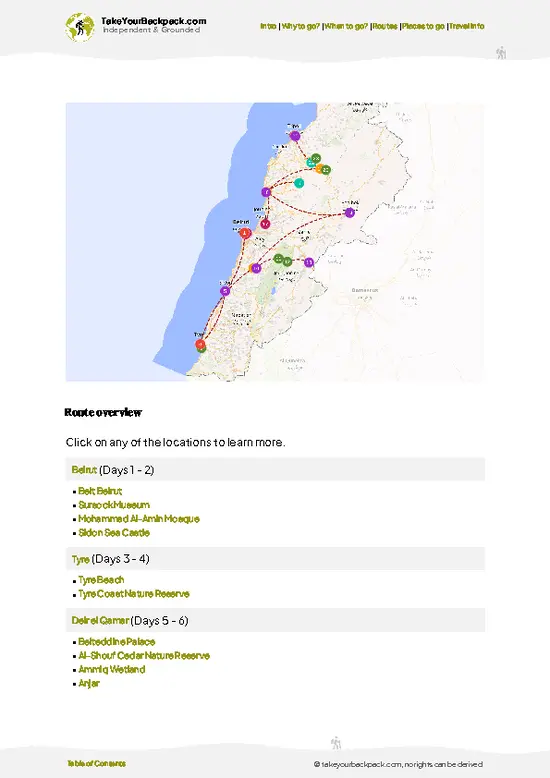
- National Museum of Beirut — Lebanon’s main archaeology museum: a compact, well-curated collection that tells the island’s long story from prehistoric tools to Roman statuary. The exhibits and restored mosaics give real context to the ruins you’ll see around the city.
- Mohammad Al-Amin Mosque (Blue Mosque) — A striking modern landmark with Ottoman-inspired domes right in downtown. It’s visually impressive, open to non-Muslim visitors outside prayer times, and worth visiting for the architecture and the way it anchors Martyrs’ Square.
- Al-Omari Grand Mosque — One of Beirut’s oldest religious sites: a Crusader church later converted to a mosque, showing the city’s layered history in its stonework and layout. You can inspect the mixture of Gothic arches and Islamic features up close—dress modestly.
- National Museum of Beirut — Lebanon’s main archaeology museum: a compact, well-curated collection that tells the island’s long story from prehistoric tools to Roman statuary. The exhibits and restored mosaics give real context to the ruins you’ll see around the city.
- Mohammad Al-Amin Mosque (Blue Mosque) — A striking modern landmark with Ottoman-inspired domes right in downtown. It’s visually impressive, open to non-Muslim visitors outside prayer times, and worth visiting for the architecture and the way it anchors Martyrs’ Square.
- Al-Omari Grand Mosque — One of Beirut’s oldest religious sites: a Crusader church later converted to a mosque, showing the city’s layered history in its stonework and layout. You can inspect the mixture of Gothic arches and Islamic features up close—dress modestly.
- Nejmeh Square & the Clock Tower — The civic heart of central Beirut where people still gather; the layout, the colonial and French Mandate buildings, and the nearby Parliament give a readable snapshot of modern Lebanese history and public life.
- Beit Beirut (Barakat Building) — A preserved “building of memory” scarred by the Civil War and now a museum/interpretive space. It’s one of the clearest, most moving places in the city to learn how recent events shaped Beirut’s neighborhoods and daily life.
- Sursock Museum — A 19th-century mansion turned contemporary art museum in Achrafieh with a lovely garden. The building itself, the rotating local art shows, and the neighborhood’s old mansions make for a cultured, peaceful stop.
- Gemmayzeh & Mar Mikhael (Gouraud Street) — Walkable neighborhoods for wandering: narrow streets, street art, old Lebanese row houses, tiny galleries, and cafés that capture Beirut’s lively, bohemian side—great for evening bar hopping or a lazy daytime stroll.
- Raouché (Pigeon Rocks) & the Corniche — The classic sea-view: walk the corniche to the cliffside viewpoint at Pigeon Rocks. Sunset here is cliché for a reason—people watching, street food vendors, and a raw seaside vibe that feels like Beirut in miniature.
- Beirut Souks & the Roman Baths ruins — A mix of modern shopping and archaeological fragments: the souks sit beside excavated Roman baths and mosaics, letting you move from contemporary Lebanese commerce straight into 2,000-year-old layers of the city.
- Hamra Street & AUB neighborhood — The university quarter with bookshops, old cafés, street vendors and a lively, intellectual energy. It’s the place to feel everyday Beirut—cheap eats, people debating politics, and authentic late-night cafés.
Spotted a mistake or missing something? Contact us.

Pigeon Rocks Boat Ride Beirut (Raouche Rocks)

Paragliding Trip Over Jounieh bay

Paragliding activity in Lebanon

PRIVATE Beirut Historical Walking Half Day Tour

Lebanon Tour Jeita Grotto -Harissa & Byblos Castle, pickup+Guide

Jeita Grotto, Byblos and Harissa Full-Day Tour from Beirut

Private Jeita Grotto, Harissa Cable Car, Byblos & Dog River Tour

Private Lebanese Cooking Class in Beirut with Amal + Transfers

Cedars, Bsharre & Kozhaya Day Tour


 Best Backpacking
.jpg) Hi, I’m Johan (Netherlands 🇳🇱), the creator of TakeYourBackpack. Over the past 3 decades, I’ve backpacked through 90+ countries across six continents, gaining extensive experience with independent travel, long-term trips, and overland routes.
Hi, I’m Johan (Netherlands 🇳🇱), the creator of TakeYourBackpack. Over the past 3 decades, I’ve backpacked through 90+ countries across six continents, gaining extensive experience with independent travel, long-term trips, and overland routes.