×

Lebanon🇱🇧 | best citiesYour Guide to the 6 Best cities in Lebanon

Cities in Lebanon are small, close together and wildly different from one another. The country is roughly 220 km long, so every stop sits within a few hours of the next, but the character changes fast: a nightlife-heavy capital, a conservative northern port, a southern coast of Phoenician ruins and fishing harbors, and Roman and Ottoman towns tucked into the mountains and the Bekaa Valley. Beirut costs the most and has the widest choice of hostels. Outside it, prices drop and the pace slows. Independent travel works well here, but there is no train network, so you rely on vans, shared taxis and the occasional driver. Skip the coastal highway sprawl. Spend your time in the old cores.

By Johan Kruseman 🇳🇱 | Updated October 19, 2026
Explore the best towns in Lebanon

Why go?Key Factors That Shape the Experience

Lebanon works for cities because of geography and history packed into a country smaller than Connecticut. A narrow coastal strip backed by the Mount Lebanon range gave Phoenician, Roman, Crusader, Mamluk and Ottoman rulers harbors to build on, and each left stone behind. The result is dense layering: Roman columns, medieval souks and French Mandate-era façades often sit within a few blocks. Religious diversity adds to it. Sunni, Shia, Maronite, Greek Orthodox, Druze and other communities shape neighborhoods, food and the calendar, so a day trip can cross very different local cultures.

Travelers should know the downsides before committing. Public transport is informal: minibuses and shared taxis run without timetables, and cities are not designed for walking between sights, with heavy traffic … read more 👉
Lebanon works for cities because of geography and history packed into a country smaller than Connecticut. A narrow coastal strip backed by the Mount Lebanon range gave Phoenician, Roman, Crusader, Mamluk and Ottoman rulers harbors to build on, and each left stone behind. The result is dense layering: Roman columns, medieval souks and French Mandate-era façades often sit within a few blocks. Religious diversity adds to it. Sunni, Shia, Maronite, Greek Orthodox, Druze and other communities shape neighborhoods, food and the calendar, so a day trip can cross very different local cultures.

Travelers should know the downsides before committing. Public transport is informal: minibuses and shared taxis run without timetables, and cities are not designed for walking between sights, with heavy traffic and patchy sidewalks. The economy has been in crisis since 2019, so power cuts are common, many businesses price in US dollars, and cash is the practical way to pay. Check your government’s travel advice, especially for the south and the border areas with Syria and Israel, before booking. Lebanon is not a place for ticking off monuments in a rush. It rewards short hops, local conversation and a flexible plan.
Behind the Scenes of Selection
The list of best cities in Lebanon is created based on culture, vibe, attractions, transport ease, and local charm. If you feel a city is missing in this list, please let us know.

When to go?Optimal Periods for Travel

Best months: April to early June and September to November are the best months for Lebanon’s cities, with daytime highs of about 20 to 28°C on the coast, low rainfall and clear air for walking old quarters and ruins. Spring brings green hills and snow still on the high peaks. Autumn keeps the sea warm enough to swim.

Summer and winter: July and August are hot and humid on the coast, with highs of 30 to 35°C and humidity that makes midday sightseeing miserable. The Bekaa Valley is drier but hotter in the afternoon. Mountain towns stay cooler, around 22 to 28°C. This is also when diaspora visitors return, so coastal hotels and beach areas fill and prices rise, often 20 to 40 percent above spring rates. Beirut’s nightlife peaks then, but it is not worth the heat if you plan to walk.

December … read more 👉
Best months: April to early June and September to November are the best months for Lebanon’s cities, with daytime highs of about 20 to 28°C on the coast, low rainfall and clear air for walking old quarters and ruins. Spring brings green hills and snow still on the high peaks. Autumn keeps the sea warm enough to swim.

Summer and winter: July and August are hot and humid on the coast, with highs of 30 to 35°C and humidity that makes midday sightseeing miserable. The Bekaa Valley is drier but hotter in the afternoon. Mountain towns stay cooler, around 22 to 28°C. This is also when diaspora visitors return, so coastal hotels and beach areas fill and prices rise, often 20 to 40 percent above spring rates. Beirut’s nightlife peaks then, but it is not worth the heat if you plan to walk.

December to February is wet on the coast, with most of the 800 to 900 mm of annual rain falling in those months. Highs are around 14 to 18°C. Mountain roads can close after heavy snow, and some Bekaa and mountain guesthouses and restaurants shut or run reduced hours. Winter does bring the lowest prices and empty ruins, so it suits flexible budget travelers who carry a rain jacket.

Holidays: Ramadan changes opening hours in more conservative areas, with daytime eating options thinner. Easter and Christmas are busy for domestic travel.

city hoppingPlanning Your Route Efficiently

How long you need: A trip linking several cities in Lebanon needs 7 to 10 days. That is enough to cover the coast, the mountains and one inland leg without spending most of each day in vans.

Direction and clusters: Start in the capital region, where flights land and the best bus and van connections run, then fan out in one direction at a time. The north coast and the cities there form one cluster, the south coast another, and the Bekaa Valley a third, reached over the mountains. Doing the north, returning to the capital, then going south works better than a single loop because routes radiate from Beirut and rarely connect to one another directly. Allow 2 to 3 nights for the capital base and 1 to 2 nights at each other stop. Single-night stops waste half a day on transit.

Transfer times: … read more 👉
How long you need: A trip linking several cities in Lebanon needs 7 to 10 days. That is enough to cover the coast, the mountains and one inland leg without spending most of each day in vans.

Direction and clusters: Start in the capital region, where flights land and the best bus and van connections run, then fan out in one direction at a time. The north coast and the cities there form one cluster, the south coast another, and the Bekaa Valley a third, reached over the mountains. Doing the north, returning to the capital, then going south works better than a single loop because routes radiate from Beirut and rarely connect to one another directly. Allow 2 to 3 nights for the capital base and 1 to 2 nights at each other stop. Single-night stops waste half a day on transit.

Transfer times: Distances are short but traffic is not. Beirut to the northern coast typically takes 1.5 to 2.5 hours, to the southern coast 1 to 2 hours, and to the Bekaa Valley 1.5 to 2.5 hours depending on the Mount Lebanon crossing. Buses leave from Beirut’s Charles Helou and Cola stations, and shared taxis fill the gaps.

Planning errors: The common mistake is assuming everything is a quick hop on the map. Trying three cities in one day means you see little but road. Another is traveling after dark or in winter without checking road and weather conditions. Pick fewer stops and allow buffer for delays.

The ListThe Best cities of Lebanon

1 Beirut

corniche, art galleries, diverse districts

Experience contrasting neighborhoods, from modern art spaces to old Armenian bakeries, and join locals promenading along the city’s shoreline.

2 Tripoli

mamluk mosques, hammams, medieval citadel

Step into a city shaped by Islamic architecture, aromatic sweet shops, and a sprawling fortress overlooking the old quarter.

3 Tyre

roman hippodrome, sandy beaches, fishing harbor

Walk through ancient ruins beside the sea, relax on public beaches, and watch fishermen mend nets along the old port.

4 Jounieh

bay views, cable car, nightlife strip

Ride the hillside gondola for sweeping coastal scenery, then unwind at seaside bars or stroll the lively marina after dark.

5 Zahle

vineyards, riverside restaurants, mountain backdrop

Sample local wines in family-run cellars, dine by the river, and enjoy cool evenings framed by Lebanon’s eastern hills.

6 Zgharta

olive groves, Maronite churches, town festivals

Experience a town where olive oil production and religious processions shape the calendar, with lively gatherings marking each season.

Loading the map 🌍

Expert viewPro Tips for Exploring the Best

How many cities: Plan on three to five cities in a week to ten days. That is enough to see the coast, a mountain town and the Bekaa without spending the trip in traffic. Lebanon’s roads are slow, and a ninety-minute drive can turn into three hours. More than five stops means more hours in vans than on the streets, and you will get little out of the old quarters you rushed through.

Which kind for which traveler: If you want nightlife, galleries, cheap street food and hostels with other travelers, base yourself in the capital and treat it as the hub. If you care about ruins, choose coastal and Bekaa cities with Roman and Phoenician sites, where you can walk a column-lined site in the morning light and eat lunch in a family restaurant afterward. If you want quiet and low prices, pick a northern … read more 👉
How many cities: Plan on three to five cities in a week to ten days. That is enough to see the coast, a mountain town and the Bekaa without spending the trip in traffic. Lebanon’s roads are slow, and a ninety-minute drive can turn into three hours. More than five stops means more hours in vans than on the streets, and you will get little out of the old quarters you rushed through.

Which kind for which traveler: If you want nightlife, galleries, cheap street food and hostels with other travelers, base yourself in the capital and treat it as the hub. If you care about ruins, choose coastal and Bekaa cities with Roman and Phoenician sites, where you can walk a column-lined site in the morning light and eat lunch in a family restaurant afterward. If you want quiet and low prices, pick a northern or mountain town: markets are working ones, not staged for visitors, so you eat fresh bread and sweets from a bakery that has served the same neighbors for decades. Skip the sprawling highway suburbs; there is nothing to see.

What it costs: Budget US$40 to 70 a day for a backpacker: dorm bed US$15 to 30, falafel or manakish meals US$2 to 6, a sit-down dinner US$10 to 20, local transport US$5 to 15. Major ruins charge entry of roughly US$6 to 15, and many museums are cheaper. A local guide at a big site runs about US$20 to 50. Shared taxis cost a few dollars per hop, and private taxis far more, so agree the price before getting in. Carry US dollars in small bills, as card payments are unreliable and power cuts shut ATMs and shops.

Safety and etiquette: Check current government advice before booking, particularly for areas near the Syrian and Israeli borders and the south, where conditions can shift quickly. Stay in the main tourist areas, avoid protests and political gatherings, and keep your phone charged for power cuts. Dress modestly in religious sites and conservative towns, with covered shoulders and knees, and bring a scarf for mosques and churches. Ask before photographing people, military posts or checkpoints. Soldiers at checkpoints are routine, so keep your passport handy and stay polite. Learn a few Arabic phrases, since locals reward the effort with tea and conversation.

✈️ The backpacker research shortcutLebanon Travel Guide

An offline-friendly backpacking guide with optimized travel routes, ranked highlights, transport advice, and the best areas to stay.
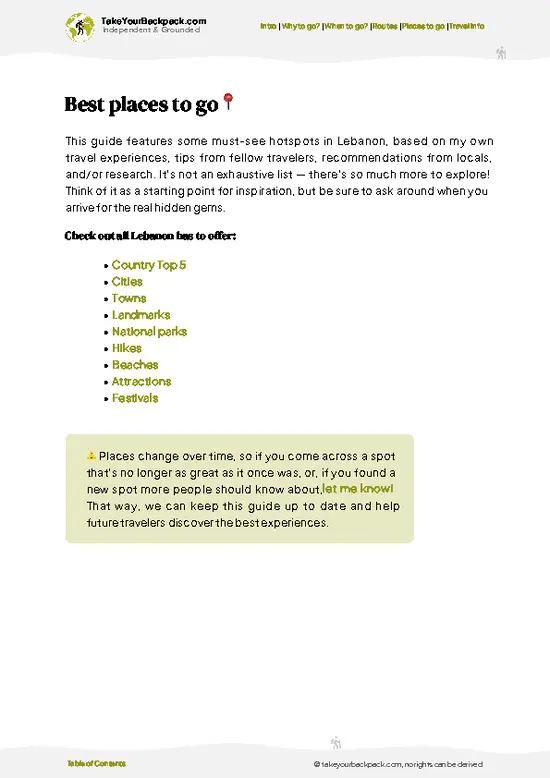
example page 0 from our offline Travel Guide for Lebanon
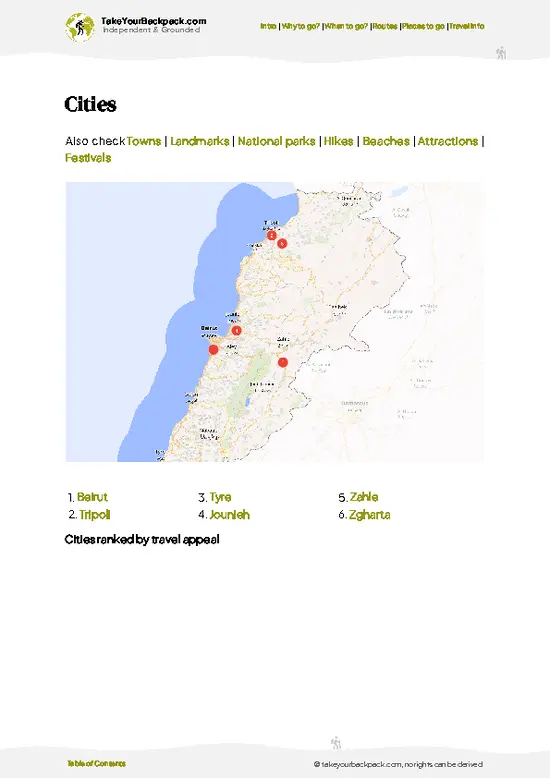
example page 1 from our offline Travel Guide for Lebanon
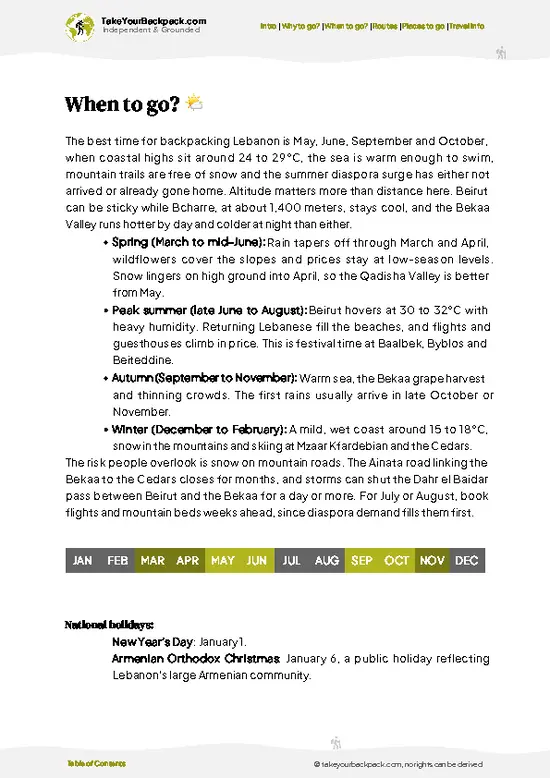
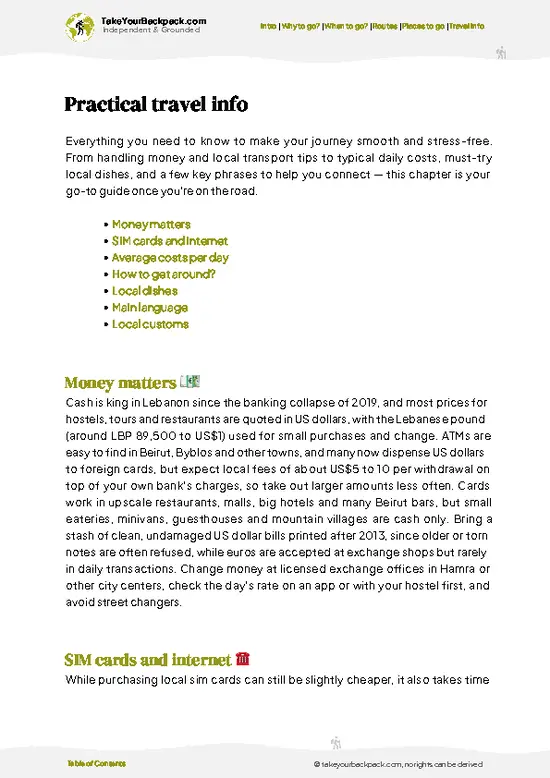
example page 2 from our offline Travel Guide for Lebanon
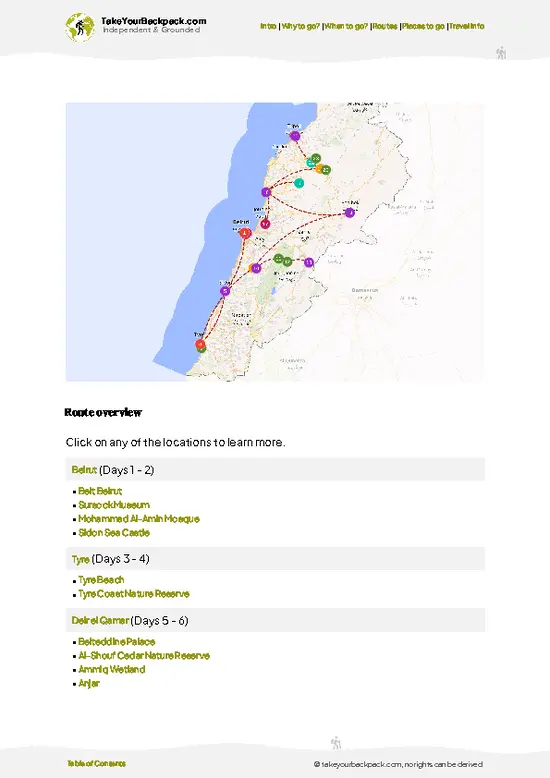
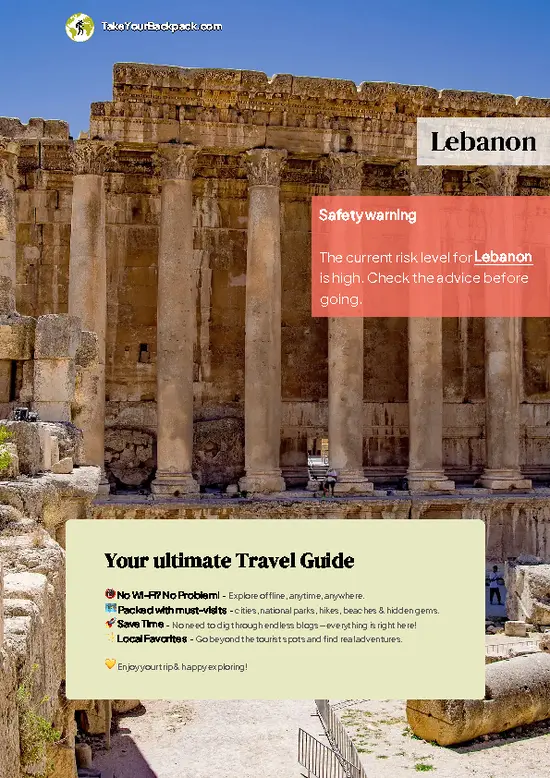
example page 3 from our offline Travel Guide for Lebanon
example page 4 from our offline Travel Guide for Lebanon
example page 5 from our offline Travel Guide for Lebanon
example page 6 from our offline Travel Guide for Lebanon
example page 7 from our offline Travel Guide for Lebanon
The digital guide (286 pages) contains:
✅ 77 highlights, ranked by travel appeal
✅ Optimized 5, 10 & 15-day travel routes
✅ Cities, national parks, landmarks, beaches
✅ How to get around
✅ Offline-friendly for travel without Wi-Fi
👉 Click to see all 30+ guide features

📅 Plan smarter in minutes, not weeks
✅ Month by month travel advice
✅ Festivals & national holidays
✅ Budget expectations

🗺️ Go to the right places, skip the overrated ones
✅ Honest pros & cons of destinations
✅ Top hikes, parks & viewpoints
✅ Lesser-known places most travelers miss
✅ Clear “worth it vs skip it” guidance

🛏️ Travel smoothly without rookie mistakes
✅ Best areas to stay
✅ Transport systems explained simply
✅ Common scams & safety advice
✅ SIM cards, money & practical tips

🌍 Understand the country, not just visit it
✅ Culture & traditions
✅ 52 Essential phrases & customs
✅ Festivals worth planning around
✅ Traveler-friendly historical context
✅ Insights that make places more meaningful

📱 Built for real travel conditions
✅ Fully downloadable PDF
✅ Works completely offline
✅ Optimized for phone use
✅ Useful in remote areas & buses
✅ Everything in one place
Stop searching, start planning
Get instant access to your full guide. 30‑day money-back guarantee.
+ Add another guide for just

By proceeding you agree to our terms.
Sent to your inbox immediately after payment • 100% Secure Checkout
Best Backpacking Travel Advisor 2025 tourism awardBest Backpacking
Travel Advisor
2025
What others say about Take Your Backpack Guides:
⭐⭐⭐⭐⭐
Fantastic, amazing amount of information!
⭐⭐⭐⭐⭐
My goodness this is amazing, it's what I've been looking for hats off too you!
⭐⭐⭐⭐⭐
I think this is absolutely BRILLIANT
⭐⭐⭐⭐
Very complete and informative. It's still missing places, but I gotta to commend you
⭐⭐⭐⭐⭐
This is truly amazing, thank you, can't wait to explore it with my kids!
⭐⭐⭐⭐⭐
Awesome resource, thank you!
⭐⭐⭐⭐⭐
This is amazing! Can't wait to explore the ones I haven't seen
⭐⭐⭐⭐
I love this! Well done, great idea.
⭐⭐⭐⭐⭐
Thanks for taking the time to make this gem!
⭐⭐⭐⭐⭐
This might be the best website I've ever seen.
⭐⭐⭐⭐⭐
Congratulations, and thank you so much for your work; it's incredibly valuable.
⭐⭐⭐⭐
In all seriousness I think you did a great job pointing out the important spots
⭐⭐⭐⭐⭐
10/10 very good
⭐⭐⭐⭐⭐
As someone who's only just starting to visit regularly this is awesome, thank you.
⭐⭐⭐⭐
Thank you very much! I'm going to visit my dad, it's going to be very useful!
⭐⭐⭐⭐⭐
This is really cool! We'll be travelling for the first time and this definitely come in handy.
⭐⭐⭐⭐⭐
You are now our minister of culture, congratulations 👨‍💼
⭐⭐⭐⭐⭐
Just wanted to tell you that this is a pearl! Going to follow your recommendations.
⭐⭐⭐⭐⭐
This is so cool. I'll definitely be using the resource for my travels soon.
⭐⭐⭐⭐⭐
This is very impressive! Good work.
⭐⭐⭐⭐⭐
This is an amazing and informative site. Very well done!

🛏️ Where to stay?Best Stay Options in Lebanon

Backpacking Lebanon is easy on a budget, with hostel dorms around US$12 to 25 a night and simple guesthouses beyond Beirut. In the capital, Hamra has the widest and cheapest choice and is walkable to the Corniche and university cafés, though traffic noise never stops, while Mar Mikhael and Gemmayzeh put you on the city’s best bar streets at the cost of loud weekend nights and pricier beds. For quieter nights, coastal Byblos and Batroun have small guesthouses near the old souks and beaches, and they work well as bases for trips north.

If you enjoy meeting fellow travelers, consider choosing hostels with high ratings for atmosphere. On the other hand, if you prefer having your own space, a hotel might be a better option.

LebanonWhere to Go Next

👋 Meet the founderWho’s Behind Take Your Backpack?

Johan, backpacker and founder of TakeYourBackpackHi, I’m Johan (Netherlands 🇳🇱), the creator of TakeYourBackpack. Over the past 3 decades, I’ve backpacked through 90+ countries across six continents, gaining extensive experience with independent travel, long-term trips, and overland routes.

This site is built on a combination of firsthand travel experience and carefully curated insights from other backpackers. Many guides are based on places I’ve personally visited, while others bring together tips, observations, and practical advice shared by trusted travelers I’ve met along the way.

The goal is to provide realistic, experience-driven guidance — not generic itineraries — so you can explore destinations with better context, clearer expectations, and more confidence.