×

Lithuania🇱🇹 | attractionsMuseum of Occupations and Freedom Fightsformer KGB prison, resistance archives, interrogation cells | things to do and best time to go

Explore Hill of Crosses Monument ComplexExplore MO Museum

Backpacking in Museum of Occupations and Freedom Fights
🏆 Top pickattraction ranked #3
By Johan Kruseman 🇳🇱 | Updated September 4, 2026

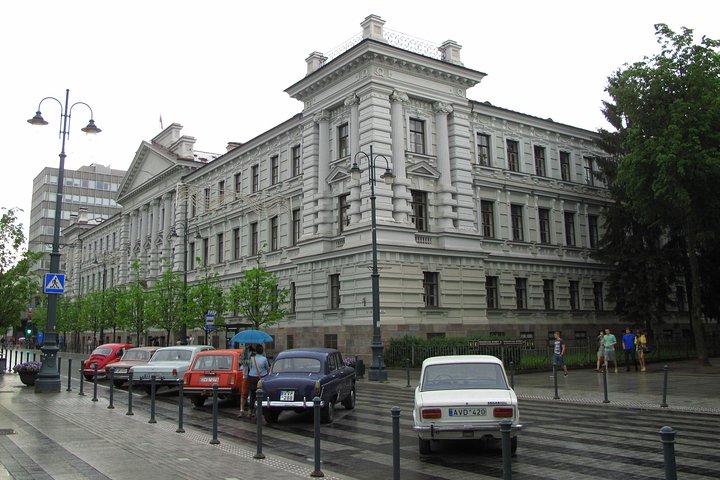
Most travelers don’t realize the Museum of Occupations and Freedom Fights is housed in the actual former KGB headquarters—yes, the cells and execution chambers are real, not some sanitized re-creation. You’ll find it in central Vilnius, Lithuania, just a brisk walk from the Old Town’s tourist bustle, but worlds away in mood. Here’s the straight truth: this isn’t your typical ‘Instagrammable’ stop. The museum is raw, heavy, and unapologetically intense—think less selfie, more gut punch. It’s not cheap by Lithuanian standards, but you’re paying for access to history’s underbelly, not a curated highlight reel. Crowds are manageable, mostly history buffs and the odd school group, so you won’t be elbowing for space. Compared to Lithuania’s castles and baroque churches, this place hits harder and lingers longer. If you want a museum that actually makes you feel something—anger, awe, maybe even hope—this is the one that delivers, no filter.

Discover everything you want to know in the 📖 Lithuania Travel Guide.
Loading the map 🌍
CLICK TO FILTER
cities
towns
landmarks
national parks
hikes
beaches
attractions
festivals
SHOW COUNTRY’S BESTSHOW ALL

✨ Why go?
Ranked #3 attraction in Lithuania
Reasons people choose to visit here

The Museum of Occupations and Freedom Fights in Lithuania isn’t your typical tourist checkbox. Sure, it’s a magnet for crowds, especially during peak seasons, and the entry fee might make you pause if you’re used to free or dirt-cheap museums. But here’s the deal: this place is a raw, unfiltered dive into Lithuania’s brutal 20th-century history. It’s not just about dates and names; it’s about the grit, the resistance, and the human cost of occupation under Soviet and Nazi regimes. Backpackers who make the trek aren’t just ticking off an iconic site—they’re stepping into a living narrative that shapes Lithuania’s soul.

The museum’s location in the former KGB headquarters adds a spine-tingling layer of authenticity. Walking through those cold, concrete cells, you feel the weight of real stories—torture, … read more 👉
The Museum of Occupations and Freedom Fights in Lithuania isn’t your typical tourist checkbox. Sure, it’s a magnet for crowds, especially during peak seasons, and the entry fee might make you pause if you’re used to free or dirt-cheap museums. But here’s the deal: this place is a raw, unfiltered dive into Lithuania’s brutal 20th-century history. It’s not just about dates and names; it’s about the grit, the resistance, and the human cost of occupation under Soviet and Nazi regimes. Backpackers who make the trek aren’t just ticking off an iconic site—they’re stepping into a living narrative that shapes Lithuania’s soul.

The museum’s location in the former KGB headquarters adds a spine-tingling layer of authenticity. Walking through those cold, concrete cells, you feel the weight of real stories—torture, surveillance, and unyielding courage. It’s a heavy experience, but one that rewards you with a profound understanding of freedom’s price. For anyone traveling the Baltic route, this museum is a milestone, a moment to pause and reflect beyond the usual sightseeing. It’s not flashy, but it’s essential. If you want to grasp Lithuania beyond postcards, this is where history hits you hard—and stays with you long after.
Want to include Museum of Occupations and Freedom Fights in your Lithuania route?
Create a personalized Lithuania itinerary that includes Museum of Occupations and Freedom Fights and the places that fit your trip — based on your travel style, budget, and available time. Get your route in seconds.

Generate my trip

💡 HighlightsThe experiences that define the visit

The KGB Prison Cells
Let’s rip off the Instagram filter: this isn’t a quirky photo op. The basement cells are the real deal—cold, claustrophobic, and untouched by time. You’ll see the scratch marks, the heavy doors, and the buckets that served as toilets. This is where the Soviet secret police interrogated, tortured, and broke people. The silence down here is thick. If you want to understand the cost of freedom, stand in these cells for a minute. No amount of online hype can prepare you for the gut punch of being in the same space where so many lives were shattered.


The Execution Chamber
This is not for the faint of heart, and that’s exactly the point. The execution chamber is preserved with chilling honesty—bullet holes in the walls, a drain in the floor, and a glass partition that keeps … read more 👉
The KGB Prison Cells
Let’s rip off the Instagram filter: this isn’t a quirky photo op. The basement cells are the real deal—cold, claustrophobic, and untouched by time. You’ll see the scratch marks, the heavy doors, and the buckets that served as toilets. This is where the Soviet secret police interrogated, tortured, and broke people. The silence down here is thick. If you want to understand the cost of freedom, stand in these cells for a minute. No amount of online hype can prepare you for the gut punch of being in the same space where so many lives were shattered.


The Execution Chamber
This is not for the faint of heart, and that’s exactly the point. The execution chamber is preserved with chilling honesty—bullet holes in the walls, a drain in the floor, and a glass partition that keeps you at a respectful distance. There’s no melodrama, just the raw facts of what happened here. It’s a rare museum that refuses to sanitize its history. If you want to see what state terror looks like up close, this room delivers the unvarnished truth.


Personal Testimonies and Artifacts
Forget the generic “interactive displays” you find in most museums. Here, you get battered suitcases, handwritten letters, and smuggled photographs—real objects from real people who resisted or suffered under Soviet and Nazi regimes. The stories are specific and personal, not just dates and numbers. You’ll read about teenagers risking everything to pass secret messages, or families torn apart overnight. It’s the human scale that hits hardest. These aren’t relics; they’re reminders that history is made by ordinary people forced into impossible choices.


The Interrogation Rooms
You can walk into the actual rooms where KGB officers grilled suspects. The furniture is original, the atmosphere oppressive. There’s no cheesy re-enactment, just the heavy presence of what went down here. The museum doesn’t spoon-feed you emotions—it lets the setting do the talking. If you want to feel the paranoia and pressure that defined life under occupation, this is where it gets real.


The Memorial to the Victims
Upstairs, the tone shifts. The memorial wall lists thousands of names—Lithuanians who vanished into Siberian gulags or were executed for resisting. It’s stark, not sentimental. The power is in the sheer scale and the relentless repetition of names. This isn’t about hero worship; it’s about remembering the cost of forgetting. If you’re looking for a moment of quiet reflection, this is where you’ll find it.


Exhibits on Resistance Movements
Lithuania’s partisan fighters don’t get much airtime in Western textbooks, but here, their story takes center stage. You’ll see homemade radios, coded messages, and the battered uniforms of forest guerrillas who fought both Nazis and Soviets. The museum doesn’t sugarcoat the odds they faced, but it does something better: it shows you the stubborn, inventive spirit that kept hope alive. If you want to understand what “freedom fight” really means, this is the exhibit that delivers.
Spotted a mistake or missing something? Contact us.

Things to do around Museum of Occupations and Freedom Fights

Ratings based on Tripadvisor reviews. When you book through this link, you support our work at no extra cost to you.

🌤️ When to go?Weather, crowds, and seasonal trade-offs


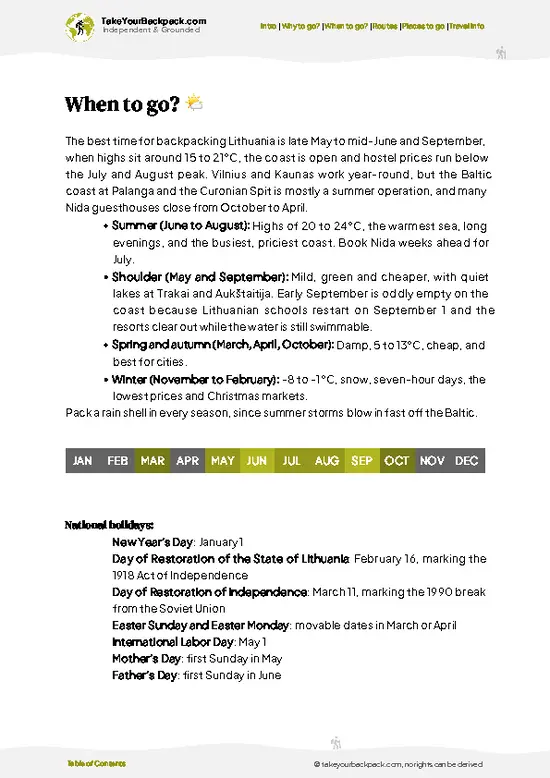
  • Weather: The Museum of Occupations and Freedom Fights is in Vilnius, where winters (December to February) are cold and often below freezing, averaging -5°C to -10°C (23°F to 14°F). Summers (June to August) are mild and pleasant, around 18°C to 22°C (64°F to 72°F), making outdoor exploration easier.

  • Temperature: Spring (April to May) and autumn (September to October) offer moderate temperatures between 10°C and 15°C (50°F to 59°F), perfect for avoiding the extremes but expect some chilly days.

  • Daylight Hours: In summer, daylight stretches up to 17 hours, giving you plenty of time to soak in the museum and surrounding city. Winter days shrink to about 6 hours, which can make visits feel rushed or gloomy.

  • Crowds: Peak tourist season in July and August means the museum can get busy, especially
read more 👉

  • Weather: The Museum of Occupations and Freedom Fights is in Vilnius, where winters (December to February) are cold and often below freezing, averaging -5°C to -10°C (23°F to 14°F). Summers (June to August) are mild and pleasant, around 18°C to 22°C (64°F to 72°F), making outdoor exploration easier.

  • Temperature: Spring (April to May) and autumn (September to October) offer moderate temperatures between 10°C and 15°C (50°F to 59°F), perfect for avoiding the extremes but expect some chilly days.

  • Daylight Hours: In summer, daylight stretches up to 17 hours, giving you plenty of time to soak in the museum and surrounding city. Winter days shrink to about 6 hours, which can make visits feel rushed or gloomy.

  • Crowds: Peak tourist season in July and August means the museum can get busy, especially with school groups and international visitors. Off-peak months like November or March see fewer crowds, offering a quieter, more reflective experience.

  • Seasonal Activities: The museum hosts special exhibitions and events around Lithuania’s Independence Day in February and Restoration of Independence Day in March, adding depth to your visit if timed right.

  • Price Fluctuations: Entrance fees remain stable year-round, but accommodation and flights spike in summer. Visiting in shoulder seasons (April-May, September-October) can save money without sacrificing comfort.


Pro-tip: Aim for late spring or early autumn to dodge crowds, enjoy mild weather, and catch meaningful local events without the tourist rush or winter freeze.


source: climatestotravel.comJANJanuary: fair for travelingFEBFebruary: good for travelingMARMarch: highly recommended for travelingAPRApril: highly recommended for travelingMAYMay: highly recommended for travelingJUNJune: highly recommended for travelingJULJuly: good for travelingAUGAugust: good for travelingSEPSeptember: highly recommended for travelingOCTOctober: highly recommended for travelingNOVNovember: good for travelingDECDecember: fair for traveling
lithuania-attraction-museum-of-occupations-and-freedom-fights
© Google |

✈️ The backpacker research shortcutLithuania Travel Guide

An offline-friendly backpacking guide with optimized travel routes, ranked highlights, transport advice, and the best areas to stay.
example page 0 from our offline Travel Guide for Lithuania
example page 1 from our offline Travel Guide for Lithuania
example page 2 from our offline Travel Guide for Lithuania
example page 3 from our offline Travel Guide for Lithuania
example page 4 from our offline Travel Guide for Lithuania
example page 5 from our offline Travel Guide for Lithuania
example page 6 from our offline Travel Guide for Lithuania
example page 7 from our offline Travel Guide for Lithuania
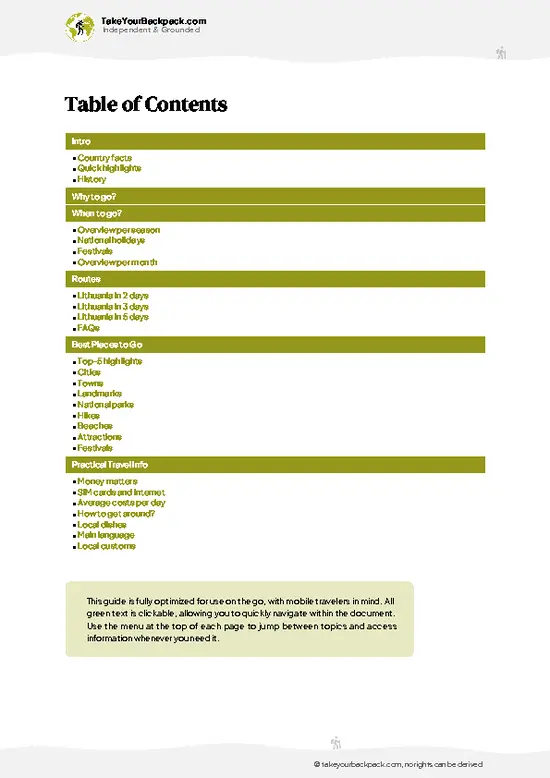
The digital guide (275 pages) contains:
71 highlights, ranked by travel appeal
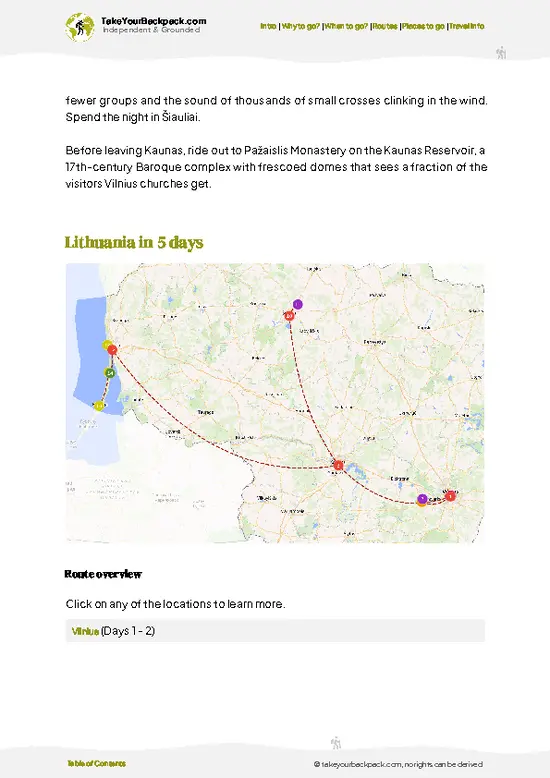
Optimized 2, 3 & 5-day travel routes
Cities, national parks, landmarks, beaches
How to get around
Offline-friendly for travel without Wi-Fi
👉 Click to see all 30+ guide features

📅 Plan smarter in minutes, not weeks
Month by month travel advice
Festivals & national holidays
Budget expectations

🗺️ Go to the right places, skip the overrated ones
Honest pros & cons of destinations
Top hikes, parks & viewpoints
Lesser-known places most travelers miss
Clear “worth it vs skip it” guidance

🛏️ Travel smoothly without rookie mistakes
Best areas to stay
Transport systems explained simply
Common scams & safety advice
SIM cards, money & practical tips

🌍 Understand the country, not just visit it
Culture & traditions
52 Essential phrases & customs
Festivals worth planning around
Traveler-friendly historical context
Insights that make places more meaningful

📱 Built for real travel conditions
Fully downloadable PDF
Works completely offline
Optimized for phone use
Useful in remote areas & buses
Everything in one place
Save weeks of stressful planning
Get instant access to your full guide. 30‑day money-back guarantee.
+ Add another guide for just US$7.80

By proceeding you agree to our terms.
Sent to your inbox immediately after payment • 100% Secure Checkout
Best Backpacking Travel Advisor 2025 tourism awardBest Backpacking
Travel Advisor
2025
What others say about Take Your Backpack Guides:
⭐⭐⭐⭐⭐
Fantastic, amazing amount of information!
⭐⭐⭐⭐⭐
My goodness this is amazing, it's what I've been looking for hats off too you!
⭐⭐⭐⭐⭐
I think this is absolutely BRILLIANT
⭐⭐⭐⭐
Very complete and informative. It's still missing places, but I gotta to commend you
⭐⭐⭐⭐⭐
This is truly amazing, thank you, can't wait to explore it with my kids!
⭐⭐⭐⭐⭐
Awesome resource, thank you!
⭐⭐⭐⭐⭐
This is amazing! Can't wait to explore the ones I haven't seen
⭐⭐⭐⭐
I love this! Well done, great idea.
⭐⭐⭐⭐⭐
Thanks for taking the time to make this gem!
⭐⭐⭐⭐⭐
This might be the best website I've ever seen.
⭐⭐⭐⭐⭐
Congratulations, and thank you so much for your work; it's incredibly valuable.
⭐⭐⭐⭐
In all seriousness I think you did a great job pointing out the important spots
⭐⭐⭐⭐⭐
10/10 very good
⭐⭐⭐⭐⭐
As someone who's only just starting to visit regularly this is awesome, thank you.
⭐⭐⭐⭐
Thank you very much! I'm going to visit my dad, it's going to be very useful!
⭐⭐⭐⭐⭐
This is really cool! We'll be travelling for the first time and this definitely come in handy.
⭐⭐⭐⭐⭐
You are now our minister of culture, congratulations 👨‍💼
⭐⭐⭐⭐⭐
Just wanted to tell you that this is a pearl! Going to follow your recommendations.
⭐⭐⭐⭐⭐
This is so cool. I'll definitely be using the resource for my travels soon.
⭐⭐⭐⭐⭐
This is very impressive! Good work.
⭐⭐⭐⭐⭐
This is an amazing and informative site. Very well done!

🛏️ Where to stay?Choosing the right base

The Museum of Occupations and Freedom Fights sits in the heart of Vilnius, and if you want to soak in the real vibe, you need to stay close enough to walk there without a second thought. The Old Town is the obvious pick—yeah, it’s touristy, but it’s also where you’ll find the pulse of the city. Streets buzz with a mix of locals and travelers, and the architecture isn’t just pretty; it’s a living history lesson that complements the museum’s heavy themes. It’s safe, well-lit, and packed with budget-friendly spots where you can meet other backpackers swapping stories over cheap beer or coffee.

If … read more 👉
The Museum of Occupations and Freedom Fights sits in the heart of Vilnius, and if you want to soak in the real vibe, you need to stay close enough to walk there without a second thought. The Old Town is the obvious pick—yeah, it’s touristy, but it’s also where you’ll find the pulse of the city. Streets buzz with a mix of locals and travelers, and the architecture isn’t just pretty; it’s a living history lesson that complements the museum’s heavy themes. It’s safe, well-lit, and packed with budget-friendly spots where you can meet other backpackers swapping stories over cheap beer or coffee.

If you want to dodge the tourist crush but stay social, consider the Užupis district. It’s a quirky, artsy neighborhood just a short stroll from the museum. It’s got a bohemian edge that attracts solo travelers and creatives, making it easy to find a community vibe without the usual hostel chaos. Plus, Užupis has its own rebellious spirit, which pairs perfectly with the museum’s story of resistance and freedom.

Both areas offer a solid base for exploring Vilnius without breaking the bank, and they keep you plugged into the city’s real energy—no Instagram filters needed.

👛 Costs (as of 4 September 2026)What things cost and how to budget

The entrance ticket to the Museum of Occupations and Freedom Fights typically costs between €3 and €5. Additional costs may include guided tours or audio guides, which can add a few euros more. There are no significant extra fees once inside.
⚠️ Prices can change and everyone travels differently, so take this as a rough guide. Hope it helps you plan your adventure!

FAQCommon questions from travelers

Plan to spend about 1.5 to 2 hours to visit the Museum of Occupations and Freedom Fights. This allows enough time to explore the exhibitions and understand the historical context. The museum is detailed but manageable within this timeframe.
Yes, the Museum of Occupations and Freedom Fights is worth the entrance fee, which is around 5 euros for adults. It offers a powerful insight into Lithuania's Soviet and Nazi occupations, with authentic artifacts and personal stories. The educational value and emotional impact justify the cost.
The museum is located in Vilnius city center and is easily accessible by public transport. You can take bus lines 1, 2, or 88 to the Aukų street stop, which is a short walk from the museum. It is also within walking distance from Vilnius Old Town.
⚠️ Things can change over time, so always validate details locally before you go.

Other Lithuanian attractions near Museum of Occupations and Freedom Fights

Explore more nearby:


💡 Not sure where to go next?
Create a personalized itinerary for Lithuania including Museum of Occupations and Freedom Fights and the places that fit your trip.

Generate my itinerary

👉 Discover all attractions

Or checkout all Lithuania has to offer (think cities, towns, villages, national parks, hikes, beaches, festivals)
Country photo of Lithuania

We 💚 feedbackKey takeaways before you go

This museum isn’t your typical polished tourist stop. Expect crowds, especially on weekends, and a no-frills, sometimes stark atmosphere that hits you in the gut. But that’s exactly why it’s worth your time. The real magic is in the raw personal stories—letters, photos, and artifacts—that pull you into Lithuania’s gritty fight for freedom. It’s not comfortable or pretty, but it’s honest and unforgettable. If you want a surface-level history, skip it. If you want to feel history’s weight, this place delivers.

✍️ Help improve this page!
The information on this page is based on in-depth research, insights shared by experienced travelers, and feedback from the local travel community in Lithuania. While every effort is made to keep the information accurate and current, conditions can change — so if you spot anything incorrect or outdated, please get in touch.


🙋‍♂️ Give feedback

👋 Meet the founderWho’s Behind Take Your Backpack?

Johan, backpacker and founder of TakeYourBackpackHi, I’m Johan (Netherlands 🇳🇱), the creator of TakeYourBackpack. Over the past decade, I’ve backpacked through 80+ countries across six continents, gaining extensive experience with independent travel, long-term trips, and overland routes.

This site is built on a combination of firsthand travel experience and carefully curated insights from other backpackers. Many guides are based on places I’ve personally visited, while others bring together tips, observations, and practical advice shared by trusted travelers I’ve met along the way.

The goal is to provide realistic, experience-driven guidance — not generic itineraries — so you can explore destinations with better context, clearer expectations, and more confidence.

Get full Lithuania guide •
Instant download • 71 highlights • Full Offline guide