×

Madagascar🇲🇬 | townsAndasibeIndri calls, night walks, lemur island, forest guides | things to do and best time to go

Explore AmbalavaoExplore Fort-Dauphin

Backpacking in Andasibe
🏆 Top picktown ranked #2
By Johan Kruseman 🇳🇱 | Updated October 16, 2026

Andasibe suits wildlife-minded travelers who like early starts, wet boots and a slow evening over a beer, and it is less rewarding if you want beaches, nightlife or a long list of town sights. It sits in eastern Madagascar, a short run off the main highway from the capital, and most people arrive by shared taxi-brousse or private car. I expected the indri’s call to sound like a bird. It is closer to a wailing whale song rolling through wet trees, so listen first and look second. The forest smells of rotting leaves and wet earth, and the light stays gray-green until mid-morning. Guides are compulsory because the animals are tracked by ear and by habit, and the good ones know where each group sleeps, so hire one at the park office rather than wandering. Guesthouses are small and the dining rooms are where travelers swap sightings. Before you go, carry cash in ariary, since the park fee and guide are paid on the spot.

Discover everything you want to know in the 📖 Madagascar Travel Guide.


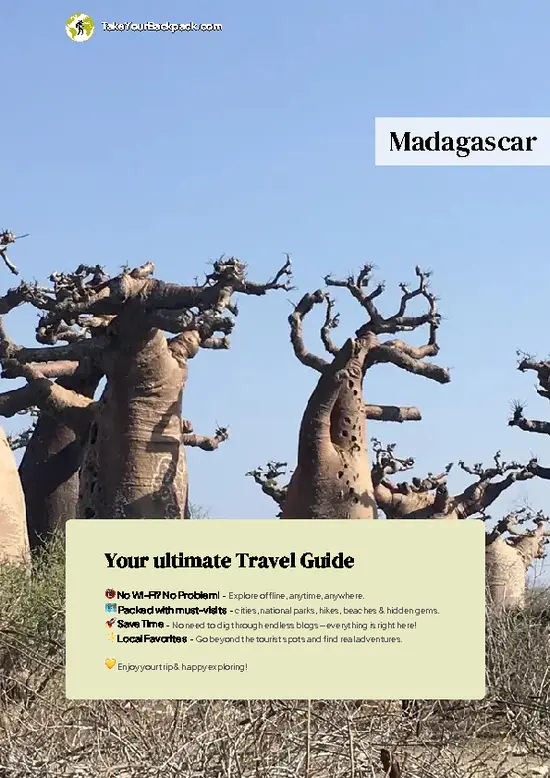
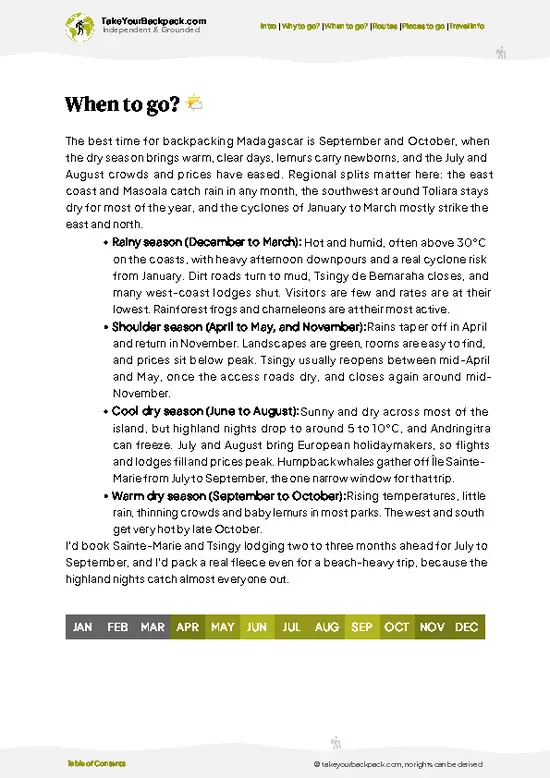
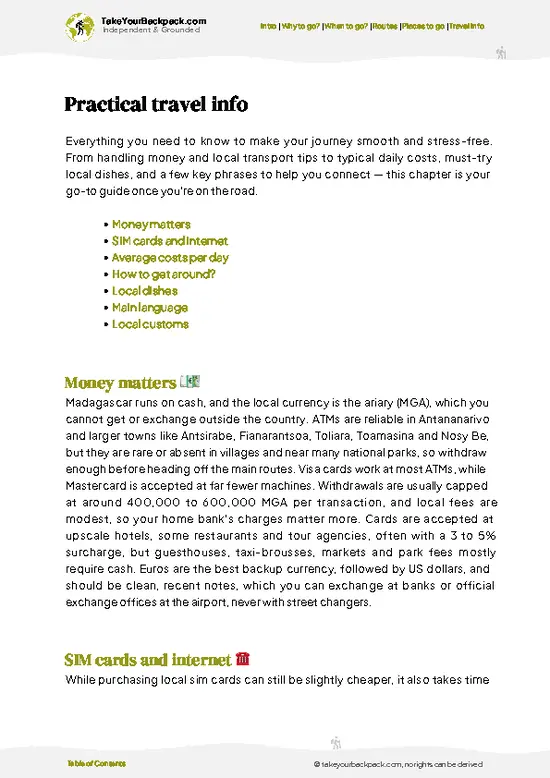
example page 0 from our offline Travel Guide for Madagascar
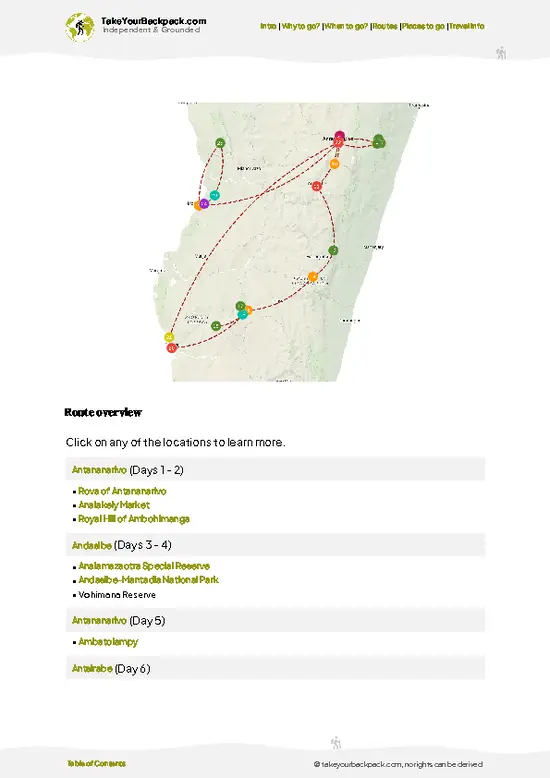
example page 1 from our offline Travel Guide for Madagascar
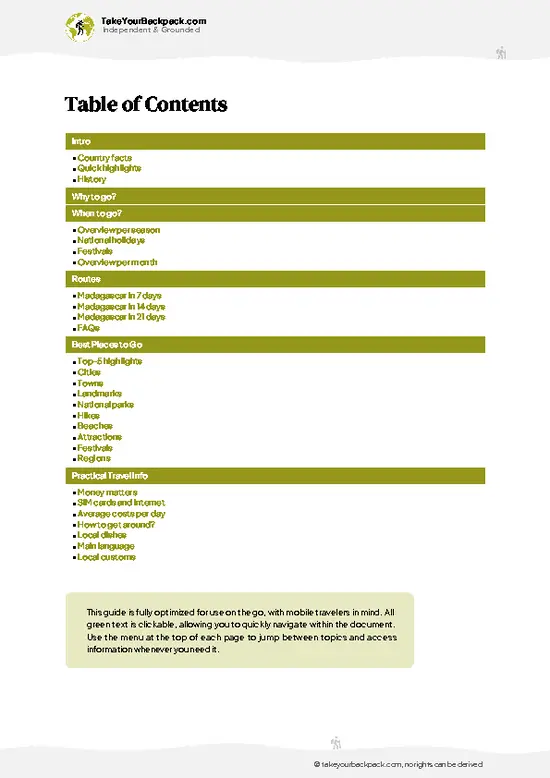
example page 2 from our offline Travel Guide for Madagascar
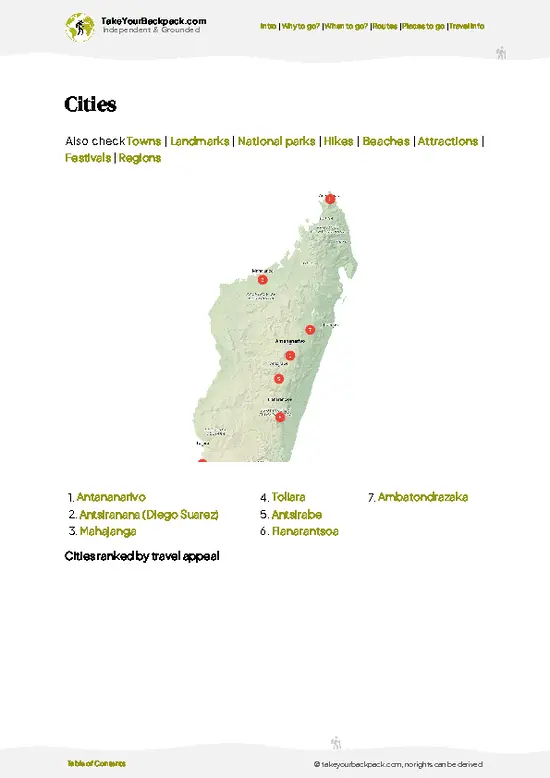
example page 3 from our offline Travel Guide for Madagascar
example page 4 from our offline Travel Guide for Madagascar
example page 5 from our offline Travel Guide for Madagascar
example page 6 from our offline Travel Guide for Madagascar
example page 7 from our offline Travel Guide for Madagascar
Loading the map 🌍
CLICK TO FILTER
cities
towns
landmarks
national parks
hikes
beaches
attractions
festivals
regions
SHOW COUNTRY’S BESTSHOW ALL

✨ Why go?
Ranked #2 town in Madagascar
What makes this town worth visiting

Andasibe earns its place on a route because it is the easiest place in Madagascar to see indri, the largest living lemurs, in real rainforest, without a multi-day trek. Walks start from the village itself, so you can be on a trail within minutes of waking. The night walk is the second reason to stay, since mouse lemurs, sleeping chameleons and tiny frogs only show up under a headlamp. That makes one night the minimum and two nights comfortable, with a morning in the forest, a slow afternoon and a night outing. Hikers can add the longer trails of Mantadia for a quieter, wilder day. The social side is gentle. Guesthouses are small, dinners are shared and there is no real nightlife, which suits solo travelers who want to meet others over soup and rum. It is a poor fit if you hate damp, cool mornings, … read more 👉
Andasibe earns its place on a route because it is the easiest place in Madagascar to see indri, the largest living lemurs, in real rainforest, without a multi-day trek. Walks start from the village itself, so you can be on a trail within minutes of waking. The night walk is the second reason to stay, since mouse lemurs, sleeping chameleons and tiny frogs only show up under a headlamp. That makes one night the minimum and two nights comfortable, with a morning in the forest, a slow afternoon and a night outing. Hikers can add the longer trails of Mantadia for a quieter, wilder day. The social side is gentle. Guesthouses are small, dinners are shared and there is no real nightlife, which suits solo travelers who want to meet others over soup and rum. It is a poor fit if you hate damp, cool mornings, or if forests without guaranteed sightings leave you restless.

💡 HighlightsPlaces and moments you shouldn't skip

  1. Analamazaotra Special Reserve (Andasibe Reserve): This is the main draw, a forest of tall trees, ferns and hanging moss where indri call from the canopy. Guides also point out diademed sifakas, brown lemurs, chameleons and orchids. Go at first light, when the calling is loudest. Expect an entry fee of roughly Ar 55,000 (about US$12) plus a guide fee shared by the group, and 2 to 3 hours.
  2. Night walk at the Mitsinjo Association station: A local community group runs evening walks through forest where mouse lemurs, leaf-tailed geckos and tree frogs appear in your torch beam. Start after dusk. Expect around Ar 50,000 to 80,000 (US$11 to 18) per person including a guide, and 1.5 to 2 hours.
  3. Lemur Island at Vakona Forest Lodge: A short boat crossing takes you to an island where habituated lemurs, including
… read more 👉
  1. Analamazaotra Special Reserve (Andasibe Reserve): This is the main draw, a forest of tall trees, ferns and hanging moss where indri call from the canopy. Guides also point out diademed sifakas, brown lemurs, chameleons and orchids. Go at first light, when the calling is loudest. Expect an entry fee of roughly Ar 55,000 (about US$12) plus a guide fee shared by the group, and 2 to 3 hours.
  2. Night walk at the Mitsinjo Association station: A local community group runs evening walks through forest where mouse lemurs, leaf-tailed geckos and tree frogs appear in your torch beam. Start after dusk. Expect around Ar 50,000 to 80,000 (US$11 to 18) per person including a guide, and 1.5 to 2 hours.
  3. Lemur Island at Vakona Forest Lodge: A short boat crossing takes you to an island where habituated lemurs, including bold brown lemurs and sifakas, hop onto shoulders for bananas. It is touristy but close and reliable, and the lemurs feel more used to people than wild ones do. Mornings are calmer. Budget about US$10 to 15 and about an hour.
  4. Mitsinjo community forest trails: Small, less visited trails run through restored forest where the same species can be seen with fewer groups on the path. A guide is needed. Fees are modest, around Ar 20,000 to 40,000 (US$4 to 9), and a visit takes 1.5 to 2 hours, best in the early morning.
  5. Andasibe village stroll: Wooden houses, roadside fruit stalls and craft sellers with carved chameleons and woven baskets line the main road. Late afternoon is lively as buses pass and school lets out. It is free and takes 30 to 45 minutes.
Beyond the village, Mantadia National Park, the Torotorofotsy wetlands and the Peyrieras reptile farm along the highway can all be visited on separate outings. All five items together fill about a day and a half at an easy pace.
Spotted a mistake or missing something? Contact us.

Things to do near Andasibe

Ratings based on Tripadvisor reviews. When you book through this link, you support our work at no extra cost to you.

🏘️ NeighborhoodsUnderstanding the local layout

Andasibe is a strung-out village along one road, so every area below is a short walk from the next, and the smart move is to match each zone to a time of day.
  • Main road and village center: A strip of small épiceries, roadside grills and a few simple restaurants where the smell of charcoal and fried zebu skewers drifts out at dusk. It is flat and walkable end to end in about 15 minutes. Trucks and taxi-brousses grind through, so the dust and horn noise are part of it. Eat here for the cheapest plates of rice with beans or greens, since lodge restaurants charge more.
  • Analamazaotra Special Reserve entrance: The ticket hut and guide stands sit at the park gate, a short walk from the village. Dawn is the time to be there, when indris call across the valley with a long, wailing song and the air is
… read more 👉
Andasibe is a strung-out village along one road, so every area below is a short walk from the next, and the smart move is to match each zone to a time of day.
  • Main road and village center: A strip of small épiceries, roadside grills and a few simple restaurants where the smell of charcoal and fried zebu skewers drifts out at dusk. It is flat and walkable end to end in about 15 minutes. Trucks and taxi-brousses grind through, so the dust and horn noise are part of it. Eat here for the cheapest plates of rice with beans or greens, since lodge restaurants charge more.
  • Analamazaotra Special Reserve entrance: The ticket hut and guide stands sit at the park gate, a short walk from the village. Dawn is the time to be there, when indris call across the valley with a long, wailing song and the air is cold and wet on your face. Guides are mandatory, which is why you book at the gate rather than wandering in alone.
  • Mantadia side and lodge strip: Lodges and a few bungalows spread along the forest edge on the road toward Mantadia. Evenings are quiet apart from frogs, crickets and the odd night-walk flashlight beam. Walking after dark is possible but unlit, so bring a headlamp, and expect to arrange transport for Mantadia itself.
  • Lemur island and Vakona side: A private reserve with habituated lemurs on islets, reached by short dugout canoe. It is reliable for close sightings, which is why first-timers go, but it is more staged than the wild forest. Combine it with the main reserve in one day.

⌛️ 1 dayA smart one-day plan

6:30 AM, Analamazaotra Special Reserve: Be at the park office as the mist lifts, pay the fee and meet your guide. The indri are most vocal now, and the guide follows the calls to find a family. Walk the main loop slowly, 2 to 3 hours, and listen for the long wail before scanning the trees.

9:30 AM, Village breakfast: Walk back to your guesthouse for coffee, eggs and fresh bread. The road is a few minutes on foot, and the damp cold wears off over the first cup.

11:00 AM, Lemur Island: Cross by boat from Vakona Forest Lodge for an hour with habituated lemurs. It is close enough to walk or take a short tuk-tuk ride, and it gives you the close-up photos the wild forest does not.

1:00 PM, Lunch and rest: Choose a simple restaurant on the main road for zebu brochettes or rice with greens. Midday … read more 👉
6:30 AM, Analamazaotra Special Reserve: Be at the park office as the mist lifts, pay the fee and meet your guide. The indri are most vocal now, and the guide follows the calls to find a family. Walk the main loop slowly, 2 to 3 hours, and listen for the long wail before scanning the trees.

9:30 AM, Village breakfast: Walk back to your guesthouse for coffee, eggs and fresh bread. The road is a few minutes on foot, and the damp cold wears off over the first cup.

11:00 AM, Lemur Island: Cross by boat from Vakona Forest Lodge for an hour with habituated lemurs. It is close enough to walk or take a short tuk-tuk ride, and it gives you the close-up photos the wild forest does not.

1:00 PM, Lunch and rest: Choose a simple restaurant on the main road for zebu brochettes or rice with greens. Midday is a good time for a nap, since the forest quiets down.

3:00 PM, Mitsinjo community trails: Spend 1.5 hours on the restored forest paths, which most day visitors skip. Guides explain how the group replants native trees, and you may spot chameleons, birds and orchids without other groups around.

5:00 PM, Village stroll: Walk the main road as the light turns gold, browse the craft stalls and buy fruit from the roadside sellers.

7:00 PM, Night walk: After dinner, head back into the forest with a headlamp and guide. Mouse lemurs, geckos and frogs appear in the beam, and the trail smells of wet leaves. Allow two hours and walk home along the road.

🌤️ When to go?Seasonal considerations and timing

The dry months of April to October give the most comfortable walking, though Andasibe sits in a rainforest at about 1,000 meters, so rain can fall in any month.
  • Cool Dry Season (May to September): Days run roughly 17 to 23°C (63 to 73°F) and nights drop to 5 to 10°C (41 to 50°F). Mornings are misty and chilly, so bring a fleece. Lemurs are active, and frogs and reptiles are quieter. Daylight is about 11 hours, with sunrise near 6 am. Peak crowds and highest lodge prices come in July and August.
  • Warm Wet Season (November to March): Highs reach 25 to 28°C (77 to 82°F) with heavy afternoon downpours, muddy trails and leeches. Cyclones can affect the east coast between January and March. This is the best time for frogs, chameleons and baby lemurs, and rooms are cheaper and easy to find. Days are
… read more 👉
The dry months of April to October give the most comfortable walking, though Andasibe sits in a rainforest at about 1,000 meters, so rain can fall in any month.
  • Cool Dry Season (May to September): Days run roughly 17 to 23°C (63 to 73°F) and nights drop to 5 to 10°C (41 to 50°F). Mornings are misty and chilly, so bring a fleece. Lemurs are active, and frogs and reptiles are quieter. Daylight is about 11 hours, with sunrise near 6 am. Peak crowds and highest lodge prices come in July and August.
  • Warm Wet Season (November to March): Highs reach 25 to 28°C (77 to 82°F) with heavy afternoon downpours, muddy trails and leeches. Cyclones can affect the east coast between January and March. This is the best time for frogs, chameleons and baby lemurs, and rooms are cheaper and easy to find. Days are about 13 hours long.
  • Shoulder Months (April, October): Fewer visitors, fair weather and lower rates.
Book a dawn guide and keep a spare dry layer, whatever the month.


source: climatestotravel.comJANJanuary: fair for travelingFEBFebruary: fair for travelingMARMarch: fair for travelingAPRApril: good for travelingMAYMay: highly recommended for travelingJUNJune: highly recommended for travelingJULJuly: excellent for travelingAUGAugust: excellent for travelingSEPSeptember: highly recommended for travelingOCTOctober: good for travelingNOVNovember: fair for travelingDECDecember: fair for traveling
madagascar-city-andasibe v1
© Google |

✈️ The backpacker research shortcutMadagascar Travel Guide

An offline-friendly backpacking guide with optimized travel routes, ranked highlights, transport advice, and the best areas to stay.
example page 0 from our offline Travel Guide for Madagascar
example page 1 from our offline Travel Guide for Madagascar
example page 2 from our offline Travel Guide for Madagascar
example page 3 from our offline Travel Guide for Madagascar
example page 4 from our offline Travel Guide for Madagascar
example page 5 from our offline Travel Guide for Madagascar
example page 6 from our offline Travel Guide for Madagascar
example page 7 from our offline Travel Guide for Madagascar
The digital guide (301 pages) contains:
✅ 96 highlights, ranked by travel appeal
✅ Optimized 7, 14 & 21-day travel routes
✅ Cities, national parks, landmarks, beaches
✅ How to get around
✅ Offline-friendly for travel without Wi-Fi
👉 Click to see all 30+ guide features

📅 Plan smarter in minutes, not weeks
✅ Month by month travel advice
✅ Festivals & national holidays
✅ Budget expectations

🗺️ Go to the right places, skip the overrated ones
✅ Honest pros & cons of destinations
✅ Top hikes, parks & viewpoints
✅ Lesser-known places most travelers miss
✅ Clear “worth it vs skip it” guidance

🛏️ Travel smoothly without rookie mistakes
✅ Best areas to stay
✅ Transport systems explained simply
✅ Common scams & safety advice
✅ SIM cards, money & practical tips

🌍 Understand the country, not just visit it
✅ Culture & traditions
✅ 52 Essential phrases & customs
✅ Festivals worth planning around
✅ Traveler-friendly historical context
✅ Insights that make places more meaningful

📱 Built for real travel conditions
✅ Fully downloadable PDF
✅ Works completely offline
✅ Optimized for phone use
✅ Useful in remote areas & buses
✅ Everything in one place
Stop searching, start planning
Get instant access to your full guide. 30‑day money-back guarantee.
+ Add another guide for just

By proceeding you agree to our terms.
Sent to your inbox immediately after payment • 100% Secure Checkout
Best Backpacking Travel Advisor 2025 tourism awardBest Backpacking
Travel Advisor
2025
What others say about Take Your Backpack Guides:
⭐⭐⭐⭐⭐
Fantastic, amazing amount of information!
⭐⭐⭐⭐⭐
My goodness this is amazing, it's what I've been looking for hats off too you!
⭐⭐⭐⭐⭐
I think this is absolutely BRILLIANT
⭐⭐⭐⭐
Very complete and informative. It's still missing places, but I gotta to commend you
⭐⭐⭐⭐⭐
This is truly amazing, thank you, can't wait to explore it with my kids!
⭐⭐⭐⭐⭐
Awesome resource, thank you!
⭐⭐⭐⭐⭐
This is amazing! Can't wait to explore the ones I haven't seen
⭐⭐⭐⭐
I love this! Well done, great idea.
⭐⭐⭐⭐⭐
Thanks for taking the time to make this gem!
⭐⭐⭐⭐⭐
This might be the best website I've ever seen.
⭐⭐⭐⭐⭐
Congratulations, and thank you so much for your work; it's incredibly valuable.
⭐⭐⭐⭐
In all seriousness I think you did a great job pointing out the important spots
⭐⭐⭐⭐⭐
10/10 very good
⭐⭐⭐⭐⭐
As someone who's only just starting to visit regularly this is awesome, thank you.
⭐⭐⭐⭐
Thank you very much! I'm going to visit my dad, it's going to be very useful!
⭐⭐⭐⭐⭐
This is really cool! We'll be travelling for the first time and this definitely come in handy.
⭐⭐⭐⭐⭐
You are now our minister of culture, congratulations 👨‍💼
⭐⭐⭐⭐⭐
Just wanted to tell you that this is a pearl! Going to follow your recommendations.
⭐⭐⭐⭐⭐
This is so cool. I'll definitely be using the resource for my travels soon.
⭐⭐⭐⭐⭐
This is very impressive! Good work.
⭐⭐⭐⭐⭐
This is an amazing and informative site. Very well done!

🛏️ Where to stay?Best areas to stay in Madagascar

The best budget base is the village strip along the main road, with the forest-edge lodge zone second.
The main road has the widest choice of basic guesthouses and small bungalows, mostly with private rooms at about US$8 to 20 and very few true dorms, so solo travelers should expect to pay for a room or share with a friend. Its advantage is food stalls and little shops within a minute’s walk, plus the trucks and vans that stop here, which is also the drawback: engines start before dawn and dogs bark through the night. Bring earplugs. Hot water is often limited, and nights are cold, so check for … read more 👉
The best budget base is the village strip along the main road, with the forest-edge lodge zone second.
The main road has the widest choice of basic guesthouses and small bungalows, mostly with private rooms at about US$8 to 20 and very few true dorms, so solo travelers should expect to pay for a room or share with a friend. Its advantage is food stalls and little shops within a minute’s walk, plus the trucks and vans that stop here, which is also the drawback: engines start before dawn and dogs bark through the night. Bring earplugs. Hot water is often limited, and nights are cold, so check for blankets.
The forest-edge zone toward the Mantadia road is quieter, with frog and insect noise rather than traffic, and it puts you closer to night walks. Rooms cost more, about US$15 to 35, and you will eat mostly at your lodge unless you walk back into the village on an unlit road.
Both areas are safe after dark when you keep to the road with a light. Book ahead in July and August and around holidays, when the few cheap rooms fill. In the wet months you can usually walk in and negotiate.

🚌 Getting aroundHow to get from A to B

A ride across the village on a pousse-pousse or tuk-tuk style taxi costs roughly 2,000 to 5,000 ariary (about US$0.50 to 1.10), paid in cash, so carry small notes because few drivers can break 20,000. Most backpackers barely need wheels, since the village is one road that you can walk end to end in around 15 minutes, with the reserve gate close by. The sound is mostly trucks, dust and roosters. The challenge is getting in and out, and for forest trails beyond the gate. Mantadia needs organized transport.
  • Walking: Free and the best way to reach the lodges, restaurants and the Analamazaotra reserve gate. The road is unlit, so carry a headlamp after dark and watch for trucks on the narrow shoulders.
  • Taxi-brousse from Antananarivo: Minibuses and vans leave from the Tana eastern station (Ampasapito)
… read more 👉
A ride across the village on a pousse-pousse or tuk-tuk style taxi costs roughly 2,000 to 5,000 ariary (about US$0.50 to 1.10), paid in cash, so carry small notes because few drivers can break 20,000. Most backpackers barely need wheels, since the village is one road that you can walk end to end in around 15 minutes, with the reserve gate close by. The sound is mostly trucks, dust and roosters. The challenge is getting in and out, and for forest trails beyond the gate. Mantadia needs organized transport.
  • Walking: Free and the best way to reach the lodges, restaurants and the Analamazaotra reserve gate. The road is unlit, so carry a headlamp after dark and watch for trucks on the narrow shoulders.
  • Taxi-brousse from Antananarivo: Minibuses and vans leave from the Tana eastern station (Ampasapito) toward Moramanga and Toamasina, and you ask to be dropped at Andasibe. Expect about US$4 to 8 and 4 to 5 hours, though vehicles leave only when full, so go early, before about 8 am. Take a connection from Moramanga (US$1 to 2, 45 minutes) onto a local van. Luggage may go on the roof, so keep valuables with you.
  • Shared or private taxi: From Moramanga a private car costs about 60,000 to 100,000 ariary (US$13 to 22). Experienced travelers split it with other guests from the guesthouse. Drivers often wait in the village and can be hired for Mantadia.
  • Hired 4x4 or driver for Mantadia: The rough, muddy track to Mantadia National Park is the hardest stretch. Expect around US$40 to 70 per vehicle for a day, so share it, since ordinary vans will not do it in the wet months.

👛 Costs (as of 16 October 2026)How expensive it really is

Expect to spend about US$30 to 55 a day in Andasibe, and most of that goes on the park fees and guides that make the trip worthwhile.
CategoryBudget RangeLocal Reality
Dorm accommodationUS$8 to 20Few true dorms exist, so a basic private room in a village guesthouse is the usual option, cheaper off-season.
MealsUS$4 to 10Rice with beans, zebu or chicken at roadside eateries costs US$2 to 4, while lodge dinners run higher.
Local transportUS$1 to 6Short taxi rides cost a few thousand ariary, and shared vehicles cost more for Mantadia.
Basic activities/entry feesUS$12 to 25Analamazaotra entry is about 55,000 ariary (US$12), with a guide fee of roughly US$10 to 15 on top.
MiscellaneousUS$2 to 5Bottled water, tips for guides and snacks, plus a headlamp battery or two.
Total Daily BudgetUS$30 to 55Higher
… read more 👉
Expect to spend about US$30 to 55 a day in Andasibe, and most of that goes on the park fees and guides that make the trip worthwhile.
CategoryBudget RangeLocal Reality
Dorm accommodationUS$8 to 20Few true dorms exist, so a basic private room in a village guesthouse is the usual option, cheaper off-season.
MealsUS$4 to 10Rice with beans, zebu or chicken at roadside eateries costs US$2 to 4, while lodge dinners run higher.
Local transportUS$1 to 6Short taxi rides cost a few thousand ariary, and shared vehicles cost more for Mantadia.
Basic activities/entry feesUS$12 to 25Analamazaotra entry is about 55,000 ariary (US$12), with a guide fee of roughly US$10 to 15 on top.
MiscellaneousUS$2 to 5Bottled water, tips for guides and snacks, plus a headlamp battery or two.
Total Daily BudgetUS$30 to 55Higher end covers a night walk or a Mantadia day.
Split guide and 4x4 costs with other travelers from your guesthouse to save the most.
⚠️ Prices can change and everyone travels differently, so take this as a rough guide. Hope it helps you plan your adventure!

🚌 Day tripsBest day trips from Andasibe

Andasibe works well as a base because the main forests are minutes to an hour away, though anything beyond the village needs a driver.Mantadia National Park: Wilder and quieter than the reserve, with bigger trees, waterfalls and a chance of diademed sifakas and black-and-white ruffed lemurs. The track is rough, so allow about 45 minutes to an hour each way. Budget US$40 to 70 for a shared 4x4, plus the park fee of roughly 55,000 ariary (US$12) and guide. Go in the dry season, since the track turns to mud in rain. First-timers often start late, so leave by 6:30 am.
Lemur Island (Vakona Forest Lodge): A private reserve where habituated brown lemurs and sifakas jump onto your shoulder, and you cross by dugout canoe. It is about 10 minutes by car or a 40-minute walk from the village. Expect to … read more 👉
Andasibe works well as a base because the main forests are minutes to an hour away, though anything beyond the village needs a driver.Mantadia National Park: Wilder and quieter than the reserve, with bigger trees, waterfalls and a chance of diademed sifakas and black-and-white ruffed lemurs. The track is rough, so allow about 45 minutes to an hour each way. Budget US$40 to 70 for a shared 4x4, plus the park fee of roughly 55,000 ariary (US$12) and guide. Go in the dry season, since the track turns to mud in rain. First-timers often start late, so leave by 6:30 am.
Lemur Island (Vakona Forest Lodge): A private reserve where habituated brown lemurs and sifakas jump onto your shoulder, and you cross by dugout canoe. It is about 10 minutes by car or a 40-minute walk from the village. Expect to pay around US$10 to 20. It feels staged, but it is a sure sighting, so combine it with a morning at the main reserve.
Night Walk in Analamazaotra: After dark, a guide with a red torch finds mouse lemurs, leaf-tailed geckos and tree frogs, and the forest smells of wet earth. It is a short walk from the village, with a fee of about US$10 to 15 plus a guide tip. Bring a headlamp and rain layer, and skip it in torrential rain.
👉 Explore Analamazaotra Special Reserve

🛡️ SafetyStaying Safe: What Travelers Should Know

Andasibe is a calm village where the main risks are mundane ones: mud, leeches and pickpocketing on the way in. Violent crime toward travelers is rare. On the taxi-brousse from Antananarivo and at the Tana station, keep your phone and wallet out of back pockets, watch your bag on the roof and carry the day’s valuables with you. Unofficial guides sometimes approach arrivals on the road and claim the reserve requires them or that the gate is closed. Official guides work through the park office at the entrance, with set fees posted, so walk to the gate and arrange it there. The village is dark at night, with no streetlights, and trucks pass fast, so carry a headlamp and avoid walking the road alone late. Solo travelers, women included, generally report no trouble, though a guesthouse hosting … read more 👉
Andasibe is a calm village where the main risks are mundane ones: mud, leeches and pickpocketing on the way in. Violent crime toward travelers is rare. On the taxi-brousse from Antananarivo and at the Tana station, keep your phone and wallet out of back pockets, watch your bag on the roof and carry the day’s valuables with you. Unofficial guides sometimes approach arrivals on the road and claim the reserve requires them or that the gate is closed. Official guides work through the park office at the entrance, with set fees posted, so walk to the gate and arrange it there. The village is dark at night, with no streetlights, and trucks pass fast, so carry a headlamp and avoid walking the road alone late. Solo travelers, women included, generally report no trouble, though a guesthouse hosting you makes late returns easier. Children may ask for money or pens, which is best declined politely.

FAQTraveler FAQ

Andasibe is well worth a stay of its own, because the Analamazaotra reserve is the most reliable place near the capital to hear and see indris, the largest living lemurs. You also get Mantadia National Park for wilder forest, night walks for mouse lemurs and chameleons, and cheap guesthouses along one road. It sits roughly 3 to 4 hours east of Antananarivo by road, so it works as a first stop on the route toward Toamasina.
Two nights gives you the best balance, with a dawn walk in Analamazaotra, a night walk and a Mantadia day. One night allows the reserve and one guided walk only, and you will be tired from the long road journey. Add a third night in the wet season if the weather turns or you want slow forest time. Park entry is about 55,000 ariary (US$12), plus guide fees.
A day trip from Antananarivo is possible but tiring, since the drive is about 3 to 4 hours each way and indris are most active at dawn. A private driver costs about US$80 to 130 for the day, and taxi-brousses are slower and unreliable for same-day return. Staying one night is far better, giving you an early guided walk, and you can leave by noon the next day.
⚠️ Things can change over time, so always validate details locally before you go.

Other Malagasy towns near Andasibe

Explore more nearby:

  • Moramanga—1947 memorial, rail junction, RN2 skewers, Andasibe gateway| 20 km away
  • Anosibe An’ala—Rainforest edge, Mangoro River, frog chorus, red mud lanes| 59 km away
  • Vatomandry—Lychee season, dark-sand beach, rusted pier, Pangalanes lagoon| 74 km away

💡 Not sure where to go next?
Create a personalized itinerary for Madagascar including Andasibe and the places that fit your trip.

Generate my itinerary

👉 Discover all towns

Or checkout all Madagascar has to offer (think cities, towns, villages, national parks, hikes, beaches, festivals)
Country photo of Madagascar

We 💚 feedbackParting advice and final tips

Stay two nights. One night gives you the indri at dawn and a night walk, but you will be rushing. A second lets you do Mantadia or the quieter trails with a full day, and it leaves time for slow breakfasts. I would skip any plan for three nights unless you love forest hiking, and I would bring a rain jacket and a headlamp.

✈️ When did I visit Madagascar?
Madagascar I went backpacking in October 2019. With a friend I rented a 4WD and drove around the southern part of Madagascar.

✍️ Help improve this page!
The information on this page is based on my own backpacking experience in Madagascar, supplemented with up-to-date research and feedback from other travelers. Travel details can change, so if you notice anything outdated or incomplete, feel free to let me know.


🙋‍♂️ Give feedback

👋 Meet the founderWho’s Behind Take Your Backpack?

Johan, backpacker and founder of TakeYourBackpackHi, I’m Johan (Netherlands 🇳🇱), the creator of TakeYourBackpack. Over the past 3 decades, I’ve backpacked through 90+ countries across six continents, gaining extensive experience with independent travel, long-term trips, and overland routes.

This site is built on a combination of firsthand travel experience and carefully curated insights from other backpackers. Many guides are based on places I’ve personally visited, while others bring together tips, observations, and practical advice shared by trusted travelers I’ve met along the way.

The goal is to provide realistic, experience-driven guidance — not generic itineraries — so you can explore destinations with better context, clearer expectations, and more confidence.