×

Madagascar🇲🇬 | best townsExplore the 10 Best towns in Madagascar

Towns in Madagascar are working places first and sightseeing stops second: red-dust market squares, pousse-pousse carts clattering over cobbles, charcoal smoke and frying mofo gasy at dawn. The central highlands are cool and crowded, with brick houses stacked up hillsides and rice paddies at the edge of every street. The east coast is humid, green and slow, with roads that turn to mud after rain. The south and west are dry, sandy and sparse, where zebu carts share the road with taxi-brousse minibuses and distances stretch long. The northwest and the islands feel Indian Ocean warm, with spice stalls and boat traffic, and the most visitors. Costs stay low almost everywhere, though transport eats time more than money. For independent travel and backpacking, the main choice is between easy, well-connected highland towns and remote coastal or southern ones that reward patience.

By Johan Kruseman 🇳🇱 | Updated October 19, 2026
Explore the best landmarks in Madagascar

Why go?Key Factors That Shape the Experience

Madagascar produces towns unlike anywhere else because the island split from Africa and India so long ago that its people, mostly of Austronesian and African origin, built their own culture, language and settlement habits. Malagasy is spoken everywhere, and French is the second language in most towns, so a few phrases carry you further than English will. Towns grew around royal hill capitals, colonial ports and trading posts, which is why highland towns climb ridges while coastal ones sprawl along bays and estuaries. Markets set the daily rhythm, with piles of vanilla pods, lychees, dried fish and charcoal sold from woven mats.

The flip side is infrastructure. Few national roads are in good shape, and taxi-brousse vehicles leave only when full, so schedules are loose and journeys of 200 kilometers … read more 👉
Madagascar produces towns unlike anywhere else because the island split from Africa and India so long ago that its people, mostly of Austronesian and African origin, built their own culture, language and settlement habits. Malagasy is spoken everywhere, and French is the second language in most towns, so a few phrases carry you further than English will. Towns grew around royal hill capitals, colonial ports and trading posts, which is why highland towns climb ridges while coastal ones sprawl along bays and estuaries. Markets set the daily rhythm, with piles of vanilla pods, lychees, dried fish and charcoal sold from woven mats.

The flip side is infrastructure. Few national roads are in good shape, and taxi-brousse vehicles leave only when full, so schedules are loose and journeys of 200 kilometers can take six to ten hours. Electricity and water can fail, and mobile data fades outside larger centers. Many towns are reached by dirt tracks, river boats or flights, and the rainy season can cut routes entirely. Towns are also not museums. Few have polished heritage quarters, and the appeal is in everyday life: the smell of woodsmoke at dusk, zebu bells, street vendors calling in rhythm.

Before choosing Madagascar for its towns, accept that time and flexibility matter more than a fixed checklist. Bring cash in Malagasy ariary, since cards work only in a few larger towns. Expect cold nights in the highlands, damp heat on the coast and little tourist infrastructure beyond the main routes. In return, prices stay low, interactions are warm and unhurried, and little feels staged.
Our Approach to Ranking
The list of best towns in Madagascar is created based on charm, local culture, atmosphere, hidden gems, and visitor appeal. If you feel a town is missing in this list, please let us know.

When to go?Optimal Periods for Travel

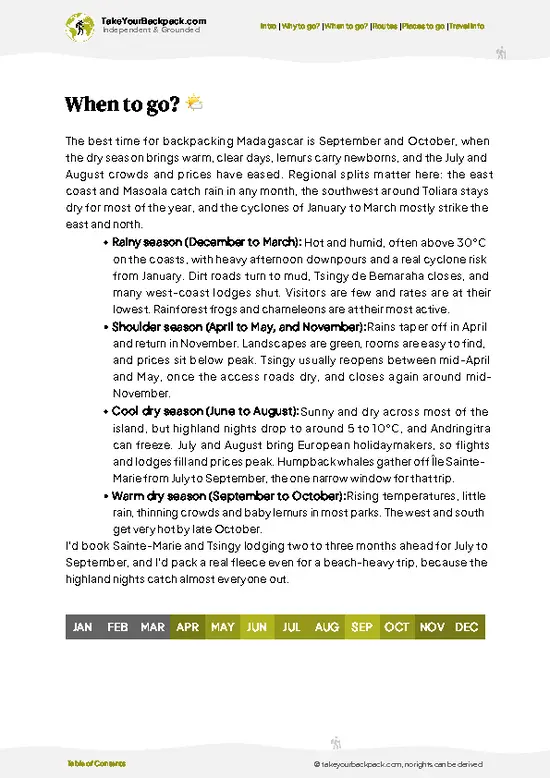
Best months and seasons: The best months for towns in Madagascar are May to October, the dry season, when roads are firmer, skies are clear and humidity drops. Daytime highs in the central highlands sit around 18 to 25°C, but nights can fall to 5 to 10°C from June to August, so a fleece and a proper blanket matter more than sunscreen. Mornings smell of woodsmoke and damp earth, and the light is sharp and pale.
Shoulder seasons: April and November are good compromises. Rain is lighter, fields are green or freshly burned, and prices and crowds are lower than in peak season. The west and south are driest, with almost no rain from May to October, and dust coats everything on the road. Heat there climbs to 30 to 35°C by November.
Rainy season and cyclones: From December to March the rains arrive, … read more 👉
Best months and seasons: The best months for towns in Madagascar are May to October, the dry season, when roads are firmer, skies are clear and humidity drops. Daytime highs in the central highlands sit around 18 to 25°C, but nights can fall to 5 to 10°C from June to August, so a fleece and a proper blanket matter more than sunscreen. Mornings smell of woodsmoke and damp earth, and the light is sharp and pale.
Shoulder seasons: April and November are good compromises. Rain is lighter, fields are green or freshly burned, and prices and crowds are lower than in peak season. The west and south are driest, with almost no rain from May to October, and dust coats everything on the road. Heat there climbs to 30 to 35°C by November.
Rainy season and cyclones: From December to March the rains arrive, especially on the east and northeast coasts, where annual rainfall can exceed 2,000 to 3,000 mm. Roads turn to red mud, bridges flood and taxi-brousse trips can stretch by half a day or more. Cyclones typically hit between January and March, mainly on the east coast, and can close roads and flights for days. Highland towns stay warm and wet, with afternoon downpours on most days.
Peak periods and prices: July to September is peak season, especially along the northwest coast and the main tourist route. Rooms fill up, and rates for mid-range lodging can rise by 20 to 40 percent. Around Christmas and Independence Day on June 26, buses and flights get crowded and local transport costs rise. Booking transport and rooms a few days ahead during these periods avoids hours of sitting by the roadside.

town hoppingPlanning Your Route Efficiently

How many days you need: A trip combining several towns in Madagascar needs 14 to 21 days, because overland travel is slow and delays are normal. Fewer than ten days forces flights or rushed taxi-brousse rides, and you spend more time in vehicles than in places.
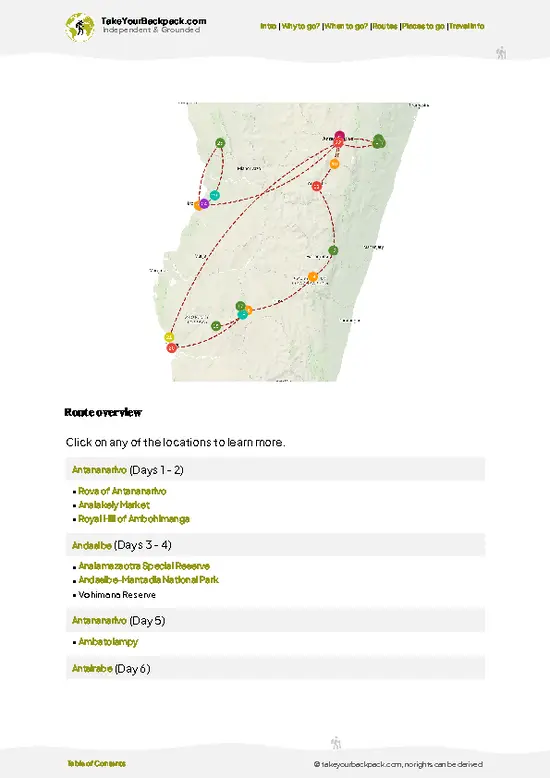
Grouping regions and direction: The highlands around Antananarivo cluster well with the east or south by road, since RN7 runs south and RN2 runs east. A common direction is south along RN7, then west or east toward the coast, with a flight back or a long return. The northwest around Mahajanga and Nosy Be is best treated as a separate block, reached by flight or a long overland day from the capital. The far south and southwest are best grouped with each other, since links back north are sparse.
Time per stop and travel times: Plan two … read more 👉
How many days you need: A trip combining several towns in Madagascar needs 14 to 21 days, because overland travel is slow and delays are normal. Fewer than ten days forces flights or rushed taxi-brousse rides, and you spend more time in vehicles than in places.
Grouping regions and direction: The highlands around Antananarivo cluster well with the east or south by road, since RN7 runs south and RN2 runs east. A common direction is south along RN7, then west or east toward the coast, with a flight back or a long return. The northwest around Mahajanga and Nosy Be is best treated as a separate block, reached by flight or a long overland day from the capital. The far south and southwest are best grouped with each other, since links back north are sparse.
Time per stop and travel times: Plan two to three nights per town so a rest day absorbs delays. Between regions, count on 6 to 12 hours by taxi-brousse or private car for 250 to 400 kilometers, and 10 to 20 hours on the worst roads. Flights between major hubs take about one to two hours and can save days, but schedules shift and baggage allowances are tight. A dawn departure helps because vehicles leave when full and mornings fill faster.
Planning mistakes: The commonest error is too many stops, drawn from a map that makes distances look short. Cut the list and leave slack. Another is trusting a tight connection to a flight home, so keep at least one buffer day. Travelers also underestimate rain, which can cut eastern routes for days, so skip fragile stops from January to March. Finally, arriving after dark in an unfamiliar town is a risk; aim to reach each stop by mid-afternoon.

The ListThe Best towns of Madagascar

1 Morondava

Baobab avenue, Vezo fishing, Nosy Kely beach bars, Tsingy gateway

Catch baobabs glowing orange at sunset, then watch Vezo fishermen land sharks and crab at dawn before heading inland to Kirindy.

madagascar-city-morondava
© Google |

2 Andasibe

Indri calls, night walks, lemur island, forest guides

Rise before dawn to hear indri wail through wet canopy, then return after dark with a guide to find mouse lemurs and tree frogs.

madagascar-city-andasibe
© Google |

3 Ambalavao

Antemoro paper, Thursday zebu market, silk looms, highland wine

Watch bark pulp pressed with petals into paper, haggle among herders at the cattle pens, then finish with a tasting at the edge-of-town vineyard.

4 Ranohira

Isalo massif, Piscine Naturelle, sapphire stalls, sandstone sunset

Walk shaded canyons with ring-tailed lemurs, swim in a cold natural pool, and watch the rock arch turn orange at dusk.

5 Maroantsetra

Masoala gateway, Nosy Mangabe, vanilla sheds, river crossings

Arrange permits and boats at town offices, then cross the bay to an island reserve of leaf-tailed geckos and red ruffed lemurs.

6 Sambava

Vanilla curing yards, casuarina beach, Marojejy permits, SAVA market

Tour plantations where pods are blanched and dried in the sun, then book guides and camps for the Marojejy trek.

7 Ihosy

Zebu auctions, RN7 stopover, Bara tombs, roadside masikita

Watch Bara herders bargain over cattle in the dust, then eat grilled zebu skewers along the highway after dark.

madagascar-city-ihosy
© Google |

8 Ambanja

Sambirano cocoa, ylang-ylang stills, chocolate workshops, river dusk

Follow cocoa from harvest to fermenting racks, smell copper stills at work, and buy local chocolate bars before moving on toward the coast.

madagascar-city-ambanja
© Google |

9 Manakara

FCE railway terminus, pousse-pousse avenues, canal paddling, spice market

Roll past colonial facades by pousse-pousse, watch freight loaded at the rail terminus, and paddle the canal past reed banks.

madagascar-city-manakara
© Google |

10 Mananjary

Sambatra ceremonies, Antemoro country, vanilla stalls, canal mouth

Time a visit for the circumcision festival along the riverbank, or come in quiet years for vanilla stalls and the point where canal meets sea.

11 Moramanga

1947 memorial, rail junction, RN2 skewers, Andasibe gateway

Learn the story of the 1947 revolt at the memorial, watch freight wagons at the junction and eat grilled zebu by the road.

12 Taolagnaro

Fort Flacourt, Libanona Beach, Pic Saint Louis, Lokaro Bay

Climb to a ridge above the peninsula, tour a 1643 French fort, and plan a full day by 4x4 and boat to Lokaro.

13 Ankify

Nosy Be ferry dock, mangrove bay, grilled crab, cashew stands

Board a speedboat or slow ferry here, and use the wait for charcoal-grilled fish, roasted cashews and a stroll along the mangrove shoreline.

14 Farafangana

River-mouth pirogues, Pangalanes waterfront, surf beach, lychee market

Watch cargo boats work the Manampatrana mouth, then hire a pirogue on the canal and walk the surf-battered shore at sunset.

15 Ambatolampy

Aluminum foundries, sand-mold pots, rice terraces, zebu skewers

Visit family workshops where recycled metal is poured into sand molds, then walk the terraced paddies and eat grilled skewers beside the highway.

16 Soanierana Ivongo

Sainte-Marie ferry quay, pirogue landing, estuary stilt huts, mofo gasy

Time your stay around the morning boat to Île Sainte-Marie, with fish sorted on the beach and snacks from the market.

17 Vatomandry

Lychee season, dark-sand beach, rusted pier, Pangalanes lagoon

Watch boats land at sunrise, smoke-dried fish on the sand, and glide through reed channels and stilt villages by lagoon boat.

18 Vangaindrano

RN12 district center, Matitanana pirogues, lamba cloth, dried fish

Use a pause on the rough southeastern road to browse the market, watch dugouts cross the river and walk the main street.

19 Vohipeno

Antaimoro paper, Matitanana banks, hilltop mission church, quiet lanes

Buy pressed-flower sheets straight from the makers, then climb to the mission church for views over rooftops and the river valley.

20 Sakaraha

Zombitse forest, sifaka loops, RN7 overnight, grilled zebu

Walk dry deciduous forest at dawn for sifakas and rare birds, then end the day with charcoal brochettes at plastic tables.

21 Maintirano

Remote west coast, fishing beach, airstrip arrivals, river-mouth sunset

Arrive by small plane, join the town at the airstrip, then negotiate a pirogue trip along mangroves and finish at the river mouth.

22 Mampikony

RN4 night stalls, rice dikes, minibus station, ariary-only market

Eat smoky zebu brochettes at dusk among arriving trucks, then walk the paddy dikes past egrets and carts the next morning.

23 Anosibe An’ala

Rainforest edge, Mangoro River, frog chorus, red mud lanes

Hire a local guide for dawn forest trails, then wander riverbank paths and village lanes where fishermen and washing families set the pace.

24 Betroka

Sapphire dealers, RN13 stopover, zebu stew, red-earth hills

Break the long southern road with a morning among gem traders, a bowl of zebu stew and a sunset climb over thatched roofs.

Think you know Madagascar?

Prove you’re a true local — uncover 14 lesser-known towns in Madagascar that locals tend to keep to themselves.
Loading the map 🌍

Expert viewInsights from Locals and Experts

How many towns to visit: Visit four to six towns in a three-week trip. Journeys swallow whole days, so fewer stops means more time walking markets, eating at roadside stalls and watching the evening light settle on terraced hills. More than six turns the trip into a series of dusty vehicle seats and cheap hotel rooms.
Choosing the kind of town: Highland towns suit first-timers and cooler-weather travelers: easy transport, reliable food, crisp air, brick streets and bargaining over handmade paper or woodcarving. Coastal towns suit those who want sea air, seafood grilled over charcoal and slower days, with more heat and more mosquitoes. Remote southern and western towns suit experienced travelers who accept dust, long rides and few facilities in return for open skies and few other visitors. If … read more 👉
How many towns to visit: Visit four to six towns in a three-week trip. Journeys swallow whole days, so fewer stops means more time walking markets, eating at roadside stalls and watching the evening light settle on terraced hills. More than six turns the trip into a series of dusty vehicle seats and cheap hotel rooms.
Choosing the kind of town: Highland towns suit first-timers and cooler-weather travelers: easy transport, reliable food, crisp air, brick streets and bargaining over handmade paper or woodcarving. Coastal towns suit those who want sea air, seafood grilled over charcoal and slower days, with more heat and more mosquitoes. Remote southern and western towns suit experienced travelers who accept dust, long rides and few facilities in return for open skies and few other visitors. If time is short, prioritize highlands plus one coast.
What it costs: Budget US$20 to 35 a day in local currency, as ariary prices move with exchange rates. That covers a basic room (about US$6 to 15), meals at local eateries (US$2 to 5), and shared taxi-brousse rides. Mid-range travelers with private rooms and occasional taxis should plan on US$40 to 70. Town entry is usually free, but individual sites charge roughly US$2 to 10, and local guides cost about US$10 to 25 a day. Private cars with drivers run US$50 to 90 a day plus fuel. Taxi-brousse fares are about US$3 to 12 for most intercity legs, and a seat usually fills faster than expected, so buy a ticket early.
Safety on the ground: Petty theft is the main risk, especially in busy markets and bus stations. Keep valuables out of sight, use a money belt, and avoid walking dark streets after sunset, when lighting is poor and potholes are deep. Cash machines are scarce and sometimes empty, so carry enough ariary for several days. Roads carry the biggest danger: overloaded vehicles, night driving and rain-slick bends. Choose daytime travel and a seat where you can see the road. Malaria is present in much of the island, and tap water is unsafe, so bring filtered or bottled water.
Cultural etiquette: Many communities observe fady, local taboos that vary by region, covering certain days, foods, animals or sacred places. Ask a local before entering a tomb, forest or sacred stone, and follow the answer. Greet people before asking for anything, dress modestly outside beach areas, and ask permission before photographing people. Pointing with a single finger can read as rude; use an open hand. A bit of Malagasy, even manao ahoana for hello, softens every exchange and often brings an invitation to sit and share a coffee or rice.

✈️ The backpacker research shortcutMadagascar Travel Guide

An offline-friendly backpacking guide with optimized travel routes, ranked highlights, transport advice, and the best areas to stay.
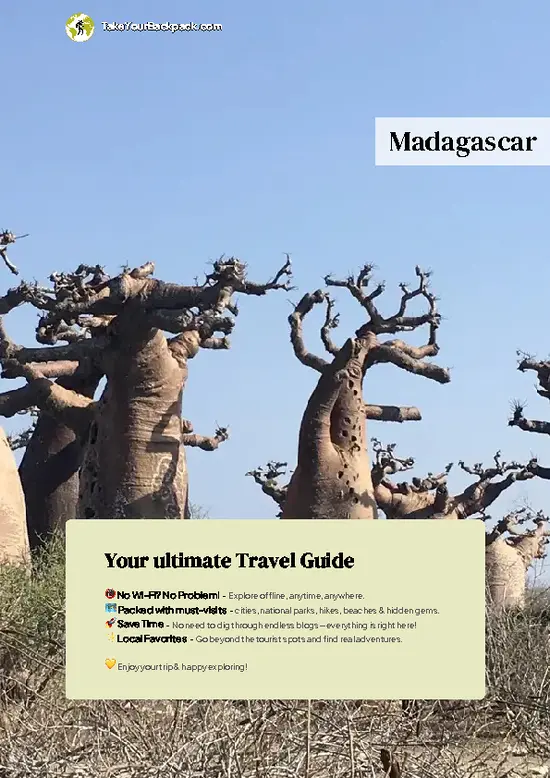
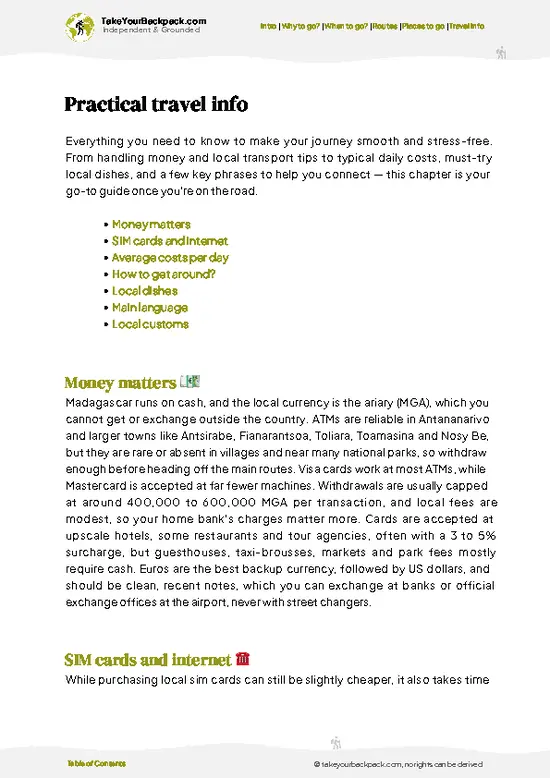
example page 0 from our offline Travel Guide for Madagascar
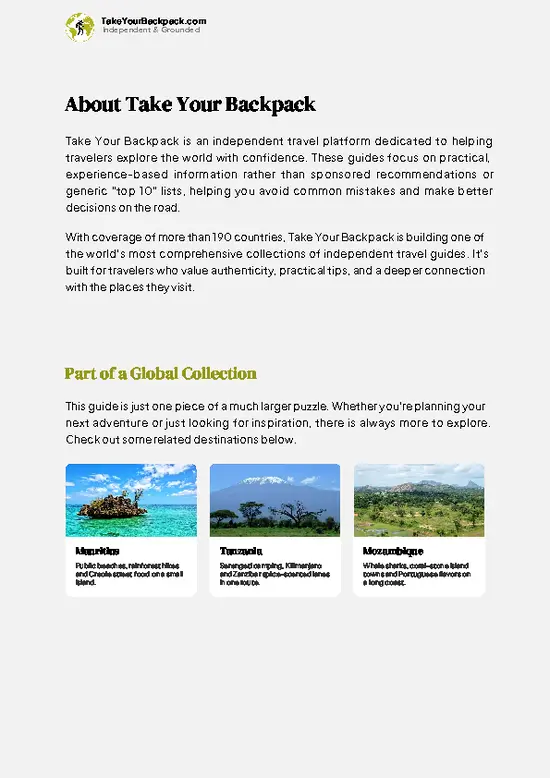
example page 1 from our offline Travel Guide for Madagascar
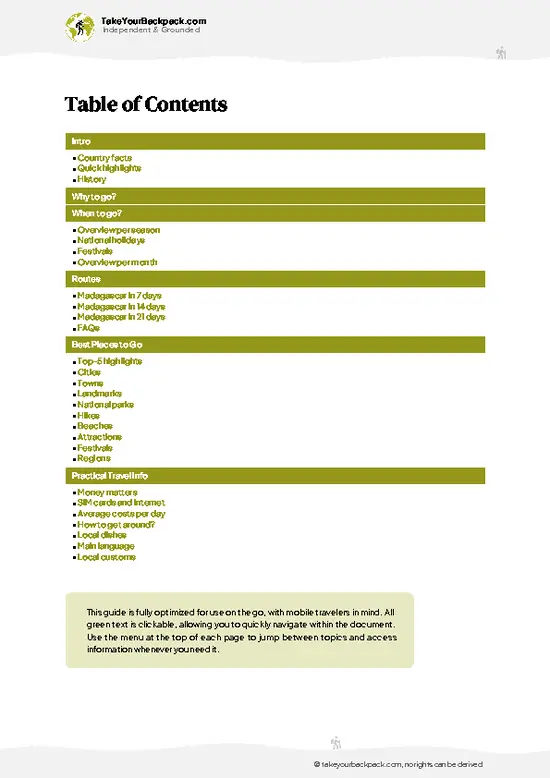
example page 2 from our offline Travel Guide for Madagascar
example page 3 from our offline Travel Guide for Madagascar
example page 4 from our offline Travel Guide for Madagascar
example page 5 from our offline Travel Guide for Madagascar
example page 6 from our offline Travel Guide for Madagascar
example page 7 from our offline Travel Guide for Madagascar
The digital guide (301 pages) contains:
✅ 96 highlights, ranked by travel appeal
✅ Optimized 7, 14 & 21-day travel routes
✅ Cities, national parks, landmarks, beaches
✅ How to get around
✅ Offline-friendly for travel without Wi-Fi
👉 Click to see all 30+ guide features

📅 Plan smarter in minutes, not weeks
✅ Month by month travel advice
✅ Festivals & national holidays
✅ Budget expectations

🗺️ Go to the right places, skip the overrated ones
✅ Honest pros & cons of destinations
✅ Top hikes, parks & viewpoints
✅ Lesser-known places most travelers miss
✅ Clear “worth it vs skip it” guidance

🛏️ Travel smoothly without rookie mistakes
✅ Best areas to stay
✅ Transport systems explained simply
✅ Common scams & safety advice
✅ SIM cards, money & practical tips

🌍 Understand the country, not just visit it
✅ Culture & traditions
✅ 52 Essential phrases & customs
✅ Festivals worth planning around
✅ Traveler-friendly historical context
✅ Insights that make places more meaningful

📱 Built for real travel conditions
✅ Fully downloadable PDF
✅ Works completely offline
✅ Optimized for phone use
✅ Useful in remote areas & buses
✅ Everything in one place
Stop searching, start planning
Get instant access to your full guide. 30‑day money-back guarantee.
+ Add another guide for just

By proceeding you agree to our terms.
Sent to your inbox immediately after payment • 100% Secure Checkout
Best Backpacking Travel Advisor 2025 tourism awardBest Backpacking
Travel Advisor
2025
What others say about Take Your Backpack Guides:
⭐⭐⭐⭐⭐
Fantastic, amazing amount of information!
⭐⭐⭐⭐⭐
My goodness this is amazing, it's what I've been looking for hats off too you!
⭐⭐⭐⭐⭐
I think this is absolutely BRILLIANT
⭐⭐⭐⭐
Very complete and informative. It's still missing places, but I gotta to commend you
⭐⭐⭐⭐⭐
This is truly amazing, thank you, can't wait to explore it with my kids!
⭐⭐⭐⭐⭐
Awesome resource, thank you!
⭐⭐⭐⭐⭐
This is amazing! Can't wait to explore the ones I haven't seen
⭐⭐⭐⭐
I love this! Well done, great idea.
⭐⭐⭐⭐⭐
Thanks for taking the time to make this gem!
⭐⭐⭐⭐⭐
This might be the best website I've ever seen.
⭐⭐⭐⭐⭐
Congratulations, and thank you so much for your work; it's incredibly valuable.
⭐⭐⭐⭐
In all seriousness I think you did a great job pointing out the important spots
⭐⭐⭐⭐⭐
10/10 very good
⭐⭐⭐⭐⭐
As someone who's only just starting to visit regularly this is awesome, thank you.
⭐⭐⭐⭐
Thank you very much! I'm going to visit my dad, it's going to be very useful!
⭐⭐⭐⭐⭐
This is really cool! We'll be travelling for the first time and this definitely come in handy.
⭐⭐⭐⭐⭐
You are now our minister of culture, congratulations 👨‍💼
⭐⭐⭐⭐⭐
Just wanted to tell you that this is a pearl! Going to follow your recommendations.
⭐⭐⭐⭐⭐
This is so cool. I'll definitely be using the resource for my travels soon.
⭐⭐⭐⭐⭐
This is very impressive! Good work.
⭐⭐⭐⭐⭐
This is an amazing and informative site. Very well done!

🛏️ Where to stay?Best Stay Options in Madagascar

Dorm-style hostels are rare in Madagascar, but budget guesthouses and simple hotels with private rooms from roughly 40,000 to 110,000 ariary (US$9 to 25) a night are easy to find in every town on the main tourist routes. In Antananarivo, Isoraka has the densest cluster of traveler-friendly guesthouses within walking distance of restaurants and bars, the Haute-Ville (upper town) is quieter with city views but involves steep climbs, and Analakely puts you beside the market and taxi-be hubs at the cost of noise and pickpockets, especially after dark. On the coast, Ambatoloaka on Nosy Be is the liveliest and most convenient base for nightlife, while Ivato, next to the airport, is a dull but practical … read more 👉
Dorm-style hostels are rare in Madagascar, but budget guesthouses and simple hotels with private rooms from roughly 40,000 to 110,000 ariary (US$9 to 25) a night are easy to find in every town on the main tourist routes. In Antananarivo, Isoraka has the densest cluster of traveler-friendly guesthouses within walking distance of restaurants and bars, the Haute-Ville (upper town) is quieter with city views but involves steep climbs, and Analakely puts you beside the market and taxi-be hubs at the cost of noise and pickpockets, especially after dark. On the coast, Ambatoloaka on Nosy Be is the liveliest and most convenient base for nightlife, while Ivato, next to the airport, is a dull but practical choice for one night before or after a flight.

If you enjoy meeting fellow travelers, consider choosing hostels with high ratings for atmosphere. On the other hand, if you prefer having your own space, a hotel might be a better option.

MadagascarWhere to Go Next

👋 Meet the founderWho’s Behind Take Your Backpack?

Johan, backpacker and founder of TakeYourBackpackHi, I’m Johan (Netherlands 🇳🇱), the creator of TakeYourBackpack. Over the past 3 decades, I’ve backpacked through 90+ countries across six continents, gaining extensive experience with independent travel, long-term trips, and overland routes.

This site is built on a combination of firsthand travel experience and carefully curated insights from other backpackers. Many guides are based on places I’ve personally visited, while others bring together tips, observations, and practical advice shared by trusted travelers I’ve met along the way.

The goal is to provide realistic, experience-driven guidance — not generic itineraries — so you can explore destinations with better context, clearer expectations, and more confidence.