×

Madagascar🇲🇬 | townsFarafanganariver mouth, clove production, southeastern markets | things to do and best time to go

Explore BetrokaExplore Maintirano

Backpacking in Farafangana
👍 Recommendedtown ranked #15
By Johan Kruseman 🇳🇱 | Updated September 4, 2026

The first real fork in the road at Farafangana is whether to linger or just pass through. That choice matters: stay, and you’re betting on slow, coastal Madagascar—where the Indian Ocean air is thick with salt and the town’s pulse is gentle, not urgent. Farafangana sits on the southeast coast, south of Manakara, where the RN12 hugs the shoreline and the rainforest presses close. For backpackers, it’s more launchpad than destination: a practical base for exploring the Manombo Reserve or catching a bush taxi further south. The town itself is modest—markets with jackfruit and river fish, a beach that’s wild and rarely crowded, evenings that wind down early. It’s quieter and less polished than Manakara, with fewer hostels and a more local rhythm, but that’s the charm if you’re after authenticity over nightlife. Buses arrive dusty and late; you’ll walk most places, or hop a pousse-pousse. Costs are low, safety is average for Madagascar—watch your bag, but don’t stress. You’ll meet other travelers, but not in droves; it’s a place for swapping stories over cheap brochettes, not for pub crawls.

Discover everything you want to know in the 📖 Madagascar Travel Guide.
Loading the map 🌍
CLICK TO FILTER
cities
towns
villages
landmarks
national parks
hikes
beaches
attractions
festivals
regions
SHOW COUNTRY’S BESTSHOW ALL

✨ Why go?
Ranked #15 town in Madagascar
Reasons people choose to visit here

Farafangana serves as a gateway for backpackers seeking both adventure and cultural immersion. Its walkable streets invite exploration, while small-scale guesthouses offer a cozy, communal vibe perfect for solo travelers or small groups. The nearby hikes and beaches are easily accessible, making it a convenient base for those wanting to dive into Madagascar’s natural beauty. You’ll find local food stalls that serve up authentic flavors, enhancing the experience. Most travelers stay a few days, soaking in the friendly atmosphere and connecting with fellow adventurers. It’s a place to linger, not just pass through.
Want to include Farafangana in your Madagascar route?
Create a personalized Madagascar itinerary that includes Farafangana and the places that fit your trip — based on your travel style, budget, and available time. Get your route in seconds.

Generate my trip

💡 HighlightsKey sights and experiences for travelers

  • Marché Municipal (Grand Marché) — the beating heart of town: rows of produce, sacks of vanilla and pepper, sari-wrapped vendors, cheap street snacks and a perfect place to watch daily life unfold and bargain with local traders.
  • Quai and Fish Market (Le Port) — early mornings here are loud and glorious: pirogues hauling in the catch, fish auctions, and the chaos of boats, nets and men hauling boxes — great for photos and fresh seafood straight off the skiff.
  • Manampatrana Riverfront & Estuary — a gentle riverside walk where you can hop in a dugout, watch estuarine birds, and see how the river shapes fishing and transport in town.
  • Town Beach (Plage de Farafangana) — long, sandy stretches right by town where locals swim, children play, and sunsets are uncomplicated and free; good for a lazy
read more 👉
  • Marché Municipal (Grand Marché) — the beating heart of town: rows of produce, sacks of vanilla and pepper, sari-wrapped vendors, cheap street snacks and a perfect place to watch daily life unfold and bargain with local traders.
  • Quai and Fish Market (Le Port) — early mornings here are loud and glorious: pirogues hauling in the catch, fish auctions, and the chaos of boats, nets and men hauling boxes — great for photos and fresh seafood straight off the skiff.
  • Manampatrana Riverfront & Estuary — a gentle riverside walk where you can hop in a dugout, watch estuarine birds, and see how the river shapes fishing and transport in town.
  • Town Beach (Plage de Farafangana) — long, sandy stretches right by town where locals swim, children play, and sunsets are uncomplicated and free; good for a lazy afternoon and to see coastal life up close.
  • Mangrove channels near the estuary — accessible by short boat trips from town; the black mangroves are alive with birds, crabs and small fisheries, and a quick guided paddle shows another side of local livelihoods.
  • Spice drying and trading yards — small, informal yards and stalls around the market where vanilla beans and pepper are dried and graded; you’ll learn a lot about the real vanilla trade here (and get to smell it properly).
  • Farafangana Cathedral (Cathédrale de Farafangana) — the local cathedral is a community anchor: simple colonial-era lines, frequent services, and a calm place to observe religious life and village rhythms.
  • Boatbuilding and wood-carving workshops — tucked along the riverbanks, you can watch craftsmen build traditional lakana (outrigger canoes) and carve practical household items — hands-on craft culture that’s still part of everyday work.
  • Seafront avenue and colonial architecture — a short walk along the waterfront and side streets reveals old administrative buildings, faded façades and shady squares that tell the town’s layered history without needing a museum.
  • Evening food stalls and riverside hangouts — when the sun drops, stalls set up along the quay with grilled fish, samosas and spicy broths; it’s social, cheap and a great way to meet locals and other travelers.
A few great day trips from Farafangana are the Réserve de Manombo (my personal favorite for easy-to-reach rainforest and wildlife), the longer excursion into Midongy du Sud National Park, and short boat trips to the small mangrove islets at the mouth of the Manampatrana.
Spotted a mistake or missing something? Contact us.

🏘️ NeighborhoodsWhere things are and how it's laid out

Farafangana is a vibrant hub on Madagascar’s southeastern coast, where the rhythm of life pulses through its streets. Each neighborhood offers a unique flavor for backpackers.

Centre Ville: This is the heart of Farafangana. It’s bustling with markets and local eateries, making it ideal for short stays. The vibe is lively, with plenty of transport options. Walkability is high, but be ready for some noise at night.

Ambanivohitra: A quieter area, perfect for longer stays. Here, you’ll find charming guesthouses and a more relaxed atmosphere. The scent of street food wafts through the air, and it’s a short walk to the beach.

Andranovory: This neighborhood offers a mix of local life and nightlife. It’s a bit further from the center, but worth it for the vibrant bars and music scene. Great for … read more 👉
Farafangana is a vibrant hub on Madagascar’s southeastern coast, where the rhythm of life pulses through its streets. Each neighborhood offers a unique flavor for backpackers.

Centre Ville: This is the heart of Farafangana. It’s bustling with markets and local eateries, making it ideal for short stays. The vibe is lively, with plenty of transport options. Walkability is high, but be ready for some noise at night.

Ambanivohitra: A quieter area, perfect for longer stays. Here, you’ll find charming guesthouses and a more relaxed atmosphere. The scent of street food wafts through the air, and it’s a short walk to the beach.

Andranovory: This neighborhood offers a mix of local life and nightlife. It’s a bit further from the center, but worth it for the vibrant bars and music scene. Great for those looking to socialize after a day of exploring.

⌛️ 1 daySeeing the highlights in 24 hours

Farafangana, a coastal town in Madagascar, pulses with a unique blend of local culture and natural beauty. The air is thick with the scent of salt and spices, and the vibrant markets buzz with life. Start your day at the bustling market in the heart of town, where you can sip on fresh coconut water while browsing colorful textiles and local crafts.

In the afternoon, take a stroll along the beach at Anakao, just a short ride away. The soft sand and gentle waves invite you to unwind. If you’re feeling adventurous, rent a canoe and paddle out to explore the nearby mangroves, where the chirping of birds and rustling leaves create a serene backdrop.

As evening falls, head to the local eatery, La Table de Farafangana, for a taste of the region’s seafood. The grilled fish, seasoned with local … read more 👉
Farafangana, a coastal town in Madagascar, pulses with a unique blend of local culture and natural beauty. The air is thick with the scent of salt and spices, and the vibrant markets buzz with life. Start your day at the bustling market in the heart of town, where you can sip on fresh coconut water while browsing colorful textiles and local crafts.

In the afternoon, take a stroll along the beach at Anakao, just a short ride away. The soft sand and gentle waves invite you to unwind. If you’re feeling adventurous, rent a canoe and paddle out to explore the nearby mangroves, where the chirping of birds and rustling leaves create a serene backdrop.

As evening falls, head to the local eatery, La Table de Farafangana, for a taste of the region’s seafood. The grilled fish, seasoned with local herbs, is a must-try. Enjoy your meal as the sun dips below the horizon, painting the sky in hues of orange and pink. This day in Farafangana is not just about sights; it’s about immersing yourself in the rhythm of life here.
Turn your Farafangana visit into an Madagascar adventure
Build a complete Madagascar route with Farafangana, hidden gems, must-see destinations, and realistic travel times included.

Generate my trip

🌤️ When to go?Seasonal considerations and timing


  • Topic: Weather — Farafangana’s dry season from May to October offers clear skies and minimal rain, perfect for trekking and beach time. The wet season (November to April) brings heavy rains and humidity, turning trails into slippery mud and limiting outdoor plans.

  • Topic: Temperature — Expect daytime highs around 25-30°C (77-86°F) in the dry season, comfortable for hiking without overheating. The wet season can push temps up to 32°C (90°F), paired with sticky humidity that drains energy fast.

  • Topic: Daylight Hours — Near the equator, daylight stays steady year-round, roughly 11-12 hours. This consistency means you can plan long days without worrying about early sunsets cutting your adventures short.

  • Topic: Crowds — Farafangana is off the beaten path, so crowds are light year-round.
read more 👉

  • Topic: Weather — Farafangana’s dry season from May to October offers clear skies and minimal rain, perfect for trekking and beach time. The wet season (November to April) brings heavy rains and humidity, turning trails into slippery mud and limiting outdoor plans.

  • Topic: Temperature — Expect daytime highs around 25-30°C (77-86°F) in the dry season, comfortable for hiking without overheating. The wet season can push temps up to 32°C (90°F), paired with sticky humidity that drains energy fast.

  • Topic: Daylight Hours — Near the equator, daylight stays steady year-round, roughly 11-12 hours. This consistency means you can plan long days without worrying about early sunsets cutting your adventures short.

  • Topic: Crowds — Farafangana is off the beaten path, so crowds are light year-round. However, the dry season sees a slight uptick in eco-tourists and local festivals, adding lively but manageable energy.

  • Topic: Seasonal Activities — The dry months are prime for exploring rainforests and beaches, while the wet season is better for birdwatching as migratory species arrive, though access can be tricky.

  • Topic: Price Fluctuations — Accommodation and transport costs rise moderately during the dry season due to demand. The wet season offers better deals but at the expense of comfort and accessibility.


Pro-tip: Aim for the shoulder months of April or October to catch decent weather, fewer tourists, and better prices—a sweet spot where the wild side of Madagascar feels just within reach.


source: climatestotravel.comJANJanuary: fair for travelingFEBFebruary: fair for travelingMARMarch: fair for travelingAPRApril: highly recommended for travelingMAYMay: excellent for travelingJUNJune: excellent for travelingJULJuly: excellent for travelingAUGAugust: excellent for travelingSEPSeptember: excellent for travelingOCTOctober: highly recommended for travelingNOVNovember: fair for travelingDECDecember: fair for traveling
when-to-go

✈️ The backpacker research shortcutMadagascar Travel Guide

An offline-friendly backpacking guide with optimized travel routes, ranked highlights, transport advice, and the best areas to stay.
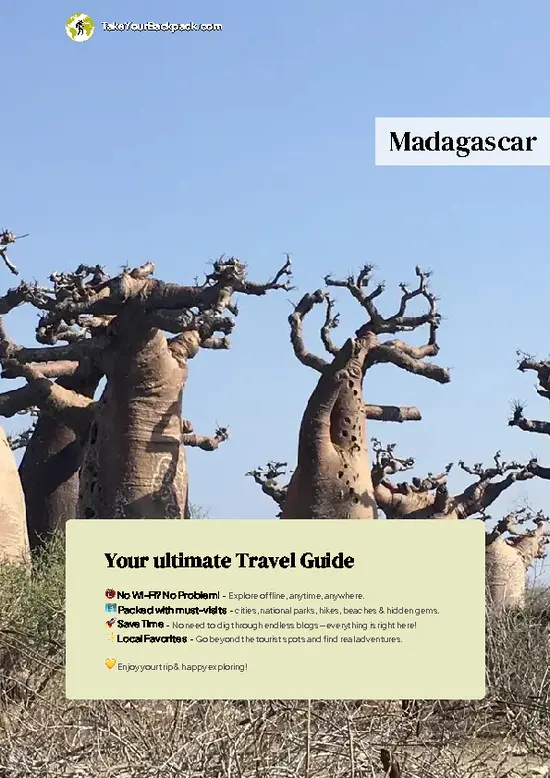
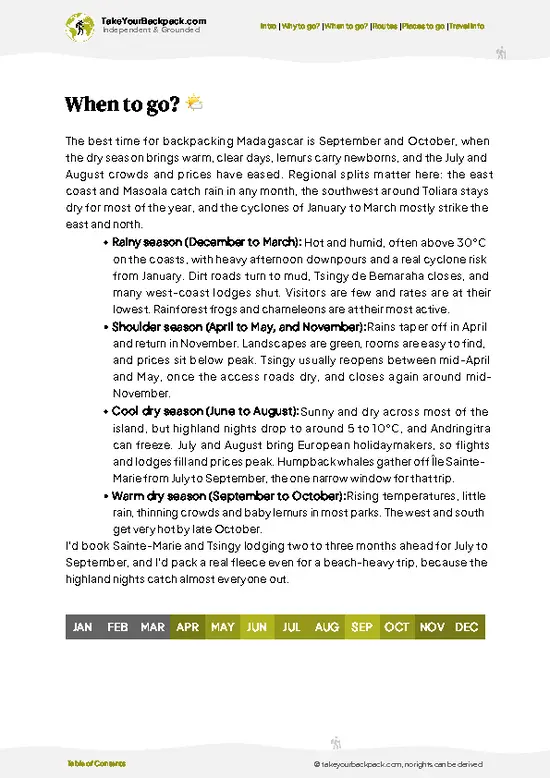
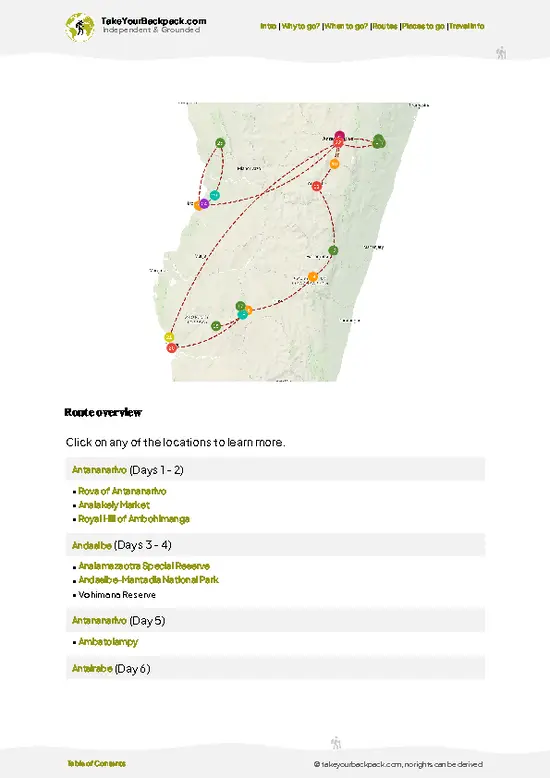
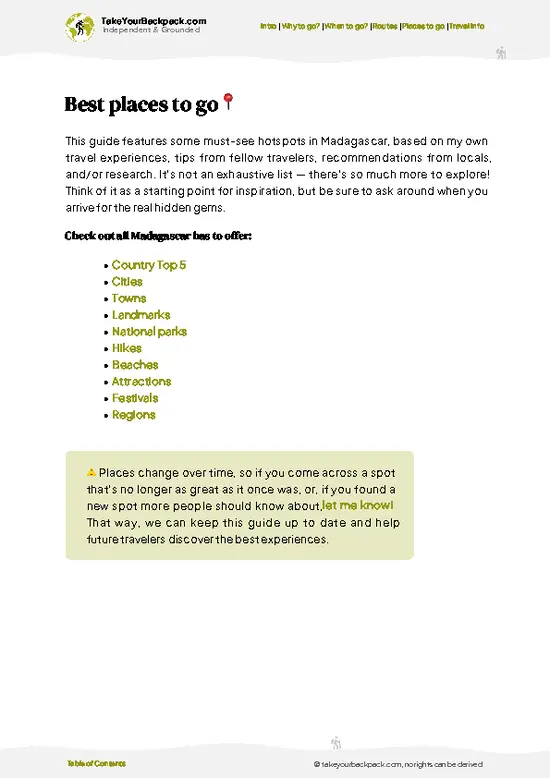
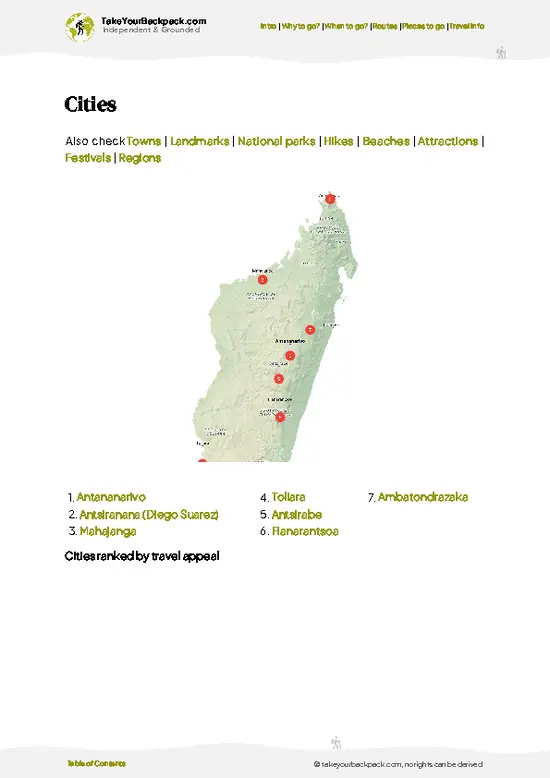
example page 0 from our offline Travel Guide for Madagascar
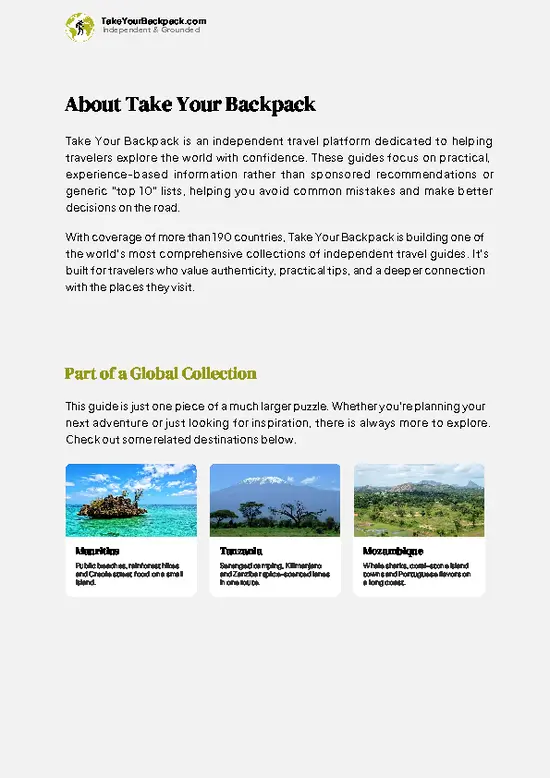
example page 1 from our offline Travel Guide for Madagascar
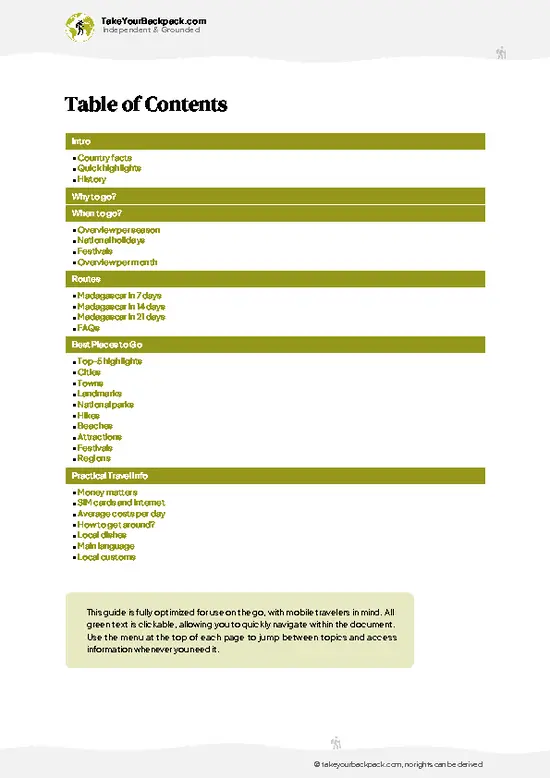
example page 2 from our offline Travel Guide for Madagascar
example page 3 from our offline Travel Guide for Madagascar
example page 4 from our offline Travel Guide for Madagascar
example page 5 from our offline Travel Guide for Madagascar
example page 6 from our offline Travel Guide for Madagascar
example page 7 from our offline Travel Guide for Madagascar
The digital guide (418 pages) contains:
110 highlights, ranked by travel appeal
Optimized 7, 14 & 21-day travel routes
Cities, national parks, landmarks, beaches
How to get around
Offline-friendly for travel without Wi-Fi
👉 Click to see all 30+ guide features

📅 Plan smarter in minutes, not weeks
Month by month travel advice
Festivals & national holidays
Budget expectations

🗺️ Go to the right places, skip the overrated ones
Honest pros & cons of destinations
Top hikes, parks & viewpoints
Lesser-known places most travelers miss
Clear “worth it vs skip it” guidance

🛏️ Travel smoothly without rookie mistakes
Best areas to stay
Transport systems explained simply
Common scams & safety advice
SIM cards, money & practical tips

🌍 Understand the country, not just visit it
Culture & traditions
52 Essential phrases & customs
Festivals worth planning around
Traveler-friendly historical context
Insights that make places more meaningful

📱 Built for real travel conditions
Fully downloadable PDF
Works completely offline
Optimized for phone use
Useful in remote areas & buses
Everything in one place
Save weeks of stressful planning
Get instant access to your full guide. 30‑day money-back guarantee.
+ Add another guide for just US$7.80

By proceeding you agree to our terms.
Sent to your inbox immediately after payment • 100% Secure Checkout
Best Backpacking Travel Advisor 2025 tourism awardBest Backpacking
Travel Advisor
2025
What others say about Take Your Backpack Guides:
⭐⭐⭐⭐⭐
Fantastic, amazing amount of information!
⭐⭐⭐⭐⭐
My goodness this is amazing, it's what I've been looking for hats off too you!
⭐⭐⭐⭐⭐
I think this is absolutely BRILLIANT
⭐⭐⭐⭐
Very complete and informative. It's still missing places, but I gotta to commend you
⭐⭐⭐⭐⭐
This is truly amazing, thank you, can't wait to explore it with my kids!
⭐⭐⭐⭐⭐
Awesome resource, thank you!
⭐⭐⭐⭐⭐
This is amazing! Can't wait to explore the ones I haven't seen
⭐⭐⭐⭐
I love this! Well done, great idea.
⭐⭐⭐⭐⭐
Thanks for taking the time to make this gem!
⭐⭐⭐⭐⭐
This might be the best website I've ever seen.
⭐⭐⭐⭐⭐
Congratulations, and thank you so much for your work; it's incredibly valuable.
⭐⭐⭐⭐
In all seriousness I think you did a great job pointing out the important spots
⭐⭐⭐⭐⭐
10/10 very good
⭐⭐⭐⭐⭐
As someone who's only just starting to visit regularly this is awesome, thank you.
⭐⭐⭐⭐
Thank you very much! I'm going to visit my dad, it's going to be very useful!
⭐⭐⭐⭐⭐
This is really cool! We'll be travelling for the first time and this definitely come in handy.
⭐⭐⭐⭐⭐
You are now our minister of culture, congratulations 👨‍💼
⭐⭐⭐⭐⭐
Just wanted to tell you that this is a pearl! Going to follow your recommendations.
⭐⭐⭐⭐⭐
This is so cool. I'll definitely be using the resource for my travels soon.
⭐⭐⭐⭐⭐
This is very impressive! Good work.
⭐⭐⭐⭐⭐
This is an amazing and informative site. Very well done!

🛏️ Where to stay?Best areas and accommodation options

Farafangana’s best backpacker zone centers around the town’s coastal edge near the main market and port. This area hums with local life—fishermen hauling nets, vendors calling out fresh produce, and the salty tang of the sea mixing with tropical blooms. It’s where budget travelers naturally gravitate because it’s safe, lively, and social without feeling touristy. You’ll find simple guesthouses and a handful of hostels here, offering basic but clean digs that encourage mingling over shared meals or sunset chats on the beach.

Stepping inland or toward the outskirts, the vibe shifts—quieter, less … read more 👉
Farafangana’s best backpacker zone centers around the town’s coastal edge near the main market and port. This area hums with local life—fishermen hauling nets, vendors calling out fresh produce, and the salty tang of the sea mixing with tropical blooms. It’s where budget travelers naturally gravitate because it’s safe, lively, and social without feeling touristy. You’ll find simple guesthouses and a handful of hostels here, offering basic but clean digs that encourage mingling over shared meals or sunset chats on the beach.

Stepping inland or toward the outskirts, the vibe shifts—quieter, less connected, and with fewer traveler-friendly spots. Staying near the market means you’re plugged into the pulse of daily Malagasy life, with easy access to local eateries and transport. It’s a practical choice that rewards you with authentic encounters and a community feel, making your stay in Farafangana more than just a stopover.

🚌 Getting aroundMoving around without the hassle

Farafangana moves at its own rhythm—neither frantic nor too slow, but a steady pulse shaped by the Indian Ocean breeze and the chatter of market vendors. The town’s flow is a blend of laid-back coastal life and the practical hustle of locals making their daily rounds. You won’t find strict timetables here; instead, transport operates on a flexible, almost intuitive schedule. The sun’s angle and the scent of salt in the air mark your best cues for timing departures. This isn’t a place to expect precision, but if you tune in to the local tempo, you’ll unlock a smoother, more authentic way to get around.


  • Walking: The best way to soak in Farafangana’s atmosphere. Streets are compact and mostly flat, making it easy to explore the market, beachfront, and local eateries on foot. No cost, and
read more 👉
Farafangana moves at its own rhythm—neither frantic nor too slow, but a steady pulse shaped by the Indian Ocean breeze and the chatter of market vendors. The town’s flow is a blend of laid-back coastal life and the practical hustle of locals making their daily rounds. You won’t find strict timetables here; instead, transport operates on a flexible, almost intuitive schedule. The sun’s angle and the scent of salt in the air mark your best cues for timing departures. This isn’t a place to expect precision, but if you tune in to the local tempo, you’ll unlock a smoother, more authentic way to get around.


  • Walking: The best way to soak in Farafangana’s atmosphere. Streets are compact and mostly flat, making it easy to explore the market, beachfront, and local eateries on foot. No cost, and you catch the town’s textures—the warm sun on your skin, the smell of grilled seafood, and the hum of daily life.


  • Bush Taxis (Taxi-Brousse): The backbone of regional travel. These shared minibuses leave when full, usually between 6 AM and 10 AM for morning runs, with afternoon departures tapering off by 4 PM. Expect a bumpy ride on dusty roads for about 10,000 to 15,000 MGA. It’s slow but authentic, and a chance to chat with locals.


  • Motorcycle Taxis (Taxi-Moto): Perfect for short hops or when you’re pressed for time. They’re everywhere, weaving through traffic with ease. Fares start around 1,000 MGA for short distances. Helmets aren’t always standard, so hold on tight and enjoy the wind and street-level views.


  • Private Car Hire: If you want to stretch beyond town limits on your own schedule, renting a car with a driver is the way to go. It’s pricier—expect around 100,000 MGA per day—but offers comfort and flexibility, especially if you’re heading to remote beaches or nature reserves.

👛 Costs (as of 4 September 2026)What things cost and how to budget

Backpacking in Farafangana, Madagascar, means embracing a laid-back coastal town where costs stay modest but the experience feels rich. Here’s how your daily budget breaks down in practical terms:
  • Dorm Accommodation: Expect to pay around €5 to €10 per night for a basic dorm bed. Options are limited but functional, often family-run guesthouses with simple rooms and shared bathrooms. The light in these places is usually soft and natural, filtering through wooden shutters, giving a calm, unpretentious vibe.
  • Meals: Local eateries serve up hearty Malagasy dishes for about €2 to €5 per meal. Street food stalls offer grilled seafood or rice dishes with fresh greens, filling you up without emptying your wallet. The scent of smoky charcoal and fresh herbs is a constant companion here.
  • Local Transport:
read more 👉
Backpacking in Farafangana, Madagascar, means embracing a laid-back coastal town where costs stay modest but the experience feels rich. Here’s how your daily budget breaks down in practical terms:
  • Dorm Accommodation: Expect to pay around €5 to €10 per night for a basic dorm bed. Options are limited but functional, often family-run guesthouses with simple rooms and shared bathrooms. The light in these places is usually soft and natural, filtering through wooden shutters, giving a calm, unpretentious vibe.
  • Meals: Local eateries serve up hearty Malagasy dishes for about €2 to €5 per meal. Street food stalls offer grilled seafood or rice dishes with fresh greens, filling you up without emptying your wallet. The scent of smoky charcoal and fresh herbs is a constant companion here.
  • Local Transport: Getting around town mostly means tuk-tuks or shared taxis, costing roughly €0.50 to €1 per short trip. For longer rides outside town, minibus taxis might run €2 to €4. The bumpy roads and open windows bring in the salty sea breeze, making even the rough rides part of the experience.
  • Basic Activities/Entry Fees: Visiting local markets, beaches, or small reserves usually costs under €3. Some community-run nature spots might ask for a small donation or entry fee around €1 to €2. These places reward you with raw, unpolished nature and authentic local life, far from tourist crowds.
  • Miscellaneous Expenses: Budget around €1 to €3 for essentials like bottled water, snacks, or occasional phone credit. Keep cash handy since card payments are rare, and small vendors appreciate exact change.

All told, you’re looking at roughly €10 to €20 per day to cover the essentials in Farafangana. This town doesn’t demand a big budget, but it does ask for patience and a willingness to roll with the local rhythm. The payoff is a genuine slice of Madagascar’s coastal life, where every euro stretches far and every moment feels earned.


source: madagascar-tourisme.com
⚠️ Prices can change and everyone travels differently, so take this as a rough guide. Hope it helps you plan your adventure!

🚌 Day tripsWhere to go beyond the main area

Farafangana is a backpacker’s dream base, offering easy access to stunning landscapes and vibrant local culture. Here are some day trips that truly deliver.

Lemur Island Adventure
Just a short boat ride away, this island is home to playful lemurs that leap from tree to tree. Spend a few hours watching them interact in their natural habitat. The trip takes about 30 minutes and costs around $10, including the boat fare. Early mornings are best for spotting these lively creatures before the heat sets in. A common mistake? Forgetting to bring snacks; you’ll want energy for all that lemur chasing!


Mangrove Exploration
Head to the nearby mangroves for a unique ecosystem experience. Rent a kayak and paddle through the winding waterways, where the air is thick with the scent of salt and earth. … read more 👉
Farafangana is a backpacker’s dream base, offering easy access to stunning landscapes and vibrant local culture. Here are some day trips that truly deliver.

Lemur Island Adventure
Just a short boat ride away, this island is home to playful lemurs that leap from tree to tree. Spend a few hours watching them interact in their natural habitat. The trip takes about 30 minutes and costs around $10, including the boat fare. Early mornings are best for spotting these lively creatures before the heat sets in. A common mistake? Forgetting to bring snacks; you’ll want energy for all that lemur chasing!


Mangrove Exploration
Head to the nearby mangroves for a unique ecosystem experience. Rent a kayak and paddle through the winding waterways, where the air is thick with the scent of salt and earth. It’s about a 45-minute ride from town, costing around $5 for kayak rental. The best time to go is during low tide when the mangroves are more accessible. Many first-timers miss the chance to explore the quieter channels, where wildlife abounds.


Local Market Immersion
Dive into the heart of Farafangana by visiting the bustling local market. It’s a sensory overload of colors, sounds, and aromas. Spend a couple of hours here, chatting with vendors and sampling street food for under $5. The market is most vibrant on Saturdays, so plan accordingly. A rookie mistake is arriving too late; by noon, many goods are sold out!
Want to know what more Madagascar offers?
The Madagascar Travel Guide describes 110 highlights, from cities to national parks, from beaches to hikes

Get the Travel Guide -

🛡️ SafetyStaying Safe: What Travelers Should Know

Farafangana is generally safe, but staying aware enhances your experience. Stick to well-lit areas at night, especially near the market; the atmosphere shifts after dark. Solo travelers should blend in—avoid flashy gear and keep your valuables discreet.

Scams are rare, but be cautious with overly friendly locals offering unsolicited help; they might expect a tip. The occasional street vendor can be persistent, so a polite but firm “no, thank you” works wonders. Embrace the local vibe, and you’ll navigate smoothly.

FAQFrequently asked questions about Farafangana

Farafangana is worth visiting for its authentic local culture and nearby natural attractions like the Manombo Reserve. It is more than just a stopover if you want to experience rural Madagascar and coastal scenery.
You need about 2 to 3 days in Farafangana to explore the town, visit local markets, and take a day trip to the Manombo Reserve or nearby beaches.
Farafangana cannot be easily visited as a day trip from a nearby city due to poor road conditions and travel times; it is about 150 km from Fianarantsoa, which takes 5 to 6 hours by car.
⚠️ Things can change over time, so always validate details locally before you go.

Other Malagasy towns near Farafangana

Explore more nearby:

  • Vohipeno—Antemoro culture, riverbank setting, traditional crafts| 52 km away
  • Vangaindrano—swampy lowlands, river crossings, southern terminus| 64 km away
  • Manakara—canal port, colonial grid, FCE railway terminus| 77 km away

💡 Not sure where to go next?
Create a personalized itinerary for Madagascar including Farafangana and the places that fit your trip.

Generate my itinerary

👉 Discover all towns

Or checkout all Madagascar has to offer (think cities, towns, villages, national parks, hikes, beaches, festivals)
Country photo of Madagascar

We 💚 feedbackWhat to keep in mind

Farafangana’s coastline is a slice of paradise, where the salty breeze mingles with the scent of fresh seafood. But be ready for the heat; it can be relentless. Embrace the sweat, and you’ll find the vibrant local life is worth every drop.

✈️ When did I visit Madagascar?
Madagascar I went backpacking in October 2019. With a friend I rented a 4WD and drove around the southern part of Madagascar.

✍️ Help improve this page!
The information on this page is based on my own backpacking experience in Madagascar, supplemented with up-to-date research and feedback from other travelers. Travel details can change, so if you notice anything outdated or incomplete, feel free to let me know.


🙋‍♂️ Give feedback

👋 Meet the founderWho’s Behind Take Your Backpack?

Johan, backpacker and founder of TakeYourBackpackHi, I’m Johan (Netherlands 🇳🇱), the creator of TakeYourBackpack. Over the past decade, I’ve backpacked through 80+ countries across six continents, gaining extensive experience with independent travel, long-term trips, and overland routes.

This site is built on a combination of firsthand travel experience and carefully curated insights from other backpackers. Many guides are based on places I’ve personally visited, while others bring together tips, observations, and practical advice shared by trusted travelers I’ve met along the way.

The goal is to provide realistic, experience-driven guidance — not generic itineraries — so you can explore destinations with better context, clearer expectations, and more confidence.

Get full Madagascar guide •
Instant download • 110 highlights • Full Offline guide