×

Madagascar🇲🇬 | attractionsRova of AntananarivoScorched palace shell, royal tombs, Besakana roof, capital panorama | things to do and best time to go

Explore Royal Hill of AmbohimangaExplore Analakely Market

Backpacking in Rova of Antananarivo
🏆 Top pickattraction ranked #3
By Johan Kruseman 🇳🇱 | Updated October 22, 2026

Most people come for Manjakamiadana, the great stone-walled palace of the Merina queens, whose gutted shell still dominates the skyline. The overlooked part is the hilltop itself, where the whole capital spreads out in brick, tin and rice-paddy green. The Rova sits on the highest hill of Madagascar’s capital, Antananarivo, and the climb up cobbled lanes is steep, so take a taxi to the gate and walk back down through the old quarter. Guides are the usual route inside because the buildings are reached through guided visits, and a good one explains the royal tombs and the 1995 fire, which you can’t read from the stones alone. When I came through the gate, kids were kicking a ball against a cannon, wood smoke drifted up from the lanes below, and the pale granite walls looked scorched at the top edge. It is a quieter, more urban place than Ambohimanga, whose forested royal hill stays intact and rural.

Discover everything you want to know in the 📖 Madagascar Travel Guide.


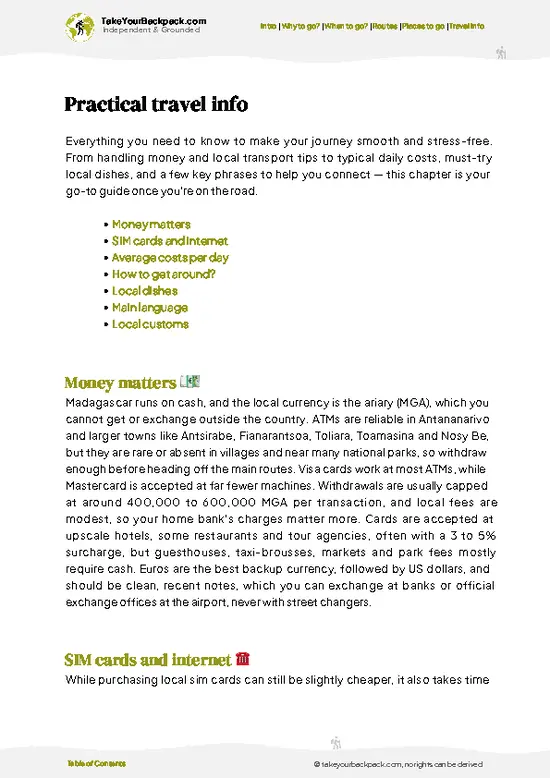
example page 0 from our offline Travel Guide for Madagascar
example page 1 from our offline Travel Guide for Madagascar
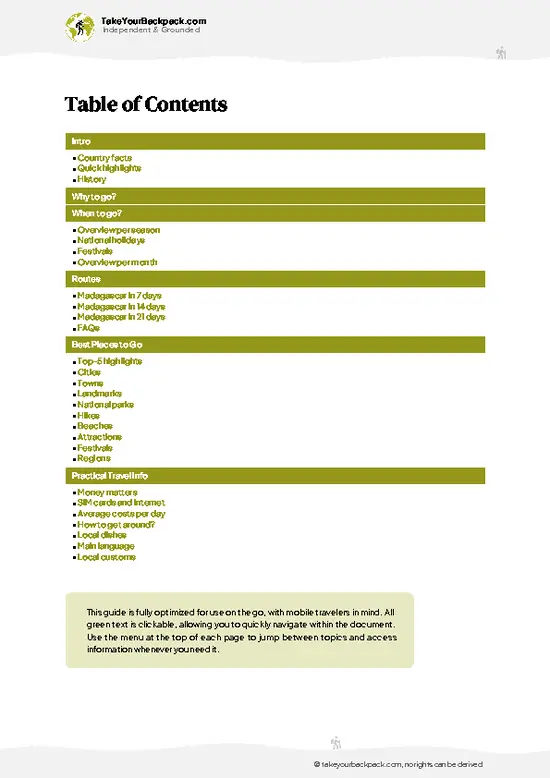
example page 2 from our offline Travel Guide for Madagascar
example page 3 from our offline Travel Guide for Madagascar
example page 4 from our offline Travel Guide for Madagascar
example page 5 from our offline Travel Guide for Madagascar
example page 6 from our offline Travel Guide for Madagascar
example page 7 from our offline Travel Guide for Madagascar
Loading the map 🌍
CLICK TO FILTER
cities
towns
landmarks
national parks
hikes
beaches
attractions
festivals
regions
SHOW COUNTRY’S BESTSHOW ALL

✨ Why go?
Ranked #3 attraction in Madagascar
What makes this attraction worth visiting

The Rova is where Madagascar’s highland kingdom was founded and ruled for about three centuries, and nowhere else makes that story as physical. You stand where kings were proclaimed and where Queen Ranavalona III lived before French troops took the capital in 1896. Even gutted, the palace shell shows the scale of Merina ambition, and the contrast between stone and the small wooden royal houses beside it explains how the court actually lived.

It also works as a milestone. Most routes through the highlands begin or end in the capital, so a morning here gives you the historical frame for everything that follows, from the rice terraces to the sacred hills and tombs you will pass on the road south. The 360-degree outlook over the city, with Lake Anosy glinting below, is the best orientation you … read more 👉
The Rova is where Madagascar’s highland kingdom was founded and ruled for about three centuries, and nowhere else makes that story as physical. You stand where kings were proclaimed and where Queen Ranavalona III lived before French troops took the capital in 1896. Even gutted, the palace shell shows the scale of Merina ambition, and the contrast between stone and the small wooden royal houses beside it explains how the court actually lived.

It also works as a milestone. Most routes through the highlands begin or end in the capital, so a morning here gives you the historical frame for everything that follows, from the rice terraces to the sacred hills and tombs you will pass on the road south. The 360-degree outlook over the city, with Lake Anosy glinting below, is the best orientation you will get in Antananarivo, and it costs only a short visit rather than a full day.

💡 HighlightsDon't-miss highlights and experiences

  1. Manjakamiadana Palace: The stone-cased palace of Queen Ranavalona I is the sight everyone searches for. The wooden original was designed by Jean Laborde, and the stone shell with its tall windows still stands, scorched and impressive, after the 1995 fire.
  2. Besakana: A reconstruction of the early royal residence on the site. Its long, steeply pitched roof and carved wooden posts show how the Merina court lived before stone arrived.
  3. Tranovola: The “Silver House” associated with King Andrianampoinimerina is a small timber building, and it is the best place to feel the intimate scale of royal life.
  4. The royal tombs: Several kings and queens were buried here in a cluster of tomb houses. The ancestral importance in Malagasy belief gives the site a hush that the views alone do not.
  5. Gate and cannons: The
… read more 👉
  1. Manjakamiadana Palace: The stone-cased palace of Queen Ranavalona I is the sight everyone searches for. The wooden original was designed by Jean Laborde, and the stone shell with its tall windows still stands, scorched and impressive, after the 1995 fire.
  2. Besakana: A reconstruction of the early royal residence on the site. Its long, steeply pitched roof and carved wooden posts show how the Merina court lived before stone arrived.
  3. Tranovola: The “Silver House” associated with King Andrianampoinimerina is a small timber building, and it is the best place to feel the intimate scale of royal life.
  4. The royal tombs: Several kings and queens were buried here in a cluster of tomb houses. The ancestral importance in Malagasy belief gives the site a hush that the views alone do not.
  5. Gate and cannons: The entrance area has old cannons and heavy stonework, and it is a good spot to read the hill’s defensive position before going in.
  6. City panorama: The terrace walls give long views over red-brick roofs, the lower town, and the flooded paddies at the edge of the capital. Late afternoon light turns the brick a deep orange.
  7. Andafiavaratra Palace: Just below the hill, this former prime minister’s residence now serves as a museum with royal-era objects, a worthwhile follow-up when you walk back down.
For a first visit, start with Manjakamiadana and its views, since the palace shell and the city panorama together tell the whole story in under an hour.
Spotted a mistake or missing something? Contact us.

Things to do around Rova of Antananarivo

Ratings based on Tripadvisor reviews. When you book through this link, you support our work at no extra cost to you.

🌤️ When to go?Seasonal considerations and timing

  • Cool Dry Season (May to September): Days run 18 to 23°C (64 to 73°F), but nights on the hill drop to 7 to 11°C (45 to 52°F) in June and July. Skies are mostly dry and sunrise is around 6:00, so you get a long, comfortable climb up the cobbled lanes. This is also peak season, with higher prices for rooms and guides.
  • Hot Dry Season (October to November): Highs reach 25 to 28°C (77 to 82°F) with little rain. Crowds thin out and the city views stay clear, though afternoons feel strong at the exposed upper terraces.
  • Rainy Season (December to March): Expect 20 to 26°C (68 to 79°F) and afternoon downpours that turn the steep lanes slick. Cyclone weather can hit in January and February. Rooms are cheaper and the site is nearly empty, but fog can hide the view.
  • Shoulder Month (April): Rain fades, hills
… read more 👉
  • Cool Dry Season (May to September): Days run 18 to 23°C (64 to 73°F), but nights on the hill drop to 7 to 11°C (45 to 52°F) in June and July. Skies are mostly dry and sunrise is around 6:00, so you get a long, comfortable climb up the cobbled lanes. This is also peak season, with higher prices for rooms and guides.
  • Hot Dry Season (October to November): Highs reach 25 to 28°C (77 to 82°F) with little rain. Crowds thin out and the city views stay clear, though afternoons feel strong at the exposed upper terraces.
  • Rainy Season (December to March): Expect 20 to 26°C (68 to 79°F) and afternoon downpours that turn the steep lanes slick. Cyclone weather can hit in January and February. Rooms are cheaper and the site is nearly empty, but fog can hide the view.
  • Shoulder Month (April): Rain fades, hills are green, and temperatures sit at 17 to 25°C (63 to 77°F).
Go in the morning, before the midday haze and the school groups arrive.


source: climatestotravel.comJANJanuary: fair for travelingFEBFebruary: fair for travelingMARMarch: fair for travelingAPRApril: fair for travelingMAYMay: highly recommended for travelingJUNJune: excellent for travelingJULJuly: excellent for travelingAUGAugust: excellent for travelingSEPSeptember: highly recommended for travelingOCTOctober: highly recommended for travelingNOVNovember: fair for travelingDECDecember: fair for traveling
when-to-go

✈️ The backpacker research shortcutMadagascar Travel Guide

An offline-friendly backpacking guide with optimized travel routes, ranked highlights, transport advice, and the best areas to stay.
example page 0 from our offline Travel Guide for Madagascar
example page 1 from our offline Travel Guide for Madagascar
example page 2 from our offline Travel Guide for Madagascar
example page 3 from our offline Travel Guide for Madagascar
example page 4 from our offline Travel Guide for Madagascar
example page 5 from our offline Travel Guide for Madagascar
example page 6 from our offline Travel Guide for Madagascar
example page 7 from our offline Travel Guide for Madagascar
The digital guide (301 pages) contains:
✅ 96 highlights, ranked by travel appeal
✅ Optimized 7, 14 & 21-day travel routes
✅ Cities, national parks, landmarks, beaches
✅ How to get around
✅ Offline-friendly for travel without Wi-Fi
👉 Click to see all 30+ guide features

📅 Plan smarter in minutes, not weeks
✅ Month by month travel advice
✅ Festivals & national holidays
✅ Budget expectations

🗺️ Go to the right places, skip the overrated ones
✅ Honest pros & cons of destinations
✅ Top hikes, parks & viewpoints
✅ Lesser-known places most travelers miss
✅ Clear “worth it vs skip it” guidance

🛏️ Travel smoothly without rookie mistakes
✅ Best areas to stay
✅ Transport systems explained simply
✅ Common scams & safety advice
✅ SIM cards, money & practical tips

🌍 Understand the country, not just visit it
✅ Culture & traditions
✅ 52 Essential phrases & customs
✅ Festivals worth planning around
✅ Traveler-friendly historical context
✅ Insights that make places more meaningful

📱 Built for real travel conditions
✅ Fully downloadable PDF
✅ Works completely offline
✅ Optimized for phone use
✅ Useful in remote areas & buses
✅ Everything in one place
Stop searching, start planning
Get instant access to your full guide. 30‑day money-back guarantee.
+ Add another guide for just

By proceeding you agree to our terms.
Sent to your inbox immediately after payment • 100% Secure Checkout
Best Backpacking Travel Advisor 2025 tourism awardBest Backpacking
Travel Advisor
2025
What others say about Take Your Backpack Guides:
⭐⭐⭐⭐⭐
Fantastic, amazing amount of information!
⭐⭐⭐⭐⭐
My goodness this is amazing, it's what I've been looking for hats off too you!
⭐⭐⭐⭐⭐
I think this is absolutely BRILLIANT
⭐⭐⭐⭐
Very complete and informative. It's still missing places, but I gotta to commend you
⭐⭐⭐⭐⭐
This is truly amazing, thank you, can't wait to explore it with my kids!
⭐⭐⭐⭐⭐
Awesome resource, thank you!
⭐⭐⭐⭐⭐
This is amazing! Can't wait to explore the ones I haven't seen
⭐⭐⭐⭐
I love this! Well done, great idea.
⭐⭐⭐⭐⭐
Thanks for taking the time to make this gem!
⭐⭐⭐⭐⭐
This might be the best website I've ever seen.
⭐⭐⭐⭐⭐
Congratulations, and thank you so much for your work; it's incredibly valuable.
⭐⭐⭐⭐
In all seriousness I think you did a great job pointing out the important spots
⭐⭐⭐⭐⭐
10/10 very good
⭐⭐⭐⭐⭐
As someone who's only just starting to visit regularly this is awesome, thank you.
⭐⭐⭐⭐
Thank you very much! I'm going to visit my dad, it's going to be very useful!
⭐⭐⭐⭐⭐
This is really cool! We'll be travelling for the first time and this definitely come in handy.
⭐⭐⭐⭐⭐
You are now our minister of culture, congratulations 👨‍💼
⭐⭐⭐⭐⭐
Just wanted to tell you that this is a pearl! Going to follow your recommendations.
⭐⭐⭐⭐⭐
This is so cool. I'll definitely be using the resource for my travels soon.
⭐⭐⭐⭐⭐
This is very impressive! Good work.
⭐⭐⭐⭐⭐
This is an amazing and informative site. Very well done!

🛏️ Where to stay?Choosing the right base

The best base is the Haute-Ville around Analakely and Isoraka, a short walk or taxi ride from the Rova. Isoraka is the backpacker favorite. It has a cluster of budget guesthouses and a few hostels, plenty of cafés and restaurants, and enough foot traffic after dark that you can walk back to your bed in the evening without much worry. Taxi-be minibuses and cheap taxis leave from nearby, so airport arrivals and onward trips are simple.
Analakely sits at the foot of the hill and has the main market, bus connections and cheap street food. It is lively by day but rougher at night, so keep to well-lit … read more 👉
The best base is the Haute-Ville around Analakely and Isoraka, a short walk or taxi ride from the Rova. Isoraka is the backpacker favorite. It has a cluster of budget guesthouses and a few hostels, plenty of cafés and restaurants, and enough foot traffic after dark that you can walk back to your bed in the evening without much worry. Taxi-be minibuses and cheap taxis leave from nearby, so airport arrivals and onward trips are simple.
Analakely sits at the foot of the hill and has the main market, bus connections and cheap street food. It is lively by day but rougher at night, so keep to well-lit streets and take a taxi after dark. Pickpocketing is common around the market and station.
Up in the old Haute-Ville near the Rova itself, a few small guesthouses offer quiet, views, and steep cobbled lanes at your door. They are atmospheric but have fewer restaurants, so you will eat out lower down. Avoid the lanes around the station for sleeping if you arrive late. Wherever you book, ask for a room with a lock and hot water, since nights are cold from May to September.

👛 Costs (as of 22 October 2026)How expensive it really is

A day at the Rova of Antananarivo costs roughly US$38 to 55 for a backpacker, with the compound itself a small part of that. The hilltop palace complex sits at the top of the old Haute-Ville, so most spending goes on getting up the steep lanes, eating, and a bed nearby. Everything is paid in Malagasy ariary, and cash is the norm at the gate.
CategoryBudget RangeLocal Reality
Entry ticketUS$2 to 4Foreign adults pay a fee at the gate for the grounds and the palace exterior. Prices have shifted in recent years, so carry small notes.
GuideUS$4 to 10Local English or French speaking guides wait at the entrance and quote per group. Agree the price before walking in.
TransportUS$1 to 5City minibuses cost under US$0.50 a ride. A taxi from the lower town runs US$2 to 5, and the final climb is on foot over
… read more 👉
A day at the Rova of Antananarivo costs roughly US$38 to 55 for a backpacker, with the compound itself a small part of that. The hilltop palace complex sits at the top of the old Haute-Ville, so most spending goes on getting up the steep lanes, eating, and a bed nearby. Everything is paid in Malagasy ariary, and cash is the norm at the gate.
CategoryBudget RangeLocal Reality
Entry ticketUS$2 to 4Foreign adults pay a fee at the gate for the grounds and the palace exterior. Prices have shifted in recent years, so carry small notes.
GuideUS$4 to 10Local English or French speaking guides wait at the entrance and quote per group. Agree the price before walking in.
TransportUS$1 to 5City minibuses cost under US$0.50 a ride. A taxi from the lower town runs US$2 to 5, and the final climb is on foot over cobbles.
Accommodation (high season, May to October)US$10 to 20Dorm beds and simple private rooms in the Haute-Ville and the Analakely area. Rates drop a little in the rainy months.
FoodUS$6 to 12Rice with zebu or pork at a hotely costs US$1.50 to 3. A sit-down meal at a restaurant near the hill runs US$6 to 10.
Drinks and snacksUS$1 to 3THB beer, coffee and fried street snacks are sold around the palace lanes.
ExtrasUS$2 to 5Camera fees may apply at some museum rooms, plus small tips for guides and crafts from the stalls outside.
Total Daily BudgetUS$38 to 55Covers one day with a bed, meals, local transport, entry and a guide.
⚠️ Prices can change and everyone travels differently, so take this as a rough guide. Hope it helps you plan your adventure!

FAQCommon questions from travelers

Plan on 1.5 to 3 hours at the Rova itself. The walk up from Analakely takes 20 to 30 minutes on steep cobbles, and the guided loop of the palace grounds, tombs and viewpoints takes about an hour. Add another hour if you also visit the nearby Haute-Ville churches and cafés.
For most visitors, yes, since the ticket is only about US$3 to 6 (roughly 15,000 to 30,000 MGA). The hilltop gives the best panorama over Antananarivo and the rice fields beyond. The palace buildings were badly damaged by fire in 1995, so you see restored shells and stone walls, and a guide at US$3 to 8 helps explain the royal history.
From central Antananarivo, walk uphill from Analakely or Isoraka in 20 to 40 minutes, or take a taxi for about US$2 to 4. Taxi-be minibuses run through the lower city for under US$0.50, but they are crowded and routes are hard to read. From Ivato airport, about 15 km north, a taxi to the city takes 30 to 60 minutes depending on traffic and costs around US$12 to 20.
⚠️ Things can change over time, so always validate details locally before you go.

Other Malagasy attractions near Rova of Antananarivo

Explore more nearby:


💡 Not sure where to go next?
Create a personalized itinerary for Madagascar including Rova of Antananarivo and the places that fit your trip.

Generate my itinerary

👉 Discover all attractions

Or checkout all Madagascar has to offer (think cities, towns, villages, national parks, hikes, beaches, festivals)
Country photo of Madagascar

We 💚 feedbackIs it worth it?

Most first-timers spend all their time at the palace and miss the small wooden Besakana and Tranovola houses, where the court’s everyday scale makes sense. I would give those buildings real time, then walk down through the old lanes instead of taking a taxi back.

✈️ When did I visit Madagascar?
Madagascar I went backpacking in October 2019. With a friend I rented a 4WD and drove around the southern part of Madagascar.

✍️ Help improve this page!
The information on this page is based on my own backpacking experience in Madagascar, supplemented with up-to-date research and feedback from other travelers. Travel details can change, so if you notice anything outdated or incomplete, feel free to let me know.


🙋‍♂️ Give feedback

👋 Meet the founderWho’s Behind Take Your Backpack?

Johan, backpacker and founder of TakeYourBackpackHi, I’m Johan (Netherlands 🇳🇱), the creator of TakeYourBackpack. Over the past 3 decades, I’ve backpacked through 90+ countries across six continents, gaining extensive experience with independent travel, long-term trips, and overland routes.

This site is built on a combination of firsthand travel experience and carefully curated insights from other backpackers. Many guides are based on places I’ve personally visited, while others bring together tips, observations, and practical advice shared by trusted travelers I’ve met along the way.

The goal is to provide realistic, experience-driven guidance — not generic itineraries — so you can explore destinations with better context, clearer expectations, and more confidence.