×

Madagascar🇲🇬 | attractionsTsimbazaza Zoo and Botanical GardenAye-aye house, elephant bird bones, ruffed lemur choruses, labeled spiny plants | things to do and best time to go

Explore Lemurs’ ParkExplore Pirate Cemetery of Île Sainte-Marie

Backpacking in Tsimbazaza Zoo and Botanical Garden
👀 For curious travelersattraction ranked #14
By Johan Kruseman 🇳🇱 | Updated October 15, 2026

The Parc Botanique et Zoologique de Tsimbazaza holds the skeleton of an elephant bird (Aepyornis), the giant flightless bird that vanished from Madagascar, in its museum hall. It sits in Antananarivo, Madagascar’s capital, south of the center near Lake Anosy. The lemurs are the draw, and seeing aye-ayes in a dim nocturnal house is worth the ticket. The cages are small and the grounds show their age, so skip the aquarium-style corners. I still hear the barking roar of the indri-like lemur calls carrying over the traffic outside. Wildlife lovers and families will enjoy it; anyone craving wilderness should head to the national parks.

Discover everything you want to know in the 📖 Madagascar Travel Guide.


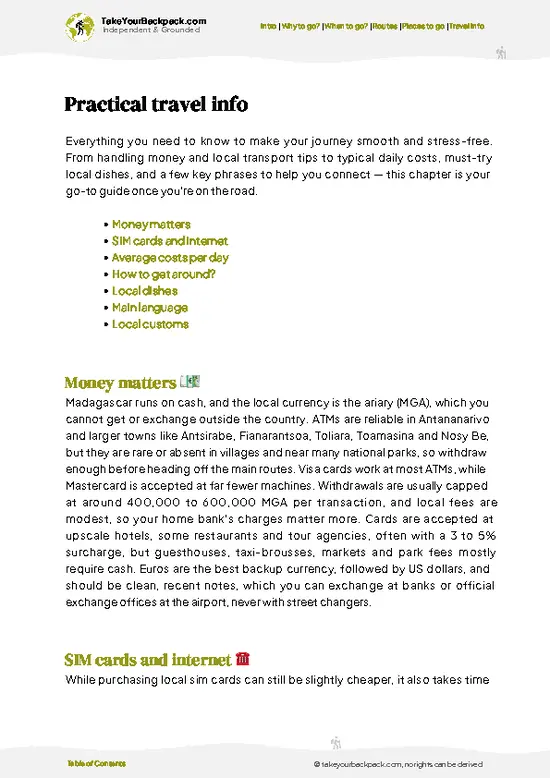
example page 0 from our offline Travel Guide for Madagascar
example page 1 from our offline Travel Guide for Madagascar
example page 2 from our offline Travel Guide for Madagascar
example page 3 from our offline Travel Guide for Madagascar
example page 4 from our offline Travel Guide for Madagascar
example page 5 from our offline Travel Guide for Madagascar
example page 6 from our offline Travel Guide for Madagascar
example page 7 from our offline Travel Guide for Madagascar
Loading the map 🌍
CLICK TO FILTER
cities
towns
landmarks
national parks
hikes
beaches
attractions
festivals
regions
SHOW COUNTRY’S BESTSHOW ALL

✨ Why go?
Ranked #14 attraction in Madagascar
What makes it a must-see attraction

Go because this is the cheapest, most reliable place to meet aye-ayes, sifakas and ruffed lemurs before you commit days of transport to the national parks. Wild lemurs hide, and here the odds are good. The park also holds the Museum of Madagascar’s natural history collection, including the bones and a giant egg of the extinct elephant bird, which explains why the island’s fauna is so strange. As a milestone, it works as a half-day primer in the capital, helping you recognize species later in the forest. Come for the education and the close, easy photography, not for polish.

💡 HighlightsMust-see experiences and standout moments

  1. Walk-through lemur enclosures: ring-tailed and brown lemurs roam near the paths, so you get close views and easy photos.
  2. Aye-aye: this rare nocturnal lemur, with its long middle finger, is kept in a dim house, so give your eyes time to adjust.
  3. Elephant bird skeletons and eggs: the museum displays remains of the giant flightless birds that vanished centuries ago.
  4. Ruffed lemurs: the loud choruses here are among the best sounds in the garden.
  5. Sifakas: the white, sideways-dancing lemurs are far easier to watch here than in the wild.
  6. Chameleons and reptile house: panther chameleons and tiny leaf-tailed geckos show off the island’s camouflage.
  7. Botanical garden: spiny forest plants, orchids and palms are labeled, a quick lesson in the island’s flora.
  8. Fossa enclosure: the cat-like predator of the forests
… read more 👉
  1. Walk-through lemur enclosures: ring-tailed and brown lemurs roam near the paths, so you get close views and easy photos.
  2. Aye-aye: this rare nocturnal lemur, with its long middle finger, is kept in a dim house, so give your eyes time to adjust.
  3. Elephant bird skeletons and eggs: the museum displays remains of the giant flightless birds that vanished centuries ago.
  4. Ruffed lemurs: the loud choruses here are among the best sounds in the garden.
  5. Sifakas: the white, sideways-dancing lemurs are far easier to watch here than in the wild.
  6. Chameleons and reptile house: panther chameleons and tiny leaf-tailed geckos show off the island’s camouflage.
  7. Botanical garden: spiny forest plants, orchids and palms are labeled, a quick lesson in the island’s flora.
  8. Fossa enclosure: the cat-like predator of the forests is a rare sight if it is out.
If time is short, skip the botanical paths and head straight for the lemurs and the aye-aye.
Spotted a mistake or missing something? Contact us.

Things to do near Tsimbazaza Zoo and Botanical Garden

Ratings based on Tripadvisor reviews. When you book through this link, you support our work at no extra cost to you.

🌤️ When to go?Choosing the right time of year

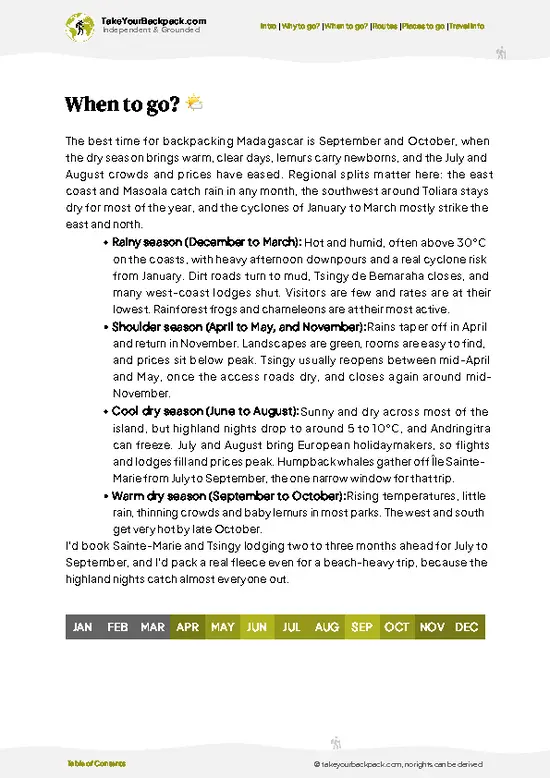
  • Cool Dry Season (May to September): Antananarivo sits at about 1,280 meters, so days run 18 to 23°C (64 to 73°F) and nights drop to 7 to 11°C (45 to 52°F). Rain is rare, and lemurs are active in the morning sun.
  • Hot Season (October to December): Highs reach 25 to 28°C (77 to 82°F), with afternoon thunderstorms building by November. Mornings stay pleasant for walking.
  • Rainy Season (January to April): Expect 20 to 27°C (68 to 81°F) and heavy downpours, with cyclone risk on the coast. Paths turn muddy, but crowds are thin.
  • Weekends and Holidays: Malagasy families fill the grounds on Sundays and school breaks. Daylight runs roughly 5:30 am to 6 pm in winter and 5 am to 7 pm in summer.
Arrive at opening on a weekday for quiet paths and active animals.

source: climatestotravel.comJANJanuary: fair for travelingFEBFebruary: fair for travelingMARMarch: fair for travelingAPRApril: fair for travelingMAYMay: excellent for travelingJUNJune: excellent for travelingJULJuly: highly recommended for travelingAUGAugust: highly recommended for travelingSEPSeptember: excellent for travelingOCTOctober: excellent for travelingNOVNovember: fair for travelingDECDecember: fair for traveling
when-to-go

✈️ The backpacker research shortcutMadagascar Travel Guide

An offline-friendly backpacking guide with optimized travel routes, ranked highlights, transport advice, and the best areas to stay.
example page 0 from our offline Travel Guide for Madagascar
example page 1 from our offline Travel Guide for Madagascar
example page 2 from our offline Travel Guide for Madagascar
example page 3 from our offline Travel Guide for Madagascar
example page 4 from our offline Travel Guide for Madagascar
example page 5 from our offline Travel Guide for Madagascar
example page 6 from our offline Travel Guide for Madagascar
example page 7 from our offline Travel Guide for Madagascar
The digital guide (301 pages) contains:
✅ 96 highlights, ranked by travel appeal
✅ Optimized 7, 14 & 21-day travel routes
✅ Cities, national parks, landmarks, beaches
✅ How to get around
✅ Offline-friendly for travel without Wi-Fi
👉 Click to see all 30+ guide features

📅 Plan smarter in minutes, not weeks
✅ Month by month travel advice
✅ Festivals & national holidays
✅ Budget expectations

🗺️ Go to the right places, skip the overrated ones
✅ Honest pros & cons of destinations
✅ Top hikes, parks & viewpoints
✅ Lesser-known places most travelers miss
✅ Clear “worth it vs skip it” guidance

🛏️ Travel smoothly without rookie mistakes
✅ Best areas to stay
✅ Transport systems explained simply
✅ Common scams & safety advice
✅ SIM cards, money & practical tips

🌍 Understand the country, not just visit it
✅ Culture & traditions
✅ 52 Essential phrases & customs
✅ Festivals worth planning around
✅ Traveler-friendly historical context
✅ Insights that make places more meaningful

📱 Built for real travel conditions
✅ Fully downloadable PDF
✅ Works completely offline
✅ Optimized for phone use
✅ Useful in remote areas & buses
✅ Everything in one place
Stop searching, start planning
Get instant access to your full guide. 30‑day money-back guarantee.
+ Add another guide for just

By proceeding you agree to our terms.
Sent to your inbox immediately after payment • 100% Secure Checkout
Best Backpacking Travel Advisor 2025 tourism awardBest Backpacking
Travel Advisor
2025
What others say about Take Your Backpack Guides:
⭐⭐⭐⭐⭐
Fantastic, amazing amount of information!
⭐⭐⭐⭐⭐
My goodness this is amazing, it's what I've been looking for hats off too you!
⭐⭐⭐⭐⭐
I think this is absolutely BRILLIANT
⭐⭐⭐⭐
Very complete and informative. It's still missing places, but I gotta to commend you
⭐⭐⭐⭐⭐
This is truly amazing, thank you, can't wait to explore it with my kids!
⭐⭐⭐⭐⭐
Awesome resource, thank you!
⭐⭐⭐⭐⭐
This is amazing! Can't wait to explore the ones I haven't seen
⭐⭐⭐⭐
I love this! Well done, great idea.
⭐⭐⭐⭐⭐
Thanks for taking the time to make this gem!
⭐⭐⭐⭐⭐
This might be the best website I've ever seen.
⭐⭐⭐⭐⭐
Congratulations, and thank you so much for your work; it's incredibly valuable.
⭐⭐⭐⭐
In all seriousness I think you did a great job pointing out the important spots
⭐⭐⭐⭐⭐
10/10 very good
⭐⭐⭐⭐⭐
As someone who's only just starting to visit regularly this is awesome, thank you.
⭐⭐⭐⭐
Thank you very much! I'm going to visit my dad, it's going to be very useful!
⭐⭐⭐⭐⭐
This is really cool! We'll be travelling for the first time and this definitely come in handy.
⭐⭐⭐⭐⭐
You are now our minister of culture, congratulations 👨‍💼
⭐⭐⭐⭐⭐
Just wanted to tell you that this is a pearl! Going to follow your recommendations.
⭐⭐⭐⭐⭐
This is so cool. I'll definitely be using the resource for my travels soon.
⭐⭐⭐⭐⭐
This is very impressive! Good work.
⭐⭐⭐⭐⭐
This is an amazing and informative site. Very well done!

🛏️ Where to stay?Best areas and accommodation options

Analakely and the Haute-Ville around Avenue de l’Indépendance are the best bases, with the greatest concentration of budget guesthouses and traveler-oriented dorms in the capital. Staying here puts you within a 10 to 20 minute taxi ride of the zoo, and local minibuses pass nearby. Isoraka is the calmer, more polished choice, with small guesthouses, cafés, and restaurants where solo travelers easily meet others over dinner. It is walkable by day, though a taxi is wiser after dark anywhere in Antananarivo. Ampefiloha sits closest to the gardens, within a short walk, and has a few simple guesthouses … read more 👉
Analakely and the Haute-Ville around Avenue de l’Indépendance are the best bases, with the greatest concentration of budget guesthouses and traveler-oriented dorms in the capital. Staying here puts you within a 10 to 20 minute taxi ride of the zoo, and local minibuses pass nearby. Isoraka is the calmer, more polished choice, with small guesthouses, cafés, and restaurants where solo travelers easily meet others over dinner. It is walkable by day, though a taxi is wiser after dark anywhere in Antananarivo. Ampefiloha sits closest to the gardens, within a short walk, and has a few simple guesthouses plus the Ampefiloha market for cheap food, but it is less social. Choose Isoraka for atmosphere and Analakely for the lowest prices and easiest transport links. Arrange a taxi back at night.

👛 Costs (as of 15 October 2026)What things cost and how to budget

A visit to Tsimbazaza Zoo and Botanical Garden fits into a daily budget of roughly US$20 to 40 in Antananarivo, with the entrance fee being a small slice of that.
CategoryBudget RangeLocal Reality
Entrance TicketUS$2 to 4Foreigners pay a higher rate than Malagasy visitors; paid in ariary at the gate.
Guide (optional)US$3 to 6Staff guides name species and explain the lemurs, and a tip is expected.
Accommodation (high season)US$10 to 18Dorm beds or simple private rooms in Analakely or Isoraka.
FoodUS$4 to 8Street food and hotely meals cost little; café lunches run higher.
Local TransportUS$1 to 4City minibuses cost pennies; short taxi rides run US$2 to 4 after negotiating.
Total Daily BudgetUS$20 to 40Per person, per day, in high season.
⚠️ Prices can change and everyone travels differently, so take this as a rough guide. Hope it helps you plan your adventure!

FAQCommon questions from travelers

Plan on 2 to 3 hours for Tsimbazza Zoo and Botanical Garden, or a half day if you linger over the lemurs and the subfossil museum. The grounds are compact, with a lake, aviary, and shaded paths. Arriving at opening around 9 am gives you the most active animals before the midday heat.
For most backpackers, yes, since entry costs only about US$2 to 4 and it is the easiest place in the capital to see ring-tailed lemurs, sifakas, and aye-ayes without paying for a national park trip. The museum holds skeletons of extinct elephant birds and giant lemurs. Enclosures are basic, so it suits a short, cheap introduction to Madagascar’s wildlife rather than a substitute for the wild parks.
Take a taxi from central Antananarivo, which takes about 10 to 20 minutes and costs roughly US$2 to 4 after bargaining. City minibuses toward Ampefiloha also stop near the gate for a few hundred ariary. From Analakely you can walk in around 30 to 40 minutes, though traffic and uneven pavements make a taxi easier.
⚠️ Things can change over time, so always validate details locally before you go.

Other Malagasy attractions near Tsimbazaza Zoo and Botanical Garden

Explore more nearby:


💡 Not sure where to go next?
Create a personalized itinerary for Madagascar including Tsimbazaza Zoo and Botanical Garden and the places that fit your trip.

Generate my itinerary

👉 Discover all attractions

Or checkout all Madagascar has to offer (think cities, towns, villages, national parks, hikes, beaches, festivals)
Country photo of Madagascar

We 💚 feedbackIs it worth it?

The usual mistake is treating it as a quick photo stop and rushing the museum. Give it a full morning, arrive at opening when the lemurs are most active, and hire a guide at the gate for the aye-aye house, where you would otherwise miss most of what you are seeing.

✈️ When did I visit Madagascar?
Madagascar I went backpacking in October 2019. With a friend I rented a 4WD and drove around the southern part of Madagascar.

✍️ Help improve this page!
The information on this page is based on my own backpacking experience in Madagascar, supplemented with up-to-date research and feedback from other travelers. Travel details can change, so if you notice anything outdated or incomplete, feel free to let me know.


🙋‍♂️ Give feedback

👋 Meet the founderWho’s Behind Take Your Backpack?

Johan, backpacker and founder of TakeYourBackpackHi, I’m Johan (Netherlands 🇳🇱), the creator of TakeYourBackpack. Over the past 3 decades, I’ve backpacked through 90+ countries across six continents, gaining extensive experience with independent travel, long-term trips, and overland routes.

This site is built on a combination of firsthand travel experience and carefully curated insights from other backpackers. Many guides are based on places I’ve personally visited, while others bring together tips, observations, and practical advice shared by trusted travelers I’ve met along the way.

The goal is to provide realistic, experience-driven guidance — not generic itineraries — so you can explore destinations with better context, clearer expectations, and more confidence.