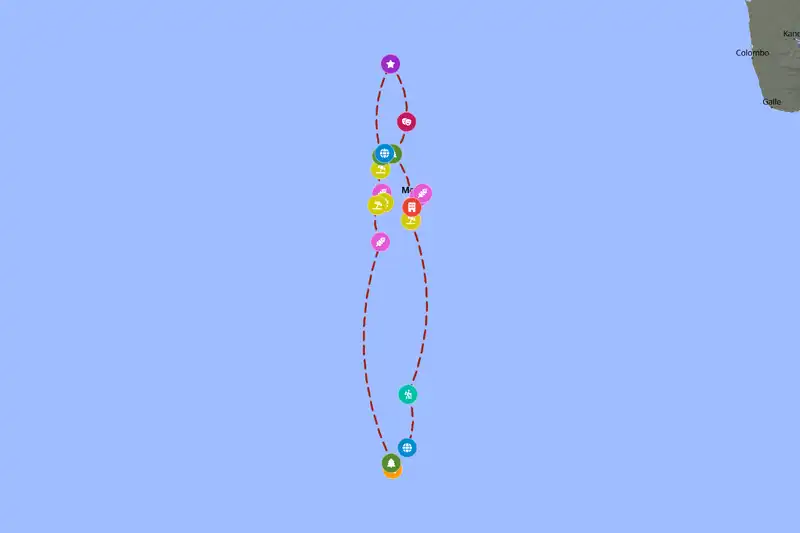
Short version: yes, but it’s not “Southeast Asia easy.” Maldives is backpackable if you play by its rules: ferries, local islands, and realistic expectations about costs. You won’t be hitchhiking between towns or wandering freely across one big landmass; you’re hopping between tiny islands spread over a huge area.
Independent travel works best if you base yourself on
local islands (not private resort islands). These are inhabited by Maldivians, have guesthouses instead of overwater villas, and cost a fraction of resort prices. Think simple rooms, family-run cafés, and public ferries instead of golf carts and champagne.
The main learning curve is logistics. Public ferries don’t run to every island, they’re slow, and many don’t operate on Fridays. You need to plan your route in advance and avoid tight connections with your international flight. Once you accept that you’ll move slowly and pick just a few islands, independent travel becomes straightforward.
Culturally, it’s also easy if you respect local norms: dress modestly on local islands (shoulders and knees covered away from designated bikini beaches), no alcohol except on resort or special “alcohol boats,” and be mindful during prayer times. If you can handle that, you’ll find locals relaxed, helpful, and used to independent travelers by now.
If you’re expecting a spontaneous, party-heavy backpacker circuit with hostels on every corner, Maldives will frustrate you. If you’re happy with a slower, more structured trip focused on beaches, snorkeling, and quiet evenings, it’s absolutely doable on your own.
For a budget traveler, the sweet spot is
7–10 days. That gives you time to reach a couple of islands without burning half your trip on ferries and transfers.
Here’s how different time frames feel in real life:
3–4 days: Only makes sense if you’re already in the region (e.g., Sri Lanka or India) and want a quick taste. Base on one island close to Malé (like Maafushi or Hulhumalé) and don’t try to island-hop. You’ll mostly just decompress on the beach and maybe do one snorkel trip.
5–7 days: Good minimum if you’re flying in from farther away. You can do 1–2 islands in the same atoll using public ferries or a mix of ferry + speedboat. Example: 3–4 nights on a budget-friendly island with tours, then 2–3 nights somewhere quieter. This is enough for a couple of snorkel trips, a sandbank visit, and a day of doing nothing.
8–10 days: Ideal for backpackers. You can visit 2–3 islands without rushing, build in a buffer day for ferry cancellations, and maybe splurge on a
single resort day pass or one night at a cheaper resort if that’s important to you. This length lets you feel the rhythm of local life instead of just ticking off activities.
2+ weeks: Worth it if you’re combining Maldives with another country or if you’re a slow-travel person who’s happy reading, swimming, and snorkeling most days. You can explore two different atolls, but costs add up quickly once you start using speedboats or domestic flights.
If you’re on a tight budget, it’s usually better to stay a bit shorter and do Maldives well (with a couple of great excursions) than to stretch it long and cut every activity.
Yes, you can absolutely get around Maldives without a car; in fact, you basically have to. Outside of Malé and Hulhumalé, there’s almost nowhere to drive. Your real transport puzzle is
boats and planes, not cars.
On each island, you’ll walk everywhere. Most local islands are tiny; you can cross them in 10–20 minutes on foot. Some have bicycles for rent, but you don’t need them unless you just enjoy riding.
Between islands, budget travelers rely on:
1. Public ferries:
- Cheapest option by far, often just a few dollars per ride.
- Slow but scenic; expect 1–4 hours depending on distance.
- Limited schedules and usually no service on Fridays.
- Great for moving between islands in the same atoll or between Malé and nearby local islands.
2. Shared speedboats:
- More expensive than ferries but much cheaper than private speedboats or seaplanes.
- Run fixed routes between Malé and popular local islands.
- Good compromise if your flight times don’t match the public ferry schedule.
3. Domestic flights:
- Only worth it if you’re heading to far-flung atolls and have a bit more budget.
- For strict backpacker budgets, it’s usually smarter to pick islands reachable by ferry or shared speedboat instead.
You’ll only encounter cars in Malé/Hulhumalé, and even there you don’t need one. You’ll walk, use cheap taxis for short hops, or get picked up by your guesthouse. For a budget trip, plan your route around ferry and shared speedboat connections, and you’ll never miss having a car.
For backpackers, “must-visit” in Maldives means places that balance cost, access, and good snorkeling or diving. You don’t need to chase the fanciest resort; you want islands where you can actually
do things without torching your budget.
1. A local island in South Malé Atoll (e.g., Maafushi)- Easy and cheap to reach from Malé by public ferry or shared speedboat.
- Lots of budget guesthouses, tour operators, and day trips (snorkeling with reef sharks, sandbanks, shipwrecks).
- Good starter island if it’s your first time in Maldives and you want things to be simple and social.
2. A quieter local island in a nearby atoll (e.g., Thoddoo or Rasdhoo in Alif Alif Atoll)- Thoddoo: known for wide beaches and agriculture (you’ll see papaya and watermelon fields), with a laid-back vibe and decent house reef snorkeling.
- Rasdhoo: strong for diving and snorkeling, with manta and shark trips in season.
- Both reachable by ferry or shared speedboat from Malé, and both feel more relaxed than the busier islands.
3. At least one island with a good house reef- This is where Maldives really shines for budget travelers: you can snorkel straight from the beach instead of paying for boat trips every day.
- Look for local islands known for drop-off reefs close to shore; this saves you money and gives you something to do daily without extra cost.
4. A day trip to a sandbank or uninhabited island- Almost every local island with tourism offers this.
- It’s usually one of the best-value experiences: you get that postcard Maldives feeling (white sand, clear water) without paying resort prices.
5. Optional: a single resort day pass or one-night splurge- Not mandatory, but if you’ve always dreamed of the overwater-villa vibe, consider a day pass from a local island to a nearby resort.
- This lets you enjoy the fancy side of Maldives once, then retreat to your budget base.
If you hit one busy, well-connected local island, one quieter island with a strong reef, and squeeze in a sandbank trip, you’ve done Maldives right on a backpacker budget.
You can skip anything that burns money or time without adding much to your experience. For budget travelers, that usually means:
1. Multiple far-flung atolls in one short trip- Hopping between distant atolls requires domestic flights or long, expensive speedboats.
- Instead of 3–4 atolls, pick
one region and explore 1–3 islands there. You’ll save money and avoid spending half your trip in transit.
2. Ultra-luxury private resorts for more than a day- If you’re counting dollars, a full multi-night stay at a high-end resort will nuke your budget.
- If you’re curious, do a single night or a day pass from a local island and skip the rest. The water and sand are just as blue on local islands.
3. Overloading on paid excursions- You don’t need a different boat trip every day. Many tours repeat the same reefs and sandbanks with slightly different names.
- Prioritize 1–2 high-quality snorkel or dive trips and one sandbank/uninhabited island visit. The rest of the time, use the house reef and free beaches.
4. Long time in Malé city- Malé is interesting for a quick wander (market, mosque exteriors, harbor), but it’s crowded and not where Maldives shines.
- If you’re short on time, treat Malé as a transit point: one afternoon or evening is enough before heading to your island.
5. Chasing “party islands”- Maldives isn’t a classic backpacker party destination, and alcohol is restricted on local islands.
- If you’re short on time, don’t waste days hunting for nightlife that doesn’t really exist in the way it does in Thailand or Bali. Focus on islands with good reefs and relaxed cafés instead.
6. Packing too many islands into a week- Constantly moving for “one more island” just means more ferry waits, more check-ins, and less time in the water.
- For a 7-day trip, 2 islands is plenty; for 10 days, 2–3. Anything more is usually not worth the stress or cost.