×

Mali🇲🇱 | attractionsBamako Grand Mosqueminaret skyline, city landmark, prayer gatherings | things to do and best time to go

Explore National Museum of MaliExplore Musée de la Femme Muso Kunda

Backpacking in Bamako Grand Mosque
🌟 Highlightattraction ranked #6
By Johan Kruseman 🇳🇱 | Updated September 3, 2026

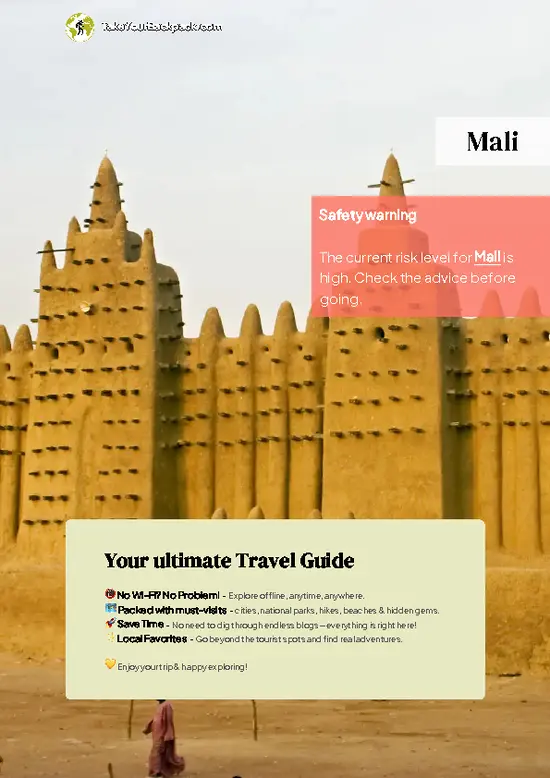
Your shoes slap the sun-baked tiles, and the call to prayer ricochets off the minaret, vibrating in your chest. Incense and exhaust tangle in the air. You’re not alone—old men in crisp boubous, kids darting between pillars, a swirl of daily life that doesn’t pause for tourists. This is the Bamako Grand Mosque, planted right in the heart of Mali’s capital, where Avenue de l’Indépendance splits the city’s chaos like a river.

Let’s cut through the Instagram haze: the mosque is not a postcard-perfect marvel, and you’ll never have it to yourself. It’s busy, loud, and unapologetically real. Backpackers come for the scale—those towering minarets—and the electric pulse of Bamako itself, not for serenity or ornate mosaics. Entry is cheap, but non-Muslims can’t always go inside, so expect to experience it from the outside, shoulder-to-shoulder with locals. Compared to Mali’s mud mosques or Dogon Country’s cliff villages, this is urban, raw, and alive—a jolt of West African city energy, not a quiet retreat.

Discover everything you want to know in the 📖 Mali Travel Guide.
Safety warning

The current risk level for Mali is high. Check the advice before going.


Get your Mali guide
72 ranked highlights, routes & tips, works offline (299 pages)
Loading the map 🌍
CLICK TO FILTER
cities
towns
landmarks
national parks
hikes
attractions
festivals
regions
SHOW COUNTRY’S BESTSHOW ALL

✨ Why go?
Ranked #6 attraction in Mali
Why visitors keep coming back

The Bamako Grand Mosque isn’t some postcard-perfect, crowd-pleasing spectacle where you snap a quick selfie and move on. It’s a heavyweight in Mali’s cultural and spiritual landscape, and backpackers who make the trek here know it’s more than just a photo op. Yes, it draws crowds—locals and tourists alike—but that’s part of its pulse. This mosque is a living, breathing hub of Malian life, not a sanitized tourist trap. Its iconic status comes from being one of the few major Islamic architectural landmarks in the region, a symbol of Bamako’s identity and Mali’s deep-rooted Islamic heritage.

What really hooks backpackers is the raw authenticity. The mosque’s mud-brick construction and intricate design speak volumes about the Sahel’s architectural ingenuity, a style that’s both ancient and surprisingly … read more 👉
The Bamako Grand Mosque isn’t some postcard-perfect, crowd-pleasing spectacle where you snap a quick selfie and move on. It’s a heavyweight in Mali’s cultural and spiritual landscape, and backpackers who make the trek here know it’s more than just a photo op. Yes, it draws crowds—locals and tourists alike—but that’s part of its pulse. This mosque is a living, breathing hub of Malian life, not a sanitized tourist trap. Its iconic status comes from being one of the few major Islamic architectural landmarks in the region, a symbol of Bamako’s identity and Mali’s deep-rooted Islamic heritage.

What really hooks backpackers is the raw authenticity. The mosque’s mud-brick construction and intricate design speak volumes about the Sahel’s architectural ingenuity, a style that’s both ancient and surprisingly resilient. Visiting here is a milestone on the Mali route because it’s a gateway to understanding the country’s complex history—colonial layers, religious traditions, and the everyday hustle of Bamako’s residents. The effort to get here, sometimes through chaotic traffic and language barriers, pays off with an adrenaline rush of cultural immersion that no polished guidebook can replicate. This isn’t just a stop; it’s a moment that grounds your journey in real, unfiltered Mali.
Want to include Bamako Grand Mosque in your Mali route?
Create a personalized Mali itinerary that includes Bamako Grand Mosque and the places that fit your trip — based on your travel style, budget, and available time. Get your route in seconds.

Generate my trip

💡 HighlightsPlaces and moments you shouldn't skip

The Minaret’s Commanding Presence
Let’s get real: the Bamako Grand Mosque isn’t the oldest, the biggest, or the most ornate mosque in West Africa. But its minaret is a local icon, a concrete-and-tile exclamation mark that slices above the city’s low-rise sprawl. You don’t need to be an architecture buff to feel the punch of its geometric lines and green-tiled crown. It’s not subtle, and that’s the point. This is the spiritual and visual anchor of downtown Bamako—if you’re lost, look for the minaret. It’s the city’s compass, and for many, a daily reminder of faith and community.


Friday Prayers: The City’s Heartbeat
Forget the Instagram fantasy of quiet contemplation. On Fridays, the mosque’s plaza and surrounding streets become a living, breathing organism. Thousands pour in, shoes off, prayer … read more 👉
The Minaret’s Commanding Presence
Let’s get real: the Bamako Grand Mosque isn’t the oldest, the biggest, or the most ornate mosque in West Africa. But its minaret is a local icon, a concrete-and-tile exclamation mark that slices above the city’s low-rise sprawl. You don’t need to be an architecture buff to feel the punch of its geometric lines and green-tiled crown. It’s not subtle, and that’s the point. This is the spiritual and visual anchor of downtown Bamako—if you’re lost, look for the minaret. It’s the city’s compass, and for many, a daily reminder of faith and community.


Friday Prayers: The City’s Heartbeat
Forget the Instagram fantasy of quiet contemplation. On Fridays, the mosque’s plaza and surrounding streets become a living, breathing organism. Thousands pour in, shoes off, prayer mats in hand, the air thick with anticipation and the scent of street food. The call to prayer rolls out like a wave, and for a moment, the city’s chaos syncs into something bigger. You don’t have to be Muslim to feel the energy—just stand back, observe, and let the collective focus wash over you. It’s raw, it’s real, and it’s the best people-watching in Bamako.


The Social Crossroads Outside the Gates
Here’s the secret: the real action isn’t always inside. The mosque’s steps and the adjacent market are where Bamako’s social engine revs up. Imams, hustlers, families, and street vendors all collide in a swirl of conversation, commerce, and gossip. You’ll see everything from heated debates about politics to impromptu tea ceremonies. This is where you get the pulse of the city—unfiltered, unscripted, and sometimes a little chaotic. If you want to understand Bamako, spend an hour just watching the ebb and flow here.


Ramadan Nights: Spiritual Electricity
If you’re lucky enough to visit during Ramadan, the mosque transforms after sunset. The fast breaks, and suddenly the area is alive with laughter, food stalls, and a sense of shared relief. The prayers are longer, the crowds denser, and the atmosphere electric. It’s not a tourist show—this is for the locals, by the locals. But respectful visitors are welcome to witness the spectacle. The sense of unity is palpable, and the hospitality is genuine. It’s a reminder that faith here is lived, not just displayed.


Street Food and Sights: Bamako on a Plate
Don’t skip the food stalls that orbit the mosque. This isn’t curated for tourists; it’s Bamako’s daily menu. Grilled brochettes, spicy rice, sweet fried dough—grab what looks good and eat with your hands. The flavors are bold, the prices are honest, and the experience is as authentic as it gets. You’ll eat elbow-to-elbow with locals, and maybe pick up a few words of Bambara along the way. This is the taste of Bamako, and it’s worth every sticky-fingered bite.
Spotted a mistake or missing something? Contact us.

Things to do near Bamako Grand Mosque

Ratings based on Tripadvisor reviews. When you book through this link, you support our work at no extra cost to you.

🌤️ When to go?Choosing the right time of year


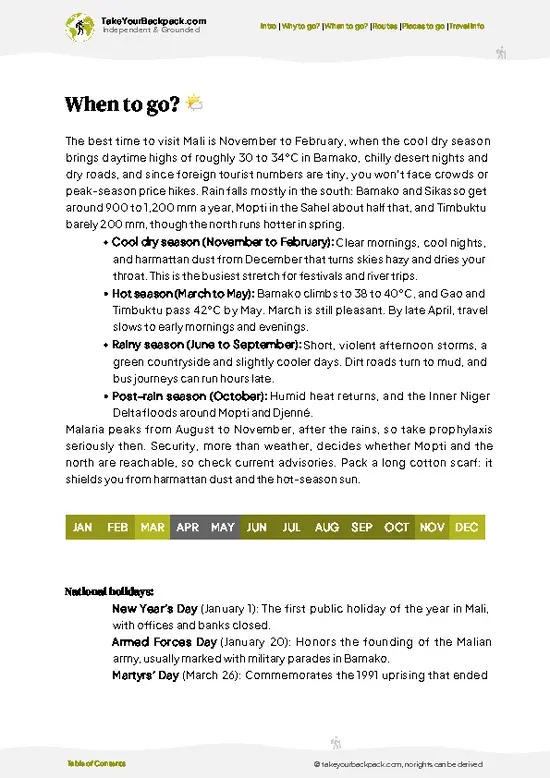
  • Weather: Bamako’s climate swings between scorching dry and sticky wet. The best window is November to February when the harmattan wind cools things down, dropping temps to a bearable 20-25°C (68-77°F). Avoid April to June; it’s a furnace hitting 38-42°C (100-108°F), brutal for wandering.

  • Temperature: Nights can get surprisingly cool during harmattan, sometimes dipping to 15°C (59°F), so pack a light jacket. Daylight highs in the cooler months hover around 28°C (82°F), perfect for exploring without melting.

  • Daylight Hours: Bamako enjoys roughly 11-12 hours of daylight year-round, but the sun rises earlier and sets earlier in December and January, giving you a solid morning start before the midday heat kicks in.

  • Crowds: The Grand Mosque isn’t a tourist magnet like other world landmarks, but
read more 👉

  • Weather: Bamako’s climate swings between scorching dry and sticky wet. The best window is November to February when the harmattan wind cools things down, dropping temps to a bearable 20-25°C (68-77°F). Avoid April to June; it’s a furnace hitting 38-42°C (100-108°F), brutal for wandering.

  • Temperature: Nights can get surprisingly cool during harmattan, sometimes dipping to 15°C (59°F), so pack a light jacket. Daylight highs in the cooler months hover around 28°C (82°F), perfect for exploring without melting.

  • Daylight Hours: Bamako enjoys roughly 11-12 hours of daylight year-round, but the sun rises earlier and sets earlier in December and January, giving you a solid morning start before the midday heat kicks in.

  • Crowds: The Grand Mosque isn’t a tourist magnet like other world landmarks, but local worshippers swell during Fridays and Islamic holidays. Visiting midweek in the cooler months means fewer people and a more contemplative vibe.

  • Seasonal Activities: The cooler dry season hosts cultural events and markets buzzing with local crafts. The rainy season (July to September) floods the city with greenery but can disrupt travel and limit access to the mosque’s surroundings.

  • Price Fluctuations: Mali’s tourism is low-key; prices for guides and accommodations stay steady year-round. However, expect slight hikes during December holidays when regional visitors arrive.


Pro-tip: Aim for early mornings in December or January—cool air, calm crowds, and the mosque’s intricate shadows come alive in the soft light, making the visit genuinely memorable.


source: climatestotravel.comJANJanuary: excellent for travelingFEBFebruary: excellent for travelingMARMarch: highly recommended for travelingAPRApril: fair for travelingMAYMay: fair for travelingJUNJune: fair for travelingJULJuly: good for travelingAUGAugust: good for travelingSEPSeptember: good for travelingOCTOctober: highly recommended for travelingNOVNovember: excellent for travelingDECDecember: excellent for traveling
when-to-go

✈️ The backpacker research shortcutMali Travel Guide

An offline-friendly backpacking guide with optimized travel routes, ranked highlights, transport advice, and the best areas to stay.
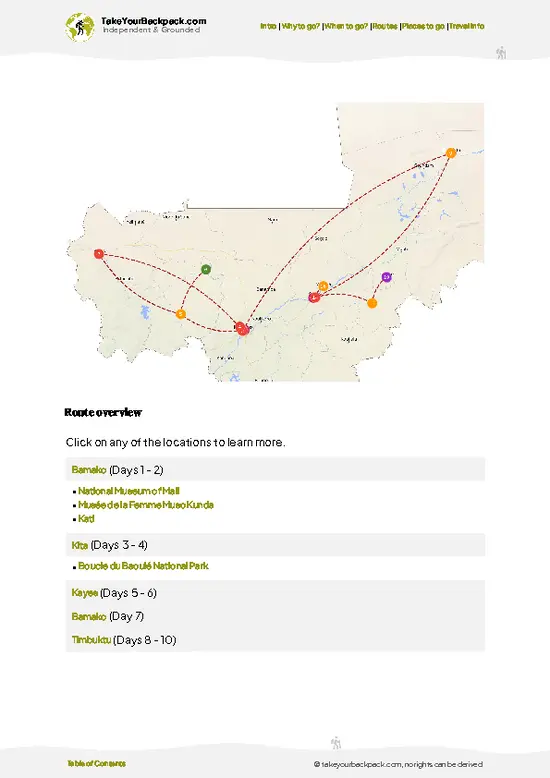
example page 0 from our offline Travel Guide for Mali
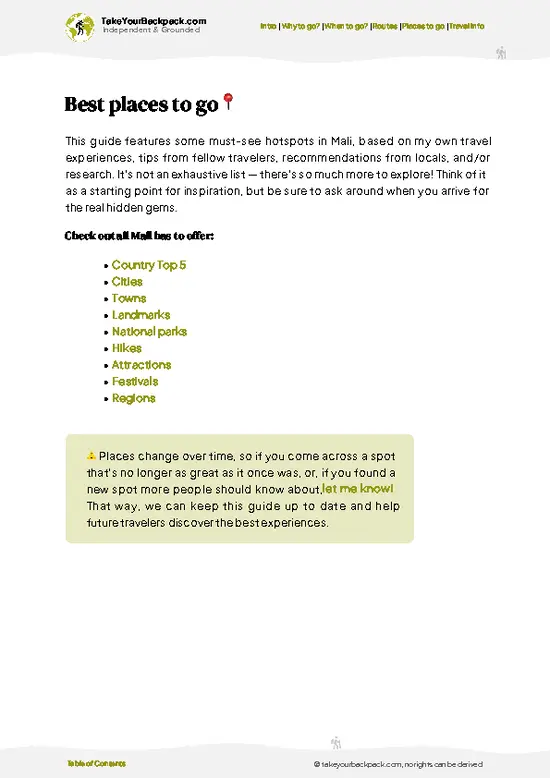
example page 1 from our offline Travel Guide for Mali
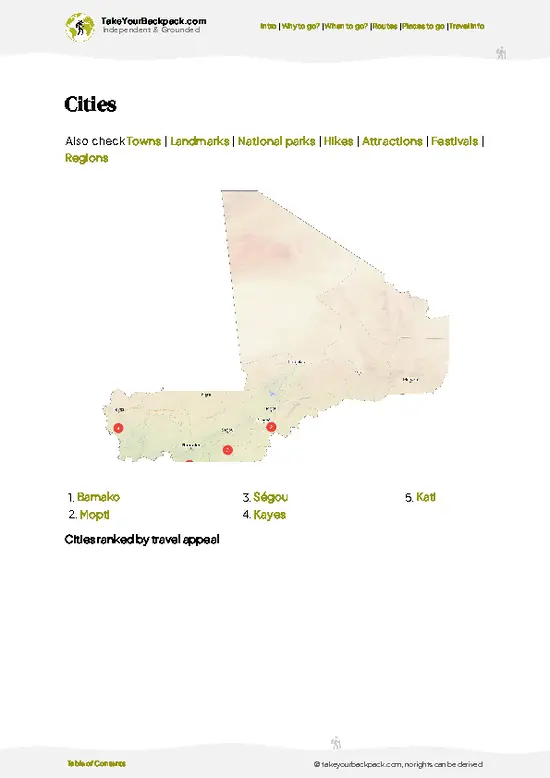
example page 2 from our offline Travel Guide for Mali
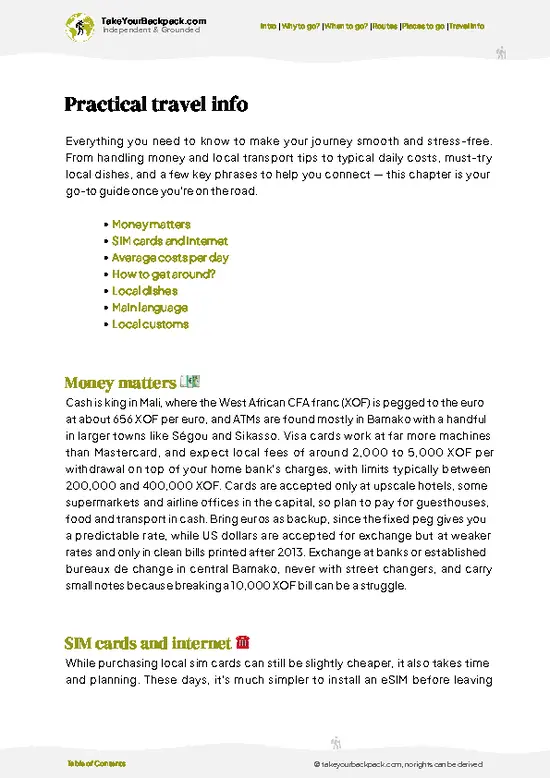
example page 3 from our offline Travel Guide for Mali
example page 4 from our offline Travel Guide for Mali
example page 5 from our offline Travel Guide for Mali
example page 6 from our offline Travel Guide for Mali
example page 7 from our offline Travel Guide for Mali
The digital guide (299 pages) contains:
72 highlights, ranked by travel appeal
Optimized 5, 10 & 15-day travel routes
Cities, national parks, landmarks, beaches
How to get around
Offline-friendly for travel without Wi-Fi
👉 Click to see all 30+ guide features

📅 Plan smarter in minutes, not weeks
Month by month travel advice
Festivals & national holidays
Budget expectations

🗺️ Go to the right places, skip the overrated ones
Honest pros & cons of destinations
Top hikes, parks & viewpoints
Lesser-known places most travelers miss
Clear “worth it vs skip it” guidance

🛏️ Travel smoothly without rookie mistakes
Best areas to stay
Transport systems explained simply
Common scams & safety advice
SIM cards, money & practical tips

🌍 Understand the country, not just visit it
Culture & traditions
52 Essential phrases & customs
Festivals worth planning around
Traveler-friendly historical context
Insights that make places more meaningful

📱 Built for real travel conditions
Fully downloadable PDF
Works completely offline
Optimized for phone use
Useful in remote areas & buses
Everything in one place
Save weeks of stressful planning
Get instant access to your full guide. 30‑day money-back guarantee.
+ Add another guide for just US$7.80

By proceeding you agree to our terms.
Sent to your inbox immediately after payment • 100% Secure Checkout
Best Backpacking Travel Advisor 2025 tourism awardBest Backpacking
Travel Advisor
2025
What others say about Take Your Backpack Guides:
⭐⭐⭐⭐⭐
Fantastic, amazing amount of information!
⭐⭐⭐⭐⭐
My goodness this is amazing, it's what I've been looking for hats off too you!
⭐⭐⭐⭐⭐
I think this is absolutely BRILLIANT
⭐⭐⭐⭐
Very complete and informative. It's still missing places, but I gotta to commend you
⭐⭐⭐⭐⭐
This is truly amazing, thank you, can't wait to explore it with my kids!
⭐⭐⭐⭐⭐
Awesome resource, thank you!
⭐⭐⭐⭐⭐
This is amazing! Can't wait to explore the ones I haven't seen
⭐⭐⭐⭐
I love this! Well done, great idea.
⭐⭐⭐⭐⭐
Thanks for taking the time to make this gem!
⭐⭐⭐⭐⭐
This might be the best website I've ever seen.
⭐⭐⭐⭐⭐
Congratulations, and thank you so much for your work; it's incredibly valuable.
⭐⭐⭐⭐
In all seriousness I think you did a great job pointing out the important spots
⭐⭐⭐⭐⭐
10/10 very good
⭐⭐⭐⭐⭐
As someone who's only just starting to visit regularly this is awesome, thank you.
⭐⭐⭐⭐
Thank you very much! I'm going to visit my dad, it's going to be very useful!
⭐⭐⭐⭐⭐
This is really cool! We'll be travelling for the first time and this definitely come in handy.
⭐⭐⭐⭐⭐
You are now our minister of culture, congratulations 👨‍💼
⭐⭐⭐⭐⭐
Just wanted to tell you that this is a pearl! Going to follow your recommendations.
⭐⭐⭐⭐⭐
This is so cool. I'll definitely be using the resource for my travels soon.
⭐⭐⭐⭐⭐
This is very impressive! Good work.
⭐⭐⭐⭐⭐
This is an amazing and informative site. Very well done!

🛏️ Where to stay?Best areas to stay in Mali

Bamako Grand Mosque is the city’s landmark, but let’s cut through the Instagram gloss: the area around it is busy, noisy, and not exactly a backpacker’s paradise at first glance. Crowds swarm the streets, vendors shout over each other, and the air carries the mix of city grit and dust. It’s not polished or touristy in the way you might expect from a famous mosque. Safety-wise, it’s generally okay during the day, but like any bustling urban center in West Africa, you need to keep your wits about you—pickpockets and scams are real. Nighttime? Best to avoid wandering solo.

That said, the real magic … read more 👉
Bamako Grand Mosque is the city’s landmark, but let’s cut through the Instagram gloss: the area around it is busy, noisy, and not exactly a backpacker’s paradise at first glance. Crowds swarm the streets, vendors shout over each other, and the air carries the mix of city grit and dust. It’s not polished or touristy in the way you might expect from a famous mosque. Safety-wise, it’s generally okay during the day, but like any bustling urban center in West Africa, you need to keep your wits about you—pickpockets and scams are real. Nighttime? Best to avoid wandering solo.

That said, the real magic isn’t in the mosque’s immediate vicinity but in the neighborhoods just a short walk or moto ride away. The Commune III district, for example, is where you’ll find a cluster of budget guesthouses and social hubs popular with solo travelers. It’s lively without being overwhelming, and you get a genuine slice of Bamako life—street food stalls, local markets, and cafés where you can swap stories with other backpackers or Malians. The vibe here is raw and authentic, not sanitized for tourists.

Staying here means you’re close enough to the mosque to visit early morning or late afternoon when the light hits just right, but you’re also plugged into the city’s pulse. It’s a trade-off: you sacrifice polished comfort for real connection. For backpackers who want to feel Bamako’s heartbeat, this is where you want to be.

👛 Costs (as of 3 September 2026)Typical daily expenses

As of the most recent estimates, visiting the Bamako Grand Mosque is free of charge, though a modest donation of €0 to €5 is appreciated to support maintenance.

source: evendo.com
⚠️ Prices can change and everyone travels differently, so take this as a rough guide. Hope it helps you plan your adventure!

FAQTraveler FAQ

30 to 45 minutes is sufficient to visit Bamako Grand Mosque. This allows time to appreciate its Sudano-Sahelian architectural style and take photos. Guided tours are rare, so plan accordingly.
Yes, Bamako Grand Mosque is worth the entrance fee, which is typically around 500 CFA francs (less than 1 USD). It offers a unique cultural and religious insight into Mali's Islamic heritage. The mosque is one of the city's key landmarks.
You can get to Bamako Grand Mosque by taxi or local minibus from central Bamako. It is located in the city center, near the Niger River, making it easily accessible. Walking is also possible if you are staying nearby.
⚠️ Things can change over time, so always validate details locally before you go.

Other Malian attractions near Bamako Grand Mosque

Explore more nearby:


💡 Not sure where to go next?
Create a personalized itinerary for Mali including Bamako Grand Mosque and the places that fit your trip.

Generate my itinerary

👉 Discover all attractions

Or checkout all Mali has to offer (think cities, towns, villages, national parks, hikes, beaches, festivals)
Country photo of Mali

We 💚 feedbackParting advice and final tips

The Bamako Grand Mosque isn’t some polished postcard spot. It’s loud, bustling, and unapologetically real—expect crowds, honking cars, and the occasional stray goat. But that’s exactly where its charm lies. The real magic happens when you pause and watch the call to prayer ripple through the city’s chaos, or catch the intricate mudbrick details up close. It’s not about Instagram perfection; it’s about feeling the pulse of Bamako’s heart. Just don’t expect silence or luxury—this is raw, living culture at its most honest.

✍️ Help improve this page!
The information on this page is based on in-depth research, insights shared by experienced travelers, and feedback from the local travel community in Mali. While every effort is made to keep the information accurate and current, conditions can change — so if you spot anything incorrect or outdated, please get in touch.


🙋‍♂️ Give feedback

👋 Meet the founderWho’s Behind Take Your Backpack?

Johan, backpacker and founder of TakeYourBackpackHi, I’m Johan (Netherlands 🇳🇱), the creator of TakeYourBackpack. Over the past decade, I’ve backpacked through 80+ countries across six continents, gaining extensive experience with independent travel, long-term trips, and overland routes.

This site is built on a combination of firsthand travel experience and carefully curated insights from other backpackers. Many guides are based on places I’ve personally visited, while others bring together tips, observations, and practical advice shared by trusted travelers I’ve met along the way.

The goal is to provide realistic, experience-driven guidance — not generic itineraries — so you can explore destinations with better context, clearer expectations, and more confidence.

Get full Mali guide •
Instant download • 72 highlights • Full Offline guide