×

Mali🇲🇱 | attractionsSankoré MosqueMud-brick university, pyramidal minaret, family manuscript libraries, re-plastering | things to do and best time to go

Explore Ahmed Baba InstituteExplore Sidi Yahia Mosque

Backpacking in Sankoré Mosque
🏆 Top pickattraction ranked #3
By Johan Kruseman 🇳🇱 | Updated October 22, 2026

Sankoré is the mosque-university where Timbuktu’s scholars made the city a name known across the Islamic world, and its earthen walls still hold that weight. What travelers overlook is that the building is only the doorway. The real story sits in the family libraries nearby, where handwritten manuscripts on astronomy, law and medicine are kept in private hands. The mosque lies in the north of Mali, in the old quarter of Timbuktu, close to the edge of the Sahara. Go for the exterior, the courtyard and the story. Don’t expect soaring interiors or polished displays, because there are none, and the visit itself is short. Crowds are rare, often nonexistent. Reaching Timbuktu is the hard part: access is limited and depends on security conditions, so the effort is large for a modest building. It is worth it only if history is your reason. The mud-brick walls are studded with protruding wooden beams, which workers climb every year to re-plaster the surface.

Discover everything you want to know in the 📖 Mali Travel Guide.
Safety warning

The current risk level for Mali is high. Check the advice before going.


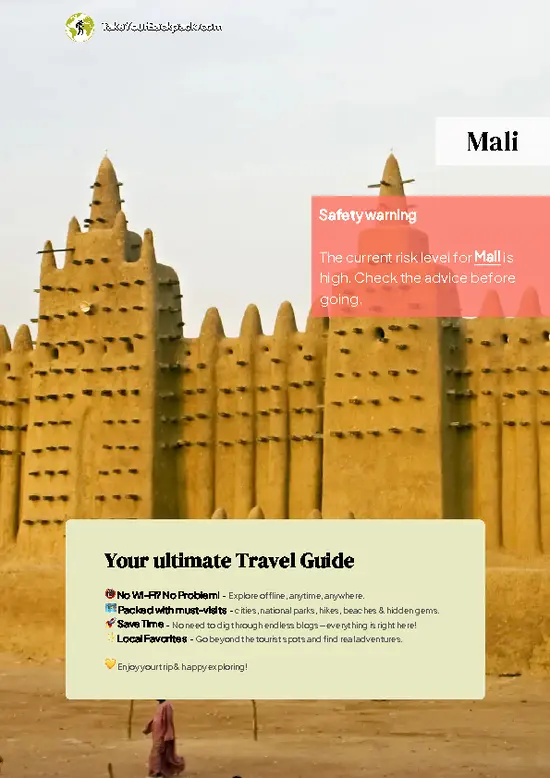
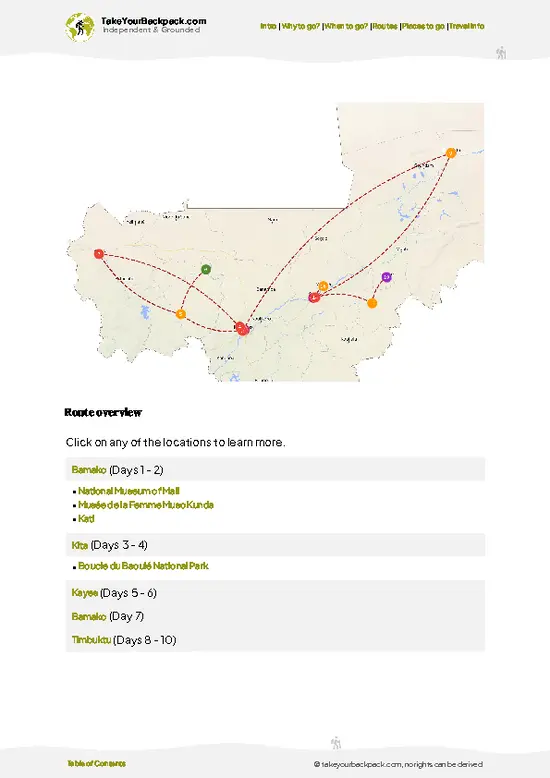
example page 0 from our offline Travel Guide for Mali
example page 1 from our offline Travel Guide for Mali
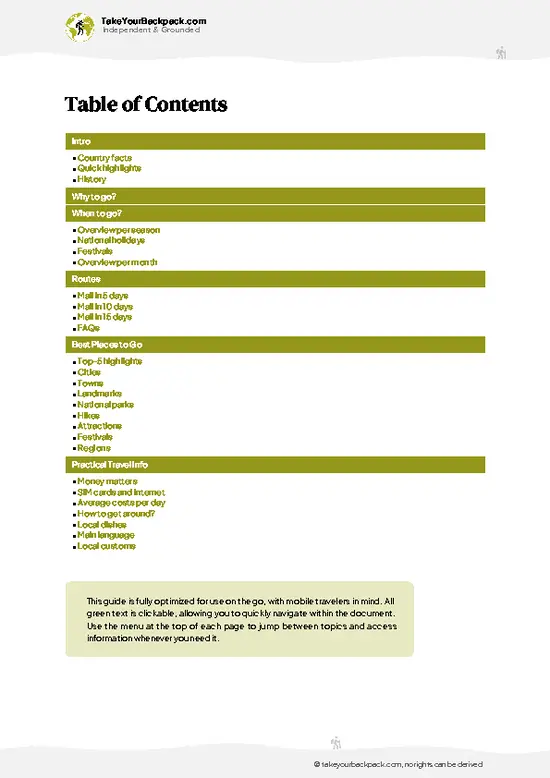
example page 2 from our offline Travel Guide for Mali
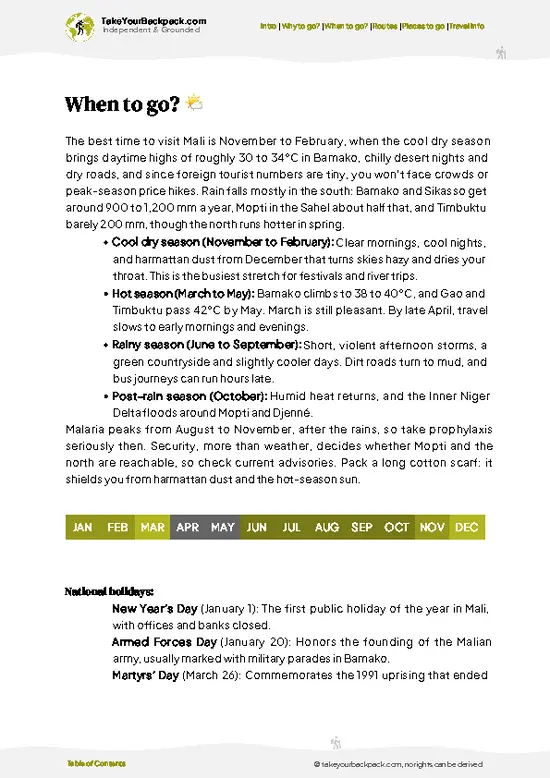
example page 3 from our offline Travel Guide for Mali
example page 4 from our offline Travel Guide for Mali
example page 5 from our offline Travel Guide for Mali
example page 6 from our offline Travel Guide for Mali
example page 7 from our offline Travel Guide for Mali
Loading the map 🌍
CLICK TO FILTER
cities
towns
landmarks
national parks
hikes
attractions
festivals
regions
SHOW COUNTRY’S BESTSHOW ALL

✨ Why go?
Ranked #3 attraction in Mali
What sets this place apart

Sankoré Mosque is the clearest physical link to the era when Timbuktu was a center of learning rather than a caravan stop. In the 15th and 16th centuries, thousands of students are said to have studied here, and scholars traded texts with Cairo, Fez and beyond. Standing in front of it, you read that history in the building itself.

The second reason is how the structure survives. Its mud-brick walls and wooden toron beams need regular re-plastering by local masons, and the community still carries out this work. Few monuments show so plainly that heritage depends on people, not on stone.

The third reason is the context around it. The mosque is part of the UNESCO World Heritage listing for Timbuktu, alongside Djingareyber and Sidi Yahia, and together they make a compact, walkable circuit of … read more 👉
Sankoré Mosque is the clearest physical link to the era when Timbuktu was a center of learning rather than a caravan stop. In the 15th and 16th centuries, thousands of students are said to have studied here, and scholars traded texts with Cairo, Fez and beyond. Standing in front of it, you read that history in the building itself.

The second reason is how the structure survives. Its mud-brick walls and wooden toron beams need regular re-plastering by local masons, and the community still carries out this work. Few monuments show so plainly that heritage depends on people, not on stone.

The third reason is the context around it. The mosque is part of the UNESCO World Heritage listing for Timbuktu, alongside Djingareyber and Sidi Yahia, and together they make a compact, walkable circuit of the old city. For anyone building a route through Mali, this is the milestone that gives the whole northern trail its meaning, and it feels earned precisely because reaching it takes real effort.

💡 HighlightsMust-see experiences and standout moments

  1. Sankoré Mosque exterior: the main sight is the sun-baked mud façade, with its pyramidal minaret and rows of projecting wooden beams that double as scaffolding. The proportions are plain and strong, and photographs flatten how rough and tactile the walls are.
  2. The central courtyard: the open space at the heart of the complex was where students gathered. It gives you the clearest sense of how a university functioned without lecture halls.
  3. The mihrab and prayer hall exterior views: the building’s simple geometry shows the Sahelian style at its most refined. Non-Muslim visitors usually view the prayer areas from outside, so take time to study the walls and doorways.
  4. The re-plastering tradition: if your visit coincides with maintenance, watching masons climb the beams and smooth fresh mud over the
… read more 👉
  1. Sankoré Mosque exterior: the main sight is the sun-baked mud façade, with its pyramidal minaret and rows of projecting wooden beams that double as scaffolding. The proportions are plain and strong, and photographs flatten how rough and tactile the walls are.
  2. The central courtyard: the open space at the heart of the complex was where students gathered. It gives you the clearest sense of how a university functioned without lecture halls.
  3. The mihrab and prayer hall exterior views: the building’s simple geometry shows the Sahelian style at its most refined. Non-Muslim visitors usually view the prayer areas from outside, so take time to study the walls and doorways.
  4. The re-plastering tradition: if your visit coincides with maintenance, watching masons climb the beams and smooth fresh mud over the walls is the best live demonstration of how this architecture survives.
  5. Nearby manuscript libraries: private family libraries in the surrounding streets keep handwritten texts on astronomy, mathematics, medicine and law. Seeing the pages, some with gold leaf and colored inks, explains why the mosque mattered.
  6. Djingareyber Mosque: a short walk away, this larger mosque from the 14th century shares the same building style and gives you a useful comparison in scale and detail.
  7. Sidi Yahia Mosque: the third of Timbuktu’s great mosques, tied to a local saint and known for its heavy door. Visiting all three in one walk makes the old city’s layout click.
  8. The old quarter lanes: the sandy alleys between the mosques, lined with mud houses and carved wooden doors, are the best free experience here and show everyday Timbuktu.
For a first visit, start with the exterior of Sankoré Mosque and then walk straight to the manuscript libraries, since the two together explain each other.
Spotted a mistake or missing something? Contact us.

🌤️ When to go?Choosing the right time of year

  • Cool Dry Season (November to February): Timbuktu is most comfortable now, with daytime highs of 28 to 33°C (82 to 91°F) and nights down to 14 to 18°C (57 to 64°F). Harmattan haze can flatten photos and carry fine dust. Days are about 11 hours long. Prices for guides and transport are firmest here.
  • Hot Dry Season (March to June): Expect 38 to 45°C (100 to 113°F). The sun makes midday walking through the sand lanes punishing, so plan visits around the heat. Crowds are minimal and guides are open to bargaining.
  • Rainy Season (July to September): Rain here is light and erratic, usually under 200 mm for the whole year. Highs sit at 35 to 40°C (95 to 104°F) and humidity rises. River levels on the Niger are highest, which can ease boat access to the area.
  • Shoulder Weeks (October): Heat eases to 35 to
… read more 👉
  • Cool Dry Season (November to February): Timbuktu is most comfortable now, with daytime highs of 28 to 33°C (82 to 91°F) and nights down to 14 to 18°C (57 to 64°F). Harmattan haze can flatten photos and carry fine dust. Days are about 11 hours long. Prices for guides and transport are firmest here.
  • Hot Dry Season (March to June): Expect 38 to 45°C (100 to 113°F). The sun makes midday walking through the sand lanes punishing, so plan visits around the heat. Crowds are minimal and guides are open to bargaining.
  • Rainy Season (July to September): Rain here is light and erratic, usually under 200 mm for the whole year. Highs sit at 35 to 40°C (95 to 104°F) and humidity rises. River levels on the Niger are highest, which can ease boat access to the area.
  • Shoulder Weeks (October): Heat eases to 35 to 38°C (95 to 100°F) with clearer air and fewer visitors.
Visit between November and February, and arrive for the cooler first hours after dawn when the mud-brick walls are best for photos.


source: climatestotravel.comJANJanuary: excellent for travelingFEBFebruary: highly recommended for travelingMARMarch: fair for travelingAPRApril: below average for travelingMAYMay: below average for travelingJUNJune: fair for travelingJULJuly: fair for travelingAUGAugust: fair for travelingSEPSeptember: good for travelingOCTOctober: good for travelingNOVNovember: excellent for travelingDECDecember: highly recommended for traveling
when-to-go

✈️ The backpacker research shortcutMali Travel Guide

An offline-friendly backpacking guide with optimized travel routes, ranked highlights, transport advice, and the best areas to stay.
example page 0 from our offline Travel Guide for Mali
example page 1 from our offline Travel Guide for Mali
example page 2 from our offline Travel Guide for Mali
example page 3 from our offline Travel Guide for Mali
example page 4 from our offline Travel Guide for Mali
example page 5 from our offline Travel Guide for Mali
example page 6 from our offline Travel Guide for Mali
example page 7 from our offline Travel Guide for Mali
The digital guide (266 pages) contains:
✅ 61 highlights, ranked by travel appeal
✅ Optimized 5, 10 & 15-day travel routes
✅ Cities, national parks, landmarks, beaches
✅ How to get around
✅ Offline-friendly for travel without Wi-Fi
👉 Click to see all 30+ guide features

📅 Plan smarter in minutes, not weeks
✅ Month by month travel advice
✅ Festivals & national holidays
✅ Budget expectations

🗺️ Go to the right places, skip the overrated ones
✅ Honest pros & cons of destinations
✅ Top hikes, parks & viewpoints
✅ Lesser-known places most travelers miss
✅ Clear “worth it vs skip it” guidance

🛏️ Travel smoothly without rookie mistakes
✅ Best areas to stay
✅ Transport systems explained simply
✅ Common scams & safety advice
✅ SIM cards, money & practical tips

🌍 Understand the country, not just visit it
✅ Culture & traditions
✅ 52 Essential phrases & customs
✅ Festivals worth planning around
✅ Traveler-friendly historical context
✅ Insights that make places more meaningful

📱 Built for real travel conditions
✅ Fully downloadable PDF
✅ Works completely offline
✅ Optimized for phone use
✅ Useful in remote areas & buses
✅ Everything in one place
Stop searching, start planning
Get instant access to your full guide. 30‑day money-back guarantee.
+ Add another guide for just

By proceeding you agree to our terms.
Sent to your inbox immediately after payment • 100% Secure Checkout
Best Backpacking Travel Advisor 2025 tourism awardBest Backpacking
Travel Advisor
2025
What others say about Take Your Backpack Guides:
⭐⭐⭐⭐⭐
Fantastic, amazing amount of information!
⭐⭐⭐⭐⭐
My goodness this is amazing, it's what I've been looking for hats off too you!
⭐⭐⭐⭐⭐
I think this is absolutely BRILLIANT
⭐⭐⭐⭐
Very complete and informative. It's still missing places, but I gotta to commend you
⭐⭐⭐⭐⭐
This is truly amazing, thank you, can't wait to explore it with my kids!
⭐⭐⭐⭐⭐
Awesome resource, thank you!
⭐⭐⭐⭐⭐
This is amazing! Can't wait to explore the ones I haven't seen
⭐⭐⭐⭐
I love this! Well done, great idea.
⭐⭐⭐⭐⭐
Thanks for taking the time to make this gem!
⭐⭐⭐⭐⭐
This might be the best website I've ever seen.
⭐⭐⭐⭐⭐
Congratulations, and thank you so much for your work; it's incredibly valuable.
⭐⭐⭐⭐
In all seriousness I think you did a great job pointing out the important spots
⭐⭐⭐⭐⭐
10/10 very good
⭐⭐⭐⭐⭐
As someone who's only just starting to visit regularly this is awesome, thank you.
⭐⭐⭐⭐
Thank you very much! I'm going to visit my dad, it's going to be very useful!
⭐⭐⭐⭐⭐
This is really cool! We'll be travelling for the first time and this definitely come in handy.
⭐⭐⭐⭐⭐
You are now our minister of culture, congratulations 👨‍💼
⭐⭐⭐⭐⭐
Just wanted to tell you that this is a pearl! Going to follow your recommendations.
⭐⭐⭐⭐⭐
This is so cool. I'll definitely be using the resource for my travels soon.
⭐⭐⭐⭐⭐
This is very impressive! Good work.
⭐⭐⭐⭐⭐
This is an amazing and informative site. Very well done!

🛏️ Where to stay?Best areas to stay in Mali

The most practical choice is the old quarter around the mosque itself, where the sandy lanes put you within a five to ten minute walk of Sankoré, the Djinguereber and Sidi Yahia mosques. Staying here means you can visit in the cooler first hours of the day, then retreat indoors during the midday heat. Guesthouses in this part of Timbuktu are mostly small, family-run courtyard houses with a handful of rooms, so you end up eating and talking with the same few travelers and hosts. That is the closest thing to a social scene in town, and it is a quiet one.

The neighborhoods toward the center, near … read more 👉
The most practical choice is the old quarter around the mosque itself, where the sandy lanes put you within a five to ten minute walk of Sankoré, the Djinguereber and Sidi Yahia mosques. Staying here means you can visit in the cooler first hours of the day, then retreat indoors during the midday heat. Guesthouses in this part of Timbuktu are mostly small, family-run courtyard houses with a handful of rooms, so you end up eating and talking with the same few travelers and hosts. That is the closest thing to a social scene in town, and it is a quiet one.

The neighborhoods toward the center, near the market and the main roads, are the second option. They have easier access to food stalls, phone credit and transport, and are a little livelier in the evening. Walking back after dark is best done with a local escort or in a group, as the lanes are unlit and easy to get lost in.

The airport area and the Kabara port zone are too far for easy walking and offer little for backpackers. Book through your guide or a trusted local contact, since options are limited and a room is not always guaranteed. Expect basic rooms, shared bathrooms in the cheapest places, and a mattress on a roof terrace when it is hot.

👛 Costs (as of 22 October 2026)What things cost and how to budget

Sankoré Mosque costs a backpacker roughly €27 to 54 per day in Timbuktu, with most of that going to the guide, security arrangements and a bed. The mosque and its adjoining university area have no fixed ticketed entry, so visitors usually pay a small donation to the caretaker or a guide fee. Travelers pay in West African francs, but the figures below are in euros.
CategoryBudget RangeLocal Reality
Entry or donation€2 to 5No formal ticket office. A donation to the caretaker is expected when you enter the courtyard.
Local guide€8 to 15Useful for the old quarter and helps with local escorts. Agree the price before starting.
Accommodation (low season)€8 to 15Basic courtyard guesthouse rooms, often with fans and shared bathrooms.
Accommodation (high season)€12 to 22Prices rise from November to February,
… read more 👉
Sankoré Mosque costs a backpacker roughly €27 to 54 per day in Timbuktu, with most of that going to the guide, security arrangements and a bed. The mosque and its adjoining university area have no fixed ticketed entry, so visitors usually pay a small donation to the caretaker or a guide fee. Travelers pay in West African francs, but the figures below are in euros.
CategoryBudget RangeLocal Reality
Entry or donation€2 to 5No formal ticket office. A donation to the caretaker is expected when you enter the courtyard.
Local guide€8 to 15Useful for the old quarter and helps with local escorts. Agree the price before starting.
Accommodation (low season)€8 to 15Basic courtyard guesthouse rooms, often with fans and shared bathrooms.
Accommodation (high season)€12 to 22Prices rise from November to February, when more visitors arrive.
Food€4 to 8Rice with sauce, grilled meat, bread and tea from small eateries.
Local transport€1 to 4Most of the old quarter is walkable. Motorbike taxis cover longer hops.
Total Daily Budget€27 to 54Based on high season accommodation, with the guide and donation included.


source: thingstodoinmali.com
⚠️ Prices can change and everyone travels differently, so take this as a rough guide. Hope it helps you plan your adventure!

FAQTraveler FAQ

Allow one to two hours for Sankoré Mosque itself, and a full day if you also want to see the Djinguereber and Sidi Yahia mosques. The three are within a short walk of each other in the old quarter. A guide will usually cover all three in about four to five hours with breaks.
Sankoré Mosque is worth a small donation of roughly €2 to 5, since there is no formal ticket and the money goes toward upkeep of a mud-brick structure that dates to the fourteenth century. It is part of a UNESCO World Heritage site, and the courtyard and the old university setting give real context to Timbuktu’s scholarly history. Paying for a guide at around €8 to 15 adds a lot more.
Sankoré Mosque is in the old quarter of Timbuktu, reached by flight or by long overland journeys, as the town is remote on the edge of the Sahara. Overland routes from Mopti or Douentza are long and take many hours, while the Niger River boat from Mopti has historically taken days. Local conditions change, so check current travel advice and arrange transport and escorts through a trusted guide before setting out.
⚠️ Things can change over time, so always validate details locally before you go.

Other Malian attractions near Sankoré Mosque

Explore more nearby:

  • Ahmed Baba Institute—South African-funded archive, manuscript research center, limited access| 0 km away
  • Sidi Yahia Mosque—Sealed door legend, saint’s tomb, compact minaret, Timbuktu lanes| 0 km away
  • Musée de Tombouctou—Saharan trade history, Timbuktu old town, mosque circuit, explorers’ plaques| 1 km away

💡 Not sure where to go next?
Create a personalized itinerary for Mali including Sankoré Mosque and the places that fit your trip.

Generate my itinerary

👉 Discover all attractions

Or checkout all Mali has to offer (think cities, towns, villages, national parks, hikes, beaches, festivals)
Country photo of Mali

We 💚 feedbackKey takeaways before you go

Sankoré Mosque suits history readers and patient overlanders who care more about ideas than spectacle. If you want drama and views, skip it. If you want to understand why this remote city mattered, hire a local guide who knows the manuscript families, and bring modest clothing and a camera with a good zoom.

✍️ Help improve this page!
The information on this page is based on in-depth research, insights shared by experienced travelers, and feedback from the local travel community in Mali. While every effort is made to keep the information accurate and current, conditions can change — so if you spot anything incorrect or outdated, please get in touch.


🙋‍♂️ Give feedback

👋 Meet the founderWho’s Behind Take Your Backpack?

Johan, backpacker and founder of TakeYourBackpackHi, I’m Johan (Netherlands 🇳🇱), the creator of TakeYourBackpack. Over the past 3 decades, I’ve backpacked through 90+ countries across six continents, gaining extensive experience with independent travel, long-term trips, and overland routes.

This site is built on a combination of firsthand travel experience and carefully curated insights from other backpackers. Many guides are based on places I’ve personally visited, while others bring together tips, observations, and practical advice shared by trusted travelers I’ve met along the way.

The goal is to provide realistic, experience-driven guidance — not generic itineraries — so you can explore destinations with better context, clearer expectations, and more confidence.