×

Marshall Islands🇲🇭 | national parksJaluit Atoll Conservation AreaGerman colonial capital, Jabor ruins, 90-islet lagoon | things to do and best time to go

Explore Ailinginae AtollExplore Arno Atoll

Backpacking in Jaluit Atoll Conservation Area
🏆 Top picknational park ranked #2
By Johan Kruseman 🇳🇱 | Updated October 15, 2026

Jabor, on the southeastern rim of Jaluit Atoll, was the German colonial capital of the Marshall Islands, and its coral-rock ruins, rusting Japanese guns and quiet lanes are what the park protects. The atoll lies southwest of Majuro, and you get there by a short domestic flight that runs only a few times a week. Seats are scarce and schedules slip, so book the return before you leave and pad your plans with spare days. The reward is space: a lagoon of 90-odd islets, almost no other visitors, and trails that are really just sandy lanes under breadfruit and coconut palms. Walk in the cool hour after dawn, when roosters, outboard motors and surf are the only noise and the coral gravel is still damp. Midday glare off the lagoon is heavy, and shade is scarce. Services are thin, so carry water and snacks from Majuro. Mosquitoes arrive at dusk, along with the smell of woodsmoke from cooking fires.

Discover everything you want to know in the 📖 Marshall Islands Travel Guide.


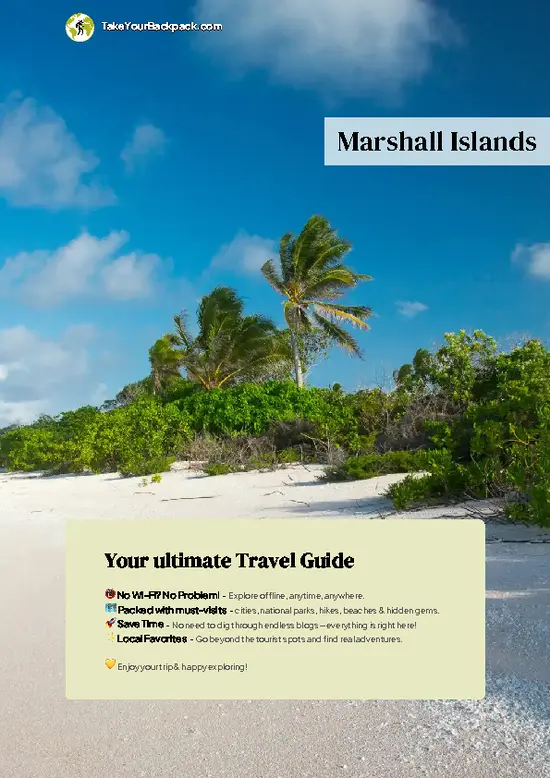
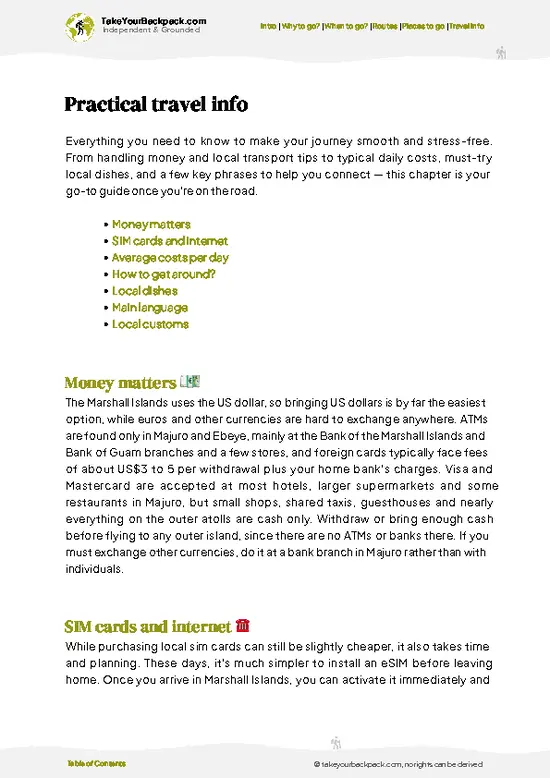
example page 0 from our offline Travel Guide for Marshall Islands
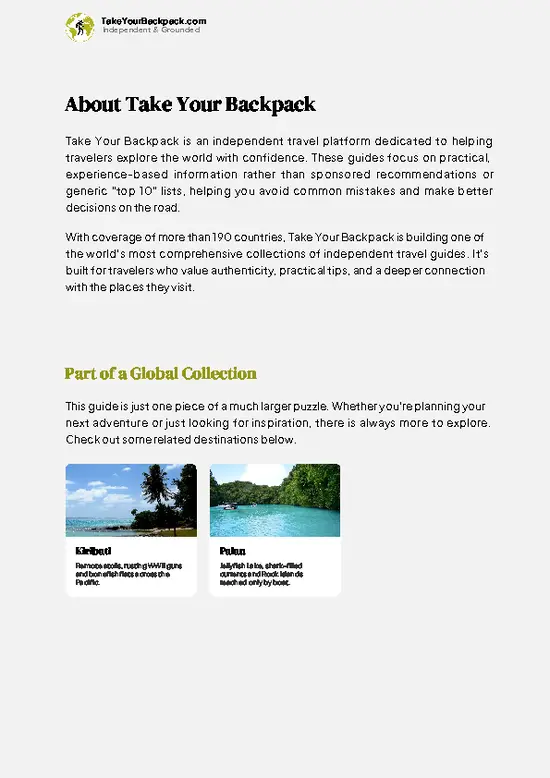
example page 1 from our offline Travel Guide for Marshall Islands
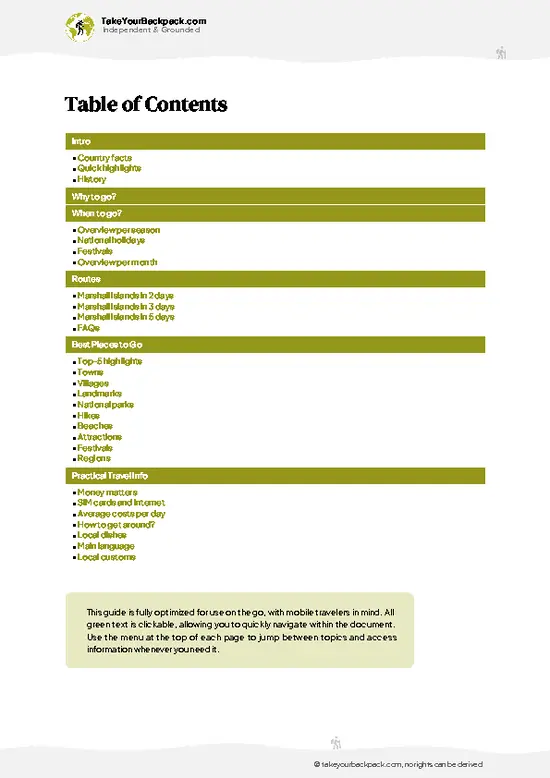
example page 2 from our offline Travel Guide for Marshall Islands
example page 3 from our offline Travel Guide for Marshall Islands
example page 4 from our offline Travel Guide for Marshall Islands
example page 5 from our offline Travel Guide for Marshall Islands
example page 6 from our offline Travel Guide for Marshall Islands
example page 7 from our offline Travel Guide for Marshall Islands
Loading the map 🌍
CLICK TO FILTER
towns
villages
landmarks
national parks
hikes
beaches
attractions
festivals
regions
SHOW COUNTRY’S BESTSHOW ALL

✨ Why go?
Ranked #2 national park in Marshall Islands
What makes it a must-see national park

Backpackers choose Jaluit because it can only be done on your own terms. There are no tour operators, no ticket queues and no set circuit, so you wander Jabor’s German relics at whatever pace you like, stopping to talk with whoever is sitting outside their house. The second draw is the water. Jaluit’s lagoon of roughly 90 islets invites boat hops, snorkeling over coral heads and sandbar picnics, and a local skipper will often take you if you ask politely and agree the arrangements first. Wildlife fans also get the Jaluit Atoll Conservation Area, with traditional sanctuaries kept by the Imroj community, where sea turtles, seabirds and giant clams are the point rather than a bonus. The trade-off is logistics: you plan flights, food and boat rides yourself, and flexibility matters more than any … read more 👉
Backpackers choose Jaluit because it can only be done on your own terms. There are no tour operators, no ticket queues and no set circuit, so you wander Jabor’s German relics at whatever pace you like, stopping to talk with whoever is sitting outside their house. The second draw is the water. Jaluit’s lagoon of roughly 90 islets invites boat hops, snorkeling over coral heads and sandbar picnics, and a local skipper will often take you if you ask politely and agree the arrangements first. Wildlife fans also get the Jaluit Atoll Conservation Area, with traditional sanctuaries kept by the Imroj community, where sea turtles, seabirds and giant clams are the point rather than a bonus. The trade-off is logistics: you plan flights, food and boat rides yourself, and flexibility matters more than any itinerary. Travelers who like improvising and chatting with locals will do well; anyone needing schedules and signage will be frustrated.

💡 HighlightsTop highlights of Jaluit Atoll Conservation Area

  1. Jabor Town Ruins: The former administrative center of German-era Marshall Islands, where crumbling coral-and-concrete structures from the Jaluit Gesellschaft trading period lie among present-day homes. This is the park’s main draw.
  2. Japanese WWII Bunkers and Gun Emplacements: Jaluit served as a Japanese base, and concrete bunkers, gun positions and shell-pocked walls still sit on the atoll. Some are overgrown, so wear closed shoes.
  3. Jaluit Lagoon: Roughly 90 islets ring a wide, sheltered lagoon with clear water, coral heads and sandbars. Boat trips to outer islets are the best way to see it.
  4. Lagoon Wrecks: Sunken vessels from the war years rest in the lagoon and attract divers and snorkelers. Arrange a local boat and check conditions on the day.
  5. Jaluit Atoll Conservation Area (Imroj): The Ramsar-listed
… read more 👉
  1. Jabor Town Ruins: The former administrative center of German-era Marshall Islands, where crumbling coral-and-concrete structures from the Jaluit Gesellschaft trading period lie among present-day homes. This is the park’s main draw.
  2. Japanese WWII Bunkers and Gun Emplacements: Jaluit served as a Japanese base, and concrete bunkers, gun positions and shell-pocked walls still sit on the atoll. Some are overgrown, so wear closed shoes.
  3. Jaluit Lagoon: Roughly 90 islets ring a wide, sheltered lagoon with clear water, coral heads and sandbars. Boat trips to outer islets are the best way to see it.
  4. Lagoon Wrecks: Sunken vessels from the war years rest in the lagoon and attract divers and snorkelers. Arrange a local boat and check conditions on the day.
  5. Jaluit Atoll Conservation Area (Imroj): The Ramsar-listed conservation area covers the whole atoll, and the Imroj community keeps traditional mo (taboo) areas and sanctuaries for sea turtles, nesting seabirds and giant clams. It is remote, so go with a local guide and boat.
  6. Jaluit Pass: The channel where ocean and lagoon exchange water, with strong currents, fish activity and good views of the surf line breaking on the reef.
For a first visit, spend a morning on foot around Jabor’s ruins, then book a lagoon boat trip for the afternoon.
Spotted a mistake or missing something? Contact us.

🌤️ When to go?Choosing the right time of year

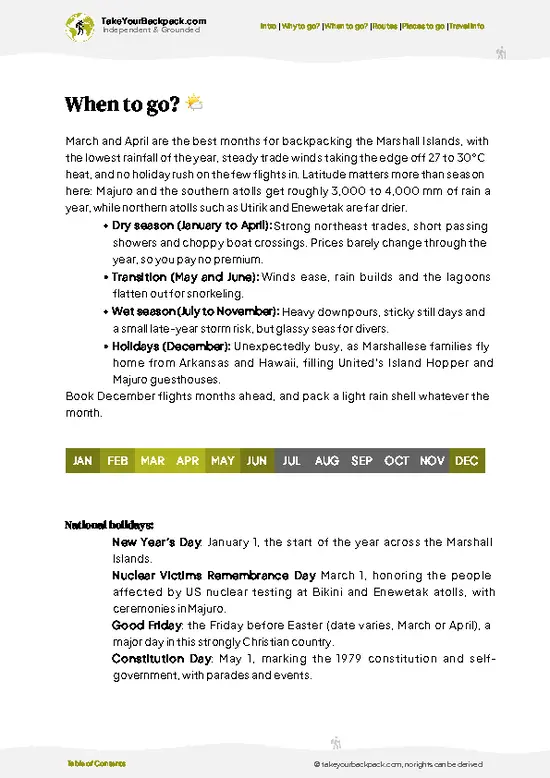
The best window for Jaluit is December to April, when trade winds keep lagoon crossings calmer and rain is lighter. Daytime highs sit around 29 to 31°C (84 to 88°F) and nights around 26 to 27°C (79 to 81°F) in every month, so timing is about rain and sea state.
  • Dry Season (December to April): Showers are shorter, the lagoon is easier on small boats, and snorkeling over Japanese-era wrecks and reef edges is at its clearest. Flights from Majuro fill up, so book early.
  • Wet Season (May to November): Expect heavy downpours most weeks, muggy air and choppier water. Cyclones are rare this close to the equator, but squalls can delay boats. Rooms are easy to get and prices stay flat.
  • Daylight: The sun rises between about 6:25 and 7:00 am and sets between about 6:20 and 7:00 pm year-round, so plan hikes
… read more 👉
The best window for Jaluit is December to April, when trade winds keep lagoon crossings calmer and rain is lighter. Daytime highs sit around 29 to 31°C (84 to 88°F) and nights around 26 to 27°C (79 to 81°F) in every month, so timing is about rain and sea state.
  • Dry Season (December to April): Showers are shorter, the lagoon is easier on small boats, and snorkeling over Japanese-era wrecks and reef edges is at its clearest. Flights from Majuro fill up, so book early.
  • Wet Season (May to November): Expect heavy downpours most weeks, muggy air and choppier water. Cyclones are rare this close to the equator, but squalls can delay boats. Rooms are easy to get and prices stay flat.
  • Daylight: The sun rises between about 6:25 and 7:00 am and sets between about 6:20 and 7:00 pm year-round, so plan hikes for early morning.
  • Crowds and Prices: Visitor numbers are tiny in every month. Fares and guesthouse rates barely move with the season.
Book your Air Marshall Islands seat first, then build the rest around it, since flights to Jaluit run only a few times a week.


source: climatestotravel.comJANJanuary: excellent for travelingFEBFebruary: excellent for travelingMARMarch: excellent for travelingAPRApril: highly recommended for travelingMAYMay: fair for travelingJUNJune: fair for travelingJULJuly: below average for travelingAUGAugust: below average for travelingSEPSeptember: below average for travelingOCTOctober: fair for travelingNOVNovember: fair for travelingDECDecember: highly recommended for traveling
when-to-go

✈️ The backpacker research shortcutMarshall Islands Travel Guide

An offline-friendly backpacking guide with optimized travel routes, ranked highlights, transport advice, and the best areas to stay.
example page 0 from our offline Travel Guide for Marshall Islands
example page 1 from our offline Travel Guide for Marshall Islands
example page 2 from our offline Travel Guide for Marshall Islands
example page 3 from our offline Travel Guide for Marshall Islands
example page 4 from our offline Travel Guide for Marshall Islands
example page 5 from our offline Travel Guide for Marshall Islands
example page 6 from our offline Travel Guide for Marshall Islands
example page 7 from our offline Travel Guide for Marshall Islands
The digital guide (125 pages) contains:
✅ 27 highlights, ranked by travel appeal
✅ Optimized 2, 3 & 5-day travel routes
✅ Cities, national parks, landmarks, beaches
✅ How to get around
✅ Offline-friendly for travel without Wi-Fi
👉 Click to see all 30+ guide features

📅 Plan smarter in minutes, not weeks
✅ Month by month travel advice
✅ Festivals & national holidays
✅ Budget expectations

🗺️ Go to the right places, skip the overrated ones
✅ Honest pros & cons of destinations
✅ Top hikes, parks & viewpoints
✅ Lesser-known places most travelers miss
✅ Clear “worth it vs skip it” guidance

🛏️ Travel smoothly without rookie mistakes
✅ Best areas to stay
✅ Transport systems explained simply
✅ Common scams & safety advice
✅ SIM cards, money & practical tips

🌍 Understand the country, not just visit it
✅ Culture & traditions
✅ 52 Essential phrases & customs
✅ Festivals worth planning around
✅ Traveler-friendly historical context
✅ Insights that make places more meaningful

📱 Built for real travel conditions
✅ Fully downloadable PDF
✅ Works completely offline
✅ Optimized for phone use
✅ Useful in remote areas & buses
✅ Everything in one place
Stop searching, start planning
Get instant access to your full guide. 30‑day money-back guarantee.
+ Add another guide for just

By proceeding you agree to our terms.
Sent to your inbox immediately after payment • 100% Secure Checkout
Best Backpacking Travel Advisor 2025 tourism awardBest Backpacking
Travel Advisor
2025
What others say about Take Your Backpack Guides:
⭐⭐⭐⭐⭐
Fantastic, amazing amount of information!
⭐⭐⭐⭐⭐
My goodness this is amazing, it's what I've been looking for hats off too you!
⭐⭐⭐⭐⭐
I think this is absolutely BRILLIANT
⭐⭐⭐⭐
Very complete and informative. It's still missing places, but I gotta to commend you
⭐⭐⭐⭐⭐
This is truly amazing, thank you, can't wait to explore it with my kids!
⭐⭐⭐⭐⭐
Awesome resource, thank you!
⭐⭐⭐⭐⭐
This is amazing! Can't wait to explore the ones I haven't seen
⭐⭐⭐⭐
I love this! Well done, great idea.
⭐⭐⭐⭐⭐
Thanks for taking the time to make this gem!
⭐⭐⭐⭐⭐
This might be the best website I've ever seen.
⭐⭐⭐⭐⭐
Congratulations, and thank you so much for your work; it's incredibly valuable.
⭐⭐⭐⭐
In all seriousness I think you did a great job pointing out the important spots
⭐⭐⭐⭐⭐
10/10 very good
⭐⭐⭐⭐⭐
As someone who's only just starting to visit regularly this is awesome, thank you.
⭐⭐⭐⭐
Thank you very much! I'm going to visit my dad, it's going to be very useful!
⭐⭐⭐⭐⭐
This is really cool! We'll be travelling for the first time and this definitely come in handy.
⭐⭐⭐⭐⭐
You are now our minister of culture, congratulations 👨‍💼
⭐⭐⭐⭐⭐
Just wanted to tell you that this is a pearl! Going to follow your recommendations.
⭐⭐⭐⭐⭐
This is so cool. I'll definitely be using the resource for my travels soon.
⭐⭐⭐⭐⭐
This is very impressive! Good work.
⭐⭐⭐⭐⭐
This is an amazing and informative site. Very well done!

🛏️ Where to stay?Where staying makes the most sense

Your realistic choice is Jabor, the main settlement on the southeast side of the atoll, since the park has no campsites or lodges of its own. Jaluit’s few guesthouses and small hotels sit here, within walking distance of the airstrip, the dock and the old Japanese and German colonial remains. Expect basic rooms with fans or air conditioning, shared or simple private bathrooms, and rates of roughly US$50 to 90 a night. Power and water can be intermittent, so bring a headlamp and a refillable bottle. Meals are often arranged with the owner, so confirm this when you book.
Jabor’s one small hotel and … read more 👉
Your realistic choice is Jabor, the main settlement on the southeast side of the atoll, since the park has no campsites or lodges of its own. Jaluit’s few guesthouses and small hotels sit here, within walking distance of the airstrip, the dock and the old Japanese and German colonial remains. Expect basic rooms with fans or air conditioning, shared or simple private bathrooms, and rates of roughly US$50 to 90 a night. Power and water can be intermittent, so bring a headlamp and a refillable bottle. Meals are often arranged with the owner, so confirm this when you book.
Jabor’s one small hotel and family-run guesthouses are the usual options, and the owners can arrange boat rides and local guides. Book by phone or message before you fly, because walk-in availability is not reliable and there are no booking platforms to lean on.
Another option is a homestay on an outer islet of the atoll, which locals can arrange through the guesthouse or the island council. Bring your own snacks and small cash gifts or supplies to share. The nearest larger town is Majuro, the capital, roughly 220 km (140 miles) away and reached by flight or the occasional field-trip ship. Many visitors stay on Majuro first, then fly to Jaluit.

👛 Costs (as of 15 October 2026)Travel costs and budget guide for Jaluit Atoll Conservation Area

Plan on roughly US$85 to 160 a day for Jaluit Atoll Conservation Area, with lodging and boat hire taking most of it.
CategoryBudget RangeLocal Reality
Entrance FeesUS$0 to 10No formal park gate. A small contribution to local landowners or guides is sometimes expected for visiting sites.
Accommodation (High Season)US$50 to 90Simple guesthouse rooms in Jabor, usually with fan or air conditioning and limited hot water.
Local TransportUS$10 to 30Most sites are walkable or reached by shared pickup. Hired boats to outer islets cost more, so split with other travelers.
Food and SuppliesUS$15 to 25Rice, fish, canned goods and breadfruit at guesthouses or small stores. Fresh produce is limited and prices run higher than on Majuro.
Guides and ActivitiesUS$5 to 10Local guides for wreck snorkeling and historic
… read more 👉
Plan on roughly US$85 to 160 a day for Jaluit Atoll Conservation Area, with lodging and boat hire taking most of it.
CategoryBudget RangeLocal Reality
Entrance FeesUS$0 to 10No formal park gate. A small contribution to local landowners or guides is sometimes expected for visiting sites.
Accommodation (High Season)US$50 to 90Simple guesthouse rooms in Jabor, usually with fan or air conditioning and limited hot water.
Local TransportUS$10 to 30Most sites are walkable or reached by shared pickup. Hired boats to outer islets cost more, so split with other travelers.
Food and SuppliesUS$15 to 25Rice, fish, canned goods and breadfruit at guesthouses or small stores. Fresh produce is limited and prices run higher than on Majuro.
Guides and ActivitiesUS$5 to 10Local guides for wreck snorkeling and historic sites are paid by negotiation, typically US$10 to 25 for a half day.
Total Daily BudgetUS$85 to 160Flights from Majuro are extra and are the biggest single expense, often US$200 to 400 round trip.
⚠️ Prices can change and everyone travels differently, so take this as a rough guide. Hope it helps you plan your adventure!

🥾 TrailsExploring Jaluit Atoll Conservation Area: trails, terrain, and views

Jaluit has no formally marked, named trails. What you walk are the roads and sandy tracks of Jabor and the neighboring islets, and every route is flat, shaded in patches and easy for any fitness level. Heat and glare are the real difficulty.
  • Jabor Ruins Loop: Start in the center of Jabor and follow the lane toward the former German trading area, passing old coral-block walls, foundations and overgrown lots. Allow one to two hours at a slow pace. Terrain is crushed coral and sand, flat and easy.
  • Village Lane Stroll: Wander past houses, churches, breadfruit trees and cooking huts, and expect greetings
… read more 👉
Jaluit has no formally marked, named trails. What you walk are the roads and sandy tracks of Jabor and the neighboring islets, and every route is flat, shaded in patches and easy for any fitness level. Heat and glare are the real difficulty.
  • Jabor Ruins Loop: Start in the center of Jabor and follow the lane toward the former German trading area, passing old coral-block walls, foundations and overgrown lots. Allow one to two hours at a slow pace. Terrain is crushed coral and sand, flat and easy.
  • Village Lane Stroll: Wander past houses, churches, breadfruit trees and cooking huts, and expect greetings from nearly everyone. Roughly an hour, entirely flat, and best at sunrise or late afternoon.
  • Lagoon Islet Hops: Hire a local boat to reach quieter islets, where you can walk the sand rim in half an hour or so, swim and look for hermit crabs, reef fish and seabirds. Difficulty is low, but the sun is intense.
  • Imroj Conservation Visit: A boat-assisted outing to the Imroj community’s traditional sanctuaries for turtles and birds, with short, informal walks along sandy shores. Only go with a local who knows the tides and landing spots.
Wildlife is mostly marine and avian. Expect reef fish, turtles, noddies and terns, plus plenty of hermit crabs and lizards on land.
Getting here means flying in from Majuro on a small domestic aircraft, which operates only a few days a week and can be delayed. There is no public transit on the atoll beyond informal local rides, so walking and arranging boats through your host are the norm. Crowds are practically nonexistent. Bring water, sunscreen, insect repellent and a hat, and ask locals before entering private land or photographing sites near homes.
⚠️ Hiking info can sometimes be outdated or inaccurate. Before you hit the trail, check the latest conditions with locals. If you do spot anything that's off, I'd love to hear from you, so I can update it for fellow travelers.

🛡️ SafetyStaying Safe: What Travelers Should Know

Jaluit is low-risk, and the main hazards are sun, heat and the water. Most sites are flat and reached on coral roads or short paths, so footing is easy, but the humidity wears down first-timers fast. Wear a hat, use reef-safe sunscreen and carry at least 2 to 3 liters of water per person, since refills are limited.
Lagoon currents can be strong near passes between islets, so swim only where locals say it is safe and snorkel with a buddy. Wear reef shoes, because coral cuts infect easily in the tropics. Sharks are present but incidents are rare. Do not touch or stand on the wrecks and rusting guns, which have sharp edges, and unexploded ordnance from World War II can still turn up, so never pick up metal objects. Ask permission before walking through private land.
Boat trips are the other real … read more 👉
Jaluit is low-risk, and the main hazards are sun, heat and the water. Most sites are flat and reached on coral roads or short paths, so footing is easy, but the humidity wears down first-timers fast. Wear a hat, use reef-safe sunscreen and carry at least 2 to 3 liters of water per person, since refills are limited.
Lagoon currents can be strong near passes between islets, so swim only where locals say it is safe and snorkel with a buddy. Wear reef shoes, because coral cuts infect easily in the tropics. Sharks are present but incidents are rare. Do not touch or stand on the wrecks and rusting guns, which have sharp edges, and unexploded ordnance from World War II can still turn up, so never pick up metal objects. Ask permission before walking through private land.
Boat trips are the other real risk. Check that your operator carries life jackets and a radio, and delay crossings in squally weather. The clinic on Jabor is small, so bring your own medications and first-aid supplies.

FAQFrequently asked questions about Jaluit Atoll Conservation Area

Plan on 3 to 4 days. That is enough to see the colonial and Japanese-era remains around Jabor, snorkel a wreck or two and take a boat to one outer islet. Flights from Majuro run only a few times a week, so your return date may add a day, and a week suits you if you want homestays on outer islets.
Yes, because the main sites around Jabor are close together and reachable on foot or by shared pickup along the coral road. Reaching the atoll itself means a flight from Majuro with Air Marshall Islands (about 1 hour) or a slow field-trip ship. Boats to outer islets are hired through your guesthouse and cost roughly US$30 to 100 depending on distance.
No formal entrance fee or permit is charged to walk around Jaluit Atoll Conservation Area. Visitors are expected to ask permission from local landowners and to hire a local guide for some sites, which typically costs US$10 to 25 for a half day. Entry to the Marshall Islands itself requires a valid passport, and many nationalities receive visa-free or on-arrival entry for short stays.
⚠️ Things can change over time, so always validate details locally before you go.

Expanding your trip beyond this stop

Jaluit Atoll Conservation Area isn’t the only highlight in Marshall Islands. Explore all what Marshall Islands has to offer.
Country photo of Marshall Islands

We 💚 feedbackFinal thoughts on exploring Jaluit Atoll Conservation Area

Check the tide before you head out along the lagoon shore. At low water, the old concrete fragments and wartime debris along the reef edge are easier to spot and the walking is firmer, while high tide hides much of it. I would plan the shoreline walk for the morning low and leave the afternoon for a boat.

✍️ Help improve this page!
The information on this page is based on in-depth research, insights shared by experienced travelers, and feedback from the local travel community in Marshall Islands. While every effort is made to keep the information accurate and current, conditions can change — so if you spot anything incorrect or outdated, please get in touch.


🙋‍♂️ Give feedback

👋 Meet the founderWho’s Behind Take Your Backpack?

Johan, backpacker and founder of TakeYourBackpackHi, I’m Johan (Netherlands 🇳🇱), the creator of TakeYourBackpack. Over the past 3 decades, I’ve backpacked through 90+ countries across six continents, gaining extensive experience with independent travel, long-term trips, and overland routes.

This site is built on a combination of firsthand travel experience and carefully curated insights from other backpackers. Many guides are based on places I’ve personally visited, while others bring together tips, observations, and practical advice shared by trusted travelers I’ve met along the way.

The goal is to provide realistic, experience-driven guidance — not generic itineraries — so you can explore destinations with better context, clearer expectations, and more confidence.