×

Marshall Islands🇲🇭 | best national parksYour Guide to the 2 Best national parks in Marshall Islands

Marshall Islands has no national parks in the Yellowstone sense. What you find are protected atolls and conservation areas, managed with local councils, where the soundtrack is surf on the reef and wind in pandanus leaves. Majuro-side options are cheap and easy to reach; remote lagoons cost thousands and need charters. For backpacking and independent travel, the choice comes down to access, cost and how much silence you want.

By Johan Kruseman 🇳🇱 | Updated October 23, 2026
Explore the best hikes in Marshall Islands

Why go?Why These national park Stand Out

The country is 29 low coral atolls and five single islands, with land that rarely rises more than 2 meters (about 6 feet) above the water. No peaks, no forests, no trailheads. Protection here means reef, lagoon and seabird habitat, not ranger huts and marked loops.

Land belongs to families under customary iroij and alap authority, so conservation works through community agreements and the Reimaanlok framework. Permission matters as much as a ticket. History adds weight: 67 nuclear tests between 1946 and 1958 left some atolls restricted for decades.

Before choosing the country for this, know that infrastructure is thin. Flights to outer atolls run a few times a week and get bumped, shops stock tinned basics, drinking water is collected rain, and the heat sits near 30°C (86°F) with salt on everything.
Evaluating the Top Choices
The list of best national parks in Marshall Islands is created based on landscapes, wildlife, adventure opportunities, facilities, and overall experience. If you feel a national park is missing in this list, please let us know.

When to go?Optimal Periods for Travel

Best months and weather: December to April is the best window, because the northeast trade winds blow steadily, rain eases, and lagoons often sit calm and clear enough for good visibility. Daytime highs stay at 28 to 31°C (82 to 88°F) all year, so the season is about water and wind, not temperature.

Shoulder and wet season: May to November brings heavier, squally rain. Majuro and the southern atolls receive roughly 3,000 to 3,500 mm a year, most of it in these months, while the drier northern atolls get far less. Showers are short and loud on tin roofs, and humidity sticks to your skin. May and November work as shoulder months with fewer cancelled boat runs than midwinter swells. Typhoons are uncommon, but rough seas from July to October can delay small boats. Flight and guesthouse prices barely … read more 👉
Best months and weather: December to April is the best window, because the northeast trade winds blow steadily, rain eases, and lagoons often sit calm and clear enough for good visibility. Daytime highs stay at 28 to 31°C (82 to 88°F) all year, so the season is about water and wind, not temperature.

Shoulder and wet season: May to November brings heavier, squally rain. Majuro and the southern atolls receive roughly 3,000 to 3,500 mm a year, most of it in these months, while the drier northern atolls get far less. Showers are short and loud on tin roofs, and humidity sticks to your skin. May and November work as shoulder months with fewer cancelled boat runs than midwinter swells. Typhoons are uncommon, but rough seas from July to October can delay small boats. Flight and guesthouse prices barely change by season, so choose by sea conditions.

national park hoppingOptimizing Your Multi-Stop Itinerary

How many days to plan: A trip combining several protected areas in Marshall Islands needs 10 to 14 days, because distances are large and flights are infrequent. Three to four days per stop is the practical minimum once you count arrivals, weather delays and slow island time.

Grouping and direction: Use Majuro as the hub for the southern and eastern atolls, which connect by short Air Marshall Islands hops of about 1 to 1.5 hours or by multi-day field-trip ships. Kwajalein links the northwest, and onward access is by charter or arranged boat. Work from Majuro outward, then finish at the airport hub for your departure.

Planning mistakes: The classic error is stacking atolls on back-to-back flights that run only once or twice a week. Leave a 2 to 3 day buffer before any international departure and … read more 👉
How many days to plan: A trip combining several protected areas in Marshall Islands needs 10 to 14 days, because distances are large and flights are infrequent. Three to four days per stop is the practical minimum once you count arrivals, weather delays and slow island time.

Grouping and direction: Use Majuro as the hub for the southern and eastern atolls, which connect by short Air Marshall Islands hops of about 1 to 1.5 hours or by multi-day field-trip ships. Kwajalein links the northwest, and onward access is by charter or arranged boat. Work from Majuro outward, then finish at the airport hub for your departure.

Planning mistakes: The classic error is stacking atolls on back-to-back flights that run only once or twice a week. Leave a 2 to 3 day buffer before any international departure and confirm return seats before you fly out. Another is packing too many stops: choose two regions, not four.

The ListHighly Recommended national parks of Marshall Islands

1 Jaluit Atoll Conservation Area

German colonial capital, Jabor ruins, 90-islet lagoon

Walk Jabor’s sandy lanes past coral-rock ruins and rusting Japanese guns, then take a boat to outer islets and the lagoon wrecks.

2 Ailinginae Atoll

Uninhabited lagoon, 1954 fallout history, seabird colonies, reef sharks

Anchor inside a lagoon where no one lives, then wade ashore to count turtle tracks and nesting terns among abandoned coconut groves.

Loading the map 🌍

Expert viewWhat You Should Know

How many to visit: Two is the number I advise. Outer-atoll flights and boats run on weekly rhythms, and a third stop usually means a missed connection and a day sitting on a coral-gravel airstrip in full sun. Two gives you time to swim, walk the lagoon edge and say yes when a family invites you to eat fresh reef fish and breadfruit.

Which kind to prioritize: Budget travelers should pick accessible conservation areas near Majuro and the southern atolls, where a guesthouse room, a local boat captain and a snorkel are enough. Divers with savings can aim for remote lagoons, which are reached on organized charters; you get empty reef walls, sharks and wreck-filled water. Birdwatchers and quiet-seekers do best on small uninhabited islets, where the reward is terns wheeling overhead and nobody else … read more 👉
How many to visit: Two is the number I advise. Outer-atoll flights and boats run on weekly rhythms, and a third stop usually means a missed connection and a day sitting on a coral-gravel airstrip in full sun. Two gives you time to swim, walk the lagoon edge and say yes when a family invites you to eat fresh reef fish and breadfruit.

Which kind to prioritize: Budget travelers should pick accessible conservation areas near Majuro and the southern atolls, where a guesthouse room, a local boat captain and a snorkel are enough. Divers with savings can aim for remote lagoons, which are reached on organized charters; you get empty reef walls, sharks and wreck-filled water. Birdwatchers and quiet-seekers do best on small uninhabited islets, where the reward is terns wheeling overhead and nobody else in sight.

What it costs: Plan on US$80 to 130 a day on the main islands, mostly for a room (US$60 to 120), simple meals and a rented vehicle or taxi. Outer-atoll flights run about US$150 to 400 return. Community landing or conservation fees are often US$10 to 50 per visit, plus US$30 to 100 for a boat and guide. Remote dive expeditions run into the thousands per week, so treat them as a separate splurge.

Safety and etiquette: Passes between lagoon and ocean carry strong currents, so ask a local before you swim and avoid them on outgoing tides. Sun exposure is brutal: carry reef-safe sunscreen, a long-sleeve shirt and at least 3 liters of water a day. Ask the landowner or mayor before camping or entering any area, dress modestly in villages, and follow guidance on eating food from atolls affected by nuclear fallout. Respect brings invitations, and with them the best meals and stories of the trip.

✈️ The backpacker research shortcutMarshall Islands Travel Guide

An offline-friendly backpacking guide with optimized travel routes, ranked highlights, transport advice, and the best areas to stay.
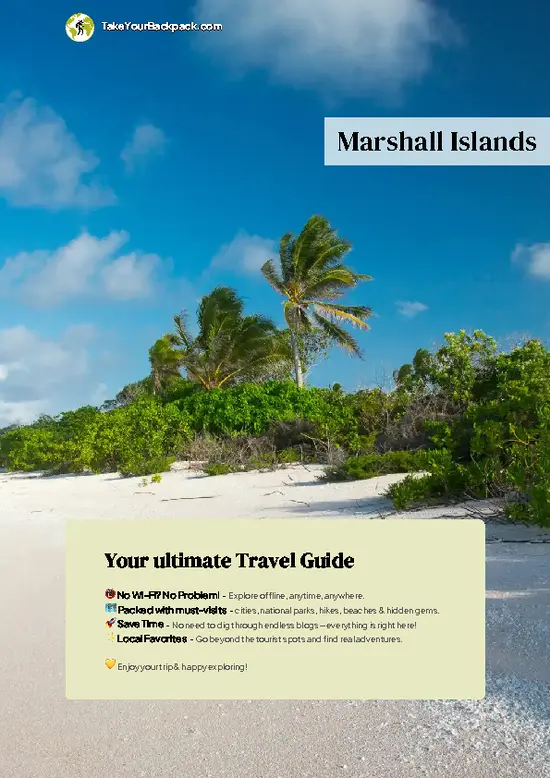
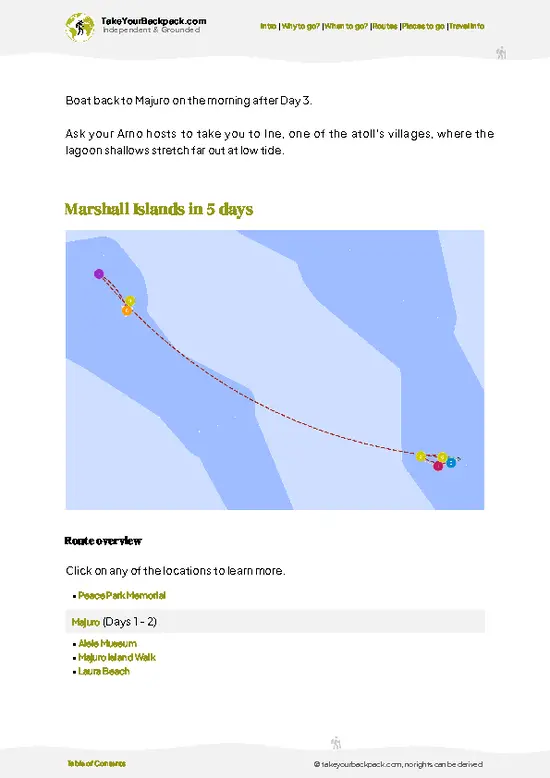
example page 0 from our offline Travel Guide for Marshall Islands
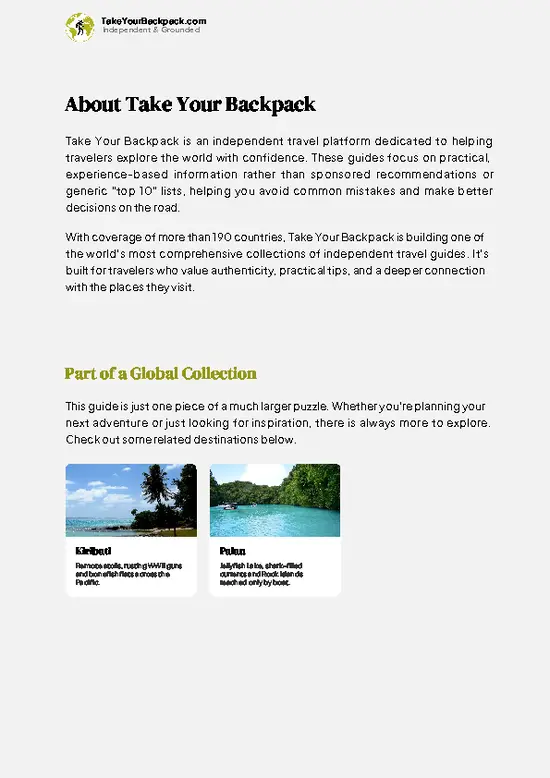
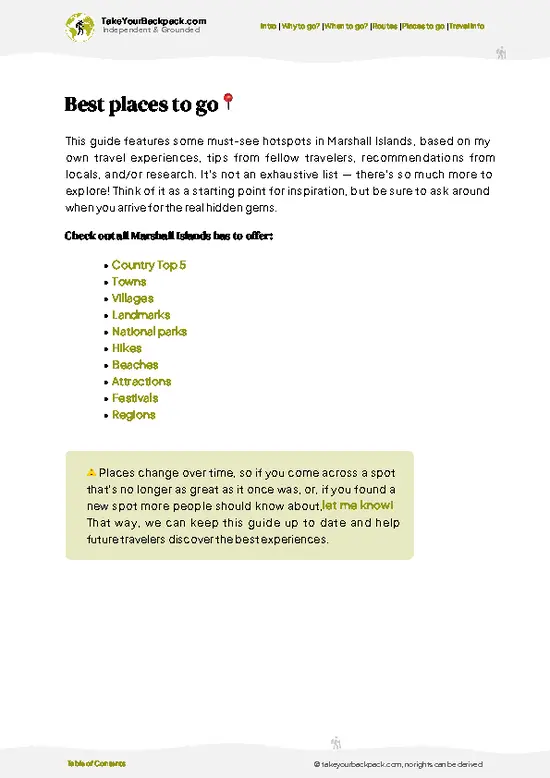
example page 1 from our offline Travel Guide for Marshall Islands
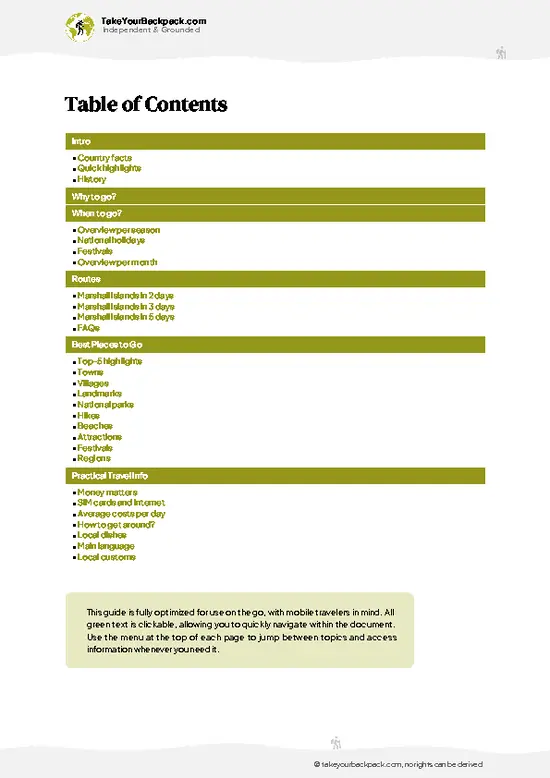
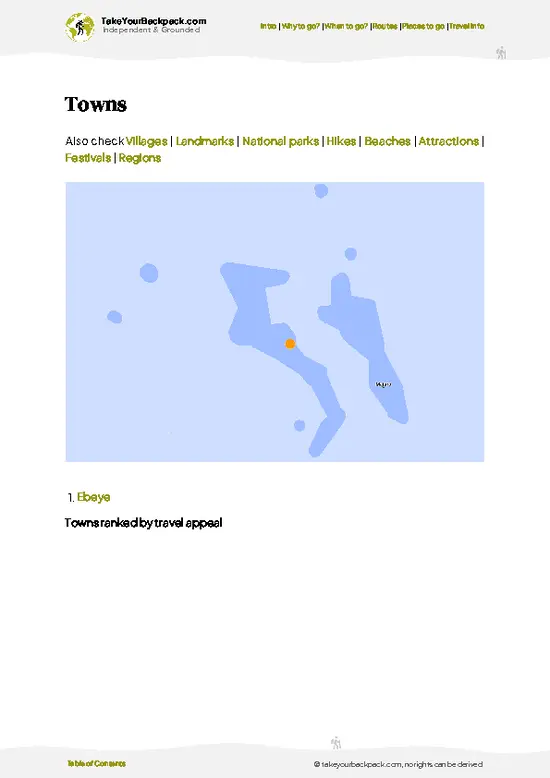
example page 2 from our offline Travel Guide for Marshall Islands
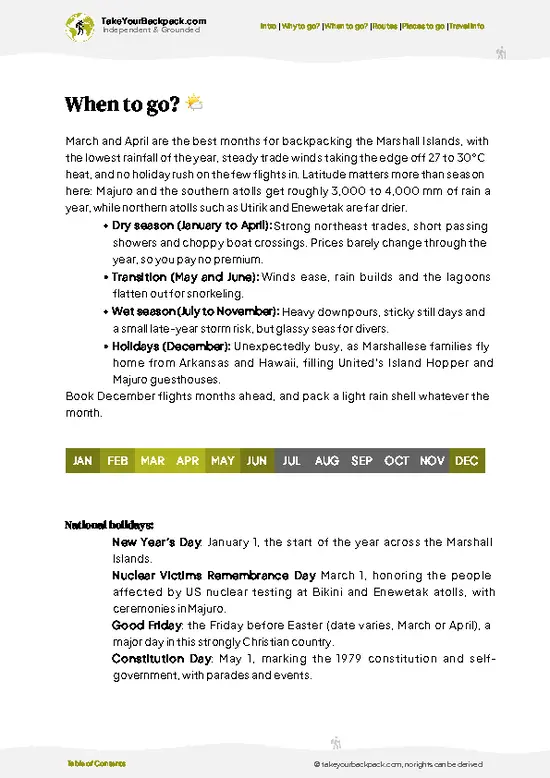
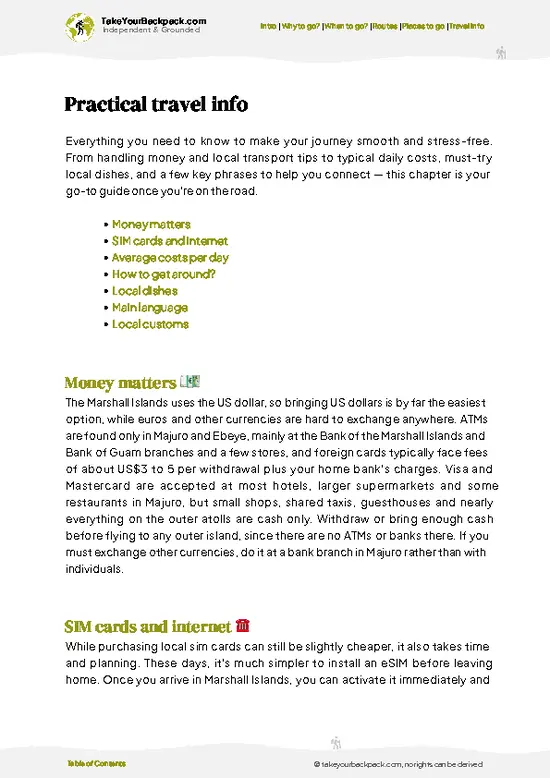
example page 3 from our offline Travel Guide for Marshall Islands
example page 4 from our offline Travel Guide for Marshall Islands
example page 5 from our offline Travel Guide for Marshall Islands
example page 6 from our offline Travel Guide for Marshall Islands
example page 7 from our offline Travel Guide for Marshall Islands
The digital guide (125 pages) contains:
✅ 27 highlights, ranked by travel appeal
✅ Optimized 2, 3 & 5-day travel routes
✅ Cities, national parks, landmarks, beaches
✅ How to get around
✅ Offline-friendly for travel without Wi-Fi
👉 Click to see all 30+ guide features

📅 Plan smarter in minutes, not weeks
✅ Month by month travel advice
✅ Festivals & national holidays
✅ Budget expectations

🗺️ Go to the right places, skip the overrated ones
✅ Honest pros & cons of destinations
✅ Top hikes, parks & viewpoints
✅ Lesser-known places most travelers miss
✅ Clear “worth it vs skip it” guidance

🛏️ Travel smoothly without rookie mistakes
✅ Best areas to stay
✅ Transport systems explained simply
✅ Common scams & safety advice
✅ SIM cards, money & practical tips

🌍 Understand the country, not just visit it
✅ Culture & traditions
✅ 52 Essential phrases & customs
✅ Festivals worth planning around
✅ Traveler-friendly historical context
✅ Insights that make places more meaningful

📱 Built for real travel conditions
✅ Fully downloadable PDF
✅ Works completely offline
✅ Optimized for phone use
✅ Useful in remote areas & buses
✅ Everything in one place
Stop searching, start planning
Get instant access to your full guide. 30‑day money-back guarantee.
+ Add another guide for just

By proceeding you agree to our terms.
Sent to your inbox immediately after payment • 100% Secure Checkout
Best Backpacking Travel Advisor 2025 tourism awardBest Backpacking
Travel Advisor
2025
What others say about Take Your Backpack Guides:
⭐⭐⭐⭐⭐
Fantastic, amazing amount of information!
⭐⭐⭐⭐⭐
My goodness this is amazing, it's what I've been looking for hats off too you!
⭐⭐⭐⭐⭐
I think this is absolutely BRILLIANT
⭐⭐⭐⭐
Very complete and informative. It's still missing places, but I gotta to commend you
⭐⭐⭐⭐⭐
This is truly amazing, thank you, can't wait to explore it with my kids!
⭐⭐⭐⭐⭐
Awesome resource, thank you!
⭐⭐⭐⭐⭐
This is amazing! Can't wait to explore the ones I haven't seen
⭐⭐⭐⭐
I love this! Well done, great idea.
⭐⭐⭐⭐⭐
Thanks for taking the time to make this gem!
⭐⭐⭐⭐⭐
This might be the best website I've ever seen.
⭐⭐⭐⭐⭐
Congratulations, and thank you so much for your work; it's incredibly valuable.
⭐⭐⭐⭐
In all seriousness I think you did a great job pointing out the important spots
⭐⭐⭐⭐⭐
10/10 very good
⭐⭐⭐⭐⭐
As someone who's only just starting to visit regularly this is awesome, thank you.
⭐⭐⭐⭐
Thank you very much! I'm going to visit my dad, it's going to be very useful!
⭐⭐⭐⭐⭐
This is really cool! We'll be travelling for the first time and this definitely come in handy.
⭐⭐⭐⭐⭐
You are now our minister of culture, congratulations 👨‍💼
⭐⭐⭐⭐⭐
Just wanted to tell you that this is a pearl! Going to follow your recommendations.
⭐⭐⭐⭐⭐
This is so cool. I'll definitely be using the resource for my travels soon.
⭐⭐⭐⭐⭐
This is very impressive! Good work.
⭐⭐⭐⭐⭐
This is an amazing and informative site. Very well done!

🛏️ Where to stay?Where to Stay: Marshall Islands Edition

There are no true hostels in the Marshall Islands, so budget accommodation means simple guesthouses and basic motel rooms, usually around US$80 to 150 a night, with very few beds below that. Most options sit in the Delap, Uliga and Djarrit strip of Majuro, where you are within walking distance or a short shared taxi ride of shops, restaurants, the few bars and the government offices, though traffic noise along the single main road can be constant. For quiet beach evenings, Laura at the western tip of the atoll has a handful of guesthouse-style stays, but it is roughly an hour from town by road with almost no nightlife, while Ebeye on Kwajalein has a few plain rooms that are crowded, cramped … read more 👉
There are no true hostels in the Marshall Islands, so budget accommodation means simple guesthouses and basic motel rooms, usually around US$80 to 150 a night, with very few beds below that. Most options sit in the Delap, Uliga and Djarrit strip of Majuro, where you are within walking distance or a short shared taxi ride of shops, restaurants, the few bars and the government offices, though traffic noise along the single main road can be constant. For quiet beach evenings, Laura at the western tip of the atoll has a handful of guesthouse-style stays, but it is roughly an hour from town by road with almost no nightlife, while Ebeye on Kwajalein has a few plain rooms that are crowded, cramped and mainly practical for onward travel.

If you enjoy meeting fellow travelers, consider choosing hostels with high ratings for atmosphere. On the other hand, if you prefer having your own space, a hotel might be a better option.

Marshall IslandsExplore Beyond This Category

👋 Meet the founderWho’s Behind Take Your Backpack?

Johan, backpacker and founder of TakeYourBackpackHi, I’m Johan (Netherlands 🇳🇱), the creator of TakeYourBackpack. Over the past 3 decades, I’ve backpacked through 90+ countries across six continents, gaining extensive experience with independent travel, long-term trips, and overland routes.

This site is built on a combination of firsthand travel experience and carefully curated insights from other backpackers. Many guides are based on places I’ve personally visited, while others bring together tips, observations, and practical advice shared by trusted travelers I’ve met along the way.

The goal is to provide realistic, experience-driven guidance — not generic itineraries — so you can explore destinations with better context, clearer expectations, and more confidence.