×

Mayotte🇾🇹 | townsDzaoudziColonial rock, barge landing, crab causeway, quayside | things to do and best time to go

Explore BandréléExplore Kani-Kéli

Backpacking in Dzaoudzi
🏆 Top picktown ranked #2
By Johan Kruseman 🇳🇱 | Updated October 22, 2026

The barge ramp clanks down on the Dzaoudzi side, diesel fumes mix with salt and mangrove mud, and scooters rattle off before the gate has stopped swinging. Dzaoudzi sits on the rock of Petite-Terre, in the east of Mayotte, and it was the island’s capital before Mamoudzou took over. Expect a small, sun-baked colonial rock with government buildings, sea views and very little nightlife. Getting here is easy, since a short barge ride crosses the lagoon from Mamoudzou, running often because it is the only link for cars. Evenings are quiet and hostels are scarce, so meeting other backpackers takes effort. Most people use Dzaoudzi as a launch point for Petite-Terre’s beaches and crater lake, or as the airport stop. Plan a first day like this: arrive on the morning barge, climb the rock while it is still cool, then lunch on grilled fish and head to the sand.

Discover everything you want to know in the 📖 Mayotte Travel Guide.


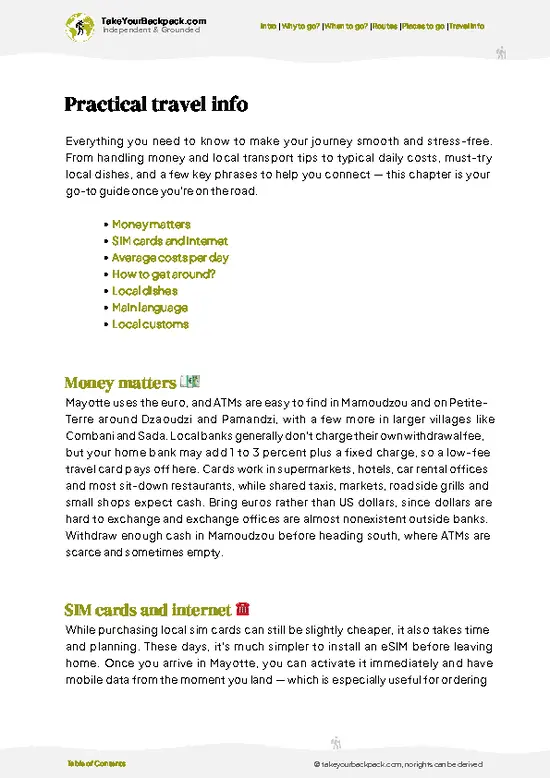
example page 0 from our offline Travel Guide for Mayotte
example page 1 from our offline Travel Guide for Mayotte
example page 2 from our offline Travel Guide for Mayotte
example page 3 from our offline Travel Guide for Mayotte
example page 4 from our offline Travel Guide for Mayotte
example page 5 from our offline Travel Guide for Mayotte
example page 6 from our offline Travel Guide for Mayotte
example page 7 from our offline Travel Guide for Mayotte
Loading the map 🌍
CLICK TO FILTER
towns
landmarks
national parks
hikes
beaches
attractions
festivals
regions
SHOW COUNTRY’S BESTSHOW ALL

✨ Why go?
Ranked #2 town in Mayotte
Why visitors keep coming back

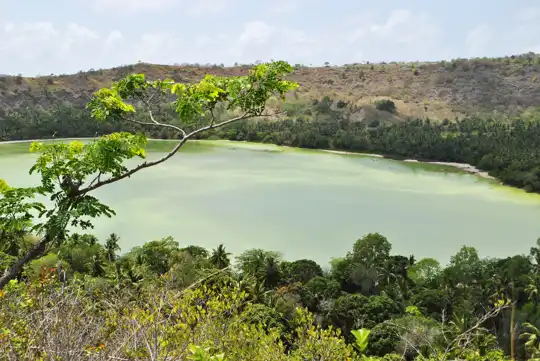
Dzaoudzi works because it gives you the quiet side of Mayotte within minutes of the capital. The Rocher de Dzaoudzi, a fortified outcrop with the old governor’s buildings, is an easy morning walk, and from there the rest of Petite-Terre opens up by foot, bike or shared taxi. Most travelers stay one night or two. That is enough to see the rock, then swim at beaches where lemurs sometimes watch from the trees, and look into the green Lac Dziani crater. Evenings are slow, with a few snack stalls and bars, so this suits solo travelers who like their own company, slow travelers, and anyone who wants the lagoon without the traffic of the main island. If you need a busy hostel scene, stay in Mamoudzou and come across for the day. The barge crossing itself is part of the appeal: a few minutes on open … read more 👉
Dzaoudzi works because it gives you the quiet side of Mayotte within minutes of the capital. The Rocher de Dzaoudzi, a fortified outcrop with the old governor’s buildings, is an easy morning walk, and from there the rest of Petite-Terre opens up by foot, bike or shared taxi. Most travelers stay one night or two. That is enough to see the rock, then swim at beaches where lemurs sometimes watch from the trees, and look into the green Lac Dziani crater. Evenings are slow, with a few snack stalls and bars, so this suits solo travelers who like their own company, slow travelers, and anyone who wants the lagoon without the traffic of the main island. If you need a busy hostel scene, stay in Mamoudzou and come across for the day. The barge crossing itself is part of the appeal: a few minutes on open water, with the rock rising ahead of you. Pack water, sun protection and patience for island timetables.

💡 HighlightsDon't-miss highlights and experiences

  1. Rocher de Dzaoudzi: the old colonial heart of Mayotte, a steep rock where the French administration sat for generations. Walk the lanes past former governor’s buildings and military sites, and look out over the lagoon toward Grande Terre. Go early, before the heat builds. Free, allow 1 to 2 hours.
  2. Musée de Mayotte (MuMA): a compact museum on the rock covering the island’s history, traditions, lagoon life and the arrival of French rule. It is the best place to understand Mayotte’s mix of Swahili, Malagasy, Arab and French influences. Expect a small entry fee of roughly €2 to 4, and allow about 1 hour. Check opening hours before you cross, because they are limited.
  3. Boulevard des Crabes causeway: a long, flat road linking the rock to the rest of Petite-Terre, with mangrove and tidal flats on both
… read more 👉
  1. Rocher de Dzaoudzi: the old colonial heart of Mayotte, a steep rock where the French administration sat for generations. Walk the lanes past former governor’s buildings and military sites, and look out over the lagoon toward Grande Terre. Go early, before the heat builds. Free, allow 1 to 2 hours.
  2. Musée de Mayotte (MuMA): a compact museum on the rock covering the island’s history, traditions, lagoon life and the arrival of French rule. It is the best place to understand Mayotte’s mix of Swahili, Malagasy, Arab and French influences. Expect a small entry fee of roughly €2 to 4, and allow about 1 hour. Check opening hours before you cross, because they are limited.
  3. Boulevard des Crabes causeway: a long, flat road linking the rock to the rest of Petite-Terre, with mangrove and tidal flats on both sides. At low tide, crabs and mudskippers move across the mud. Late afternoon is the cooler time for walking or cycling. Free, 30 to 60 minutes.
  4. The barge crossing: the lagoon ferry connecting Dzaoudzi to Mamoudzou. It is a short ride, but the view of the rock, boats and the main island’s hills is worth the time. Early morning and late afternoon light is softer. Fares are low for foot passengers, and the crossing takes under 15 minutes.
  5. Waterfront by the quay: the shoreline near the barge landing, where fishing boats come and go and locals sit in the shade. It makes an easy sunset stop with a cold drink. Free, 30 minutes.
Beyond town, Petite-Terre offers the crater lake of Lac Dziani, Moya beach, Papani beach and the Mont Vigie viewpoint, and Mamoudzou lies across the lagoon. For a first visit, start with the Rocher de Dzaoudzi, which explains the place better than anything else.
Spotted a mistake or missing something? Contact us.

Things to do near Dzaoudzi

Ratings based on Tripadvisor reviews. When you book through this link, you support our work at no extra cost to you.

🏘️ NeighborhoodsUnderstanding the local layout

Petite-Terre is small enough to cover in a day, but each area has its own texture. Distances look short on a map, yet the sun and humidity make them feel longer, so plan walks for early morning or late afternoon.
  • Le Rocher de Dzaoudzi: The old colonial rock, with administrative buildings, the former Legion base and a salty wind coming off the lagoon. It is compact and walkable. The climb to the top is short but steep, and the stone holds heat by midday, so go early. Few places serve food here, so eat elsewhere.
  • The causeway: A long road with water on both sides, the link between the rock and the rest of Petite-Terre. Barges rumble in at one end, and the air smells of diesel and seaweed. It is flat and walkable, but there is little shade, so carry water.
  • Labattoir: The everyday center. Mornings
… read more 👉
Petite-Terre is small enough to cover in a day, but each area has its own texture. Distances look short on a map, yet the sun and humidity make them feel longer, so plan walks for early morning or late afternoon.
  • Le Rocher de Dzaoudzi: The old colonial rock, with administrative buildings, the former Legion base and a salty wind coming off the lagoon. It is compact and walkable. The climb to the top is short but steep, and the stone holds heat by midday, so go early. Few places serve food here, so eat elsewhere.
  • The causeway: A long road with water on both sides, the link between the rock and the rest of Petite-Terre. Barges rumble in at one end, and the air smells of diesel and seaweed. It is flat and walkable, but there is little shade, so carry water.
  • Labattoir: The everyday center. Mornings bring the sound of scooters and voices over small shops, and you can buy brochettes, fried snacks and fruit from stalls. Streets are walkable, though pavements are patchy. This is where you eat cheaply, because prices follow local customers rather than visitors.
  • Pamandzi and Moya: Quieter and more residential, with the airport nearby. Moya beach is the main draw, with pale sand, warm shallow water and families at weekends. It is too far to walk comfortably from the rock in the heat, so take a shared taxi or a bike. Nights are very quiet, and nightlife is minimal across Petite-Terre.
  • Mont Vigie and Lac Dziani: The green crater lake sits among forest, and the viewpoint above it looks across the lagoon. Both need a ride or a long, hot walk, and the paths turn muddy in the rains.

⌛️ 1 daySeeing the highlights in 24 hours

A slow rock-and-lagoon day, built around walking and swimming rather than ticking off sights.
8:00 AM, Barge landing: Arrive from Mamoudzou on an early crossing, when the lagoon is calm and the heat has not arrived. Walk off the ramp and head straight up toward the rock.
8:30 AM, Rocher de Dzaoudzi: Wander the lanes and viewpoints, taking in the old administrative buildings and the view back across the water. The climb is short but sunny, so carry water.
10:30 AM, Musée de Mayotte: Spend an hour inside, where the displays on traditions, the lagoon and colonial history give the rock’s buildings some context.
12:00 PM, Quay waterfront: Eat grilled fish or a simple plate at a local stall near the water, and sit in the shade to let the midday heat pass.
2:00 PM, Boulevard des Crabes: Walk or cycle … read more 👉
A slow rock-and-lagoon day, built around walking and swimming rather than ticking off sights.
8:00 AM, Barge landing: Arrive from Mamoudzou on an early crossing, when the lagoon is calm and the heat has not arrived. Walk off the ramp and head straight up toward the rock.
8:30 AM, Rocher de Dzaoudzi: Wander the lanes and viewpoints, taking in the old administrative buildings and the view back across the water. The climb is short but sunny, so carry water.
10:30 AM, Musée de Mayotte: Spend an hour inside, where the displays on traditions, the lagoon and colonial history give the rock’s buildings some context.
12:00 PM, Quay waterfront: Eat grilled fish or a simple plate at a local stall near the water, and sit in the shade to let the midday heat pass.
2:00 PM, Boulevard des Crabes: Walk or cycle the causeway at an easy pace, watching the mangrove edge and the tidal flats. This stretch is rarely part of a standard checklist, yet it is the best place to see everyday Petite-Terre life and the lagoon in its quieter mood.
4:00 PM, Beach time on Petite-Terre: Take a shared taxi or walk toward the sandy coves on the island’s east side. Swim, rest and watch for lemurs in the trees nearby.
6:00 PM, Return to the quay: Head back for a cold drink as the light fades, then catch the barge back to Mamoudzou or stay for a quiet evening on the rock.

🌤️ When to go?Weather, crowds, and seasonal trade-offs

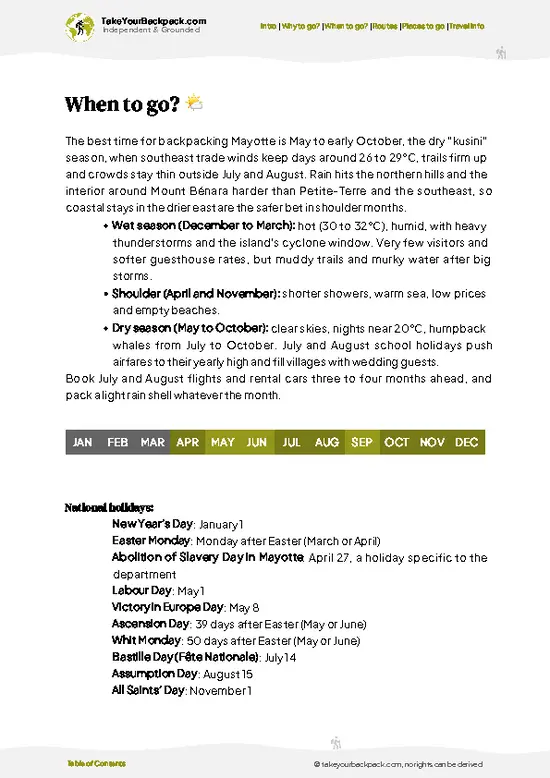
The dry season from May to October is the most comfortable window for Dzaoudzi, with daytime highs of about 27 to 30°C (81 to 86°F).
  • Dry season (May to October): Lower humidity, cooler nights near 20 to 23°C (68 to 73°F), and calm, clear water for snorkeling. Daylight lasts roughly 11 to 12 hours. Prices for flights and rooms rise in July and August, when many visitors and returning families arrive.
  • Whale season (July to October): Humpbacks pass through the lagoon and beyond, so boat trips are at their best, though they also fill up faster.
  • Wet season (November to April): Hot and sticky, with highs of 30 to 33°C (86 to 91°F), heavy downpours and some risk of cyclones. Roads and trails get muddy and boat trips are canceled more often. Rooms are easier to find and sometimes cheaper.
  • Shoulder months
… read more 👉
The dry season from May to October is the most comfortable window for Dzaoudzi, with daytime highs of about 27 to 30°C (81 to 86°F).
  • Dry season (May to October): Lower humidity, cooler nights near 20 to 23°C (68 to 73°F), and calm, clear water for snorkeling. Daylight lasts roughly 11 to 12 hours. Prices for flights and rooms rise in July and August, when many visitors and returning families arrive.
  • Whale season (July to October): Humpbacks pass through the lagoon and beyond, so boat trips are at their best, though they also fill up faster.
  • Wet season (November to April): Hot and sticky, with highs of 30 to 33°C (86 to 91°F), heavy downpours and some risk of cyclones. Roads and trails get muddy and boat trips are canceled more often. Rooms are easier to find and sometimes cheaper.
  • Shoulder months (April to May, November): Fewer people and mixed conditions.
Book boat trips and car rental several weeks ahead for July and August.


source: climatestotravel.comJANJanuary: fair for travelingFEBFebruary: fair for travelingMARMarch: fair for travelingAPRApril: fair for travelingMAYMay: excellent for travelingJUNJune: highly recommended for travelingJULJuly: highly recommended for travelingAUGAugust: highly recommended for travelingSEPSeptember: excellent for travelingOCTOctober: highly recommended for travelingNOVNovember: fair for travelingDECDecember: fair for traveling
when-to-go

✈️ The backpacker research shortcutMayotte Travel Guide

An offline-friendly backpacking guide with optimized travel routes, ranked highlights, transport advice, and the best areas to stay.
example page 0 from our offline Travel Guide for Mayotte
example page 1 from our offline Travel Guide for Mayotte
example page 2 from our offline Travel Guide for Mayotte
example page 3 from our offline Travel Guide for Mayotte
example page 4 from our offline Travel Guide for Mayotte
example page 5 from our offline Travel Guide for Mayotte
example page 6 from our offline Travel Guide for Mayotte
example page 7 from our offline Travel Guide for Mayotte
The digital guide (129 pages) contains:
✅ 27 highlights, ranked by travel appeal
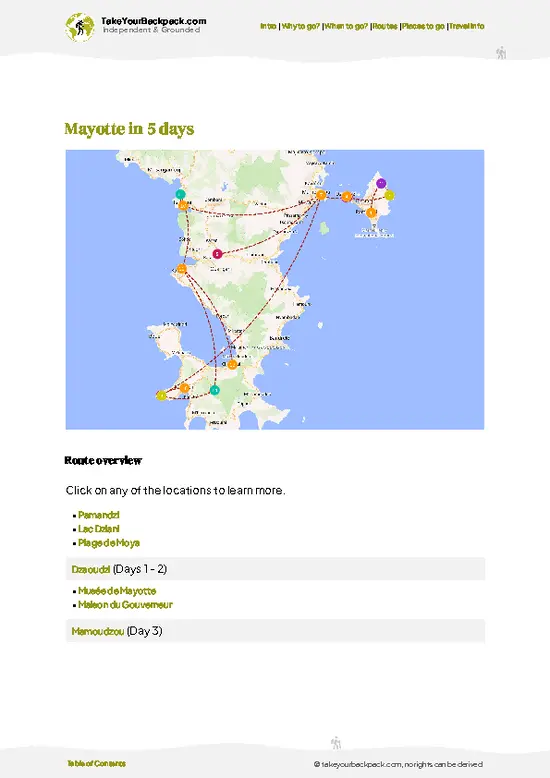
✅ Optimized 2, 3 & 5-day travel routes
✅ Cities, national parks, landmarks, beaches
✅ How to get around
✅ Offline-friendly for travel without Wi-Fi
👉 Click to see all 30+ guide features

📅 Plan smarter in minutes, not weeks
✅ Month by month travel advice
✅ Festivals & national holidays
✅ Budget expectations

🗺️ Go to the right places, skip the overrated ones
✅ Honest pros & cons of destinations
✅ Top hikes, parks & viewpoints
✅ Lesser-known places most travelers miss
✅ Clear “worth it vs skip it” guidance

🛏️ Travel smoothly without rookie mistakes
✅ Best areas to stay
✅ Transport systems explained simply
✅ Common scams & safety advice
✅ SIM cards, money & practical tips

🌍 Understand the country, not just visit it
✅ Culture & traditions
✅ 52 Essential phrases & customs
✅ Festivals worth planning around
✅ Traveler-friendly historical context
✅ Insights that make places more meaningful

📱 Built for real travel conditions
✅ Fully downloadable PDF
✅ Works completely offline
✅ Optimized for phone use
✅ Useful in remote areas & buses
✅ Everything in one place
Stop searching, start planning
Get instant access to your full guide. 30‑day money-back guarantee.
+ Add another guide for just

By proceeding you agree to our terms.
Sent to your inbox immediately after payment • 100% Secure Checkout
Best Backpacking Travel Advisor 2025 tourism awardBest Backpacking
Travel Advisor
2025
What others say about Take Your Backpack Guides:
⭐⭐⭐⭐⭐
Fantastic, amazing amount of information!
⭐⭐⭐⭐⭐
My goodness this is amazing, it's what I've been looking for hats off too you!
⭐⭐⭐⭐⭐
I think this is absolutely BRILLIANT
⭐⭐⭐⭐
Very complete and informative. It's still missing places, but I gotta to commend you
⭐⭐⭐⭐⭐
This is truly amazing, thank you, can't wait to explore it with my kids!
⭐⭐⭐⭐⭐
Awesome resource, thank you!
⭐⭐⭐⭐⭐
This is amazing! Can't wait to explore the ones I haven't seen
⭐⭐⭐⭐
I love this! Well done, great idea.
⭐⭐⭐⭐⭐
Thanks for taking the time to make this gem!
⭐⭐⭐⭐⭐
This might be the best website I've ever seen.
⭐⭐⭐⭐⭐
Congratulations, and thank you so much for your work; it's incredibly valuable.
⭐⭐⭐⭐
In all seriousness I think you did a great job pointing out the important spots
⭐⭐⭐⭐⭐
10/10 very good
⭐⭐⭐⭐⭐
As someone who's only just starting to visit regularly this is awesome, thank you.
⭐⭐⭐⭐
Thank you very much! I'm going to visit my dad, it's going to be very useful!
⭐⭐⭐⭐⭐
This is really cool! We'll be travelling for the first time and this definitely come in handy.
⭐⭐⭐⭐⭐
You are now our minister of culture, congratulations 👨‍💼
⭐⭐⭐⭐⭐
Just wanted to tell you that this is a pearl! Going to follow your recommendations.
⭐⭐⭐⭐⭐
This is so cool. I'll definitely be using the resource for my travels soon.
⭐⭐⭐⭐⭐
This is very impressive! Good work.
⭐⭐⭐⭐⭐
This is an amazing and informative site. Very well done!

🛏️ Where to stay?Best areas and accommodation options

Labattoir and the stretch near Dzaoudzi’s harbor are the best places for a budget bed on Petite-Terre. True hostels and dorms are almost absent in Mayotte, so budget travelers usually choose small guesthouses, simple rooms and rental apartments, with prices around €35 to 70 a night. Beds are limited, so reserve ahead in July and August.
Labattoir suits most backpackers. It has shops, bakeries and street food within a short walk, so you can buy supplies and eat cheaply without hiring a car. Streets are residential and quiet at night, with some scooter noise early in the evening. Shared taxis stop … read more 👉
Labattoir and the stretch near Dzaoudzi’s harbor are the best places for a budget bed on Petite-Terre. True hostels and dorms are almost absent in Mayotte, so budget travelers usually choose small guesthouses, simple rooms and rental apartments, with prices around €35 to 70 a night. Beds are limited, so reserve ahead in July and August.
Labattoir suits most backpackers. It has shops, bakeries and street food within a short walk, so you can buy supplies and eat cheaply without hiring a car. Streets are residential and quiet at night, with some scooter noise early in the evening. Shared taxis stop here, and the barge terminal and airport are close, which makes early departures easy.
The area near the Dzaoudzi harbor is the second choice if you have an early barge or flight. You can walk to the barge in minutes, the lagoon breeze helps in the heat, and the setting is calm. Options are fewer and prices a little higher, and there is little to eat nearby after dark.
Mamoudzou has more rooms, but it is a barge ride away. Staying on Petite-Terre avoids the traffic and the late-night noise of the main island, and the ferry connection stays practical for day trips.

🚌 Getting aroundHow to get around Dzaoudzi

Dzaoudzi’s rock and the causeway are walkable in the cool of early morning, and your feet will do for the old streets and the harbor. Walking stops making sense once you head for Moya beach, the crater lake or anywhere far from the center, because there is little shade and the humidity is heavy. Traffic is light on Petite-Terre but heavy on the main island, and public transport exists but is thin, so you plan around timetables rather than flagging something at random.
  • Walking: The rock, harbor and causeway take under an hour at a slow pace. Go early, because the pavement radiates heat from late morning and shade is scarce. Carry water and wear a hat.
  • Barge to Mamoudzou: The amphibious barge is the backbone of travel here, crossing the lagoon in roughly 15 to 30 minutes. Foot passengers pay about
… read more 👉
Dzaoudzi’s rock and the causeway are walkable in the cool of early morning, and your feet will do for the old streets and the harbor. Walking stops making sense once you head for Moya beach, the crater lake or anywhere far from the center, because there is little shade and the humidity is heavy. Traffic is light on Petite-Terre but heavy on the main island, and public transport exists but is thin, so you plan around timetables rather than flagging something at random.
  • Walking: The rock, harbor and causeway take under an hour at a slow pace. Go early, because the pavement radiates heat from late morning and shade is scarce. Carry water and wear a hat.
  • Barge to Mamoudzou: The amphibious barge is the backbone of travel here, crossing the lagoon in roughly 15 to 30 minutes. Foot passengers pay about €1 each way. Services start before dawn and finish in the late evening, and queues build for the morning commute, so travel outside rush hour. Sit on the open deck for air and the smell of diesel and salt.
  • Shared taxis and minibuses: Local collective taxis link Dzaoudzi, Labattoir and Pamandzi for about €1 to 2. They run when full and mostly in daytime, with few after dark, so ask the driver for the last return before you head out. They are crowded but friendly, and you pay in cash.
  • Rental car or scooter: The only practical way to reach Lac Dziani, Moya and the main island’s beaches on your own schedule. Cars cost about €35 to 60 a day and often need an international license. Book ahead in July and August, as stock is limited. Fuel and a hot parking lot are the main extras. Park off the roadside, since heavy rains can flood low spots.

👛 Costs (as of 22 October 2026)Money, prices, and spending tips

Dzaoudzi costs about €97 a day for a backpacker in high season, and the biggest share goes to the bed. Prices are higher than in neighboring countries because Mayotte is part of France and uses the euro. Hostels are rare, so a basic room stands in for a dorm bed.
CategoryBudget RangeLocal Reality
Dorm or budget bed (high season, July to October)€40 to 60Very few true dorms exist. Expect a simple guesthouse room or apartment. Prices ease off outside July and August.
Meals€15 to 25Street brochettes, samosas and rice plates run about €2 to 8. A sit-down restaurant meal costs €15 to 25.
Local transport€2 to 6The barge to Mamoudzou costs about €1 each way. Shared taxis run €1 to 2. A rental car is €35 to 60 a day on top.
Basic activities and entry fees€10 to 20Lac Dziani and the beaches are free. A
… read more 👉
Dzaoudzi costs about €97 a day for a backpacker in high season, and the biggest share goes to the bed. Prices are higher than in neighboring countries because Mayotte is part of France and uses the euro. Hostels are rare, so a basic room stands in for a dorm bed.
CategoryBudget RangeLocal Reality
Dorm or budget bed (high season, July to October)€40 to 60Very few true dorms exist. Expect a simple guesthouse room or apartment. Prices ease off outside July and August.
Meals€15 to 25Street brochettes, samosas and rice plates run about €2 to 8. A sit-down restaurant meal costs €15 to 25.
Local transport€2 to 6The barge to Mamoudzou costs about €1 each way. Shared taxis run €1 to 2. A rental car is €35 to 60 a day on top.
Basic activities and entry fees€10 to 20Lac Dziani and the beaches are free. A boat trip to the sandbanks costs €50 to 90 on days you book one.
Miscellaneous€5 to 10Water, snacks, sunscreen and a SIM card. Imported goods are pricey.
Total Daily Budget€97Roughly €72 to 121 depending on bed and activities.
Buy fruit and bread at Labattoir and Mamoudzou markets, and eat at local stalls rather than restaurants, to save €10 or more a day.
⚠️ Prices can change and everyone travels differently, so take this as a rough guide. Hope it helps you plan your adventure!

🚌 Day tripsShort trips worth adding

Dzaoudzi works well as a base for day trips because the barge puts you on the main island in under half an hour, though most sights beyond Petite-Terre need a car or a booked tour. Plan around the barge schedule and heavy morning traffic.
Lac Dziani and Moya Beach:
This is the easy half day, all on Petite-Terre. The crater lake is green and calm, ringed by forest, and Moya beach has warm, shallow water for swimming. Reach both in 10 to 20 minutes by car or shared taxi, and spend €0 to 10 total. Go in the dry season when paths are firm. First-timers often arrive at midday, when the heat is brutal, so start early.
👉 Explore Lac Dziani
Mamoudzou:
A short barge crossing brings you to the island’s largest town, with a produce market, waterfront and many cheap lunch stalls. Allow a few hours and about … read more 👉
Dzaoudzi works well as a base for day trips because the barge puts you on the main island in under half an hour, though most sights beyond Petite-Terre need a car or a booked tour. Plan around the barge schedule and heavy morning traffic.
Lac Dziani and Moya Beach:
This is the easy half day, all on Petite-Terre. The crater lake is green and calm, ringed by forest, and Moya beach has warm, shallow water for swimming. Reach both in 10 to 20 minutes by car or shared taxi, and spend €0 to 10 total. Go in the dry season when paths are firm. First-timers often arrive at midday, when the heat is brutal, so start early.
👉 Explore Lac Dziani
Mamoudzou:
A short barge crossing brings you to the island’s largest town, with a produce market, waterfront and many cheap lunch stalls. Allow a few hours and about €10 to 20 with food and local transport. Weekday mornings are the liveliest. Keep a close eye on belongings in crowds and avoid heading out at dusk.
👉 Explore Mamoudzou
Sandbanks and Lagoon Snorkeling:
Boat trips head to the white sandbanks and reef, where turtles and colorful fish are common, and humpback whales appear from July to October. A full-day trip costs roughly €50 to 90 per person with lunch sometimes included. Calm dry-season mornings are best. Book ahead, and wear a rash guard, because the midday sun burns quickly.

N’Gouja Beach:
The south coast is the place to snorkel with turtles and spot lemurs in the trees at the edge of the beach. Expect 2 to 3 hours each way with the barge and a car, and about €50 to 90 including rental and fuel. Go early and leave before dark, since the roads are winding and poorly lit.

🛡️ SafetyScams, Hazards, and Annoyances

Petite-Terre is calmer than the main island, and daytime on Dzaoudzi’s rock, the harbor and Labattoir is relaxed. The main concerns are petty theft and, on the main island, periods of tension in some districts. Keep phones and cameras out of sight on the barge and in Mamoudzou markets, and avoid carrying more cash than you need.
After dark, stick to the causeway and Labattoir streets you already know, and take a taxi rather than walking long, unlit stretches. Solo travelers, including women, report few problems in the center, but quiet roads at night are not a place to wander alone. On the main island, check with your host or local contacts before traveling to areas such as Kawéni or driving at night, since unrest and road blockages have affected traffic in the past. Do not leave valuables … read more 👉
Petite-Terre is calmer than the main island, and daytime on Dzaoudzi’s rock, the harbor and Labattoir is relaxed. The main concerns are petty theft and, on the main island, periods of tension in some districts. Keep phones and cameras out of sight on the barge and in Mamoudzou markets, and avoid carrying more cash than you need.
After dark, stick to the causeway and Labattoir streets you already know, and take a taxi rather than walking long, unlit stretches. Solo travelers, including women, report few problems in the center, but quiet roads at night are not a place to wander alone. On the main island, check with your host or local contacts before traveling to areas such as Kawéni or driving at night, since unrest and road blockages have affected traffic in the past. Do not leave valuables in a parked car.
Swimming needs care too. Beaches have no lifeguards, and currents run strong outside the lagoon. Cyclone season runs November to April, so follow local weather alerts.

FAQTraveler FAQ

Worth a visit, but for a short one. The rock’s colonial buildings, Moya beach and the crater lake at Lac Dziani fill a day or two, and the quiet pace suits travelers who want calm water over nightlife. Most of the island’s best snorkeling and turtle spots lie across the lagoon, reached by the barge in about 15 to 30 minutes.
Two days cover Dzaoudzi and Petite-Terre comfortably, with time for the rock, Labattoir and a beach afternoon at Moya. Add one or two more days for a sandbank boat trip (about €50 to 90) and a drive to N’Gouja. Three to four days suit most travelers who also want Mamoudzou.
Yes, Dzaoudzi is easy to visit from Mamoudzou, since the barge takes roughly 15 to 30 minutes and costs about €1 each way. A day gives you enough time for the rock, Labattoir and a swim at Moya. Check the last return before dark, and start early because the heat is intense by midday.
⚠️ Things can change over time, so always validate details locally before you go.

Other Mahoran towns near Dzaoudzi

Explore more nearby:

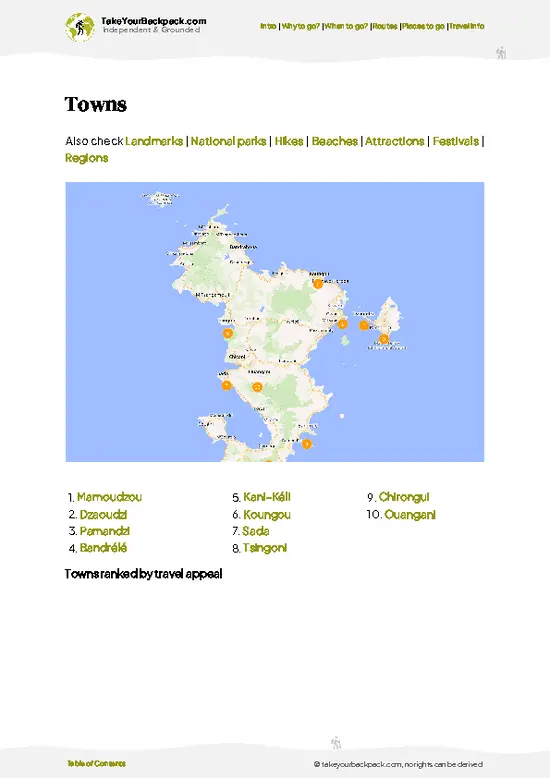
  • Mamoudzou—market district, administrative center, urban sprawl| 3 km away
  • Sima—eastern coast, fishing port, mangrove creeks| 3 km away
  • Pamandzi—airport access, Petite-Terre, salt lake| 3 km away

💡 Not sure where to go next?
Create a personalized itinerary for Mayotte including Dzaoudzi and the places that fit your trip.

Generate my itinerary

👉 Discover all towns

Or checkout all Mayotte has to offer (think cities, towns, villages, national parks, hikes, beaches, festivals)
Country photo of Mayotte

We 💚 feedbackSumming up the experience

Dzaoudzi will suit you best if you like history, lagoon views and quiet evenings more than hostel parties. Solo travelers and slow walkers will do well here. I would stay a night to catch the empty rock at dawn, and I would pack your own water and snacks, because shops close early and options are thin after dark.

✍️ Help improve this page!
The information on this page is based on in-depth research, insights shared by experienced travelers, and feedback from the local travel community in Mayotte. While every effort is made to keep the information accurate and current, conditions can change — so if you spot anything incorrect or outdated, please get in touch.


🙋‍♂️ Give feedback

👋 Meet the founderWho’s Behind Take Your Backpack?

Johan, backpacker and founder of TakeYourBackpackHi, I’m Johan (Netherlands 🇳🇱), the creator of TakeYourBackpack. Over the past 3 decades, I’ve backpacked through 90+ countries across six continents, gaining extensive experience with independent travel, long-term trips, and overland routes.

This site is built on a combination of firsthand travel experience and carefully curated insights from other backpackers. Many guides are based on places I’ve personally visited, while others bring together tips, observations, and practical advice shared by trusted travelers I’ve met along the way.

The goal is to provide realistic, experience-driven guidance — not generic itineraries — so you can explore destinations with better context, clearer expectations, and more confidence.