×

Mayotte🇾🇹 | townsKani-KéliMont Choungui, ylang-ylang hills, fishing landing, southwest shore | things to do and best time to go

Explore DzaoudziExplore Mamoudzou

Backpacking in Kani-Kéli
👍 Recommendedtown ranked #5
By Johan Kruseman 🇳🇱 | Updated October 22, 2026

The real decision at Kani-Kéli is whether to sleep here or treat it as a long day out from Mamoudzou, and a rental car or a patient wait for the sparse minibuses tips it either way. Kani-Kéli sits on the southwest coast of Mayotte, at the end of a winding road through ylang-ylang and cassava hillsides. The reward is quiet: calm lagoon water, fishing boats on the sand, and mango-shaded lanes where goats stand about at noon. The hard parts are heat, thin public transport and almost no nightlife, so evenings mean a plate of grilled fish and the sound of frogs. Meeting other backpackers is rare. Compared with busy Mamoudzou, Kani-Kéli is smaller, greener and far more relaxed, and compared with the beach-resort feel of Mtsamoudou, it is more of a working village.

Discover everything you want to know in the 📖 Mayotte Travel Guide.


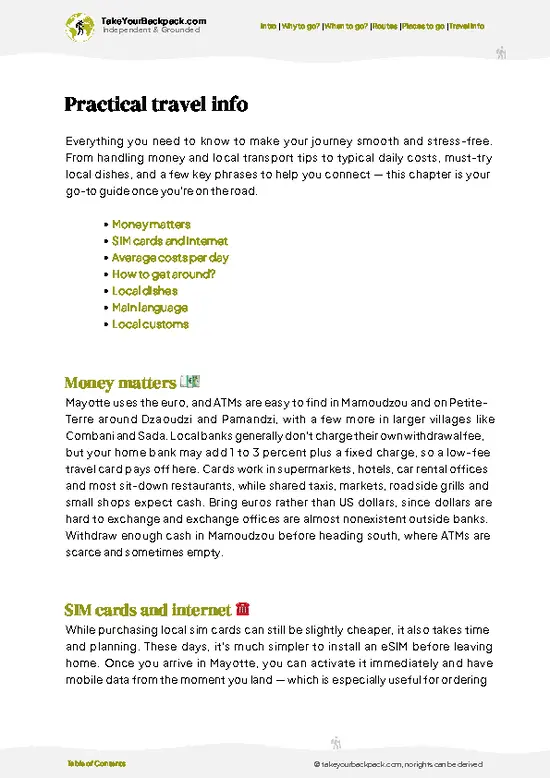
example page 0 from our offline Travel Guide for Mayotte
example page 1 from our offline Travel Guide for Mayotte
example page 2 from our offline Travel Guide for Mayotte
example page 3 from our offline Travel Guide for Mayotte
example page 4 from our offline Travel Guide for Mayotte
example page 5 from our offline Travel Guide for Mayotte
example page 6 from our offline Travel Guide for Mayotte
example page 7 from our offline Travel Guide for Mayotte
Loading the map 🌍
CLICK TO FILTER
towns
landmarks
national parks
hikes
beaches
attractions
festivals
regions
SHOW COUNTRY’S BESTSHOW ALL

✨ Why go?
Ranked #5 town in Mayotte
What makes this town worth visiting

Kani-Kéli earns a stop if you want the southwest coast of Mayotte without the traffic of the capital. The draw is the string of calm beaches and the Mont Choungui foothills just beyond the village, plus a village rhythm that suits slow travelers who like to wander rather than tick off sights. Most people stay one or two nights, and those who bring a car or arrange rides linger longer, using Kani-Kéli as a base for coastal walks and snorkeling in clear shallows. Accommodation is small-scale, mostly family-run guesthouses and gîtes, so the feel is homey rather than social. Solo travelers who enjoy quiet will like it, and hikers get sunrise-friendly trails with the lagoon below. Food comes from local stalls and home cooking, with fresh fish, cassava and coconut sauces. If you need hostel banter and nightlife, make it a short stop instead.

💡 HighlightsMust-see experiences and standout moments

  1. Mont Choungui: The signature peak of the southwest, a volcanic summit with long views over the lagoon and the southern tip of the island. The hike takes about 3 to 4 hours round trip, is free, and is best started early in the morning before the heat builds.
  2. Plage de Kani-Bé: A calm lagoon beach with warm shallows and fishing boats pulled up on the sand. Free, with 1 to 2 hours enough for a swim, and mornings are quietest.
  3. Ylang-ylang plantations: The hills around the village grow the flowering trees behind Mayotte’s perfume industry. A walk among them takes about 1 hour and costs nothing, and the flowers smell strongest in the cooler early hours.
  4. Village waterfront and fishing landing: Boats come in with the catch and neighbors gather to buy. Free, about 45 minutes, best in the late afternoon
… read more 👉
  1. Mont Choungui: The signature peak of the southwest, a volcanic summit with long views over the lagoon and the southern tip of the island. The hike takes about 3 to 4 hours round trip, is free, and is best started early in the morning before the heat builds.
  2. Plage de Kani-Bé: A calm lagoon beach with warm shallows and fishing boats pulled up on the sand. Free, with 1 to 2 hours enough for a swim, and mornings are quietest.
  3. Ylang-ylang plantations: The hills around the village grow the flowering trees behind Mayotte’s perfume industry. A walk among them takes about 1 hour and costs nothing, and the flowers smell strongest in the cooler early hours.
  4. Village waterfront and fishing landing: Boats come in with the catch and neighbors gather to buy. Free, about 45 minutes, best in the late afternoon when the day’s catch is sorted.
  5. Mosque and old village lanes: A stroll through narrow lanes with small shops and houses shows daily Mahoran life. Free, about 1 hour, and modest dress with a respectful approach is expected.
Beyond the village, the Sada and Bouéni coast and the beaches near Mtsamoudou are good day outings, as are the Bandrélé sites. Pair the Mont Choungui hike in the early morning with a late swim at Plage de Kani-Bé.
Spotted a mistake or missing something? Contact us.

Things to do near Kani-Kéli

Ratings based on Tripadvisor reviews. When you book through this link, you support our work at no extra cost to you.

🏘️ NeighborhoodsWhere things are and how it's laid out

Kani-Kéli spreads along the southwest coast of Mayotte as a string of small villages rather than one center, so you explore it by hopping between them.
  • Kani-Kéli village: The administrative heart is a quiet grid of low concrete houses, a mairie and a few small shops (épiceries) that sell baguettes, canned sardines and cold sodas. Roosters and goats set the soundtrack. Walkable in 15 minutes, and you leave with a feel for everyday village life.
  • Bandrélé-side coast near Choungui: Dirt tracks climb through ylang-ylang and mango trees toward the Choungui peninsula, with red soil underfoot and sticky heat by midday. Shade is scarce on the final stretch. The reward is a ridge view over the lagoon and the Passe en S.
  • Bouéni road villages: Small seaside hamlets where fishermen pull wooden pirogues onto
… read more 👉
Kani-Kéli spreads along the southwest coast of Mayotte as a string of small villages rather than one center, so you explore it by hopping between them.
  • Kani-Kéli village: The administrative heart is a quiet grid of low concrete houses, a mairie and a few small shops (épiceries) that sell baguettes, canned sardines and cold sodas. Roosters and goats set the soundtrack. Walkable in 15 minutes, and you leave with a feel for everyday village life.
  • Bandrélé-side coast near Choungui: Dirt tracks climb through ylang-ylang and mango trees toward the Choungui peninsula, with red soil underfoot and sticky heat by midday. Shade is scarce on the final stretch. The reward is a ridge view over the lagoon and the Passe en S.
  • Bouéni road villages: Small seaside hamlets where fishermen pull wooden pirogues onto gray-brown sand and women sell fried cassava and bananas from roadside stalls. Distances between them are too long for comfortable walking. You get salty air and a snack eaten facing the water.
  • Passi-Keli and Nyambadao beaches: Wide pale sand backed by coconut palms, with the surf hushed by the reef. Evenings are silent apart from frogs and wind in the fronds. There is no nightlife at all, and the stars are what you came for.

⌛️ 1 dayA smart one-day plan

A slow coastal day of one hike, one swim and a village walk, keeping to the cooler hours.
6:30 AM, Trailhead at Mont Choungui: Start early so the heat does not catch you on the climb. The path winds through scrub and rocky slopes to the summit, and the view over the lagoon is clearest in morning light. Allow about 3 hours up and down.
10:30 AM, Plage de Kani-Bé: Drive or ride down to the shore and cool off in the shallows. Rest under the trees, snorkel along the rocks and watch fishermen mending nets.
12:30 PM, Village lunch: Look for a family-run stall or guesthouse serving grilled fish, cassava and coconut sauce. Eat slowly and use the midday heat to rest.
3:00 PM, Ylang-ylang hillsides: Walk the lanes above the village, away from the usual tourist circuit, where old plantation terraces and … read more 👉
A slow coastal day of one hike, one swim and a village walk, keeping to the cooler hours.
6:30 AM, Trailhead at Mont Choungui: Start early so the heat does not catch you on the climb. The path winds through scrub and rocky slopes to the summit, and the view over the lagoon is clearest in morning light. Allow about 3 hours up and down.
10:30 AM, Plage de Kani-Bé: Drive or ride down to the shore and cool off in the shallows. Rest under the trees, snorkel along the rocks and watch fishermen mending nets.
12:30 PM, Village lunch: Look for a family-run stall or guesthouse serving grilled fish, cassava and coconut sauce. Eat slowly and use the midday heat to rest.
3:00 PM, Ylang-ylang hillsides: Walk the lanes above the village, away from the usual tourist circuit, where old plantation terraces and small distilleries still sit between houses. Ask politely before entering private plots, and the locals are usually happy to point out the flowers.
5:00 PM, Fishing landing: Return to the waterfront as boats land. Watch the catch sorted and the evening begin, then finish with a short wander through the lanes and the mosque quarter.

🌤️ When to go?Seasonal considerations and timing

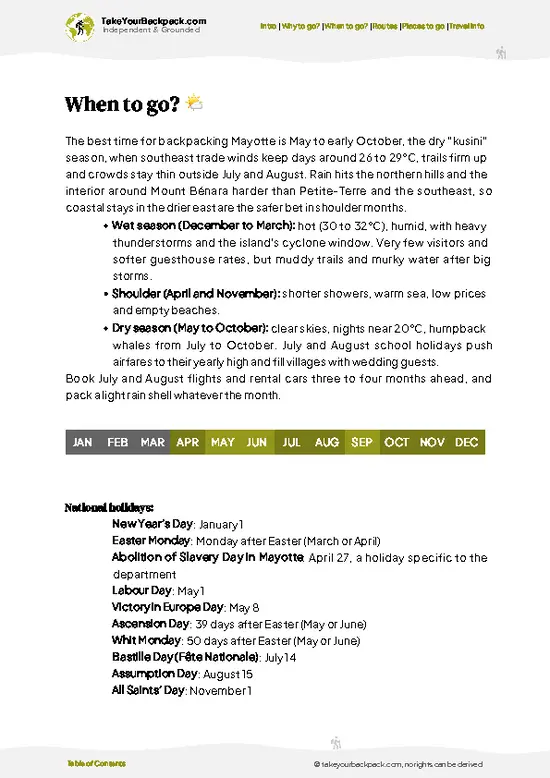
The dry season, from May to October, is the easiest time for Kani-Kéli, with sunny days and low humidity.
  • Dry Season (May to October): Days reach 27 to 30°C (81 to 86°F), nights dip to 19 to 22°C (66 to 72°F), and showers are rare. Daylight runs about 11 hours. Humpback whales pass through the lagoon from roughly July to September. Flights are priciest in July and August.
  • Wet Season (November to April): Expect 28 to 33°C (82 to 91°F), heavy humidity and downpours that turn the dirt tracks to red mud. Cyclone risk peaks from January to March. Daylight stretches to about 12.5 hours, and prices drop.
  • Shoulder Months (April, May, November): Fewer visitors, warm sea, and rain easing or starting.
Book flights to Mayotte early for July and August, and plan hikes for the cooler morning hours.

source: climatestotravel.comJANJanuary: fair for travelingFEBFebruary: fair for travelingMARMarch: fair for travelingAPRApril: fair for travelingMAYMay: highly recommended for travelingJUNJune: highly recommended for travelingJULJuly: excellent for travelingAUGAugust: excellent for travelingSEPSeptember: excellent for travelingOCTOctober: highly recommended for travelingNOVNovember: fair for travelingDECDecember: fair for traveling
when-to-go

✈️ The backpacker research shortcutMayotte Travel Guide

An offline-friendly backpacking guide with optimized travel routes, ranked highlights, transport advice, and the best areas to stay.
example page 0 from our offline Travel Guide for Mayotte
example page 1 from our offline Travel Guide for Mayotte
example page 2 from our offline Travel Guide for Mayotte
example page 3 from our offline Travel Guide for Mayotte
example page 4 from our offline Travel Guide for Mayotte
example page 5 from our offline Travel Guide for Mayotte
example page 6 from our offline Travel Guide for Mayotte
example page 7 from our offline Travel Guide for Mayotte
The digital guide (129 pages) contains:
✅ 27 highlights, ranked by travel appeal
✅ Optimized 2, 3 & 5-day travel routes
✅ Cities, national parks, landmarks, beaches
✅ How to get around
✅ Offline-friendly for travel without Wi-Fi
👉 Click to see all 30+ guide features

📅 Plan smarter in minutes, not weeks
✅ Month by month travel advice
✅ Festivals & national holidays
✅ Budget expectations

🗺️ Go to the right places, skip the overrated ones
✅ Honest pros & cons of destinations
✅ Top hikes, parks & viewpoints
✅ Lesser-known places most travelers miss
✅ Clear “worth it vs skip it” guidance

🛏️ Travel smoothly without rookie mistakes
✅ Best areas to stay
✅ Transport systems explained simply
✅ Common scams & safety advice
✅ SIM cards, money & practical tips

🌍 Understand the country, not just visit it
✅ Culture & traditions
✅ 52 Essential phrases & customs
✅ Festivals worth planning around
✅ Traveler-friendly historical context
✅ Insights that make places more meaningful

📱 Built for real travel conditions
✅ Fully downloadable PDF
✅ Works completely offline
✅ Optimized for phone use
✅ Useful in remote areas & buses
✅ Everything in one place
Stop searching, start planning
Get instant access to your full guide. 30‑day money-back guarantee.
+ Add another guide for just

By proceeding you agree to our terms.
Sent to your inbox immediately after payment • 100% Secure Checkout
Best Backpacking Travel Advisor 2025 tourism awardBest Backpacking
Travel Advisor
2025
What others say about Take Your Backpack Guides:
⭐⭐⭐⭐⭐
Fantastic, amazing amount of information!
⭐⭐⭐⭐⭐
My goodness this is amazing, it's what I've been looking for hats off too you!
⭐⭐⭐⭐⭐
I think this is absolutely BRILLIANT
⭐⭐⭐⭐
Very complete and informative. It's still missing places, but I gotta to commend you
⭐⭐⭐⭐⭐
This is truly amazing, thank you, can't wait to explore it with my kids!
⭐⭐⭐⭐⭐
Awesome resource, thank you!
⭐⭐⭐⭐⭐
This is amazing! Can't wait to explore the ones I haven't seen
⭐⭐⭐⭐
I love this! Well done, great idea.
⭐⭐⭐⭐⭐
Thanks for taking the time to make this gem!
⭐⭐⭐⭐⭐
This might be the best website I've ever seen.
⭐⭐⭐⭐⭐
Congratulations, and thank you so much for your work; it's incredibly valuable.
⭐⭐⭐⭐
In all seriousness I think you did a great job pointing out the important spots
⭐⭐⭐⭐⭐
10/10 very good
⭐⭐⭐⭐⭐
As someone who's only just starting to visit regularly this is awesome, thank you.
⭐⭐⭐⭐
Thank you very much! I'm going to visit my dad, it's going to be very useful!
⭐⭐⭐⭐⭐
This is really cool! We'll be travelling for the first time and this definitely come in handy.
⭐⭐⭐⭐⭐
You are now our minister of culture, congratulations 👨‍💼
⭐⭐⭐⭐⭐
Just wanted to tell you that this is a pearl! Going to follow your recommendations.
⭐⭐⭐⭐⭐
This is so cool. I'll definitely be using the resource for my travels soon.
⭐⭐⭐⭐⭐
This is very impressive! Good work.
⭐⭐⭐⭐⭐
This is an amazing and informative site. Very well done!

🛏️ Where to stay?Choosing the right base

The best base for a budget stay is Kani-Kéli village itself, with Mamoudzou as the fallback if you rely on public transport. Kani-Kéli has a handful of guesthouses and simple rooms, but no true hostel scene, so rooms are small in number and book out in the whale season. Nights are very quiet and the village feels safe after dark, with only dogs and roosters for noise. Minibuses connect to the capital, though evening service is limited, so staying here suits those who have a car or are happy to stay put.

Mamoudzou offers the widest choice of budget beds, supermarkets and the barge to Petite-Terre, … read more 👉
The best base for a budget stay is Kani-Kéli village itself, with Mamoudzou as the fallback if you rely on public transport. Kani-Kéli has a handful of guesthouses and simple rooms, but no true hostel scene, so rooms are small in number and book out in the whale season. Nights are very quiet and the village feels safe after dark, with only dogs and roosters for noise. Minibuses connect to the capital, though evening service is limited, so staying here suits those who have a car or are happy to stay put.

Mamoudzou offers the widest choice of budget beds, supermarkets and the barge to Petite-Terre, plus the widest range of onward transport. It is noisier and busier, and a long ride from the southern beaches. Many travelers split their time, spending a night or two in the south and the rest in the capital. Book ahead from July to September, and ask hosts about airport pickups since transfers are scarce late in the day.

🚌 Getting aroundGetting around like a local

Kani-Kéli has no bus station as such, so you reach the village center from the main road by a short walk or a lift from the stop on the RN2 route, which takes about five minutes. Traffic is light locally, but the roads from Mamoudzou clog badly in the morning and late afternoon. Public transport is limited and slow, so most backpackers combine buses with hitching or a rental car.
  • Walking: Fine within a village, where you pass flowering hibiscus, chickens and the smell of wood smoke. Between villages it is hot, with little shade. You get slow, close-up detail you miss from a car.
  • Shared minibus (taxi collectif): The white vans run from Mamoudzou, about €2 to 3 per trip, and take 1 hour 15 minutes to 1 hour 45 minutes depending on traffic. They fill up before leaving, often with schoolchildren
… read more 👉
Kani-Kéli has no bus station as such, so you reach the village center from the main road by a short walk or a lift from the stop on the RN2 route, which takes about five minutes. Traffic is light locally, but the roads from Mamoudzou clog badly in the morning and late afternoon. Public transport is limited and slow, so most backpackers combine buses with hitching or a rental car.
  • Walking: Fine within a village, where you pass flowering hibiscus, chickens and the smell of wood smoke. Between villages it is hot, with little shade. You get slow, close-up detail you miss from a car.
  • Shared minibus (taxi collectif): The white vans run from Mamoudzou, about €2 to 3 per trip, and take 1 hour 15 minutes to 1 hour 45 minutes depending on traffic. They fill up before leaving, often with schoolchildren and shopping. Services thin out after mid-afternoon and are rare on Sundays, so check the return before you go. You get a local ride and a window on the southern coast.
  • Hitchhiking: Widely accepted on quiet southern roads, and drivers often stop within 10 to 15 minutes. Carry water and a hat while you wait. It saves money, and you get conversations in French and Shimaore.
  • Rental car: About €30 to 55 a day, booked in Mamoudzou or at the airport. The roads are winding with steep drops, and potholes appear after rain. Fuel runs about €1.50 a liter. It is the only comfortable way to reach Choungui and remote beaches at your own pace, with stops at lookouts along the way.
  • Taxi: Pre-arranged local rides cost roughly €10 to 25 for short hops, more from Mamoudzou. Useful for late arrivals when minibuses have stopped.

👛 Costs (as of 22 October 2026)Money, prices, and spending tips

Kani-Kéli costs a backpacker about €67 a day in high season, mostly for lodging and getting around. Everything is priced in euros, and prices run well above mainland Africa because most goods are imported.
CategoryBudget RangeLocal Reality
Dorm accommodation€25 to 40 (high season), €20 to 30 (low season)Basic guesthouse rooms or gîtes, since true dorms are rare; book ahead from July to September.
Meals€12 to 20Baguettes and groceries from small shops, plus roadside snacks; restaurant mains cost €10 to 18.
Local transport€4 to 10Shared minibuses cost €2 to 3 per ride; a rental car runs €30 to 55 a day.
Basic activities/entry fees€0 to 10Beaches and hikes are free; lagoon boat trips or snorkeling cost more.
Miscellaneous expenses€3 to 8Water, SIM data, sunscreen and the occasional cold drink.
Total
… read more 👉
Kani-Kéli costs a backpacker about €67 a day in high season, mostly for lodging and getting around. Everything is priced in euros, and prices run well above mainland Africa because most goods are imported.
CategoryBudget RangeLocal Reality
Dorm accommodation€25 to 40 (high season), €20 to 30 (low season)Basic guesthouse rooms or gîtes, since true dorms are rare; book ahead from July to September.
Meals€12 to 20Baguettes and groceries from small shops, plus roadside snacks; restaurant mains cost €10 to 18.
Local transport€4 to 10Shared minibuses cost €2 to 3 per ride; a rental car runs €30 to 55 a day.
Basic activities/entry fees€0 to 10Beaches and hikes are free; lagoon boat trips or snorkeling cost more.
Miscellaneous expenses€3 to 8Water, SIM data, sunscreen and the occasional cold drink.
Total Daily Budget€67Roughly €50 in low season with careful spending.
Buy supplies at a supermarket in Mamoudzou before heading south, since village shops charge more and stock less.
⚠️ Prices can change and everyone travels differently, so take this as a rough guide. Hope it helps you plan your adventure!

🚌 Day tripsBest day trips from Kani-Kéli

Kani-Kéli works well as a base for day trips on the southern half of Mayotte, though a rental car makes it far easier than minibuses.Choungui Peninsula Hike: The trail to the Choungui ridge takes 2 to 3 hours round trip on red earth, with a few steep scrambles. Start early to beat the heat, and bring at least 1.5 liters of water. Costs are essentially zero beyond transport. The dry season is best, since the clay becomes slippery in rain.
Sada and Chirongui Villages: About 30 to 40 minutes by car, these towns give a taste of daily life with markets, mosques and coastal cafés. A minibus plus walking costs about €4 to 6 return. Many first-timers arrive in the afternoon after the stalls pack up, so go by late morning.
👉 Explore SadaMont Choungui and Passe en S Viewpoints: Lookouts above the narrow … read more 👉
Kani-Kéli works well as a base for day trips on the southern half of Mayotte, though a rental car makes it far easier than minibuses.Choungui Peninsula Hike: The trail to the Choungui ridge takes 2 to 3 hours round trip on red earth, with a few steep scrambles. Start early to beat the heat, and bring at least 1.5 liters of water. Costs are essentially zero beyond transport. The dry season is best, since the clay becomes slippery in rain.
Sada and Chirongui Villages: About 30 to 40 minutes by car, these towns give a taste of daily life with markets, mosques and coastal cafés. A minibus plus walking costs about €4 to 6 return. Many first-timers arrive in the afternoon after the stalls pack up, so go by late morning.
👉 Explore SadaMont Choungui and Passe en S Viewpoints: Lookouts above the narrow reef channel show the lagoon in turquoise and navy stripes, and July to September brings whale sightings. Driving takes 30 to 45 minutes, and a car rental share averages €15 to 25 per person.
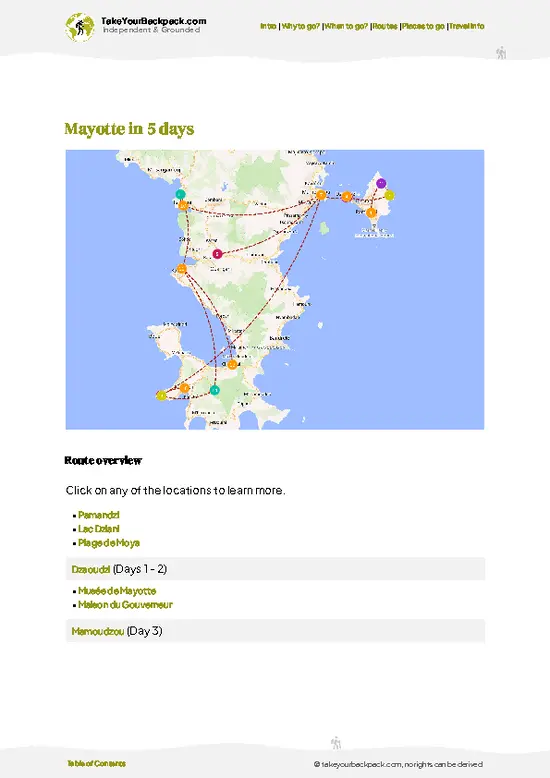
Mamoudzou and Petite-Terre: The capital is 1 hour 15 minutes to 1 hour 45 minutes away, and the barge to Dzaoudzi costs about €1 return. Plan for Moya beach and the Dzaoudzi rock. Leave by 3 pm so you are not stranded without a minibus.

🛡️ SafetyTraveler Safety Guide

Kani-Kéli is among the calmer corners of Mayotte, and most visitors have no trouble beyond heat and rough roads. Petty theft from parked cars and unattended beach bags does occur on the island, so keep valuables out of sight and lock the car even for a short stop. Walking alone at night in the village is generally fine, but unlit roads have no pavement and drivers move fast, so carry a headlamp and avoid hitching after dark. Tensions and occasional road blockades have occurred around the island in recent years, so ask your host about conditions before long drives toward Mamoudzou. Swim only where locals do, since currents in the passes can be strong, and treat the reef with care because rock and coral cut easily. Dress modestly in villages, since the population is largely Muslim, and greet … read more 👉
Kani-Kéli is among the calmer corners of Mayotte, and most visitors have no trouble beyond heat and rough roads. Petty theft from parked cars and unattended beach bags does occur on the island, so keep valuables out of sight and lock the car even for a short stop. Walking alone at night in the village is generally fine, but unlit roads have no pavement and drivers move fast, so carry a headlamp and avoid hitching after dark. Tensions and occasional road blockades have occurred around the island in recent years, so ask your host about conditions before long drives toward Mamoudzou. Swim only where locals do, since currents in the passes can be strong, and treat the reef with care because rock and coral cut easily. Dress modestly in villages, since the population is largely Muslim, and greet people with a friendly bonjour. Scams are uncommon.

FAQCommon questions from travelers

Kani-Kéli is worth visiting if you want quiet beaches and hiking, rather than just passing through. The Choungui peninsula trail takes 2 to 3 hours and rewards you with lagoon views, while whales appear off the coast from about July to September. Expect little nightlife and sparse services, so it suits travelers happy with simple village stays.
Two to three days is enough in Kani-Kéli to cover the Choungui hike, a beach day and a drive along the southern coast. With a car, a third day lets you add Sada and Passe en S viewpoints. Without a car, plan on 3 days because minibuses are slow and thin out after mid-afternoon.
Kani-Kéli can be done as a day trip from Mamoudzou, but it is a long one. The drive takes 1 hour 15 minutes to 1 hour 45 minutes each way depending on traffic, and minibuses cost about €2 to 3 per ride with limited late service. A rental car at €30 to 55 a day makes a round trip practical, though staying a night gives you more time on the trails.
⚠️ Things can change over time, so always validate details locally before you go.

Other Mahoran towns near Kani-Kéli

Explore more nearby:

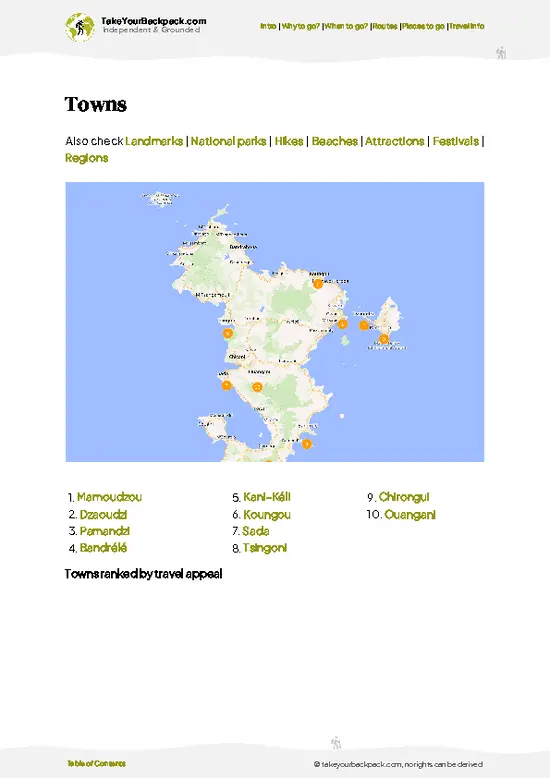
  • Chirongui—southern hills, roadside stalls, agricultural produce| 5 km away
  • Bandrélé—coastal villages, Baobab forests, lagoon views| 11 km away
  • Sada—traditional crafts, Friday market, inland crossroads| 12 km away

💡 Not sure where to go next?
Create a personalized itinerary for Mayotte including Kani-Kéli and the places that fit your trip.

Generate my itinerary

👉 Discover all towns

Or checkout all Mayotte has to offer (think cities, towns, villages, national parks, hikes, beaches, festivals)
Country photo of Mayotte

We 💚 feedbackIs it worth it?

Kani-Kéli works best as one or two nights, enough for the Mont Choungui hike and a lazy lagoon afternoon. Stay longer only if you have a car and want to explore the coast. I would bring cash, water and insect repellent, and skip any plan that depends on late buses.

✍️ Help improve this page!
The information on this page is based on in-depth research, insights shared by experienced travelers, and feedback from the local travel community in Mayotte. While every effort is made to keep the information accurate and current, conditions can change — so if you spot anything incorrect or outdated, please get in touch.


🙋‍♂️ Give feedback

👋 Meet the founderWho’s Behind Take Your Backpack?

Johan, backpacker and founder of TakeYourBackpackHi, I’m Johan (Netherlands 🇳🇱), the creator of TakeYourBackpack. Over the past 3 decades, I’ve backpacked through 90+ countries across six continents, gaining extensive experience with independent travel, long-term trips, and overland routes.

This site is built on a combination of firsthand travel experience and carefully curated insights from other backpackers. Many guides are based on places I’ve personally visited, while others bring together tips, observations, and practical advice shared by trusted travelers I’ve met along the way.

The goal is to provide realistic, experience-driven guidance — not generic itineraries — so you can explore destinations with better context, clearer expectations, and more confidence.