×

Mexico🇲🇽 | regionsYucatán PeninsulaMaya ruins, flamingo coast, yellow-walled Izamal, Mérida plazas | things to do and best time to go

Explore Tehuacán-Cuicatlán ValleyExplore Isla Holbox

Backpacking in Yucatán Peninsula
🏆 Top pickregion ranked #2
By Johan Kruseman 🇳🇱 | Updated October 20, 2026

Most people come to the Yucatán Peninsula for Chichén Itzá and the cenotes, and they leave with sunburned shoulders and a very good photo of a pyramid. What gets overlooked is the colonial interior: Mérida, Valladolid and small Maya villages where the cooking and the language feel nothing like the resort coast. The peninsula sits in southeastern Mexico, a flat limestone shelf with almost no surface rivers, which is why the sinkholes matter. Cancún prices are set for package tourists, so experienced travelers sleep in Valladolid or Mérida and take colectivos, the shared vans that run on a fill-up-and-go schedule. Ticket windows at big ruins open early, so arrive then. A cook in Valladolid once waved my menu away and said, “Pork, pibil, today. Everything else is for tourists.” She was right. Lunch arrived wrapped in a banana leaf, with pickled red onions glowing pink on top.

Discover everything you want to know in the 📖 Mexico Travel Guide.


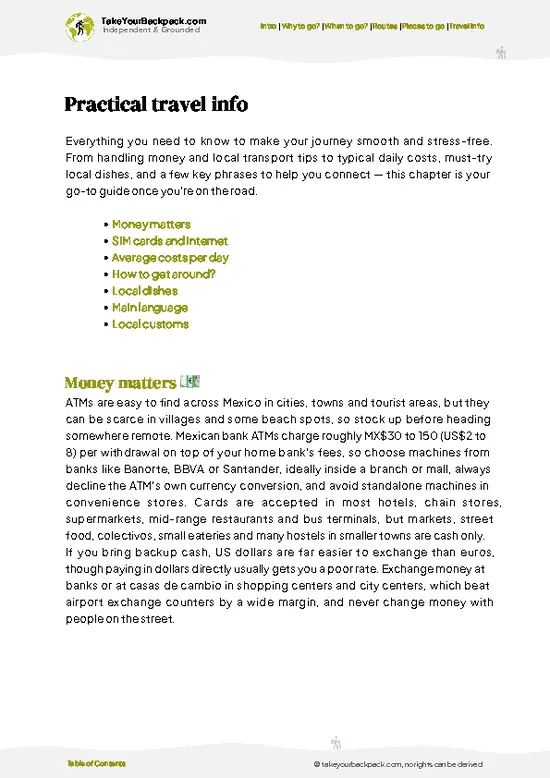
example page 0 from our offline Travel Guide for Mexico
example page 1 from our offline Travel Guide for Mexico
example page 2 from our offline Travel Guide for Mexico
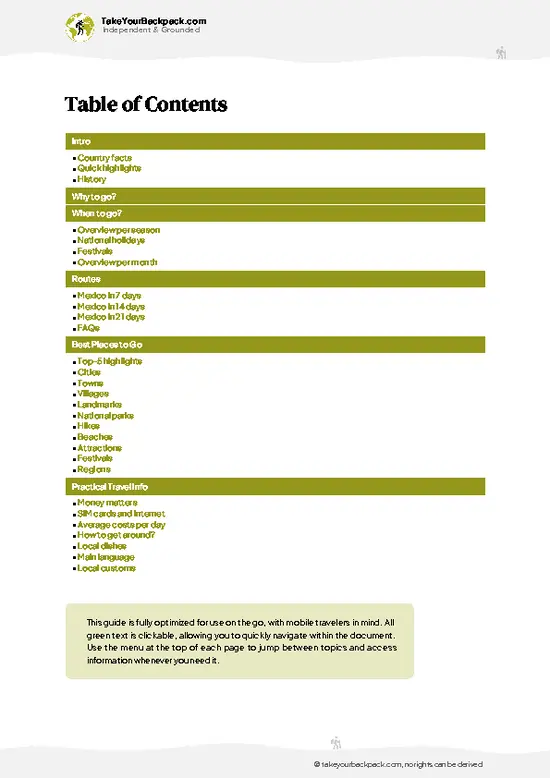
example page 3 from our offline Travel Guide for Mexico
example page 4 from our offline Travel Guide for Mexico
example page 5 from our offline Travel Guide for Mexico
example page 6 from our offline Travel Guide for Mexico
example page 7 from our offline Travel Guide for Mexico
Loading the map 🌍
CLICK TO FILTER
cities
towns
villages
landmarks
national parks
hikes
beaches
attractions
festivals
regions
SHOW COUNTRY’S BESTSHOW ALL

✨ Why go?
Ranked #2 region in Mexico
What makes it a must-see region

The Yucatán Peninsula packs three very different trips into one flat, connected shelf of limestone. You can sleep beside the Caribbean, then spend a morning among the Puuc route ruins of Uxmal and Kabah, then end up in a courtyard in colonial Mérida without ever flying. Distances are short enough that you can change plans halfway without losing a day. That flexibility is the real reason backpackers linger here.

The second draw is the water underground. The peninsula has thousands of cenotes, natural sinkholes where you swim in cool, clear, mineral-rich pools beneath rock ceilings. Some are open skylights, others are caves lit by a single shaft of light. Local farms and villages run many of them, so your entry fee often goes straight to the community.

Finally, the food and language. In the … read more 👉
The Yucatán Peninsula packs three very different trips into one flat, connected shelf of limestone. You can sleep beside the Caribbean, then spend a morning among the Puuc route ruins of Uxmal and Kabah, then end up in a courtyard in colonial Mérida without ever flying. Distances are short enough that you can change plans halfway without losing a day. That flexibility is the real reason backpackers linger here.

The second draw is the water underground. The peninsula has thousands of cenotes, natural sinkholes where you swim in cool, clear, mineral-rich pools beneath rock ceilings. Some are open skylights, others are caves lit by a single shaft of light. Local farms and villages run many of them, so your entry fee often goes straight to the community.

Finally, the food and language. In the interior, Yucatec Maya is still spoken in markets, and the regional kitchen of achiote, sour orange and slow-roasted pork is its own thing. Eating a cochinita pibil taco from a market counter teaches you more about the place than any museum placard.

💡 HighlightsKey sights and experiences for travelers

  1. Chichén Itzá: The famous stepped pyramid of Kukulcán, where a clap at its base returns a bird-like chirp. Entry runs about US$25 to 40 with local fees, so go at opening before tour buses arrive.
  2. Tulum Ruins: Small Maya walled port on a bluff above turquoise water. Short visit, best early, and the beach below is swimmable.
  3. Cenote Ik Kil: Polished, open-air sinkhole with hanging vines near Chichén Itzá. Busy by midday, so go early.
  4. Uxmal: Puuc-style ruins with the curved Pyramid of the Magician and ornate geometric friezes. It is usually much quieter than Chichén Itzá.
  5. Mérida Historic Center: Plaza Grande, the cathedral and Sunday street closures for the Bici-Ruta and market stalls. Evenings fill with free music in the squares.
  6. Valladolid and Cenote Zací: A calm colonial town with a swimmable sinkhole
… read more 👉
  1. Chichén Itzá: The famous stepped pyramid of Kukulcán, where a clap at its base returns a bird-like chirp. Entry runs about US$25 to 40 with local fees, so go at opening before tour buses arrive.
  2. Tulum Ruins: Small Maya walled port on a bluff above turquoise water. Short visit, best early, and the beach below is swimmable.
  3. Cenote Ik Kil: Polished, open-air sinkhole with hanging vines near Chichén Itzá. Busy by midday, so go early.
  4. Uxmal: Puuc-style ruins with the curved Pyramid of the Magician and ornate geometric friezes. It is usually much quieter than Chichén Itzá.
  5. Mérida Historic Center: Plaza Grande, the cathedral and Sunday street closures for the Bici-Ruta and market stalls. Evenings fill with free music in the squares.
  6. Valladolid and Cenote Zací: A calm colonial town with a swimmable sinkhole right in the center. Its Convent of San Bernardino is a short ride away.
  7. Ek Balam: Ruins where you can still climb the main Acropolis and see stucco carvings of winged figures. Far fewer visitors than the big sites.
  8. Río Lagartos: Fishing village and flamingo-spotting boat tours on pink lagoons near Las Coloradas. Rarely visited by tour groups.
  9. Izamal: The “yellow city”, where buildings are painted ochre around a huge Franciscan convent built over a Maya pyramid base. Locals love it for a quiet half-day.
  10. Calakmul: Remote jungle ruins deep in a biosphere reserve, where pyramids rise above the canopy and howler monkeys echo. A long trip, but few see it.
All of this fits into roughly a week and a half if you move steadily, or two weeks at a gentler pace.
Spotted a mistake or missing something? Contact us.

⌛️ 5 daysA smart one-week plan

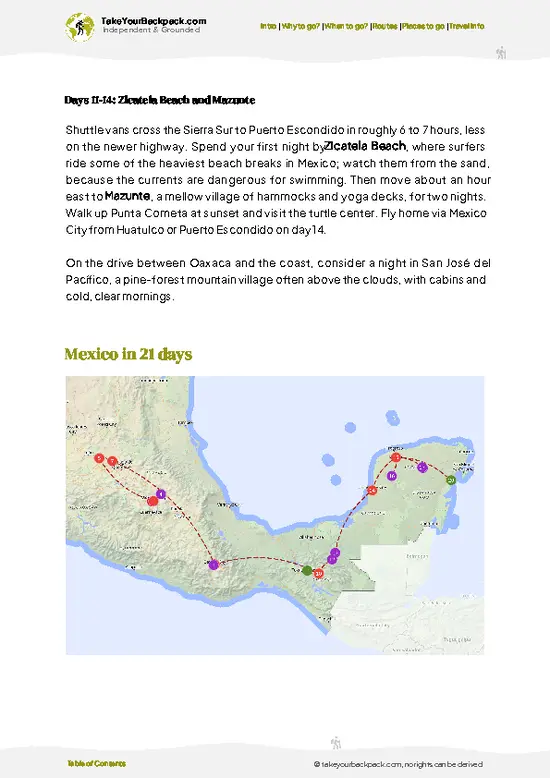
Day 1: Mérida: Start here because the city has the peninsula’s best bus connections and the cheapest beds in the north. Wander the Plaza Grande, eat at a market stall and let the heat pass in a shaded courtyard. Buses leave from several terminals, so check which one your ride uses before you walk across town.

Day 2: Uxmal: Take a morning bus south to the Puuc ruins. Services thin out after midday, so go early and plan your return around the last departure. The calm here makes it a better first ruin than the larger sites.

Day 3: Izamal: Shift east, with a stop in Izamal. It sits on the way and breaks the longer ride. Walk the yellow streets and the convent courtyard, then continue on before dark.

Day 4: Valladolid: This town works as the hub for the east. First-class buses and shared vans … read more 👉
Day 1: Mérida: Start here because the city has the peninsula’s best bus connections and the cheapest beds in the north. Wander the Plaza Grande, eat at a market stall and let the heat pass in a shaded courtyard. Buses leave from several terminals, so check which one your ride uses before you walk across town.

Day 2: Uxmal: Take a morning bus south to the Puuc ruins. Services thin out after midday, so go early and plan your return around the last departure. The calm here makes it a better first ruin than the larger sites.

Day 3: Izamal: Shift east, with a stop in Izamal. It sits on the way and breaks the longer ride. Walk the yellow streets and the convent courtyard, then continue on before dark.

Day 4: Valladolid: This town works as the hub for the east. First-class buses and shared vans reach Chichén Itzá and cenotes within an hour, and you can reach them without a car. Swim at Cenote Zací, then take a colectivo to Ek Balam for a quieter second ruin. Detour: spend one morning at Río Lagartos for flamingos and the pink lagoons, then return by the afternoon bus.

Day 5: Chichén Itzá and Tulum: Reach Chichén Itzá at opening, leave by late morning, then ride on to the coast. The ruins at Tulum close in the afternoon, so aim to see them at the next dawn instead. The day that justifies the whole trip is Day 4. Swimming in a cave pool at midday, then climbing an empty pyramid at Ek Balam, shows you what the peninsula does that no beach can.

🌤️ When to go?Best time to visit Yucatán Peninsula

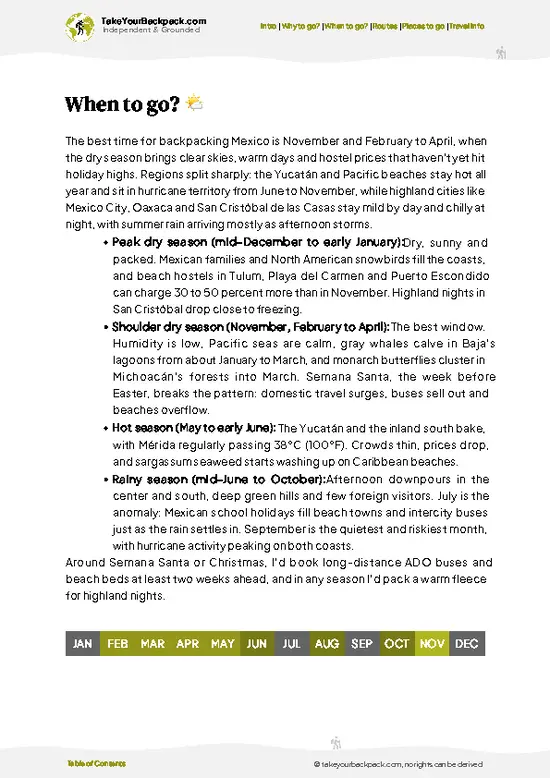
  • Dry Season (November to April): Days run 27 to 32°C (81 to 90°F) with low humidity and cool nights near 18 to 22°C (64 to 72°F). Daylight lasts about 11 to 13 hours. Christmas through Easter brings the biggest crowds and highest room rates, especially on the Caribbean coast.
  • Hot Season (May to June): Highs reach 34 to 38°C (93 to 100°F) inland, and ruins like Chichén Itzá turn into frying pans by noon. Prices soften and sites empty out. Go at opening time.
  • Rainy and Hurricane Season (July to October): Expect 30 to 34°C (86 to 93°F), thick humidity and afternoon downpours. Sargassum can pile up on Caribbean beaches in summer. Rates drop 20 to 40 percent, and September to October carries the highest storm risk.
  • Cenote and Wildlife Windows: Cenotes are good year-round, with clearest water in the
… read more 👉
  • Dry Season (November to April): Days run 27 to 32°C (81 to 90°F) with low humidity and cool nights near 18 to 22°C (64 to 72°F). Daylight lasts about 11 to 13 hours. Christmas through Easter brings the biggest crowds and highest room rates, especially on the Caribbean coast.
  • Hot Season (May to June): Highs reach 34 to 38°C (93 to 100°F) inland, and ruins like Chichén Itzá turn into frying pans by noon. Prices soften and sites empty out. Go at opening time.
  • Rainy and Hurricane Season (July to October): Expect 30 to 34°C (86 to 93°F), thick humidity and afternoon downpours. Sargassum can pile up on Caribbean beaches in summer. Rates drop 20 to 40 percent, and September to October carries the highest storm risk.
  • Cenote and Wildlife Windows: Cenotes are good year-round, with clearest water in the dry months. Flamingos at Celestún and Río Lagartos peak roughly November to March, and whale sharks off Isla Holbox appear June to September.
Book Christmas and Easter weeks months ahead, or aim for late January and February for the best balance.


source: climatestotravel.comJANJanuary: excellent for travelingFEBFebruary: excellent for travelingMARMarch: excellent for travelingAPRApril: highly recommended for travelingMAYMay: fair for travelingJUNJune: fair for travelingJULJuly: fair for travelingAUGAugust: fair for travelingSEPSeptember: below average for travelingOCTOctober: good for travelingNOVNovember: highly recommended for travelingDECDecember: excellent for traveling
mexico-region-yucatan-peninsula
© Google | Abd Abo Naser

✈️ The backpacker research shortcutMexico Travel Guide

An offline-friendly backpacking guide with optimized travel routes, ranked highlights, transport advice, and the best areas to stay.
example page 0 from our offline Travel Guide for Mexico
example page 1 from our offline Travel Guide for Mexico
example page 2 from our offline Travel Guide for Mexico
example page 3 from our offline Travel Guide for Mexico
example page 4 from our offline Travel Guide for Mexico
example page 5 from our offline Travel Guide for Mexico
example page 6 from our offline Travel Guide for Mexico
example page 7 from our offline Travel Guide for Mexico
The digital guide (402 pages) contains:
✅ 138 highlights, ranked by travel appeal
✅ Optimized 7, 14 & 21-day travel routes
✅ Cities, national parks, landmarks, beaches
✅ How to get around
✅ Offline-friendly for travel without Wi-Fi
👉 Click to see all 30+ guide features

📅 Plan smarter in minutes, not weeks
✅ Month by month travel advice
✅ Festivals & national holidays
✅ Budget expectations

🗺️ Go to the right places, skip the overrated ones
✅ Honest pros & cons of destinations
✅ Top hikes, parks & viewpoints
✅ Lesser-known places most travelers miss
✅ Clear “worth it vs skip it” guidance

🛏️ Travel smoothly without rookie mistakes
✅ Best areas to stay
✅ Transport systems explained simply
✅ Common scams & safety advice
✅ SIM cards, money & practical tips

🌍 Understand the country, not just visit it
✅ Culture & traditions
✅ 52 Essential phrases & customs
✅ Festivals worth planning around
✅ Traveler-friendly historical context
✅ Insights that make places more meaningful

📱 Built for real travel conditions
✅ Fully downloadable PDF
✅ Works completely offline
✅ Optimized for phone use
✅ Useful in remote areas & buses
✅ Everything in one place
Stop searching, start planning
Get instant access to your full guide. 30‑day money-back guarantee.
+ Add another guide for just

By proceeding you agree to our terms.
Sent to your inbox immediately after payment • 100% Secure Checkout
Best Backpacking Travel Advisor 2025 tourism awardBest Backpacking
Travel Advisor
2025
What others say about Take Your Backpack Guides:
⭐⭐⭐⭐⭐
Fantastic, amazing amount of information!
⭐⭐⭐⭐⭐
My goodness this is amazing, it's what I've been looking for hats off too you!
⭐⭐⭐⭐⭐
I think this is absolutely BRILLIANT
⭐⭐⭐⭐
Very complete and informative. It's still missing places, but I gotta to commend you
⭐⭐⭐⭐⭐
This is truly amazing, thank you, can't wait to explore it with my kids!
⭐⭐⭐⭐⭐
Awesome resource, thank you!
⭐⭐⭐⭐⭐
This is amazing! Can't wait to explore the ones I haven't seen
⭐⭐⭐⭐
I love this! Well done, great idea.
⭐⭐⭐⭐⭐
Thanks for taking the time to make this gem!
⭐⭐⭐⭐⭐
This might be the best website I've ever seen.
⭐⭐⭐⭐⭐
Congratulations, and thank you so much for your work; it's incredibly valuable.
⭐⭐⭐⭐
In all seriousness I think you did a great job pointing out the important spots
⭐⭐⭐⭐⭐
10/10 very good
⭐⭐⭐⭐⭐
As someone who's only just starting to visit regularly this is awesome, thank you.
⭐⭐⭐⭐
Thank you very much! I'm going to visit my dad, it's going to be very useful!
⭐⭐⭐⭐⭐
This is really cool! We'll be travelling for the first time and this definitely come in handy.
⭐⭐⭐⭐⭐
You are now our minister of culture, congratulations 👨‍💼
⭐⭐⭐⭐⭐
Just wanted to tell you that this is a pearl! Going to follow your recommendations.
⭐⭐⭐⭐⭐
This is so cool. I'll definitely be using the resource for my travels soon.
⭐⭐⭐⭐⭐
This is very impressive! Good work.
⭐⭐⭐⭐⭐
This is an amazing and informative site. Very well done!

🛏️ Where to stay?Best areas to stay in Mexico

Mérida, Valladolid, Tulum and Bacalar are the four bases most backpackers use, and each suits a different mood. Mérida is the safest and most rounded choice, with a walkable colonial center, free concerts and dance nights in the plazas, and cheap dorm and private room options within a few blocks of Plaza Grande. It also works well for day trips to Uxmal, Celestún and cenotes near Homún.

Valladolid is smaller and calmer, with a central square, easy walking, and Chichén Itzá, Ek Balam and several cenotes within 20 to 45 minutes by colectivo or taxi. It is social without being loud, which makes … read more 👉
Mérida, Valladolid, Tulum and Bacalar are the four bases most backpackers use, and each suits a different mood. Mérida is the safest and most rounded choice, with a walkable colonial center, free concerts and dance nights in the plazas, and cheap dorm and private room options within a few blocks of Plaza Grande. It also works well for day trips to Uxmal, Celestún and cenotes near Homún.

Valladolid is smaller and calmer, with a central square, easy walking, and Chichén Itzá, Ek Balam and several cenotes within 20 to 45 minutes by colectivo or taxi. It is social without being loud, which makes it good for solo travelers who want to meet people over dinner.

Tulum splits into the town (cheaper, more local) and the beach zone (pricey and spread out along a road). Stay in the town, rent a bike, and ride to the ruins and beaches. Playa del Carmen suits those who want nightlife and transport links, though it is busier and less distinctive.

Bacalar, on its pale blue lagoon, has a laid-back crowd, hammocks over the water and a slower pace. Isla Holbox and Campeche are good extras if you want fewer backpackers and more quiet streets. Campeche’s walled old town is especially safe after dark.

🚌 Getting aroundGetting around like a local

From the ADO bus terminal in most Yucatán towns, the center is a 5 to 15 minute walk or a US$2 to 4 taxi ride, and Mérida’s main terminals sit close enough to the old center that a taxi costs about US$3 to 5. Yucatán Peninsula transport is dependable once you accept that schedules are suggestions with good intentions. Buses are the backbone, and they run on time more often than your nerves will predict.
  • First-class buses (ADO, Oriente): Mérida to Cancún takes about 4 to 5 hours for US$25 to 40, and Mérida to Valladolid runs 2 to 2.5 hours for US$9 to 15. Seats are assigned and the air conditioning is set to meat locker, because the buses are built for comfort and the coolers are never turned down. Buy online a day ahead on busy routes, and carry a sweater.
  • Colectivos (vans): Shared vans link
… read more 👉
From the ADO bus terminal in most Yucatán towns, the center is a 5 to 15 minute walk or a US$2 to 4 taxi ride, and Mérida’s main terminals sit close enough to the old center that a taxi costs about US$3 to 5. Yucatán Peninsula transport is dependable once you accept that schedules are suggestions with good intentions. Buses are the backbone, and they run on time more often than your nerves will predict.
  • First-class buses (ADO, Oriente): Mérida to Cancún takes about 4 to 5 hours for US$25 to 40, and Mérida to Valladolid runs 2 to 2.5 hours for US$9 to 15. Seats are assigned and the air conditioning is set to meat locker, because the buses are built for comfort and the coolers are never turned down. Buy online a day ahead on busy routes, and carry a sweater.
  • Colectivos (vans): Shared vans link towns like Valladolid, Tulum and Playa del Carmen for US$2 to 8 and leave when full. They are faster than they look and cheaper than buses, which is why locals use them. Ask the driver where to flag a stop, since cenotes and small ruins are often right on the road.
  • Tren Maya: The train connects Cancún, Mérida, Campeche, Palenque and other stops, with foreigner fares of roughly US$20 to 60 depending on route. Stations are often far from town centers, so budget US$5 to 15 for the connecting taxi or shuttle. Book ahead on the official site, because tickets sell out and queues at the station do not move quickly.
  • Taxis and ride-hailing: Taxis in Tulum and Cancún cost more than the meter you will not find. Agree on the fare before getting in. Uber works in Mérida and Cancún but is restricted in some resort areas, so check which taxi union controls a given spot.
  • Rental bikes and scooters: Towns like Valladolid, Bacalar and Holbox are flat, and bikes cost US$5 to 10 a day. Short hops to cenotes by bike beat paying for a taxi.
Group your stops along one corridor, such as Mérida, Valladolid and the coast, rather than doubling back, and pay in pesos since drivers rarely have change for big bills.

🍲 FoodEating & Drinking in Yucatán Peninsula

Start with cochinita pibil, pork marinated in sour orange and achiote, wrapped in banana leaf and slow-roasted until it pulls apart at a look. It lands in tacos or panuchos (fried tortillas stuffed with beans and topped with turkey, pickled red onion and avocado). Also try sopa de lima, a bright chicken broth with lime and crisp tortilla strips, and poc chuc, charred pork with a smoky edge. The fiery habanero salsa on the table is no decoration, so add it by the drop.

For drinks, order horchata with a hint of cinnamon, fresh agua de chaya, or Xtabentún, an anise and honey liqueur made from Maya fermented honey. Cold beer, usually Montejo or Sol, is the answer to the afternoon heat.

Eat at market stalls like Mérida’s Lucas de Gálvez or Valladolid’s municipal market, where a plate costs about … read more 👉
Start with cochinita pibil, pork marinated in sour orange and achiote, wrapped in banana leaf and slow-roasted until it pulls apart at a look. It lands in tacos or panuchos (fried tortillas stuffed with beans and topped with turkey, pickled red onion and avocado). Also try sopa de lima, a bright chicken broth with lime and crisp tortilla strips, and poc chuc, charred pork with a smoky edge. The fiery habanero salsa on the table is no decoration, so add it by the drop.

For drinks, order horchata with a hint of cinnamon, fresh agua de chaya, or Xtabentún, an anise and honey liqueur made from Maya fermented honey. Cold beer, usually Montejo or Sol, is the answer to the afternoon heat.

Eat at market stalls like Mérida’s Lucas de Gálvez or Valladolid’s municipal market, where a plate costs about US$3 to 6. Look for loncherías (small lunch counters) and evening taco carts, where the queue tells you everything. Cafés cluster around the plazas for strong coffee and breakfast, often huevos motuleños (fried eggs on tortillas with ham, peas and plantain).

Lunch is the main meal and often runs long. Say la cuenta, por favor to ask for the bill, since it rarely arrives unprompted. Tip around 10 to 15 percent in cash, and carry small bills for street stalls.

FAQTraveler FAQ

Plan on 7 to 10 days for the Yucatán Peninsula if you want a loop covering Mérida, Valladolid, Tulum and Bacalar. Four to five days handles a shorter route such as Mérida, Chichén Itzá and Valladolid. Add 2 to 3 days if you want Campeche, Uxmal or Isla Holbox, and 1 day each for the cenotes and Celestún.
On the Yucatán Peninsula, first-class ADO buses link nearly every major town, with Mérida to Cancún taking 4 to 5 hours for roughly US$25 to 40. Colectivo vans cover shorter hops such as Valladolid to Tulum for US$3 to 8. The Tren Maya connects Cancún, Mérida and Campeche with foreigner fares around US$20 to 60, and bikes at US$5 to 10 a day suit small towns like Bacalar and Valladolid.
The Yucatán Peninsula is known for its Maya ruins, including Chichén Itzá, Uxmal, Ek Balam and Tulum, and for roughly 6,000 natural limestone sinkholes called cenotes where you can swim. It also has Caribbean beaches near Tulum and Playa del Carmen, colonial cities like Mérida and Campeche, and dishes such as cochinita pibil. Most entry fees run about US$5 to 30, with Chichén Itzá among the priciest.
⚠️ Things can change over time, so always validate details locally before you go.

Other Mexican regions near Yucatán Peninsula

Explore more nearby:

  • Riviera Maya—Cenotes, Tulum cliff ruins, Sian Ka’an boat trips, Akumal turtles| 261 km away
  • Cozumel—Drift dives, west-shore sunsets, sandbar boat trips, ferry from Playa| 268 km away
  • Isla Holbox—Car-free sand streets, bioluminescence, flamingo flats, whale sharks| 309 km away

💡 Not sure where to go next?
Create a personalized itinerary for Mexico including Yucatán Peninsula and the places that fit your trip.

Generate my itinerary

👉 Discover all regions

Or checkout all Mexico has to offer (think cities, towns, villages, national parks, hikes, beaches, festivals)
Country photo of Mexico

We 💚 feedbackKey takeaways before you go

Yucatán Peninsula works best when you pair its colonial interior with a few days on the Caribbean coast, rather than choosing one. I would spend the first half in Mérida and Valladolid, then finish by the sea to rest. Skip the resort corridor if your budget is tight, and bring a quick-dry towel.

✈️ When did I visit Mexico?
As part of my 1.5 year travel around the world trip, I visited Mexico in February and March 2016. Had to hurry a bit as I didn’t want to miss the free performance of the Rolling Stones in Cuba.

✍️ Help improve this page!
The information on this page is based on my own backpacking experience in Mexico, supplemented with up-to-date research and feedback from other travelers. Travel details can change, so if you notice anything outdated or incomplete, feel free to let me know.


🙋‍♂️ Give feedback

👋 Meet the founderWho’s Behind Take Your Backpack?

Johan, backpacker and founder of TakeYourBackpackHi, I’m Johan (Netherlands 🇳🇱), the creator of TakeYourBackpack. Over the past 3 decades, I’ve backpacked through 90+ countries across six continents, gaining extensive experience with independent travel, long-term trips, and overland routes.

This site is built on a combination of firsthand travel experience and carefully curated insights from other backpackers. Many guides are based on places I’ve personally visited, while others bring together tips, observations, and practical advice shared by trusted travelers I’ve met along the way.

The goal is to provide realistic, experience-driven guidance — not generic itineraries — so you can explore destinations with better context, clearer expectations, and more confidence.