v2.webp)
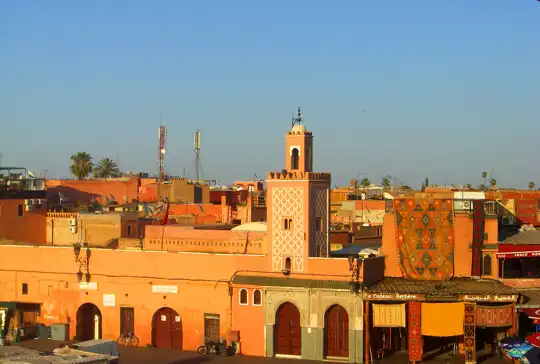
- Djemaa el-Fna: The main square is quiet and almost empty in the morning, then fills from late afternoon with orange juice carts, storytellers, Gnawa musicians and rows of smoking food stalls. Free to enter. Go around dusk and stay 1 to 2 hours. Eat at the stalls that are busiest with locals, and agree prices before ordering.
- The Souks: The covered lanes north of the square are split by trade: leather, metalwork, dyers’ skeins, spices, lanterns. Free to wander. Go before 10 am or after 4 pm when it is calmer. Allow 2 to 3 hours, and expect to get lost at least once.
- Ben Youssef Madrasa: A former Quranic school with a carved cedar and stucco courtyard and tiny student cells upstairs. Entry is about US$5. Arrive at opening to get photos without crowds. Plan 45 minutes.
- Bahia Palace: A 19th-century
- Djemaa el-Fna: The main square is quiet and almost empty in the morning, then fills from late afternoon with orange juice carts, storytellers, Gnawa musicians and rows of smoking food stalls. Free to enter. Go around dusk and stay 1 to 2 hours. Eat at the stalls that are busiest with locals, and agree prices before ordering.
- The Souks: The covered lanes north of the square are split by trade: leather, metalwork, dyers’ skeins, spices, lanterns. Free to wander. Go before 10 am or after 4 pm when it is calmer. Allow 2 to 3 hours, and expect to get lost at least once.
- Ben Youssef Madrasa: A former Quranic school with a carved cedar and stucco courtyard and tiny student cells upstairs. Entry is about US$5. Arrive at opening to get photos without crowds. Plan 45 minutes.
- Bahia Palace: A 19th-century vizier’s palace with painted ceilings, zellige courtyards and orange trees. Entry is about US$7. Mornings are best, before tour groups. Plan 1 hour.
- Saadian Tombs: A sixteenth-century royal burial ground, sealed for centuries and rediscovered in 1917, with a hall of twelve marble columns. Entry is about US$7. Queues build by late morning, so go early. Plan 30 to 45 minutes.
- Jardin Majorelle: A cobalt-blue garden of cacti and bamboo created by painter Jacques Majorelle and later owned by Yves Saint Laurent. Entry is about US$15, with a small extra fee for the Berber museum. Book a morning slot online. Plan 1 to 1.5 hours.
- Koutoubia Mosque: The 12th-century minaret that anchors the skyline. Non-Muslims cannot enter, but the gardens around it are free and pleasant at evening call to prayer. Plan 20 to 30 minutes.
Spotted a mistake or missing something? Contact us.

Merzouga Desert 3-Day Tour from Marrakech with Camel Ride

Private Atlas Mountains and 5 Valleys Tour from Marrakech - All inclusive -

5-Day Private Tour to Sahara and ErgChebbi from Marrakech

Private 4 Days Tour From Marrakech to Fes Via Merzouga Desert

Day Trip from Marrakech Explore the Atlas Mountains and 4 Valleys

Agafay Desert Sunset Tour

Agafay Desert Full Day Tour in Quad bike with lunch

Half Day Marrakech City Tour : VISITE CULTURELLE DE MARRAKECH

Myrugy-Small Group Rug Making Workshop in Marrakech with Licensed

 Best Backpacking
.jpg) Hi, I’m Johan (Netherlands 🇳🇱), the creator of TakeYourBackpack. Over the past 3 decades, I’ve backpacked through 90+ countries across six continents, gaining extensive experience with independent travel, long-term trips, and overland routes.
Hi, I’m Johan (Netherlands 🇳🇱), the creator of TakeYourBackpack. Over the past 3 decades, I’ve backpacked through 90+ countries across six continents, gaining extensive experience with independent travel, long-term trips, and overland routes.