×

Morocco🇲🇦 | national parksToubkal National ParkNorth Africa’s top peak, Imlil base, summit refuge, walnut valleys | things to do and best time to go

Explore AkchourExplore Souss Massa

Backpacking in Toubkal
🏆 Top picknational park ranked #1
By Johan Kruseman 🇳🇱 | Updated October 22, 2026

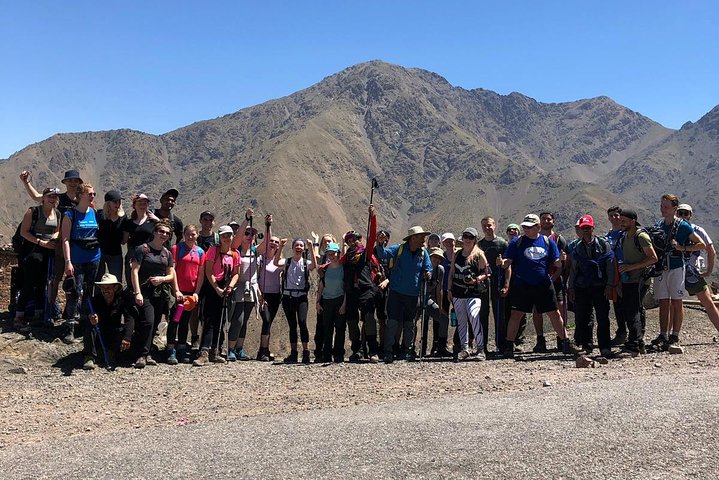
Toubkal National Park puts North Africa’s highest summit within a day’s reach of Marrakech, so you can be on the trail the morning after you land. It sits in the High Atlas of Morocco, south of the city, with Imlil as the gateway village. The valley paths are real mule tracks: stone-walled terraces, walnut trees, and Berber hamlets where a glass of tea costs little and the view across the gorge comes free. The 4,167 meter summit is a hard two-day walk, not a stroll, and the refuge area below it fills up and gets noisy. Skip the souvenir stalls in Imlil; the walk to Aremd is the better use of an hour. Before heading up, I would buy bread, nuts and dates in Imlil’s little shops, because the same food costs more higher up and you eat it on the ridge with the whole valley below you. Trekkers with a few days and sturdy boots will like it most. Anyone who wants solitude, flat paths or a quick tick-off should look elsewhere.

Discover everything you want to know in the 📖 Morocco Travel Guide.


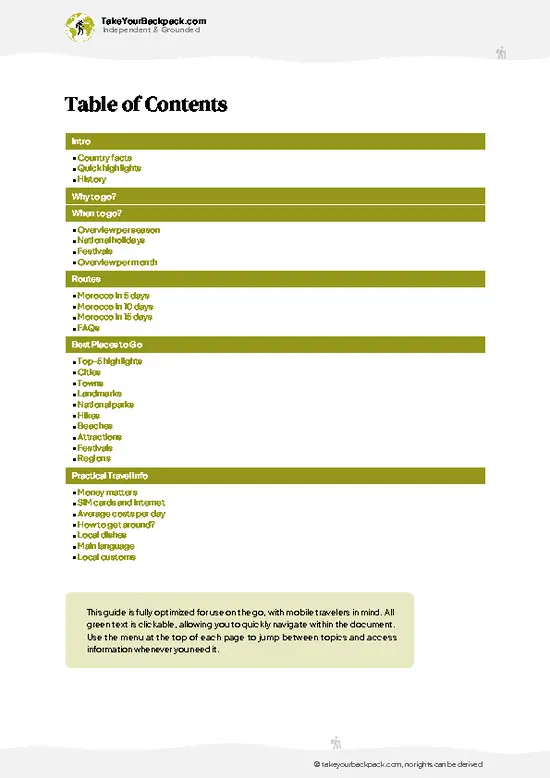
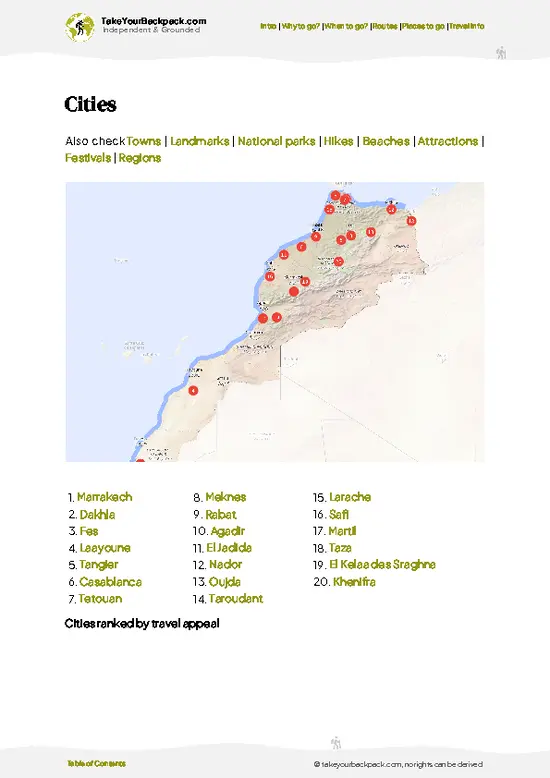
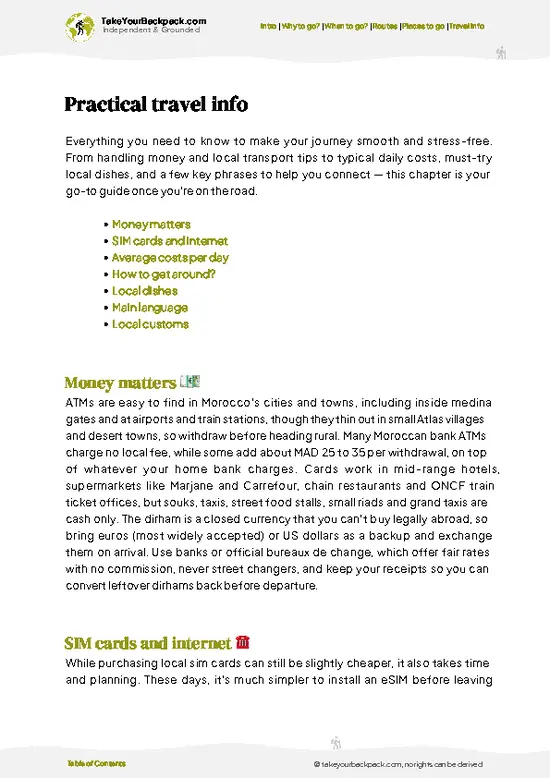
example page 0 from our offline Travel Guide for Morocco
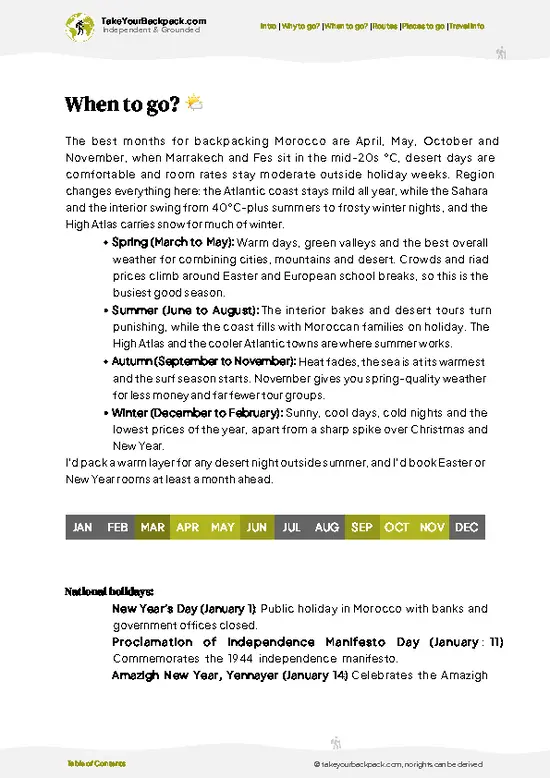
example page 1 from our offline Travel Guide for Morocco
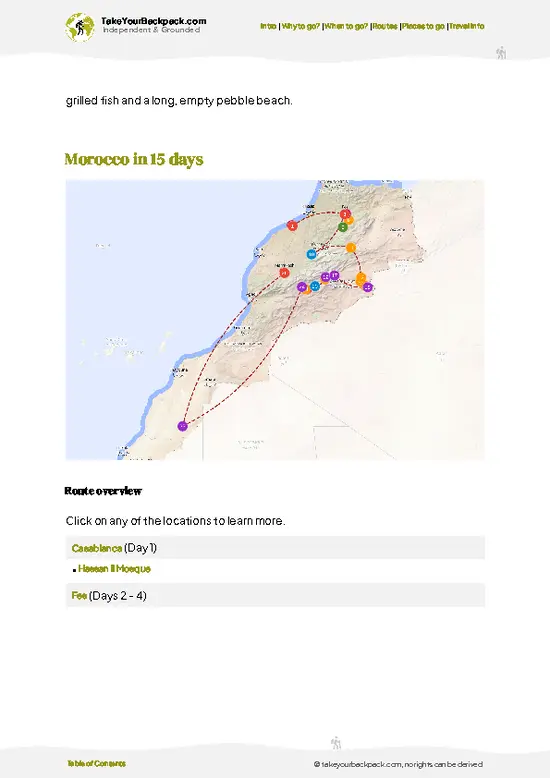
example page 2 from our offline Travel Guide for Morocco
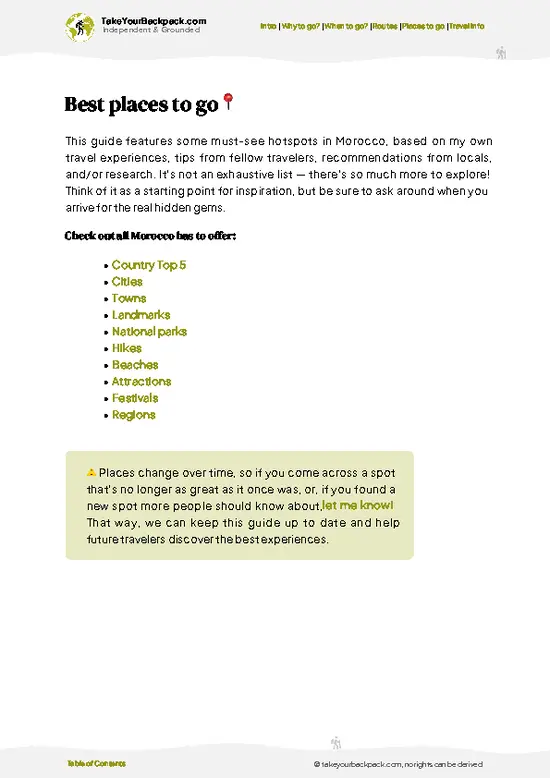
example page 3 from our offline Travel Guide for Morocco
example page 4 from our offline Travel Guide for Morocco
example page 5 from our offline Travel Guide for Morocco
example page 6 from our offline Travel Guide for Morocco
example page 7 from our offline Travel Guide for Morocco
Loading the map 🌍
CLICK TO FILTER
cities
towns
landmarks
national parks
hikes
beaches
attractions
festivals
regions
SHOW COUNTRY’S BESTSHOW ALL

✨ Why go?
Ranked #1 national park in Morocco
The unique appeal for travelers

Toubkal National Park works for backpackers because everything can be done on your own. Trails from Imlil are well worn and waymarked by habit, and the standard Toubkal Refuge at 3,207 meters takes walk-in bunk guests, so you don't need an agency or a tent. Local guides are available if you want one, and for snow season in winter that's sensible, but in summer a confident hiker with a map app manages fine.

The second draw is the variety packed into a small area. In a single day you pass from walnut orchards and Berber villages such as Aroumd to scree slopes and high cols. Extending your trip to a loop through valleys like Azzaden or the Tizi n'Tamatert pass gets you away from the summit crowds and into places where shepherds and village kids are the only company.

It also suits people who … read more 👉
Toubkal National Park works for backpackers because everything can be done on your own. Trails from Imlil are well worn and waymarked by habit, and the standard Toubkal Refuge at 3,207 meters takes walk-in bunk guests, so you don't need an agency or a tent. Local guides are available if you want one, and for snow season in winter that's sensible, but in summer a confident hiker with a map app manages fine.

The second draw is the variety packed into a small area. In a single day you pass from walnut orchards and Berber villages such as Aroumd to scree slopes and high cols. Extending your trip to a loop through valleys like Azzaden or the Tizi n'Tamatert pass gets you away from the summit crowds and into places where shepherds and village kids are the only company.

It also suits people who like to eat and sleep simply. Family-run gîtes serve tagine and omelets on low tables, and you pay in dirhams. That keeps the trip cheap and gives you a much better sense of mountain life than a package tour ever could.

💡 HighlightsMust-see experiences and standout moments

  1. Jbel Toubkal summit: At 4,167 meters, it's the highest peak in North Africa. The final scramble is loose scree, and the top gives views across the Atlas ridgelines and, on clear days, toward the Sahara fringe.
  2. Toubkal Refuge (Neltner): A stone-built mountain hut at 3,207 meters where most climbers spend the night. Expect shared dorms, hot tea and a communal dinner, and a rowdy mix of languages.
  3. Imlil village: The gateway at about 1,740 meters, with walnut trees, mule handlers, small shops for last-minute supplies and the best place to arrange a guide.
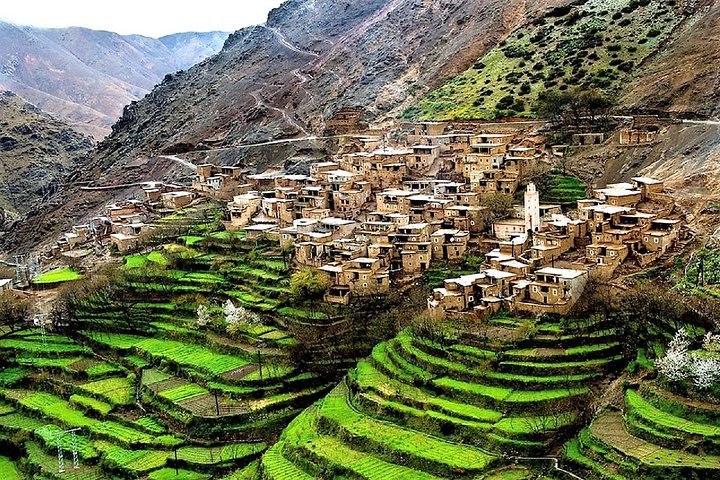
  4. Aroumd (Armed): A flat-roofed Berber village above Imlil with terraced fields and a view straight up the Mizane valley. The stroll through it is the gentlest introduction to the park.
  5. Sidi Chamharouch: A whitewashed shrine and cluster of tea stalls
… read more 👉
  1. Jbel Toubkal summit: At 4,167 meters, it's the highest peak in North Africa. The final scramble is loose scree, and the top gives views across the Atlas ridgelines and, on clear days, toward the Sahara fringe.
  2. Toubkal Refuge (Neltner): A stone-built mountain hut at 3,207 meters where most climbers spend the night. Expect shared dorms, hot tea and a communal dinner, and a rowdy mix of languages.
  3. Imlil village: The gateway at about 1,740 meters, with walnut trees, mule handlers, small shops for last-minute supplies and the best place to arrange a guide.
  4. Aroumd (Armed): A flat-roofed Berber village above Imlil with terraced fields and a view straight up the Mizane valley. The stroll through it is the gentlest introduction to the park.
  5. Sidi Chamharouch: A whitewashed shrine and cluster of tea stalls on the river below the refuge. Non-Muslims can't enter the shrine, but the cold fruit juice stands and the stream-side stop make it a natural rest point.
  6. Tizi n'Tamatert: A high pass used for a longer loop into quieter valleys. The path crosses ridges with sweeping views over villages and pine-dotted slopes.
  7. Lac d'Ifni: A high alpine lake at roughly 2,300 meters on the south side of the massif, reached by a multi-day trek, with turquoise water, grazing mules and almost no other visitors.
  8. Azzaden valley: A long, green valley with scattered hamlets and walnut groves, far quieter than the main route and good for a gentle day out.
Take the Aroumd walk first, because it warms up your legs and lets you check the altitude before the climb to the refuge.
Spotted a mistake or missing something? Contact us.
Things to do around Toubkal National Park

Ratings based on Tripadvisor reviews. When you book through this link, you support our work at no extra cost to you.

🌤️ When to go?Seasonal considerations and timing

  • Late Spring (April to June): Snow retreats from the summit trail by mid-April in most years, and valley slopes turn green. Days reach 15 to 25°C (59 to 77°F) at Imlil (1,740 m), dropping to around 0°C (32°F) near the Neltner Refuge at night. Summit-day crowds build from May.
  • Summer (July to August): Dry, reliable trail conditions and the longest daylight, but Imlil hits 28 to 33°C (82 to 91°F) and afternoon thunderstorms can roll over the ridges. Summit mornings are cold, around 5°C (41°F) or less. Refuge beds fill on weekends.
  • Early Autumn (September to October): Clear skies, 12 to 22°C (54 to 72°F) in the valleys, and thinner crowds after the August rush. Walnut harvest brings activity to the villages.
  • Winter (November to March): Snow and ice cover the upper mountain, with valley days of 5
… read more 👉
  • Late Spring (April to June): Snow retreats from the summit trail by mid-April in most years, and valley slopes turn green. Days reach 15 to 25°C (59 to 77°F) at Imlil (1,740 m), dropping to around 0°C (32°F) near the Neltner Refuge at night. Summit-day crowds build from May.
  • Summer (July to August): Dry, reliable trail conditions and the longest daylight, but Imlil hits 28 to 33°C (82 to 91°F) and afternoon thunderstorms can roll over the ridges. Summit mornings are cold, around 5°C (41°F) or less. Refuge beds fill on weekends.
  • Early Autumn (September to October): Clear skies, 12 to 22°C (54 to 72°F) in the valleys, and thinner crowds after the August rush. Walnut harvest brings activity to the villages.
  • Winter (November to March): Snow and ice cover the upper mountain, with valley days of 5 to 12°C (41 to 54°F) and summit temperatures of -10 to -20°C (14 to -4°F). Daylight is short, around 10 hours. Crampons and an ice axe are needed, and some travelers ski the nearby slopes. Guesthouse rates drop.
Mid-week starts in May or late September give you the best weather with the fewest people on the Toubkal trail.


source: climatestotravel.comJANJanuary: fair for travelingFEBFebruary: fair for travelingMARMarch: good for travelingAPRApril: excellent for travelingMAYMay: excellent for travelingJUNJune: highly recommended for travelingJULJuly: fair for travelingAUGAugust: fair for travelingSEPSeptember: excellent for travelingOCTOctober: excellent for travelingNOVNovember: highly recommended for travelingDECDecember: fair for traveling
when-to-go

✈️ The backpacker research shortcutMorocco Travel Guide

An offline-friendly backpacking guide with optimized travel routes, ranked highlights, transport advice, and the best areas to stay.
example page 0 from our offline Travel Guide for Morocco
example page 1 from our offline Travel Guide for Morocco
example page 2 from our offline Travel Guide for Morocco
example page 3 from our offline Travel Guide for Morocco
example page 4 from our offline Travel Guide for Morocco
example page 5 from our offline Travel Guide for Morocco
example page 6 from our offline Travel Guide for Morocco
example page 7 from our offline Travel Guide for Morocco
The digital guide (424 pages) contains:
✅ 112 highlights, ranked by travel appeal
✅ Optimized 5, 10 & 15-day travel routes
✅ Cities, national parks, landmarks, beaches
✅ How to get around
✅ Offline-friendly for travel without Wi-Fi
👉 Click to see all 30+ guide features

📅 Plan smarter in minutes, not weeks
✅ Month by month travel advice
✅ Festivals & national holidays
✅ Budget expectations

🗺️ Go to the right places, skip the overrated ones
✅ Honest pros & cons of destinations
✅ Top hikes, parks & viewpoints
✅ Lesser-known places most travelers miss
✅ Clear “worth it vs skip it” guidance

🛏️ Travel smoothly without rookie mistakes
✅ Best areas to stay
✅ Transport systems explained simply
✅ Common scams & safety advice
✅ SIM cards, money & practical tips

🌍 Understand the country, not just visit it
✅ Culture & traditions
✅ 52 Essential phrases & customs
✅ Festivals worth planning around
✅ Traveler-friendly historical context
✅ Insights that make places more meaningful

📱 Built for real travel conditions
✅ Fully downloadable PDF
✅ Works completely offline
✅ Optimized for phone use
✅ Useful in remote areas & buses
✅ Everything in one place
Stop searching, start planning
Get instant access to your full guide. 30‑day money-back guarantee.
+ Add another guide for just

By proceeding you agree to our terms.
Sent to your inbox immediately after payment • 100% Secure Checkout
Best Backpacking Travel Advisor 2025 tourism awardBest Backpacking
Travel Advisor
2025
What others say about Take Your Backpack Guides:
⭐⭐⭐⭐⭐
Fantastic, amazing amount of information!
⭐⭐⭐⭐⭐
My goodness this is amazing, it's what I've been looking for hats off too you!
⭐⭐⭐⭐⭐
I think this is absolutely BRILLIANT
⭐⭐⭐⭐
Very complete and informative. It's still missing places, but I gotta to commend you
⭐⭐⭐⭐⭐
This is truly amazing, thank you, can't wait to explore it with my kids!
⭐⭐⭐⭐⭐
Awesome resource, thank you!
⭐⭐⭐⭐⭐
This is amazing! Can't wait to explore the ones I haven't seen
⭐⭐⭐⭐
I love this! Well done, great idea.
⭐⭐⭐⭐⭐
Thanks for taking the time to make this gem!
⭐⭐⭐⭐⭐
This might be the best website I've ever seen.
⭐⭐⭐⭐⭐
Congratulations, and thank you so much for your work; it's incredibly valuable.
⭐⭐⭐⭐
In all seriousness I think you did a great job pointing out the important spots
⭐⭐⭐⭐⭐
10/10 very good
⭐⭐⭐⭐⭐
As someone who's only just starting to visit regularly this is awesome, thank you.
⭐⭐⭐⭐
Thank you very much! I'm going to visit my dad, it's going to be very useful!
⭐⭐⭐⭐⭐
This is really cool! We'll be travelling for the first time and this definitely come in handy.
⭐⭐⭐⭐⭐
You are now our minister of culture, congratulations 👨‍💼
⭐⭐⭐⭐⭐
Just wanted to tell you that this is a pearl! Going to follow your recommendations.
⭐⭐⭐⭐⭐
This is so cool. I'll definitely be using the resource for my travels soon.
⭐⭐⭐⭐⭐
This is very impressive! Good work.
⭐⭐⭐⭐⭐
This is an amazing and informative site. Very well done!

🛏️ Where to stay?Best areas and accommodation options

Imlil, a village about 1.5 hours by road from Marrakech, is the best place to stay for Toubkal National Park, and it sits at the park's northern edge. Guesthouses (gîtes) here run US$10 to 25 per person with breakfast, and many have terraces facing the valley. Simpler dorm beds start around US$8. Book ahead for weekends in spring and autumn.
Inside the park, the Neltner Refuge (Toubkal Refuge) at 3,207 m is the main base for summit attempts, with bunk beds at about US$15 to 20, and half-board meals are available for roughly US$10 to 15 more. Les Mouflons refuge next door is a second option, and … read more 👉
Imlil, a village about 1.5 hours by road from Marrakech, is the best place to stay for Toubkal National Park, and it sits at the park's northern edge. Guesthouses (gîtes) here run US$10 to 25 per person with breakfast, and many have terraces facing the valley. Simpler dorm beds start around US$8. Book ahead for weekends in spring and autumn.
Inside the park, the Neltner Refuge (Toubkal Refuge) at 3,207 m is the main base for summit attempts, with bunk beds at about US$15 to 20, and half-board meals are available for roughly US$10 to 15 more. Les Mouflons refuge next door is a second option, and both fill quickly in peak season. Sleeping bags are usually essential in winter, though blankets are provided.
For a quieter option, villages like Aroumd (Around), a short walk above Imlil, have gîtes with a more traditional feel and fewer day-trippers. Some travelers choose Setti Fatma in the Ourika Valley for a different approach.
Marrakech is the realistic city base, with hostels from US$8 to 15 for dorm beds, and shared taxis run to Imlil from Moulay Hassan stand.

👛 Costs (as of 22 October 2026)How expensive it really is

Toubkal National Park costs about US$53 to 105 per day for a backpacker using guesthouses, refuge meals and shared transport.
CategoryBudget RangeLocal Reality
Entrance feeUS$0No ticket is charged for entering the park or hiking from Imlil.
Accommodation (high season)US$10 to 25Imlil gîtes include breakfast. Refuge bunks near the summit cost about US$15 to 20.
Accommodation (low season)US$8 to 15Winter and midsummer rates drop, and bargaining is easier.
Local transportUS$3 to 10Shared taxi from Marrakech to Imlil is roughly US$3 to 5 per seat, a private taxi US$25 to 35 per car.
Food and suppliesUS$10 to 20Tagines and set dinners in gîtes cost US$5 to 10. Pack snacks and water, as the refuge sells them at a premium.
Guide and muleUS$15 to 25A guide runs US$30 to 50 a day, usually split in a group.
… read more 👉
Toubkal National Park costs about US$53 to 105 per day for a backpacker using guesthouses, refuge meals and shared transport.
CategoryBudget RangeLocal Reality
Entrance feeUS$0No ticket is charged for entering the park or hiking from Imlil.
Accommodation (high season)US$10 to 25Imlil gîtes include breakfast. Refuge bunks near the summit cost about US$15 to 20.
Accommodation (low season)US$8 to 15Winter and midsummer rates drop, and bargaining is easier.
Local transportUS$3 to 10Shared taxi from Marrakech to Imlil is roughly US$3 to 5 per seat, a private taxi US$25 to 35 per car.
Food and suppliesUS$10 to 20Tagines and set dinners in gîtes cost US$5 to 10. Pack snacks and water, as the refuge sells them at a premium.
Guide and muleUS$15 to 25A guide runs US$30 to 50 a day, usually split in a group. Mules for bags are about US$15 to 20.
Total Daily BudgetUS$53 to 105Lower if you skip the guide and share rooms.
⚠️ Prices can change and everyone travels differently, so take this as a rough guide. Hope it helps you plan your adventure!

🥾 TrailsBest hikes in Toubkal national park

Toubkal National Park has trails from half-day village strolls to multi-day circuits, and most start at Imlil, with mule tracks and stone paths linking the valleys.
  • Toubkal Summit Route: Imlil to the refuge is roughly 10 to 12 kilometers one way, 5 to 6 hours with packs. The summit day from the refuge adds about 3 to 4 hours up, with a steep scree finish. Moderate to hard, mainly due to altitude.
  • Imlil to Aroumd and Sidi Chamharouch: A gentle valley walk on a wide path past orchards, easy to do in 1 to 2 hours each way. Suited to beginners.
  • Tizi n'Tamatert loop: A 1 to 2 day circuit crossing a high
… read more 👉
Toubkal National Park has trails from half-day village strolls to multi-day circuits, and most start at Imlil, with mule tracks and stone paths linking the valleys.
  • Toubkal Summit Route: Imlil to the refuge is roughly 10 to 12 kilometers one way, 5 to 6 hours with packs. The summit day from the refuge adds about 3 to 4 hours up, with a steep scree finish. Moderate to hard, mainly due to altitude.
  • Imlil to Aroumd and Sidi Chamharouch: A gentle valley walk on a wide path past orchards, easy to do in 1 to 2 hours each way. Suited to beginners.
  • Tizi n'Tamatert loop: A 1 to 2 day circuit crossing a high pass between valleys. Moderate, with rocky stretches and long ascents, but fewer people.
  • Azzaden Valley: A full day out with terraced fields and quiet hamlets. Easy to moderate, with long, steady climbs.
  • Lac d'Ifni trek: A 3 to 4 day route through remote highlands. Hard, with route-finding and variable weather.
Wildlife is limited. Look for choughs, eagles and the occasional macaque in lower woodlands. Snow often covers the summit from late autumn into spring, and crampons and an ice axe may be needed. Summer afternoons can bring storms.

By public transport, shared taxis and minibuses run from Marrakech to Asni and onward to Imlil, and the final stretch is often a shared grand taxi. Weekends and summer holidays bring the crowds, especially on the refuge route. A small entrance fee may apply for some park areas, but most visitors pay mainly for guides, mules and accommodation.
⚠️ Hiking info can sometimes be outdated or inaccurate. Before you hit the trail, check the latest conditions with locals. If you do spot anything that's off, I'd love to hear from you, so I can update it for fellow travelers.

🛡️ SafetyStaying Safe: What Travelers Should Know

Toubkal's normal route is straightforward and well used, but it is a real mountain, and the main problems are altitude, cold and loose footing. Summit day reaches 4,167 m, and headaches are common if you go up too fast. Spend a night at the Neltner Refuge rather than rushing from Imlil, and drink plenty of water.
The upper trail has loose scree, and in winter and early spring it is covered in snow and ice. Crampons, an ice axe and winter experience are needed then, and rescues usually involve people who underestimated conditions. In summer, start before dawn to avoid afternoon storms and heat on the climb.
Mules use the path to the refuge, so step uphill and give them room. Wildlife is minimal and not a concern. Hiring a local guide (about US$30 to 50 a day) is sensible for winter, and reasonable … read more 👉
Toubkal's normal route is straightforward and well used, but it is a real mountain, and the main problems are altitude, cold and loose footing. Summit day reaches 4,167 m, and headaches are common if you go up too fast. Spend a night at the Neltner Refuge rather than rushing from Imlil, and drink plenty of water.
The upper trail has loose scree, and in winter and early spring it is covered in snow and ice. Crampons, an ice axe and winter experience are needed then, and rescues usually involve people who underestimated conditions. In summer, start before dawn to avoid afternoon storms and heat on the climb.
Mules use the path to the refuge, so step uphill and give them room. Wildlife is minimal and not a concern. Hiring a local guide (about US$30 to 50 a day) is sensible for winter, and reasonable in any season if you are unsure of the route. Carry layers, a headlamp and offline maps, as phone signal is patchy.

FAQTraveler FAQ

Two to three days is enough for Toubkal National Park if your goal is the summit: day one from Imlil to the Neltner Refuge takes 4 to 6 hours, and summit day plus the descent to Imlil takes 7 to 9 hours. Add a third day for the Aroumd valley villages, or a fourth for a loop via Lake Ifni, which is about 3 to 4 days in total. Winter climbs need extra buffer days for weather.
Yes, Toubkal National Park works well without a car because Imlil, the main trailhead, is reachable by shared taxi from Marrakech in about 1.5 to 2 hours, costing roughly US$3 to 5 per seat. Grands taxis leave from near Bab Er-Rob in Marrakech once they fill. From Imlil, everything is on foot, and mules carry bags to the Neltner Refuge if you hire one.
Toubkal National Park has no entrance fee and no permit for regular hiking, and you can walk in from Imlil freely. Costs come from the refuge bunks (about US$15 to 20 per night), guides (US$30 to 50 per day) and mules if you hire them. Guides are not legally required in summer, though they are advisable in winter when snow covers the upper trail.
⚠️ Things can change over time, so always validate details locally before you go.

Other Moroccan national parks near Toubkal

Explore more nearby:


💡 Not sure where to go next?
Create a personalized itinerary for Morocco including Toubkal and the places that fit your trip.

Generate my itinerary

👉 Discover all national parks

Or checkout all Morocco has to offer (think cities, towns, villages, national parks, hikes, beaches, festivals)
Country photo of Morocco

We 💚 feedbackWhat to keep in mind

Toubkal National Park works best with three to four days: one to settle into Imlil and walk the valley, two for the summit with a night at the refuge, and a spare day for weather. Two days is possible but rushed. I would add the spare day, because wind or snow can close the summit and you will want a second chance.

✈️ When did I visit Morocco?
In October 2011, I backpacked Morocco for two weeks, with climbing the Mount Toubkal in summer clothing as a highlight.

✍️ Help improve this page!
The information on this page is based on my own backpacking experience in Morocco, supplemented with up-to-date research and feedback from other travelers. Travel details can change, so if you notice anything outdated or incomplete, feel free to let me know.


🙋‍♂️ Give feedback

👋 Meet the founderWho’s Behind Take Your Backpack?

Johan, backpacker and founder of TakeYourBackpackHi, I’m Johan (Netherlands 🇳🇱), the creator of TakeYourBackpack. Over the past 3 decades, I’ve backpacked through 90+ countries across six continents, gaining extensive experience with independent travel, long-term trips, and overland routes.

This site is built on a combination of firsthand travel experience and carefully curated insights from other backpackers. Many guides are based on places I’ve personally visited, while others bring together tips, observations, and practical advice shared by trusted travelers I’ve met along the way.

The goal is to provide realistic, experience-driven guidance — not generic itineraries — so you can explore destinations with better context, clearer expectations, and more confidence.