×

Namibia🇳🇦 | national parksDorob National ParkSandwich Harbour dunes, flamingo lagoon, Cape Cross seals, welwitschia | things to do and best time to go

Explore Nkasa Rupara National ParkExplore Mangetti National Park

Backpacking in Dorob
👌 Worth visitingnational park ranked #10
By Johan Kruseman 🇳🇱 | Updated October 22, 2026

Dorob National Park is not a separate patch of desert behind Swakopmund; it wraps the town and Walvis Bay, a 107,000-square-kilometer strip of coast and Namib gravel plain that you drive through without noticing a gate. It lies on the central coast of Namibia, stretching from the Ugab River south to Sandwich Harbour. Expect cold fog that smells of kelp, flamingo chatter on the lagoon, and dunes that squeak underfoot. Hiking is mostly self-made on flat gravel, so heat and glare catch people out; carry more water than seems sensible. Skip a flimsy rental car on sand, since recovery costs are steep; book a guided 4x4 for the dunes. Sandwich Harbour's tide-washed dune edge is the detail you will remember.

Discover everything you want to know in the 📖 Namibia Travel Guide.


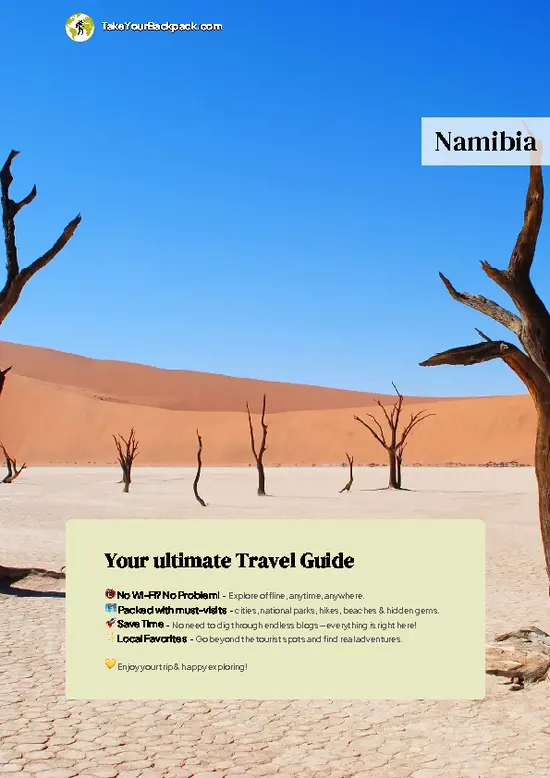
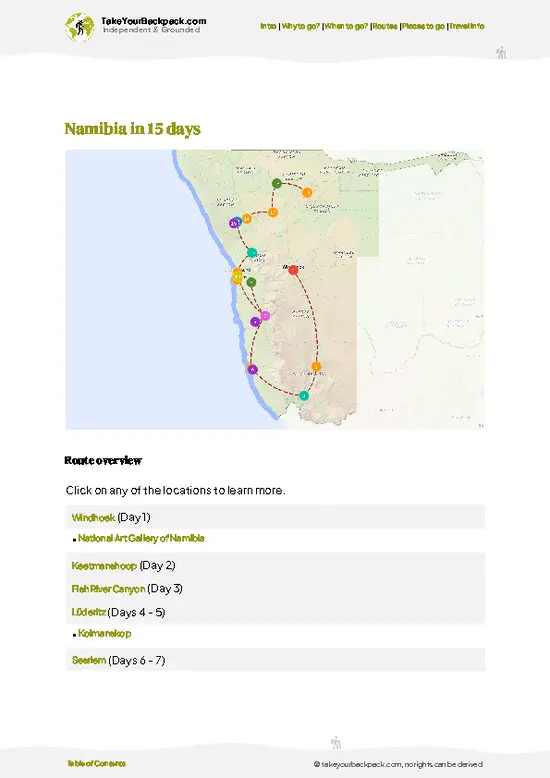
example page 0 from our offline Travel Guide for Namibia
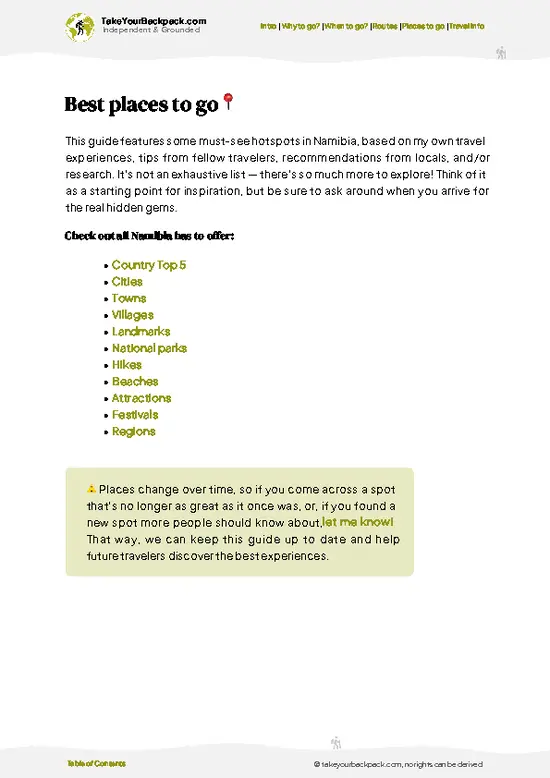
example page 1 from our offline Travel Guide for Namibia
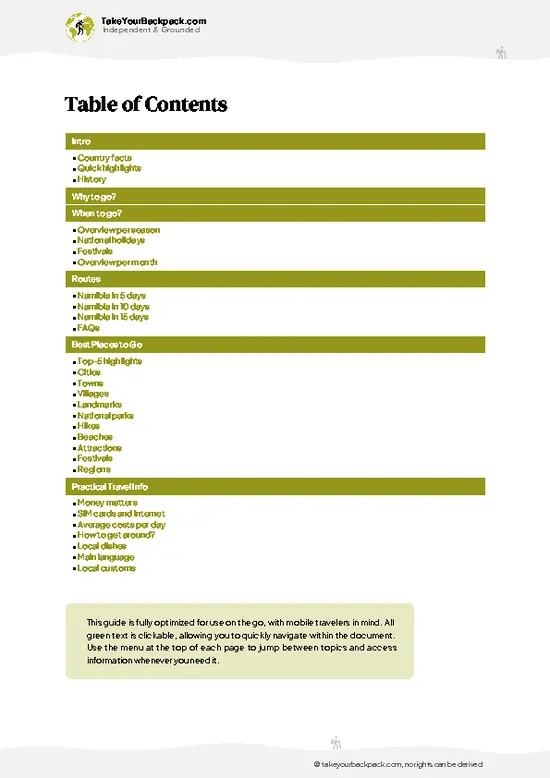
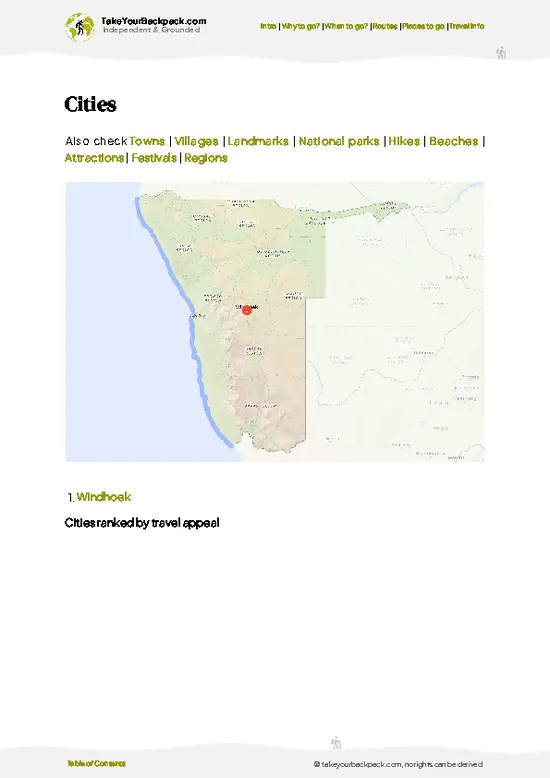
example page 2 from our offline Travel Guide for Namibia
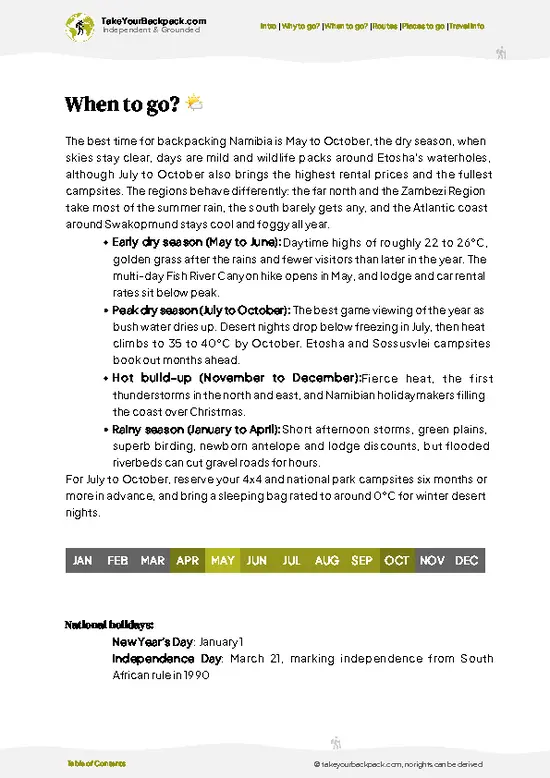
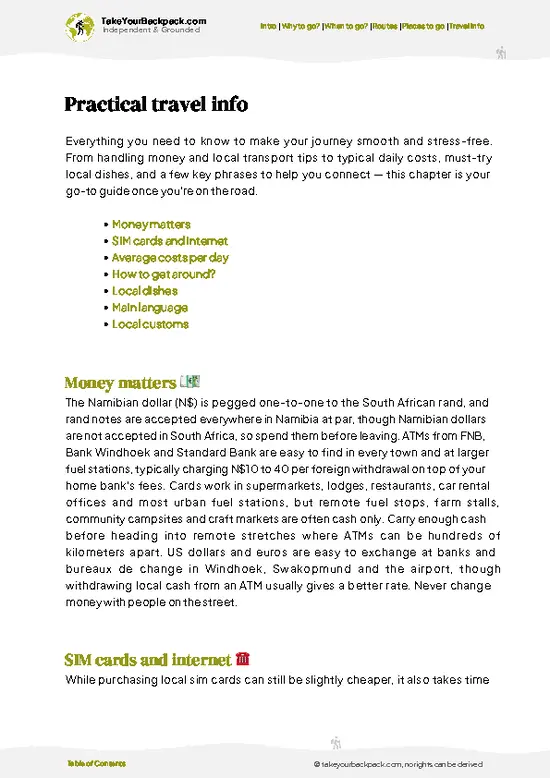
example page 3 from our offline Travel Guide for Namibia
example page 4 from our offline Travel Guide for Namibia
example page 5 from our offline Travel Guide for Namibia
example page 6 from our offline Travel Guide for Namibia
example page 7 from our offline Travel Guide for Namibia
Loading the map 🌍
CLICK TO FILTER
cities
towns
villages
landmarks
national parks
hikes
beaches
attractions
festivals
regions
SHOW COUNTRY’S BESTSHOW ALL

✨ Why go?
Ranked #10 national park in Namibia
The unique appeal for travelers

Dorob National Park suits backpackers because most of it is open ground you can reach from Swakopmund or Walvis Bay without joining a coach tour. You can cycle or walk straight from town to the coastal dunes, then pay for only the one or two guided experiences that truly need a 4x4 and a local driver. The variety is the real draw: Walvis Bay Lagoon with its flamingos and pelicans, the Moon Landscape of eroded schist canyons near the Swakop River, and the Dune 7 climb all sit within a short ride of each other. Hostels and campsites in town keep costs low, and the park rewards people who like choosing their own pace, with fog-cooled mornings for walking and afternoons for wandering the shoreline.

💡 HighlightsPlaces and moments you shouldn't skip

  1. Sandwich Harbour: the best-known sight, where giant dunes drop straight into the Atlantic and a lagoon holds flamingos, pelicans and migratory waders. It is reached by 4x4 along the beach.
  2. Walvis Bay Lagoon: a shallow Ramsar wetland where thousands of greater and lesser flamingos feed, easy to see from the promenade.
  3. Dune 7: one of the tallest dunes near the coast, a steep, windy climb along the crest that takes about 30 to 45 minutes up.
  4. Moon Landscape: a maze of barren, wrinkled canyons above the Swakop River, best seen from the lookout at sunrise or late day.
  5. Welwitschia Drive: a gravel loop in the Swakop River valley with ancient welwitschia plants, some estimated at over 1,000 years old.
  6. Cape Cross Seal Reserve: a colony of Cape fur seals on the northern coast, loud, smelly and photogenic,
… read more 👉
  1. Sandwich Harbour: the best-known sight, where giant dunes drop straight into the Atlantic and a lagoon holds flamingos, pelicans and migratory waders. It is reached by 4x4 along the beach.
  2. Walvis Bay Lagoon: a shallow Ramsar wetland where thousands of greater and lesser flamingos feed, easy to see from the promenade.
  3. Dune 7: one of the tallest dunes near the coast, a steep, windy climb along the crest that takes about 30 to 45 minutes up.
  4. Moon Landscape: a maze of barren, wrinkled canyons above the Swakop River, best seen from the lookout at sunrise or late day.
  5. Welwitschia Drive: a gravel loop in the Swakop River valley with ancient welwitschia plants, some estimated at over 1,000 years old.
  6. Cape Cross Seal Reserve: a colony of Cape fur seals on the northern coast, loud, smelly and photogenic, with thousands of animals on the rocks.
  7. Swakop River Valley: a dry riverbed with green ribbons of trees that cuts through the desert plain and attracts birds and the occasional springbok.
Dorob National Park itself needs no ticket, but Sandwich Harbour requires a booked guided 4x4 trip, and Cape Cross and Welwitschia Drive charge small entry fees at their gates.
Spotted a mistake or missing something? Contact us.

🌤️ When to go?Best time to explore Dorob

  • Cool Season (May to September): Dorob National Park runs 10 to 22°C (50 to 72°F) by the coast, with fog banks rolling in off the Atlantic most mornings. Dry, and the best window for dune walks and Walvis Bay to Swakopmund drives. Daylight lasts roughly 11 hours.
  • Warm Season (October to April): Coastal highs reach 20 to 26°C (68 to 79°F), while the inland gravel plains and Namib edge climb to 30 to 38°C (86 to 100°F). Rain is rare and light, mostly February to April.
  • December and Easter: Namibian families fill Swakopmund, and beds cost 20 to 40 percent more.
  • Fishing and birds: Anglers crowd the beaches in winter, and flamingos at Walvis Bay stay year-round.
Book Swakopmund beds early for December and January, and carry a windbreaker in every month.

source: climatestotravel.comJANJanuary: fair for travelingFEBFebruary: fair for travelingMARMarch: fair for travelingAPRApril: good for travelingMAYMay: excellent for travelingJUNJune: highly recommended for travelingJULJuly: highly recommended for travelingAUGAugust: highly recommended for travelingSEPSeptember: excellent for travelingOCTOctober: excellent for travelingNOVNovember: fair for travelingDECDecember: fair for traveling
namibia-national-park-dorob-national-park v2
© Google |

✈️ The backpacker research shortcutNamibia Travel Guide

An offline-friendly backpacking guide with optimized travel routes, ranked highlights, transport advice, and the best areas to stay.
example page 0 from our offline Travel Guide for Namibia
example page 1 from our offline Travel Guide for Namibia
example page 2 from our offline Travel Guide for Namibia
example page 3 from our offline Travel Guide for Namibia
example page 4 from our offline Travel Guide for Namibia
example page 5 from our offline Travel Guide for Namibia
example page 6 from our offline Travel Guide for Namibia
example page 7 from our offline Travel Guide for Namibia
The digital guide (294 pages) contains:
✅ 71 highlights, ranked by travel appeal
✅ Optimized 5, 10 & 15-day travel routes
✅ Cities, national parks, landmarks, beaches
✅ How to get around
✅ Offline-friendly for travel without Wi-Fi
👉 Click to see all 30+ guide features

📅 Plan smarter in minutes, not weeks
✅ Month by month travel advice
✅ Festivals & national holidays
✅ Budget expectations

🗺️ Go to the right places, skip the overrated ones
✅ Honest pros & cons of destinations
✅ Top hikes, parks & viewpoints
✅ Lesser-known places most travelers miss
✅ Clear “worth it vs skip it” guidance

🛏️ Travel smoothly without rookie mistakes
✅ Best areas to stay
✅ Transport systems explained simply
✅ Common scams & safety advice
✅ SIM cards, money & practical tips

🌍 Understand the country, not just visit it
✅ Culture & traditions
✅ 52 Essential phrases & customs
✅ Festivals worth planning around
✅ Traveler-friendly historical context
✅ Insights that make places more meaningful

📱 Built for real travel conditions
✅ Fully downloadable PDF
✅ Works completely offline
✅ Optimized for phone use
✅ Useful in remote areas & buses
✅ Everything in one place
Stop searching, start planning
Get instant access to your full guide. 30‑day money-back guarantee.
+ Add another guide for just

By proceeding you agree to our terms.
Sent to your inbox immediately after payment • 100% Secure Checkout
Best Backpacking Travel Advisor 2025 tourism awardBest Backpacking
Travel Advisor
2025
What others say about Take Your Backpack Guides:
⭐⭐⭐⭐⭐
Fantastic, amazing amount of information!
⭐⭐⭐⭐⭐
My goodness this is amazing, it's what I've been looking for hats off too you!
⭐⭐⭐⭐⭐
I think this is absolutely BRILLIANT
⭐⭐⭐⭐
Very complete and informative. It's still missing places, but I gotta to commend you
⭐⭐⭐⭐⭐
This is truly amazing, thank you, can't wait to explore it with my kids!
⭐⭐⭐⭐⭐
Awesome resource, thank you!
⭐⭐⭐⭐⭐
This is amazing! Can't wait to explore the ones I haven't seen
⭐⭐⭐⭐
I love this! Well done, great idea.
⭐⭐⭐⭐⭐
Thanks for taking the time to make this gem!
⭐⭐⭐⭐⭐
This might be the best website I've ever seen.
⭐⭐⭐⭐⭐
Congratulations, and thank you so much for your work; it's incredibly valuable.
⭐⭐⭐⭐
In all seriousness I think you did a great job pointing out the important spots
⭐⭐⭐⭐⭐
10/10 very good
⭐⭐⭐⭐⭐
As someone who's only just starting to visit regularly this is awesome, thank you.
⭐⭐⭐⭐
Thank you very much! I'm going to visit my dad, it's going to be very useful!
⭐⭐⭐⭐⭐
This is really cool! We'll be travelling for the first time and this definitely come in handy.
⭐⭐⭐⭐⭐
You are now our minister of culture, congratulations 👨‍💼
⭐⭐⭐⭐⭐
Just wanted to tell you that this is a pearl! Going to follow your recommendations.
⭐⭐⭐⭐⭐
This is so cool. I'll definitely be using the resource for my travels soon.
⭐⭐⭐⭐⭐
This is very impressive! Good work.
⭐⭐⭐⭐⭐
This is an amazing and informative site. Very well done!

🛏️ Where to stay?Choosing the right base

Swakopmund is the place to sleep, since Dorob National Park has no lodges and only basic rules-bound camping along the coast. The park stretches between Swakopmund and Walvis Bay and north toward the Ugab River, so both towns sit on its doorstep.
Swakopmund has the most choice. Dorm beds at hostels such as Villa Wiese or Skeleton Surf Backpackers run about US$15 to 25, and private rooms start around US$40 to 70. Most have kitchens, tour desks and storage for gear.
Walvis Bay is quieter and cheaper, with guesthouses at roughly US$35 to 60 and easy access to the lagoon and flamingos. Henties Bay, … read more 👉
Swakopmund is the place to sleep, since Dorob National Park has no lodges and only basic rules-bound camping along the coast. The park stretches between Swakopmund and Walvis Bay and north toward the Ugab River, so both towns sit on its doorstep.
Swakopmund has the most choice. Dorm beds at hostels such as Villa Wiese or Skeleton Surf Backpackers run about US$15 to 25, and private rooms start around US$40 to 70. Most have kitchens, tour desks and storage for gear.
Walvis Bay is quieter and cheaper, with guesthouses at roughly US$35 to 60 and easy access to the lagoon and flamingos. Henties Bay, to the north, suits anglers and travelers heading up the Skeleton Coast, with self-catering rooms and a small campsite for about US$12 to 25 per person.
Rent a car for flexibility, as the park sits between these towns. Fuel and groceries are best bought in Swakopmund before heading out.

👛 Costs (as of 22 October 2026)Money, prices, and spending tips

A backpacker should plan on roughly US$72 to 105 a day around Dorob National Park, with Swakopmund as the base. Travelers pay in Namibian dollars or South African rand, though cards work in town.
CategoryBudget RangeLocal Reality
Entrance and permitsUS$0 to 5Most coastal areas are open without a fee, with small charges for some camps and sites
AccommodationUS$15 to 30Hostel dorms in Swakopmund, higher in December and Easter
Local transportUS$15 to 25Shared shuttle or share of fuel and rental car costs, as there is no public transit in the park
Food and suppliesUS$12 to 20Self-catering from supermarkets, or seafood meals for about US$10 to 18
ActivitiesUS$10 to 25Sandboarding, quad biking and lagoon tours cost more, but dune walks are free
Total Daily BudgetUS$72 to 105Costs drop with a shared car and cooking
⚠️ Prices can change and everyone travels differently, so take this as a rough guide. Hope it helps you plan your adventure!

🥾 TrailsPlan your hike in Dorob: routes, terrain, and sights

Dorob National Park is a place for short, self-led walks rather than long, marked backcountry routes. Terrain is flat gravel, soft sand and dry riverbed, so footing is easy but exposure is not.
  • Dune 7 climb: a steep, sandy ridge walk of roughly 1 to 1.5 hours round trip. Moderate effort, with loose sand and wind on the crest.
  • Walvis Bay lagoon shoreline: a flat, easy stroll of 1 to 2 hours past flamingos, pelicans and waders along the water.
  • Moon Landscape lookout: short and easy on foot, with wider views of the dissected canyons; best with sturdy shoes on the loose rock.
  • Swakop River valley and Welwitschia
… read more 👉
Dorob National Park is a place for short, self-led walks rather than long, marked backcountry routes. Terrain is flat gravel, soft sand and dry riverbed, so footing is easy but exposure is not.
  • Dune 7 climb: a steep, sandy ridge walk of roughly 1 to 1.5 hours round trip. Moderate effort, with loose sand and wind on the crest.
  • Walvis Bay lagoon shoreline: a flat, easy stroll of 1 to 2 hours past flamingos, pelicans and waders along the water.
  • Moon Landscape lookout: short and easy on foot, with wider views of the dissected canyons; best with sturdy shoes on the loose rock.
  • Swakop River valley and Welwitschia Drive: a gravel loop with short walks to marked plants, about 2 to 3 hours with stops. Easy, but shadeless.
  • Sandwich Harbour dunes: guided only, with walking on the dune slopes beside the lagoon. Moderate in soft sand, and tide timing controls access.
Wildlife includes flamingos, Cape fur seals, jackals, springbok and desert-adapted lizards. Fog often burns off by late morning, so temperatures swing from cold to hot. Public buses reach Walvis Bay and Swakopmund, and from either you can cycle or take local taxis to the nearer sights. Crowds are light outside the seal reserve and the main dune. Entry to the open park is free, though specific sites charge small fees.
⚠️ Hiking info can sometimes be outdated or inaccurate. Before you hit the trail, check the latest conditions with locals. If you do spot anything that's off, I'd love to hear from you, so I can update it for fellow travelers.

🛡️ SafetySafety Tips and Common Scams in Dorob

Dorob National Park is straightforward, and the main hazards are the sea and the sand. Cold Atlantic currents and heavy surf make swimming unsafe on most beaches, so stay out of the water beyond the shallows and never turn your back on the waves. Dense fog can reduce visibility to a few meters, so keep your phone charged and track your route when walking dunes. Wind-blown sand and sun exposure are strong even on cool days, so bring sunscreen, a hat and at least 3 liters of water per person. Stay on marked tracks, because gravel plains and lichen fields scar for decades. Stay away from seal colonies and keep your distance from jackals and hyenas. Petty theft from parked cars happens in town, so keep gear out of sight.

FAQTraveler FAQ

Two days cover Dorob National Park well, using Swakopmund as a base. One day goes to the coast road toward Walvis Bay, the flamingo lagoon and Sandwich Harbour, and another to the dunes, Moon Landscape and Welwitschia Drive. Add a third day for fishing at Henties Bay or a longer Namib edge trip.
Reaching Dorob National Park without a car is possible but limited. Swakopmund and Walvis Bay are linked by shared shuttles and taxis for about US$5 to 15, and most hostels sell guided half-day tours from US$40 to 90. For Moon Landscape, Welwitschia Drive or Sandwich Harbour, a guided tour is the practical choice.
Dorob National Park has no single entrance gate, and the coastal areas are largely open without a fee. Some inland zones such as Moon Landscape and Welwitschia Drive need a permit from the Namibian Ministry of Environment, Forestry and Tourism, at roughly US$3 to 6 per person and a small amount per vehicle. Sandwich Harbour tours include their own access costs.
⚠️ Things can change over time, so always validate details locally before you go.

Other Namibian national parks near Dorob

Explore more nearby:


💡 Not sure where to go next?
Create a personalized itinerary for Namibia including Dorob and the places that fit your trip.

Generate my itinerary

👉 Discover all national parks

Or checkout all Namibia has to offer (think cities, towns, villages, national parks, hikes, beaches, festivals)
Country photo of Namibia

We 💚 feedbackParting advice and final tips

Dorob National Park rewards the people who get out of the car. Most visitors treat the dunes between Swakopmund and Walvis Bay as a blur through the window, yet the gravel plains inland hide lichen fields that bloom green after a morning of coastal fog. Carry a spray bottle of water, wet a patch and watch the crust change color. Then step carefully, because those crusts take decades to recover.

✍️ Help improve this page!
The information on this page is based on in-depth research, insights shared by experienced travelers, and feedback from the local travel community in Namibia. While every effort is made to keep the information accurate and current, conditions can change — so if you spot anything incorrect or outdated, please get in touch.


🙋‍♂️ Give feedback

👋 Meet the founderWho’s Behind Take Your Backpack?

Johan, backpacker and founder of TakeYourBackpackHi, I’m Johan (Netherlands 🇳🇱), the creator of TakeYourBackpack. Over the past 3 decades, I’ve backpacked through 90+ countries across six continents, gaining extensive experience with independent travel, long-term trips, and overland routes.

This site is built on a combination of firsthand travel experience and carefully curated insights from other backpackers. Many guides are based on places I’ve personally visited, while others bring together tips, observations, and practical advice shared by trusted travelers I’ve met along the way.

The goal is to provide realistic, experience-driven guidance — not generic itineraries — so you can explore destinations with better context, clearer expectations, and more confidence.