×

Namibia🇳🇦 | landmarksEpupa FallsKunene cascades, baobab above the gorge, makalani palms, Himba villages | things to do and best time to go

Explore Brandberg MountainExplore Kolmanskop

Backpacking in Epupa Falls
👍 Recommendedunique site ranked #4
By Johan Kruseman 🇳🇱 | Updated October 22, 2026

Epupa Falls is a string of cascades split by islands and rock ledges, not a single sheer drop, and the Kunene River spreads across a gorge roughly 500 meters wide before dropping about 37 meters at the main fall. It sits in the far north of Namibia, on the Angolan border, west of Opuwo. The road in is long, gravel and rough, and there is no bargain version of the trip: fuel, vehicle hire and campsite fees add up, though the falls themselves cost nothing to look at. Crowds are thin. You hear the water before you see it, a low roar over the rustle of makalani palms, with spray cooling your face and red rock hot under your palms. Baobabs lean over the pools, and crocodiles lie in the river, so swimming is off the table. Still, sunrise light on the mist is worth the drive.

Discover everything you want to know in the 📖 Namibia Travel Guide.


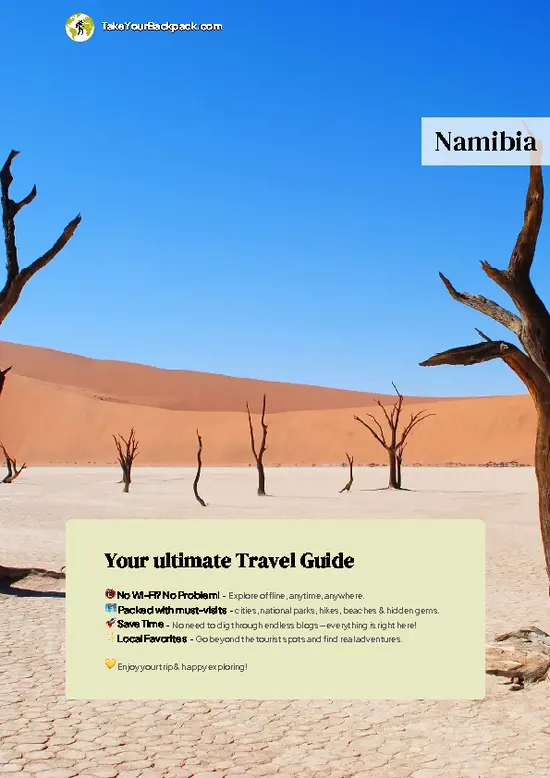
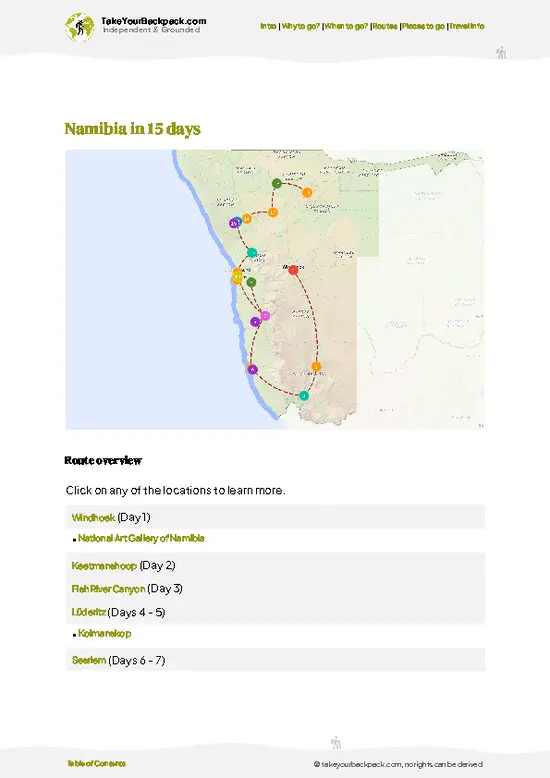
example page 0 from our offline Travel Guide for Namibia
example page 1 from our offline Travel Guide for Namibia
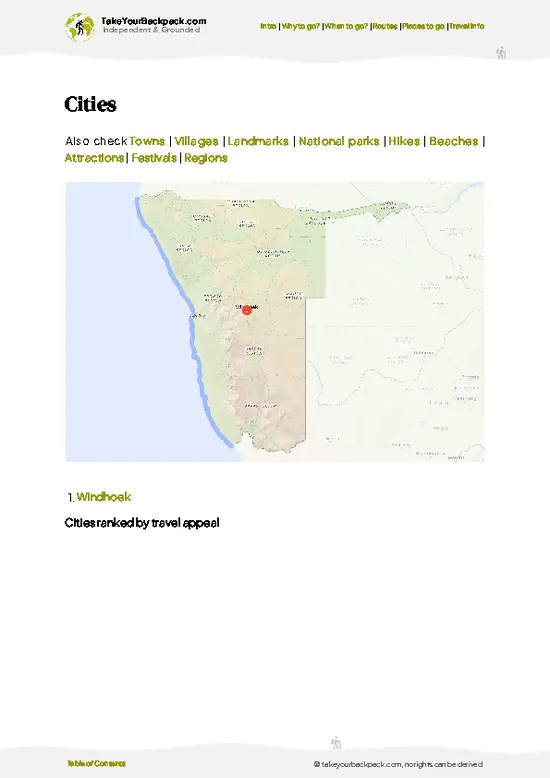
example page 2 from our offline Travel Guide for Namibia
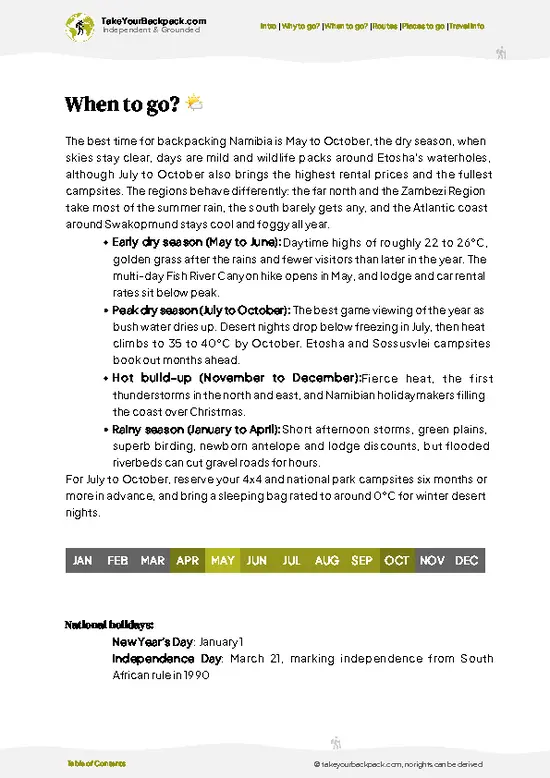
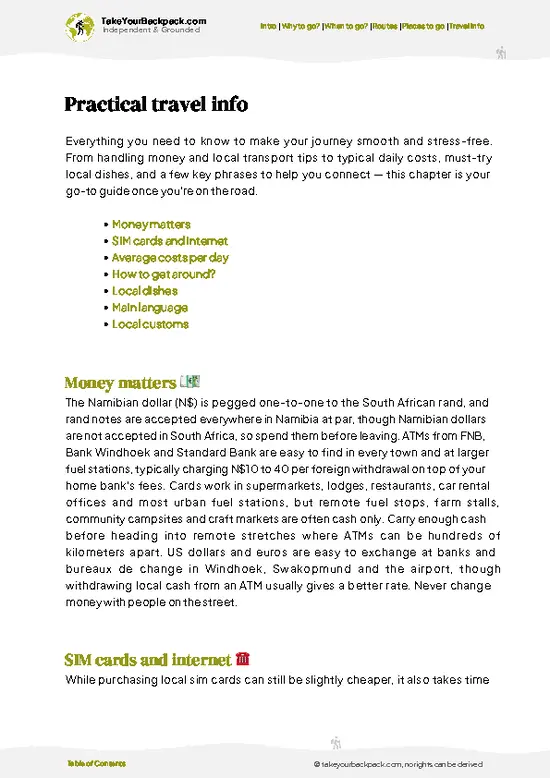
example page 3 from our offline Travel Guide for Namibia
example page 4 from our offline Travel Guide for Namibia
example page 5 from our offline Travel Guide for Namibia
example page 6 from our offline Travel Guide for Namibia
example page 7 from our offline Travel Guide for Namibia
Loading the map 🌍
CLICK TO FILTER
cities
towns
villages
landmarks
national parks
hikes
beaches
attractions
festivals
regions
SHOW COUNTRY’S BESTSHOW ALL

✨ Why go?
Ranked #4 unique site in Namibia
What makes this unique site worth visiting

Epupa Falls rewards the effort because nothing else in Namibia looks like it: a green ribbon of makalani palms and fig trees cutting through dry Kaokoveld hills, with water roaring where everything else is rock and dust. The road from Opuwo is slow, but that distance keeps the place quiet and the camps small.

The area is also the doorstep to Himba country. Villages stand within reach of the river, and a guided visit is the respectful way to meet people whose cattle-herding life still shapes the valley. Go with a local guide who arranges it properly, and bring a small gift of staples like maize meal or sugar.

It also stretches a northern loop nicely. Pair it with Etosha and the Kamanjab and Opuwo stretch, or follow the river further to the remote Kunene River Lodge area. Campsites sit right … read more 👉
Epupa Falls rewards the effort because nothing else in Namibia looks like it: a green ribbon of makalani palms and fig trees cutting through dry Kaokoveld hills, with water roaring where everything else is rock and dust. The road from Opuwo is slow, but that distance keeps the place quiet and the camps small.

The area is also the doorstep to Himba country. Villages stand within reach of the river, and a guided visit is the respectful way to meet people whose cattle-herding life still shapes the valley. Go with a local guide who arranges it properly, and bring a small gift of staples like maize meal or sugar.

It also stretches a northern loop nicely. Pair it with Etosha and the Kamanjab and Opuwo stretch, or follow the river further to the remote Kunene River Lodge area. Campsites sit right above the cascades, so you fall asleep to the sound of water.

💡 HighlightsEssential experiences to have while visiting Epupa Falls

  1. The Main Epupa Falls Viewpoint: a short walk from the camps brings you to the edge of the gorge, where the Kunene splits into channels and plunges about 37 meters. The mist cools the air noticeably.
  2. The Baobab on the Cliff: a huge, old baobab leans over the falls and makes the classic photo, especially with the water behind it.
  3. Makalani Palm Groves: the palms line the river and the pools, and their fronds rattle in the wind. They give a lush, tropical look against the barren hills.
  4. Sunrise at the Rim: the spray catches low light and throws rainbows across the gorge. It is calm, and few people are about.
  5. Himba Village Visit: guided visits let you see daily life, with hand-made jewelry, ochre-coated skin and cattle kraals. Pay a guide fee and ask before taking photos.
  6. Kunene River Pools: some calmer
… read more 👉
  1. The Main Epupa Falls Viewpoint: a short walk from the camps brings you to the edge of the gorge, where the Kunene splits into channels and plunges about 37 meters. The mist cools the air noticeably.
  2. The Baobab on the Cliff: a huge, old baobab leans over the falls and makes the classic photo, especially with the water behind it.
  3. Makalani Palm Groves: the palms line the river and the pools, and their fronds rattle in the wind. They give a lush, tropical look against the barren hills.
  4. Sunrise at the Rim: the spray catches low light and throws rainbows across the gorge. It is calm, and few people are about.
  5. Himba Village Visit: guided visits let you see daily life, with hand-made jewelry, ochre-coated skin and cattle kraals. Pay a guide fee and ask before taking photos.
  6. Kunene River Pools: some calmer stretches above the falls look inviting, but crocodiles live in the river. Watch from the bank, and ask locals which spots are safe.
  7. Riverside Campsite Sunsets: sites along the banks put you within earshot of the falls. The evening air smells of wet rock and woodsmoke.
The sunrise rim walk and the Himba village visit pair easily in one day, with the village trip filling the late morning.
Spotted a mistake or missing something? Contact us.

🌤️ When to go?Best time to visit Epupa Falls

  • Dry Season (May to September): Epupa Falls is at its most comfortable from May to September, with days of 28 to 32°C (82 to 90°F) and nights of 12 to 18°C (54 to 64°F). The Kunene runs clear, the falls are easy to walk around, and daylight lasts roughly 11 hours. This is peak season for overlanders, so campsites fill and rates rise.
  • Hot Dry Months (October to November): Daytime temperatures reach 35 to 40°C (95 to 104°F). Crowds thin out and the natural rock pools are tempting, but the midday heat is punishing and the air is dusty.
  • Rainy Season (December to April): Showers arrive in short, heavy bursts, with highs of 30 to 36°C (86 to 97°F). Upstream rains in Angola swell the river, so the falls roar at their widest and loudest around March and April. Gravel roads from Opuwo can turn slick or
… read more 👉
  • Dry Season (May to September): Epupa Falls is at its most comfortable from May to September, with days of 28 to 32°C (82 to 90°F) and nights of 12 to 18°C (54 to 64°F). The Kunene runs clear, the falls are easy to walk around, and daylight lasts roughly 11 hours. This is peak season for overlanders, so campsites fill and rates rise.
  • Hot Dry Months (October to November): Daytime temperatures reach 35 to 40°C (95 to 104°F). Crowds thin out and the natural rock pools are tempting, but the midday heat is punishing and the air is dusty.
  • Rainy Season (December to April): Showers arrive in short, heavy bursts, with highs of 30 to 36°C (86 to 97°F). Upstream rains in Angola swell the river, so the falls roar at their widest and loudest around March and April. Gravel roads from Opuwo can turn slick or impassable, and the humidity is high. Lodging is cheaper and you may have the place almost to yourself.
Aim for May or June, when the river is still full from the rains but the roads have dried out.


source: climatestotravel.comJANJanuary: fair for travelingFEBFebruary: fair for travelingMARMarch: fair for travelingAPRApril: good for travelingMAYMay: highly recommended for travelingJUNJune: excellent for travelingJULJuly: excellent for travelingAUGAugust: excellent for travelingSEPSeptember: highly recommended for travelingOCTOctober: highly recommended for travelingNOVNovember: fair for travelingDECDecember: fair for traveling
namibia-unique-site-epupa-falls
© Google |

✈️ The backpacker research shortcutNamibia Travel Guide

An offline-friendly backpacking guide with optimized travel routes, ranked highlights, transport advice, and the best areas to stay.
example page 0 from our offline Travel Guide for Namibia
example page 1 from our offline Travel Guide for Namibia
example page 2 from our offline Travel Guide for Namibia
example page 3 from our offline Travel Guide for Namibia
example page 4 from our offline Travel Guide for Namibia
example page 5 from our offline Travel Guide for Namibia
example page 6 from our offline Travel Guide for Namibia
example page 7 from our offline Travel Guide for Namibia
The digital guide (294 pages) contains:
✅ 71 highlights, ranked by travel appeal
✅ Optimized 5, 10 & 15-day travel routes
✅ Cities, national parks, landmarks, beaches
✅ How to get around
✅ Offline-friendly for travel without Wi-Fi
👉 Click to see all 30+ guide features

📅 Plan smarter in minutes, not weeks
✅ Month by month travel advice
✅ Festivals & national holidays
✅ Budget expectations

🗺️ Go to the right places, skip the overrated ones
✅ Honest pros & cons of destinations
✅ Top hikes, parks & viewpoints
✅ Lesser-known places most travelers miss
✅ Clear “worth it vs skip it” guidance

🛏️ Travel smoothly without rookie mistakes
✅ Best areas to stay
✅ Transport systems explained simply
✅ Common scams & safety advice
✅ SIM cards, money & practical tips

🌍 Understand the country, not just visit it
✅ Culture & traditions
✅ 52 Essential phrases & customs
✅ Festivals worth planning around
✅ Traveler-friendly historical context
✅ Insights that make places more meaningful

📱 Built for real travel conditions
✅ Fully downloadable PDF
✅ Works completely offline
✅ Optimized for phone use
✅ Useful in remote areas & buses
✅ Everything in one place
Stop searching, start planning
Get instant access to your full guide. 30‑day money-back guarantee.
+ Add another guide for just

By proceeding you agree to our terms.
Sent to your inbox immediately after payment • 100% Secure Checkout
Best Backpacking Travel Advisor 2025 tourism awardBest Backpacking
Travel Advisor
2025
What others say about Take Your Backpack Guides:
⭐⭐⭐⭐⭐
Fantastic, amazing amount of information!
⭐⭐⭐⭐⭐
My goodness this is amazing, it's what I've been looking for hats off too you!
⭐⭐⭐⭐⭐
I think this is absolutely BRILLIANT
⭐⭐⭐⭐
Very complete and informative. It's still missing places, but I gotta to commend you
⭐⭐⭐⭐⭐
This is truly amazing, thank you, can't wait to explore it with my kids!
⭐⭐⭐⭐⭐
Awesome resource, thank you!
⭐⭐⭐⭐⭐
This is amazing! Can't wait to explore the ones I haven't seen
⭐⭐⭐⭐
I love this! Well done, great idea.
⭐⭐⭐⭐⭐
Thanks for taking the time to make this gem!
⭐⭐⭐⭐⭐
This might be the best website I've ever seen.
⭐⭐⭐⭐⭐
Congratulations, and thank you so much for your work; it's incredibly valuable.
⭐⭐⭐⭐
In all seriousness I think you did a great job pointing out the important spots
⭐⭐⭐⭐⭐
10/10 very good
⭐⭐⭐⭐⭐
As someone who's only just starting to visit regularly this is awesome, thank you.
⭐⭐⭐⭐
Thank you very much! I'm going to visit my dad, it's going to be very useful!
⭐⭐⭐⭐⭐
This is really cool! We'll be travelling for the first time and this definitely come in handy.
⭐⭐⭐⭐⭐
You are now our minister of culture, congratulations 👨‍💼
⭐⭐⭐⭐⭐
Just wanted to tell you that this is a pearl! Going to follow your recommendations.
⭐⭐⭐⭐⭐
This is so cool. I'll definitely be using the resource for my travels soon.
⭐⭐⭐⭐⭐
This is very impressive! Good work.
⭐⭐⭐⭐⭐
This is an amazing and informative site. Very well done!

🛏️ Where to stay?Best areas and accommodation options

The best base for backpackers is the riverside strip at Epupa Falls itself, where a handful of campsites sit along the Kunene within walking distance of the cascades. Budget travelers here mostly pitch tents, either their own or on rented platforms, under shady makalani palms and fig trees. Evenings are social, with overlanders and small-group tour travelers swapping road stories around shared fire pits and riverside bars. Walking between sites after dark is generally fine, but crocodiles live in the river, so keep clear of the water’s edge at night and swim only in the designated safe pools. … read more 👉
The best base for backpackers is the riverside strip at Epupa Falls itself, where a handful of campsites sit along the Kunene within walking distance of the cascades. Budget travelers here mostly pitch tents, either their own or on rented platforms, under shady makalani palms and fig trees. Evenings are social, with overlanders and small-group tour travelers swapping road stories around shared fire pits and riverside bars. Walking between sites after dark is generally fine, but crocodiles live in the river, so keep clear of the water’s edge at night and swim only in the designated safe pools. Solo travelers will find it easy to meet people, and many campsites arrange Himba village visits and sunset walks at the falls.

If you arrive late or want a bed under a roof, Opuwo is the other option, about 180 kilometers away by gravel road. It has basic guesthouses and the last real supermarkets and fuel stations, so it works well for a night of stocking up. It is less atmospheric than the river, but a practical first or last stop. Staying on the Angolan side is not an option for most travelers, so keep your base on the Namibian bank.

👛 Costs (as of 22 October 2026)Travel costs and budget guide for Epupa Falls

Epupa Falls costs backpackers roughly US$10 to 20 a day, with a total daily budget of about US$60 once camping, food and a share of fuel are covered.
CategoryBudget RangeLocal Reality
Camping (high season)US$10 to 20Per person at riverside sites; basic rooms or chalets cost far more.
Accommodation (low season)US$8 to 15Same campsites, with lower rates and more space.
Food and drinkUS$12 to 22Campsite restaurants serve simple meals and cold drinks; self-caterers stock up in Opuwo.
TransportUS$15 to 25Shared fuel or car hire costs per person; public transport to the falls is very limited. Fuel is sold in Opuwo and sometimes at Epupa, at higher prices.
Village and guided visitsUS$8 to 20Himba village visits are usually arranged through campsites for a modest fee, payable in cash.
Entry and feesUS$0
… read more 👉
Epupa Falls costs backpackers roughly US$10 to 20 a day, with a total daily budget of about US$60 once camping, food and a share of fuel are covered.
CategoryBudget RangeLocal Reality
Camping (high season)US$10 to 20Per person at riverside sites; basic rooms or chalets cost far more.
Accommodation (low season)US$8 to 15Same campsites, with lower rates and more space.
Food and drinkUS$12 to 22Campsite restaurants serve simple meals and cold drinks; self-caterers stock up in Opuwo.
TransportUS$15 to 25Shared fuel or car hire costs per person; public transport to the falls is very limited. Fuel is sold in Opuwo and sometimes at Epupa, at higher prices.
Village and guided visitsUS$8 to 20Himba village visits are usually arranged through campsites for a modest fee, payable in cash.
Entry and feesUS$0 to 3Viewing the falls is largely free, though some campsites charge for access through their land.
Total Daily BudgetUS$60Based on high-season camping, meals and shared transport.
Travelers pay in Namibian dollars or South African rand, and cash is vital since there are no ATMs at Epupa. Withdraw money in Opuwo before heading north.
⚠️ Prices can change and everyone travels differently, so take this as a rough guide. Hope it helps you plan your adventure!

FAQFrequently asked questions about Epupa Falls

Epupa Falls is a series of waterfalls on the Kunene River along the Namibia and Angola border, in the Kunene Region. The river drops about 37 meters in total across several channels, among palms and ancient baobab trees. The nearest town is Opuwo, roughly 180 kilometers south, and the area is home to the semi-nomadic Himba people.
Epupa Falls deserves two nights, giving you one full day to walk the viewpoints and rock channels and another for a Himba village visit or river activity. A single night works if you are passing through, but the drive in is long. Allow a third day if you want to hike along the river or rest after the rough road.
Epupa Falls lies about 180 kilometers north of Opuwo on a gravel road, which takes roughly 3 to 4 hours by 4x4 or a high-clearance vehicle. Opuwo is about 700 kilometers from Windhoek, a drive of 8 to 9 hours by tarmac, so most travelers split it over two days. Public transport is very limited, so hiring a car or joining an overland tour is the practical choice.
⚠️ Things can change over time, so always validate details locally before you go.

Other Namibian landmarks near Epupa Falls

Explore more nearby:

  • Twyfelfontein—Pecked engravings, Lion Man slab, Dancing Kudu, red sandstone valley| 414 km away
  • Brandberg Mountain—White Lady panel, Tsisab Ravine, granite massif, guided rock art walk| 481 km away
  • Sandwich Harbour—Dunes meeting surf, lagoon flocks, 4x4 sand driving, seal colonies| 675 km away

💡 Not sure where to go next?
Create a personalized itinerary for Namibia including Epupa Falls and the places that fit your trip.

Generate my itinerary

👉 Discover all landmarks

Or checkout all Namibia has to offer (think cities, towns, villages, national parks, hikes, beaches, festivals)
Country photo of Namibia

We 💚 feedbackWhat to keep in mind

Epupa Falls hides its best trick away from the main viewpoint: walk downstream along the rocks toward the quieter channels, where the water splits around palm-covered islets and the noise drops to a murmur. I would go at dawn, bring sturdy shoes for slick rock, and keep well back from the water's edge.

✍️ Help improve this page!
The information on this page is based on in-depth research, insights shared by experienced travelers, and feedback from the local travel community in Namibia. While every effort is made to keep the information accurate and current, conditions can change — so if you spot anything incorrect or outdated, please get in touch.


🙋‍♂️ Give feedback

👋 Meet the founderWho’s Behind Take Your Backpack?

Johan, backpacker and founder of TakeYourBackpackHi, I’m Johan (Netherlands 🇳🇱), the creator of TakeYourBackpack. Over the past 3 decades, I’ve backpacked through 90+ countries across six continents, gaining extensive experience with independent travel, long-term trips, and overland routes.

This site is built on a combination of firsthand travel experience and carefully curated insights from other backpackers. Many guides are based on places I’ve personally visited, while others bring together tips, observations, and practical advice shared by trusted travelers I’ve met along the way.

The goal is to provide realistic, experience-driven guidance — not generic itineraries — so you can explore destinations with better context, clearer expectations, and more confidence.