×

The Netherlands🇳🇱 | regionsFrieslandHarbor towns, lakes, ferry crossings, Elfstedentocht towns | things to do and best time to go

Explore Brabantse KempenExplore Texel

Backpacking in Friesland
👌 Worth visitingregion ranked #4
By Johan Kruseman 🇳🇱 | Updated October 3, 2026

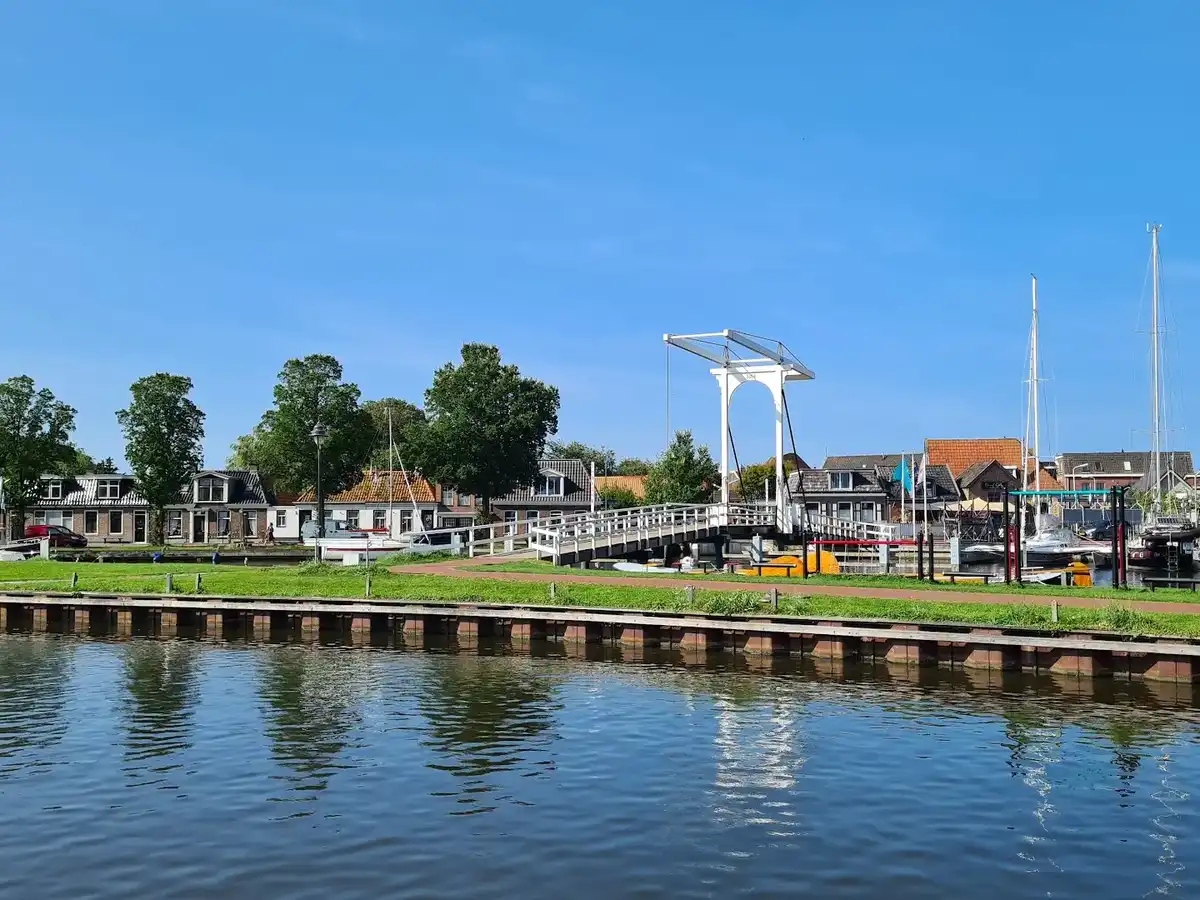
The ferry deckhand on the Vlieland crossing from Harlingen handed my bike back and said, “Wind’s from the west, so you ride home with it. Everyone plans the outbound leg wrong.” He was right. Friesland sits in the northern Netherlands, between the IJsselmeer and the Wadden Sea, and wind is the organizing principle: it decides cycling direction, sailing days and mudflat timing. The upsides are real. Flat terrain, lakes, Frisian-language towns like Franeker and Sneek, and the Wadden coast give variety without long transfers. Crowds are thin outside Leeuwarden and Harlingen. The downsides are weather and sparse trains beyond the main lines. Compared with Groningen, you get more water and less city; compared with Amsterdam’s orbit, far lower prices and more authenticity.

Discover everything you want to know in the 📖 The Netherlands Travel Guide.


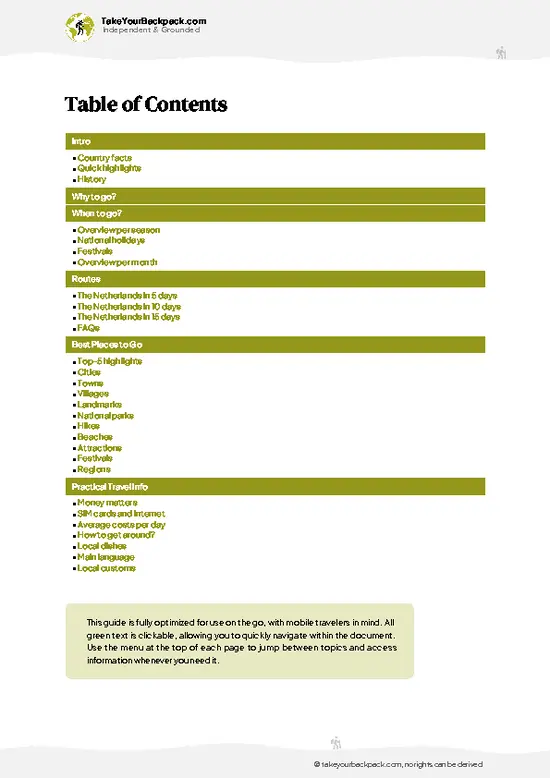
example page 0 from our offline Travel Guide for Netherlands
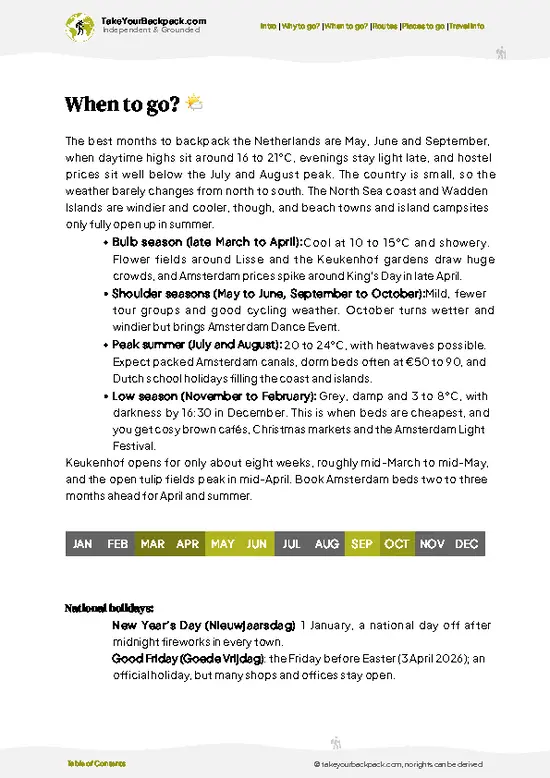
example page 1 from our offline Travel Guide for Netherlands
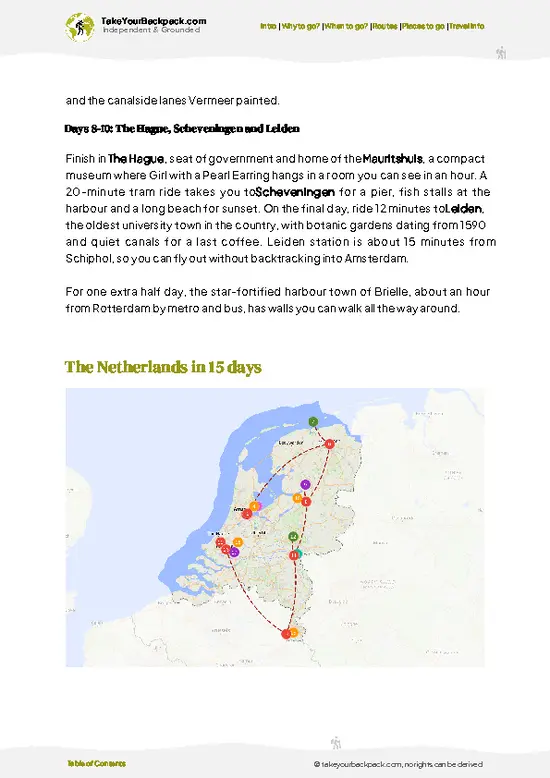
example page 2 from our offline Travel Guide for Netherlands
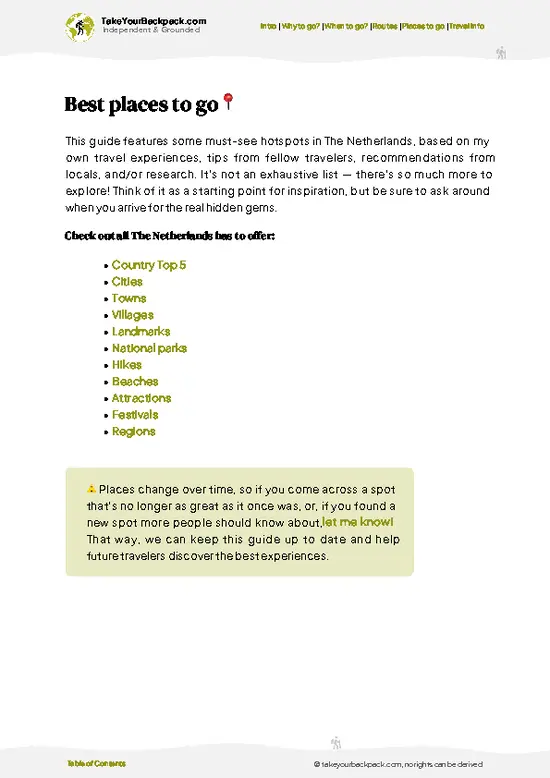
example page 3 from our offline Travel Guide for Netherlands
example page 4 from our offline Travel Guide for Netherlands
example page 5 from our offline Travel Guide for Netherlands
example page 6 from our offline Travel Guide for Netherlands
example page 7 from our offline Travel Guide for Netherlands
Loading the map 🌍
CLICK TO FILTER
cities
towns
villages
landmarks
national parks
hikes
beaches
attractions
festivals
regions
SHOW COUNTRY’S BESTSHOW ALL

✨ Why go?
Ranked #4 region in The Netherlands
The unique appeal for travelers

Backpackers come for a region where one bike and a rail pass cover wildly different settings. The Elfstedenroute, the 200-kilometer route linking eleven historic cities, lets you string together canals, windmills and quiet villages at your own pace, with hostels, campsites and B&Bs roughly 20 to 30 kilometers apart. The second reason is the Wadden Sea UNESCO coast. From Harlingen, ferries reach Terschelling and Vlieland in about 1 to 2 hours, so you can swap farmland for dunes and beaches without hauling a car. Mudflat walking (wadlopen) from Pieterburen is just over the border in Groningen, but Friesland’s own Wad tours from Holwerd to Ameland give you the same strange seabed experience. Add the Frisian language and its own flag, and you travel through a place with a distinct identity rather … read more 👉
Backpackers come for a region where one bike and a rail pass cover wildly different settings. The Elfstedenroute, the 200-kilometer route linking eleven historic cities, lets you string together canals, windmills and quiet villages at your own pace, with hostels, campsites and B&Bs roughly 20 to 30 kilometers apart. The second reason is the Wadden Sea UNESCO coast. From Harlingen, ferries reach Terschelling and Vlieland in about 1 to 2 hours, so you can swap farmland for dunes and beaches without hauling a car. Mudflat walking (wadlopen) from Pieterburen is just over the border in Groningen, but Friesland’s own Wad tours from Holwerd to Ameland give you the same strange seabed experience. Add the Frisian language and its own flag, and you travel through a place with a distinct identity rather than a generic Dutch backdrop. Trains link Leeuwarden, Sneek, Harlingen and Stavoren, and buses fill gaps.

💡 HighlightsDon't-miss highlights and experiences

  1. Leeuwarden old town: Canals, the leaning Oldehove tower (about 35 meters, tilted since the 1500s) and the Fries Museum make it the best base.
  2. Harlingen harbor: A working port with captains’ houses and the ferry gateway to the islands.
  3. Terschelling: Car-free feel, wide beaches and cranberry bogs, reached by ferry in about 2 hours.
  4. Vlieland: Quieter and smaller, with one village, Oost-Vlieland, and cycling through dunes.
  5. Sneek: The Waterpoort gate and sailing culture make it the center of the lake district.
  6. Franeker: Home to the Eise Eisinga Planetarium, a working 18th-century model of the solar system built in a living room.
  7. Hindeloopen: Tiny harbor town with painted Frisian folk furniture and a local skating tradition.
  8. Lake Fluessen and Gaasterland: Rolling woods and beaches near Rijs and Oudemirdum,
… read more 👉
  1. Leeuwarden old town: Canals, the leaning Oldehove tower (about 35 meters, tilted since the 1500s) and the Fries Museum make it the best base.
  2. Harlingen harbor: A working port with captains’ houses and the ferry gateway to the islands.
  3. Terschelling: Car-free feel, wide beaches and cranberry bogs, reached by ferry in about 2 hours.
  4. Vlieland: Quieter and smaller, with one village, Oost-Vlieland, and cycling through dunes.
  5. Sneek: The Waterpoort gate and sailing culture make it the center of the lake district.
  6. Franeker: Home to the Eise Eisinga Planetarium, a working 18th-century model of the solar system built in a living room.
  7. Hindeloopen: Tiny harbor town with painted Frisian folk furniture and a local skating tradition.
  8. Lake Fluessen and Gaasterland: Rolling woods and beaches near Rijs and Oudemirdum, rarely visited by foreigners.
  9. Dokkum: Complete star-shaped moats, ramparts and a calm windmill-lined center.
  10. Lauwersmeer National Park edge: Shared with Groningen, a birdwatching wetland with huge skies and few people.
Franeker and Harlingen combine well in one day, since they are about 15 minutes apart by train.
Spotted a mistake or missing something? Contact us.

Things to do around Friesland

Ratings based on Tripadvisor reviews. When you book through this link, you support our work at no extra cost to you.

⌛️ 5 daysA smart one-week plan

Day 1: Leeuwarden: Arrive by train from Zwolle or Groningen and start here, because the rail network radiates from Leeuwarden and every later move is easier from this hub. Climb the Oldehove, see the Fries Museum, and sleep nearby.
Day 2: Franeker and Harlingen: Take the train to Franeker for the planetarium, then continue to Harlingen. Trains here run every 30 minutes, so you can stack towns cheaply without a bike. Sleep in Harlingen to catch the early boat.
Day 3: Terschelling: Ferries take about 2 hours, so a full island day makes the crossing worth it. Rent a bike at the harbor, ride to the beach and the lighthouse, and expect the westerly to shape your route.
Day 4: Sneek and Hindeloopen: Return, then ride the train to Sneek and bus or cycle to Hindeloopen. Buses thin out after early evening, … read more 👉
Day 1: Leeuwarden: Arrive by train from Zwolle or Groningen and start here, because the rail network radiates from Leeuwarden and every later move is easier from this hub. Climb the Oldehove, see the Fries Museum, and sleep nearby.
Day 2: Franeker and Harlingen: Take the train to Franeker for the planetarium, then continue to Harlingen. Trains here run every 30 minutes, so you can stack towns cheaply without a bike. Sleep in Harlingen to catch the early boat.
Day 3: Terschelling: Ferries take about 2 hours, so a full island day makes the crossing worth it. Rent a bike at the harbor, ride to the beach and the lighthouse, and expect the westerly to shape your route.
Day 4: Sneek and Hindeloopen: Return, then ride the train to Sneek and bus or cycle to Hindeloopen. Buses thin out after early evening, so plan arrival before dark. The detour: from Hindeloopen, cycle the dike to Gaasterland for forest and lake beaches, adding about 20 kilometers.
Day 5: Dokkum: Finish with a bus from Leeuwarden to Dokkum for ramparts and quiet. My recommendation for the one day that justifies the trip is Day 3 on Terschelling, when the wind drops late afternoon and the dunes go gold.

🌤️ When to go?Choosing the right time of year

  • Late Spring (May to June): The best window for cycling, with highs of 14 to 20°C (57 to 68°F), long light until about 10 pm in June, and tulip-bright polders. Crowds are light and prices are normal.
  • Summer (July to August): Highs of 20 to 23°C (68 to 73°F) and daylight of 16 hours or more. Sailing on the lakes, Wadden Sea mudflat walks and Waddenzee ferries to Terschelling and Ameland peak, so book beds early; prices rise 20 to 40 percent.
  • Autumn (September to October): Highs of 11 to 18°C (52 to 64°F), more rain and wind, but empty paths and cheaper rooms. Migratory geese arrive on the coast.
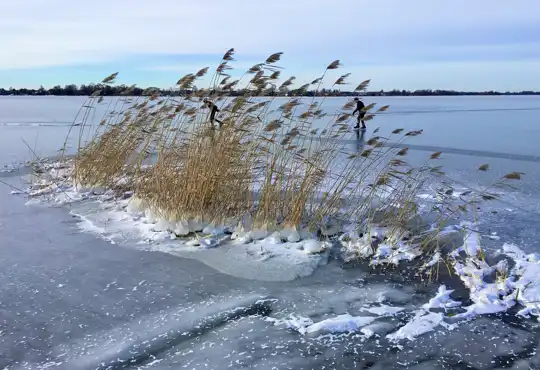
  • Winter (December to February): Highs of 3 to 6°C (37 to 43°F), with daylight of only 8 hours. Most campsites close. In a hard freeze the Elfstedentocht-style skating on canals and lakes is possible, though
… read more 👉
  • Late Spring (May to June): The best window for cycling, with highs of 14 to 20°C (57 to 68°F), long light until about 10 pm in June, and tulip-bright polders. Crowds are light and prices are normal.
  • Summer (July to August): Highs of 20 to 23°C (68 to 73°F) and daylight of 16 hours or more. Sailing on the lakes, Wadden Sea mudflat walks and Waddenzee ferries to Terschelling and Ameland peak, so book beds early; prices rise 20 to 40 percent.
  • Autumn (September to October): Highs of 11 to 18°C (52 to 64°F), more rain and wind, but empty paths and cheaper rooms. Migratory geese arrive on the coast.
  • Winter (December to February): Highs of 3 to 6°C (37 to 43°F), with daylight of only 8 hours. Most campsites close. In a hard freeze the Elfstedentocht-style skating on canals and lakes is possible, though rarely.
Ride in late May or September for the best mix of light, calm and low prices.


source: climatestotravel.comJANJanuary: fair for travelingFEBFebruary: fair for travelingMARMarch: good for travelingAPRApril: good for travelingMAYMay: excellent for travelingJUNJune: highly recommended for travelingJULJuly: highly recommended for travelingAUGAugust: highly recommended for travelingSEPSeptember: excellent for travelingOCTOctober: good for travelingNOVNovember: fair for travelingDECDecember: fair for traveling
netherlands-region-friesland
© Google | Jan Willem Bouma

✈️ The backpacker research shortcutThe Netherlands Travel Guide

An offline-friendly backpacking guide with optimized travel routes, ranked highlights, transport advice, and the best areas to stay.
example page 0 from our offline Travel Guide for Netherlands
example page 1 from our offline Travel Guide for Netherlands
example page 2 from our offline Travel Guide for Netherlands
example page 3 from our offline Travel Guide for Netherlands
example page 4 from our offline Travel Guide for Netherlands
example page 5 from our offline Travel Guide for Netherlands
example page 6 from our offline Travel Guide for Netherlands
example page 7 from our offline Travel Guide for Netherlands
The digital guide (373 pages) contains:
✅ 127 highlights, ranked by travel appeal
✅ Optimized 5, 10 & 15-day travel routes
✅ Cities, national parks, landmarks, beaches
✅ How to get around
✅ Offline-friendly for travel without Wi-Fi
👉 Click to see all 30+ guide features

📅 Plan smarter in minutes, not weeks
✅ Month by month travel advice
✅ Festivals & national holidays
✅ Budget expectations

🗺️ Go to the right places, skip the overrated ones
✅ Honest pros & cons of destinations
✅ Top hikes, parks & viewpoints
✅ Lesser-known places most travelers miss
✅ Clear “worth it vs skip it” guidance

🛏️ Travel smoothly without rookie mistakes
✅ Best areas to stay
✅ Transport systems explained simply
✅ Common scams & safety advice
✅ SIM cards, money & practical tips

🌍 Understand the country, not just visit it
✅ Culture & traditions
✅ 52 Essential phrases & customs
✅ Festivals worth planning around
✅ Traveler-friendly historical context
✅ Insights that make places more meaningful

📱 Built for real travel conditions
✅ Fully downloadable PDF
✅ Works completely offline
✅ Optimized for phone use
✅ Useful in remote areas & buses
✅ Everything in one place
Stop searching, start planning
Get instant access to your full guide. 30‑day money-back guarantee.
+ Add another guide for just

By proceeding you agree to our terms.
Sent to your inbox immediately after payment • 100% Secure Checkout
Best Backpacking Travel Advisor 2025 tourism awardBest Backpacking
Travel Advisor
2025
What others say about Take Your Backpack Guides:
⭐⭐⭐⭐⭐
Fantastic, amazing amount of information!
⭐⭐⭐⭐⭐
My goodness this is amazing, it's what I've been looking for hats off too you!
⭐⭐⭐⭐⭐
I think this is absolutely BRILLIANT
⭐⭐⭐⭐
Very complete and informative. It's still missing places, but I gotta to commend you
⭐⭐⭐⭐⭐
This is truly amazing, thank you, can't wait to explore it with my kids!
⭐⭐⭐⭐⭐
Awesome resource, thank you!
⭐⭐⭐⭐⭐
This is amazing! Can't wait to explore the ones I haven't seen
⭐⭐⭐⭐
I love this! Well done, great idea.
⭐⭐⭐⭐⭐
Thanks for taking the time to make this gem!
⭐⭐⭐⭐⭐
This might be the best website I've ever seen.
⭐⭐⭐⭐⭐
Congratulations, and thank you so much for your work; it's incredibly valuable.
⭐⭐⭐⭐
In all seriousness I think you did a great job pointing out the important spots
⭐⭐⭐⭐⭐
10/10 very good
⭐⭐⭐⭐⭐
As someone who's only just starting to visit regularly this is awesome, thank you.
⭐⭐⭐⭐
Thank you very much! I'm going to visit my dad, it's going to be very useful!
⭐⭐⭐⭐⭐
This is really cool! We'll be travelling for the first time and this definitely come in handy.
⭐⭐⭐⭐⭐
You are now our minister of culture, congratulations 👨‍💼
⭐⭐⭐⭐⭐
Just wanted to tell you that this is a pearl! Going to follow your recommendations.
⭐⭐⭐⭐⭐
This is so cool. I'll definitely be using the resource for my travels soon.
⭐⭐⭐⭐⭐
This is very impressive! Good work.
⭐⭐⭐⭐⭐
This is an amazing and informative site. Very well done!

🛏️ Where to stay?Choosing the right base

Leeuwarden is the best base in Friesland for most backpackers, because it has the province’s widest choice of budget beds, a compact and safe old center, and direct trains to the rest of the Netherlands. Evenings are lively around its canals and student cafés, which makes it the easiest place to meet other travelers.
Harlingen suits those heading for the Wadden Islands. The harbor town is small and walkable, with a relaxed, seafaring feel, and you can catch the ferry in the morning without a long transfer.
Sneek is the natural stop for sailors and cyclists. Its water gate, boat yards and lakeside … read more 👉
Leeuwarden is the best base in Friesland for most backpackers, because it has the province’s widest choice of budget beds, a compact and safe old center, and direct trains to the rest of the Netherlands. Evenings are lively around its canals and student cafés, which makes it the easiest place to meet other travelers.
Harlingen suits those heading for the Wadden Islands. The harbor town is small and walkable, with a relaxed, seafaring feel, and you can catch the ferry in the morning without a long transfer.
Sneek is the natural stop for sailors and cyclists. Its water gate, boat yards and lakeside paths attract a friendly, outdoorsy crowd, and the town is quiet and very safe at night.
Staveren and the Hindeloopen area work well for a coastal night. Both are small, with sandy shores, and they are good bases for the long-distance cycle routes along the IJsselmeer.
Terschelling is the island to stay on if you want walks, dunes and beach campsites. Nights there are calm, social around the campsites, and safe to wander after dark.

🚌 Getting aroundHow to get from A to B

A bicycle is the easiest way for a backpacker to get around Friesland, because the province is flat, crossed by signposted bike routes and linked by a dense network of numbered junctions (knooppunten). Trains and buses cover the longer gaps, and both run reliably, though buses thin out sharply in the evening and on Sundays. The pattern is simple: trains connect the main towns, buses fill in the countryside, and bikes do the last stretch.
  • Bicycle: Rentals cost about US$12 to 20 a day, and many stations and hostels also rent by the week. You control your schedule and see far more than from a window. At 15 to 20 km per hour, this gives the best return for time, money and comfort, though headwinds off the coast can make a 40 km day feel twice as long.
  • Train: Lines from Leeuwarden reach Groningen,
… read more 👉
A bicycle is the easiest way for a backpacker to get around Friesland, because the province is flat, crossed by signposted bike routes and linked by a dense network of numbered junctions (knooppunten). Trains and buses cover the longer gaps, and both run reliably, though buses thin out sharply in the evening and on Sundays. The pattern is simple: trains connect the main towns, buses fill in the countryside, and bikes do the last stretch.
  • Bicycle: Rentals cost about US$12 to 20 a day, and many stations and hostels also rent by the week. You control your schedule and see far more than from a window. At 15 to 20 km per hour, this gives the best return for time, money and comfort, though headwinds off the coast can make a 40 km day feel twice as long.
  • Train: Lines from Leeuwarden reach Groningen, Zwolle and Harlingen, and to Amsterdam in about 2 hours with a change. Fares run roughly US$5 to 30 per trip. Trains are fast and comfortable, but they serve only a handful of towns, so they suit long hops best.
  • Bus: Regional buses reach villages such as those on the IJsselmeer coast, at about US$3 to 8 per trip. They are slow and sparse, so they work as a backup when a rental bike is not practical, or in rain.
  • Ferry: Boats from Harlingen reach Terschelling (about 2 hours by regular ferry, 50 minutes by fast boat) and from Holwerd to Ameland (about 45 minutes). Foot passengers pay about US$20 to 35 return. Summer crossings fill up, so reserve ahead.
  • Boat rental: Sailing boats and small motor boats on the lakes cost more, from about US$100 a day, but split between four people they become affordable and give a view of the province you cannot get on land.
Take your bike on regional trains outside the rush hours and buy a bike day pass where offered, then plan the longer legs by rail and ride the rest.

🍲 FoodEating & Drinking in Friesland

Friesland’s plate is built on dairy and the sea. Try Frisian sugar bread (suikerbrood), dense and studded with chunks of cinnamon sugar, and Frisian nut cake (Fryske dúmkes) with a spicy aniseed crunch. Aged Frisian cheese (Friese nagelkaas) is flavored with cloves and cumin, and sharp enough to wake you up. Along the coast, look for herring, Wadden Sea mussels and smoked eel, and in spring, sweet brown shrimp in a paper cone.
For drinks, order a glass of Beerenburg, a herbal bitter spirit that is very Frisian and warms you quickly, or Fryske tee, strong black tea served with a lump of rock sugar. A local craft beer is a good alternative on a long evening.
Backpackers eat well at weekly markets, bakeries and harbor fish stands, where a sandwich or snack costs about US$3 to 8. Brown cafés (bruine … read more 👉
Friesland’s plate is built on dairy and the sea. Try Frisian sugar bread (suikerbrood), dense and studded with chunks of cinnamon sugar, and Frisian nut cake (Fryske dúmkes) with a spicy aniseed crunch. Aged Frisian cheese (Friese nagelkaas) is flavored with cloves and cumin, and sharp enough to wake you up. Along the coast, look for herring, Wadden Sea mussels and smoked eel, and in spring, sweet brown shrimp in a paper cone.
For drinks, order a glass of Beerenburg, a herbal bitter spirit that is very Frisian and warms you quickly, or Fryske tee, strong black tea served with a lump of rock sugar. A local craft beer is a good alternative on a long evening.
Backpackers eat well at weekly markets, bakeries and harbor fish stands, where a sandwich or snack costs about US$3 to 8. Brown cafés (bruine kroegen) serve cheap soup and sandwiches at lunch. Dinner is early, often 5:30 to 7 pm, and kitchens close by 9 pm, so plan accordingly. Tipping is modest; rounding up the bill is enough.

FAQCommon questions from travelers

Four to five days is enough to see Friesland well. That covers Leeuwarden, Harlingen, one Wadden island such as Terschelling (about 2 hours by ferry) and a lake town like Sneek or Hindeloopen. Add 2 more days if you want to cycle the Elfstedenroute in sections.
Trains and buses plus a rented bike cover Friesland without a car. Trains link Leeuwarden with Harlingen, Sneek and Stavoren, and buses reach Dokkum and Franeker area villages, though evenings are sparse. Bike rental typically costs about 10 to 15 euros a day, and ferries from Harlingen serve Terschelling and Vlieland.
Friesland is known for its own Frisian language, lakes and canals, and the Wadden Sea coast. Leeuwarden was European Capital of Culture, and the Elfstedentocht skating race along 200 kilometers of frozen waterways is a national obsession. The Frisian islands, sailing at Sneek and the Eise Eisinga Planetarium in Franeker are other highlights.
⚠️ Things can change over time, so always validate details locally before you go.

Other Dutch regions near Friesland

Explore more nearby:

  • Ameland—Whale-rib gates, Hollum lighthouse, seal trips, mudflat walks| 26 km away
  • Wadden Islands—Five islands, ferry ports, dune reserves, island festival| 33 km away
  • Texel—Sheep polders, salt marsh, seal center, lighthouse tip| 68 km away

💡 Not sure where to go next?
Create a personalized itinerary for The Netherlands including Friesland and the places that fit your trip.

Generate my itinerary

👉 Discover all regions

Or checkout all The Netherlands has to offer (think cities, towns, villages, national parks, hikes, beaches, festivals)
Country photo of The Netherlands

We 💚 feedbackFinal thoughts on visiting Friesland

The one mistake to avoid is treating Friesland as a quick day trip from Amsterdam. It rewards slowness, and the wind, ferry timetables and thin evening buses punish rushing. Give it at least four days, ride with the wind when you can, and book island lodging early in summer. It is gentle, not dramatic, and that is the point.

✈️ When did I visit The Netherlands?
Netherlands is my home base, so whenever I don’t travel, you can find me in this tiny spot on the globe. When friends from abroad visit me, it’s the time to actually explore my own country as a traveler.

✍️ Help improve this page!
The information on this page is based on my own backpacking experience in The Netherlands, supplemented with up-to-date research and feedback from other travelers. Travel details can change, so if you notice anything outdated or incomplete, feel free to let me know.


🙋‍♂️ Give feedback

👋 Meet the founderWho’s Behind Take Your Backpack?

Johan, backpacker and founder of TakeYourBackpackHi, I’m Johan (Netherlands 🇳🇱), the creator of TakeYourBackpack. Over the past 3 decades, I’ve backpacked through 90+ countries across six continents, gaining extensive experience with independent travel, long-term trips, and overland routes.

This site is built on a combination of firsthand travel experience and carefully curated insights from other backpackers. Many guides are based on places I’ve personally visited, while others bring together tips, observations, and practical advice shared by trusted travelers I’ve met along the way.

The goal is to provide realistic, experience-driven guidance — not generic itineraries — so you can explore destinations with better context, clearer expectations, and more confidence.