×

The Netherlands🇳🇱 | regionsWadden IslandsFive islands, ferry ports, dune reserves, island festival | things to do and best time to go

Explore TexelExplore Doesburg

Backpacking in Wadden Islands
UNESCO World Heritage site
🏆 Top pickregion ranked #1
By Johan Kruseman 🇳🇱 | Updated October 15, 2026

The Dutch Wadden Islands are five separate inhabited islands with five ferry ports, and only Texel belongs to North Holland; Vlieland, Terschelling, Ameland and Schiermonnikoog belong to Friesland. They form an arc off the northern coast, facing the tidal flats of the Wadden Sea. The pattern is consistent: the farther east you go, the longer the crossing and the fewer the people. Texel is a 20-minute ferry from Den Helder and has the most to do, but also the most day-trippers and holiday parks. Terschelling takes about two hours on the regular ferry from Harlingen (45 minutes on the pricier fast boat) and gives a backpacker the most for the time, with big dunes, lively village pubs and quiet cycle paths. Schiermonnikoog has the best national park, yet is awkward to reach. I stepped off the boat on Vlieland expecting a sleepy hush and found the quay rattling with handcarts and bike trailers, because visitors’ cars are banned and every suitcase moves by muscle.

Discover everything you want to know in the 📖 The Netherlands Travel Guide.


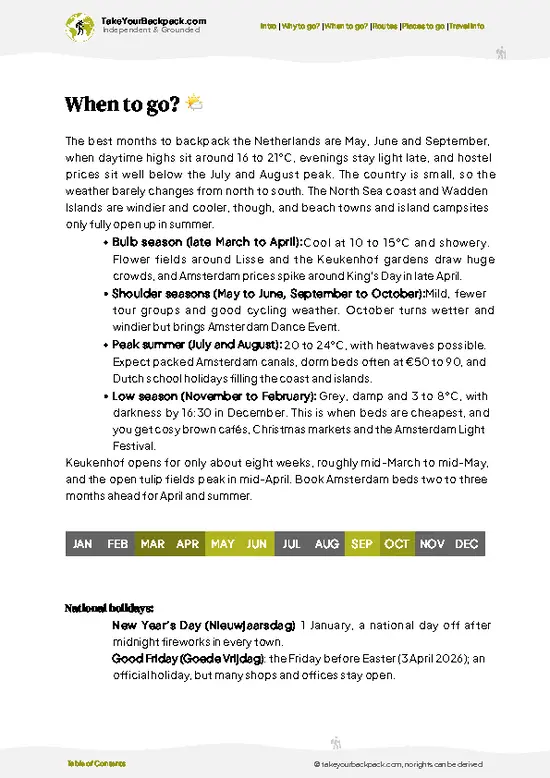
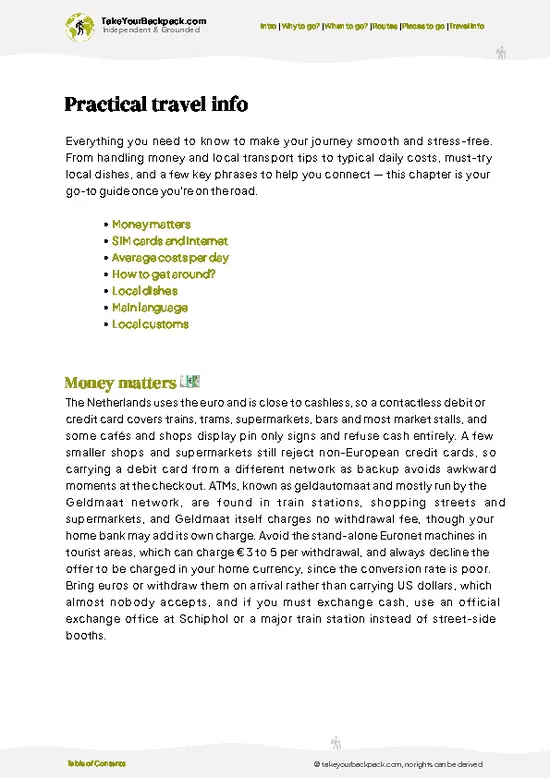
example page 0 from our offline Travel Guide for Netherlands
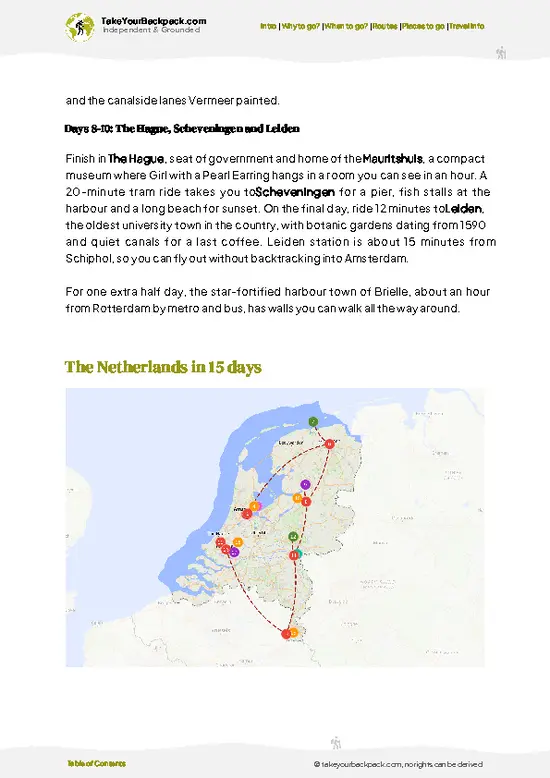
example page 1 from our offline Travel Guide for Netherlands
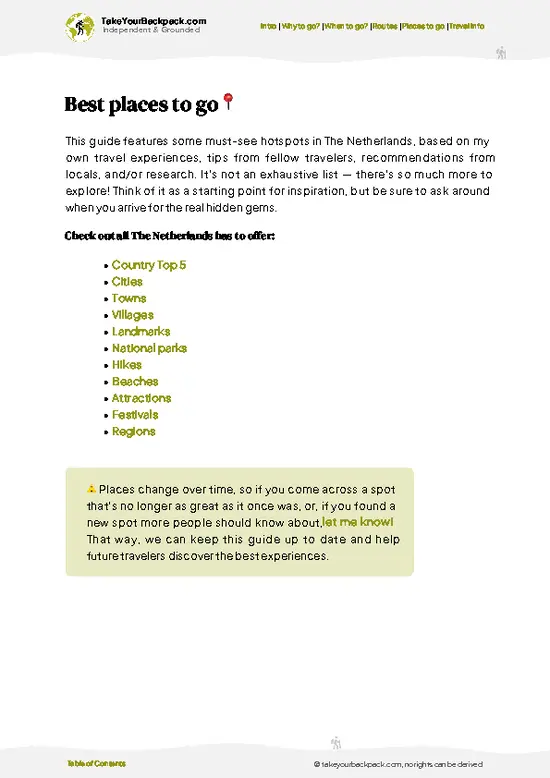
example page 2 from our offline Travel Guide for Netherlands
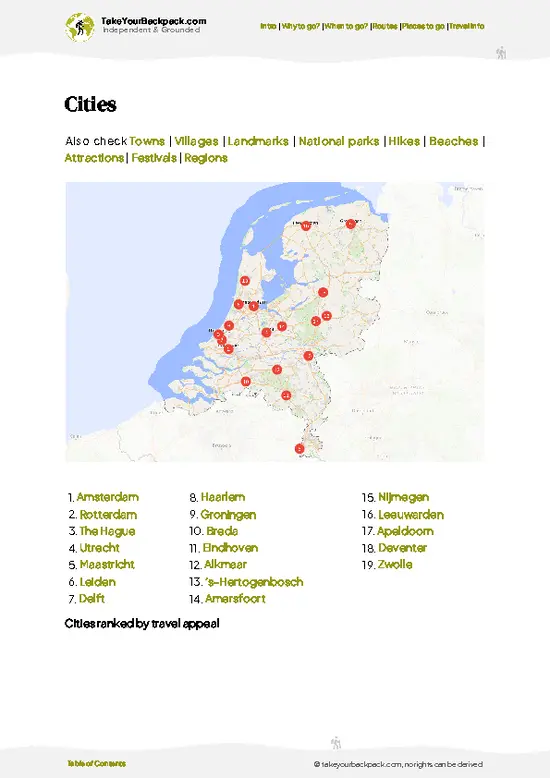
example page 3 from our offline Travel Guide for Netherlands
example page 4 from our offline Travel Guide for Netherlands
example page 5 from our offline Travel Guide for Netherlands
example page 6 from our offline Travel Guide for Netherlands
example page 7 from our offline Travel Guide for Netherlands
Loading the map 🌍
CLICK TO FILTER
cities
towns
villages
landmarks
national parks
hikes
beaches
attractions
festivals
regions
SHOW COUNTRY’S BESTSHOW ALL

✨ Why go?
Ranked #1 region in The Netherlands
What sets this place apart

Backpackers come for landscape variety packed into small distances. On Texel you can cycle from sheep pastures to the dune valley of De Slufter in under an hour, and on Vlieland the Vliehors sand plain, one of the largest bare sand flats in Europe, lies a short ride from the village. Nothing requires a car. Bikes rent for roughly €10 to 15 a day, and Vlieland and much of Schiermonnikoog keep visitors’ cars out, so you roll along paths that cross dunes, dikes and forest without a traffic jam.
The second reason is rhythm. The Wadden Sea drains and refills twice a day, and activities on the exposed seabed, from shell-picking to guided wadlopen mudflat walks, set your afternoon for you. Slow travel is built in.
Third, Harlingen works as a hinge. Ferries to both Terschelling and Vlieland leave from … read more 👉
Backpackers come for landscape variety packed into small distances. On Texel you can cycle from sheep pastures to the dune valley of De Slufter in under an hour, and on Vlieland the Vliehors sand plain, one of the largest bare sand flats in Europe, lies a short ride from the village. Nothing requires a car. Bikes rent for roughly €10 to 15 a day, and Vlieland and much of Schiermonnikoog keep visitors’ cars out, so you roll along paths that cross dunes, dikes and forest without a traffic jam.
The second reason is rhythm. The Wadden Sea drains and refills twice a day, and activities on the exposed seabed, from shell-picking to guided wadlopen mudflat walks, set your afternoon for you. Slow travel is built in.
Third, Harlingen works as a hinge. Ferries to both Terschelling and Vlieland leave from the same harbor, so you can chain two islands in a week without returning inland. Hostels and campsites stay affordable outside July and August, when beds fill and prices climb, and a booked ferry slot matters more than a booked bed.

💡 HighlightsEssential experiences to have while visiting Wadden Islands

  1. Ecomare, Texel: a seal and porpoise rehabilitation center in De Koog where you can watch rescued animals in outdoor pools, plus clear exhibits on the tides and dunes. Go before you walk the coast and the landscape makes more sense.
  2. De Slufter, Texel: a tidal valley cut into the dunes where seawater floods a salt marsh at high tide. Sea lavender turns it purple in summer, and a marked trail crosses to the beach.
  3. Eierland Lighthouse, Texel: a red lighthouse at the island’s northern tip near De Cocksdorp, with a climb to a wide view over dunes and open sea. The surrounding Eierland dunes are quiet even in August.
  4. Vliehors, Vlieland: a huge bare sand plain at the island’s western end, partly a military range. Vliehors Express trucks cross it on scheduled trips, and the flat horizon feels almost desert-like.
… read more 👉
  1. Ecomare, Texel: a seal and porpoise rehabilitation center in De Koog where you can watch rescued animals in outdoor pools, plus clear exhibits on the tides and dunes. Go before you walk the coast and the landscape makes more sense.
  2. De Slufter, Texel: a tidal valley cut into the dunes where seawater floods a salt marsh at high tide. Sea lavender turns it purple in summer, and a marked trail crosses to the beach.
  3. Eierland Lighthouse, Texel: a red lighthouse at the island’s northern tip near De Cocksdorp, with a climb to a wide view over dunes and open sea. The surrounding Eierland dunes are quiet even in August.
  4. Vliehors, Vlieland: a huge bare sand plain at the island’s western end, partly a military range. Vliehors Express trucks cross it on scheduled trips, and the flat horizon feels almost desert-like.
  5. Brandaris Lighthouse, Terschelling: dating from 1594, it stands over West-Terschelling and is among the oldest lighthouses in the Netherlands. It is best seen from the harbor streets below, where captains’ houses still line the lanes.
  6. Boschplaat, Terschelling: a protected nature reserve of salt marsh and open beach at the island’s eastern end, reached by bike and then on foot. Breeding birds and wide tidal flats make it a favorite with locals and a miss for most visitors.
  7. Oerol Festival, Terschelling: a ten-day theater and performance festival in June that uses forests, dunes and barns as stages. Beds sell out months ahead, so book early or skip it.
  8. Hollum Lighthouse, Ameland: a striped lighthouse above the village of Hollum, in a former whaling community. Nearby captains’ houses and the Sorgdrager museum explain how the island’s men once lived.
  9. Nationaal Park Schiermonnikoog: the island is almost entirely a national park, with a beach that stretches wide at low tide and a forest-and-dune interior reached by bike or on foot. Visitors’ cars are banned, so it is quiet.
  10. Westerplas, Schiermonnikoog: a bird lake inside the park with an observation hide, where spoonbills and geese feed. Few day-trippers venture this far from the village, which is why it stays calm.
Most visitors miss the Boschplaat, because it demands a long bike ride and a walk at the far end of Terschelling.
Spotted a mistake or missing something? Contact us.

Things to do near Wadden Islands

Ratings based on Tripadvisor reviews. When you book through this link, you support our work at no extra cost to you.

⌛️ 5 days5-day itinerary for Wadden Islands

Day 1-2: Texel: Trains from Amsterdam reach Den Helder in about 75 minutes, and a connecting bus runs to the ferry terminal. The TESO boat crosses in 20 minutes at roughly hourly intervals, so Texel is the low-pressure opener: you can arrive in the afternoon and still ride out before dark. Rent a bike, visit Ecomare on day one, then spend day two on De Slufter and the Eierland lighthouse. Both rides are flat, and the ferry rhythm means no daily timetable stress.Day 3-4: Terschelling: No ferry links Texel with the other islands, so day three is a transit day: back to Den Helder, then rail to Harlingen Haven (about three hours with changes) and a Doeksen boat to Terschelling (45 minutes fast, roughly two hours regular). Accept this cost and plan the afternoon around the village of West-Terschelling … read more 👉
Day 1-2: Texel: Trains from Amsterdam reach Den Helder in about 75 minutes, and a connecting bus runs to the ferry terminal. The TESO boat crosses in 20 minutes at roughly hourly intervals, so Texel is the low-pressure opener: you can arrive in the afternoon and still ride out before dark. Rent a bike, visit Ecomare on day one, then spend day two on De Slufter and the Eierland lighthouse. Both rides are flat, and the ferry rhythm means no daily timetable stress.Day 3-4: Terschelling: No ferry links Texel with the other islands, so day three is a transit day: back to Den Helder, then rail to Harlingen Haven (about three hours with changes) and a Doeksen boat to Terschelling (45 minutes fast, roughly two hours regular). Accept this cost and plan the afternoon around the village of West-Terschelling and the Brandaris. Day four is for the dunes and the cycle paths. Detour: ride about 20 kilometers east to the Boschplaat and walk its salt marsh. It adds the wildest scenery of the trip, and since it is a round trip from your bed, it never touches the ferry schedule.Day 5: Vlieland: In summer a passenger boat connects Terschelling and Vlieland in about an hour; outside the season you must return through Harlingen, so check the timetable before committing. Arrive early, drop your bag at the harbor, and book the Vliehors Express ahead since seats are limited.
If you only have one day to justify the whole trip, make it this one. Standing alone on that flat sand with the sea far off, after four days of bike paths and pastures, shows you how large and strange these islands are.

🌤️ When to go?When to go for the best experience

The best months for backpacking the Wadden Islands are May through September, when days are long and ferries run on full schedules.
  • Spring (April to May): Highs of 10 to 16°C (50 to 61°F), about 14 to 16 hours of daylight by May, and tulip-season visitors mostly stay inland. Wind is stiff, so pack a shell. Prices are moderate, though Easter and King’s Day (April 27) fill beds.
  • Summer (June to August): Highs of 18 to 22°C (64 to 72°F), with light until after 10 pm in June. Beaches, seal trips and mudflat walking peak, and so do crowds and rates, especially on Texel and Vlieland in July and August and during Dutch school holidays.
  • Autumn (September to October): Highs of 13 to 18°C (55 to 64°F), thinner crowds, migrating birds in huge flocks and falling accommodation prices. Rain and gales increase
… read more 👉
The best months for backpacking the Wadden Islands are May through September, when days are long and ferries run on full schedules.
  • Spring (April to May): Highs of 10 to 16°C (50 to 61°F), about 14 to 16 hours of daylight by May, and tulip-season visitors mostly stay inland. Wind is stiff, so pack a shell. Prices are moderate, though Easter and King’s Day (April 27) fill beds.
  • Summer (June to August): Highs of 18 to 22°C (64 to 72°F), with light until after 10 pm in June. Beaches, seal trips and mudflat walking peak, and so do crowds and rates, especially on Texel and Vlieland in July and August and during Dutch school holidays.
  • Autumn (September to October): Highs of 13 to 18°C (55 to 64°F), thinner crowds, migrating birds in huge flocks and falling accommodation prices. Rain and gales increase from October.
  • Winter (November to March): Highs of 3 to 7°C (37 to 45°F) and only about 8 hours of daylight. Many hostels and cafés close, ferries can be canceled in storms, but beaches are empty and rooms are cheap.
Book summer ferries and beds weeks ahead, or travel in early June or September for the same sand with fewer people.


source: climatestotravel.comJANJanuary: fair for travelingFEBFebruary: fair for travelingMARMarch: good for travelingAPRApril: highly recommended for travelingMAYMay: excellent for travelingJUNJune: highly recommended for travelingJULJuly: good for travelingAUGAugust: good for travelingSEPSeptember: excellent for travelingOCTOctober: highly recommended for travelingNOVNovember: good for travelingDECDecember: fair for traveling
netherlands-region-wadden-islands
© Google | Ron Bertelink

✈️ The backpacker research shortcutThe Netherlands Travel Guide

An offline-friendly backpacking guide with optimized travel routes, ranked highlights, transport advice, and the best areas to stay.
example page 0 from our offline Travel Guide for Netherlands
example page 1 from our offline Travel Guide for Netherlands
example page 2 from our offline Travel Guide for Netherlands
example page 3 from our offline Travel Guide for Netherlands
example page 4 from our offline Travel Guide for Netherlands
example page 5 from our offline Travel Guide for Netherlands
example page 6 from our offline Travel Guide for Netherlands
example page 7 from our offline Travel Guide for Netherlands
The digital guide (373 pages) contains:
✅ 127 highlights, ranked by travel appeal
✅ Optimized 5, 10 & 15-day travel routes
✅ Cities, national parks, landmarks, beaches
✅ How to get around
✅ Offline-friendly for travel without Wi-Fi
👉 Click to see all 30+ guide features

📅 Plan smarter in minutes, not weeks
✅ Month by month travel advice
✅ Festivals & national holidays
✅ Budget expectations

🗺️ Go to the right places, skip the overrated ones
✅ Honest pros & cons of destinations
✅ Top hikes, parks & viewpoints
✅ Lesser-known places most travelers miss
✅ Clear “worth it vs skip it” guidance

🛏️ Travel smoothly without rookie mistakes
✅ Best areas to stay
✅ Transport systems explained simply
✅ Common scams & safety advice
✅ SIM cards, money & practical tips

🌍 Understand the country, not just visit it
✅ Culture & traditions
✅ 52 Essential phrases & customs
✅ Festivals worth planning around
✅ Traveler-friendly historical context
✅ Insights that make places more meaningful

📱 Built for real travel conditions
✅ Fully downloadable PDF
✅ Works completely offline
✅ Optimized for phone use
✅ Useful in remote areas & buses
✅ Everything in one place
Stop searching, start planning
Get instant access to your full guide. 30‑day money-back guarantee.
+ Add another guide for just

By proceeding you agree to our terms.
Sent to your inbox immediately after payment • 100% Secure Checkout
Best Backpacking Travel Advisor 2025 tourism awardBest Backpacking
Travel Advisor
2025
What others say about Take Your Backpack Guides:
⭐⭐⭐⭐⭐
Fantastic, amazing amount of information!
⭐⭐⭐⭐⭐
My goodness this is amazing, it's what I've been looking for hats off too you!
⭐⭐⭐⭐⭐
I think this is absolutely BRILLIANT
⭐⭐⭐⭐
Very complete and informative. It's still missing places, but I gotta to commend you
⭐⭐⭐⭐⭐
This is truly amazing, thank you, can't wait to explore it with my kids!
⭐⭐⭐⭐⭐
Awesome resource, thank you!
⭐⭐⭐⭐⭐
This is amazing! Can't wait to explore the ones I haven't seen
⭐⭐⭐⭐
I love this! Well done, great idea.
⭐⭐⭐⭐⭐
Thanks for taking the time to make this gem!
⭐⭐⭐⭐⭐
This might be the best website I've ever seen.
⭐⭐⭐⭐⭐
Congratulations, and thank you so much for your work; it's incredibly valuable.
⭐⭐⭐⭐
In all seriousness I think you did a great job pointing out the important spots
⭐⭐⭐⭐⭐
10/10 very good
⭐⭐⭐⭐⭐
As someone who's only just starting to visit regularly this is awesome, thank you.
⭐⭐⭐⭐
Thank you very much! I'm going to visit my dad, it's going to be very useful!
⭐⭐⭐⭐⭐
This is really cool! We'll be travelling for the first time and this definitely come in handy.
⭐⭐⭐⭐⭐
You are now our minister of culture, congratulations 👨‍💼
⭐⭐⭐⭐⭐
Just wanted to tell you that this is a pearl! Going to follow your recommendations.
⭐⭐⭐⭐⭐
This is so cool. I'll definitely be using the resource for my travels soon.
⭐⭐⭐⭐⭐
This is very impressive! Good work.
⭐⭐⭐⭐⭐
This is an amazing and informative site. Very well done!

🛏️ Where to stay?Where staying makes the most sense

Texel and Terschelling are the best islands to stay on if you want other budget travelers around, with Vlieland a close third for quiet company.
Texel is the most practical base. It has the most hostels, campsites and simple guesthouses, and the main village of Den Burg has supermarkets, cafés and bike rental. Oudeschild suits you if you like the harbor and a calmer evening, while De Koog is closer to the dunes and has a livelier summer scene.
Terschelling is the party island. West-Terschelling has a lively harbor strip with bars, plenty of other young travelers and easy access to bikes, beaches … read more 👉
Texel and Terschelling are the best islands to stay on if you want other budget travelers around, with Vlieland a close third for quiet company.
Texel is the most practical base. It has the most hostels, campsites and simple guesthouses, and the main village of Den Burg has supermarkets, cafés and bike rental. Oudeschild suits you if you like the harbor and a calmer evening, while De Koog is closer to the dunes and has a livelier summer scene.
Terschelling is the party island. West-Terschelling has a lively harbor strip with bars, plenty of other young travelers and easy access to bikes, beaches and the cranberry-fringed dunes. It is easy to meet people here, especially in July and August, and during festivals such as Oerol in June.
Vlieland has one village, Oost-Vlieland, with a small cluster of budget beds and a relaxed, car-free feel. Everyone ends up in the same few cafés, which makes it surprisingly social. Safety is excellent across all the islands.
Ameland and Schiermonnikoog are lovely but less set up for backpackers. Schiermonnikoog’s campsite is the draw for tent travelers. Book anywhere in summer well ahead.

🚌 Getting aroundHow to get from A to B

A single bus ride on the islands costs about €3 to 4.50, and you pay by tapping a contactless bank card or phone, or an OV-chipkaart, on the reader when boarding and again when leaving. Most backpackers combine a train to the mainland harbor, a ferry to an island, and then a bicycle or local bus. The system is highly reliable, but it follows tides, weather and the school calendar, so sailing times shift by season.
  • Ferries: Texel (from Den Helder, 20 minutes, about €2 to 3 for foot passengers each way, paid at the terminal). Vlieland and Terschelling leave from Harlingen (roughly 1 to 2 hours, €20 to 35 return, slower boats are cheaper, fast boats save about 45 minutes but cost more). Ameland and Schiermonnikoog sail from Holwerd and Lauwersoog (about 45 minutes, €15 to 25 return). Ferries are
… read more 👉
A single bus ride on the islands costs about €3 to 4.50, and you pay by tapping a contactless bank card or phone, or an OV-chipkaart, on the reader when boarding and again when leaving. Most backpackers combine a train to the mainland harbor, a ferry to an island, and then a bicycle or local bus. The system is highly reliable, but it follows tides, weather and the school calendar, so sailing times shift by season.
  • Ferries: Texel (from Den Helder, 20 minutes, about €2 to 3 for foot passengers each way, paid at the terminal). Vlieland and Terschelling leave from Harlingen (roughly 1 to 2 hours, €20 to 35 return, slower boats are cheaper, fast boats save about 45 minutes but cost more). Ameland and Schiermonnikoog sail from Holwerd and Lauwersoog (about 45 minutes, €15 to 25 return). Ferries are the one fixed cost, so choose the islands carefully and you save most.
  • Island buses: Texel, Terschelling and Ameland have regular services, typically hourly, €3 to 4.50 a ride or a day pass around €10 to 14. They are the best choice for long distances in wet weather or when you carry a full pack.
  • Bicycles: Rental runs about €8 to 15 per day, with electric bikes at €20 to 30. Islands are flat, so bikes give the most freedom for the least money, but headwinds can turn a 10 km ride into hard work. Bring your own on the ferry for a small fee, usually €5 to 10.
  • Trains: Only the mainland portion uses rail, from Amsterdam to Den Helder (about 1 hour 15 minutes, €15 to 20) or to Leeuwarden and Harlingen (about 2 hours, €25 to 30). Off-peak discounts lower fares. Trains are fast and comfortable.
  • Mudflat hiking and tours: Guided walks across the seabed to Schiermonnikoog or Ameland cost about €20 to 40 and take hours. They are slow, but also an experience in themselves, and more fun than any ferry crossing.
Check tide-dependent timetables for your chosen sailing, and note the last ferry back, since missing it means paying for an extra night.

🍲 FoodEating & Drinking in Wadden Islands

Start with the North Sea seafood: a paper tray of kibbeling (battered cod chunks, about €7 to 10) with garlic sauce from a harbor stall, or herring eaten Dutch style, held by the tail with raw onion. Mussels from the Wadden Sea arrive in steaming pots with fries in autumn.
Each island adds its own twist. Texel brings lamb raised on salt marsh, plus Texels Skuumkoppe meringues and local beer from Texelse Bierbrouwerij. Terschelling is known for cranberries, in jam, juice and a sweet liqueur. Schiermonnikoog and Ameland offer sea lavender honey and Amelander koek, a spiced, almond-scented cake that smells like Christmas.
For budget eating, rely on supermarkets for fresh bread, cheese and smoked fish to build picnic lunches. Island bakeries sell sweet buns and sandwiches, beach pavilions serve … read more 👉
Start with the North Sea seafood: a paper tray of kibbeling (battered cod chunks, about €7 to 10) with garlic sauce from a harbor stall, or herring eaten Dutch style, held by the tail with raw onion. Mussels from the Wadden Sea arrive in steaming pots with fries in autumn.
Each island adds its own twist. Texel brings lamb raised on salt marsh, plus Texels Skuumkoppe meringues and local beer from Texelse Bierbrouwerij. Terschelling is known for cranberries, in jam, juice and a sweet liqueur. Schiermonnikoog and Ameland offer sea lavender honey and Amelander koek, a spiced, almond-scented cake that smells like Christmas.
For budget eating, rely on supermarkets for fresh bread, cheese and smoked fish to build picnic lunches. Island bakeries sell sweet buns and sandwiches, beach pavilions serve soup and uitsmijter (fried eggs on bread with ham or cheese) for around €10 to 14, and harbor cafés pour a cold pils or a Dutch jenever as the wind drops.
Customs are relaxed. Dutch people split bills, say “eet smakelijk” before a meal, and dinner kitchens often close by 8:30 or 9 pm, so eat early. Tap water is excellent, so carry a bottle. In low season, many cafés shut on weekdays.

FAQFrequently asked questions about Wadden Islands

Four to five days is enough for two islands without rushing. Spend two nights on Texel (a 20-minute ferry from Den Helder) and two on Terschelling (45 minutes to 2 hours from Harlingen), and leave a day for the crossing between them. A long weekend suits a single island, while Schiermonnikoog adds roughly another day because of the Lauwersoog ferry connection.
Bicycles and island buses cover every island, so a car is unnecessary. Bike rental runs about €10 to 15 a day, and local buses meet most ferries for a few euros per ride. Trains reach Den Helder for Texel and Harlingen Haven for Terschelling and Vlieland, and foot-passenger ferry tickets typically cost around €20 to 35 return.
The Wadden Islands are known for the Wadden Sea, a UNESCO World Heritage tidal ecosystem with seals, migrating birds and mudflats you can walk at low tide. Vlieland is famous for its car-free streets and the Vliehors sand plain, and Terschelling for its cranberries and the Oerol festival in June. Texel adds a seal sanctuary at Ecomare, sheep farms and the dune valley of De Slufter.
⚠️ Things can change over time, so always validate details locally before you go.

Other Dutch regions near Wadden Islands

Explore more nearby:

  • Ameland—Whale-rib gates, Hollum lighthouse, seal trips, mudflat walks| 24 km away
  • Friesland—Harbor towns, lakes, ferry crossings, Elfstedentocht towns| 33 km away
  • Texel—Sheep polders, salt marsh, seal center, lighthouse tip| 52 km away

💡 Not sure where to go next?
Create a personalized itinerary for The Netherlands including Wadden Islands and the places that fit your trip.

Generate my itinerary

👉 Discover all regions

Or checkout all The Netherlands has to offer (think cities, towns, villages, national parks, hikes, beaches, festivals)
Country photo of The Netherlands

We 💚 feedbackIs it worth it?

The mistake is treating the islands like a checklist. Five islands means five ferry ports, and every crossing eats half a day. I’ve watched travelers burn a week collecting boat tickets and seeing mostly piers. Pick two islands, stay two nights on each, rent a bike the moment you land, and let the tide set your afternoon. You will skip Ameland and Schiermonnikoog, and that’s fine. They’ll still be there next time.

✈️ When did I visit The Netherlands?
Netherlands is my home base, so whenever I don’t travel, you can find me in this tiny spot on the globe. When friends from abroad visit me, it’s the time to actually explore my own country as a traveler.

✍️ Help improve this page!
The information on this page is based on my own backpacking experience in The Netherlands, supplemented with up-to-date research and feedback from other travelers. Travel details can change, so if you notice anything outdated or incomplete, feel free to let me know.


🙋‍♂️ Give feedback

👋 Meet the founderWho’s Behind Take Your Backpack?

Johan, backpacker and founder of TakeYourBackpackHi, I’m Johan (Netherlands 🇳🇱), the creator of TakeYourBackpack. Over the past 3 decades, I’ve backpacked through 90+ countries across six continents, gaining extensive experience with independent travel, long-term trips, and overland routes.

This site is built on a combination of firsthand travel experience and carefully curated insights from other backpackers. Many guides are based on places I’ve personally visited, while others bring together tips, observations, and practical advice shared by trusted travelers I’ve met along the way.

The goal is to provide realistic, experience-driven guidance — not generic itineraries — so you can explore destinations with better context, clearer expectations, and more confidence.