v2.webp)
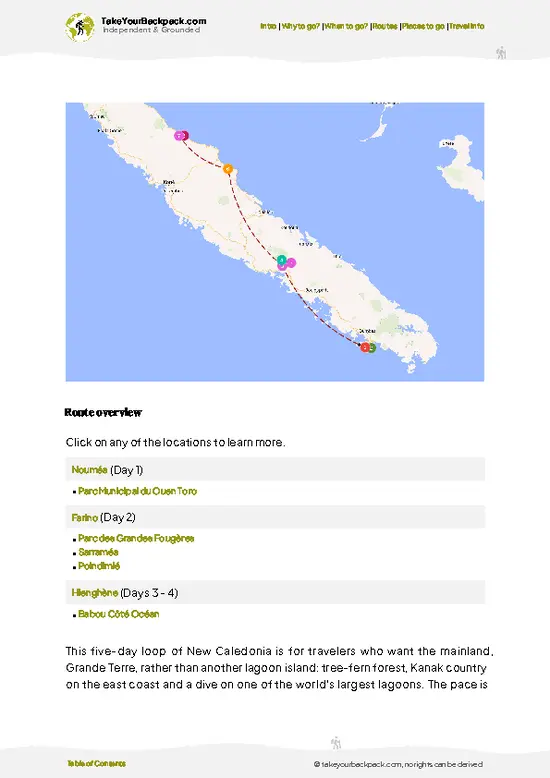
- Parc des Grandes Fougères: The reason to come. Marked trails of roughly 30 minutes to 3 hours wind through humid forest where tree ferns reach several meters high, with streams, birdsong and filtered green light. Go early in the morning, when mist hangs between the trunks and birds are loudest. Expect a small entry fee, around 500 XPF (about US$5), and plan 2 to 4 hours. Wear shoes with grip, because the clay turns slick after rain.
- The kagu viewing area in the park: The kagu is a gray, crested ground bird that barks rather than sings, and the park is one of the places where it is protected and can be seen. Stay quiet on the path, move slowly and look low in the undergrowth. Early morning gives the best chance. Allow 1 to 2 hours; there is no extra fee beyond park entry.
- Farino village center
- Parc des Grandes Fougères: The reason to come. Marked trails of roughly 30 minutes to 3 hours wind through humid forest where tree ferns reach several meters high, with streams, birdsong and filtered green light. Go early in the morning, when mist hangs between the trunks and birds are loudest. Expect a small entry fee, around 500 XPF (about US$5), and plan 2 to 4 hours. Wear shoes with grip, because the clay turns slick after rain.
- The kagu viewing area in the park: The kagu is a gray, crested ground bird that barks rather than sings, and the park is one of the places where it is protected and can be seen. Stay quiet on the path, move slowly and look low in the undergrowth. Early morning gives the best chance. Allow 1 to 2 hours; there is no extra fee beyond park entry.
- Farino village center and church: A short stroll of 20 to 40 minutes past the church, the small mairie and houses set among gardens and coffee-era plantings. It is free, best in the late afternoon when the light softens and the air cools, and it gives a feel for the rural, inland side of the island that tourists on the coast never see.
Spotted a mistake or missing something? Contact us.

Water Taxi Signal Island Turtle Tour for cruisers
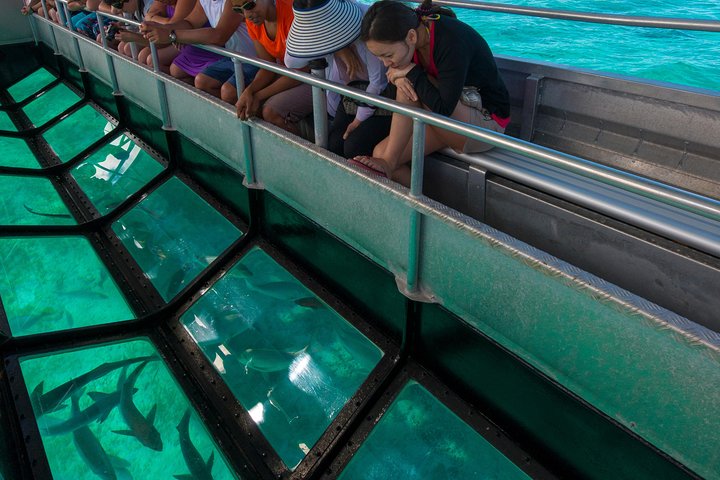
Amedee Lighthouse

FAMOUS Local Green Train Noumea (01h30) with LYVAI
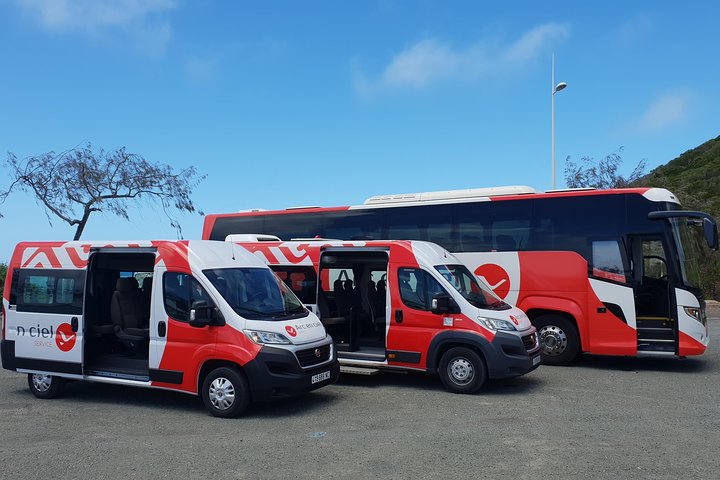
Airport Transfer: La Tontouta International Airport to Noumea

Blissful Getaway: Treat Yourself to a Spa Massage in Nouméa

Country Tour 2.5 included Tjibaou Cultural Center & Church -LYVAI

Transfer Tontouta International Airport (New Caledonia) - LYVAI

Whale Watching by sailing catamaran from Noumea

Hop-On Hop-Off / HOHO / All Day Pass (return ticket's) with LYVAI


 Best Backpacking
.jpg) Hi, I’m Johan (Netherlands 🇳🇱), the creator of TakeYourBackpack. Over the past 3 decades, I’ve backpacked through 90+ countries across six continents, gaining extensive experience with independent travel, long-term trips, and overland routes.
Hi, I’m Johan (Netherlands 🇳🇱), the creator of TakeYourBackpack. Over the past 3 decades, I’ve backpacked through 90+ countries across six continents, gaining extensive experience with independent travel, long-term trips, and overland routes.