
×

New Zealand🇳🇿 | beachesHot Water BeachDig-your-own hot pool, low-tide springs, spade hire, Pacific rips | things to do and best time to go

Explore Cathedral CoveExplore Karekare Beach

Backpacking in Hot Water Beach
🏆 Top pickbeach ranked #3
By Johan Kruseman 🇳🇱 | Updated October 15, 2026

Dig your own thermal pool here and the beach does the heating for free, which is the best bargain on the Coromandel Peninsula. Hot Water Beach sits on the east coast of the Coromandel in the north of New Zealand, on the Pacific side of the peninsula. Two underground springs rise through the sand near the rocks, and only for about two hours either side of low tide is that sand exposed enough to dig. The sand is clean and the setting is open and pleasant, but the surf has strong rips, so swimming is unwise and the flagged patrol areas matter. Midday low tides in summer pack the digging zone shoulder to shoulder. Snorkeling is poor and the nearest budget beds and cheap food are in the small village behind the dunes. I once dug a beautiful hole on the cool side of the springs because I hadn't checked the tide table, and the sea filled it in minutes. Now I look up the tide first. A good first day: check low tide, rent a spade, dig near the rocks, then walk the shore.

Discover everything you want to know in the 📖 New Zealand Travel Guide.


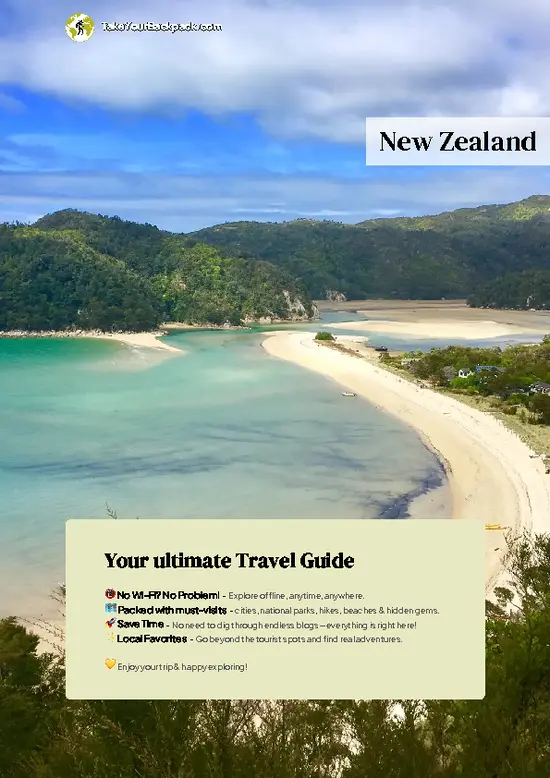
example page 0 from our offline Travel Guide for New Zealand
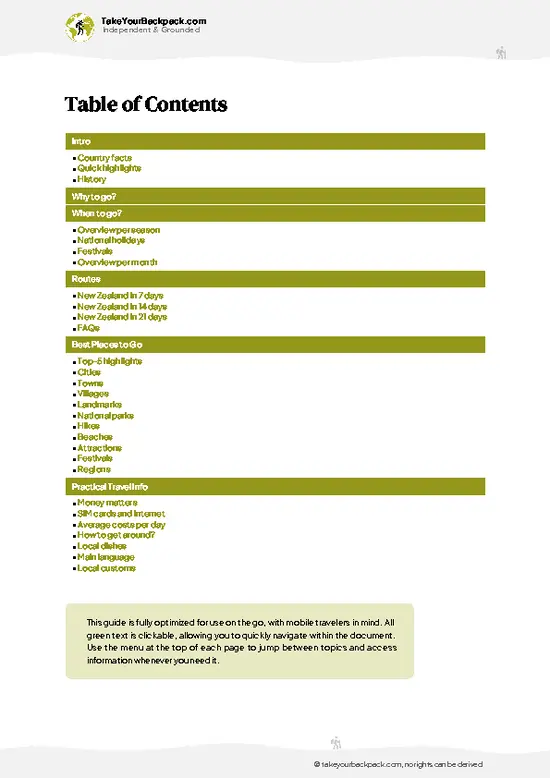
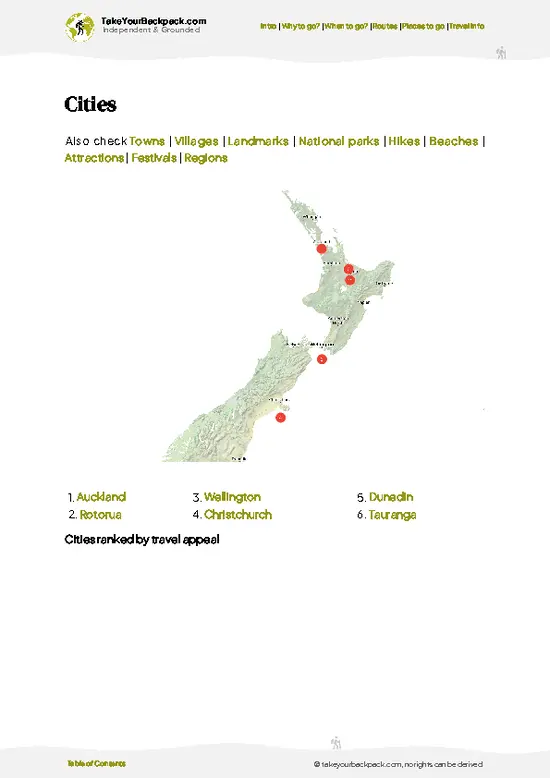
example page 1 from our offline Travel Guide for New Zealand
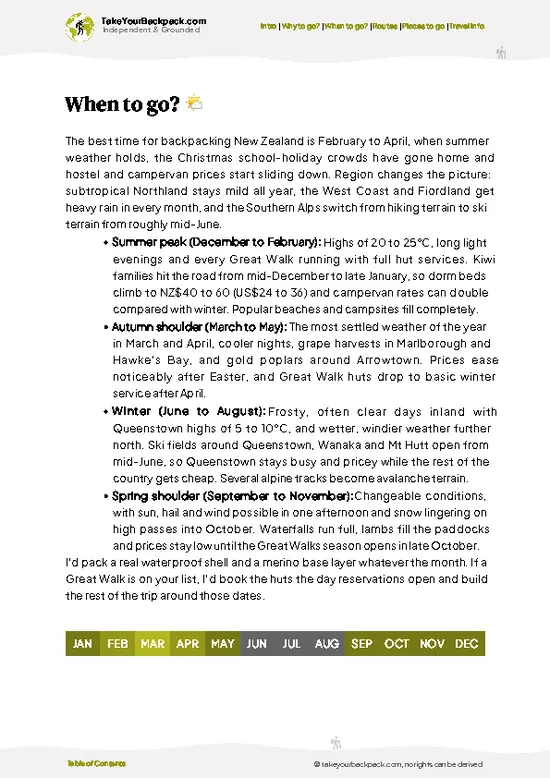
example page 2 from our offline Travel Guide for New Zealand
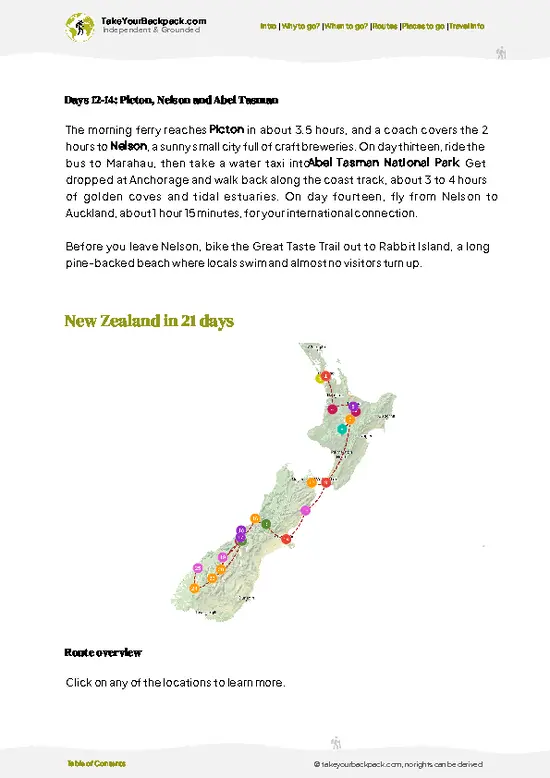
example page 3 from our offline Travel Guide for New Zealand
example page 4 from our offline Travel Guide for New Zealand
example page 5 from our offline Travel Guide for New Zealand
example page 6 from our offline Travel Guide for New Zealand
example page 7 from our offline Travel Guide for New Zealand
Loading the map 🌍
CLICK TO FILTER
cities
towns
villages
landmarks
national parks
hikes
beaches
attractions
festivals
regions
SHOW COUNTRY’S BESTSHOW ALL

✨ Why go?
Ranked #3 beach in New Zealand
What sets this place apart

Backpackers stop here for one reason you can't get at most beaches: you make your own hot spa. The water seeping up through the sand reaches roughly 60°C (140°F) at its hottest spot, so you dig a hole with a rented spade and mix hot and cold water in it. It costs next to nothing, and it's social in a way few activities are. Strangers share spades, swap hole-building advice and trade seats when a pool gets too scorching. The crowd forms around the two hours either side of low tide, then dissolves as the sea returns, which gives the day a clear rhythm.

The second reason is its position. Hot Water Beach sits between Hahei and Whitianga, so it works as an easy pause on a Coromandel loop. Just north, Cathedral Cove pulls in walkers, and the village here has hostels and campgrounds that make staying … read more 👉
Backpackers stop here for one reason you can't get at most beaches: you make your own hot spa. The water seeping up through the sand reaches roughly 60°C (140°F) at its hottest spot, so you dig a hole with a rented spade and mix hot and cold water in it. It costs next to nothing, and it's social in a way few activities are. Strangers share spades, swap hole-building advice and trade seats when a pool gets too scorching. The crowd forms around the two hours either side of low tide, then dissolves as the sea returns, which gives the day a clear rhythm.

The second reason is its position. Hot Water Beach sits between Hahei and Whitianga, so it works as an easy pause on a Coromandel loop. Just north, Cathedral Cove pulls in walkers, and the village here has hostels and campgrounds that make staying overnight simple. That matters because the best experience is not always at the busiest tide time. A late or very early low tide can leave you nearly alone with steaming sand and a big sky. Visitors who plan around the tide chart get the beach at its best, and that planning is half the fun.

💡 HighlightsTop highlights of Hot Water Beach

  1. Digging your own hot pool: This is why the beach is famous. Springs rise beneath the sand near the rocks at the middle of the beach, and for roughly two hours either side of low tide you can dig a hole, let the hot water fill it, and add cold seawater to adjust. Spades can be rented from nearby businesses, and sand in the hot zone can be scalding, so wear footwear.
  2. Walking to the thermal zone at low tide: The hot patch is small and sits near the rocky outcrop at the southern end of the beach. Steam rises, and the sand there is visibly darker and wetter. Watching the crowd cluster there is part of the show, and reaching it takes only a short walk from the access path and car park.
  3. Sunrise or early morning beach walk: When low tide falls near dawn, the beach is quiet and the light turns the long
… read more 👉
  1. Digging your own hot pool: This is why the beach is famous. Springs rise beneath the sand near the rocks at the middle of the beach, and for roughly two hours either side of low tide you can dig a hole, let the hot water fill it, and add cold seawater to adjust. Spades can be rented from nearby businesses, and sand in the hot zone can be scalding, so wear footwear.
  2. Walking to the thermal zone at low tide: The hot patch is small and sits near the rocky outcrop at the southern end of the beach. Steam rises, and the sand there is visibly darker and wetter. Watching the crowd cluster there is part of the show, and reaching it takes only a short walk from the access path and car park.
  3. Sunrise or early morning beach walk: When low tide falls near dawn, the beach is quiet and the light turns the long stretch of pale sand pink and gold. The hot spot is often yours, and you can walk the full curve of the bay in peace. It is the best time for photography.
  4. Surf watching and swimming within the flags: Waves roll in with force, and rips run along the beach, so the surf is a spectacle more than a place to relax. In summer, lifeguards patrol and flags mark the safer zone. Confident swimmers can cool off between soaks, and others can sit on the dune and watch the break.
  5. Sunset and stargazing from the sand: The Pacific horizon opens wide here, and after dark the sky is dark enough that the stars show clearly. Evenings are quiet, with no club scene, which suits travelers who want to end the day on a blanket or at the village campground, perhaps with a low evening tide that lets a few late diggers keep soaking.
Together these fit comfortably into a single day, with the tide-timed soak taking about two to three hours and the rest filling a morning or evening.
Spotted a mistake or missing something? Contact us.

Things to do near Hot Water Beach

Ratings based on Tripadvisor reviews. When you book through this link, you support our work at no extra cost to you.

🌤️ When to go?Seasonal considerations and timing

  • Low tide window: The hot spring only works about two hours either side of low tide, so the tide table matters more than the month. Dig a pool in the sand at the rocks near the stream, and the water seeps up at around 50°C (122°F).
  • Summer (Dec to Feb): Days run 20 to 25°C (68 to 77°F) with up to 15 hours of light. Low tides at midday mean packed sand and queues for shovels. Beds in Whitianga and Hahei cost the most now, and many fill weeks ahead.
  • Autumn (Mar to May): Highs of 17 to 22°C (63 to 72°F), warm sea, and far fewer people.
  • Winter (Jun to Aug): Highs of 12 to 15°C (54 to 59°F), around 10 hours of light. Steam against cold air feels wonderful, and prices drop. Rain and swell can cut the dig short.
  • Spring (Sep to Nov): Showers are frequent, temperatures climb from 14 to 19°C (57 to 66°F),
… read more 👉
  • Low tide window: The hot spring only works about two hours either side of low tide, so the tide table matters more than the month. Dig a pool in the sand at the rocks near the stream, and the water seeps up at around 50°C (122°F).
  • Summer (Dec to Feb): Days run 20 to 25°C (68 to 77°F) with up to 15 hours of light. Low tides at midday mean packed sand and queues for shovels. Beds in Whitianga and Hahei cost the most now, and many fill weeks ahead.
  • Autumn (Mar to May): Highs of 17 to 22°C (63 to 72°F), warm sea, and far fewer people.
  • Winter (Jun to Aug): Highs of 12 to 15°C (54 to 59°F), around 10 hours of light. Steam against cold air feels wonderful, and prices drop. Rain and swell can cut the dig short.
  • Spring (Sep to Nov): Showers are frequent, temperatures climb from 14 to 19°C (57 to 66°F), and crowds build slowly.
Check the tide times a day ahead, and aim for a low tide near sunrise or after dark to have the sand almost to yourself.


source: climatestotravel.comJANJanuary: excellent for travelingFEBFebruary: excellent for travelingMARMarch: highly recommended for travelingAPRApril: good for travelingMAYMay: fair for travelingJUNJune: below average for travelingJULJuly: below average for travelingAUGAugust: below average for travelingSEPSeptember: fair for travelingOCTOctober: good for travelingNOVNovember: highly recommended for travelingDECDecember: excellent for traveling
new-zealand-beach-hot-water-beach
© Google |

✈️ The backpacker research shortcutNew Zealand Travel Guide

An offline-friendly backpacking guide with optimized travel routes, ranked highlights, transport advice, and the best areas to stay.
example page 0 from our offline Travel Guide for New Zealand
example page 1 from our offline Travel Guide for New Zealand
example page 2 from our offline Travel Guide for New Zealand
example page 3 from our offline Travel Guide for New Zealand
example page 4 from our offline Travel Guide for New Zealand
example page 5 from our offline Travel Guide for New Zealand
example page 6 from our offline Travel Guide for New Zealand
example page 7 from our offline Travel Guide for New Zealand
The digital guide (327 pages) contains:
✅ 110 highlights, ranked by travel appeal
✅ Optimized 7, 14 & 21-day travel routes
✅ Cities, national parks, landmarks, beaches
✅ How to get around
✅ Offline-friendly for travel without Wi-Fi
👉 Click to see all 30+ guide features

📅 Plan smarter in minutes, not weeks
✅ Month by month travel advice
✅ Festivals & national holidays
✅ Budget expectations

🗺️ Go to the right places, skip the overrated ones
✅ Honest pros & cons of destinations
✅ Top hikes, parks & viewpoints
✅ Lesser-known places most travelers miss
✅ Clear “worth it vs skip it” guidance

🛏️ Travel smoothly without rookie mistakes
✅ Best areas to stay
✅ Transport systems explained simply
✅ Common scams & safety advice
✅ SIM cards, money & practical tips

🌍 Understand the country, not just visit it
✅ Culture & traditions
✅ Local customs
✅ Festivals worth planning around
✅ Traveler-friendly historical context
✅ Insights that make places more meaningful

📱 Built for real travel conditions
✅ Fully downloadable PDF
✅ Works completely offline
✅ Optimized for phone use
✅ Useful in remote areas & buses
✅ Everything in one place
Stop searching, start planning
Get instant access to your full guide. 30‑day money-back guarantee.
+ Add another guide for just

By proceeding you agree to our terms.
Sent to your inbox immediately after payment • 100% Secure Checkout
Best Backpacking Travel Advisor 2025 tourism awardBest Backpacking
Travel Advisor
2025
What others say about Take Your Backpack Guides:
⭐⭐⭐⭐⭐
Fantastic, amazing amount of information!
⭐⭐⭐⭐⭐
My goodness this is amazing, it's what I've been looking for hats off too you!
⭐⭐⭐⭐⭐
I think this is absolutely BRILLIANT
⭐⭐⭐⭐
Very complete and informative. It's still missing places, but I gotta to commend you
⭐⭐⭐⭐⭐
This is truly amazing, thank you, can't wait to explore it with my kids!
⭐⭐⭐⭐⭐
Awesome resource, thank you!
⭐⭐⭐⭐⭐
This is amazing! Can't wait to explore the ones I haven't seen
⭐⭐⭐⭐
I love this! Well done, great idea.
⭐⭐⭐⭐⭐
Thanks for taking the time to make this gem!
⭐⭐⭐⭐⭐
This might be the best website I've ever seen.
⭐⭐⭐⭐⭐
Congratulations, and thank you so much for your work; it's incredibly valuable.
⭐⭐⭐⭐
In all seriousness I think you did a great job pointing out the important spots
⭐⭐⭐⭐⭐
10/10 very good
⭐⭐⭐⭐⭐
As someone who's only just starting to visit regularly this is awesome, thank you.
⭐⭐⭐⭐
Thank you very much! I'm going to visit my dad, it's going to be very useful!
⭐⭐⭐⭐⭐
This is really cool! We'll be travelling for the first time and this definitely come in handy.
⭐⭐⭐⭐⭐
You are now our minister of culture, congratulations 👨‍💼
⭐⭐⭐⭐⭐
Just wanted to tell you that this is a pearl! Going to follow your recommendations.
⭐⭐⭐⭐⭐
This is so cool. I'll definitely be using the resource for my travels soon.
⭐⭐⭐⭐⭐
This is very impressive! Good work.
⭐⭐⭐⭐⭐
This is an amazing and informative site. Very well done!

🛏️ Where to stay?Best areas and accommodation options

Hot Water Beach itself has only a small cluster of holiday parks and cottages, so most backpackers sleep either right here for the convenience or in Hahei, about 15 minutes by road to the north.
Staying at the beach suits you if you want to walk to the sand at low tide, whatever the hour. Accommodation is mostly campgrounds, powered and tent sites, and a few simple cabins. It is quiet after dark, with little nightlife and no real shops beyond a café and a small store, so bring food. Low tides at 5 am or 10 pm are easy to catch from here.
Hahei is the better choice for a social stay. It has a relaxed … read more 👉
Hot Water Beach itself has only a small cluster of holiday parks and cottages, so most backpackers sleep either right here for the convenience or in Hahei, about 15 minutes by road to the north.
Staying at the beach suits you if you want to walk to the sand at low tide, whatever the hour. Accommodation is mostly campgrounds, powered and tent sites, and a few simple cabins. It is quiet after dark, with little nightlife and no real shops beyond a café and a small store, so bring food. Low tides at 5 am or 10 pm are easy to catch from here.
Hahei is the better choice for a social stay. It has a relaxed beach village feel, a handful of cafés, and easy access to Cathedral Cove walks, kayak tours, and a calm, swimmable bay. Budget travelers meet there over dinner and on the trails.
Whitianga, around 30 minutes away by road, has the widest range of hostels, supermarkets, and bars, and works if you have a vehicle. Without a car, staying there makes the tide timing harder. Book ahead from late December to February, when everywhere fills and rates jump.

🛡️ SafetyTraveler Safety Guide

Hot Water Beach is a surf beach, and the ocean is the real hazard, not the spring. Rips form here regularly, especially around the rocks at the northern end and when swell picks up, and the beach has drowned swimmers over the years. Lifeguards patrol in the summer season, and you should swim only between the flags. Outside patrol hours, or in big surf, paddle at knee depth and skip the deep water.
The spring water can reach about 64°C (147°F) in spots, so test each patch with your hand and mix in cooler water before sitting down. Dig only near the rocks where the heat rises, and fill your hole afterward.
The sun here is strong, so bring a hat and sunscreen. Cars parked above the beach get broken into now and then, so take valuables with you and leave nothing visible. Night visits at low tide … read more 👉
Hot Water Beach is a surf beach, and the ocean is the real hazard, not the spring. Rips form here regularly, especially around the rocks at the northern end and when swell picks up, and the beach has drowned swimmers over the years. Lifeguards patrol in the summer season, and you should swim only between the flags. Outside patrol hours, or in big surf, paddle at knee depth and skip the deep water.
The spring water can reach about 64°C (147°F) in spots, so test each patch with your hand and mix in cooler water before sitting down. Dig only near the rocks where the heat rises, and fill your hole afterward.
The sun here is strong, so bring a hat and sunscreen. Cars parked above the beach get broken into now and then, so take valuables with you and leave nothing visible. Night visits at low tide are common and feel relaxed, though a headlamp helps on the sand.

FAQCommon questions from travelers

Drive or take a shuttle, since no public bus reaches the beach. It is about 15 minutes south of Hahei and roughly 30 minutes from Whitianga, which is a 2.5 to 3 hour drive from Auckland via the Thames coast or Kopu. In summer, some operators run day trips from Whitianga or Hahei, and the beach car park charges a small fee at busy times.
Swimming is risky, because rips and heavy surf are common, so stay between the flags when lifeguards are on duty (summer season). Surfing is popular, with beach break waves that suit beginners to intermediates, and boards can be rented nearby for about NZ$20 to 40 (US$12 to 25). Snorkeling is poor here, so head to Hahei or Cathedral Cove marine reserve, about 15 to 20 minutes away.
Yes, the beach and the thermal area are free to enter, and you can dig your own pool at no charge. You will pay for parking in the busy season, usually around NZ$5 to 10 (US$3 to 6) per day. Spade hire from local shops costs about NZ$10 to 15 (US$6 to 9), and you should dig within two hours of low tide.
⚠️ Things can change over time, so always validate details locally before you go.

Other New Zealander beaches near Hot Water Beach

Explore more nearby:

  • Cathedral Cove—Limestone arch, marine reserve, Te Hoho Rock, foot access| 7 km away
  • New Chums Beach—Walk-in only, pohutukawa shade, tidal rocks, no facilities| 29 km away
  • Mount Maunganui Main Beach—Mauao summit, learner surf, Moturiki blowhole, bakery dinners| 93 km away

💡 Not sure where to go next?
Create a personalized itinerary for New Zealand including Hot Water Beach and the places that fit your trip.

Generate my itinerary

👉 Discover all beaches

Or checkout all New Zealand has to offer (think cities, towns, villages, national parks, hikes, beaches, festivals)
Country photo of New Zealand

We 💚 feedbackIs it worth it?

Go on a day when low tide falls in the early morning or at dusk. You skip the midday scrum, the light is better, and your pool stays hot and private for longer. In summer I would book a spade and accommodation early, and bring sandals, because the sand in the thermal patch burns.

✈️ When did I visit New Zealand?
All the way back in high school I have been visiting the North Island of New Zealand (1993).

✍️ Help improve this page!
The information on this page is based on my own backpacking experience in New Zealand, supplemented with up-to-date research and feedback from other travelers. Travel details can change, so if you notice anything outdated or incomplete, feel free to let me know.


🙋‍♂️ Give feedback

👋 Meet the founderWho’s Behind Take Your Backpack?

Johan, backpacker and founder of TakeYourBackpackHi, I’m Johan (Netherlands 🇳🇱), the creator of TakeYourBackpack. Over the past 3 decades, I’ve backpacked through 90+ countries across six continents, gaining extensive experience with independent travel, long-term trips, and overland routes.

This site is built on a combination of firsthand travel experience and carefully curated insights from other backpackers. Many guides are based on places I’ve personally visited, while others bring together tips, observations, and practical advice shared by trusted travelers I’ve met along the way.

The goal is to provide realistic, experience-driven guidance — not generic itineraries — so you can explore destinations with better context, clearer expectations, and more confidence.