×

Nicaragua🇳🇮 | citiesDiriambaSan Sebastián basilica, January dancers, Chorotega masks, Carazo coffee hills | things to do and best time to go

Explore RivasExplore Managua

Backpacking in Diriamba
👀 For curious travelerscity ranked #9
By Johan Kruseman 🇳🇱 | Updated October 20, 2026

Diriamba was once a coffee-and-cattle crossroads that most travelers saw only from a bus window; today it is a working highland town of about 40,000 people that opens up for anyone willing to step off the highway. It sits in the Carazo department in the southwest of Nicaragua, on the cooler ridge above the Pacific. I still connect it with the hollow clatter of drums and chirimía flutes drifting down a side street before a festival, long before I saw a single dancer. The center is dusty, the traffic is noisy, and there is no hostel scene. Skip it if you need nightlife. Spend your time on the basilica, the folk costumes and the surrounding coffee hills. It suits curious, self-sufficient travelers who like local festivals, and will bore anyone chasing beaches or party hostels.

Discover everything you want to know in the 📖 Nicaragua Travel Guide.


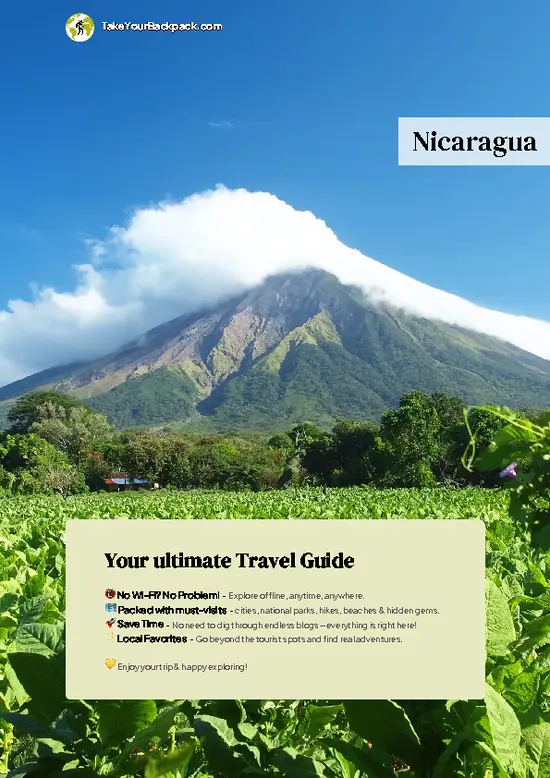
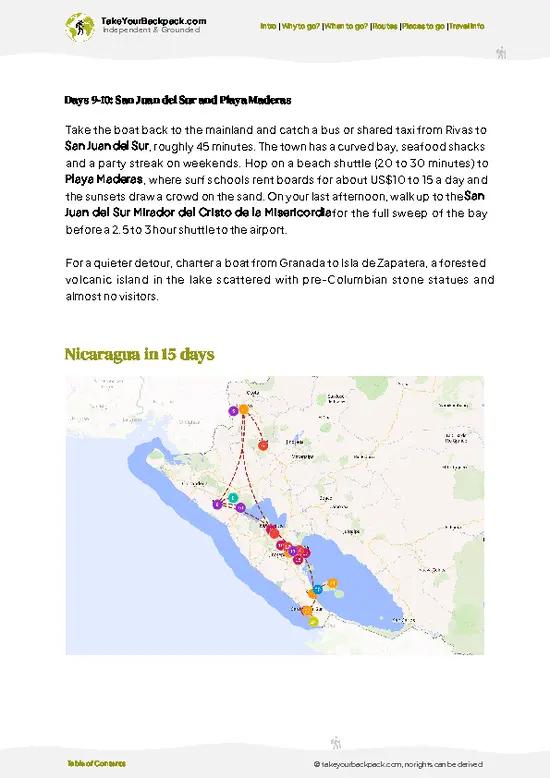
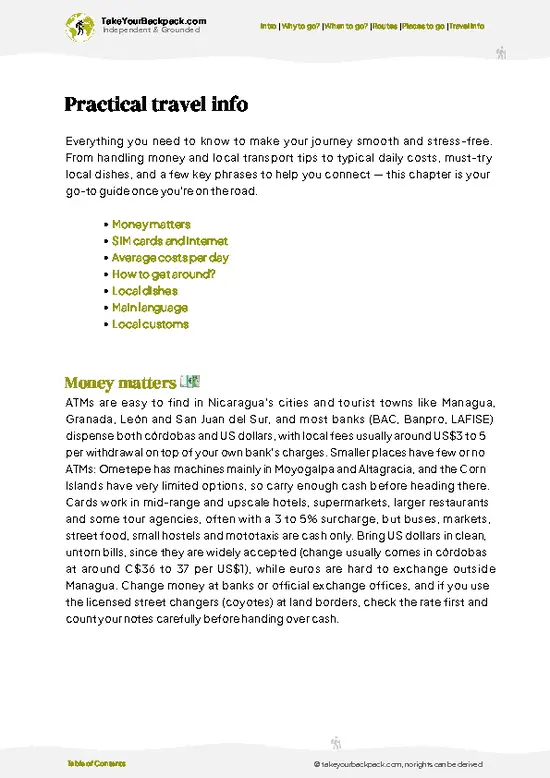
example page 0 from our offline Travel Guide for Nicaragua
example page 1 from our offline Travel Guide for Nicaragua
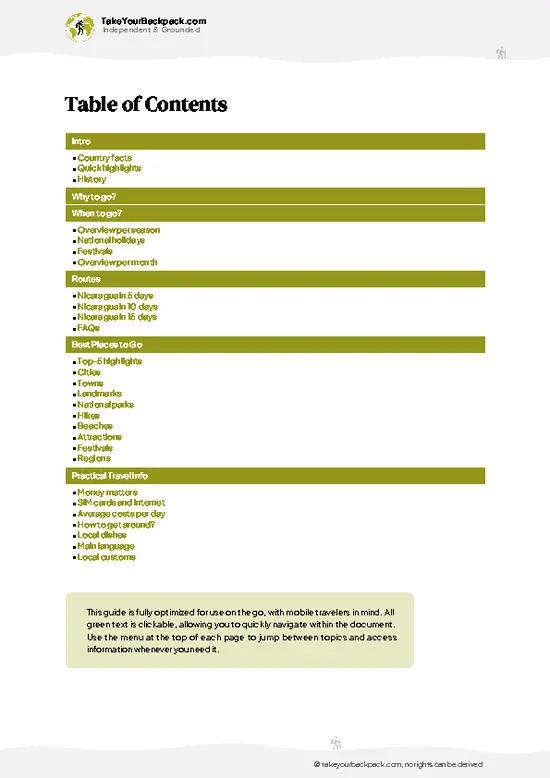
example page 2 from our offline Travel Guide for Nicaragua
example page 3 from our offline Travel Guide for Nicaragua
example page 4 from our offline Travel Guide for Nicaragua
example page 5 from our offline Travel Guide for Nicaragua
example page 6 from our offline Travel Guide for Nicaragua
example page 7 from our offline Travel Guide for Nicaragua
Loading the map 🌍
CLICK TO FILTER
cities
towns
landmarks
national parks
hikes
beaches
attractions
festivals
regions
SHOW COUNTRY’S BESTSHOW ALL

✨ Why go?
Ranked #9 city in Nicaragua
Why Diriamba should be on your travel list

Diriamba works as a cultural stop on the way between Managua and the Pacific coast, and that is its real value. Backpackers come for the El Güegüense tradition, a UNESCO-recognized masked satire that still defines local identity, and for the January San Sebastián festival, when the streets fill with costumed dancers, drummers and processions. Outside festival days, the town is quiet, walkable in about twenty minutes end to end, and cheap to eat in. Do not expect many beds, so most people treat Diriamba as a half-day or overnight stop rather than a base. Its position on the main highway makes onward travel easy, with frequent minibuses and buses toward neighboring towns and the beaches. If you like places where locals outnumber foreigners ten to one, this fits. If you want a packed sightseeing list, move on.

💡 HighlightsThe experiences that define the visit

  1. Basílica de San Sebastián: The town’s landmark church holds the image of its patron saint and anchors every January procession. Go in the morning, when the interior is cool and quiet. Free entry, 20 to 30 minutes.
  2. Museo Ecológico y Cultural de Diriamba: A small museum on the local Chorotega heritage, masks and regional history. Open mainly on weekdays, so check hours locally. Around US$1 to 2, 45 minutes.
  3. Central Park: The shaded plaza in front of the basilica is where life happens: vendors, old men on benches, school kids at midday. Late afternoon is best. Free, 30 minutes.
  4. San Sebastián festival: Each January, costumed dancers, El Güegüense performers and drummers fill the streets, with the main days around the 20th. Free to watch, plan a full day and arrive early to find space.
  5. Local mercado:
… read more 👉
  1. Basílica de San Sebastián: The town’s landmark church holds the image of its patron saint and anchors every January procession. Go in the morning, when the interior is cool and quiet. Free entry, 20 to 30 minutes.
  2. Museo Ecológico y Cultural de Diriamba: A small museum on the local Chorotega heritage, masks and regional history. Open mainly on weekdays, so check hours locally. Around US$1 to 2, 45 minutes.
  3. Central Park: The shaded plaza in front of the basilica is where life happens: vendors, old men on benches, school kids at midday. Late afternoon is best. Free, 30 minutes.
  4. San Sebastián festival: Each January, costumed dancers, El Güegüense performers and drummers fill the streets, with the main days around the 20th. Free to watch, plan a full day and arrive early to find space.
  5. Local mercado: Stalls selling fruit, tortillas, cheese and household goods. Go before noon for the best selection. Snacks cost about US$1 to 3, 45 minutes.
  6. Mirador views over the Carazo hills: Roads leaving town climb through coffee and banana plots with wide views toward the Pacific on clear days. Go in the early morning. Free, 1 to 2 hours on foot or by taxi.
Outside town, Diriamba makes a good jumping-off point for day trips to the colonial streets of Jinotepe, the coffee villages of Carazo, the artisan town of San Marcos and the beaches at Pochomil and Casares. Start with the basilica in the morning, because the light is soft, the church is quiet, and the plaza around it tells you how the rest of the town works.
Spotted a mistake or missing something? Contact us.

Things to do near Diriamba

Ratings based on Tripadvisor reviews. When you book through this link, you support our work at no extra cost to you.

🏘️ NeighborhoodsWhere things are and how it's laid out

Diriamba is small enough to cover on foot in an afternoon, and the useful parts cluster within a few blocks of each other.
  • Parque Central and the Basilica area: Start here. The twin-towered Basilica de San Sebastián looms over a park of shade trees, with church bells, shoeshine stands and the smell of frying plantain after dark. Worth the most time, especially in January when the San Sebastián festival fills the streets with drums and costumed dancers. Fully walkable.
  • Market streets: The blocks around the mercado are loud, hot and crowded with sacks of coffee, produce stalls and sizzling comedores. Go in the morning for the best food and the least heat. Mind your bag in the crush. Walkable, though the sidewalks are narrow and uneven.
  • Highway edge: Along the Pan-American road, you get fuel stations,
… read more 👉
Diriamba is small enough to cover on foot in an afternoon, and the useful parts cluster within a few blocks of each other.
  • Parque Central and the Basilica area: Start here. The twin-towered Basilica de San Sebastián looms over a park of shade trees, with church bells, shoeshine stands and the smell of frying plantain after dark. Worth the most time, especially in January when the San Sebastián festival fills the streets with drums and costumed dancers. Fully walkable.
  • Market streets: The blocks around the mercado are loud, hot and crowded with sacks of coffee, produce stalls and sizzling comedores. Go in the morning for the best food and the least heat. Mind your bag in the crush. Walkable, though the sidewalks are narrow and uneven.
  • Highway edge: Along the Pan-American road, you get fuel stations, buses and exhaust. Skip it except to catch transport.
  • Coffee hills toward Jinotepe and El Carmen: Cooler air, shaded farms and roosters. Too far to walk, so hop a local bus or taxi. Quiet at night, with almost no nightlife in town beyond a few bars.

⌛️ 1 dayHow to make the most of one day

8:00 AM, Basílica de San Sebastián: Begin here, because the church is the heart of Diriamba and the morning light and calm make it the best time. Look at the saint’s image and the details tied to the January festival, then step into the plaza next door.
9:00 AM, Central Park: Sit with a coffee from a nearby stall and watch the town start its day. Walk a few minutes to the next stop.
10:00 AM, Museo Ecológico y Cultural: See the masks, indigenous heritage displays and regional history that explain the festival you are not seeing. Allow about 45 minutes.
11:30 AM, Local mercado: Wander through produce, cheese and tortilla stalls. Eat a simple lunch from a comedor here, where plates are filling and cheap.
2:00 PM, Coffee-hill lanes above town: Take a taxi or walk out along the rural roads beyond … read more 👉
8:00 AM, Basílica de San Sebastián: Begin here, because the church is the heart of Diriamba and the morning light and calm make it the best time. Look at the saint’s image and the details tied to the January festival, then step into the plaza next door.
9:00 AM, Central Park: Sit with a coffee from a nearby stall and watch the town start its day. Walk a few minutes to the next stop.
10:00 AM, Museo Ecológico y Cultural: See the masks, indigenous heritage displays and regional history that explain the festival you are not seeing. Allow about 45 minutes.
11:30 AM, Local mercado: Wander through produce, cheese and tortilla stalls. Eat a simple lunch from a comedor here, where plates are filling and cheap.
2:00 PM, Coffee-hill lanes above town: Take a taxi or walk out along the rural roads beyond the center, which most visitors never do. You pass small coffee plots, banana trees and wide views toward the Pacific. Take water and a hat.
5:00 PM, Back to the plaza: Return as the heat drops and families come out. Finish with a snack and, if you plan to move on, catch a minibus from the main road.

🌤️ When to go?Choosing the right time of year

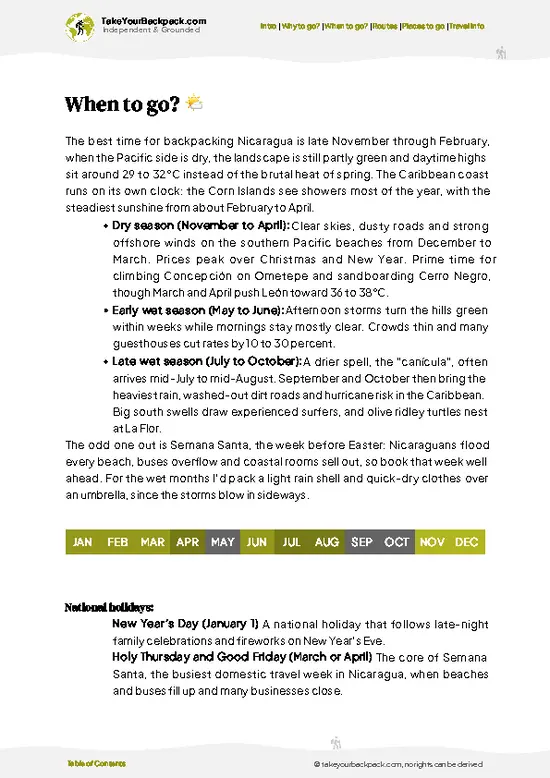
The dry months of December to April are easiest for backpacking in Diriamba, and January is the peak because of the San Sebastián festival.
  • Dry season (Nov to Apr): Hot and breezy, with highs of 30 to 34°C (86 to 93°F) and cooler nights near 21°C (70°F). Roads are easy and the coffee harvest begins around the end of the year.
  • Festival weeks (mid to late January): Crowds fill the center and nearby towns, and rooms in Managua or Granada get snapped up early.
  • Rainy season (May to Oct): Afternoon downpours turn streets muddy, but hills turn green and highs drop to 28 to 31°C (82 to 88°F). Prices stay flat, with fewer visitors.
Arrive a few days before January 20 to catch the build-up without the heaviest crush.

source: climatestotravel.comJANJanuary: highly recommended for travelingFEBFebruary: good for travelingMARMarch: good for travelingAPRApril: highly recommended for travelingMAYMay: fair for travelingJUNJune: fair for travelingJULJuly: fair for travelingAUGAugust: fair for travelingSEPSeptember: fair for travelingOCTOctober: fair for travelingNOVNovember: highly recommended for travelingDECDecember: highly recommended for traveling
when-to-go

✈️ The backpacker research shortcutNicaragua Travel Guide

An offline-friendly backpacking guide with optimized travel routes, ranked highlights, transport advice, and the best areas to stay.
example page 0 from our offline Travel Guide for Nicaragua
example page 1 from our offline Travel Guide for Nicaragua
example page 2 from our offline Travel Guide for Nicaragua
example page 3 from our offline Travel Guide for Nicaragua
example page 4 from our offline Travel Guide for Nicaragua
example page 5 from our offline Travel Guide for Nicaragua
example page 6 from our offline Travel Guide for Nicaragua
example page 7 from our offline Travel Guide for Nicaragua
The digital guide (256 pages) contains:
✅ 77 highlights, ranked by travel appeal
✅ Optimized 5, 10 & 15-day travel routes
✅ Cities, national parks, landmarks, beaches
✅ How to get around
✅ Offline-friendly for travel without Wi-Fi
👉 Click to see all 30+ guide features

📅 Plan smarter in minutes, not weeks
✅ Month by month travel advice
✅ Festivals & national holidays
✅ Budget expectations

🗺️ Go to the right places, skip the overrated ones
✅ Honest pros & cons of destinations
✅ Top hikes, parks & viewpoints
✅ Lesser-known places most travelers miss
✅ Clear “worth it vs skip it” guidance

🛏️ Travel smoothly without rookie mistakes
✅ Best areas to stay
✅ Transport systems explained simply
✅ Common scams & safety advice
✅ SIM cards, money & practical tips

🌍 Understand the country, not just visit it
✅ Culture & traditions
✅ 52 Essential phrases & customs
✅ Festivals worth planning around
✅ Traveler-friendly historical context
✅ Insights that make places more meaningful

📱 Built for real travel conditions
✅ Fully downloadable PDF
✅ Works completely offline
✅ Optimized for phone use
✅ Useful in remote areas & buses
✅ Everything in one place
Stop searching, start planning
Get instant access to your full guide. 30‑day money-back guarantee.
+ Add another guide for just

By proceeding you agree to our terms.
Sent to your inbox immediately after payment • 100% Secure Checkout
Best Backpacking Travel Advisor 2025 tourism awardBest Backpacking
Travel Advisor
2025
What others say about Take Your Backpack Guides:
⭐⭐⭐⭐⭐
Fantastic, amazing amount of information!
⭐⭐⭐⭐⭐
My goodness this is amazing, it's what I've been looking for hats off too you!
⭐⭐⭐⭐⭐
I think this is absolutely BRILLIANT
⭐⭐⭐⭐
Very complete and informative. It's still missing places, but I gotta to commend you
⭐⭐⭐⭐⭐
This is truly amazing, thank you, can't wait to explore it with my kids!
⭐⭐⭐⭐⭐
Awesome resource, thank you!
⭐⭐⭐⭐⭐
This is amazing! Can't wait to explore the ones I haven't seen
⭐⭐⭐⭐
I love this! Well done, great idea.
⭐⭐⭐⭐⭐
Thanks for taking the time to make this gem!
⭐⭐⭐⭐⭐
This might be the best website I've ever seen.
⭐⭐⭐⭐⭐
Congratulations, and thank you so much for your work; it's incredibly valuable.
⭐⭐⭐⭐
In all seriousness I think you did a great job pointing out the important spots
⭐⭐⭐⭐⭐
10/10 very good
⭐⭐⭐⭐⭐
As someone who's only just starting to visit regularly this is awesome, thank you.
⭐⭐⭐⭐
Thank you very much! I'm going to visit my dad, it's going to be very useful!
⭐⭐⭐⭐⭐
This is really cool! We'll be travelling for the first time and this definitely come in handy.
⭐⭐⭐⭐⭐
You are now our minister of culture, congratulations 👨‍💼
⭐⭐⭐⭐⭐
Just wanted to tell you that this is a pearl! Going to follow your recommendations.
⭐⭐⭐⭐⭐
This is so cool. I'll definitely be using the resource for my travels soon.
⭐⭐⭐⭐⭐
This is very impressive! Good work.
⭐⭐⭐⭐⭐
This is an amazing and informative site. Very well done!

🛏️ Where to stay?Choosing the right base

Stay in the streets around Parque Central, because Diriamba has only a handful of simple guesthouses and no real hostel scene.
Beds in the center are within walking distance of the market, the buses and the evening food stalls. It is quiet at night apart from church bells and the odd dog, and the area feels safe for a short walk after dark. Expect basic rooms with a fan, typically US$15 to 30 for a double.
If you want dorm beds and a social crowd, sleep in Granada or Managua and ride in. Both are about an hour by bus, and that is the more practical choice for most backpackers. San Juan del Sur is … read more 👉
Stay in the streets around Parque Central, because Diriamba has only a handful of simple guesthouses and no real hostel scene.
Beds in the center are within walking distance of the market, the buses and the evening food stalls. It is quiet at night apart from church bells and the odd dog, and the area feels safe for a short walk after dark. Expect basic rooms with a fan, typically US$15 to 30 for a double.
If you want dorm beds and a social crowd, sleep in Granada or Managua and ride in. Both are about an hour by bus, and that is the more practical choice for most backpackers. San Juan del Sur is farther but also an option.
Book ahead in the second half of January, when festival visitors take every room in town.

🚌 Getting aroundHow to get from A to B

From the bus stop along the highway, Diriamba’s center is a flat 5 to 10 minute walk or a short taxi ride, and most backpackers simply walk. Traffic is dense on the main road with horns, trucks and diesel haze, but the center is calm. Public transport is frequent, cheap and crowded.
  • Walking: Best choice. The center is compact, with the church, market and park all within about 1 km. Go early, because midday heat is heavy.
  • Express minibuses and buses: Frequent runs to Managua (about 45 to 60 minutes, US$1 to 2) and Jinotepe (15 minutes, under US$1). Expect loud music, packed seats and a conductor shouting the destination. Services run from roughly 5 am until early evening.
  • Taxis: Shared or private cars cost US$1 to 3 inside town. Agree on the fare first. Worth it after dark or with luggage.
  • Caponera
… read more 👉
From the bus stop along the highway, Diriamba’s center is a flat 5 to 10 minute walk or a short taxi ride, and most backpackers simply walk. Traffic is dense on the main road with horns, trucks and diesel haze, but the center is calm. Public transport is frequent, cheap and crowded.
  • Walking: Best choice. The center is compact, with the church, market and park all within about 1 km. Go early, because midday heat is heavy.
  • Express minibuses and buses: Frequent runs to Managua (about 45 to 60 minutes, US$1 to 2) and Jinotepe (15 minutes, under US$1). Expect loud music, packed seats and a conductor shouting the destination. Services run from roughly 5 am until early evening.
  • Taxis: Shared or private cars cost US$1 to 3 inside town. Agree on the fare first. Worth it after dark or with luggage.
  • Caponera and moto-taxis: Three-wheeled and motorbike options for hill trips to coffee villages like El Carmen, about US$1 to 4. Bumpy, but they reach places buses skip.

👛 Costs (as of 20 October 2026)What things cost and how to budget

Diriamba costs about US$32 to 52 a day for a backpacker, with dorm beds scarce and private rooms the norm.
CategoryBudget RangeLocal Reality
Accommodation (high season)US$15 to 25Simple private room with a fan, since dorms are rare
Accommodation (off-season)US$12 to 20Same rooms, slightly easier to haggle
MealsUS$6 to 10Market comedores and fritanga plates
Local transportUS$1 to 3Taxis within town, minibuses nearby
City transport passNot availablePay per ride
Activities and entry feesUS$2 to 5Most sights are free, such as the Basilica and park
MiscellaneousUS$2 to 4Water, snacks, coffee
Total Daily BudgetUS$32 to 52Using high-season accommodation, about US$32 at the low end
Eat your main meal at midday from the market, since comedores often sell a set lunch cheaper than dinner.

source: visitnicaragua.us
⚠️ Prices can change and everyone travels differently, so take this as a rough guide. Hope it helps you plan your adventure!

🚌 Day tripsShort trips worth adding

Diriamba sits on the highway between Managua and the Pacific, so day trips are easy by bus.
Jinotepe:
The sister town, 15 minutes away for under US$1, has its own church, quiet plaza and a lively Santiago festival in July. A half-day is plenty. Go in the morning when the market is open.

La Boquita:
This Pacific beach is about 30 to 40 minutes away by bus or shared taxi, roughly US$1 to 3 each way. Expect grey sand, seafood shacks and surf. Weekends fill with locals, so go midweek. First-timers often leave too late and face fewer buses in the evening.

Casares:
A fishing village with boats pulled onto the sand and fresh fish grilled on the beach. It takes about 45 minutes, US$2 to 4 round trip, and is best in the dry season.

Managua Old Center:
About an hour by minibus for US$1 to 2. The lakefront, … read more 👉
Diriamba sits on the highway between Managua and the Pacific, so day trips are easy by bus.
Jinotepe:
The sister town, 15 minutes away for under US$1, has its own church, quiet plaza and a lively Santiago festival in July. A half-day is plenty. Go in the morning when the market is open.

La Boquita:
This Pacific beach is about 30 to 40 minutes away by bus or shared taxi, roughly US$1 to 3 each way. Expect grey sand, seafood shacks and surf. Weekends fill with locals, so go midweek. First-timers often leave too late and face fewer buses in the evening.

Casares:
A fishing village with boats pulled onto the sand and fresh fish grilled on the beach. It takes about 45 minutes, US$2 to 4 round trip, and is best in the dry season.

Managua Old Center:
About an hour by minibus for US$1 to 2. The lakefront, old cathedral ruins and the National Palace are worth a morning. Leave before late afternoon rush.
👉 Explore Managua

🍲 FoodEating & Drinking in Diriamba

Diriamba sits in Nicaragua’s coffee hills, so coffee is the headline. Order a cup at a small café or ask for it black and strong with a sweet pastry. The area is also known for rosquillas, crunchy corn and cheese rings, and for cosa de horno, baked corn sweets common in Carazo. The mercado is the best place to eat, with comedores serving grilled meat, gallo pinto and fresh juices for US$2 to 4 a plate.
At festival time, stalls sell nacatamales and fritanga by the park, with smoke drifting across the plaza. Evenings bring street grills and plantain chips with cheese. Cold Toña or Victoria beer is the default drink at the few local bars. Ask for a refresco in a plastic bag if you want to walk and sip.

🛡️ SafetySafety Tips and Common Scams in Diriamba

Diriamba is a calm town where daily life is the main thing you see, and most trouble is petty. In the market and on crowded buses, keep your phone and wallet in a front pocket, since pickpocketing happens. Solo travelers, including women, can walk the center comfortably in daytime. After dark, stay on the lit streets around the park and take a taxi for anything longer. Festival nights in January bring crowds, alcohol and fireworks, so keep valuables at the room. Taxis sometimes quote higher prices to foreigners, so agree on the fare before you get in. Avoid walking the highway shoulder at night because of fast traffic.

FAQCommon questions from travelers

Diriamba needs one day, or two if you add the coffee hills and a beach. Spend a morning at the Basilica de San Sebastián and market, then ride 15 minutes to Jinotepe or 30 to 40 minutes to La Boquita. An overnight is useful only in January for the festival.
Diriamba is fairly safe for solo backpackers, especially in daytime around the park and market. Watch for pickpockets on crowded buses and in the market, and take a taxi (US$1 to 3) after dark. Festival nights in January are rowdier, so keep valuables locked up.
Diriamba is known for the Basilica de San Sebastián and its festival each January, with traditional dances like El Güegüense. It also sits in Carazo’s coffee country, with rosquillas and baked sweets sold locally. Managua is about an hour away by minibus for US$1 to 2.
⚠️ Things can change over time, so always validate details locally before you go.

Other Nicaraguan cities near Diriamba

Explore more nearby:

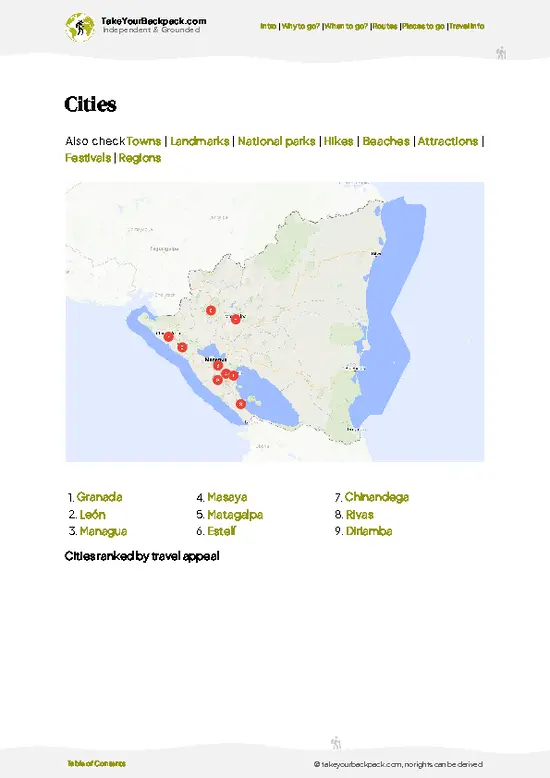
  • Masaya—Smoking crater, artisan market, Thursday verbena, hammock weavers| 21 km away
  • Managua—Quake-ruined cathedral, Malecón, Tiscapa crater, transit hub| 29 km away
  • Granada—Mustard cathedral, La Calzada, lakeshore, Choco Museo| 32 km away

💡 Not sure where to go next?
Create a personalized itinerary for Nicaragua including Diriamba and the places that fit your trip.

Generate my itinerary

👉 Discover all cities

Or checkout all Nicaragua has to offer (think cities, towns, villages, national parks, hikes, beaches, festivals)
Country photo of Nicaragua

We 💚 feedbackFinal thoughts on visiting Diriamba

Diriamba is best in January, when the San Sebastián festival fills the streets with drums, masks and dancers, though book ahead and arrive early. On an ordinary day, go in the morning when the basilica is quiet and the market is busy. I would skip it if you have only one day and want beaches.

✈️ When did I visit Nicaragua?
Nicaragua I visited during my half year trip through South and Central America back in 2003

✍️ Help improve this page!
The information on this page is based on my own backpacking experience in Nicaragua, supplemented with up-to-date research and feedback from other travelers. Travel details can change, so if you notice anything outdated or incomplete, feel free to let me know.


🙋‍♂️ Give feedback

👋 Meet the founderWho’s Behind Take Your Backpack?

Johan, backpacker and founder of TakeYourBackpackHi, I’m Johan (Netherlands 🇳🇱), the creator of TakeYourBackpack. Over the past 3 decades, I’ve backpacked through 90+ countries across six continents, gaining extensive experience with independent travel, long-term trips, and overland routes.

This site is built on a combination of firsthand travel experience and carefully curated insights from other backpackers. Many guides are based on places I’ve personally visited, while others bring together tips, observations, and practical advice shared by trusted travelers I’ve met along the way.

The goal is to provide realistic, experience-driven guidance — not generic itineraries — so you can explore destinations with better context, clearer expectations, and more confidence.