×

Niger🇳🇪 | best national parksThe Must-See 5 national parks in Niger

National parks in Niger are not drive-up reserves with lodges and paved loops. The two that matter sit at opposite ends of the country: a Sahel savanna and river park in the southwest, an easy few hours from Niamey, and a vast Saharan reserve in the north that takes days of desert driving and a proper expedition. The southwest park is cheap, quiet and workable for independent travel, though you still need a local guide. The northern reserve costs far more, needs a 4x4 convoy and security clearance, and suits only experienced overlanders. Skip anything that promises easy Sahara wildlife. Choose by budget and risk tolerance.

By Johan Kruseman 🇳🇱 | Updated October 18, 2026
Explore the best hikes in Niger

Why go?Why These national park Stand Out

Niger is a strange place to choose for national parks, and that is exactly its appeal for the right traveler. It is one of the world's poorest countries, so infrastructure is thin: few paved roads beyond the southwest, almost no lodges inside protected areas, and no self-drive culture. Do not expect Kenya or South Africa.

What Niger does have is a sharp ecological divide. The south sits in the Sahel and the Niger River basin, where the last West African giraffes and other savanna wildlife survive. The north is Sahara, including the Aïr and Ténéré, where the draw is desert landscape, rock art and rare relict species rather than animal numbers. That range inside one country is unusual.

Before committing, know that security shapes everything. Government travel advice is restrictive for large … read more 👉
Niger is a strange place to choose for national parks, and that is exactly its appeal for the right traveler. It is one of the world's poorest countries, so infrastructure is thin: few paved roads beyond the southwest, almost no lodges inside protected areas, and no self-drive culture. Do not expect Kenya or South Africa.

What Niger does have is a sharp ecological divide. The south sits in the Sahel and the Niger River basin, where the last West African giraffes and other savanna wildlife survive. The north is Sahara, including the Aïr and Ténéré, where the draw is desert landscape, rock art and rare relict species rather than animal numbers. That range inside one country is unusual.

Before committing, know that security shapes everything. Government travel advice is restrictive for large parts of the country, and the north in particular has seen closures, convoys and permit rules that change without notice. Border and regional conditions shift, so check current advisories and use a registered Niamey or Agadez agency. Going without one is not worth the risk. Visas also take planning, and the yellow fever certificate is mandatory. Come for rarity and remoteness, not for volume of wildlife.
Evaluating the Top Choices
The list of best national parks in Niger is created based on landscapes, wildlife, adventure opportunities, facilities, and overall experience. If you feel a national park is missing in this list, please let us know.

When to go?Best Time to Visit Niger for national parks

Best months: The best months are November to February, when daytime highs stay around 28 to 35°C and the dry air makes both savanna and desert travel bearable. Rain is essentially absent in this window, roads are firm and the tracks are open.
Shoulder seasons: October and March work, with highs creeping to 35 to 40°C. In the south, October still has leftover mud on tracks and tall grass that hides animals. March brings heat haze and the first harmattan dust, which flattens photography.
Seasons to avoid: From April to June the Sahel and Sahara are brutal. Temperatures often reach 40 to 46°C, and desert driving then is a poor idea. The rainy season runs roughly June to September in the south, with most of Niger's 300 to 800 mm falling in July and August. River crossings flood, tracks turn to clay … read more 👉
Best months: The best months are November to February, when daytime highs stay around 28 to 35°C and the dry air makes both savanna and desert travel bearable. Rain is essentially absent in this window, roads are firm and the tracks are open.
Shoulder seasons: October and March work, with highs creeping to 35 to 40°C. In the south, October still has leftover mud on tracks and tall grass that hides animals. March brings heat haze and the first harmattan dust, which flattens photography.
Seasons to avoid: From April to June the Sahel and Sahara are brutal. Temperatures often reach 40 to 46°C, and desert driving then is a poor idea. The rainy season runs roughly June to September in the south, with most of Niger's 300 to 800 mm falling in July and August. River crossings flood, tracks turn to clay and many routes become impassable. The north stays almost rain-free year-round, but summer heat makes it pointless.
Crowds and prices: Crowds are not a factor anywhere in Niger. The only pressure is availability of guides and vehicles in the dry winter months, so book 3 to 4 weeks ahead. In the north, nights can drop to 5 to 10°C from December to January, so pack a warm layer.

national park hoppingPlanning Your Route Efficiently

How many days: A trip combining several national parks in Niger needs 10 to 14 days at minimum, and more if the north is included, because the distances are the real cost. The country splits into two clusters that do not combine well in a short trip.
Grouping and direction: The southwest cluster hangs off Niamey, the only practical base, with the park an easy trip of roughly 1 to 3 hours by road. Allow 2 to 3 days there. The north works from Agadez, reached from Niamey by a long road of roughly 12 to 16 hours, or by flight where available. Go south first, then north, so that you finish with the hardest leg and have buffer for permit delays. Desert stops need 5 to 8 days including travel, since daily progress by 4x4 is slow.
Mistakes to avoid: The commonest error is underestimating transit. Do … read more 👉
How many days: A trip combining several national parks in Niger needs 10 to 14 days at minimum, and more if the north is included, because the distances are the real cost. The country splits into two clusters that do not combine well in a short trip.
Grouping and direction: The southwest cluster hangs off Niamey, the only practical base, with the park an easy trip of roughly 1 to 3 hours by road. Allow 2 to 3 days there. The north works from Agadez, reached from Niamey by a long road of roughly 12 to 16 hours, or by flight where available. Go south first, then north, so that you finish with the hardest leg and have buffer for permit delays. Desert stops need 5 to 8 days including travel, since daily progress by 4x4 is slow.
Mistakes to avoid: The commonest error is underestimating transit. Do not plan a 1-day dash to the north from Niamey; it is not worth the exhaustion. Another is skipping security clearance. Permits and escorts must be arranged before you leave Niamey, and processing can eat 2 to 4 days. Travelers also pack stops too tightly and leave no slack for breakdowns or convoy waits. Add at least 2 spare days, and do not combine both clusters if you only have a week. Pick one.

The ListMust-Visit national parks in Niger

1 W National Park

savanna woodlands, elephants, meandering river bends

Travel through undulating grasslands and forest patches, tracking large mammals and exploring the park’s distinctive W-shaped river course.

2 Aïr and Ténéré Natural Reserves

Sahara dunes, volcanic massifs, desert wildlife, ancient caravan routes

Travel across vast desert expanses, encounter rare antelopes, and witness the stark beauty of volcanic outcrops rising from endless sand.

3 Termit and Tin Toumma National Nature Reserve

Saharan plateaus, wild dorcas gazelles, isolated dunes

Venture into remote plateaus and sand fields, seeking rare antelope and experiencing the silence of one of Africa’s least disturbed deserts.

4 Aïr Mountains

granite peaks, Saharan oases, prehistoric rock art

Hike among rugged massifs and discover ancient engravings, where desert valleys shelter rare wildlife and Tuareg culture endures.

5 Gadabedji Biosphere Reserve

Sahelian steppe, reintroduced scimitar-horned oryx, nomadic herders

Witness conservation efforts in open grasslands, where rare antelope graze and traditional pastoralist life continues alongside wildlife.

Loading the map 🌍

Expert viewTips and Advice from Travelers

How many parks to visit: I advise one park, or two at most. Niger's distances, permits and security checks mean each additional stop adds days, not hours. One well-run visit beats two rushed ones, and the two main options are too far apart to pair on a short trip.
Which kind for which traveler: If you are a budget or first-time backpacker, choose the southwest savanna and river park. It is accessible from Niamey, relatively cheap, and the wildlife is the headline. Choose the Saharan reserve only if you have desert experience, a larger budget and flexible dates. Do not go north for animals. Go for landscape, rock art and isolation. If time is short, skip the north entirely.
What it costs: The southwest is workable at US$60 to 120 a day including a guide, vehicle share and basic lodging. Entry … read more 👉
How many parks to visit: I advise one park, or two at most. Niger's distances, permits and security checks mean each additional stop adds days, not hours. One well-run visit beats two rushed ones, and the two main options are too far apart to pair on a short trip.
Which kind for which traveler: If you are a budget or first-time backpacker, choose the southwest savanna and river park. It is accessible from Niamey, relatively cheap, and the wildlife is the headline. Choose the Saharan reserve only if you have desert experience, a larger budget and flexible dates. Do not go north for animals. Go for landscape, rock art and isolation. If time is short, skip the north entirely.
What it costs: The southwest is workable at US$60 to 120 a day including a guide, vehicle share and basic lodging. Entry fees are modest, typically US$5 to 15 per person, plus a guide fee of roughly US$20 to 40 a day. Vehicle hire with driver adds US$80 to 150 a day. The north is far pricier: expect US$150 to 300 a day per person in a small group for 4x4, driver, cook, fuel, camping gear and escort, and a total of US$1,200 to 2,500 for a week. Costs fall when you split a vehicle among four people.
Costs and delays that catch people out: Permit and escort fees are often quoted separately, so ask for an all-inclusive written price. Agencies sometimes add fuel surcharges after departure; fix this in writing. Bring cash in West African CFA francs, since ATMs outside Niamey and Agadez are unreliable and cards are rarely accepted. Convoys leave late, so build slack into any onward flight.
Safety and cultural points: Check government travel advisories before booking, as many cover the north and border zones with warnings, and insurance may be void against them. Use only a registered agency and never travel unescorted. Register with your embassy. Niger is predominantly Muslim, so dress modestly (covered shoulders and knees), avoid photographing people without asking, and never photograph military posts, checkpoints or officials. Tuareg and Fulani communities live around the parks, so ask before entering camps and offer greetings properly. Expect many checkpoints and carry passport copies and permits. Drink only treated water, and take malaria prophylaxis.
What is not worth it: Skip any tour that sells guaranteed sightings, and avoid last-minute fixers in Niamey with no registration. Spend money on a competent guide and a sound vehicle instead. A strong driver is worth more than any lodge.

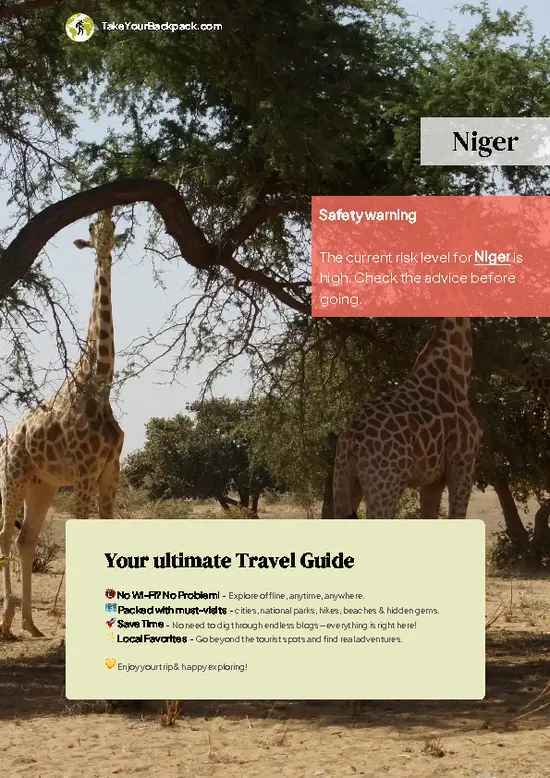
✈️ The backpacker research shortcutNiger Travel Guide

An offline-friendly backpacking guide with optimized travel routes, ranked highlights, transport advice, and the best areas to stay.
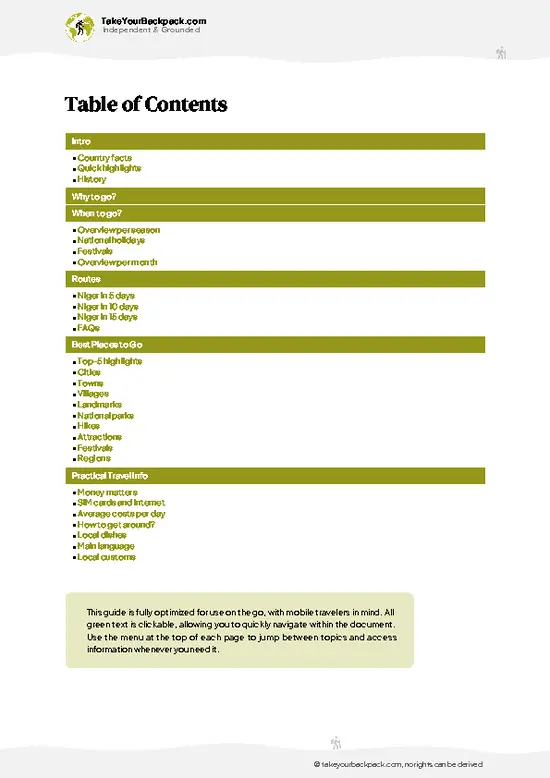
example page 0 from our offline Travel Guide for Niger
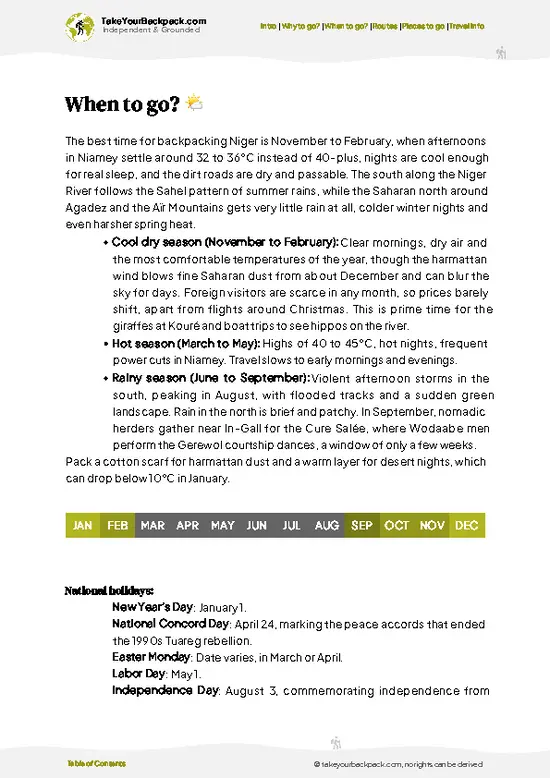
example page 1 from our offline Travel Guide for Niger
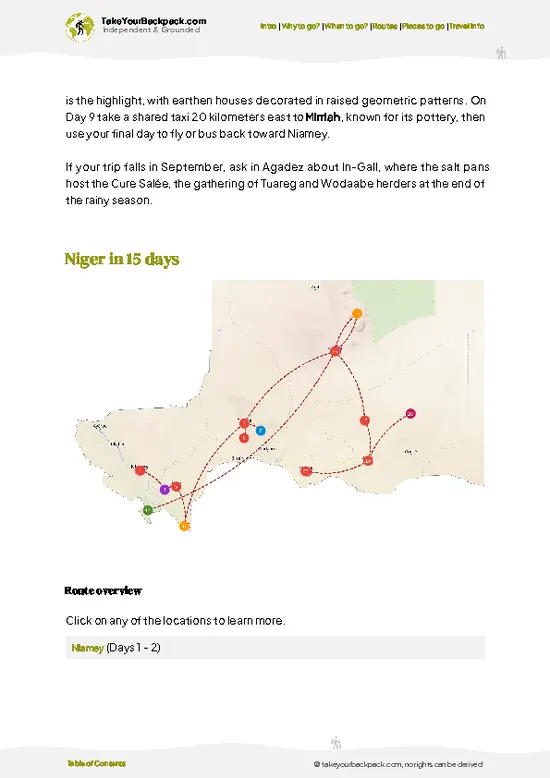
example page 2 from our offline Travel Guide for Niger
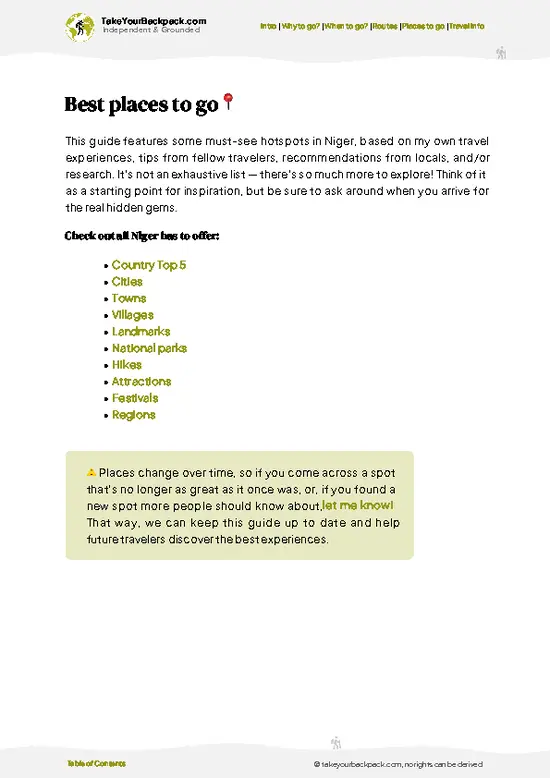
example page 3 from our offline Travel Guide for Niger
example page 4 from our offline Travel Guide for Niger
example page 5 from our offline Travel Guide for Niger
example page 6 from our offline Travel Guide for Niger
example page 7 from our offline Travel Guide for Niger
The digital guide (254 pages) contains:
✅ 57 highlights, ranked by travel appeal
✅ Optimized 5, 10 & 15-day travel routes
✅ Cities, national parks, landmarks, beaches
✅ How to get around
✅ Offline-friendly for travel without Wi-Fi
👉 Click to see all 30+ guide features

📅 Plan smarter in minutes, not weeks
✅ Month by month travel advice
✅ Festivals & national holidays
✅ Budget expectations

🗺️ Go to the right places, skip the overrated ones
✅ Honest pros & cons of destinations
✅ Top hikes, parks & viewpoints
✅ Lesser-known places most travelers miss
✅ Clear “worth it vs skip it” guidance

🛏️ Travel smoothly without rookie mistakes
✅ Best areas to stay
✅ Transport systems explained simply
✅ Common scams & safety advice
✅ SIM cards, money & practical tips

🌍 Understand the country, not just visit it
✅ Culture & traditions
✅ 52 Essential phrases & customs
✅ Festivals worth planning around
✅ Traveler-friendly historical context
✅ Insights that make places more meaningful

📱 Built for real travel conditions
✅ Fully downloadable PDF
✅ Works completely offline
✅ Optimized for phone use
✅ Useful in remote areas & buses
✅ Everything in one place
Stop searching, start planning
Get instant access to your full guide. 30‑day money-back guarantee.
+ Add another guide for just

By proceeding you agree to our terms.
Sent to your inbox immediately after payment • 100% Secure Checkout
Best Backpacking Travel Advisor 2025 tourism awardBest Backpacking
Travel Advisor
2025
What others say about Take Your Backpack Guides:
⭐⭐⭐⭐⭐
Fantastic, amazing amount of information!
⭐⭐⭐⭐⭐
My goodness this is amazing, it's what I've been looking for hats off too you!
⭐⭐⭐⭐⭐
I think this is absolutely BRILLIANT
⭐⭐⭐⭐
Very complete and informative. It's still missing places, but I gotta to commend you
⭐⭐⭐⭐⭐
This is truly amazing, thank you, can't wait to explore it with my kids!
⭐⭐⭐⭐⭐
Awesome resource, thank you!
⭐⭐⭐⭐⭐
This is amazing! Can't wait to explore the ones I haven't seen
⭐⭐⭐⭐
I love this! Well done, great idea.
⭐⭐⭐⭐⭐
Thanks for taking the time to make this gem!
⭐⭐⭐⭐⭐
This might be the best website I've ever seen.
⭐⭐⭐⭐⭐
Congratulations, and thank you so much for your work; it's incredibly valuable.
⭐⭐⭐⭐
In all seriousness I think you did a great job pointing out the important spots
⭐⭐⭐⭐⭐
10/10 very good
⭐⭐⭐⭐⭐
As someone who's only just starting to visit regularly this is awesome, thank you.
⭐⭐⭐⭐
Thank you very much! I'm going to visit my dad, it's going to be very useful!
⭐⭐⭐⭐⭐
This is really cool! We'll be travelling for the first time and this definitely come in handy.
⭐⭐⭐⭐⭐
You are now our minister of culture, congratulations 👨‍💼
⭐⭐⭐⭐⭐
Just wanted to tell you that this is a pearl! Going to follow your recommendations.
⭐⭐⭐⭐⭐
This is so cool. I'll definitely be using the resource for my travels soon.
⭐⭐⭐⭐⭐
This is very impressive! Good work.
⭐⭐⭐⭐⭐
This is an amazing and informative site. Very well done!

🛏️ Where to stay?Best Places to Stay in Niger

Niger has no real hostel scene, so budget stays in Niamey mean simple guesthouses, auberges and church-run mission lodgings at roughly 10,000 to 25,000 CFA (US$17 to 42) a night, with air-conditioned rooms costing more. Plateau is the calmest and best-guarded district, close to embassies, banks and the Niger riverfront but quiet after dark, while the Centre-ville around the Grand Marché puts you near the markets, street food and evening maquis bars at the cost of noise, traffic and more petty theft. Residential Koira Kano and Yantala have villa-style guesthouses with gardens and a relaxed feel, though you will need taxis to reach most sights.

If you enjoy meeting fellow travelers, consider choosing … read more 👉
Niger has no real hostel scene, so budget stays in Niamey mean simple guesthouses, auberges and church-run mission lodgings at roughly 10,000 to 25,000 CFA (US$17 to 42) a night, with air-conditioned rooms costing more. Plateau is the calmest and best-guarded district, close to embassies, banks and the Niger riverfront but quiet after dark, while the Centre-ville around the Grand Marché puts you near the markets, street food and evening maquis bars at the cost of noise, traffic and more petty theft. Residential Koira Kano and Yantala have villa-style guesthouses with gardens and a relaxed feel, though you will need taxis to reach most sights.

If you enjoy meeting fellow travelers, consider choosing hostels with high ratings for atmosphere. On the other hand, if you prefer having your own space, a hotel might be a better option.

NigerExplore Niger

👋 Meet the founderWho’s Behind Take Your Backpack?

Johan, backpacker and founder of TakeYourBackpackHi, I’m Johan (Netherlands 🇳🇱), the creator of TakeYourBackpack. Over the past 3 decades, I’ve backpacked through 90+ countries across six continents, gaining extensive experience with independent travel, long-term trips, and overland routes.

This site is built on a combination of firsthand travel experience and carefully curated insights from other backpackers. Many guides are based on places I’ve personally visited, while others bring together tips, observations, and practical advice shared by trusted travelers I’ve met along the way.

The goal is to provide realistic, experience-driven guidance — not generic itineraries — so you can explore destinations with better context, clearer expectations, and more confidence.