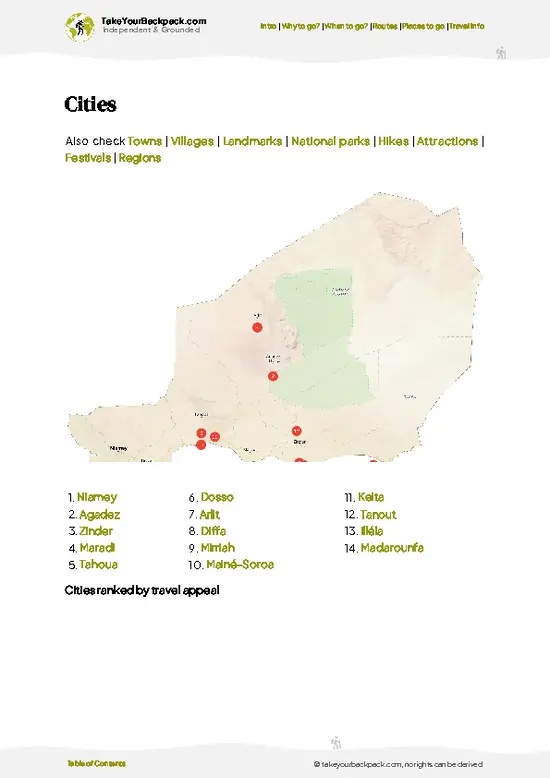
How many cities to visit: I advise
two to three cities in one trip. Distances of 200 to 950 km, early departures and slow checkpoints mean each extra stop costs a full day of travel, and the extra cities are rarely different enough to justify it. One capital plus one northern or eastern hub is the strongest pairing.
Choosing by travel style: If you want
architecture and desert culture, prioritize the Saharan north. If you want
markets and everyday life, prefer a Hausa trading town in the south. If you need
comfort, ATMs and flights, use the capital as your base and keep it short. Skip towns that are only junctions: nothing there repays a night.
What it costs: A realistic budget is
US$35 to 60 a day (about CFA 21,000 to 36,000), covering a basic room at CFA 12,000 to 30,000 (US$20 to 50), street …
read more 👉 How many cities to visit: I advise
two to three cities in one trip. Distances of 200 to 950 km, early departures and slow checkpoints mean each extra stop costs a full day of travel, and the extra cities are rarely different enough to justify it. One capital plus one northern or eastern hub is the strongest pairing.
Choosing by travel style: If you want
architecture and desert culture, prioritize the Saharan north. If you want
markets and everyday life, prefer a Hausa trading town in the south. If you need
comfort, ATMs and flights, use the capital as your base and keep it short. Skip towns that are only junctions: nothing there repays a night.
What it costs: A realistic budget is
US$35 to 60 a day (about CFA 21,000 to 36,000), covering a basic room at CFA 12,000 to 30,000 (US$20 to 50), street meals at CFA 1,500 to 4,000 and local taxis. Add roughly
US$25 to 60 a day for a guide or fixer, which is often required beyond city limits. Long-distance buses cost about CFA 8,000 to 20,000 (US$13 to 33) per leg. Entry fees and photo permits are small, typically CFA 1,000 to 5,000, but pay only at official counters and ask for receipts. A short trip of 10 days typically runs US$500 to 1,000 plus visa and flights.
Costs and delays that catch travelers out: Cash is the main trap. Cards fail often and ATMs run dry, so carry enough euros to change into CFA francs and keep a reserve. Visa fees and processing can take weeks, so apply early. Bus departures slip, so buy tickets the day before and arrive by 5:30 a.m. Overpaying taxi fares is common, so agree the price before getting in. Skip pricey hotel tours when a local guide can arrange the same visit.
Safety and cultural considerations: Check
current government advisories before booking, because large parts of the country are restricted and rules change fast. Register with your embassy, use a reputable local agency, and do not travel at night. Do not walk around cities after dark. Photography is the most common source of trouble. Never photograph soldiers, government buildings, checkpoints or bridges, and ask permission before photographing people. Niger is overwhelmingly Muslim, so dress modestly: covered shoulders and knees for everyone, and a headscarf for women at religious sites. Avoid public affection, eat and shake with your right hand, and carry copies of your passport, visa and yellow fever card for frequent checkpoints. During Ramadan, avoid eating or drinking openly by day, and expect slower service and shorter opening hours.



 Best Backpacking
 Hi, I’m Johan (Netherlands 🇳🇱), the creator of TakeYourBackpack. Over the past 3 decades, I’ve backpacked through 90+ countries across six continents, gaining extensive experience with independent travel, long-term trips, and overland routes.